Distressed animals — to rescue or not?

By Todd Wilkinson, National Geographic

Maybe it’s a baby robin that falls out of a nest in the backyard, or perhaps twin deer fawns left orphaned after their mother gets struck by a car or eaten by wolves, or perchance a bald eagle, behaving strangely, staggering on the ground and unable to fly.

When wild animals appear to be in distress, should human beings intervene to rescue them or is it better to back off and let nature take its course?

This existential question is being debated again following a recent incident in Yellowstone National Park involving a bison that raised eyebrows and attracted international media attention.

Earlier in May, a Canadian tourist captured a wild bison calf with his bare hands and loaded it into his SUV. The man, Shamash Kassam, said he found the animal alone and shivering along the roadside in Yellowstone’s wildlife-rich Lamar Valley. Once he turned it over to rangers, park biologists made several attempts to reunite the youngster with its herd but when the calf was rejected, they euthanized it.

Read the whole story


Park Service considers visitor caps

By Amy Beth Hanson, AP

As the National Park Service kicks off a centennial summer expected to draw record crowds, the agency is seriously considering caps on how many people pass through some of the country’s most iconic landscapes and historical sites each day.

Park managers have begun looking at whether, when and how best to manage the impact of more people on the parks, their features and the visitors’ experience.

“Fundamental to the mission of the National Park Service is preservation of natural and cultural resources, social and ecological values, for the enjoyment, education and inspiration of this generation and those to come,” said Rose Keller, social scientist at Denali National Park and Preserve in Alaska.

Denali and Yellowstone plan to survey visitors about their experiences this summer, hoping the responses will provide insight on what limitations visitors might accept.

Arches and Canyonlands national parks in Utah have been taking public comment on their plans for tighter rules about how many people can be in the park at the same time. Grand Teton National Park in Wyoming should announce by the end of the year how it intends to limit access to a popular roadway.

It’s not clear how individual parks would make up for any shortfall in revenue from letting in fewer paying customers. Some parks, including Mesa Verde National Park in southwestern Colorado, already employ congestion pricing, charging more per person and per vehicle during the peak season that begins this weekend.

Last summer at Grand Canyon National Park, park managers increased entrance fees and moved lines along by dedicating an entrance gate to people who already had an annual park pass. They also promoted the use of shuttles.

Nearly 4.1 million people visited Yellowstone National Park in 2015, a 17 percent increase in visitors over 2014 — or an additional 580,000 people. There weren’t enough bathrooms or parking spaces. Trash cans overflowed. Wildlife jams caused waits of up to two hours along park roadways. Staff and visitors reported pulses of crowding at popular spots, partially due to an increasing number of tour buses, Yellowstone social scientist Ryan Atwell said.

This season, the park hired extra workers and added bathrooms and trash cans in key locations. Yellowstone has seen a 60 percent increase in visitation in the first few weeks of the 2016 season, Park Superintendent Dan Wenk has said.

If the growth continues, Wenk told a gathering of business people last week, he could envision a peak-season limit on Yellowstone visitors, albeit not for at least a decade.

“We realize that currently we’re on an unsustainable course in terms of demands for visitation compared to the ability of the current park system to handle it,” Atwell said.

Last year’s record crowds pushed Yellowstone over some thresholds as far as employee and visitor safety and propriety, he said.

In 2015, interpretive rangers gave out 52,036 resource warnings for behaviors such as threatening thermal features, approaching wildlife too closely, hiking in restricted areas and “taking bathroom breaks outside of the restroom.” That number was a 19 percent increase over the 43,558 citations issued in 2014.

From 2014 to 2015, motor vehicle accidents with injuries were up 167 percent, emergency medical transports to facilities outside the park were up 37 percent and search and rescue operations were up 61 percent, Atwell said.

In anticipation of another record year, people who plan to check out Yellowstone’s grandeur are being asked to be patient and plan ahead, respect the park, consider entering the park before 9am or after 3pm to avoid larger crowds, drive responsibly and learn how to travel in bear country. Visitors are reminded to stay on the boardwalks, because hot springs have caused more injuries than wildlife. Park officials also urge visitors to “practice safe selfies” and not approach wildlife to take pictures.

Arches and Canyonlands national parks in Utah are looking at additional options to address increased visitor numbers, including a timed entry system, building more parking lots and other infrastructure, setting a daily cap on vehicle entrances and adding a private shuttle service.

Grand Teton expects a final decision by the end of the year on a proposal to limit visitor capacity on the 7.1-mile Moose-Wilson Corridor to 200 cars at a time, which would include implementing wait times during peak visitation days and times. Visitors to the Laurance S. Rockefeller Preserve in Grand Teton are limited by the 50 available parking spaces, park spokeswoman Denise Germann said.

“What we’re trying to create and manage is the experience that you come to the Moose-Wilson to enjoy, and protect the resources of that corridor,” Germann said.
Invasive species may be traveling on firewood

Californians can help protect urban and wildland trees this summer by buying firewood local to where they will be using it and not moving it from one place to another, according to officials.

“Time and time again we see invasive species spread long distances as a result of firewood movement. This is something we can all help stop. Keeping firewood local is such an easy way for all of us to help do our part to protect our trees and the forests we love,” Katie Harrell, California Firewood Task Force chair, said in a press release.

Invasive species such as the goldspotted oak borer, shot hole borers, sudden oak death, and pitch canker are killing millions of trees in California, and all can move on firewood. Over the past year alone, the goldspotted oak borer, Kuroshio shot hole borer, and polyphagous shot hole borer have spread to new counties in Southern California as a result of firewood and green waste movement, officials said.

For more information on invasive species in California’s forests or the risks of moving firewood, go online.


Clear Creek: Varied landscape, fabulous views

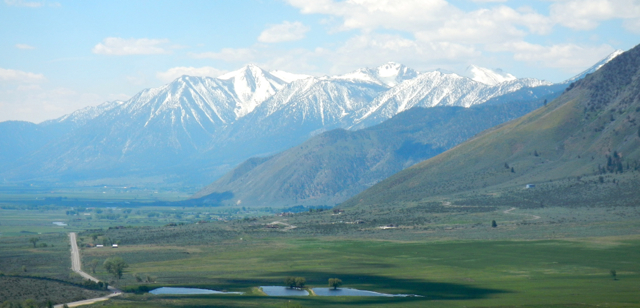
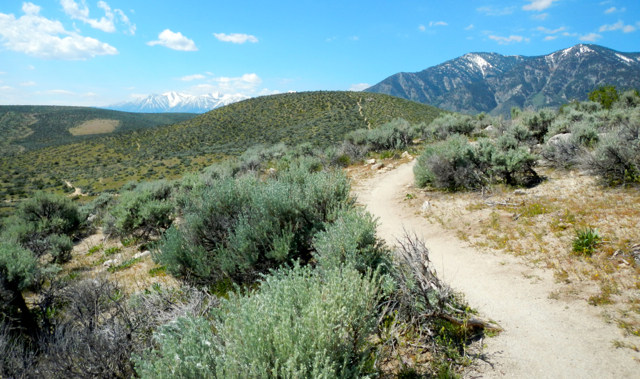
Dropping in elevation means being able to see the mountains instead being immersed in them. Photo/Kathryn Reed

Dropping down in elevation means being able to see the mountains instead being immersed in them. Photo/Kathryn Reed

By Kathryn Reed

CARSON CITY – Rugged, desolate, colorful, stark, verdant, snow capped. Clear Creek Trail has it all.

Sagebrush is everywhere at the start, then it starts to peter out as the trail keeps going west into the mountains. The pines bring welcome shade. But they are never as thick and tall as hiking in the Tahoe basin.

A swath of mule’s ear blankets one section. But this is not a wildflower hike. A few snow plants are protruding and tiny wildflowers are out. This hike is about the views in the distance, not what’s immediately on the ground.

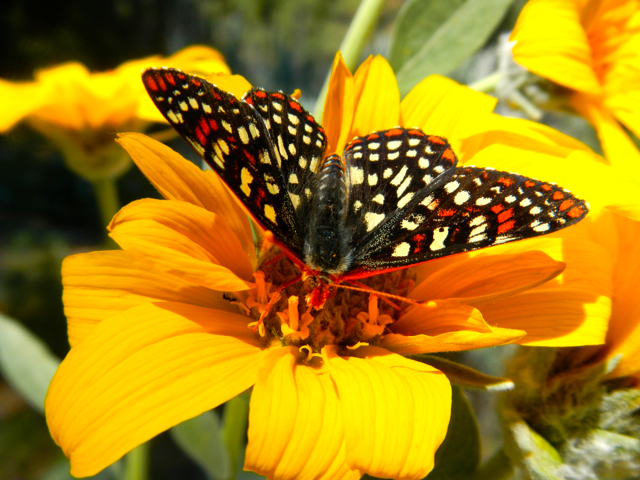
Butterflies are the most prominent fauna. Photo/Kathryn Reed

Butterflies are the most prominent fauna. Photo/Kathryn Reed

Still, the contrast in the landscape is welcome. As Sue put it, it was a nice change to be looking at the mountains instead of being in the mountains. The snow-capped peaks of the Carson Range were immediate, while the Pine Nuts were off in the distance.

The fertile Carson Valley seemed to never end. The lush green was clearly providing plenty of natural food for the cattle.

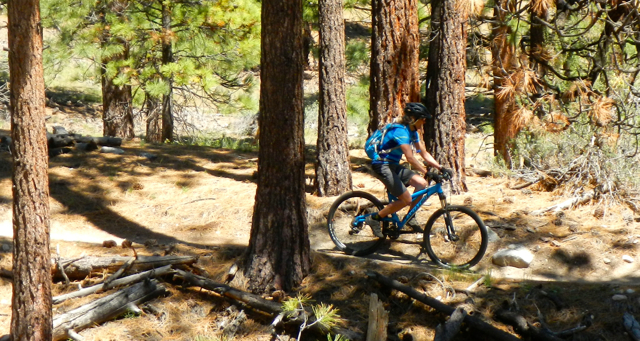
The trail is a mix of soft dirt and loose sand. It’s definitely single track. Most of the time there is enough room to comfortably get out of the way of mountain bikers. If sharing the trail is not your thing, this is not your hike. More mountain bikers were on this trail that is managed by the Carson Valley Trails Association than hikers.

Clear Creek is a popular mountain biking trail. Photo/Kathryn Reed

Clear Creek is a popular mountain biking trail. Photo/Kathryn Reed

At times the trail crosses private property. Signs say as much, and they ask people to stay on the trail. It proves public-private partnerships can work.

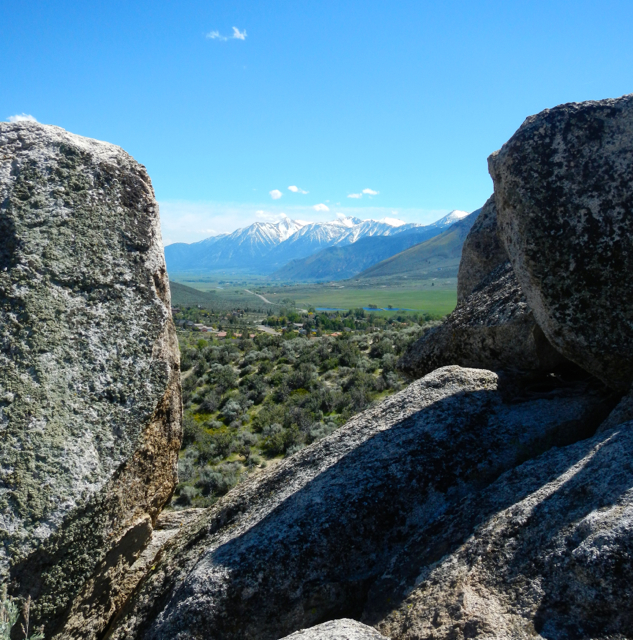
Our destination was The Knob. Having never been on the trail we didn’t know what outcropping we were headed to. I’m not sure it was ever distinct from the trail. It’s actually good there was a sign pointing us toward it.

From The Knob mostly the Carson Valley spills forth. Immediately to the left it’s possible to see vehicles coming down Spooner Summit, but it’s impossible to hear them. Greens belonging to the private Tahoe Golf Course seem within reach.

There is something to look at around every switchback. Photo/Kathryn Reed

There is something to look at around every switchback. Photo/Kathryn Reed

The 14-mile round trip hike in some ways feels less than that because the grade is gradual (5 percent or less most places) and the elevation gain (start 4,950 feet, highest is 6,200 feet) is not that much. Plus, the highest point is the same as Lake Tahoe’s elevation.

About 3,100 acres here are managed as winter deer range. After a fire in 1966, 700 acres were replanted for forage and ground cover. While this is mule deer country, we didn’t see any. In fact, other than hearing a few birds the fauna did not make themselves known.

Dogs are allowed off leash if they are under control. This is rattlesnake country, so that is something to consider. Clear Creek provides water, at least in May. This is one of those hikes, though, where I was glad I brought water for AJ. Even in May she needed more than just the stream crossing.

A gentle breeze cooled us off. This would definitely be a super hot trek in mid-summer.

Much of the trail is exposed. Photo/Kathryn Reed

Much of the trail is exposed. Photo/Kathryn Reed

—–

Getting there:

It will depend where you are coming from because the trail can be accessed from Kingsbury Grade or Spooner Summit.

The trail begins on the southwest side of Jacks Valley Elementary School.

Coming from Kingsbury Grade it is on the left side. It is well marked.


Everest: Emotional battle big as mountain

By Benjamin Spillman, Reno Gazette-Journal

The top of Mt. Everest is a bad place for a celebration.

Just ask Cory Richards.

He spent his three minutes on the summit battling to stay warm, coherent and energized for the trip down.

Richards, an elite climber, knew most high altitude mountaineering tragedies happen after reaching the summit.

The fact Richards, of Boulder, Colo., was climbing without supplemental oxygen or his partner, Adrian Ballinger of Olympic Valley, who stopped short of the summit, made his summit push all the more daunting.

Read the whole story


Sage grouse plan touted as workable

By Sandra Chereb, Las Vegas Review-Journal

CARSON CITY — A final plan to conserve and restore sagebrush habit critical to a distinct population of sage grouse found along the Nevada-California line was announced Friday by the Bureau of Land Management.

“This plan strikes a balance among public land uses and users and offers a workable solution to protect natural and cultural resources as well as the socio-economic fabric of the bi-state region,” John Ruhs, Nevada state director for the Bureau of Land Management, said in a statement.

Under the record of decision and amendment to the existing resource management plan for the 280,000-acre area, no changes are made to activity or projects within sage grouse habitat. Instead, any such decisions will be subject to further analysis under National Environmental Policy Act guidelines.

Read the whole story


Haase hires ex-STHS coach for Stanford job

By Fresno Bee

Clovis West High boys basketball coach Tom Orlich, who won three Central Section championships and more than 300 games in 14 seasons, is retiring from his district job and will join the staff of new Stanford coach Jerod Haase.

Orlich’s retirement as a teacher and coach was announced in a Clovis Unified news release Friday. School administrators and Orlich met with players earlier to share the news and a timeline for hiring a replacement. A parent meeting is planned next week, according to the district.

His new job will be a reunion, having coached Haase at South Lake Tahoe High from 1988-92. Haase was hired away from the University of Alabama at Birmingham on March 25.

Read the whole story


Yosemite waterfalls roaring after years of drought

By Tom Stienstra, San Francisco Chronicle

If item No. 1 on your summer to-do list is to witness the booming waterfalls of Yosemite National Park, you’re in for a treat. Water levels appear to have rebounded from four years of drought and we’re now in a window of peak waterfall conditions.

U.S. Geological Survey numbers indicate water under the Pohono Bridge at the west end of the Yosemite Valley has been climbing, and reaching heights not seen since 2012.

The water level has peaked between May 19 and June 29 in recent years, but the high water mark hasn’t crested above 8 feet in four years, according to the USGS.

Read the whole story


Master gardeners putting on educational plant sale

UCCE Master Gardeners of Lake Tahoe’s annual Jamboree and Plant Sale is June 11.

Master gardeners will be on hand to answer questions about gardening at Tahoe. Whether it is growing vegetables, learning which plants attracts butterflies and bees, finding out
how to keep a garden growing with less water, or learning about various phenology studies that are taking place in our area, the information will be available.

The event is form 9am-1pm at the Lake Tahoe Community College Demonstration Garden in South Lake Tahoe.

Tours of the garden will also be offered.

The funds raised through the plant sale will help offset program costs such as printing materials, seeds, soil and other materials used in teaching demonstrations.


Navigational tool helps Tahoe cyclists, hikers

Lake Tahoe bicycling advocate has created a navigational aid designed to make it easier for people in the basin to locate a hike or bike ride that best matches their interest and skill level.

It’s called Tahoe’s Ultimate Bicycling Guide.

The guide covers five regions: California Alps, South Shore, North Shore, Carson Valley and Truckee. For each region there are suggestions for mountain biking, road cycling
and cruiser rides.

Each category describes a ride or hike with distance, GPS coordinates, trailhead details, and challenge level. Additionally, each page is complete with a Google map, photographs, a brief historical background, and is GPS enabled. The GPS enabling features allow smart phone users to locate their position on their ride/hike in real time.

The Tahoe guide is administered by the nonprofit Team Tahoe, a nonprofit.