Winter popping up for holiday weekend

By Molly Sullivan, Sacramento Bee

You may need to bring your winter coat in Tahoe for Memorial Day weekend.

An unseasonably cool weather system is moving into California on Friday, the National Weather Service said.

There’s a chance of showers and thunderstorms in the South Lake Tahoe forecast for Friday and into Saturday.

Read the whole story


Mountain bike group fights for wilderness access

By Carl Segerstrom, High Country News

Ted Stroll, a bespectacled, balding, retired attorney whose remaining hair is short and white, doesn’t fit the stereotype of an extremist mountain biker. But his group, the Sustainable Trails Coalition, is challenging the mainstream mountain biking establishment by fighting to permit bikes in America’s wilderness areas.

Stroll’s crusade has sparked strong resistance, particularly from wilderness advocates and environmentalists. His alliance with notoriously environmentally unfriendly Republican congressmen, whom he has enlisted to push a bikes-in-wilderness bill, is particularly controversial. Stroll’s group has alienated would-be allies in the mountain biking community, who are loath to ostracize the greater recreation and conservation communities, especially at a time when many feel public-lands protections are taking a back seat to extractive industries.

The original text of the 1964 Wilderness Act bans “mechanical transport” — and bicycles are clearly a form of mechanized transport. For the federal agencies tasked with enforcing the ban, however, the definition hasn’t always been clear-cut.

Read the whole story


Incline swimmer sets unbreakable record

By Jim Krajewski, Reno Gazette-Journal

A record was set at the Nevada state swim meet on Saturday that can never be broken.

Incline senior Kate Rye won the 50-yard race for the fourth time. She is the first person in any division, boys and girls, to accomplish the feat of winning the same race at four state meets.

She won in 24.25, a personal best. She also won the 100-freestyle in 53.64 in the state meet held at the Jim Reitz Natatorium, UNLV Aquatic Center on the UNLV campus.

Read the whole story


Mountain thunder, lightning mean summer has arrived

By Tom Stienstra, San Francisco Chronicle

The thunder rumbled across the mountains, a low, steady roll that carried for miles.

On Saturday evening, as I cooked dinner at our fire pit, I gazed above a distant ridge, where the thunder seemed to originate. About a minute later, a lightning bolt fired across the dark sky.

“One, two three,” I counted, and at “nine,” another deep thunder roll resonated across the mountains.

The time from flash to bang, or lightning to thunder, represents 5 seconds per mile. At 9 seconds, the lightning was nearly 2 miles away.

Read the whole story


200-acre meadow in S. Lake Tahoe publicly owned

A section of the Upper Truckee River is part of the 200-plus acre land deal. Photo/Kathryn Reed

By Kathryn Reed

With the acquisition of the 206-acre Johnson Meadow, 93 percent of the Upper Truckee watershed is now owned by public agencies.

Tahoe Resource Conservation District in April closed on the South Lake Tahoe property. It roughly borders Lake Tahoe Airport, Highway 50, the Upper Truckee River on the Sierra Tract side, and the Barton Memorial Hospital/Fourth Street area.

It cost $8.315 million to buy, with the money coming from the California Department of Fish and Wildlife ($4 million), California Tahoe Conservancy ($4.215 million), and Tahoe Fund ($100,000).

Standing above the river it’s like being transported to an oasis that should take hours to walk to, but is less than a five-minute walk from the Sierra Tract neighborhood. Two arms of the river are running at a pretty good clip, with the one to the right likely to dry up as the snowmelt subsides.

Unfolding behind the river is a carpet of native green grasses. From this distance it looks like a playground. One day it might be. Recreation and connectivity are two words being associated with the parcel now that it is in the public domain.

This large swath of land in the middle of South Lake Tahoe was once going to be an integral component of the original South Tahoe Greenway bike trail that was to go from Meyers to Stateline. The owners wouldn’t sell. The route was scrapped and downsized.

But with the property now in the public domain it’s possible the original plans could be resurrected by the California Tahoe Conservancy.

The CTC tried to buy the land in 2006, but Bill Mosher wouldn’t sell. Talks resumed in 2010, then stalled. Then Mosher reached out to the TRCD about three years ago. Mosher died in January 2017 before the deal could be finalized. His extended family continued on with the talks and made the transaction a reality this spring.

Mosher was familiar with resource conservation districts in the Sacramento area, and knew the work they did. They are all about being local.

“One of the big concerns or challenges is the main channel is deeply incised and the erosion,” Nicole Cartwright, TRCD executive director, said as she peered out at the Upper Truckee River.

The Johnson Meadow spills forth beyond the Upper Truckee River, with Lake Tahoe beyond the tree line. Photo/Kathryn Reed

In the distance is a grove of willows where historical photos show the river once ran. This is something scientists are analyzing as they consider how to restore this damaged landscape.

It wasn’t that long ago this was ranch land. Names like Mosher, Ledbetter and Johnson all have ties to this acreage. In the ranching world a parcel is named after the previous owner not the current one. So, maybe it will be renamed Mosher Meadow.

In an attempt to be good stewards, the Moshers erected an array of fencing to keep the dairy cows from the river so as to reduce the erosion. Those fences dot the landscape and keep the public from the area.

“There is a lot of fencing throughout the meadow,” Cartwright told LTN. “There is some exposed barbwire and T-posts in the river.”

Safety is the No. 1 concern. That will be addressed before any real plans are put into action. The majority of the fencing will remain until funding is secured for restoration.

It’s estimated that between $10 million and $15 million will be needed for planning and implementation. The hope is the plans can be designed in the next three to five years, with implementation taking no more than 10 years.

Molly Hurt and Nicole Cartwright with the TRCD on the remaining portion of the Barton Bridge. Photo/Kathryn Reed

Creating a meandering wet meadow that naturally floods and therefore keeps sediment from reaching Lake Tahoe would be a big goal – just like it is with other reaches of the Upper Truckee River. Providing sustainable recreation and access are other desires. It is possible trails will be built, maybe boardwalks, with connections to other parts of town.

Today there are user created trails; mostly on the border of the property.

This parcel is surrounded by various other landowners, mostly public entities.

Preserving habitat – primarily riparian – will be another centerpiece of restoration work. Song birds, migratory birds and the threatened willow flycatcher make their home here.

“It’s also a refuge for species. As ranges contract these meadows will be ever more important,” Molly Hurt, TRCD director of programs, told Lake Tahoe News.

This is the first land acquisition for the TRCD. It’s too soon to know if this is the first of many or the lone one. It was a good fit, according to Cartwright, and one other agencies supported.

Also on this parcel is what’s locally known as Hospital Bridge. A large section of it came tumbling down in winter 2016-17. It was a popular connector for mountain bike riders from Barton Memorial Hospital to what could be considered the Pioneer Trail side of the river.

TRCD wants to rebuild the bridge. It’s possible a temporary structure could be erected, perhaps not in the exact same alignment. A more permanent solution will be studied in the formal planning process.

It was originally installed and maintained by the prior owner, with the last iteration built in the early 1990s.

The money to purchase what at the time was the largest sensitive public land holding in the basin came with strings attached. This means it won’t be developed with structures. But it does mean the public will have access, which hasn’t happened in more than 100 years.

Social media changing adventure with deadly consequences

By Sarah Tory, High Country News

On July 14 of last year, Peter Doro and Jake Lord joined the Friday afternoon stream of people leaving the sprawling cities of Colorado’s Front Range for the mountains. They planned to summit Capitol Peak, a soaring mass of granite 14,130 feet tall near Aspen on the state’s Western Slope. They reached Capitol Peak’s trailhead late in the day and set off on the 6.5-mile hike to the mountain’s base. The sun sank low, filling the sky with streaks of red, purple and orange, and a few cows meandered across the trail, which followed a creek through a sliver of valley that widens abruptly into a vast alpine basin. Capitol Lake lay before them, ringed by the high peaks of the Elk Range, a view so stunning that Doro felt as if he had entered Middle Earth, the setting of J.R.R. Tolkien’s epic fantasy, Lord of the Rings.

The Elks are among Colorado’s highest and most challenging mountain ranges, with seven of the state’s 54 peaks over 14,000 feet. And Capitol Peak is considered the hardest of them all — so difficult, in fact, that the Forest Service posted a sign near the trailhead, cautioning would-be climbers about “down-sloping, loose, rotten and unstable rock” that “kills without warning.”

For Doro, 25, and Lord, 24, both avid outdoorsmen, the sign was little more than a formality. As they hiked, their thoughts were not of death, but of the endless beauty and possibilities that the mountains seemed to hold.

Read the whole story


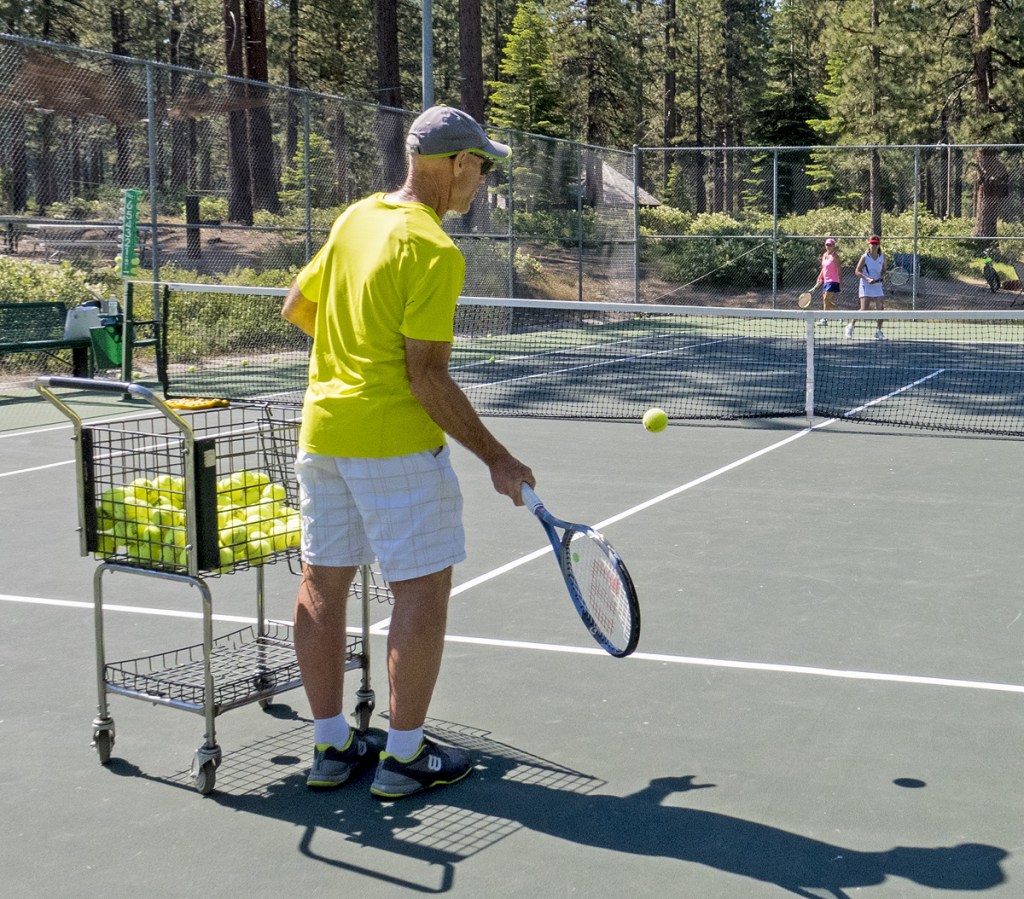
Day, night and weekend tennis instruction at ZCTC

A backboard is one way to improve your tennis game, but it won’t provide any insight into why your backhand isn’t as penetrating as it could be.
 
A pro – that’s who you should be hitting with. A professional has the ability to work with players of all levels to elevate their game. It could be adding top spin, changing a grip for better command or adding a new shot like a drop volley.

Dave Nostrant leads a tennis clinic at Zephyr Cove Tennis Club. Photo/Provided

Zephyr Cove Tennis Club has two professionals to help refine one’s skills. They offer a variety of clinics and more personalized instruction. Text or email the instructor to confirm a spot in the desired clinic: Dave Nostrant, 702.496.6277 or davenostrant@yahoo.com and Ginny  Unger, 775.901.6713 or ginnyunger@yahoo.com. For more details on pricing and other offerings, go online.

Here is a current list of classes:

·       Mondays: 9-10:30am – Women’s 3.0-3.5 Drill Clinic (Unger)

10:30-noon – Beginner to Advanced Beginner, Men/Women(Nostrant)

·       Tuesdays: 11am-12:30pm – Winning Strokes and Strategies Doubles, 3.0-3.5 Men/Women (Nostrant)

7-8:30pm – Masters Clinic, 3.5 and above Men/Women (Nostrant)

·       Wednesdays: 9-10:30am — Winning Strokes and Strategies Doubles, 3.0-3.5 Men/Women (Nostrant)

7-9pm – Doubles 3.5 and above, Men/Women (Nostrant)

·       Thursdays: 9:30-11am – Super Play, 3.5 and above Men/Women (Nostrant)

7-8:30pm — Super Play, 3.5 and above Men/Women (Nostrant)

·       Fridays: 9-10:30am — Beginner to Advanced Beginner, Men/Women(Nostrant)

·       Saturdays: 9-10:30am — Masters Clinic, 3.5 and above Men/Women (Nostrant).


Firewood permits to be available in basin

Firewood permits go on sale at the South Lake Tahoe office of the Lake Tahoe Basin Management Unit on June 4 and at the Incline Village Forest Service office on June 6. 

Permits cost $20 per cord, with a two-cord minimum and a limit of 10 cords per household. 

Permits have specific conditions and complete information is provided when the permit is issued.  Maps to designated cutting areas are provided and must be in the permit holder’s possession along with the valid permit when cutting. 

The permit is for collection of “down-dead” wood in designated areas. “Down-dead” means the tree is down on the ground and dead, rather than dead and standing. Cutting any standing tree, whether dead or green, is not allowed.

Permit holders must keep vehicles on National Forest roads. No off-road travel is allowed and permit holders must comply with all permit conditions. Some designated fuel areas are only open during specified dates and all areas are subject to closure at any time. 

Permit sales will end on Nov. 16 and the last day to cut is Nov. 18.


States need to scramble to deal with sports betting

By Jennifer Roberts, The Conversation

On May 14, the United States Supreme Court invalidated the Professional and Amateur Sports Protection Act, a federal law that prohibited states, aside from a few exemptions like Nevada, from allowing sports betting operations.

In a victory for states’ rights, the court ruled that the law unconstitutionally interfered with states’ ability to implement their own legislation on the issue.

So now what? As someone who studies sports wagering and gambling law, I’ve been following the case closely. While the decision marks an end to years of legal action to challenge the federal law, it also now creates a host of issues for states that are considering sports betting legislation and regulation.

To legalize or not to legalize

First and foremost, it’s now on states to decide whether to legalize sports betting. Many, like Pennsylvania and New York, have preemptively introduced or passed legislation to do just that.

But for those that have already legalized sports betting or end up doing so in the coming months, there’s a lot of work to be done – and decisions to be made.

The states that do legalize sports betting will have to decide whether it will be operated by the state, like lotteries, or if private enterprises will be allowed to offer sports bets. If private businesses are permitted, states must consider whether sports betting will be limited to certain types, such as casinos and racetracks, or if online operators and smaller retailers will also be able to participate.

Then there are the types of wagers that will be permitted and prohibited. Does the legalization of sports betting allow for wagering on events that are related to professional sports, such as the NBA draft? Do esports count as a “sport” for wagering purposes? Will betting on events beyond sports be legalized, too? For example, in Nevada, you can’t bet on the outcome of elections, but you can bet on approved esports events and the NBA draft.

States will also need to determine whether live betting – also known as in-running, live-game or in-game betting – will be offered. This type of wager, which has become increasingly popular in Nevada, allows you to bet on certain aspects of the game as it unfolds. For example, at halftime of a game, you could bet on the outcome regardless of what happened in the first half.

There’s also the issue of how bettors will establish betting accounts and place their bets. Will they be able to do so through an app on their phones? Or must it be done in person at a licensed location?

Building a regulatory framework

Some elected officials think the federal government could play a role by building a regulatory template for states to follow. Before the decision, Congressman Frank Pallone of New Jersey had already introduced legislation to create one. However, Congress might not have the appetite to tackle the issue, given other priorities and the upcoming midterm elections.

Moreover, Nevada’s system could easily serve as a starting point for states from which to build. Since 1949, the state has been auditing sports books, resolving patron disputes, approving technology for use in sports books, and approving wagering options.

So far, little has been said about the benefit the federal government will receive from an expansion of sports wagering throughout the United States. The current tax code imposes a 0.25 percent federal tax on the total amount wagered on sports.

However, the sports leagues also want a cut of the bets – and have pushed for what they call an “integrity fee.” But it’s really just a share of all wagers made. This could prove detrimental to sports book operators, since sports betting, by its nature, is a relatively low-margin business – after all, they do have to pay out on winning wagers. If states aren’t careful, integrity fees, burdensome taxes, license fees and regulatory costs might push out suitable, experienced operators – and force patrons to remain in the illegal market.

These are just a snapshot of issues that states will have to grapple with, and a careful, cautious and informed approach must be undertaken. But in the long term, it will serve states and bettors well: A legal, regulated market is much better than the illegal, unaccountable system that’s been operating for years.

Jennifer Roberts is an adjunct professor of law at UNLV.


Ballpark blends history with modern conveniences

Braves fans learn at an early age to “chop on.” Photo/Kathryn Reed

By Kathryn Reed

ATLANTA – Baseball may be a simple game – hit, catch, throw – but the history, the competition, the nuances of the game, the pageantry are what make it magical.

Unlike football and basketball where the dimensions of the field and court never change, the same is not true for baseball parks. Sure, the distance from the pitcher’s mound to home plate and between all the bases are a constant, but outfield configurations are all different. This makes each park unique.

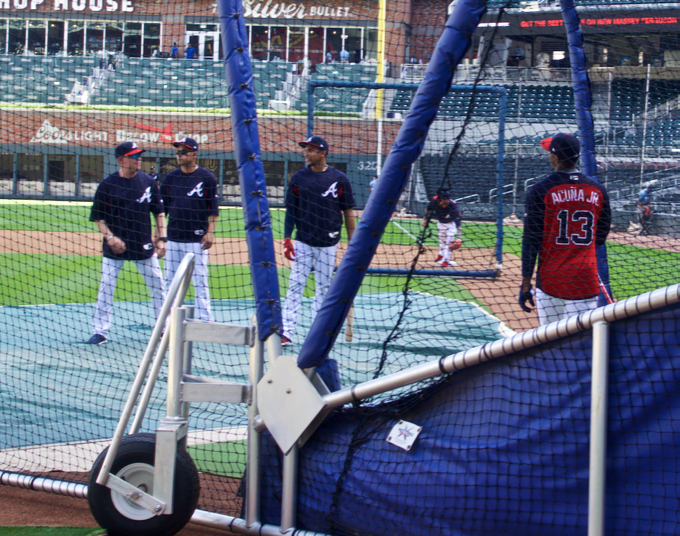
Ronald Acuna Jr. is one of the Braves hot young players. Photo/Kathryn Reed

SunTrust Park, now in its second season, is the newest ballpark in Major League Baseball. The Braves are an exciting team to watch this season with a slew of young players; some aren’t even old enough to drink.

Left fielder Ronald Acuna Jr., 20, is one of those players. He’s also one of the major draws to the ballpark. For his home debut on May 4 it was a sell-out and an attendance record of 41,807 for this park that opened in 2017.

Giants third baseman Pablo Sandoval signs autographs. Photo/Kathryn Reed

As a Giants fan – thus the reason to be there for three games earlier this month – I thought the crowd size might have had something to do with who the visiting team was. The Giants cooled off the sizzling Braves, sweeping them in three games.

While the game is the main draw, this ballpark has so much to offer that even a casual fan of the sport is bound to find plenty to enjoy. I think of AT&T Park in San Francisco as still being new even though it opened in 2000. After being in Atlanta, I can tell my home park is a bit dated.

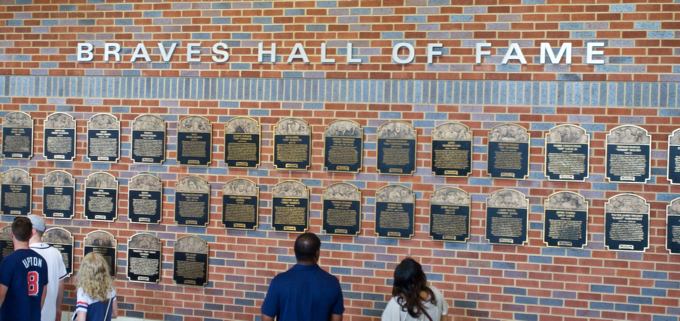
More than 50 Braves players and managers have been inducted into the Hall of Fame. Photo/Kathryn Reed

I was especially impressed by the tribute to the Braves’ history, with a nod to baseball lore in general, that is showcased on the lower level. It is appropriately named Monument Garden.

It tells the story of the Braves journey from Boston starting in 1871, which makes this the oldest franchise in Major League Baseball, to Milwaukee and then to Atlanta in 1966. Names like Babe Ruth and Hank Aaron are tied to the Braves.

Greg Maddux’s 1995 Cy Young award is there for all to see.

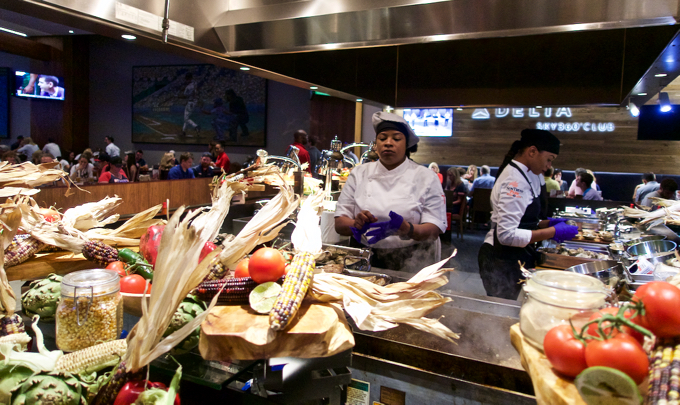
Even traditional ballpark food is better in the Delta Club. Photo/Kathryn Reed

The hardware the Braves have collected through the years is impressive.

It so happened that some of that history was on the field during batting practice on May 4. Legendary outfielder Andruw Jones was seen talking to John Schuerholz, who was general manager of the Braves from 1990-2007 and then the Braves president from 2007-16. He entered the Hall of Fame in 2017.

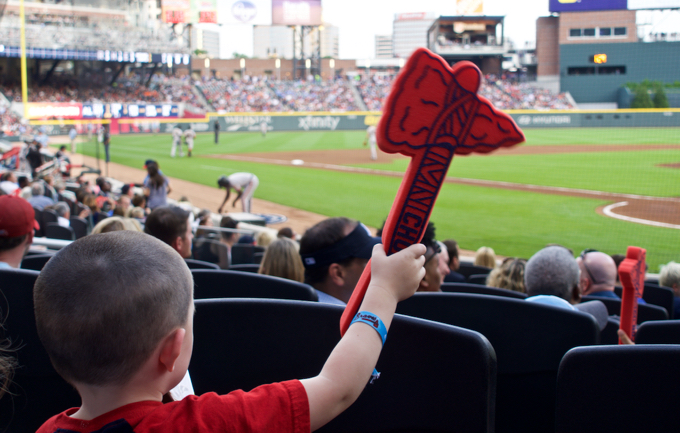
Another piece of history the Braves are holding onto is the tomahawk chop. The phrase now being touted by the marketing folks is “chop on.” It’s supposed to be less offensive. It really is something to see nearly 40,000 people either wave foam tomahawks or raise their arm in a chopping motion.

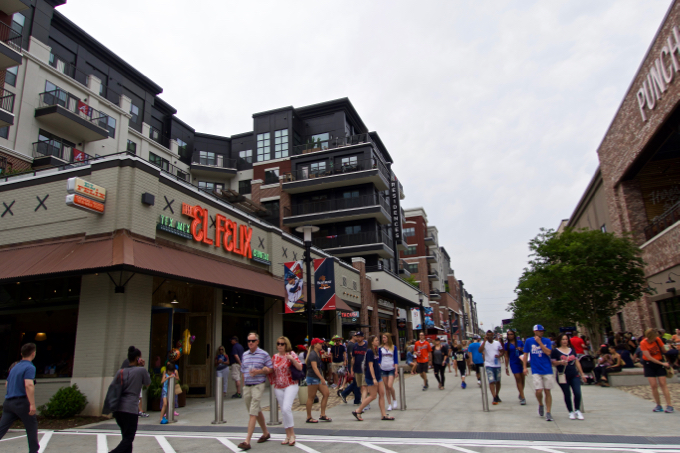
The area outside SunTrust Park is full of eateries, shops and condos. Photo/Kathryn Reed

As with most of the modern parks, an area has been dedicated to the younger set. A zipline and other kids’ activities are behind the outfield.

I had the privilege of being at the park with a season ticket holder who has seats in row 11 behind home plate. Wow! It had been a while since I’d seen a game from that perspective. These were the most luxurious seats I’ve ever sat in for a sporting event – they had cushioning – not just hard plastic.

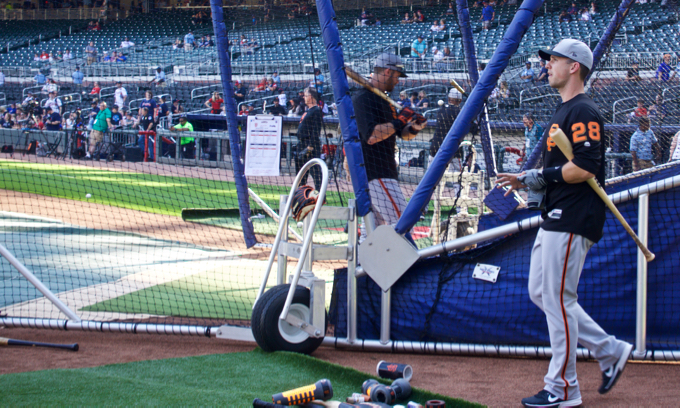
Giants catcher Buster Posey is ready for batting practice. Photo/Kathryn Reed

These are part of the Delta Club section. Much like at AT&T, there is a special eating area for these ticket holders where the masses are not allowed. A big difference though is all the food and drink are included with the ticket price at SunTrust.

And it’s not just traditional ballpark food that is available. The chefs acknowledge each visiting team with specialties from their home city. For San Francisco, it was grilled oysters on the half shell and ahi tacos.

The food was outstanding – grilled vegetables, portabella sliders, a corn concoction that was worth having more than one day, pizza with soft dough, nachos with a slightly spicy white cheese, salads that tasted like the veggies were just picked.

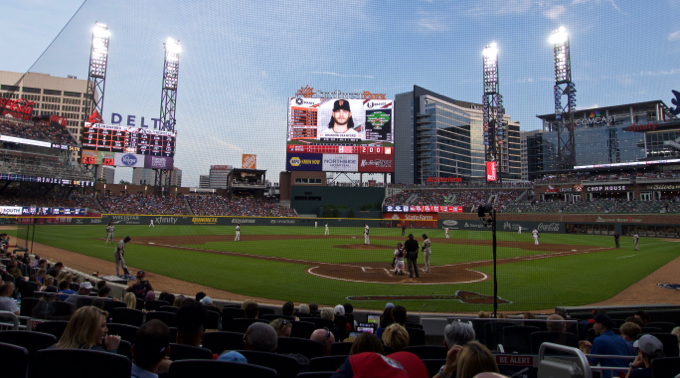
SunTrust Park is beautiful day and night. Photo/Kathryn Reed

And with Sharla’s tickets come the opportunity for four “memories” she can participate in. She cashed one in while I was there – the opportunity to be on the field for batting practice. What a treat.

Sure it was fun to see some of my favorite players – Buster Posey, Brandon Crawford – up close, but it was more impressive watching the players interact with the fans. (It’s also possible to pay for this experience.) These players on both teams were warming up for a job they were about to do, but some still took the time to sign autographs – no matter who the fan was rooting for. This was classy – just like the park.