DiMatteo faces federal drug charges; bribery investigation involving Swanson still alive

By Kathryn Reed

Gino DiMatteo, the man accused of bribing South Lake Tahoe City Councilwoman Angela Swanson, is back behind bars. This time he faces federal drug charges.

While the state drug charges have been dropped, the federal charges are more serious if only because of the venue. Plus, the El Dorado County District Attorney’s Office in a press release said, “… the investigation into certain South Lake Tahoe city officials as to their dealings with DiMatteo is ongoing.”

Gino DiMatteo

DiMatteo was arrested Nov. 2 in Placerville where he was scheduled to appear in El Dorado County Superior Court on a hearing related to the state charges.

His criminal attorney, Rob Woelfel, told Lake Tahoe News, “I’m pleased that all of the California charges have been dropped and it is disappointing that law enforcement is trying to direct this into a federal forum to deny my client a medical marijuana defense.”

DiMatteo, who used to run the City of Angels II medical marijuana dispensary in South Lake Tahoe, was first arrested Aug. 31 on a slew of drug charges as well as bribing a public official. Now he operates Push Fitness, which Friday night still had its lights on.

In moving the case to U.S. District Court, it raises the seriousness of the allegations against Dimatteo. For one, the feds don’t recognize any form of marijuana being legal. This is in direct contrast to the state of California which allows the sale and use of medical marijuana.

The exact charges DiMatteo faces have not been released and the federal complaint is sealed.

Swanson has never been charged or detained. However, she has been questioned and her electronic devices taken as evidence. It has come out that she solicited a donation from DiMatteo for the Lake Tahoe Educational Foundation, on whose board she sits, at the same time she was voting to allow DiMatteo to move his pot club to a different location in town. She maintains her innocence. DiMatteo was known to give quite a bit to charity, so this donation would not have been out of the ordinary. And Swanson’s votes have consistently been in favor of medical marijuana, so the time of the donation and vote may look bad, but are not out of character for either individual.

Swanson did not return a phone call Friday.

A twist often not seen in cases like this is in the press release from the district attorney there are quotes from DiMatteo criticizing Long: “I – I really think that Ted Long’s only agenda is political. And I think it’s his intention to no, you know, not represent me properly and just use my – my – I don’t know how to say it. You now, what’s happening to me – to advance himself and his own agenda.”

Ted Long was not available for comment. He had been DiMatteo’s civil attorney, but had spoken out about the criminal case.


Businessmen banking on 2 states legalizing pot

By Tony Dokoupil, Newsweek

Full dark in downtown Denver, and inside one of the twinkling high-rises that make the skyline, drug dealers are putting money into envelopes. They’re trying to be discreet. No one signed the security logbook in the lobby. All assume the room could be bugged. But if your image of the drug trade involves armed gangs or young men in parked cars, these dealers offer a surreal counterpoint. There’s a finance veteran, two children of the Ivy League, multiple lawyers, and the son of a police chief. At their side is a Pulitzer Prize–winning communications consultant, two state lobbyists, and a nationally known political operative. And the guest of honor: a state senator who likes the look of those envelopes being stuffed.

“What’s the maximum contribution?” one of the dealers asks. “Do you take cash?” wonders another. A third man breaks into a smile. “You better,” he says, eyebrows dancing, “because the banks don’t like doing business with us.” Laughter fills the room as the envelopes are passed forward and slipped into a briefcase. “Huge thank you, everyone,” the politician says, guiding the conversation back to the next legislative session and the kinds of legal changes this group would like to see. Here again, it’s not what you’d expect: there’s talk of a youth drug-abuse-prevention program and a bill to define “drugged” driving. When the politician finally rises to leave, after more than an hour, the dealers, in their pressed shirts and suit jackets, clap heartily. The average participant looks to be about 35, white and male, and on good terms with a barber. “Thank you,” the politician says, bowing slightly. “Thank you for what you do.”

What they do is sell marijuana. And not on street corners. Colorado is the developed world’s only regulated for-profit cannabis market, and sales—to the 100,000 residents who have a thumbs up from their M.D.s—are closing in on $200 million this year, a sum that generates tens of millions of dollars in local, state, and federal taxes. (Yes, the IRS taxes marijuana operations, even as the Justice Department attempts to shut them down.) Colorado is not the world’s only experiment in free-market pot, but it’s the most sophisticated, pushing beyond the Netherlands’ confusing ban on wholesale and California’s hazy nonprofit status. Denver’s former city attorney has called it California “on steroids.”

While the cannabis market remains illegal under federal law, attitudes are changing quickly, and it’s that fact that the Colorado growers are banking on. The number of regular pot users is up by 3 million in the past five years, and the rate of high-school experimentation is at a 30-year high. When a kid first lights up at about age 16, it’s usually not with a cigarette. Twelve states now treat a personal stash like a minor traffic offense, 17 allow medical marijuana, and this Election Day, if current polls hold, voters in Washington State and Colorado will vote to legalize marijuana—not for medical purposes but, as Rolling Stone recently enthused, “for getting-high purposes.”

That would close out a 40-year fight launched by boomers and carried through by a big tent of talented reformers, growing bigger all the time. “Weed is the new gay,” says Ted Trimpa, a Democratic strategist who helped engineer Colorado’s flip from red state to blue. He’s now focused on marijuana reform. But what I saw in Colorado was something altogether new: self-described “social entrepreneurs,” the Sergey Brins and Mark Zuckerbergs of the Green Rush. They could have done almost anything with their lives—“my brother is a physician” is the kind of thing one hears from them—but they chose to enter the pot business because they see it as a boom market, miracle cure, and social movement decades in the making and suddenly, thrillingly, near.

“This is our Facebook,” says one of my hosts, Norton Arbelaez, the owner of two dispensaries and a commercial grow. “This is the same kind of environment, the same kind of setting, and the same kind of people.” He was a founding member of the Medical Marijuana Industry Group (MMIG), a powerful young lobby that’s buried the age of drum-circle activism and instead strives to partner with law enforcement and politicians. It was their board meeting in the high-rise downtown, a weekly gathering two blocks from the Capitol dome. And it is their goal to dress legal pot in a style as conservative as their own.

Read the whole story


Labor leaders back Raley’s employees

By Dale Kasler, Sacramento Bee

Heading into eleventh-hour contract negotiations with Raley’s, unionized grocery workers got public support Thursday from Sacramento’s most powerful labor leaders.

A rally in front of the federal building in downtown Sacramento turned into a rousing send-off for union negotiator Jacques Loveall, president of Local 8 of the United Food and Commercial Workers.

The UFCW already had the backing of unions that Raley’s would need to keep its doors open, such as the Teamsters. Now it has the support of a slew of unions outside the grocery industry, with leaders saying their members wouldn’t cross picket lines.

“We will not shop at Raley’s,” said Yvonne Walker of Local 1000 of the Service Employees International Union, which represents thousands of state workers.

Given Sacramento’s mostly pro-union sympathies – and the choices available to shoppers in a crowded supermarket field – a strike could leave Raley’s isolated. Raley’s vows to keep as many stores open as possible in a walkout.

Before leaving for negotiations in San Francisco, Loveall said the UFCW would bargain around the clock to get a fair deal. “It’s not too late,” he told the crowd of about 200. “There are two days to bargain.”

Raley’s had threatened to unilaterally impose the terms of its “last and final” contract offer Thursday, which includes wage concessions. That would have likely triggered a strike.

The West Sacramento grocer has put that on hold until midnight Saturday and agreed to resume bargaining instead.

Talks ended late Thursday and were scheduled to resume today.

If there’s no deal by Saturday night, and Raley’s imposes the contract terms, a strike could begin the next morning.

Raley’s says it needs to reduce labor costs to compete with nonunion stores. The UFCW agreed to concessions with another struggling grocer, Save Mart Supermarkets, in September.

Loveall expressed hope for a deal with Raley’s. “We’re within striking distance” on most issues, he said in an interview.

But there’s a big sticking point: retiree health care. Raley’s wants to eliminate coverage for retirees who are eligible for Medicare, as it has done already for nonunion retirees.

Loveall’s response: “Not on our watch.”

Raley’s argues that retiree health care shouldn’t be an issue this week. The company is threatening to impose only the wage portion of its “last and final” offer, said John Segale, a spokesman for the West Sacramento grocer.

The union filed an unfair labor charge Thursday with the National Labor Relations Board, accusing Raley’s of bargaining in bad faith. If upheld, Loveall said, the filing could make it harder for Raley’s to hire replacement workers, as it has threatened.

Segale called the charge “frivolous.”


No contingency plan in place if disaster strikes on Election Day

By Alan Greenblatt, NPR

Suppose Sandy had struck a week later. With power out across multiple states, how would people be able to vote on Election Day?

“If this were happening next week, we have no provisions for dealing with this in law,” says Thad Hall, a political scientist at the University of Utah.

Many states have contingency plans for conducting elections in the wake of a natural disaster or terrorist attack. But they tend to focus on strictly local effects — moving polling places over to a neighboring precinct, for example.

There’s no controlling authority when it comes to rescheduling presidential voting when roads are blocked and power is down in several states at once, according to the Congressional Research Service.

When terrorists struck Manhattan on Sept. 11, 2001, New York City suspended its mayoral primary, which was to be that day, delaying the vote until that November.

But postponing the vote in a single city or state — or across multiple states — would skew the result of a national election, says Curtis Gans, director of the Center for the Study of the American Electorate at American University.

“We don’t have a contingency for major disasters on Election Day,” he says. “If [Sandy] occurred next Monday and Tuesday, there’d be an enormous number of people who couldn’t vote.”

Local officials frequently call on courts to allow a little more time for voting when there are blizzards or power outages within a contained area. On Colorado’s primary election day in June, wildfires were raging across 12 counties, but vote counting continued.

“The people in Colorado Springs were counting even with masks on, and there were embers and everything,” says Donetta Davidson, executive director of the Colorado County Clerks Association. “They didn’t leave until they were told to get out.”

Colorado’s primary, though, was conducted mostly by mail. Getting voters and poll workers to voting stations could be difficult after a disaster.

And, while counties have gotten better about having backup batteries and generators in place to power voting machines, making sure schools, churches and other voting centers remain open in an emergency might be tricky.

“We’ll ignore it until it happens, and when it happens, we’ll figure it out,” says Doug Lewis, executive director of the National Association of Election Officials. “It’s not the best way to go about doing something like this.”

It might be smarter to have plans in place ahead of time. Overburdened state and local officials understandably have other priorities while coping with a crisis.

“I don’t give a damn about Election Day,” New Jersey GOP Gov. Chris Christie told reporters Tuesday, during a briefing about Sandy. “It doesn’t matter a lick to me at the moment. I’ve got bigger fish to fry.”

But Lewis says election officials have typically been shouted down the moment they bring the subject up for discussion. No politician, it seems, wants to be accused of plotting to manipulate an election by changing its possible time frame.

“Elected officials are reluctant to take on the task of canceling the election and being accused of doing that for partisan purposes,” says Ray Holmberg, a Republican state senator in North Dakota.

Early voting might ease some of the strain of a storm-struck Election Day, Davidson suggests. States along Sandy’s path, such as Pennsylvania, Connecticut and Massachusetts, allow very little by way of early voting, which would leave them with a much more difficult task if voting were disrupted.

But early voting has become a partisan issue, with Republicans in states such as Ohio and Florida seeking to curb the practice this year.

In terms of tinkering with the final election date, Congress clearly has that power. The current system, in which the presidential election is on the first Tuesday after the first Monday in November, was set by statute. But despite prodding from some academics, Congress hasn’t taken up the question of contingency planning if disaster were to strike.

That means, should the time ever come when a storm the size of Sandy occurs on or just before Election Day, officials in the affected areas would be left scrambling at the worst possible time.

“Whether it’s man-made or natural,” says Lewis, the association director, “we’re eventually going to get hit by something on Election Day.”


S. Tahoe man gives up plane in deal to have drug charges dropped

By Jonathan Edwards, Lincoln Journal Star

Carrying 175 pounds of marijuana, Justin Woodcock landed his single-engine plane March 9 at the Alliance Municipal Airport in Nebraska.

Alliance police Detective Dusty Bryner was waiting, armed with a tip and a police dog specially trained to find drugs.

Bryner found the pot and arrested the South Lake Tahoe man. Prosecutors charged him with felony possession with intent to distribute marijuana.

His lawyer, San Francisco-based Zenia Gilg, said she’s seen clients convicted in similar cases land 2- to 2 1/2-year prison sentences.

Six months later, the charges against Woodcock have vanished and the videographer is back home in South Lake Tahoe, free man.

“It’s definitely changed my life,” said Woodcock, who said he learned a valuable lesson.

His life didn’t change as much as it could have.

Chief U.S. District Judge Laurie Camp tossed out the case earlier this month, with the blessing of federal prosecutor Nancy Svoboda.

Svoboda said settlements happen “all the time for a plethora of reasons,” but declined to comment further on the case.

Two weeks before the case was dismissed, Gilg said key facts in Bryner’s search warrant were wrong and pushed Camp to void it.

In the application for the warrant, Bryner said Special Agent Gil Johnson from Immigration and Customs Enforcement told him Woodcock was headed his way, and he might be carrying drugs.

In his report, Johnson said he was tipped off by a Reno airport employee who suspected Woodcock was a drug mule, according to Gilg’s motion.

But an independent investigator hired by Woodcock learned that federal investigators reached out to the airport employee, not the other way around. Once contacted, the employee said he saw that the plane was full of luggage, but did not say he thought Woodcock was a drug mule, according to Gilg’s motion.

Bryner did not return phone calls from the Journal Star.

Gilg also urged Camp to suppress the marijuana itself as evidence because of problems with the drug dog.

The dog, Capone, didn’t have enough hours of training, and the training he did have was crammed into too few days, according to an expert hired by the defense. Without proper training, the dog’s signal that drugs were aboard the plane was meaningless.

“What stood out to us was the complete lack of training the dog,” Gilg said.

Ultimately, prosecutors agreed to drop the case before Camp ruled.

Gilg complimented Svoboda for agreeing to dismiss the case. Most prosecutors would have pushed on, hoping to score a sympathetic judge, she said, but Svoboda relayed information from the Alliance Police Department that bolstered Woodcock’s case, even though she didn’t have to.

“I’d say the U.S. Attorney’s Office evaluated the search and agreed there were some problems with the Fourth Amendment violations,” Gilg said.

“I can’t say enough nice things about the prosecutor. She had a lot of integrity. She made sure things we’re done right.”

Woodcock, 29, agreed to forfeit his plane as part of an agreement to dismiss the case, Gilg said.

“My client is a really nice kid,” she said, adding that the charge was his first offense. “He’s certainly learned a valuable lesson.”

Said Woodcock: “I’m just glad it’s over and done with. I’m just so thankful.”


Online classes bring higher education to all corners of the world

By Amanda Ripley, Time

On Sept. 17, the Pakistani government shut down access to YouTube. The purported reason was to block the anti-Muslim film trailer that was inciting protests around the world.

One little-noticed consequence of this decision was that 215 people in Pakistan suddenly lost their seats in a massive, open online physics course. The free college-level class, created by a Silicon Valley start-up called Udacity, included hundreds of short YouTube videos embedded on its website. Some 23,000 students worldwide had enrolled, including Khadijah Niazi, a pigtailed 11-year-old in Lahore. She was on question six of the final exam when she encountered a curt message saying “this site is unavailable.”

Niazi was devastated. She’d worked hard to master this physics class before her 12th birthday, just one week away. Now what? Niazi posted a lament on the class discussion board: “I am very angry, but I will not quit.”

In every country, education changes so slowly that it can be hard to detect progress. But what happened next was truly different. Within an hour, Maziar Kosarifar, a young man taking the class in Malaysia, began posting detailed descriptions for Niazi of the test questions in each video. Rosa Brigída, a novice physics professor taking the class from Portugal, tried to create a workaround so Niazi could bypass YouTube; it didn’t work. From England, William, 12, promised to help and warned Niazi not to write anything too negative about her government online.

None of these students had met one another in person. The class directory included people from 125 countries. But after weeks in the class, helping one another with Newton’s laws, friction and simple harmonic motion, they’d started to feel as if they shared the same carrel in the library. Together, they’d found a passageway into a rigorous, free, college-level class, and they weren’t about to let anyone lock it up.

By late that night, the Portuguese professor had successfully downloaded all the videos and then uploaded them to an uncensored photo-sharing site. It took her four hours, but it worked. The next day, Niazi passed the final exam with the highest distinction. “Yayyyyyyy,” she wrote in a new post. (Actually, she used 43 y’s, but you get the idea.) She was the youngest girl ever to complete Udacity’s Physics 100 class, a challenging course for the average college freshman.

That same day, Niazi signed up for Computer Science 101 along with her twin brother Muhammad. In England, William began downloading the videos for them.

High-end learning on the cheap

The hype about online learning is older than Niazi. In the late 1990s, Cisco CEO John Chambers predicted that “education over the Internet is going to be so big, it is going to make email usage look like a rounding error.” There was just one problem: online classes were not, generally speaking, very good. To this day, most are dry, uninspired affairs, consisting of a patchwork of online readings, written Q&As and low-budget lecture videos. Many students nevertheless pay hundreds of dollars for these classes — 3 in 10 college students report taking at least one online course, up from 1 in 10 in 2003 — but afterward, most are no better off than they would have been at their local community college.

Now, several forces have aligned to revive the hope that the Internet (or rather, humans using the Internet from Lahore to Palo Alto, Calif.) may finally disrupt higher education — not by simply replacing the distribution method but by reinventing the actual product. New technology, from cloud computing to social media, has dramatically lowered the costs and increased the odds of creating a decent online education platform. In the past year alone, start-ups like Udacity, Coursera and edX — each with an elite-university imprimatur — have put 219 college-level courses online, free of charge. Many traditional colleges are offering classes and even entire degree programs online. Demand for new skills has reached an all-time high. People on every continent have realized that to thrive in the modern economy, they need to be able to think, reason, code and calculate at higher levels than before.

At the same time, the country that led the world in higher education is now leading its youngest generation into a deep hole. According to the Federal Reserve Bank of New York, Americans owe some $914 billion in student loans; other estimates say the total tops $1 trillion. That’s more than the nation’s entire credit-card debt. On average, a college degree still pays for itself (and then some) over the course of a career. But about 40% of students at four-year colleges do not manage to get that degree within six years. Regardless, student loans have to be repaid; unlike other kinds of debt, they generally cannot be shed in bankruptcy. The government can withhold tax refunds and garnish paychecks until it gets its money back — stifling young people’s options and their spending power.

Read the whole story


Public given opportunity to come up with loop road ideas

By Kathryn Reed

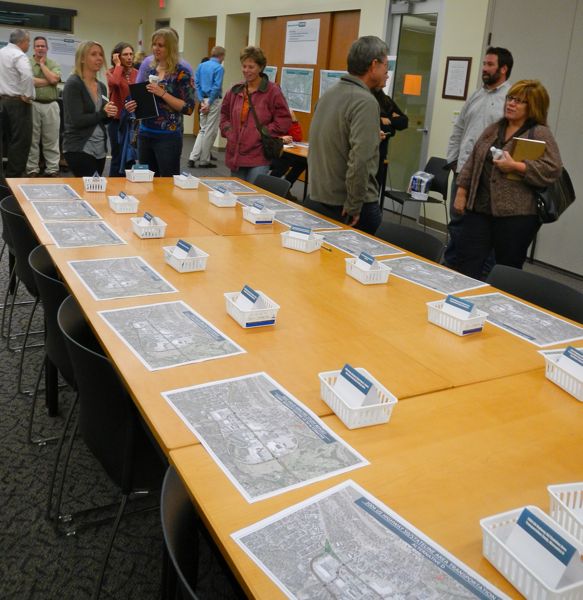
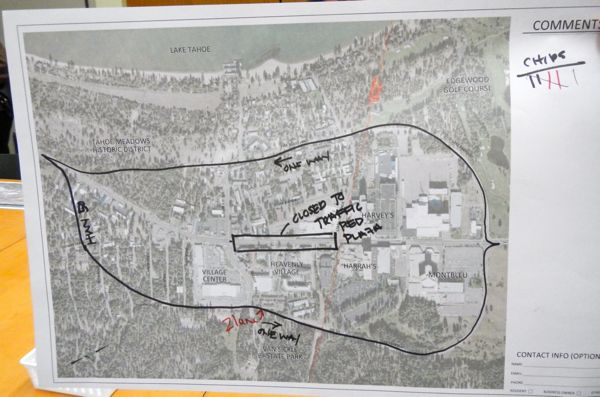
With pens in hand, people started drawing what they thought would be the best route for a loop road at the South Shore’s state line. At the other end of the table a container was filling up with those casting a vote for there never to be a loop road beyond what exists today.

Tuesday’s meeting at Lake Tahoe Community College was a bit of a do-it-yourself exercise instead of having people talk ad nauseam.

People have multiple choices for what a loop road could look like on the South Shore. Photos/Kathryn Reed

Along the walls was information detailing the history of the road that dates to the 1970s. At that time the road was to be an actual loop around the backsides of the Stateline casinos. The most recent official drawings have the road only going on the mountain side – behind Harrah’s and MontBleu.

A long table had placemat size renderings of 16 alternatives. At each one was a bucket of sorts where people could cast up to two votes for their preferred alternative(s). Those not wanting change could put their chip(s) in the 17th container.

Plenty of other people came up with suggestions that were unique or melded alternatives already on the table.

People were also asked to list their top three goals of a loop road or offer new ones. The 12 that were listed, that consultants said came from the community, were:

• Decrease traffic congestion • Improve pedestrian-bike facilities • Safer streets • Increase access to amenities • Better pedestrian amenities • Fulfill requirements of the Tahoe Regional Planning Agency Compact and area plans • Better pedestrian lighting • Have advanced forms for transportation • Encourage special events • Increase air-water quality • Improve economy • Enhance community and tourist experiences.

Some people read the list and wondered who came up with those and why people aren’t trying to achieve them even without a loop road.

Wood Rodgers is the consulting firm hired by the Tahoe Transportation District to cull all the information and run the workshops. TTD is the lead agency for the loop road.

Several people drew alternatives not already provided by planners.

While the bulk of the businesses and residents that could be displaced are in South Lake Tahoe, this project could go through even if the City Council doesn’t want it.

Proponents of a loop road want to turn the current state highway into a city street so the state line area – which includes California and Nevada – would be more pedestrian friendly. Highway 50 would be routed behind the casinos in Nevada and through existing neighborhoods and/or businesses in California.

For those who want some sort of rerouting of the highway, it’s the “where does it go in California?” that causes the most consternation. To this date, consensus has been elusive.

“We want to quantify what we’ve heard from the community,” Mark Rayback with Wood Rodgers told Lake Tahoe News.

His team will do that by coalescing the written comments, looking at which alternatives are most popular, and taking the similarities of what has been suggested to come up with what the public deems the top priorities.

A second meeting like the one Oct. 30 will be conducted Nov. 7 from 1-3pm at Embassy Suites in South Lake Tahoe. It will be the same format.

It’s possible at the Dec. 14 TTD board meeting that someone from Wood Rodgers would present a summary of findings, but with no action to be taken.

In the first quarter of 2013 a design charette is likely to occur. From there, four alternatives – though that number is not definite – could be chosen to be studied via environmental documents.


Environmental issues divide presidential candidates

By Paul Rogers, San Jose Mercury News

Two months after taking office, President Barack Obama signed a historic wilderness bill that banned logging, mining and oil drilling across 2 million acres of scenic federal lands, including the Sierra Nevada, wildflower meadows on Oregon’s Mount Hood and vast vistas of California desert.

But today, with less than one week until Election Day, the environment as a campaign issue is as quiet as some of those remote landscapes.

“When you are looking at a high unemployment rate, most voters are not concerned about saving the planet,” said Barbara O’Connor, director emeritus of the Institute for the Study of Politics and the Media at Sacramento State. “They are much more interested in the economy and jobs — and whether they’ll have a pension or health care.”

Yet despite its relatively low profile this year, there is a Grand Canyon of difference between Obama and his challenger, Mitt Romney, on environmental issues, from public lands to climate change.

Since taking office, Obama has mostly sided with environmental groups, approving new regulations to limit pollution. Romney has criticized those actions as burdensome on industry and costly to consumers and taxpayers. On Romney’s campaign website, there are policy positions for 26 major issues. “Environment” is not on the list.

During the past four years, Obama has:

Approved several major new air pollution laws, including strict limits on mercury pollution and smog that

drifts between states.

Doubled the gas mileage rules for cars, copying California’s greenhouse gas standards to require the U.S. auto fleet to average 54.5 mpg within 12 years.

Set the U.S. Environmental Protection Agency on course to require mandatory limits on greenhouse gases from new power plants by next year.

Included $90 billion in the 2009 stimulus bill for energy projects, doubling wind and solar energy nationwide.

Romney has opposed all of those measures.

“I think the EPA has gotten completely out of control for a very simple reason,” Romney said in an appearance on Fox News during the GOP primary fight. “It is a tool in the hands of the president to crush the private enterprise system, to crush our ability to have energy, whether it’s oil, gas, coal or nuclear.”

Environmental groups say Obama did as much as he could, given opposition to new environmental rules from Republicans in Congress.

“I’d give the president a B-plus — and Romney an F,” said Michael Brune, national executive director of the Sierra Club, based in San Francisco. “He hasn’t even made an effort to discuss any strategy to clean up our air and water or use energy more efficiently.”

Obama has established four new national monuments, including one at Fort Ord in Monterey County. He tightened offshore oil-drilling rules after the BP blowout in the Gulf of Mexico. He defended the Clinton administration’s “roadless rule” banning logging in millions of acres of national forests. And he appointed leading scientists to top posts, including Monterey Bay Aquarium Research Institute director Marcia McNutt to run the U.S. Geological Survey and Lawrence Berkeley Laboratory director Steven Chu as energy secretary.

In one major area, however, environmentalists remain bitterly disappointed.

In 2009, then-House Speaker Nancy Pelosi pressured Democrats to pass a bill regulating greenhouse gas emissions that most scientists say are contributing to global warming. But the bill — which would have imposed a cap-and-trade system on major polluters similar to California’s — died in the Senate when key Democrats from coal and oil states balked, including Louisiana’s Mary Landrieu and Robert Byrd of West Virginia.

Environmental groups say Obama did not fight hard enough. And they remain frustrated that climate change hasn’t been an issue in the campaign, particularly in a year with historic U.S. droughts and wildfires.

“Truth be told, after the health care bill, they lost an appetite for another heavy lift,” said Larry Schweiger, president and CEO of the National Wildlife Federation. “I give Nancy Pelosi enormous credit, but when the bill got to the Senate, it was clear there was not a lot of interest and engagement from the White House.”

Critics of new climate laws, however, say green groups are out of touch with an American public that suffered during the recession, and they look warily at rules that could raise electricity or gas prices.

“The Obama administration is worried about the perception in certain states that there are people who believe environmentalists take their jobs — in mining states, in logging states, places that make cars,” said Kenneth Green, resident scholar in energy and the environment at the American Enterprise Institute, a free-market think tank in Washington, D.C.

Over time, some of Romney’s views on environmental issues have changed.

As Massachusetts governor a decade ago, Romney opposed new offshore oil drilling, pushed for tax credits for hybrid cars and expanded recycling laws. In 2003, he denied a request from a coal plant in Salem for more time to meet toxic air pollution rules.

“If the choice is between dirty power plants or protecting the health of the people of Massachusetts, I will always come down on the side of public health,” he said then.

This fall, however, his campaign has launched a full-throated defense of the coal industry, which has been hurt by cheap natural gas and tougher EPA rules. “We have 250 years of coal. Why wouldn’t we use it?” Romney said in one ad, flanked by Ohio coal miners.

On climate change, Romney said he believes the science but is concerned over the costs of curbing coal and oil. “I think it’s getting warmer,” he said in an interview last year. “Two, I believe we contribute to it. And three, I don’t know by how much — a lot or a little. And so I am not willing to adopt multitrillion-dollar programs to reduce greenhouse gases in America. They don’t call it America warming; they call it global warming.”

In the end, whoever wins Nov. 6 will have to deal with opposition in Congress, lawsuits and other challenges.

“People making voting decisions based on environmental and energy issues are going to be disappointed when the governance begins,” said Frank Maisano, a spokesman for Bracewell & Giuliani, a Houston firm that lobbies on behalf of refineries and utilities. “You usually can’t govern the way you campaign.”


New environmental curriculum corrects plastic bag information

By Susanne Rust, California Watch

The state’s Environmental Protection Agency finalized a revision of a controversial K-12 environmental curriculum on plastic bags Friday.

California Watch reported last year that whole sections of an 11th-grade teachers’ edition guide for a new curriculum had been lifted almost verbatim from comments and suggestions submitted by the American Chemistry Council, the chemical and plastics industry trade group.

That investigation spurred politicians and state regulators to demand an examination into how the controversial text was compiled and changed, and whether industry bias was present.

State schools chief Tom Torlakson issued a statement saying his office would work with Cal/EPA to examine the material and identify areas “where further review may be warranted.”

And state Sen. Fran Pavley, D-Santa Monica, also called for an investigation, to which Cal/EPA responded by saying it would review the chapter.

The new text provides more updated statistics on plastic bag consumption and recycling rates, many of which were provided by California Watch in its story on the textbook.

For instance, while the old text used a statistic offered by the American Chemistry Council indicating that 12 percent of Americans recycle plastic shopping bags, the new text notes “recycling rates specific to plastic shopping bags are not currently calculated by state or federal agencies.”

It also refers to a CalRecycle’s estimate, which suggests that recycling rates may be as low as 3 percent.

“This is the final revised version, which will be available to members of the public and teachers for download,” said Bryan Ehlers, assistant secretary of education and quality programs at Cal/EPA.

“We think the curriculum is excellent, and this process gave us the opportunity to go through it with a fine- toothed comb, getting at the same goal of producing a thoughtful and reasoned discussion about the consequences of consumption,” Ehlers said.

In 2003, a state law was enacted requiring environmental concepts and principles be taught to all of California’s K-12 public school students.

Cal/EPA outsourced the development and editing of the curriculum to Gerald Lieberman, director of the State Education and Environment Roundtable. The roundtable is a nonprofit group originally developed by departments of education in 16 states to enhance environmental education in schools.

In 2009, after the curriculum had been written, the state posted final drafts of the text online for public review. It was during that period that a public relations specialist hired by the American Chemistry Council submitted comments, edits and suggestions on the text.

Lieberman incorporated nearly all of the trade group’s suggestions, including adding a new section to the text called “Advantages of Plastic Shopping Bags.”

The California curriculum covers science, history, social studies and arts and weaves in environmental principles and concepts within 85 units and hundreds of pages. The full-color pages of the curriculum, which can be downloaded from the state’s website, mirror the look of a textbook. Teachers are encouraged to use the materials as handouts in the classroom and as reading assignments for students.

Ehlers, the Cal/EPA official, said that after the revised curriculum was posted for review, the agency received about a half-dozen comments, and none from the American Chemistry Council.

The American Chemistry Council did not reply to a California Watch request to respond to the new revisions.

According to Ehlers, the agency has now trained about 2,000 teachers with the new curriculum, which is likely to reach about 60,000 students in more than 100 school district across the state.


Asian clams being suffocated to protect Emerald Bay

By Kathryn Reed

Asian clams are expected to always be a reality in Lake Tahoe. But an $810,000, yearlong project is under way to keep them from taking over Emerald Bay.

With it estimated that 95 percent of the people who launch a boat at Lake Tahoe make their way to Emerald Bay, keeping that inlet as pristine as possible is not only good for the environment, but for tourism – aka the economy.

Brant Allen brings up a handful of Asian clams -- the ones he is helping get rid of at Emerald Bay. Photos/Kathryn Reed

Excretion from the clams creates algae blooms, which makes the nearshore, or beach area, unappealing to swim in, look at or paddle over. The bay has about 10 acres of nearshore.

These are not clams one eats – mostly because it would take too long to get a forkful. They are about 2 to 3 centimeters, with some 1-2 millimeters – like a grain of sand.

Another reason to eliminate the Asian clams is that they produce calcium – which Lake Tahoe doesn’t naturally have much of. And calcium is needed for quagga mussels to survive and thrive. To date, that aquatic invasive specie has not turned up in Tahoe. It is the critter that has devastated Lake Mead in Southern Nevada.

Allison Gamble with the Tahoe Environmental Research Center said it will be impossible to ever eradicate the clams from Lake Tahoe, but controlling them and eliminating them from key locations are the goals.

The earliest recording of this invasive clam at Tahoe was 2002, but it took six years for them to be a problem. A year later, 2009, was when the Aquatic Invasive Species Program rolled out. This included boat inspections, which look for Asian clams. Most likely the clams arrived via a boat’s bilge.

While scientists know the Asian clams are in Donner Lake, they were surprised when told by a photographer with the Reno Gazette-Journal that she found some in the Truckee River. There is no monitoring program on the river.

Clam control

On Oct. 25 a team of divers began covering 5 acres at the mouth of Emerald Bay with a biomass material made of shredded aspen that is then covered with a rubber mat. The purpose is to smoother the clams. This is all being done in about 15-feet of water, with 25 feet being about the deepest.

Looking over a boat it’s easy to see the black covering the sand. Crews should be done placing the mats by the end of November. During this time boats may still access Emerald Bay, but there could be a bit of a delay if divers are in the water.

Brant Allen with UC Davis is one of those divers. On Tuesday he described it as an “exhausting day of work.” The mats that are rolled out by two divers weigh 300 pounds on land and not much less under water.

It takes about 30 minutes to unroll each mat. Two hundred thirty-eight mats need to be placed on the lake bottom. The project also includes 25 tons of rebar that cover 10 miles, and 17,000 rivets.

The goal is to suffocate the clams by extinguishing their oxygen supply. Scientists have access points to check the site on what will likely be a monthly basis until all of the material is removed a year from now.

They live just under the sand. When shells are visible, it means the clam is dead.

Other points of interest

Steve Chilton with the U.S. Fish and Wildlife Service said, “AIS is the largest threat to the ecosystem.”

Most of the clams are on the south end of the lake. Emerald Bay is the farthest point north and west they have been found.

“The economic impact of Emerald Bay to Lake Tahoe and the region cannot be overstated,” Dan Shaw, environmental scientist with California State Parks said. The bay is state parks land.

About 1,000 boats a day come into the bay on peak summer days. Shaw told Lake Tahoe News a camera was set up this summer to record the speed of boats, but because so many come through the mouth it was impossible to gather that data.

To pay for the project, California Water Board allocated $458,220 and $352,000 came from the Southern Nevada Public Lands Management Act. The latter source of funding will be exhausted in 2014, so where money will come from for future projects is an unknown.

ngg_shortcode_0_placeholder (Click on photos to enlarge.)