Whittemore’s attorneys file for dismissal

By Jeff German and Francis McCabe, Las Vegas Review-Journal

Defense lawyers for Harvey Whittemore filed court papers Friday seeking to suppress evidence in the high-profile federal case charging the one-time power broker in a scheme to unlawfully funnel $138,000 in campaign contributions to Senate Majority Leader Harry Reid.

The lawyers argued the evidence – including a note from the Nevada Democrat thanking Whittemore – was unlawfully obtained without a warrant.

The court papers included motions to dismiss the case against the longtime legislative lobbyist because of a lack of evidence.

Whittemore, 59, who once wielded influence within the state’s political hierarchy, faces four felony charges, including making excessive campaign contributions, making contributions in the name of another and making a false statement to a federal agency. His trial is set for Feb. 26 before U.S. District Judge Larry Hicks in Reno.

In a motion to suppress, Las Vegas attorney Dominic Gentile sought to toss out all evidence found without a court-approved warrant in 81 boxes taken from Whittemore’s offices after his business partners cut ties with him.

The boxes contained documents identifying the surrogate contributors Whittemore is alleged to have used in the scheme and his reimbursements to the contributors, a book about campaign finance law, a note to Reid and a note from Reid.

An FBI agent told the grand jury Reid authenticated his note to Whittemore that read, “Harvey, you’re a man of your word” and “You are a true friend now and for all days.”

According to the indictment, Whittemore duped Reid’s campaign committee into believing the contributions came legally from family members and associates.

Reid has distanced himself from Whittemore since the Las Vegas Review-Journal first reported in February that he was the subject of a federal investigation.

In one defense motion seeking to dismiss the case, Gentile argued the government cannot prove Whittemore knowingly violated the campaign laws.

“The indictment is devoid of any factual allegations that Mr. Whittemore knew the specific laws with which he is charged of violating,” Gentile wrote. “Thus, the court should dismiss the indictment in full because the government has failed to allege the essential facts constituting the element of willfulness.”

The indictment alleges Whittemore met with Reid in February 2007 in Las Vegas and agreed to raise $150,000 by the March 31, 2007, campaign finance deadline.

Whittemore unlawfully used family members and associates as conduits for contributions to the senator’s campaign and then reimbursed them, the indictment alleges.

But Gentile argued Whittemore’s conduct supports the conclusion that he did not believe he was breaking the law.

“These are all people that Mr. Whittemore cared deeply about and would be the last people that he would put in harm’s way, if he believed his conduct was illegal,” Gentile wrote.

“It is unfathomable that he would knowingly and willfully expose his children to criminal liability just to make a few extra campaign donations.”

Evidence presented to the grand jury included testimony about the boxes filled with the contents of Whittemore’s offices with his former company, Wingfield Nevada Group Holding Co., according to the suppression motion.

After Thomas and Albert Seeno, two wealthy California brothers who partnered with Whittemore in Wingfield Nevada, removed him from the company, his offices were sealed, and the contents were boxed and delivered to the Las Vegas law firm of Pisanelli Bice.

James Pisanelli told a county judge hearing a lawsuit over the failed business partnership that the FBI had subpoenaed the boxes and ordered the firm to keep them, according to Gentile’s motion.

Gentile argued that Whittemore was never served with the “purported subpoena” that allowed the FBI to examine the boxes.

Because the search “led directly to the alleged discovery of the very acts and transactions which are the basis” of the indictment, all evidence derived from the illegal search must be suppressed, Gentile wrote.

The investigation became public Feb. 9, as FBI agents fanned out across the state at some 30 locations to serve subpoenas on Whittemore business associates, family members and employees.

Allegations had surfaced that employees of Wingfield Nevada and its subsidiaries were used to donate to political campaigns and were later reimbursed by Whittemore with company money.

In recent years, Whittemore turned his attention away from lobbying to land development.

At the time of his big push to contribute money to Reid’s campaign, Whittemore was orchestrating the development of Coyote Springs, a master-planned community in Southern Nevada.

With the help of Reid and other members of the Nevada congressional delegation, Whittemore sought to overcome several government hurdles because of county water and federal land issues.

But in 2008, the 43,000-acre development stalled because of the housing crash and economic recession and has languished ever since.



Raley’s, union back at negotiation table

By Dale Kasler, Sacramento Bee

Raley’s and the United Food and Commercial Workers on Sunday announced they have resumed negotiations in San Francisco as the two sides seek an end to a week-old strike.

UFCW Local 8 in Roseville said Raley’s initiated the talks, a move that Raley’s spokesman John Segale confirmed.

“It is abundantly clear to us Raley’s desire to return to the (bargaining) table has been driven by the success of our picket lines and consumer support for our members,” the local told members on its website. “Raley’s chief negotiator contacted your bargaining team with a request to resume negotiations.”

Union officials urged their members to continue picketing despite the resumption of talks.

“While this is a positive development, it is no time to let down our guard,” UFCW Local 5 in San Jose said in a message posted on its website.

Few details were available about the new negotiations.

“Both parties have agreed to not discuss the progress of these talks while the current negotiations are ongoing,” Raley’s said in a prepared statement.

Raley’s workers went on strike a week ago rather than agree to the company’s demands for wage and benefit concessions.

The main sticking point is Raley’s proposal to alter the health insurance plan, including the elimination of health care for retirees eligible for Medicare.

Both sides have been claiming success so far. Raley’s has said sales, while reduced, have improved day by day, and that some union members have returned to work.

Union officials say they’ve kept picket lines intact and persuaded the vast majority of Raley’s customers to shop elsewhere. About 80 stores are affected.


2-day TRPA meeting before Regional Plan vote

By Kathryn Reed

One month from today the Tahoe Regional Planning Agency Governing Board is expected to vote on the much-anticipated, much-overdue Regional Plan update.

This voluminous document is the planning bible for the Lake Tahoe Basin. It was last updated in 1987. However, it was supposed to be updated in 2007, but got bogged down because of a multitude of reasons.

More than 5,000 people have weighed-in on the plan in the last five years, with others and many of the same who show up each meeting expected to talk some more on Wednesday and Thursday.

Lake Tahoe’s environmental and economic future are tied to the TRPA Regional Plan update. Photo/LTN file

This week two sessions of the Governing Board will be all about the update. But everything is not a done deal.

Board members Mara Bresnick and Byron Sher at the October meeting raised some questions. Concerns that some people believe could have been brought up months ago so they could have been carefully vetted instead of having the potential to derail the process. Plus, Bresnick was asked to be on the Regional Plan Update Committee, but said she was too busy.

“I’m hesitant to assign a motive (for Bresnick and Sher’s late comments),” Kristi Boosman, TRPA spokeswoman, told Lake Tahoe News. “I think everyone on the Governing Board is committed to the well-being of Lake Tahoe and there are some differences on how to achieve that end.”

Here are Bresnick and Sher comments from the October meeting. Bresnick is the California Assembly speaker appointee and Sher is the California Senate Rules Committee appointee.

“If the state of California would like to monitor everything that comes out of our decisions here, then I suggest that the economy be a measurement because the economy is absolutely critical for what we are suggesting,” Claire Fortier, South Lake Tahoe’s rep to the Governing Board, said at the Oct. 25 meeting. “We recently completed the Tahoe [environmental] forum where both governors supported a public-private partnership to increase the environmental gain as well as the economic sustainability of this community. There is no measurement of that.”

Local and state reps from California and Nevada who are appointed govern the bi-state board.

The two states have been bickering for almost the entire 40-plus years TRPA has existed. It came to a head in the last couple years with Nevada threatening to pull out of the federally created agency if changes were not made.

Since then, top officials in each state have been meeting to help foster a better, more cohesive relationship.

John Laird (California Natural Resources secretary) and Leo Drozdoff (Nevada Department of Conservation and Natural Resources director) wrote a letter to the TRPA board that in part said, “The states of California and Nevada take seriously our unique and shared roles at Lake Tahoe. Through our personal engagement we believe we have fostered a bi-state relationship that is healthier now than in recent memory and has engendered stronger trust among the stakeholders and represents a new start.”

Clearly, not all the board members share that view.

—–

Notes:

• Nov. 14, public comments will be taken at 10:30am at the Chateau in Incline Village.

• Nov. 14, in the afternoon the Regional Plan Update Committee will convene to discuss issues recently raised by Bresnick and Sher.

• Nov. 15, public comments will be taken at 1pm at Harveys in Stateline. In the morning, it’s likely the board will discuss what the update committee talked about the day before.

• Dec. 12, Governing Board meeting starts at 9:30am at Harveys in Stateline.

• For $15 TRPA staff will have USB thumb drives available for purchase at this week’s meetings that contain the final draft Regional Plan update and associated documents.

• Here is the agenda for the meetings this week.


Comments being taken on draft EIR for Truckee CHP project

The Truckee Town Council on Dec. 19 will discuss the draft environmental impact report that has been prepared for the California Highway Patrol Communication Facilities Replacement Project.

The project would replace and upgrade the CHP telecommunications facilities at the Truckee area office on Highway 89. This is the communications hub that serves South Lake Tahoe, Truckee, Gold Rush and Donner Pass inspection facility as well as a portion of Sierra, Nevada, Placer, El Dorado and Alpine counties.

Right now the Truckee office only has one line to a CHP facility out side the area. If the Donner beacon goes down or the microwave dish at the Truckee office is out, there is no way for the Truckee CHP office to communicate with the rest of California.

Here is a link to the draft EIR, which includes more specifics about what is being proposed. Comments are being taken until Dec. 21.

The town council meeting is at 6pm Dec. 19 in council chambers, 10183 Truckee Airport Road.


Housing indicators in S. Tahoe following national trend

By Theresa Souers

According to the National Association of Realtors, the median sales prices increased in the third quarter compared to the same period last year in 120 of 149 metropolitan areas.

In fact, home prices rose in 81 percent of U.S. cities. While not quite there yet, South Lake Tahoe’s home prices are showing signs of a similar trend.

When comparing the sales for the month of October 2012 to 2011, the median home price rose from $236,000 to $270,000 and the percent of sales to list price rose from 95.7 percent to 96.8 percent.

When looking at the average median home prices for South Lake Tahoe for the past 12 months (Nov. 1 – Oct. 31) there is an overall decrease in value from $285,000 in 2011 to $239,450 in 2012. However, the median home price for the past three months has steadily risen from $234,000 in August to the reported $239,450 at the end of October.

The National Association of Realtors also reported that foreclosures and short sales, in which the price is less than the mortgage balance, accounted for 23 percent of third-quarter deals, down from 30 percent a year earlier. The numbers reported for South Tahoe again represent similar trends.

During the third quarter of 2012, distressed sales made up 39 percent of the overall purchases. This number is down from the 46 percent in the third quarter of 2011.

As of Oct. 31, there were 237 homes for sale in South Tahoe as compared to 408 the previous year.

Theresa Souers is on the South Tahoe Association of Realtors board.


Truckee cops confiscate 30 pounds of pot

Thirty pounds of marijuana with an estimated street value of $75,000 was found at a Truckee residence on Friday.

Truckee officers were investigating a suspicious subject in the Sierra Meadows neighborhood on Nov. 9 when they contacted an individual at his residence and discovered approximately 30 pounds of processed marijuana and an active marijuana grow.

Police have not released the name of the individual who was arrested because other potential subjects are under investigation.

Officers said they found processed marijuana packaged for sale in half pound and pound quantities.

— Lake Tahoe News staff report


Meyers residents map out future for their community

By Kathryn Reed

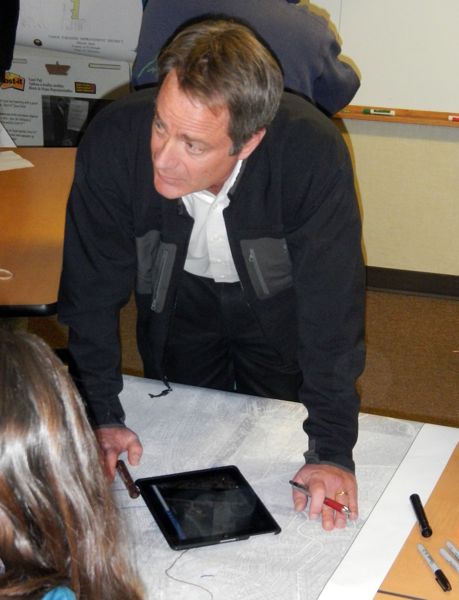
MEYERS – With markers in hand, a room full of people started drawing and writing descriptions on maps about what Meyers should evolve into. And much like the discussions being had around the basin, recreation, connectivity and a sense of place evolved as dominant themes.

Moving the boat inspection from where it is on Highway 89 to someplace where it’s easier for motorists was an idea. But a bigger idea was to incorporate a visitors center into the boat wash area since this is a captive audience. Plus, the Meyers station is the busiest one in the Lake Tahoe Basin.

Having distinct cross country ski routes through Lake Valley Recreation Area and Washoe Meadow State Park, as well as putting in bridges across the Upper Truckee River and Angora Creek that have nothing to do with golfing were some of the ideas.

Steve Bannar talks about trails he would like developed in Meyers. Photo/Kathryn Reed

Changing land use designations to accommodate the possible relocation of Lake Tahoe Wildlife Care is on the table.

These ideas and more were discussed at a three-hour meeting Nov. 7 at the Lake Valley firehouse in Meyers. The goal is to come up with an updated plan for Meyers – the last one is 20 years old – and have it ready to be presented to the Tahoe Regional Planning Agency early next year.

John Hitchcock with TRPA ran the Wednesday workshop.

When someone brought up how Winter Park, Colo., has a commercial area about as long as Meyers’ on a state highway and functions better, Hitchcock said, “The problem is the Department of Transportation in Colorado is more progressive than Caltrans.”

The highway is so wide in this section of the South Shore because it was going to be a freeway at one time.

El Dorado County Supervisor Norma Santiago would like to see the county take over the right-of-way from Caltrans. This would likely allow businesses to be able to do more with their properties and could take some snow removal responsibilities out of the state’s hands.

She also suggested flopping the lanes for the bug station so locals go right through without veering to the right, and those needing to be inspected are off to the side of the road.

Santiago wants a new building that is not an “eye-sore” and meets legal requirements.

Transportation was one of the main topics of the night. Creating park and ride areas to access recreation, plus having plowed winter recreation parking were brought up.

The fact Meyers does not have bus service other than on-demand was noted.

Being able to have connections to places that don’t involve being on or alongside a highway were mentioned, though so was creating a bike path along Highway 89.

Linking Tahoe Paradise Park and the state park was broached.

The Western Juniper Tree is on the cover of the 1993 Meyers plan because this is the only enclave in the basin where this species is found. People advocated for highlighting this fact in a more public manner.

Yanks Station in the prior plan was touted as where retail would go. It doesn’t exist anymore. In its place is the California Conservation Corps building. So that aspect of the old plan will definitely be revised.

The old plan also called for median landscaping on the highway with five distinct districts, with retail being two of them at opposite ends.

“What is missing from the old plan is mixing uses,” Hitchcock said. This would require not having as many districts.

He also suggested the possibility of having all of Meyers designated an area where special events can take place so it is less limiting than current policy.


Santa Rosa man accused of robbery arrested in S. Lake Tahoe

By CBS-SF

SANTA ROSA — A former Santa Rosa Hydroponics and Growing Supplies store employee was arrested in South Lake Tahoe on Nov. 7 on suspicion of robbing the store last month, Santa Rosa police said.

Jessie Hicks, 28, of Santa Rosa was detained by the California Highway Patrol while he was driving in South Lake Tahoe, police said.

The robbery suspect was armed with a handgun when he entered the store at 4880 Highway 12 about 7:30pm on Oct. 29, police said.

The suspect’s face was covered with a cloth and he was wearing a hood, but he addressed the clerk by his first name and demanded cash from the register, police said.

Witnesses identified Hicks as the suspect and an ex-employee of the store and police then broadcast an alert to other law enforcement agencies regarding Hicks’ involvement in the robbery.

Based on the broadcast alert, the CHP detained Hicks in South Lake Tahoe and notified Santa Rosa police.

The CHP learned Hicks moved to an apartment in Stateline and the Douglas County Sheriff’s Office in Nevada got a warrant to search Hick’s apartment, where evidence from the robbery was found, police said.

Santa Rosa police detectives went to the El Dorado County jail in South Lake Tahoe where Hicks was being held and arrested him on suspicion of the robbery.


Cost of a house on the rise in California

By Hudson Sangree, Sacramento Bee

Home prices in the Sacramento region continued rising in September at rates that outpaced national gains and mirrored statewide increases in residential real estate values, CoreLogic reported Tuesday.

Across El Dorado, Placer, Sacramento and Yolo counties, home prices rose by an average of 6.9 percent in September compared with the same month a year before, the Santa Ana-based firm said in a monthly report.

California also saw a 6.9 percent price increase during the same period, it reported.

Excluding distressed properties – meaning foreclosures and short sales – home prices in the Sacramento area and the state both increased by more than 8 percent from September 2011 to September 2012, CoreLogic reported.

Nationally, house prices jumped by 5 percent in September from the same month a year ago. That was the largest price gain since 2006 and the seventh consecutive month of year-over-year gains, the firm said.

“Home price improvement nationally continues to outpace our expectations,” Mark Fleming, chief economist for CoreLogic, said in a news release.

Price increases have been especially strong in states such as California, Arizona and Florida that experienced dramatic boom-and-bust cycles, and in energy-rich states such as North Dakota. There are only a handful of states where prices continue falling, including New Jersey and Illinois, CoreLogic said.

“Most states are exhibiting price increases,” Fleming said. “Gains are particularly large in former housing-bubble states and energy-industry concentrated states.”

The local, state and national markets are all improving because of short supply and increased demand, based partly on record-low interest rates.

“Home prices are responding to better market fundamentals, such as reduced inventories and improved buyer demand,” said Anand Nallathambi, president and CEO of CoreLogic.

“So far this year, we’re seeing clear signs of stabilization and improvement that show promise for a gradual recovery in the residential housing market.”


Safeway workers-management reach consensus on contract

By Heather Somerville and George Avalos, San Jose Mercury News

Safeway struck a deal with union leaders early Thursday, ending more than 15 months of negotiations and easing fears that the recent bout of labor strife in local grocery stores might spread to the region’s largest supermarket.

The tentative contract lays out new agreements on health care, wages and other prickly labor issues, and would cover Safeway employees in the Bay Area and Northern California through October 2014.

“This new agreement provides our employees with among the best wages, benefits and working conditions in the region, while ensuring the company can compete successfully in the future,” said Karl Schroeder, president of Safeway’s Northern California Division.

While Safeway turns an amicable corner in labor negotiations, family-owned grocery Raley’s remains locked in a bitter stalemate with union members who went on strike Sunday and show no sign of leaving the picket line.

Ron Lind, Local 5 president of the United Food and Commercial Workers Union, would not disclose the specifics of the Safeway agreement, but said he was pleased that the union health plan was unscathed in the final offer.

“Members are relieved,” Lind said. “They’ve seen what happened at Raley’s and Nob Hill. I think they are relieved to have a peaceful settlement.”

The Safeway contract awaits approval by members of Locals 5, 8 and 648 of the UFCW, and labor leaders said Thursday they expected to finalize the contract in less than a month.

“We will recommend strongly that they ratify this contract, and I’m confident that they will,” Lind said.

The agreement could put pressure on Raley’s to bend to union demands on pay and benefits. Save Mart, the other major grocer in the region, has already signed a deal with the UFCW.

A Raley’s spokesman said this week the company’s offer is better more generous than the Save Mart contract, and Raley’s will keep stores open and continue serving customers until the union votes. The strike is the first in Raley’s 77-year history.