Thieves steal ancient petroglyphs in Eastern Sierra

By Louis Sahagun, Los Angeles Times

BISHOP — Ancient hunters and gatherers etched vivid petroglyphs on cliffs in the Eastern Sierra that withstood winds, flash floods and earthquakes for more than 3,500 years. Thieves needed only a few hours to cut them down and haul them away.

Federal authorities say at least four petroglyphs have been taken from the site. A fifth was defaced with deep saw cuts on three sides. A sixth had been removed and broken during the theft, then propped against a boulder near a visitor parking lot.

Dozens of other petroglyphs were scarred by hammer strikes and saw cuts.

“The individuals who did this were not surgeons, they were smashing and grabbing,” U.S. Bureau of Land Management archaeologist Greg Haverstock said last week as he examined the damage. “This was the worst act of vandalism ever seen” on the 750,000 acres of public land managed by the BLM field office in Bishop.

The theft required extraordinary effort: Ladders, electric generators and power saws had to be driven into the remote and arid high desert site near Bishop. Thieves gouged holes in the rock and sheared off slabs that were up to 15 feet above ground and 2 feet high and wide.

Visitors discovered the theft and reported it to the BLM on Oct. 31. BLM field office manager Bernadette Lovato delivered the bad news to Paiute-Shoshone tribal leaders in Bishop.

“It was the toughest telephone call I ever had to make,” Lovato said. “Their culture and spiritual beliefs had been horribly violated. We will do everything in our power to bring those pieces back.”

The region is known as Volcanic Tableland. It is held sacred by Native Americans whose ancestors adorned hundreds of lava boulders with spiritual renderings: concentric circles, deer, rattlesnakes, bighorn sheep, and hunters with bows and arrows.

For generations, Paiute-Shoshone tribal members and whites have lived side by side but not together in Bishop. But desecration of the site, which Native Americans still use in spiritual ceremonies, has forced reservation officials and U.S. authorities to come together and ask a tough question: Can further vandalism be prevented?

“How do we manage fragile resources that have survived as much as 10,000 years but can be destroyed in an instant?” asked archaeologist David Whitley, who in 2000 wrote the nomination that succeeded in getting the site listed on the National Register of Historic Places. “Do we keep them secret in hopes that no one vandalizes them? Or, do we open them to the public so that visitors can serve as stewards of the resources?”

The easy answer is to police the site and others listed under the Archaeological Resources Protection Act. But that’s not possible given the condition of cash-strapped federal lands agencies, authorities said.

Authorities said the petroglyphs aren’t worth a great deal on the illicit market, probably $500 to $1,500 each. But they are priceless to Native Americans, who regard the massive tableaux as a window into the souls of their ancestors.

The site is one of dozens of such locations managed by the BLM office in Bishop. A small army of volunteers has stepped up surveillance of the area.

For archaeologists, the images carved into a half-mile-long volcanic escarpment depict the culture and spiritual notions of the ancient tribes that once populated the sage flats and river valleys of the Eastern Sierra.

Paiute tribal historic preservation officer Raymond Andrews observed sacred law by quietly chanting a traditional prayer when he approached the site earlier this month.

Standing beneath a panel of geometric renderings believed to have been carved by shamans, Andrews took a slow, deep breath and said, “We still use this sacred place as a kind of church to educate tribal members and children about our historical and spiritual connections. So, our tribal elders are appalled by what happened here.”

Federal authorities and Native American leaders plan to mark each defaced petroglyph with a small sign pointing out that, as archaeologist Haverstock put it, “this damage was done by malicious, selfish individuals.”

The BLM is offering a $1,000 reward for information leading to the arrest and conviction of the thieves. Damaging or removing the petroglyphs is a felony. First-time offenders can be imprisoned for up to one year and fined as much as $20,000, authorities said. Second-time offenders can be fined up to $100,000 and imprisoned up to five years.



Prop. 30 not creating an exodus of super rich from California

By Jim Christie and Peter Henderson, Reuters

SAN FRANCISCO — Warnings that a new millionaires’ tax would send California’s wealthy stampeding for the state line began before the results were final. But the super-rich may well stand their ground.

“Anyone know a good realtor in Incline Village?” Aaron McLear, the spokesman for California’s anti-tax campaign, tweeted early the morning of Nov. 7 as the votes against his cause streamed in.

California’s vote raised its top rate by 3 percentage points to 13.3 percent, easily the highest in the nation, drawing howls of protests from critics who doubt the taxes will be well spent and who fear a Democratic supermajority will wreak further havoc. “At least Californians can still escape to Nevada or Idaho,” a Wall Street Journal editorial concluded.

It’s too early to look for signs of an exodus. But if history in California and New Jersey, another state with high taxes and its share of multi-millionaires, is any guide their won’t be a run for the exits.

At high-end Incline Village real estate broker Chase International, a short hop from San Francisco into Nevada, the phones have not been ringing off the hooks, said Realtor Shari Chase.

Some wealthy retirees and mobile professionals called before the election, she noted, and nearby business owners in California expressed interest in a move. But Silicon Valley executives will not be trying to telecommute from her side of Lake Tahoe, she said.

“We do have billionaires here,” said Chase. “But I’m not sure the 3 percent (state tax increase) is going to make as big a difference for them.”

Gov. Jerry Brown’s seven-year income tax hike, known as Proposition 30, looked poised for failure before Election Day, but it sailed through by a vote of 54.5 to 45.5 percent.

Brown promoted it as a temporary fix to the state’s big fiscal gap, which gave California time to make bigger changes and save schools and universities from $6 billion in cuts.

Business groups from the Beverly Hills Chamber of Commerce to the tech industry policy group TechNet backed the tax, and the state Chamber of Commerce took no position.

A few defections are likely, said Jim Wunderman, president of the Bay Area Council business group, but many can’t and won’t. “California offers too much to too many,” he said.

Using tax funds for education scored with the wealthy. The state’s higher education system “is a large reason why we are the world’s technology leader,” venture capitalist and former state controller Steve Westly, a Democrat, wrote in an email.

“No. I don’t think high-income earners will leave the state,” he added.

Business has been good in Silicon Valley, and venture capital investment is pouring in, something even tax opponents could appreciate, said TechNet Senior Vice President Jim Hawley.

“I don’t think Prop. 30 itself was going to push anybody over the edge,” he said. “People look at the business climate in total.”

Low-tax Texas beckons

“We’ve decided to put the pedal to the metal and get out of California as soon as possible,” one Southern California businessman told Reuters.

He has not told his clients yet, and declined to be named. He and his wife decided after the election to sell their house at a loss, sell his advertising business and head to Texas.

The Lone Star State does not have an income tax and has clinched the No. 1 spot on Chief Executive magazine’s list of best states for business for eight consecutive years.

California politician Chuck DeVore abandoned California for Texas after he lost the Republican primary for the U.S. Senate. Entrepreneurs frustrated by business conditions – California perennially ranks dead last in polls of business friendliness – are sure to respond to the tax, he said.

“They may see this as the last straw,” DeVore said.

A September 2012 Stanford Center on Poverty and Inequality which looked at state tax records found the contrary.

In fact, more millionaires came to the state than left after California’s so-called Millionaire’s Tax was introduced in 2005 – adding 1 percentage point of tax to incomes over $1 million. A 1996 cut to taxes for those earning $110,000 and up did not spur migration into the state, either.

The number of millionaires has risen or fallen by about 10,000 a year, but that change has been almost entirely due to the state economy, not wealthy people coming into or leaving the state. Such migration accounted for about 47 people, net, on average.

The very richest, who were likely to have houses and properties in many parts of the world with creative means to finesse their taxes, were the least likely to move after the tax hike, but even those at the bottom end of the millionaires scale did not pick up and leave, according to the September study.

The Stanford researchers found New Jersey millionaires also stayed put, despite plenty of nearby, relatively inexpensive alternatives, after the state hiked its top rate by 2.6 percentage points. There was a modest increase in migration among millionaires past retirement age and living mostly on investment income, they found.

A Manhattan Institute study published in September in the buildup to the tax vote, warned California’s golden age of domestic migration was over, as jobs proved harder to come by, crowding increased and government cut services while increasing taxes. Immigration from abroad wasn’t considered.

But former New York state chief demographer Robert Scardamalia, one of the co-authors of the Manhattan Institute report, pointed out that the U.S. census and Internal Revenue Service data he used did not get at the “why” for migration.

“Bottom line is that I think they find what many would expect – there are a lot of other reasons driving the migration decision other than taxes,” he concluded in an email to Reuters.

If you go, sever ties

Many find it hard to leave the good weather and vibrant cities of California, which offer an especially pleasant life for those of means. Tax authorities make it even harder.

Back in Incline Village, Chase has some advice for folks considering switching residency: don’t fool around.

“You can’t live in a $10 million house in California and come up to Nevada and buy a million dollar house and call that a residence,” she said.

California tax men and women go to great lengths to nail “former” residents who have not really left. So the rich who leave California should not plan on coming back any time soon, said Scott Kauffman, a tax lawyer in Irvine.

“They’re extremely thorough,” he said. “They’re going to check your bank accounts, where you’re charging purchases and your cell phone records,” he added.

“What I tell people is to prepare to leave for two years,” said Kauffman. “You’ve got to sever all your California connections.”


Officials using public input to prioritize how to improve Lake Tahoe Nevada State Park

By Anne Knowles

CARSON CITY – Officials are considering a whole menu of changes in Lake Tahoe Nevada State Park and will prioritize them based, in part, on public input.

The Nevada Division of State Parks received input on Sand Harbor, Cave Rock and Spooner Lake backcountry at its second public meeting on the Lake Tahoe Nevada State Park general management plan update.

About a dozen people showed up here last week to discuss ideas for improving the park, including redesigning the boat launch at Cave Rock, creating additional access for kayakers at Sand Harbor and the future of recreation at Spooner Lake now that the concession for cross-country skiing and mountain bikes has closed.

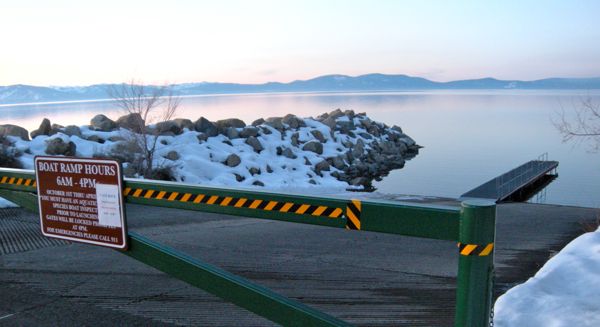
At Cave Rock, for example, the department is looking at reducing congestion at the boat ramp by possibly adding slips to expedite launching; building a ramada for picnic tables and barbecues; redrawing the parking lot to lengthen spaces; and adding acceleration and deceleration lanes for vehicles at the entrance.

It’s possible that slips would be added at Cave Rock. Photo/LTN file

At Sand Harbor, the parks division’s suggestions include making the south beach area more accessible for kayakers; relieving congestion at the boat ramp; adding picnic seating for groups; and making the whole area easier to navigate for visitors with disabilities.

“That place is loved to death,” said Steve Noll, principal at Design Workshop, discussing the challenges at Sand Harbor. His firm is working with Ascent Environmental, the main engineering consultant on the park’s general management plan.

A visitor center may be built at Spooner Summit, Noll said. The division is considering three locations: off Highway 50 where 50 meets Highway 28; and two spots on Highway 28, one at the junction of 50 and 28, on the opposite side of 28, and another farther down 28, on the lake side of the highway. Each location has its pros and cons, said Noll.

Jay Howard, parks supervisor, said the division is working on getting another concession in Spooner. But for now, he said, the division plans to plow the parking lot and may use skimobiles to clear some trails for skiers. Previously, Max Jones cleared the trails as part of his work as the concession operator.

“We’ll do our darnedest to keep it open,” Howard said.

Jones said, “I’ve had the concession for 27 years, but it’s hard to rely on it in the winter. I’m tired of stepping up to the winter roulette table.”

Jones said the concession was long a struggle because of unpredictable snowfall, but he finally decided to give up the business when the parks division said it was raising his fees.

“Last year we were open 30 days in the winter,” Jones said. “I can’t make a go of it.”

Jones now operates the Tunnel Creek Café in Incline Village and plans to open a 1,000-square-foot mountain bike shop on a parcel behind the restaurant. He said he’d continue to run a shuttle busing runners, bikers and hikers between Incline and Spooner, and to work with the parks division, on a volunteer basis, to develop bike trails.

“I’m here about the continued winter use of Spooner,” said Jennifer Roman, a Minden resident attending the meeting, who said she skis at Spooner and kayaks out of Sand Harbor. “And the boat launch area (at Sand Harbor) gets pretty packed sometimes.”

Dave Morrow, administrator for the state parks division, said he and Howard sit on a committee overseeing the plan to improve the Highway 28 corridor from Crystal Bay to Spooner Lake, and are working to coordinate the park’s plan with the highway proposal.

The Highway 28 plan involves a dozen state and federal agencies with the goal of making the recreational areas along the East Shore of the lake safer and more accessible for visitors.

Funding is an issue, though, and both plans are long-term roadmaps, not immediate checklists of changes, Morrow said.

“We want people to know that we will use this as guidance,” Morrow said. “Trouble is people make comments and think something is going to be done right away. Where we go with this in the future depends on funding.”

The division is accepting public comment on the update until Nov. 30. Maps and details are available at the division’s website, and comments can be emailed to Dana Dapolito, conservation staff specialist, at ddapolito@parks.nv.gov.

At its first meeting in March, the division said it planned to produce a draft plan by year-end. But a draft is now likely in March or April next year, with time for further public comment then.


2 fake car repairmen scam cash from S. Tahoe resident

Two men offering car repair services are being sought by South Lake Tahoe police officers.

On Nov. 17 at about 4pm an 89-year-old resident of South Lake Tahoe was approached by two men in the Safeway parking lot who offered to repair a dent in the car for a cash payment $80 and later additional work for an additional $20. The senior citizen agreed to it and the men followed the senior citizen to his residence.

The men worked on his car in the garage. Officers say the repair was of very poor quality and may have been a ruse to get inside the man’s home or a scam to get some money from him.

The men are described as Hispanic male adults in their 30s. They were driving a white full size SUV with a rear lift gate type of hatch.

The South Lake Tahoe police officers warns citizens of the dangers of allowing strangers into their homes and of getting repair work done by unlicensed and uninsured repairmen. Anyone who comes across a similar situation is asked to contact Sgt. Shannon Laney at the South Lake Tahoe Police Department, (530) 542.6100.

 — Lake Tahoe News staff report


California moves forward with health care exchange

By Kevin Yamamura, Sacramento Bee

Since the waning days of former Gov. Arnold Schwarzenegger’s administration, California has pushed to become the earliest adopter of President Obama’s health care plan.

But it wasn’t until Obama’s re-election this month that state officials were fully confident their plans would take flight.

They first had to survive a U.S. Supreme Court decision in June and wait to find out whether a new Republican administration in Washington would reverse the federal Patient Protection and Affordable Care Act.

“The answer is clear,” said Peter V. Lee, head of the state’s new marketplace for subsidized health insurance. “A year from now, California will be expanding its coverage to millions of Californians.”

California submitted its formal application to the federal government this week to run its own health care marketplace, newly dubbed Covered California. Such entities – called exchanges – are the linchpin of Obama’s plan because they will deliver subsidized health care to the uninsured and influence the rest of the market starting in 2014.

California is seeking more than $700 million over two years from the federal government to run the state program.

Covered California will serve households earning up to four times the federal poverty level, equal to $92,200 for a family of four in 2012. The federal government will also expand Medicaid – Medi-Cal in California – to residents below 138 percent of the federal poverty guideline, including childless adults who did not have access before.

While Obama’s win may have cleared the last political hurdle, it didn’t make the state’s logistical task easier.

“Clearly the things that could have interfered with the implementation have been resolved,” said California Health and Human Services Secretary Diana S. Dooley, who chairs the board overseeing Covered California. “That’s not to say, however, that it’s smooth sailing. This is still a very, very heavy lift. The timeline is extraordinarily ambitious.”

California has taken a hands-on approach to how it manages its health care exchange, said Micah Weinberg, a health care expert and senior policy adviser with the business group Bay Area Council.

In a short time frame, the state is building a new enrollment system that must communicate with existing county programs that currently provide health care to low-income residents.

Covered California also wants tight control over which health plans and insurers can sell subsidized coverage to residents. Weinberg said other states have taken a more relaxed approach in which any plan can participate if it meets minimum standards.

“That decision has certain virtues, but more hands-on means more time and more difficulty,” Weinberg said.

Covered California expects to begin enrollment by Oct. 1, 2013, and will have six months to sign up its initial class of subscribers. It expects to have between 150,000 and 430,000 enrollees by Jan. 1, 2014. A year later, it anticipates between 490,000 and 1.4 million subscribers.

Between now and next October, Covered California and its contractor, Accenture, must build a statewide Web-based enrollment system. The health exchange must also negotiate with more than 30 health plans to design coverage and pricing in 19 separate regions of California.

One of the biggest challenges will be persuading the uninsured to sign up, particularly the healthy subscribers necessary to ensure that the program is financially viable. Lee said Covered California will devote much of its energy and resources to connecting with residents through paid advertising and community outreach.

The state health exchange previously hired Ogilvy Public Relations for $900,000 to work on an outreach plan. The Bee reported in July that ideas ranged from having First Lady Michelle Obama lead a California summit to asking television writers in Hollywood to draft story lines featuring subsidized health care options, the latter of which drew objections from GOP congressmen.

Despite the flak, Lee said Covered California isn’t backing away from those ideas: “We want it talked about at the dinner table, in front of the TV, in barber shops.”

Health insurers are concerned that the federal law limits their ability to charge significantly lower rates for young people than for older adults. Patrick Johnston of the California Association of Health Plans says older adults typically have health care costs five to seven times higher than young enrollees.

Johnston said health insurers are asking the Obama administration to allow greater discounts for young subscribers. Otherwise, he fears, healthy young adults will avoid signing up.

“What Congress did was take (pricing) out of math and science and move it into politics,” Johnston said. “It’s good for older people. But the effect will not only be on younger people, but the stability of the pool. It’s a concern.”

As recently as several weeks ago, Gov. Jerry Brown worried that Obama’s overhaul might not survive the election. The governor vetoed bills that would have enshrined some of the most popular federal components in state law.

Obama’s plan requires health insurers to cover people regardless of condition and prohibits higher premiums based on illness. That pencils out for insurers only if healthy people are mandated to buy coverage, as the federal plan requires under threat of financial penalty.

Brown feared that Obama-plan critic Mitt Romney might eliminate the mandate if elected president, leaving California insurers required under Senate Bill 961 and Assembly Bill 1461 to cover sick patients while healthy residents could avoid buying coverage.

While much of the health care action will take place at Covered California, the Legislature must still make several major decisions in a special legislative session in January.

Sen. Ed Hernandez, D-West Covina, chairman of the Senate Health Committee, said lawmakers must revisit the legislation that Brown vetoed to require insurers to cover all individuals regardless of medical condition and define how premiums are set.

He said the Legislature also has to consider how to extend Medi-Cal benefits to more people and whether to create an alternative basic health plan for low-income residents.


Red Hawk Casino rewrites deal with state to stay afloat

By Dale Kasler, Sacramento Bee

The Indian tribe that owns struggling Red Hawk Casino in Shingle Springs struck a new deal with the state Friday that could bring the tribe some desperately needed financial relief.

Gov. Jerry Brown announced a new gambling compact that significantly reduces the amount of money the state gets from Red Hawk’s owners, the Shingle Springs Band of Miwok Indians.

The deal acknowledges how badly the casino has performed – and what a financial disappointment it’s been to the tribe, which was counting on Red Hawk to lift it out of poverty.

“The compact is designed to address fiscal challenges the tribe has faced and to meet the requirements of federal law that the tribe be the primary beneficiary of its gaming operation,” said an announcement from the governor’s office.

Nick Fonseca, the tribe’s chairman, said in a press release that the compact “ensures the long-term financial prosperity of the tribe and its casino.”

The agreement is far from a done deal. It must be ratified by the Legislature – and it requires the tribe to restructure its debts with bondholders and Lakes Entertainment Inc., the Minnesota company that manages Red Hawk.

The governor will have final say on whether the restructurings go far enough to ease the tribe’s debt burden, which is around $500 million.

As part of the deal, the maximum number of slot machines allowed at Red Hawk is cut from 5,000 to 3,000. Red Hawk now has 2,200 slots.

The new deal suggests that without help, the casino is headed toward disaster.

Red Hawk “cannot currently or in the coming years generate enough revenue for the tribe to cover its financial obligations,” the compact says.

The biggest change involves the state’s takeaway. The tribe now pays the state up to 25 percent of its slot-machine winnings – believed to be the highest percentage of any tribal casino in California. Under the new deal, that would fall to 15 percent.

The new compact may be unprecedented. I. Nelson Rose, a gambling-law expert at Whittier College, said he’s never heard of a state rewriting a tribal compact to ease the financial terms.

“It’s innovative,” Rose said. “It’s better to get … a lesser amount, 15 percent, than to get zero.”

The casino is doing so poorly that when an El Dorado Superior Court jury ordered the tribe last winter to pay its former casino partner $30 million in a contract dispute, the tribe said it didn’t have the money and warned Red Hawk might close.

The case is on appeal.

AmyAnn Taylor, the tribe’s general counsel, said the Shingle Springs band hasn’t yet spoken to bondholders or Lakes Entertainment about restructuring the debts. The tribe has two years to complete the restructurings, according to the new compact.

Lakes executives couldn’t be reached for comment. The company already agreed a year ago to let the tribe defer principal payments on a $66 million start-up loan.

Taylor said the tribe recently amended the deal under which it pays $5.2 million a year to El Dorado County – another requirement of the new compact. She said the tribe will pay the county the same amount, but will get reimbursed $2.6 million a year to help run its medical clinic, which serves the community at large.

“The county saw an opportunity to help them out,” said county Supervisor Ron Briggs. “They’re here, they’re our partner.” Red Hawk employs 1,350 workers.

Federal law says Indian casinos are mainly supposed to benefit their tribal owners. Yet Taylor said the casino has been generating far more income for the state than for tribal members.

The tribe has earned just $6 million a year from Red Hawk – the bare minimum guaranteed under the management contract with Lakes. Fonseca, in an interview last year, said individual tribal members were getting just $800 a month from the casino.

By contrast, Taylor said the tribe has been paying the state $30 million a year.

The casino opened in December 2008, during the worst of the recession, and has never performed up to the tribe’s expectations. In 2010, its gambling revenue fell $100 million short of projections, according to testimony in the Superior Court case.


Heavenly seeks to expand summer operations

Heavenly Mountain Resort wants to start expanding its summer operations next year, with the goal of having the projects in the ground in the next building season.

Before they can move forward the U.S. Forest Service must sign off on the proposal. Public comment is being taken by the Lake Tahoe Basin Management Unit.

The projects are consistent with the improvements identified in Heavenly’s Master Plan Amendment.

Additions would include a climbing wall, zipline canopy tour, adventure course, aerial challenge park and zipline center.

The Adventure Peak climbing wall would be replaced with a larger, realistic three-dimensional rock structure approximately 30-feet high adjacent to the Tamarack Lodge. A Discovery Forest Zipline Canopy Tour is proposed for the forested area between Tamarack Express lift and the Big Easy trail. The Discovery Forest would provide a tree-bound zipline and canopy tour activities that would incorporate environmental education information designed for children. This would require selective tree removal.

A proposed Bear Cave Challenge Course adjacent to the ski school near Tamarack Lodge would include a multi-level climbing structure approximately 40-feet high. Selective tree removal would be required.

Boulder Cove Challenge Park would be built across from the base of the gondola stairs and would include a self-guided challenge activity that consists of a series of vertical wooden columns, platforms and rope walkways/bridges approximately 30-feet high. Limited tree removal and limb removal of existing trees would be required.

A new Zipline Center would be constructed in the area between the existing tubing hill and the Big Easy lift and would include four ziplines approximately 1,000 feet in length. Limited tree removal would be required and low voltage electrical and communication lines would be installed. A total of 40 trees would be removed for the entire project.

Comments should be turned in by Dec. 21. For more information on the proposal, contact Jonathan Cook-Fisher at (530) 543.2741 or email jcfisher@fs.fed.us. A map of the proposed project area is online.


Census: More Californians in poverty than any other state

By Aaron Sankin, Huffington Post

California has a poverty rate of 23.5 percent, the highest of any state in the country, according to figures released this week by the United States Census Bureau.

The only other geographic region with an equivalent poverty rate is the District of Columbia, with 23.2 percent. The second most poverty-stricken state was Florida, at 19.5 percent.

The recognition of California’s shockingly high poverty rate comes as a part of a shift in the way the Census Bureau measures its data. When the government began examining poverty back in the early 1960s, the line for determining who fell underneath the threshold was determined solely by looking at food costs.

In the decades since, there’s been increasing criticism this benchmark, as it doesn’t take into account tax rates and assistance programs such as food stamps, child care expenses and medical costs. In examining its most recent data, the Census Bureau considered these previously ignored factors, deemed the “supplemental poverty measure.”

These new metrics have yielded quite different results than in past years. Under the traditional definition of poverty, for example, California’s rate is 16.3 percent.

“We’re seeing a very slow recovery [nationally], with increases in poverty among workers due to more new jobs which are low-wage,” University of Wisconsin-Madison economist Timothy Smeeding told the Associated Press. “As a whole, the safety net is holding many people up, while California is struggling more because it’s relatively harder there to qualify for food stamps and other benefits.”

The Golden State’s jump between the supplemental and conventional measures was the largest swing of any state, and the Sacramento Bee attributes it to California’s high cost of living.

“There are several important differences between the official and supplemental poverty measures,” explained Census Bureau economist Kathleen Short in a statement. “For instance, the supplemental measure uses new poverty thresholds that represent a dollar amount spent on a basic set of goods adjusted to reflect geographic differences in housing costs. The official poverty thresholds are the same no matter where you live.”

Under the supplemental measures, the national poverty rate jumped by a full point up to 16.1 percent, or just under 50 million individuals. The poverty rate for minors dropped from 22.3 percent down to 18.1 percent, while the rate for seniors (ages 65 and above) nearly doubled to 15.1 percent.


GOP says Nevada still a state to fight over

By Anjeanette Damon, Las Vegas Sun

Rest easy, Nevada. You’re still a battleground state.

At least so say political operatives on both sides of the aisle.

Admittedly, they may have a bit of a vested interest in saying so. Presidential battleground status opens the spigot to tens of millions of advertising dollars.

By the last count compiled by the Washington Post, $54 million was spent on Nevada airwaves to influence the presidential election here this year — that’s about $53 per vote cast here.

But some are questioning whether Tuesday’s results support the claim that Nevada’s six electoral votes are worth fighting over anymore.

President Obama last week won Nevada convincingly for the second time. In fact, his margins in 2008 and 2012 far exceeded former President George W. Bush’s Nevada margins in 2000 and 2004.

Democrats have 90,000 more registered voters than Republicans. They have a well-financed party structure in place — an organization noticeably absent on the Republican side. And they have control of the state Legislature.

Some might say that doesn’t sound like the metrics of a true swing state.

Indeed, it’s starting to sound a lot like New Mexico — previously a battleground state before turning convincingly blue beginning about four years ago and disappearing from the presidential campaign radar screen.

Is Nevada in danger of becoming the dreaded flyover state that the presidential contenders pass by in between campaign stops in Colorado and fundraising stops in California?

Republicans, with a tinge of apprehension in their voices, say: Not yet.

“This is the bluest purple state in the country,” said Mac Abrams, Sen. Dean Heller’s campaign manager. “But we’re still a purple state.”

Perhaps Heller’s victory is an indication of that. The Republican barely defeated Democrat Shelley Berkley, whose campaign was hamstrung from the beginning by a House ethics investigation.

But Republicans also point to the fact that Nevada’s most popular politician, Gov. Brian Sandoval, is a Republican. The party represents half of Nevada’s congressional delegation. And although the GOP narrowly lost an attempted takeover of the state Senate, the number of voters statewide backing a Republican candidate for the Legislature almost equaled the number of voters backing a Democratic candidate.

“Yes, we’re still a battleground state,” Republican strategist Robert Uithoven said. “However, we need to do significant work within the Republican Party to keep it a battleground state.”

And that’s where the argument becomes more than just how much battleground status increases the bottom lines for television station owners.

If Republican presidential contenders cede Nevada, they’re pretty much handing it over to the Democrats. And that’s not necessarily good for Republican candidates down ticket.

“At this point, it’s the Republicans’ responsibility to keep us a battleground state,” Uithoven reiterated.

Democrats aren’t about to take Nevada for granted, either.

“Clearly it’s more Democratic than it used to be,” one Democratic operative said. “I think you can call it a Democratic-leaning state, but I personally feel less confident about calling it a solidly blue state.

“I don’t think we’re there yet. And Democrats have to be careful not to go down the same flawed path Nevada Republicans went down.”

Just a decade ago, Republicans were the powerful party in Nevada. Democrats had no party structure to rely on, held only one statewide office and seemed unable to wrest control of the state Senate away from the Republicans.

The story is a cautionary indication that the political balance of power in Nevada can easily execute an about-face.

So will Nevada voters have the same level of television ads, robo-calls and door knocks to complain about again in four years?

“I think they will,” the Democratic operative said. “If either side takes Nevada for granted, I think they do it at their own peril.”


2 TRPA board members refuse to listen to public

By Kathryn Reed

STATELINE – The two Tahoe Regional Planning Agency board members who have the most issues with the Regional Plan update chose not to listen to the 2½ hours of public testimony on Thursday.

Claire Fortier, who represents South Lake Tahoe on the Governing Board, called out Mara Bresnick and Byron Sher for not taking the time to hear what the locals had to say. It’s their job to listen — even if they don’t like what is being said. (Bresnick is the California Assembly speaker appointee and Sher is the California Senate Rules Committee appointee.) Bresnick attended the morning session Nov. 15.

“It should speak volumes to the community and the state that the two members who are most vocal are not here to hear the locals,” Fortier said at the end of public comment. “We need to stop catering to those who do not live here. Science has proven we can fix the environment. It is entirely doable. Let us do it.”

She told Lake Tahoe News afterward it was not a planned speech – she didn’t even have notes to read from. The room was eerily silent as she spoke.

And then Fortier’s impassioned tongue lashing of her colleagues was met with applause.

When it comes time to vote on the Regional Plan next month, it will take a minimum of four yes votes from each state for it to pass.

Before public comment was taken Thursday at Harveys, the Governing Board went over issues the Regional Plan Update Committee discussed the previous day. Bresnick and Sher, who are not on the committee, had seven points to make. They each mentioned how they were bringing forth concerns of the Tahoe Area Sierra Club.

While the League to Save Lake Tahoe has in the past been in lockstep with the Sierra Club, that is not the case with the Regional Plan update. No one from the League spoke either day this week. The League has been at the table as the conservation industry’s voice. A TRPA employee said Darcie Goodman-Collins, executive director of the League, has made positive contributions throughout the process.

The board, with Sher and Nancy McDermid not present for the vote, agreed to the committee’s recommendation to the Regional Plan update that parcel level best management practices will be required for any redevelopment or new construction until the area-wide BMP project is completed.

The committee was split as to whether a few words should be changed to bring clarity. The board voted to make the changes, with Fortier the lone dissenting vote.

Imperfect. That word was often used by people to describe the Regional Plan update. It’s because no one entity or person has gotten everything they want.

What is different from this plan compared to the one approved in 1987 that the basin is still governed by is that the next one will be updated as needed, not overhauled in 20 years.

Those who for the past two days advocated for the Governing Board to approve the document next month said it is time to adopt the plan and move forward – that the status quo would be worse. Those who have issues with the plan contend it does not protect lake clarity, it would increase development and would create high-rises – that more work is needed before it’s adopted.

Jennifer Quashnick with the Tahoe Area Sierra Club on Nov. 14 spoke about how there is no air quality monitoring going on. Regarding this, TRPA Executive Director Joanne Marchetta was visibly perturbed. She said her agency monitors the air at six sites in the basin at an annual cost of $165,000.

Earlier in the day fire officials spoke about the threat to prescribed fire operations if the Bresnick-Sher proposal were added to the Regional Plan update.

The committee voted not to adopt the Sher-Bresnick proposal.

Twenty-eight people spoke at the Nov. 14 meeting in Incline Village, while 50 people gave input a day later in Stateline.

While all the comments are recorded, no further study of any of them will be done. All the hours of talk were about swaying the Governing Board — at least those who chose to attend. No more meetings of the board or any committee involving the Regional Plan update are scheduled between now and the Dec. 12 vote of the Governing Board. (That meeting will be at Harveys in Stateline, though the time has not been set.)

People, including the economy, vs. the environment are in large part what continue to divide those who have not found consensus. Those for the plan believe the environment, economy and people are tied together. Those who are against or are wary of the plan believe the environment trumps everything else.