Flu season taking its time reaching Lake Tahoe

By Kathryn Reed

It’s beginning to feel and sound a little like flu season.

“Although seasonal influenza seems to be hitting other parts of the country early this year, we have had very low rates of influenza so far in Tahoe,” Greg Bergner, physician at Barton Urgent Care, told Lake Tahoe News.

The Centers for Disease Control and Prevention is reporting a high number of flu cases in Southern states.

Typically Lake Tahoe’s flu season goes from before Christmas to late March or early April.
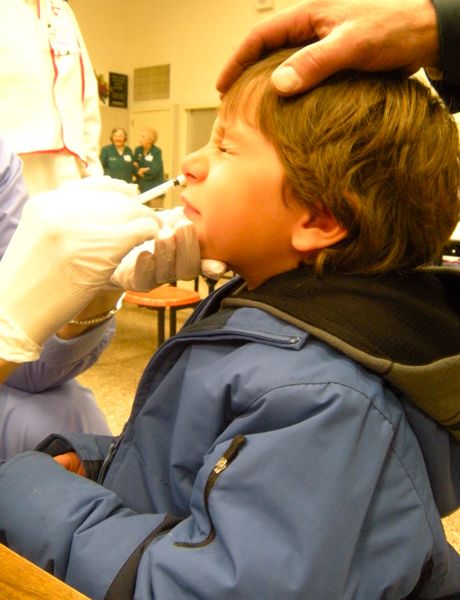
A South Lake Tahoe boy winces when receiving the mist vaccine during a previous flu season. Photo/LTN file

While the flu can be deadly, that’s not usually the case in the basin.

“It is very rare for anyone from Tahoe to die from influenza for a number of reasons. Because of Tahoe’s geographic isolation, our altitude, and our rougher winter weather we have fewer patients living here with serious chronic diseases,” Bergner explained. “Tahoe’s population is generally healthier and consequently less likely to die from influenza infections. Also, children less than 2 years with any serious health conditions are normally transported promptly to tertiary care facilities, where the full cadre of pediatric subspecialty care is available.”

The flu and colds are different animals, though some of the symptoms are the same. Doctors can perform a test to tell the difference. Flu can sometimes be treated with anti-viral medication. Drugs are the most beneficial if taken within the first 72 hours.

“Influenza is nasty. Typically it includes a bad headache, light sensitivity, unusually bad muscle aches, a cough and fever. The common cold has similar symptoms, but in lesser severity,” Bergner said.

Doing all the things mom said to do is what the doc recommends – get plenty of sleep, drink lots of fluids, and Advil or Tylenol will help with the headache and/or fever.

“Although the influenza A virus of today is much like a ‘nasty cold’, the concern from public health officials stems from the possibility that the virus can someday mutate into a much more virulent viral strain, with a much higher death rate,” Bergner said.

Of course, there is always the flu shot or nasal spray to help ward off the chance of getting sick. Through the years Barton officials have noticed a steady increase in the number of people opting for a dose of prevention.

But it’s not an exact science when it comes to developing the vaccine each year.

“The flu shots clearly work and have been scientifically proven to do so. The problem is that the influenza virus has a propensity to change its molecular shape periodically. This change in viral shape can make a vaccine less effective, though not totally ineffective,” Bergner said. “The vaccine must be modeled a year in advance in order it to be manufactured and then distributed. This means that there is always a possibility that the vaccine won’t be as effective as hoped, if the virus changes its shape in that intervening time.”

This is the first year El Dorado County Public Health is mandating healthcare workers wear masks while providing patient care if they have not been immunized for influenza. Vaccinated Barton staff members have a bright green sticker on their ID badge.

Here are tips for not getting and not spreading the flu:

• Don’t visit hospitalized patients if you are ill – especially if you have respiratory symptoms.

• If you visit any health care facility with flu-like symptoms, ask for a mask.

• Get immunized with the influenza vaccine.

• Wash your hands often.

• If you have the flu or any other respiratory illness, be sure to cough or sneeze into your elbow.

• Avoid close contact with people who are sick.

• Stay home from work, school and other activities if you are sick.

Who should be immunized:

• Children aged 6 months to 18 years receiving long-term aspirin therapy and who therefore might be at risk for experiencing Reye syndrome after influenza virus infection;

• Residents of nursing homes and other chronic-care facilities;

• American Indians/Alaska Natives;

• People who are morbidly obese (body-mass index is 40 or greater);

• Health-care personnel;

• Household contacts and caregivers of children aged younger than 5 years and adults aged 50 years and older, with particular emphasis on vaccinating contacts of children aged younger than 6 months;

• Household contacts and caregivers of persons with medical conditions that put them at higher risk for severe complications from influenza.

Those who should not be vaccinated:

• People who have a severe allergy to chicken eggs;

• People who have had a severe reaction to an influenza vaccination;

• Children younger than 6 months of age (influenza vaccine is not approved for children in this age group);

• People who have a moderate to severe illness with a fever (they should wait until they recover to get vaccinated);

• A history of Guillain-Barré Syndrome (GBS) within 6 weeks following receipt of influenza vaccine is a precaution for the use of influenza vaccine.


Nevada may require voters to show photo ID

By Nevada News Bureau

CARSON CITY – Secretary of State Ross Miller announced last week he is seeking legislation in the 2013 session aimed at curbing the potential for voter fraud by including photographs of registered voters at polling places on election day.

Miller said his proposal is not a voter identification measure. Instead it would be an upgrade to the current antiquated paper roster system by implementing electronic voter rosters with the enhanced feature of a photograph of each registered voter.

The requirement of a photograph in the new electronic roster would prevent ineligible voters from impersonating other, eligible voters at a polling place, Miller said. The proposed law, which is currently being drafted, will seek to import existing photographs of eligible voters from the Nevada Department of Motor Vehicles database of drivers’ licenses and state identification cards.

The photographs would be part of a new “electronic poll book” as an adjunct to the existing poll books that currently use signatures for identifying voters. When photographs of the eligible voters are not available through the database, poll workers would be available to take photos at the polling place at the time of voting and verify their identity by way of an affidavit.

Voter ID laws have been passed in other states, but have frequently led to court challenges. Nevada does not now have such a law.

Sen. Michael Roberson, R-Las Vegas, proposed a voter ID law in the 2011 legislative session, but the measure did not win approval from a Senate Committee and died without action.

Assemblyman Lynn Stewart, R-Henderson, has submitted a bill draft request for a voter identification law for the 2013 session.

“This provides a significant safeguard in our election process while simultaneously ensuring that we don’t disenfranchise any voters,” Miller said. “It’s really just an enhancement of the existing system, by providing an electronic poll book that could include a photo to go with the already recorded signature.”


Vail Resorts buys 2 Midwest ski resorts

By Ed Sealover, Denver Business Journal

Vail Resorts Inc. has entered into agreements to buy two Midwestern ski resorts, making the Broomfield, Colo.-based company’s cache of out-of-state resorts larger than its in-state collection for the first time.

The company that owns and operates Heavenly, Northstar and Kirkwood in California, and the Vail, Keystone, Breckenridge and Beaver Creek resorts in Colorado will add Afton Alps in Minnesota and Mount Brighton in Michigan to its portfolio for the combined price of $20 million, CEO/chairman Rob Katz announced Thursday.

Vail Resorts then plans to upgrade the ski areas and to include them for the 2013-14 season in what will be a nine-resort season pass, he said.

“These acquisitions are part of a new strategy for Vail Resorts to drive season pass sales and build broader guest loyalty by looking at premier smaller ski areas located near major urban markets,” Katz said in a news release. “We plan to bring state-of-the-art racing, terrain parks, coaching and technology to the guest experience.”

The announcement comes two days after KSL Capital Partners LLC of Denver, which owns Squaw Valley, announced that it will buy a 24 percent stake in Whistler Blackcomb Holdings Inc., the Canadian company that owns the popular Whistler ski resort near Vancouver, British Columbia. Katz was asked during Vail’s quarterly earnings call Tuesday about whether his company had looked at buying Whistler, and he responded that he was not interested in buying a minority stake in a resort company because it would not allow Vail to make changes and drive value the way it feels is necessary.

Afton Alps and Mount Brighton host a combined 468,000 active skiers each year and are near the Minneapolis-St. Paul and Detroit markets. Both currently are family-owned.


Indictment: South Tahoe man skiing and collecting workers’ comp benefits

A federal grand jury returned an 11-count indictment today against South Lake Tahoe resident Mark E. Leung. The 58-year-old is accused of wire fraud, mail fraud, and making a false statement to obtain federal workers’ compensation.

Leung worked for the U.S. Postal Service until 1987. At that time he claimed he sustained a work-related injury. He never returned to full-time employment with the Postal Service and began receiving workers’ compensation benefits.

From September 2007 through November 2012, Leung received approximately $160,000 from the Department of Labor. To obtain the benefits, Leung submitted an annual certification form and also had his medical providers attest that he could not perform any work due to the pain he suffered that limited his mobility and range of movement.

But he was mobile enough to ski.

According to U.S. Attorney Benjamin B. Wagner, Leung has a season pass at Heavenly Mountain Resort and regularly skis 40 days a season.

“Moreover, Leung was as also observed performing arduous physical labor on numerous days,” according to a press release from the U.S. Attorneys Office.

If convicted of the 11 counts, Leung faces a maximum statutory penalty of 20 years in prison and a $250,000 fine.

— Lake Tahoe News staff report


Nevada-centric bills languishing in Congress

By Karoun Demirjian, Las Vegas Sun

With only a few weeks left in the congressional session, it’s do-or-die time for two years’ worth of bills Nevada lawmakers have filed to fix local problems that need federal attention.

There are pending bills to free up federal lands for mining and declare other sections of the state as wilderness. There are bills-in-waiting to mitigate unemployment and homelessness for veterans. There is lingering legislation to help with mortgage modification. And that’s not even counting online poker — which technically doesn’t count because a bill hasn’t been officially filed.

To pass all these measures is an impossible task: They are competing with thousands of other pieces of legislation — not to mention a little thing called the fiscal cliff — for attention before the holidays.

That means the Nevada delegation must pick their favorites, then plead their case with those who have the power to push them through in the last few weeks.

“To just say, ‘Hey I introduced your bill, have a nice day,’ well that is a nice piece of paper, but you should be moving this through and getting it done,” said Rep. Mark Amodei, R-Nev. “So I’m putting all my cards on the table and going as hard as I can.”

Luckily, the chief operator at the helm of the process is also a Nevadan: Sen. Harry Reid.

This week, Reps. Joe Heck and Shelley Berkley had private meetings with the senior senator, in which they urged him to do everything in his power to move local Nevada bills — especially the many public-lands bills that have been collecting dust on the Senate calendar for many months.

“Sen. Reid’s always been upfront with me,” said Heck, who has four bills he’s prioritized as must-do: Two on veterans affairs and two on public lands, to authorize the Three Kids Mine cleanup and the Mesquite land conveyance. “There are several issues, none of which I think are insurmountable.”

Nevada representatives report the obstacles they have encountered to their bills are usually the result of some philosophical hangup or an unfamiliarity with Nevada’s unique relationship with the federal government — especially when it comes to public lands.

“Any time you give federal land back to a state, that is considered an earmark, even if they’re paying a fair market value for it,” Heck said.

When it comes to public-lands issues, there is remarkably little disagreement within the Nevada delegation, which has become expert at making successful tradeoffs of exploitable and conservation lands.

The pending bills include one to sell 10,400 acres of BLM land to the city of Yerington to develop a copper mine, a bill to hand over about 1,000 acres of BLM land to aid in the cleanup of the Three Kids Mine in Henderson, and bills to designate the Pine Forest Range, north of Winnemucca, a wilderness area.

This year, if all the Nevada public-lands bills were to pass, the trade would be 15,000 acres for mining and 75,000 acres for wilderness, according to Amodei, who as representative of the rural districts has filed the lion’s share of public-lands bills.

But federal-lands matters aren’t just up to the Nevada delegation.

This year, the fate of Nevada’s lands bills is tied up with that of lands bills in general. Three Kids Mine, Mesquite, and the more highly publicized Yerington Land Conveyance and Pine Forest bills have all, for the moment, been rolled into one large public-lands package that incorporates projects in Nevada and other states.

Republican Sen. Tom Coburn of Oklahoma, who has a habit of placing holds on public-lands bills, has objected to it.

“I just don’t believe we should be giving the federal government any more land,” Coburn told the Sun this week.

Reid ultimately controls the calendar of what gets taken up in the Senate. But the Senate’s practice of holds — where a single senator can block progress on a piece of legislation — means that authority can be quickly undermined.

“Even though (Reid’s) the majority leader, there’s only so much he can do in the Senate. And so if there are issues on my side of the aisle, it’s hard for him to impact those,” Heck said. “So that’s where I got engaged more heavily.”

Nevada’s lawmakers are skeptical that Coburn’s objections have more to do with his made-in-Oklahoma opinions about federal land — less than 4 percent of Oklahoma is owned by the federal government compared with about 85 percent in Nevada — than it does with the particulars of the Silver State projects proposed.

“The vast majority of these bills, they’re paying for themselves. So if you’ve got issues with them, tell us what they are,” Amodei said. “I was thinking of calling (former Sen. John) Ensign up and saying, hey, what’s up with Coburn? They did live together. … I haven’t decided if I’m going to do that. Probably not.”

Amodei is kicking himself about not directly approaching Reid earlier to hash out a way to shuttle at least some Nevada lands bills — primarily Yerington and Pine Forest — through before Coburn got in the way.

“I do recall that he’s the majority leader and that they do have things on the radar screen that might be a little higher than this,” Amodei said. “But I’m not going back to Winnemucca and saying, ‘Hey guess what? … Congratulations, you’ve done everything right, but you’ve got nothing to show for it.’”

Coburn isn’t the only hold-up to the Nevada delegation’s final-week ambitions. Heck said he also has been having trouble getting two veterans bills that passed the House up in the Senate. He is running up against senators with similar legislation that don’t seem too keen on working with him to close the loop.

One is Heck’s Stolen Valor bill; Sen. Jim Webb has similar legislation in the Senate.

“His version unfortunately won’t meet constitutional muster,” Heck said. “We’re trying to work with his office to say, ‘Why don’t you just take ours?’ I’ve had a hard time tracking him down. I might have to go stake out his office.”

A spokeswoman for Webb said she was aware of Heck’s bill but did not respond to a request for comment Friday afternoon.

Heck also has a bill to mitigate veteran homelessness. A spokeswoman for Reid said Friday that he expected the Senate would vote on legislation written by Rhode Island Sen. Jack Reed.

For those who have been in Congress for a while, this sort of last minute pileup is par for the course.

But the newer members of the delegation — especially those in the House — find the slow pace of getting local bills through Congress baffling.

“I’m surprised,” Heck said of his veterans bill. “I don’t think I was naive, but when a bill passes out 410 to 3, you’d think that it was a slam dunk.”

Amodei said: “The Yerington bill … it was here before me. … Seriously? It shouldn’t take years and years and years. Does it cure the ills of cancer? No, but hey, this is a big step, this is a good thing to do regionally and you don’t have to take a bath as the federal government to do it.”

Over the next few weeks they will watch, and wait, until the final hours of the 112th Senate, when Reid will rattle off the bill numbers of the measures he’s managed to reach unanimous consent on in the Senate.

And they will hope that Reid exercises a little home-state advantage.

“These bills are priorities for Sen. Reid,” said his spokeswoman, Kristen Orthman. “He will work hard with the Nevada delegation to get them done.”


Missing Gardnerville couple located; 1 dead, 1 alive

By KOLO-TV

KOLO 8 News has been in contact with family of Roderick Clifton, one of two people missing in the Sierra since last Thursday.

His brother-in-law first informed KOLO 8 News Now that the couple Clifton and Paula Lane of Gardnerville had been found right around 8:30pm Wednesday. At 10pm he called our newsroom back to inform us that Roderick did not survive, but Paula Lane is alive.

The circumstances of their disappearance is not known at this point in time.

CHP Sgt. Joe Sherry told KOLO 8 News he was notified at 8:30pm Wednesday that, “A female subject had made contact with somebody at Sorensen’s Resort (in Hope Valley). She had said that they were in a collision. I don’t have a name on her.”

A lieutenant with the Citrus Heights Police Department tells us that his agency was called about 8:30pm saying, “We’ve got some preliminary information that we’re following up on from a different agency.”

Clifton’s brother-in-law informed KOLO 8 News the couple was being taken by Careflight to Carson-Tahoe Hospital.

Our ABC affiliate in Sacramento, News10.net, spoke with a friend of Paula Lane’s family. She told News10.net that Paula Lane’s mother is on her way to Carson-Tahoe Hospital.


Caesars Entertainment on its way to offer online poker

By Steve Green, Las Vegas Sun

The online unit of Caesars Entertainment Corp. of Las Vegas today was recommended for licensure as an online intrastate poker operator in Nevada.

At a meeting in Carson City, the State Gaming Control Board voted to recommend a license for Caesars to the Nevada Gaming Commission.

The commission could issue the license as early as later this month.

Caesars, which has the largest share of the U.S. physical casino market, plans to offer online poker with its World Series of Poker brand.

If approved, Caesars would be the 17th company licensed to participate in Nevada’s emerging online poker sector. Some of the previously approved applicants are in the technical testing phases needed before going live.

Caesars, which is parent company of Harrah’s and Harveys in Stateline, plans to launch online poker once its technical partner — 888 Holdings LLC Plc, a British online gaming firm — is licensed, possibly next year.

Mitch Garber, who heads Caesars’ interactive division, said marketing and operational plans for online poker have been established.

“We are ready, the people are in place,” he said.

The type of online poker approved so far in Nevada is not video poker as is commonly seen in casinos and bars. Instead, it’s players competing against each other.


Guns a big seller on Black Friday

By Cathy Locke, Sacramento Bee

Toy and electronics stores weren’t the only businesses racking up big sales numbers on Black Friday.

For area gun shops, the weekend after Thanksgiving is typically one of the busiest of the year. They saw even more sales this year after the re-election of President Obama, continuing a trend that occurred after he was first elected president.

“California is following pretty much the national trend,” said Michelle Gregory, spokeswoman for the California Department of Justice, which keeps a record of dealer sales.

Gun sales typically increase after elections, and whenever gun lobbying groups suggest the possibility of gun control legislation.

This year, Black Friday gun sales were up 59 percent over from the same day a year ago, she said. The figure for transactions in November also showed a 49 percent increase over November 2011.

Adam Fahlbusch, manager of the Big Horn Gun Shop in the El Dorado County community of El Dorado, said the spike in sales during the past month exceeded those following the 2008 presidential election and Y2K, the beginning of the new millennium, when some people feared that computer crashes could lead to civil unrest.

He attributed the increase during the past month to a number of factors, including the presidential election, the economic climate, dwindling law enforcement and fallout from the state’s prison realignment, as well as a proposed United Nations arms treaty.

The Arms Trade Treaty is intended to regulate global conventional arms trade. U.S. officials have said it would apply only to exports and have no effect on domestic gun sales and ownership.

But some gun enthusiasts fear it could lead to a reduction in firearms from overseas being sold in the United States.

Meanwhile, gun-control advocates have expressed disappointment that Obama hasn’t pushed gun-control legislation. The issue received little attention during his first term and this year’s presidential campaign. The 1994 ban on sales of certain types of semiautomatic weapons expired in 2004 and hasn’t been reauthorized by Congress.

In California, handgun sales increased by 113,231, or 63 percent, from 2007 to 2011, according to dealer sales tallied by the state Department of Justice. Long gun sales increased by 117,373, or 62 percent, during the same period.

Handgun purchases and violent crime rates peaked statewide during the early 1990s. In 1993, California residents bought 433,822 handguns, compared with 293,421 purchased last year.

But postelection fears and holiday shopping fervor appear to have combined to give gun dealers a boost this year.

When Fahlbusch posted the day’s sales with the Department of Justice on the Saturday before the Nov. 6 election, statewide firearms transactions for the 24-hour period were about 1,500, he said. For the following Saturday, the figure was more than 3,300, and for the Saturday after Thanksgiving, he said, approximately 9,700 transactions had been reported by 6pm.

“And they were open for another six hours,” Fahlbusch said, explaining that the Department of Justice extended its hours until midnight Nov. 23-25 in anticipation of the higher than usual number of transactions.

Fahlbusch said about 75 percent of his customers have been purchasing firearms for personal and home protection.

Glen Ward, owner of Action Guns, in Rancho Cordova, however, said sales at his shop had remained pretty steady, with customers purchasing handguns for self-protection and recreation.

“They enjoy the art of shooting guns,” he said.


School districts extending time kids are in class

By Motoko Rich, New York Times

The school day and year are about to get longer in 10 school districts in five states, where schools will add up to 300 hours to their calendars starting next fall.

In an effort to help underperforming students catch up on standardized tests and give them more opportunities for enrichment activities, 35 schools that enroll about 17,500 students will expand the school day and year in the 2013-14 academic year. Forty more schools that enroll about 20,000 students will also extend classroom and after-school time in the next three years.

The effort is being coordinated by state education officials; the National Center on Time and Learning, a nonprofit research and advocacy group; and the Ford Foundation, which is committing $3 million a year in grants over the next three years. The districts will use state and federal financing to pay for all of the operating costs, including extra teaching time and coordination with nonprofit groups.

Already, more than 1,000 public schools across the country, including numerous charter schools, have added more time to the school day and year. A growing group of education advocates is pushing for schools to keep students on campus longer, arguing that low-income children in particular need more time to catch up as schools face increasing pressure to improve student test scores. Advocates also say that poor students tend to have less structured time outside school, without the privilege of classes and extracurricular activities that middle-class and affluent children frequently enjoy.

Research on the benefits of adding time to the school day has so far been mixed. Detractors in teachers’ unions, who say they need fair compensation for working more, have said that more hours and days in the classroom is not enough.

In a statement, Luis Ubiñas, the president of the Ford Foundation, said the initiative was not “about adding time and doing more of the same. It’s about creating a learning day that suits the needs of our children, the realities of working parents and the commitment of our teachers. It’s a total school makeover.”

Participating in the extended learning initiative are districts in Colorado, Connecticut, Massachusetts, New York and Tennessee, including Denver, East Hartford, Fall River, Rochester and a special school district including the poorest-performing schools in Memphis. The time will be used for core academic instruction, extra tutoring for struggling students and cultural activities like art and music.


Police officers out on leave means minimal coverage on streets of South Lake Tahoe

By Kathryn Reed

Going to 12-hour shifts was supposed to put more officers on the streets of South Lake Tahoe on weekend nights during times when crime more often occurs.

That hasn’t happened despite the change from 10-hour to 12-hour shifts about 100 days ago.

Police Chief Brian Uhler blames it on staffing issues. Three officers are out on medical leave, though he would not say if it’s work related or when they may return. Two officers were just hired last month to replace two who had left the department. They are in training. And then there’s Officer Johnny Poland’s spot that cannot be filled until the FBI figures out what it is going to do.

Johnny Poland gets paid to be a South Lake Tahoe police officer even though he hasn’t worked in more than a year. Photo/LTN file

It’s been more than a year since Poland was put on paid administrative because of the federal investigation.  But no one to this day is saying what Poland may have done.

FBI spokeswoman Gina Swankie, as in the past, would not speak about the investigation.

Uhler told Lake Tahoe News, “It is still a joint investigation involving our agency and the FBI. There have been some developments in the recent past. We are trying to bring this situation to some form of closure in the not so distant future.”

What the developments are, what closure means and what the time line is are not being made public.

Poland is training with the National Guard and therefore was unavailable for comment. While he is working for the Guard he is not being paid by the city. When he’s not training, he’s collecting a check, health benefits and retirement benefits from the city. That total cost for taxpayers is not known. The city is not legally able to fill the void created by his forced departure.

12-hour shifts

Lt. Brian Williams will give the City Council an update Dec. 11 about how the 12-hour shift is working. The council had asked to be briefed at about the 90-day mark.

The council was concerned fatigue could be an issue. Uhler says that has not been an issue to date. Data was collected to see if accidents might go up during the last two hours of the shift. There has not been a single accident.

“We looked at overtime savings in terms of payback time with the shift schedule and there has been a $15,000 savings in the first 90-plus days,” Uhler said. “There have been no negatives that are tangible.”

When Uhler went before the council in the summer to tell them about how the shifts would be lengthened one of the benefits was supposed to be more manpower at critical times.  That has not materialized with officers out. And while they are off duty their positions are vacant.

With the loss of two sergeants and a captain because of budget constraints, there is no room to move someone down into a patrol car even on a temporary basis.

“We have absorbed some loses through attrition, but we’ve reached the point where we no longer can lose officers and maintain the minimum service levels,” Uhler said.