Road salt still used, despite negative impacts

Brine leaves streaks on the road at the end of North Upper Truckee Road toward Highway 50. Photo/John Adamski

By Jamie Summers and Robin Valleau, The Conversation

Marshes, streams and lakes lie alongside many of the roads and highways that zigzag across North America. Plants and animals inhabit these water bodies and can be exposed to many of the substances we put on those roads, including road salt.

Rock salt helps keep roads safe when winter storms hit, reducing winter road accidents. But it can also have serious, negative effects on aquatic ecosystems.

At high concentrations, salt can be fatal to some aquatic animals. Salt can also change the way the water mixes and lead to the formation of salty pockets near the bottom of lakes, creating biological dead zones.

When the weather takes a wintry turn, many cities and municipalities in North America rely on salt to deice their roads. This rock salt is similar to table salt, made up of sodium and chloride, but coarser. It dissolves quickly on the road, leaving the chloride to enter nearby waters through runoff and leaching. In fact, almost all chloride ions from the road salt eventually find their way into waterways downstream.

At low concentrations, chloride is relatively benign but as concentrations rise, it can be toxic to aquatic wildlife, including the plankton and fish that inhabit inland lakes. These ecological changes affect water quality.

In salt water

One study of North American lakes found that as little as one per cent of the land area within 500 meters of the lake had to be paved (or otherwise impervious) for there to be an increased risk of becoming saltier over the long term.

Basically, a little development can lead to a lot of salt entering a water body. About 27 per cent of large lakes in the United States are at least one per cent developed along their shores.

A recent study suggests that salt concentrations in many U.S. lakes will fall outside the bounds necessary for healthy aquatic plants, animals and microorganisms — and for good-tasting drinking water — by 2050.

Canada will likely face the same issues. Depending on the severity of the winter, approximately five million tonnes of road salt are applied annually to Canadian roads. Many municipalities in southern Ontario use more than 100,000 tonnes per year.

Road salt applications in Canada began in the 1950s. To fully understand how these increasing chloride concentrations have affected lake ecosystems, we must look back in time. But there’s little long-term data about these lakes for us to look at.

Instead, we examine past environmental conditions by coring into the lake bottoms and using the information preserved in the lake sediments.

A window into the past

Clay, silt, sand, pollen, chemicals and other substances from the surrounding environment accumulate slowly — and continuously — in layers at the bottom of lakes. That sediment provides a natural archive of past conditions. For example, a layer with a lot of charcoal may indicate increased forest fires in the region.

Scientists use the information preserved in this archive to understand how environmental conditions have changed over long periods of time — from years to centuries.

The Muskoka region of central Ontario — known for its lakes, rivers and cottages — has been applying road salt since the 1950s. The remains of algae and microscopic animals (called zooplankton) contained within the region’s lake sediments show us that changes have occurred in these lakes, coinciding with the onset of road salt applications in the region.

There are more salt-tolerant zooplankton species now than there were before road salt was widely used. The effect of that shift isn’t fully understood. But we do know that when things change at the lower levels of the food web, the effects may be felt through the whole ecosystem.

Consider, for example, a fish that has become adapted to eating one type of zooplankton. If all of a sudden it is replaced by another type — perhaps one that is larger — it may run into trouble.

Chloride can be toxic to zooplankton. At lower concentrations it can have sub-lethal effects — weakening individuals and raising rates of egg mortality. Fish are generally more tolerant to increasing salt concentrations, but the longer they are exposed to high chloride levels, the more toxic it is. Many young fish feed on plankton and if they lose their food source, they will not thrive.

Brine alternatives

Some communities in North America are looking for environmentally safe alternatives to road salt.

Beet wastewater — left over from sugar beet processing — cheese brine, pickle juice and potato juice are some of the unconventional deicers being tested.

The carbohydrates or sugars in beet wastewater make it more effective at lower temperatures than salt water or brine alone, lowering the melting point of the ice to below -20℃ from -10℃ — and reducing the amount of chloride applied to the road.

But there are downsides. Some communities dislike the smell of the beet wastewater, which people have likened to soy sauce, molasses or stale coffee. It also adds sugar to aquatic ecosystems, which may encourage bacterial growth.

Instead of using salt and salt additives, some engineers are experimenting with roads that clear themselves of snow and ice. Early tests have suggested that solar panels could replace asphalt to melt ice and eliminate the need for road salt, by heating water in pipes embedded in the road.

Others are looking for more effective ways to use rock salt — and reduce the amount that enters water ecosystems. A significant portion of rock salt bounces off the road when it’s applied so trucks tend to apply more than necessary. Wetting the pavement and applying brine solutions help the salt adhere to the road, meaning cities and municipalities can cut back on how much they use.

Scientists are also helping to figure out how much salt our lakes can handle, which species are at risk and which lakes are most sensitive to road salt exposure to find a way to keep humans safe on the road and plants and animals safe in our lakes, streams and wetlands.


Transmitter may be installed on top of Jobs Peak

The U.S. Forest Service is considering installing a transmitter at the top of Jobs Peak.

Comments on the proposal, which is under environmental review, are being accepted until Jan. 8.

The plan is for a 25-square-foot shelter that would house a radio repeater for improved communications. It would include solar panels to power the transmitter and a 20-foot antenna.

The goal is to improve cover at in the Carson Ranger District.

Comments should be sent to elnoesser@fs.fed.us.

— Lake Tahoe News staff report


Nevada lawmakers eyeing traffic law reforms

By James DeHaven, Reno Gazette-Journal

Nevada leaders looking to decriminalize traffic tickets are hoping the third time’s the charm.

Fierce resistance from cops, courts and local governments scuttled two past efforts, in 2013 and 2015, to halt arrests over small-time offenses such as an expired driver’s license, vehicle registration or car insurance policy.

Not everyone can cough up the cash to take care of those tickets, which can mean jail time for violations as minor as a speeding or fix-it ticket.

Read the whole story


California wildfire now largest in state history

By Robert Jablon, AP

A California wildfire that has killed two people and seared its way through cities, towns and wilderness northwest of Los Angeles became the largest blaze ever officially recorded in California on Friday, authorities said.

The Thomas fire took only 2 ½ weeks to burn its way into history books as unrelenting winds and parched weather turned everything in its path to tinder — including more than 700 homes.

The fire in Ventura and Santa Barbara counties had scorched 273,400 acres, or about 427 square miles of coastal foothills and national forest, according to CalFire.

Read the whole story


California’s population doubled since 1970

By Melody Gutierrez, San Francisco Chronicle

If it seems more crowded in California, that’s because it is.

California’s population is nearly 40 million, a number that has steadily grown despite birth rates declining to the fourth-lowest level in more than a century, according to state estimates released Thursday.

State Department of Finance data showed that between July 1, 2016, and July 1, 2017, California’s population grew by 301,000 people to 39.6 million, a growth rate of nearly 1 percent. That’s an increase of 2.4 million people since 2010 and double the number of residents who lived in California in 1970.

Read the whole story


No charges to be filed in drowning at MontBleu

A Bay Area family who was in Tahoe for a pre-holiday gathering will never be the same.

Two sisters were with their kids in the indoor pool-hot tub area of MontBleu on Dec. 17. One stepped away, leaving the other in charge.

According to Douglas County sheriff’s officials, the remaining sister went to a chair and was on her phone when one of the kids kept trying to get her attention. By that time, it was too late. Her 4-year-old nephew had been under the hot water too long.

The child was pronounced dead at Barton Memorial hospital after being pulled from the water at about 1:30pm.

No charges will be filed.

This was the third child to die in Douglas County this month. The other two incidents were in the Carson Valley. One infant suffocated after falling between two twin beds, while the other infant aspirated.

— Lake Tahoe News staff report


Douglas County struggles with Master Plan update

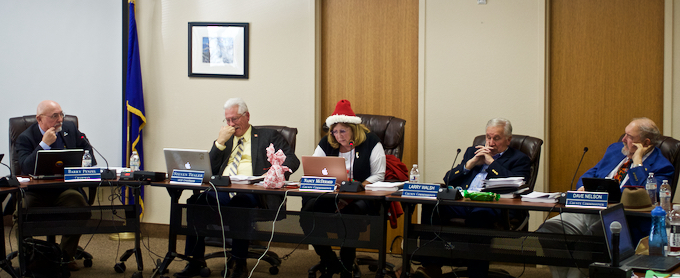
Douglas County commissioners disagree about the Master Plan process and its contents. Photo/LTN

By Kathryn Reed

STATELINE – For those hoping Douglas County’s Master Plan update was going to be certified by the Board of Commissioners this week, just the opposite and then some occurred.

Not only did the electeds not vote on the update Dec. 21, they chose to methodically go through each of the remaining elements in late January and then will schedule a joint meeting with the planning commissioners to tell them what to do. By that time, though, there are likely to be three new planning commissioners who have had nothing to do with this update.

The current plan was adopted in April 1996 and was last updated in 2011.

It is state law that dictates some of the process. Counties with more than 45,000 residents are mandated to have a planning commission. That entity is tasked with preparing a master plan that must be updated every five years.

The seven-member Planning Commission, which is appointed by the Board of Commissioners, has conducted multiple meetings in this two-year update process, gathered public input at the meetings and via a survey.

The two bodies met together at the beginning of the year with the purpose of making sure they were on the same page. That didn’t last long.

All changes the electeds make must go back to the Planning Commission for approval, with the Board of Commissioners having the ultimate say.

A change to this year’s document is there was more supporting material to explain how they came to their conclusions

Not all of the electeds believe that much detail should be part of the Master Plan. Some want to revamp the entire process, while others said that should be done prior to the next update.

Others don’t like that the plan is presented as a wish list instead of being more concrete. Others see this as an umbrella document, with the master plan as a guiding document from which precise code can be written. Others questioned if the electeds are going to have this much input, then what is the purpose of the Planning Commission? Others don’t want to be a rubber stamp.

Of the 11 elements in the Master Plan, housing and agriculture have been vetted, with proposed changes to go back to the Planning Commission. The remaining elements are conservation, economic development, growth management, historic preservation, land use, parks and recreation, public facilities and services, public safety, and implementation.

At this rate, adoption of the Master Plan is not expected until spring at the earliest.


SLT man dies crossing street in Nevada City

A South Lake Tahoe man was killed Wednesday after being struck by a vehicle in Nevada City.

Ronson Sakioka, 64, was walking back to his vehicle after attending the Victorian Christmas when the incident occurred. He was with his wife, who escaped injury. They were crossing Highway 49 where it is dark and there was no sidewalk.

Sakioka was airlifted to a hospital in Roseville, where he later died.

The driver was not cited. Alcohol and drugs are not believed to be a factor in the Dec. 20, 9:25pm accident, according to the California Highway Patrol.

— Lake Tahoe News staff report


Wildfire recovery legislation aims to protect Californians

By Michael Livingston, Los Angeles Times
 
As one of California’s largest wildfires in modern history stretches into its third week, state Sen. Ricardo Lara, D-Bell Gardens, has introduced legislation to protect residents from canceled insurance policies.

Lara announced the Wildfire Safety and Recovery Act on Wednesday morning. The senator said he hopes that, after going through the legislative process, his proposal could become law by 2019.

The act would require companies to offer mitigation discounts to homeowners who invested in fire-resistant materials and seek approval from the Department of Insurance before reducing policies in high-risk areas.

Read the whole story


Resolution of Bijou commercial property still elusive

The legal proceedings involving Patty Olson’s ability to retain ownership of the commercial strip of land at the Bijou Center in South Lake Tahoe continues to weave an indirect path to resolution.

Olson has retained another attorney in the case; now Craig Demetras of Reno is representing her.

A judge has postponed the status conference on the pending appeal on the bankruptcy decision to Jan. 23.

The judge is allowing Cody Bass’ attorney to conduct discovery and depose Olson in regards to the case in El Dorado County Superior Court. Bass is a tenant of Olson’s; he operates the Tahoe Well Cooperative. They are battling over his lease agreement, which is also an issue with the city of South Lake Tahoe.

Also part of the legal proceedings is U.S. Bank.

— Lake Tahoe News staff report