Oregon man breaks both legs in fall on Mt. Tallac

A Portland man was whisked off Mount Tallac via helicopter Saturday after he broke both legs in a 400-foot fall.

Brian Meek, 50, was on snowshoes when he lost traction on the ice. He tumbled down the west bowl area, stopping only after hitting a large rock.

With the snowy and icy conditions of the terrain on Dec. 8 and the location of the victim, technical mountaineering skills were necessary.

El Dorado County and Douglas County search and rescue teams led the effort, with Lake Valley fire, Calstar and CHP assisting. It was the California Highway Patrol helicopter that airlifted Meek to Renown Medical Center in Reno.

 — Lake Tahoe News staff report


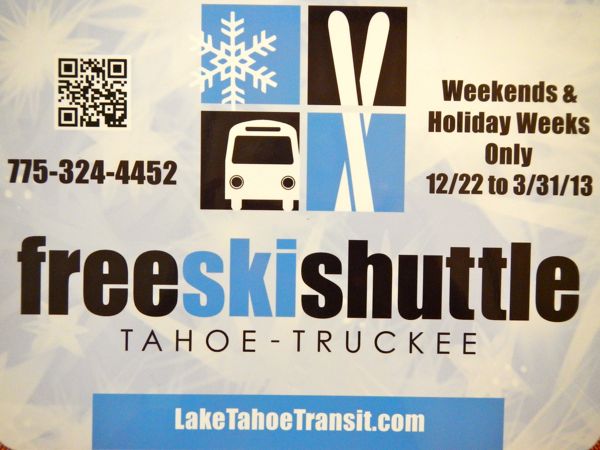
North Shore launching free ski bus shuttle

By Kathryn Reed

STATELINE – Less than one hour before the Tahoe Transportation District board was to vote on creating a free ski bus shuttle on the North Shore, negotiations were still ongoing.

This is because days before the Dec. 7 vote Northstar and Diamond Peak ski resorts backed out of their previous commitments. Squaw Valley-Alpine stepped in at the last minute with another $40,000 to ensure five of the six planned buses would be able to roll starting Dec. 22.

“We actually are participating in the program. There is recognition that our already existing shuttle system plugs into the system that is being contemplated for the region. Our shuttles currently provide service to/from Incline Village and Tahoe Vista,” Jessica VanPernis with Northstar told Lake Tahoe News after the meeting.

However, the signs being devised won’t say Northstar.

TTD board President Steve Teshara acknowledged Northstar has a network of buses for its guests, but added that it is not part of the larger regional coordinated transit program that will be launched this month.

Northstar had originally committed to $86,800 for the coordinated program.

VanPernis said that offer was withdrawn “because our existing shuttle services are being utilized as part of the system being proposed.”

That is not at all how it was presented at last week’s meeting.

Brad Wilson, general manager at Diamond Peak, did not return a phone call. The Incline Village resort had originally said it would put up $7,700 for the shuttle.

Talks have been going on in earnest for the last year to devise such a ski bus shuttle, though people have actually been discussing it for the last 20 years.

“Resort operators realize you can go to other ski destinations and have this seamless transit,” Teshara told Lake Tahoe News. They wanted to finally implement such a service in Tahoe. Plus, North Shore has the largest concentration of resorts in North America.

The bus service will run on weekends and holiday weeks from Dec. 22-March 31.

Amador Stage Lines was awarded the contract at the Friday meeting. The main reason Amador won out over El Camino Charters is that they guaranteed, per stipulations by TTD, that each bus will be accessible by disabled people.

Buses will seat 38. Skiers and snowboarders will bring their equipment on board.

Funding comes from:

• Homewood Mountain Resort — $5,700

• Squaw Valley-Alpine Meadows — $169,000

• Truckee — $5,000

• North Lake Tahoe Resort Association — $65,900.

All but $20,000 of that total will go to the bus company. That $20,000 will be used for marketing and other expenses – which include signs.

Other ski areas are on the route – including Boreal, Royal Gorge, Donner Ski Ranch and Sugar Bowl.

There are more than 30 stops that ring the North Shore and jut into Truckee. The schedule is broken into morning and afternoon time periods.

Route and times may be found online.


Jackson Rancheria’s local appeal keeps people coming back

By Dale Kasler, Sacramento Bee

JACKSON – Name another casino in America where a total stranger can walk up to the boss, pull on his mustache and ask, “Is that real?”

This is Rich Hoffman’s world. The portly chief executive of Jackson Rancheria Casino Resort, instantly recognizable from the casino’s comical TV ads, is routinely swamped with handshakes, hugs and autograph requests whenever he strolls through the venue.

“We’re the kingdom for the common guy,” said Hoffman, wearing a fedora and faded jeans during a walkaround last week. “People feel comfortable here.”

Hoffman personifies the un-Vegas, down-home strategy of Jackson Rancheria, the smallest and least glitzy of the four Indian casinos in greater Sacramento. Its business is dwarfed by big competitors such as Thunder Valley, but after a couple of rough years, Jackson weathered the recession comparatively well. It just unveiled an $80 million remodel of its hotel, casino and restaurants, with a new VIP room for high rollers.

Industry consultants say Jackson Rancheria has built up a strong and steadfast following. Customer loyalty helped the casino withstand a series of infrastructure problems. It could also serve as a firewall if, as expected, more Indian casinos come to Amador County.

“It’s just like kind of a family affair,” said customer Dar Drittenbas, a retiree from Pioneer who gave Hoffman a hug.

The casino’s owners, the Jackson Rancheria Band of Miwuk Indians, paid for the remodel with cash on hand, according to Hoffman. Not one cent was borrowed.

“The tribe has always been very conservative,” Hoffman said.

Jackson’s situation contrasts sharply with that of the struggling Red Hawk Casino in Shingle Springs, a relative newcomer to the market, which a year ago deferred principal payments on a $66 million startup loan and is now trying to restructure its finances.

That doesn’t mean Jackson Rancheria has been immune to problems. The remodel, which took five years, was launched in part to remedy a series of major construction defects in the old facility.

Half the casino was shut down in 2008 after the discovery of water and mold problems that forced the temporary relocation of hundreds of slot machines to another building.

A year later, inspectors uncovered potential fire hazards that temporarily closed most of the resort’s hotel.

Hoffman said Jackson Rancheria collected $50 million by suing its contractors, but the damage done to the facility was considerable. Just moving slot machines around was disruptive to customers, many of whom are loyal to a particular machine, he said.

“You couple that with the economic downturn – it was a rough couple of years,” Hoffman said.

The soft economy prompted Jackson to lay off 265 workers and eliminate another 100 jobs through attrition. The remodel created 150 new jobs, and Jackson now employs 1,200 full- and part-time workers.

Other potential challenges lie ahead, in the form of new competition.

Two tribes are proposing to build major casinos within 15 miles of Jackson: the Buena Vista Rancheria of Me-Wuk Indians and the Ione Band of Miwok Indians.

While Amador County is fighting both proposals in court, Hoffman acknowledged the possibility that his corner of the casino universe could get more crowded.

“Any time you split the pie into more pieces, it’s a challenge,” he said.

Still, Hoffman said his casino could handle the newcomers but questions if their plans will be fully realized.

“With our position in the marketplace, and the good will we’ve created, it would be tough for them competitively to do a very large project,” he said.

The rancheria casino’s financials are a closely guarded secret. But Hoffman said its 1,600 slot machines take in an average of more than $200 a day. That translates into at least $116 million in annual revenue from slots alone.

Hoffman said he expects business to grow 8 percent next year, due to the improving economy and the effect of the remodel.

Jackson Rancheria was one of the first tribes in California to explore gambling. Under the leadership of the late Margaret Dalton, the tribe opened a bingo hall in 1984.

The remote location – several miles off Highway 49 – was and still is something of a handicap, and the bingo hall closed several times. A full-fledged casino didn’t emerge until California voters approved Vegas-style gambling in 2000.

Getting into the business early paid off for the tribe, which has 20 members. Its gambling compact with the state, signed by Gov. Gray Davis in 1999, lets Jackson Rancheria keep more of its profits than many other casino tribes – especially those like Red Hawk that signed compacts with Davis’ successor, Arnold Schwarzenegger. Members of the tribe get profit dividends from the casino, but Hoffman wouldn’t say how much.

Even as it has grown, analysts say Jackson Rancheria will never challenge high-end properties such as Thunder Valley, the dominant player in Sacramento’s casino industry.

But Jackson does occupy a sweet spot in the marketplace. It has developed strong ties in the community as a “locals casino” and has resisted the temptation to overbuild or overreach, said Ken Adams, a consultant in Reno.

“They understood where (the customer) was going to come from,” Adams said.

Jackson runs some charter buses from the Bay Area but relies mainly on middle-class customers living between Galt and Modesto, Hoffman said.

“We tend to see people two, three, four, five times a week,” Hoffman said.

In some respects, Hoffman himself is part of the attraction. The Fresno State graduate has been working at Jackson Rancheria since 1997. Since 2004 he’s been CEO of the entire tribal enterprise, not just the resort.

Thanks to the casino’s goofy commercials, Hoffman has become the unlikely face of Jackson Rancheria – donning a leprechaun’s hat for St. Patrick’s Day, stumbling around a baseball diamond to promote the “Grand Slam of Cash,” donning a ridiculous toupee to play a TV weather forecaster.

“I love your sense of humor, you’re doing a great job,” customer Bob Escobar told Hoffman as the CEO was touring the casino the other day.

Escobar, a retiree who lives near Arnold, got Hoffman’s autograph and wished him “a prosperous December.”

He said he sometimes visits Black Oak Casino in Tuolumne. But Jackson will always be his favorite.

“They know my name here,” he said.


Changes to GED may impact those who want to take the test

By Diane Orson, NPR

When Toni Walker is not in Hartford, Conn., serving as a state representative, she can usually be found at the New Haven Adult and Continuing Education Center.

“We basically educate approximately 800 people a day,” says Walker, an assistant principal at the center. “It is open enrollment, so when somebody gets an epiphany and says, ‘I need to get my high school diploma so that I can get a job,’ they can walk through the doors, and they can get [their GED] here.”

From 9am to 9pm, the center’s classes are packed with people preparing to take the GED test. Steve Cober, a union carpenter for two decades, is one of them. “I come here to try to get my GED to go into … something different than carpentry. Medical field or something like that,” he says.

For years, the GED has offered millions of people like Cober a low-cost second chance at a high school equivalency diploma. The test is updated every decade or so, but some particularly significant changes are planned for 2014.

People come here with pennies and nickels, bringing us change to pay for their GED. So it’s going to be a class issue.

Last year, the GED Testing Service — part of the nonprofit American Council on Education — announced that it was merging with Pearson, a for-profit British company, and one of the largest educational testing companies in the world.

The merger, the testing service says, would help to generate the money needed to revamp the test. The new assessment will be more rigorous and aligned with Common Core Standards, a set of uniform educational standards now adopted by almost every state. The test will be offered only on computer, and it will cost more.

Fees to take the exam vary by state, says Randy Trask, president of the GED Testing Service.

Administrators at the adult education center are concerned that the GED overhaul will make it harder for many test takers to complete the exam.

“Historically, states have chosen to subsidize the GED test; some partially and some in its entirety,” Trask says. “The state then chooses what to charge test takers for the test. And the state bears — or has historically born — all of the costs associated with the delivery of that test and the scoring.”

In Connecticut, it currently costs $13 to take the GED. The actual price of the exam is closer to $60, but the state subsidizes the balance. The price of the new test, however, will jump to $120. And though Connecticut may pick up the difference for a while, state Rep. Walker says that probably won’t last. As a result, she’s worried the higher cost will hurt the low-income people the test is supposed to help.

“It is going to be prohibitive … People come here with pennies and nickels, bringing us change to pay for their GED,” Walker says. “So it’s going to be a class issue. People who have no money will never be able to actually take the GED.”

The New Haven Adult and Continuing Education Center has begun to ramp up its computer capabilities to prepare for the online exam. But Walker says the change presents another hurdle to students here: Fewer than 20 percent of them have computers at home.

“So if we don’t show them how to use a computer, they’re never going to be able to pass the GED, because they won’t be able to do it online — and that’s the way they’re going to be delivering the test,” Walker says.

Though the GED is by far America’s most popular high school equivalency credential, states are starting to explore other options. New York, for example, has put out a request for proposals to companies that might be able to create an alternative test.

Meanwhile, the new GED is scheduled to replace the current exam in January 2014.


El Dorado County-Red Hawk Casino revised agreement doesn’t help Lake Tahoe area

By Kathryn Reed

Red Hawk Casino and El Dorado County have rewritten their agreement from 2006 and still the Lake Tahoe Basin portion of the county isn’t getting a dime.

“We’ve had the biggest negative impacts on the East Slope. They get all the positives and we get all the negatives,” South Lake Tahoe City Councilman Tom Davis said of folks in the Placerville area.

The South Shore economy tanked for a variety of reasons – a big one being the proliferation of Indian casinos on the three main routes into the Lake Tahoe Basin – Red Hawk on Highway 50, Thunder Valley near Interstate 80, and Jackson Rancheria along Highway 88.

Red Hawk Casino has had financial issues since it opened in December 2008.

The 2006 agreement stemmed from a settlement involving a lawsuit the county had filed against the Shingle Springs Band of Miwok Indians in regards to the interchange that needed to be built to access the casino from Highway 50, along with environmental concerns.

Ultimately, the Indians agreed to pay the county $5.2 million a year for 20 years.

“All the money that the tribe paid to the county was for mitigation … the negative impacts we expected when the casino went in,” Ed Knapp, who today became chief county counsel, told Lake Tahoe News. “The original agreement hammered out with the tribe was the richest agreement ever in American history of a local public entity and an Indian tribe.”

This was pre-recession, and although gaming was declining, it was still a huge reason to come to the South Shore. Red Hawk opened in December 2008.

While officials on the South Shore made noise about how the Indian casino would be bad for the basin section of the county, the supervisors only saw the potential dollar signs in front of them. What they didn’t listen to were projections that gamblers stopping in Shingle Springs would never make it to Tahoe so it negatively impacted the county as a whole.

No money from the tribe has been used to mitigate that negative impact.

The money must be “spent on things impacted by the casino,” Knapp said.

Davis told Lake Tahoe News, “I always advocated some of that money should come to the East Slope because our casino business is impacted.”

Not a penny has been spent in Tahoe on Red Hawk’s impact on the South Shore.

“The business community is unclear as to why El Dorado County would in essence subsidize poor business performance of one select business to the detriment of the county’s citizens, especially those located in the Tahoe basin,” B Gorman, CEO-president of Lake Tahoe South Shore Chamber of Commerce, told Lake Tahoe News. “While we may not have all the relevant information, it is difficult to understand why such a concession would be given to a gaming business that has wrought such harm on our local economy.”

The 2006 agreement said the money was to be used to build carpool lanes on Highway 50 near the casino to alleviate what officials’ thought would be a dramatic increase in traffic. The traffic didn’t materialize. And then the federal government offered stimulus money for the same roadwork.

Three payments by the tribe have been made to date. Half was spent to get what became the federal project shovel ready and the other half is sitting in the bank.

County Supervisors Jack Sweeney and Ron Briggs, who are on the Indian Gaming Special Distribution Funds committee, got the revised agreement on a November agenda. It passed 5-0.

Supervisor Norma Santiago said, “There is nothing to indicate Tahoe got screwed. (The money) can be used for specific roads in the area impacted by the casino. The entire county made out very well in the deal.”

But neither she nor Knapp could explain how the entire county benefits.

The new deal calls for $2.6 million to be paid by the tribe to the county for road improvements in the general area of the casino.

The other $2.6 million will be given back to the Miwoks for the tribal health clinic. The clinic is open to all county residents.

However, instead of being billed for services rendered, the county is paying a flat fee for the health center even if not a single Band-Aid is ever used on a non-tribal county resident.

In some respects, the new deal amounts to the county only collecting half of what it was originally promised.

This is good for a casino that is financially troubled and just recently renegotiated the deal it has with the state.

Then there is the little issue with the county budget having not been revised, so the $2.6 million check that is due by Dec. 14 can’t be written to the tribe.


Nevada tourism conference focuses on international traveler

By Richard N. Velotta, Las Vegas Sun

SPARKS — Increasing international visitation and taking advantage of technological innovations to increase the number of tourists visiting the state dominated the conversation at the opening day of the lightly attended Governor’s Conference on Tourism on Tuesday.

Nearly every presentation referenced strategies to use technology to do more with less and mining new markets for more visitors — strategies that run parallel to Gov. Brian Sandoval’s economic development program.

Even the Nevada Tourism Commission meeting that preceded the opening of the conference at John Ascuaga’s Nugget was filled with presentations from the state’s newest representatives working in foreign countries to get tourists to visit Nevada.

About 150 people are attending the event, which routinely drew nearly 1,000 people in its pre-recession heyday. While the state’s tourism conferences generally attract more people when they’re in Las Vegas, the 2010 event in Reno — the first one in three years after the stagnant economy forced cancellations in 2008 and 2009 — had more than 200 people present.

Claudia Vecchio, director of the Nevada Department of Cultural Affairs, which oversees the Tourism Commission, said she felt the two-year void of not having the event probably has hurt turnout. She said she expects to appeal to large resort operators to be more supportive next year.

But for those attending, the day was filled with updates on the state of the state’s most important industry.

In his opening address, Sandoval applauded the work of the state’s tourism innovators, listing Ascuaga, Steve Wynn, and Reno’s Carano family among them, and explained how events like Elko’s Cowboy Poetry Gathering have been transformed into a world-renowned attractions.

“And our work, of course, is not yet finished,” Sandoval said. “Nevada will continue to be a nationwide leader in innovation by creating more experiences that enhance the quality of life for Nevadans and the quality of tourist visits. Innovation does not have to be grandiose campaigns and programs. It can be small steps that doing something better, more efficiently and more creatively can make a difference.”

Sandoval noted that tourism generates more than $56.5 billion in traveler spending and employs more than 447,000 Nevadans — 30 percent of the state’s work force. The industry accounts for 26 percent of the state’s tax revenue and 12.5 percent of the state’s gross domestic product.

Sandoval also referenced the state’s efforts to establish a brand, a project that has been delayed and is now expected to be unveiled in the spring.

“We talked about this effort at last year’s tourism conference, but we still have a ways to go. But I know you will appreciate and embrace that brand once it’s completed. Good things take time, so please be patient.”

Lt. Gov. Brian Krolicki followed up with a summary of the Tourism Commission’s international efforts.

In a strategy shared by the Las Vegas Convention and Visitors Authority, the state pays representatives in prospective markets to sell Nevada as a destination. The state’s representatives in Australia, Brazil, France, South Korea and Mexico are attending the conference and addressed Tuesday morning’s commission meeting.

While the marketers have found niches that will bring visitors to the state’s rural attractions, they acknowledge that Las Vegas is a major draw for foreign tourists.

Zelie Breval, the state’s representative in France, said Death Valley National Park and Nevada’s gateway town of Beatty have strong appeal to her customers.

Benjamin Diaz, the representative in Mexico, has helped position Lake Tahoe to be a stronger attraction for his customers than Aspen and Vail, according to online surveys. Visits from Brazil have been buoyed by a vast improvement in the visa application process.

Ana Beatriz Di Pietro, who represents the state in Brazil, said improved air service to Las Vegas should expand that market.

South Korea’s Amy Lee and the agencies she works with have created customized tours that will take visitors to Las Vegas, the Grand Canyon, Death Valley and Lake Tahoe in one trip.

Panama-based Copa Airlines now offers one-stop service from several Brazilian cities to Las Vegas through Panama City.

U.S. Travel Association President Roger Dow told the conference that the wait time for visa applications has shrunk from more than 90 days in June 2011 to less than five days in September, thanks to efforts by the U.S. State Department.

Ultimately, Dow said, he hopes Brazil joins Taiwan and South Korea in visa waiver programs that result in citizens not having to apply for a visa to visit the United States. He said he expects approval of new waiver programs for Brazil and Poland to be forthcoming.

The international marketing component also has been enhanced by the development of Brand USA, the nonprofit operation that has begun marketing the United States in foreign countries.

Amir Eylon, vice president of partnership development for Brand USA, said the enactment of the Travel Promotion Act has started to pay off, as the organization has begun distributing ads in countries regarded as “low-hanging fruit.”

The first campaigns were launched in May in Japan, the United Kingdom and Canada using catchy theme music — “Land of Dreams” by Roseanne Cash — and quick-hitting images of destinations and people from across the country to carry the message. A one-minute version of the ad, which has a tagline of “Discover this land, like never before,” is a slice of a music video Cash produced for Brand USA.

Eylon said it’s still too early to quantify the effectiveness of the ads, but anecdotally, he said, the campaign has been a hit overseas and with American tourism leaders who have seen them.


Incoming S. Tahoe council to be busy at first meeting

Besides swearing in a new member and then picking a mayor for the next year at the Dec. 11 South Lake Tahoe City Council meeting, the five have a full agenda.

Tahoe Transportation District officials are slated to give an update on projects. Separate is a consent agenda item involving funding between the TTD and the city.

This comes right after the California Tahoe Conservancy briefs the council on its strategic plan.

Parking meters are scheduled for a vote.

And it’s possible a subcommittee will be re-established to deal with the Chateau project. That’s the name that was given to the never-built convention center-hotel debacle near the state line.

South Tahoe Refuse officials will be at the meeting seeking a 1.57 percent rate increase to take effect Jan. 1. There will be a public hearing.

Harrison Avenue’s environmental and design will be discussed during a public hearing.

The meeting starts at 9am at Lake Tahoe Airport.

— Lake Tahoe News staff report


Supreme Court rules government may be liable for flooding

By Terry Baynes and Jonathan Stempel, Reuters

WASHINGTON — The Supreme Court ruled on Tuesday that the federal government may be required to pay damages when it releases water from a dam that causes temporary flooding for a property owner downstream.

The case addressed the politically charged issue of when government activity that affects private property constitutes a “taking” that requires payment to a landowner. Under the 5th Amendment to the U.S. Constitution, the government must pay owners of private property that it takes for public purposes.

Writing for a unanimous court, Justice Ruth Bader Ginsburg said temporary flooding of private land by the government is “not categorically exempt” from liability under the 5th Amendment’s Takings Clause.

There is “no solid grounding in precedent for setting flooding apart from all other government intrusions on property,” Ginsburg wrote.

The Arkansas Game & Fish Commission, which operated the 23,000-acre Dave Donaldson Black River Wildlife Management Area, had complained about water releases by the U.S. Army Corps of Engineers from the Clearwater Dam in Missouri, about 115 miles upstream.

It claimed that releases between 1993 and 1998 led to six years of flooding, causing the death or weakening of nearly 18 million board feet of timber and making it harder to operate.

A federal judge awarded $5.7 million for lost timber and to regenerate forestry, but the U.S. Federal Circuit Court of Appeals overturned that award in March 2011, saying the flooding was only temporary and required no compensation.

The government had argued that the releases had only incidental consequences, and that it had the right to balance the “benefits and burdens” of such releases, which could also be used to protect crops or avert flooding in specific areas.

The Supreme Court cautioned that its ruling was not meant to “credit all, or even many, such claims.” Rather, lower courts would have to weigh numerous factors in deciding whether to award landowners compensation for temporary flooding, including the degree to which the damage was intended or foreseeable, recurring or severe.

The commission’s appeal was supported by a variety of advocates for fish, forestry and wildlife groups, as well as private property advocates. Justice Elena Kagan recused herself from the case, likely because she worked on the case in her former role as U.S. solicitor general.


Climate changing taking a toll on California ski industry

By Mark Glover, Sacramento Bee

A warming climate is melting California’s winter tourism dollars.

That’s the conclusion of a new economic analysis released Thursday.

The study – titled “Climate Impacts on the Winter Tourism Economy in the United States” and written by two University of New Hampshire researchers – said California and 37 other states have lost an estimated $1 billion and up to 27,000 jobs over the last decade alone due to less snowfall and shorter winters that research indicates are linked to global climate change.

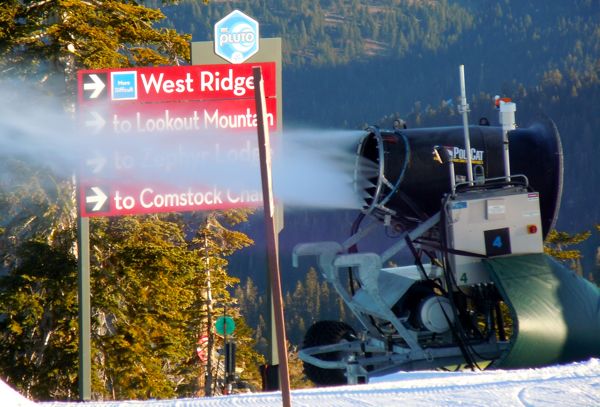
Snowmaking at Tahoe resorts helps supplement the natural white stuff. Photo/LTN file

The report warned that a continuation of the global warming trend could result in the loss of thousands more jobs at ski resorts and create numerous related economic setbacks, costing billions in lost revenue and tax dollars.

The report, released by the advocacy groups Protect Our Winters in Pacific Palisades and the Natural Resources Defense Council in New York, offered this grim look at the future: “Without intervention, winter temperatures are projected to warm an additional 4 to 10 degrees Fahrenheit by the end of the century, with subsequent decreases in snow cover area, snowfall and (a) shorter snow season. Snow depths could decline in the West by 25 to 100 percent ….”

The related effects would include economic and job losses in the restaurant/hotel industries, grocery stores and gas stations, as well as a reduced tax base, possible winter resort closures and sharp declines in sales of winter sports equipment.

The report calls for the winter tourism industry to press federal lawmakers and the Obama administration for further action to reduce carbon pollution. Officials particularly focused on a revised pollution standard for large power plants.

The report cited an industry survey that said 50 percent of responding U.S. ski areas opened late in 2011 and 48 percent closed early.

“This spells significant economic uncertainty for a winter sports industry deeply dependent upon predictable, heavy snowfall,” said Elizabeth Burakowski, co-author of the report.

For California’s winter sports industry, the potential downfalls are significant.

During the 2009-10 winter sports season, the most recent measured by the report’s authors, nearly 24,000 jobs were supported by the industry in California, providing an economic boost of $1.37 billion statewide. Labor income alone that year was put at $787 million.

The report cited evidence of reduced activity as a result of low snow years. It said California saw a nearly 5 percent loss in skier visits to resorts between high and low snowfall years from November 1999 to April 2010, with a projected economic loss of $75.2 million over that period.

Burakowski said California stands to be one of the most affected states, noting that “snow is currency.”

The Lakewood, Colo.-based National Ski Areas Association released a statement Thursday saying that “resorts nationwide are taking meaningful steps toward combating climate change.”

That includes reducing greenhouse gas emissions through investments in wind, solar, geothermal micro-hydro and other sources.

“Ski areas have not been on the sidelines when it comes to climate change,” said Michael Berry, NSAA president.

“The ski industry took a leadership role on this issue over a decade ago, and we continue to advance that mission.”

Berry added that the industry remains optimistic about the future. He said U.S. winter resort areas have enjoyed the best 10-year average on record, with 57.5 million skier and snowboarder visits on average nationally.


Stateline casinos follow state trend of minimal revenue gains

Nevada casinos eked out small gains in October. Revenue was up 1.8 percent to $978.8 million compared to 2011, the Gaming Control Board reported today.

Stateline casinos were up 0.7 percent, with revenues of $15. 8 million.

Washoe County dropped 7 percent, Carson City was done 5.5 percent.

 — Lake Tahoe News staff report