Nevada lawmakers may tackle concealed weapons on college campuses

By Sean Whaley, Nevada News Bureau

CARSON CITY -– A newly elected Republican state lawmaker plans to push forward with a bill next session to allow students and others with permits to carry concealed weapons on the campuses of the Nevada System of Higher Education.

Assemblywoman Michele Fiore, R-Las Vegas, elected to Assembly District 4 in November, has submitted a bill draft request to prepare a measure for consideration in the 2013 legislative session.

The one-line description for the request says: “Authorizes the possession of a concealed firearm on property of the Nevada System of Higher Education under certain circumstances.”

Fiore, a lifetime member of the National Rifle Association, made 2nd Amendment rights a key part of her campaign for the Assembly.

The “campus carry” issue was a controversial topic in the 2011 session, when former state Sen. John Lee, D-North Las Vegas, brought a similar bill to the Legislature. The bill passed the Senate but did not get a vote in the Assembly Judiciary Committee late in the session.

Lee sponsored the bill on behalf of Amanda Collins, a concealed weapons permit holder who was unarmed when she was raped by James Biela in a UNR parking garage in 2007. Collins gave emotional and candid testimony on behalf of the measure at the 2011 session.

Fiore cites the Collins case in requesting the bill, saying in an email there is no reason to prohibit concealed weapons permit holders from being able to protect themselves while on a campus of Nevada’s higher education system.

“In our communities today the bad guys have guns and the good guys obey the law and sometimes because of our firearm laws us good guys are put in a compromising position,” she said. “That is not OK. I will not hesitate to protect myself with my handguns. If I have to make a choice between saving my children’s lives or my own life or letting a scum bag take our lives, I’ll choose to take the culprit out.”

Collins said in her 2011 testimony that she could have defended herself if she had been allowed to carry her weapon on campus.

Biela was sentenced to death in 2010 for the murder of another Reno woman, Brianna Denison, in 2008.

Lee said at a hearing on his bill in 2011 that the decision to make Nevada college campuses “gun-free zones” actually created “defenseless-victim zones.”

CCW permit holders must be at least 21 years of age and take an eight-hour training class.

The Nevada System of Higher Education and several law enforcement groups opposed the measure, however, arguing in part that the discretion to deal with weapons on campus belonged to the Board of Regents, not lawmakers.

Concerns were also cited with how to deal with campus athletic events where alcohol is served, and how to ensure weapons would be safely stored in student dormitories.
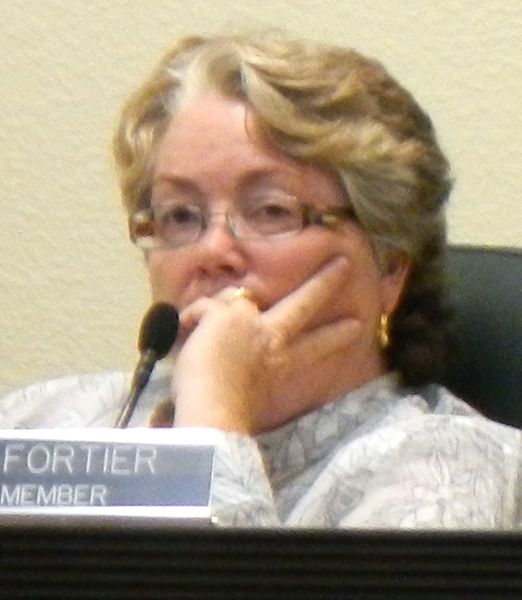


Fortier quits, but forgets to tell anyone at city hall

By Kathryn Reed

“Today is the first day of a whole new adventure. No more politics. No more mayor. No more Tahoe. I am soon off to Redmond, WA. Better make some room in the closet for my clothes, Maria. I am on my way.”

That is what Claire Fortier wrote on her Facebook page Friday morning just before 7.

The South Lake Tahoe (former?) city councilwoman forgot one step in the process. She has not given the city a resignation letter – either in the professional way of being on real paper or the less professional way via email.

Claire Fortier

Lake Tahoe News first reported in May that Fortier was unlikely to finish her term that expires in December 2014 because her spouse had taken a job in Washington state.

Fortier long held the belief she was the only one on the council who could shepherd the Regional Plan update through the Tahoe Regional Planning Agency. With the TRPA approving that plan on Wednesday, Fortier believes she has done her job even though the people elected her to do a job that lasts another two years.

The process is that the remaining council members must decide within 60 days of a council position being vacated whether to appoint someone or to call for an election. There are three specified dates in 2013 when an election could occur — March 5, June 4 and Nov. 5. The election cannot occur less than 114 days from the date it is called. So, the soonest there could be an election to fill that vacated seat is June 4.

But the council cannot go forward without a letter of resignation.


Gas prices falling before holiday driving begins

By Steven E.F. Brown, San Francisco Business Times

AAA Northern California, Nevada & Utah said California gas prices have been falling and will likely continue to fall, a holiday boon for Golden State drivers.

The Emeryville-based auto club said Tuesday that California’s average price for a gallon of gas is $3.62, down 23 cents from the time of its last report on Nov. 13.

Despite the drop, California still has the fourth highest gas price in the United States — Hawaii has the highest at $4, with a gallon in Wailuku costing $4.06. The Golden State’s average price is 29 cents higher than the U.S. average of $3.33.

Bay Area prices are above the California average, at $3.71 per gallon, but that’s still down 27 cents from a month ago.

San Franciscans pay $3.83 per gallon, down 22 cents from a month ago, while those across the bay in Oakland are paying $3.68, down 27 cents from a month ago. Skiiers up in South Lake Tahoe will find gas costs $3.60 per gallon.

Cynthia Harris of AAA said low demand and high supply are driving the decrease. Though demand will go up slightly during the holidays, overall demand is expected to stay low into next year, which should keep prices low.

Modesto has the cheapest gas in the state, at $3.40 per gallon. Eureka has the highest, at $3.88.

Missouri has the lowest price of any state, at $3.03 per gallon.


Lane advising group wanting to develop retail space at South Lake Tahoe convention center site

By Kathryn Reed

Six years after the first mound of dirt was moved on the then-$410 million hotel-convention center project, more may be turned over.

Bill Owens, who owns 20 of the 29 parcels on the 11-plus-acre site by Stateline, is ready to build part of the project.

The goal is in summer 2013 work will begin on developing 30,000-square-feet of retail space – exactly what was originally planned. Depending on how fast work progresses, shops could be open by the holidays a year from now.

Owens owns about two-thirds of the project site on the east end of South Lake Tahoe. City National owns the other nine parcels that constitute about one-third of the site. The latter has not come forward with any ideas for that section.

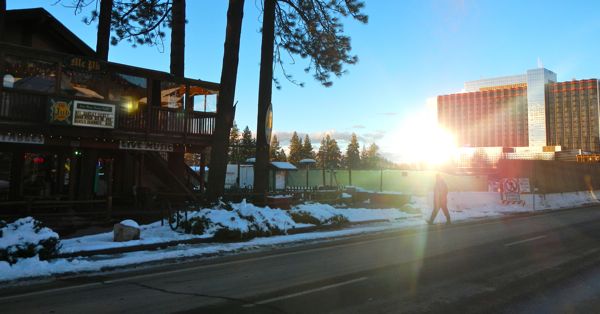
A pedestrian on Dec. 13 walks from the fenced off non-existent convention center toward McP’s Pub. Photo/Kathryn Reed

In October, the city hired a structural engineer to determine if the concrete and rebar are stable. The report said there would be no problem building on top of what was laid years ago.

The City Council at its Dec. 11 meeting briefly discussed the resurrection of the project.

City Manager Nancy Kerry at the meeting said a performance bond and parcel consolidation map would be in place before construction crews return to the idle site.

Not having those helped contribute to the mess that has ensued. While Councilman Hal Cole now wants that bond, he at one time told this reporter there is no such thing as a performance bond.

Nonetheless, the council agreed to put Cole and Mayor Tom Davis on the ad hoc committee that will be working with the developer. Cole with then-Councilman John Upton were the only two electeds to have read the market report that did not favor a convention center, but told their peers to go ahead with it.

Randy Lane, the original builder who ran the now bankrupt Lake Tahoe Development Company, is an adviser to Owens and is the person to whom the city has been talking about moving forward. Owens is the leader of Owens Financial, one of the lending agencies that ended up with property when the largest development project in South Lake Tahoe’s history folded.

Lane told Lake Tahoe News he expects to submit the necessary paperwork to South Lake Tahoe officials the first week of January.

Kerry said it could be a $10 million infusion of cash into the local economy if construction resumes.

“It could be a catalyst for economic recovery in the area,” Kerry told Lake Tahoe News. “We are excited that something is going to get going and getting rid of the blight that is pulling down economic recovery.”

Sidewalks would be put in and other streetscape aspects as were originally planned. This will help with safety issues because right now there is minimal room to walk along the fenced-off site on Highway 50.

What businesses may go in there remains to be seen.

“I’m not concerned about the leasing part of it,” Lane said.

Originally McP’s Pub, which is still open at the western edge of the site, was going to move into the new center. It was going to be three times the size it is now, with a stage, more pool tables and expanded food menu.

Pete Joseph, who owns McP’s, is out of the town and unavailable for comment.

Lane said he had not spoken with Joseph to see if he would want to keep with the original plan.

This new first phase (the originally project had two phases) would stop short of the current McP’s bar-restaurant.

Making sure the public and businesses are secure is another concern of the city’s. The proposed development would go about one-third of the way from Highway 50 to Cedar Avenue. Right now it’s covered in concrete and rebar and has a cyclone fence around it.

Parking for the retail center would need to be worked out, too. In the first set of plans underground parking was to be provided for some aspects of the project. But the council and Tahoe Regional Planning Agency officials in the permits that were issued allowed for the project to go forward without adequate parking. The developer was supposed to secure parking at Harveys, but that was never done. So, whether enough spaces would be incorporated into the project as it’s put together in a piecemeal process remains to be seen.


Baccarat not just for high-rollers

By Christopher Palmeri, Bloomberg Businessweek

Mention the game of baccarat and images of international spies, playboys or tuxedo-clad royalty come to mind. But don’t tell that to Dallas Teerlink, director of table games at the Running Aces Harness Park in Columbus, Minn.

After he introduced the card game to his Midwest customers two years ago, it turned into a surprise hit at the casino 30 miles northeast of Minneapolis, in part due to side bets that can pay as much as 40 to 1. A computer monitor at the table lets everyone know if the right cards come up. Explains Teerlink: “When that light goes off, the floor goes nuts.”

Best known as the second-favorite evening pastime of James Bond, baccarat has become the world’s highest-grossing casino game, thanks to wealthy Asians who sometimes bet tens of thousands of dollars a hand. Now, with China’s slowing economy pinching the purse strings of mainland gamblers, casino operators are seeking growth by taking baccarat from private salons onto the main gambling floors catering to the masses.

“High rollers get all the attention, but there is an enormous amount of play that is outside that category,” says Robin Powell, a consultant who helped develop a more accessible version of the game called EZ Baccarat, which is played at Running Aces.

Casino winnings in the former Portuguese colony of Macau grew tenfold in the past decade to $33.5 billion last year, 90 percent from baccarat, in which players bet on which of two hands will add up closest to nine. At tables in Macau, China’s wealthy stand two or three deep, sometimes squeezing, folding and blowing on the cards for good luck. “It’s all new money,” Stephen Wynn, the founder of Wynn Resorts, said in a May conference call. “What you’re seeing is an explosion of pent-up demand for the good life.”

In Nevada, where baccarat revenue has tripled since 2002, the game was bigger than blackjack, craps and poker combined at $1.4 billion for the 12 months ended in September. “I always knew baccarat would be big in Macau,” says Las Vegas Sands Chief Executive Officer Sheldon Adelson, whose $20.4 billion fortune is due largely to the game. “Those players coming to Las Vegas are the frosting on the cake.”

The cake itself may be getting a bit stale. The high-roller business in Macau has fallen for three consecutive quarters. Wynn Resorts saw casino revenue in China decline 4 percent, to $857.2 million, in the third quarter, led by a drop among VIP customers. Table game winnings from its mass market clientele rose 8.3 percent, to $211 million. Those lower rollers are the new target for gaming houses. “What has been a VIP-fueled growth engine is now transitioning into mass growth,” Robert Goldstein, Las Vegas Sands’ president of global gaming operations, said in October.

On the Las Vegas Strip, baccarat is still mostly an upscale pursuit. At the Mansion at MGM Grand, guests stay in 29 villas, each with its own pool. The Tuscan-themed courtyard adjoins a restaurant featuring bean curd cakes and dried squid snacks. Nearby, gamblers with $1 million credit lines can play baccarat in six semiprivate salons.

It’s a different story across town. Station Casinos, which caters to Vegas locals, has increased the number of tables it devotes to lower-stakes versions of the game, including mini-baccarat, where players don’t get to touch the cards and minimum bets start at $10. International Game Technology, the largest maker of slot machines, is even pitching Golden Baccarat, an electronic version for customers who may be intimidated playing at tables with others. Boasts the company’s marketing material: “Neither high-stakes wagering nor special agent status is required to play.”


Renewed call for probe of federal Wildlife Services

By Tom Knudson, Sacramento Bee

Two U.S. congressmen are once again calling for a probe of a little-known federal agency called Wildlife Services, citing photos of animal abuse posted on the Internet by an agency employee.

“We are gravely concerned that (the) photographs … do not represent an isolated occurrence, but may reflect a deep-rooted problem within the Wildlife Services program,” wrote Reps. John Campbell, an Irvine Republican, and Peter DeFazio, an Oregon Democrat, in a Nov. 30 letter requesting a U.S. Office of Inspector General investigation.

The photos show two dogs attacking a coyote in a leg-hold trap and Wyoming-based agency trapper Jamie Olson posing with the tattered carcass of a coyote. They also show other trapped animals, dead and alive.

The photos, which began to circulate on the Web in late October, have sparked an agency review which “is still under way, underscoring that USDA takes this matter seriously,” said Wildlife Services spokeswoman Carol Bannerman.

She added: “Wildlife Services has taken this opportunity to reaffirm to employees their obligations to uphold professional standards as well as their responsibilities to the American public.”

Animal advocates are wary.

“What they address in the letter is absolutely accurate,” said Brooks Fahy, executive director of Predator Defense, an Oregon nonprofit group. “This is not an isolated incident by any stretch of the imagination.”

The photos have stirred outrage online, where more than 43,000 people have signed a petition calling for Olson’s termination at www.change.org.

“They hope it will all just go away if they ignore it long enough,” said Camilla Fox, executive director of Project Coyote, a Bay Area group that drafted the petition with the Animal Welfare Institute. “But we are not going away and we will do all that we can to ensure that this kind of brutality against wildlife is fully exposed.”

For eight decades, Wildlife Services has specialized in trapping, shooting and poisoning predators for farmers and ranchers. More recently it has expanded into killing and controlling geese, pigeons and other species in urban areas.

“It would be good to review the whole program,” said Carter Niemeyer, a retired Wildlife Services district supervisor who contends the agency’s predator control practices are excessive and expensive.

“We live in a new society today. Forty, 50, 60 years ago, there were more livestock on the range,” Niemeyer said. “It would be a good time to examine the extent to which aggressive predator control is needed any longer.”

Federal trappers use dogs to attract coyotes or locate dens. But Niemeyer said some also train their dogs by letting them attack coyotes in traps, a practice he considers unnecessary and cruel.

The letter from Campbell and DeFazio comes almost six months after they requested a congressional oversight hearing in the wake of a Bee series earlier this year that found the agency targets wildlife in ways that are indiscriminate, at odds with science and inhumane. No hearing was held.

Several nonprofit groups have called for action, too, including the Humane Society of the United States, which in May urged U.S. Secretary of Agriculture Thomas Vilsack to conduct a “top-to-bottom review.” Vilsack declined.

“This is the latest in a mounting portfolio of evidence that there are a lot of problems at Wildlife Services,” said Campbell, referring to the trapper’s photos.

“Several other requests we have had seem to have fallen on deaf ears,” he said. “We’re hoping these new revelations will cause someone to take notice.”


1 person hurt in traffic collision near Cave Rock

Updated: Dec. 13 10:05am

An injury accident on the east side of the Cave Rock tunnel sent one person to the hospital and made the commute into Carson City even slower.

Patricia Schille, 48, from Carson City crossed over the center line in her Subaru, striking a maroon truck driven by 58-year-old Richard Kline of South Lake Tahoe, according to the Nevada Highway Patrol.

Schille was taken by ambulance to Barton Memorial Hospital with non-life threatening injuries.

One person was hurt Dec. 13 in a two-car crash near Cave Rock. Photo/Susan Wood

The accident occurred about 7:30am Dec. 13 on Highway 50. The vehicles involved were in the westbound lane at least an hour after the crash.

The road is icy and slippery. People were traveling about 30 mph down Spooner Summit into Carson after inching past the accident scene in the one lane that is open.

— Lake Tahoe News staff report


Man killed by El Dorado County sheriff’s deputy identified

By Bill Lindelof, Sacramento Bee

An El Dorado County man was killed in gunfire last night in an officer-involved shooting.

The dead man was identified as Christopher Michael Sheldon, 38, of Pollock Pines.

The incident began when the El Dorado County Sheriff’s Office dispatch center received a call about 9:30pm Wednesday from a resident in the 2900 block of Kimberly Lane in Pollock Pines. The caller said that a man at the residence was threatening to shoot himself.

Deputies immediately began to drive to the address, but before they could get there the man left the home, according to a sheriff’s department press release.

After a search of the area, deputies found the man. He had a firearm and was standing in the 6000 block middle of Pony Express Trail, a main road through Pollock Pines.

During contact with the man, gunfire began. The sheriff’s department did not release information on whether the man fired his weapon.

The armed man was shot by at least one of the deputies. He was pronounced dead at the scene.

“The incident is currently being investigated by sheriff’s coroner investigators and a team of investigators working under the El Dorado County Officer Involved Critical Incident Protocol,” stated the press release.


Change in seasons does not bring end to drought

By John Eligon, New York Times

KANSAS CITY, Mo. — Even as the summer swelter has given way to frost, nearly two-thirds of the country remains in a drought, with forest fires still burning, winter crops choking in parched soil and barges nearly scraping the mucky bottoms of sunken rivers.

More than 62 percent of the continental United States is experiencing moderate to exceptional drought, according to the weekly Drought Monitor report released on Thursday, compared with just over 29 percent at this time last year.

Save for patches of California, Montana and Wyoming, the drought is expected to persist in most of the dry regions west of the Mississippi River over the next three months, according to the Seasonal Drought Outlook released Thursday by the National Weather Service.

“It’s not looking very promising right now,” said David Miskus, a meteorologist with the National Oceanic and Atmospheric Administration’s climate prediction center.

This is typically the driest time of the year, Mr. Miskus said, so precipitation will have to be far above normal levels to put a dent in regions that have been rain starved since the spring.

With the Great Plains — from southern South Dakota to the Texas Panhandle — enduring the most desiccated conditions, the agricultural sector is bracing for the hardest blow. Most of the Plains and the Mississippi River Valley had less than a quarter-inch of rain over the past week, according to the Drought Monitor.

The drought expanded across parts of Southeast Texas through central Louisiana in areas that had precipitation shortfalls of 8 to 14 inches over the past three months, the report said.

Just over a quarter of the nation’s wheat crop, planted mostly in September and October, was in poor or very poor condition, according to a report released last week by the United States Department of Agriculture. Those are the worst conditions since the department began keeping records in 1986, said Brad Rippey, a meteorologist with the department.

In Nebraska, where most of the state has been in an exceptional drought, farmers have reported planting their wheat in dry soil with the hope that rain or snow will eventually come and germinate the seeds and allow them to sprout, said Caroline Brauer, a spokeswoman for the Nebraska Wheat Board.

But for now, in some dehydrated fields, thin, green whiskers resembling grassy patches poke from the dusty ground, rather than the thick, wavy plants that typically sprout from a healthy wheat field.

The wheat harvest is not until next summer, so there is still time for it to bounce back. But a dry winter would make adequate precipitation in March and April that much more essential for the crop. And snow is also important to help insulate the wheat from extreme cold and wind during the winter.

Corn and soybean farmers are eager for precipitation to prepare the soil for their plantings in April.

“We know we got time ahead of us,” said Dennis McNinch, a corn and wheat farmer in west-central Kansas. But, he added: “Every day is a day closer to needing more moisture. That time will come that we’re going to have to get the tractors rolling and putting seed in the ground. We’ll just keep praying that next storm’s on its way.”

Perhaps the most unusual sign of the nagging drought is the 3,700-acre wildfire raging in the Rocky Mountains in northern Colorado.

The fire in Estes Park, which started in October from an illegal campfire, is burning at altitudes of 8,000 to 10,000 feet, on peaks that should be covered in snow right now.

The fire more than doubled in size on Saturday morning after 70 mile-per-hour winds swept through the area, forcing the evacuation of about 600 residences nearby, said Don Ferguson, a spokesman for the National Park Service.

The lack of moisture is also taxing water systems throughout the country, most notably the Mississippi River.

“If we continue to get or stay below normal for rainfall, and if the level continues to drop, we could even get close to or surpass the record low level on the river,” said Jim Kramper, a warning coordination meteorologist for the National Weather Service.

This could spell trouble for barges that transport billions of dollars in agricultural products, chemicals, coal and petroleum products. The industry estimates that water levels could bring navigation closings between St. Louis and Cairo, Ill., before the end of December.

Debra Colbert, a spokeswoman for the Waterways Council, a group that lobbies on behalf of inland carriers, operators and ports, said, “We are headed for our own fiscal waterfall here.”

Steven Yaccino contributed reporting from Chicago and John Schwartz from New York.


TRPA board approves Regional Plan update

By Kathryn Reed

STATELINE – Historic. That is what some called the near unanimous vote Wednesday by the Tahoe Regional Planning Agency Governing Board to approve the Regional Plan.

For a document that was supposed to be approved in 2007, it was long in coming. It got derailed, turned upside down and faced the threat of Nevada not being at the table.

In the end, the voluminous document earned the support of all but two California appointees.

Now all eyes are on the calendar 60 days from now. For one, that is when the Regional Plan would become the law of the land. Second, that is the deadline individuals and groups have to file a lawsuit to prevent the Regional Plan from taking effect.

The TRPA Regional Plan is the planning bible for the Lake Tahoe Basin. Photo/LTN file

While the board approved all the items voted on, not everyone in the room agreed with the decision. Of the 51 people who spoke at the daylong meeting at Harveys casino on Dec. 12, 34 were for the plan, 14 against and three were non-committal.

The first 22 people who spoke were either from the government, fire service, utility district, science community, education or health care. All were in favor.

Then it was open to the public at large.

“Today is your legacy. It is your legacy to leave,” Joanne Marchetta, executive director of TRPA, told the board before the vote.

Ultimately seven items were voted on. The Advisory Planning Commission voted on each first. For the item to be approved by the Governing Board each required four votes from California reps, and four from Nevada members.

The items were:

1. Issuance of 2011 Threshold Evaluation

2. Certification of Regional Plan Update Final Environmental Impact Statement

3. Amendment of Environmental Threshold Carrying Capacities

4. Adoption of Regional Plan Update and Code of Ordinances

5. Certification of the Mobility 2035: Regional Transportation Plan and Sustainable Communities Strategy Final Environmental Impact Statement

6. Adoption of Mobility 2035: Regional Transportation Plan and Sustainable Communities Strategy

7. Submit 208 Plan to California and Nevada Agencies for Approval and Certification.

The APC board voted unanimously to approve all the items.

Governing board member Mara Bresnick, who is the California Assembly Speaker appointee, voted no on everything.

Governing board member Byron Sher, California Senate Rules Committee appointee, voted for Nos. 1 and 7, and then abstained on the rest.

During deliberations Sher said, “If I were going to remain on the board, I would probably vote against the Regional Plan update.”

While Sher has been a vocal opponent to the Regional Plan, he was given a standing ovation by the board and those in the room for his service. This was his last meeting as he plans to resign Dec. 13 from the Governing Board.

—-

Note: Here are a TRPA RPU fact sheets that give an overview of the new Regional Plan.