Scientists worry about long-term effects of changing levels of algae, oxygen in Lake Tahoe

By Kathryn Reed

INCLINE VILLAGE – In the last four years the amount of algae found in Lake Tahoe has dramatically increased.

Why?

Scientists are still trying to figure that out.

Cells that are 5, 6, 7 microns in size that were not detected a decade ago are here.

“For some reason they have exploded,” Geoff Schladow, director of the Tahoe Environmental Research Center on the Sierra Nevada College campus, said during the Dec. 13 State of the Lake report.

Asian clams in Lake Tahoe create algae blooms as seen in the top right of this photo. Photo/LTN

The data pertains to 2011. These reports began in 2007, though issues surrounding Lake Tahoe’s clarity have been studied since the 1800s.

Algae blooms are also related to the growing Asian clam population. While these creatures have not been found throughout the lake, pockets of them are on the southern end. The algae they produce washes ashore and contributes to the degradation of the beach experience because the pristine waters are anything but that in some areas.

Divers the first week of December finished laying 5 acres of organic material at the mouth of Emerald Bay in an attempt to smother the clams at that location.

One thing scientists are still trying to figure out is why lake clarity improved by 4½ feet in 2011 when it was one of the wettest winters on record. Normally wet years bring more sediment via runoff into the lake. Conversely, it’s drought years that are usually good for lake clarity because fine particles are staying on land.

Climate change is something those who study Tahoe know is taking a toll. Each year the flow of stormwater runoff is measured.

“The peak has advanced two weeks,” Schladow told the group of nearly 60 people. This means there is less snow in the mountains.

Records of air temperature also point to climate change, Schladow said.

Another measurement scientists look at is how often the lake mixes – as in the water at the bottom comes to the top and vice versa.

“As we go through the next century we will run out of oxygen at the bottom of the lake,” Schladow said. “Less oxygen at the bottom changes the chemistry at the bottom. ”

This could lead to more phosphorous and nitrogen being created. Those elements contribute to the decline of the lake’s clarity.

A cable is used to measure oxygen at the surface down to the bottom. Water temperature is measured, too.

“We are seeing how mixing changes oxygen (levels). Oxygen is the key variable for climate change,” Schladow said.

He is a believer that the lake needs to continue to be studied and monitored.

“If you don’t measure it, you can’t manage it,” Schladow said in regards to needing to make sure the funding is in place to study the lake and then take the corrective measures to ensure its health.


Banks want to alter 2011 Nevada foreclosure law

By David McGrath Schwartz, Las Vegas Sun

Foreclosures in Nevada could spike next year if lawmakers and banks roll back a bill passed in 2011 that played a large role in stymieing banks’ attempts to retake homes from Nevadans, according to the state’s banking association president and housing analysts.

But more foreclosures aren’t necessarily a bad thing for Nevada’s housing market, at least in the long term, according to housing analysts.

Banks are in talks with Attorney General Catherine Cortez Masto and lawmakers about how to amend the state law that slowed foreclosures to a trickle in fall 2011.

Although foreclosures since have risen, they’re still about a quarter of where they were before the law went into effect.

At issue is Assembly Bill 284, a measure passed by the Nevada Legislature in 2011 and signed by Gov. Brian Sandoval that forces banks to prove they have the legal right to foreclose on a particular home before they take action. Most important, the law requires bank workers to sign an affidavit that they have personal knowledge of a property’s document history, or they will face criminal or civil penalties.

Democratic lawmakers and Cortez Masto, a Democrat, who helped pass the bill, said the law was intended to uphold the integrity of the legal process and protect homeowners from banks wrongfully foreclosing on homeowners without having necessary paperwork.

Cortez Masto has said it was never intended to prevent legitimate foreclosures.

But after the law took effect in late 2011, foreclosures in Nevada — which previously led the nation in foreclosures — ground to a halt.

In August 2011, banks issued 5,350 foreclosure notices in the state, according to the Nevada Foreclosure Mediation Program. In September, there were 4,684 “notices of default.”

In October 2011, when the law went into effect, the number dropped to 80.

Since then, the foreclosure filings per month have crept upward, reaching 1,417 in November.

That is proof, according to some consumer advocates, that banks are figuring out the paperwork behind home loans that had been sliced and diced into various investment instruments at the height of the housing boom. That slicing and dicing is what made it so difficult to determine which entity could legally foreclose on a home.

Many housing analysts believe the law is stalling legitimate foreclosures and creating an artificial, short-term boost in housing prices.

Cortez Masto has created a working group involving the state’s largest banks to discuss possible changes to the law in the next legislative session.

That group includes bankers, servicers, title and other real estate interests, as well as consumer representatives and lawmakers.

“We do not anticipate recommending repeal of any of the current provisions of the law,” she said in the statement. “The working group is attempting to clarify some of the terms in the law.”

She said it’s still unclear what recommendations the group will make to lawmakers.

Bill Uffelman, president and CEO of the Nevada Bankers Association, which lobbies the Legislature, said banks were not looking to repeal the entire law.

“The Attorney General’s Office and affected parties are working to change the affidavits so it’s workable, without fear of criminal or civil liability,” Uffelman said.

“Just amend it,” he said. “The notion behind AB284 wasn’t bad. The policy’s fine. Let’s fix the application.”

Some housing analysts say the law has allowed some Nevadans to live in their homes without paying a mortgage. Banks, confounded by their own shoddy paperwork and the state law, aren’t able to foreclose for months or years. Economics analyst Jeremy Aguero this fall labeled them “strategic squatters.”

This shadow inventory — of homes headed for almost certain foreclosure — has loomed over the seemingly positive news of slightly increasing home values and the rise of new housing construction.

John Restrepo, principal of RCG Economics in Las Vegas, called it “a bit of an artificial spike not likely to be sustained as it is today, depending on how the law is changed.”

The politics of easing restrictions for banks are dicey and likely to face opposition.

Sen. Tick Segerblom, D-Las Vegas, chairman of the Senate Judiciary Committee, said he’d listen to Cortez Masto, a fellow Democrat.

But, he said, “I’m extremely reluctant to change anything that everyone agrees has raised property values in the state of Nevada.”

He said if banks can’t foreclose, it’s their own fault for losing track of the paperwork.

“If it comes down to a homeowner who had a mortgage, or a bank — who has the right to be there? I’ll go with the homeowner,” he said. “I’m not worried about the banks. They made their beds. They can sleep in it.”

Uffelman, the banking association president, said banks have been focused on meeting the terms of the National Mortgage Settlement — the $26 billion settlement that requires banks to take such actions as principal reductions, short sales and forgiveness of second loans. But soon, their focus is going to turn back to foreclosures.

“The reality is foreclosures are going to start again, probably sooner rather than later,” he said.


Finger pointing turns to gaming industry as hopes dim for online poker bill

By Karoun Demirjian, Las Vegas Sun

The top policy-making senators on online poker are agreed: The chances that a federal online poker bill will pass before the end of 2012 are pretty much nil.

“Two weeks before Christmas, without being vulgar, what the hell would I put it on?” Sen. Harry Reid said this week, referring to his effort to find a bill to which he could attach a poker amendment.

For months, Reid has complained that Republicans have not come up with the votes necessary to advance legislation legalizing online poker through Congress.

But now, his top policy adviser has another bone to pick: with the industry.

“The AGA had met with a lot of people and claimed they’ve done a lot of other visits,” said David Krone, Reid’s chief of staff. “But unfortunately, I haven’t seen that turned into votes.”

The American Gaming Association does not represent every casino interest on the Las Vegas Strip, much less every gaming stakeholder in the country. But in Washington, it is the unofficial leader of a body of lobbyists who have spent the past four years pushing for an online poker bill.

In that time, the poker industry has been near-unanimous in its support for some form of federal intervention to legalize betting in Internet poker games and clarifying that poker is the only form of online gambling that is allowed.

But even lobbyists admit that the industry has not been speaking with a single, clarion voice about what that fix should look like — leaving room for doubt that those on the fence about online poker can wallow in.

“This is an industry of entrepreneurs. So saying we’re all going to think alike is not going to happen,” said Jan Jones, a lobbyist for Caesars Entertainment, likely the most active of the Nevada casinos angling for an Internet poker bill. “It’s big personalities, big thinkers. Harnessing this into one cohesive mind is a near impossibility.”

It has been especially hard over the past two years, as the casino industry has contended with a march of dramatic and jarring events. In the spring of 2011, online poker outfits Full Tilt, Absolute Poker and PokerStars were charged in federal court, sending lawmakers scrambling to divest themselves of any associations with those companies or their affiliates, and casting a pall over the issue of online poker in general.

Then, at the end of 2011, a new reading of the 1961 Wire Act from the Justice Department set states racing to approve their own, in-state online lotteries, significantly upping the pressure on the pro-poker lobby to push their issue through the federal process or miss their chance entirely.

Shortly after that, influential Republican donor Sheldon Adelson declared himself opposed to legalizing online poker, giving Republican lawmakers an opportunity to distance themselves from the issue, and exposing conflicts in the casino industry to the country at large.

“I don’t think everyone’s working in lockstep toward the same goal,” Jones added. “But I think the AGA has done a very good job of trying to keep their members informed and moving along a path.”

The AGA’s members reject the suggestion that the efforts — either in messaging or emphasis — were anything less than satisfactory.

Instead, lobbyists pointed an accusing finger back toward Congress as a whole and the body’s well-documented inability, these past two years, to get much legislation accomplished.

Las Vegas-based casino companies such as MGM Resorts International and Caesars Entertainment are pushing for federal legislative regulating online poker.

“I think this is sort of typical of politicians: It’s never Congress’ fault that they didn’t get their act together; there’s always some other reason,” said Alan Feldman, spokesman for MGM Resorts International, a member of the AGA. “If you’re a Democrat, it’s the Republicans’ fault; if you’re a Republican, it’s the Democrats’ fault; and if you’re trying to toe the line with both, it’s someone else’s fault. If someone wants to use that as an excuse for why this won’t happen, fine, but it doesn’t change the fact there’s clearly a need for federal action.”

“There have been some very good lobbyists who have been retained by the companies on this — but it’s like, you could have the best yachtsman in the world sailing into a headwind and he’d have difficulty navigating,” said Mike Sloan, a lobbyist with Fertitta Entertainment, which owns Station Casinos. It is not a member of the AGA. “Nothing is getting done, and that’s where we are.”

Lobbyists point out that lawmakers never actually developed a bill they felt they could peddle around.

Reid and Sen. Jon Kyl, R-Ariz., were sharing a draft of a poker bill with Sen. Dean Heller as early as last summer. But Kyl insisted the draft not be shared outside of the small group.

Since September, however, the text of that draft has been public. Reid, Kyl and Heller have all expressed confidence that the legislation is adequate to both walk back the 2011 Wire Act reading and address concerns about the security of Internet poker. In public, they continue to maintain it’s only a draft.

“I don’t know where things stand as far as a final piece of legislation. Within the last few weeks was the first time that any type of actual language on a bill had ever really surfaced,” said Whittaker Askew, a lobbyist with the AGA. “Being out there talking about the issue without a tangible product, which up until the last few weeks has been the case, that makes it a little more of a challenge.”

Because of that, Askew said, the AGA focused its efforts on educating lawmakers about poker instead of aggressively whipping up votes.

“It’s important for us to have spent a lot of time giving background, educating members and their staff,” Askew said. “We’ve been focused on this education effort for the last 18 to 20 months. So this is certainly nothing new, but it is certainly a big effort.”

Still, that effort has been mostly behind the scenes. Askew detailed the public outreach part of the AGA’s work as essentially boiling down to a few press releases and two videos intended for social media: one produced in 2011 and one produced in 2012.

Lobbyists say public perception of their efforts doesn’t really matter.

“Just because it flares up in the press, doesn’t mean there hasn’t been a consistent effort,” Jones said. “If you’re really working a legislative process … you cannot let that define the path that you’re on.”

However, every casino has its own style.

“I don’t think there is really a dime’s worth of difference between our position and those of most of our colleagues,” Sloan said. “The difference may be in effort.”

Not every company that supports online poker appears to be putting equal skin in the game.

Companies like Caesars have been a visible force working with lawmakers to advance a poker bill on Capitol Hill: Over the past two years, the company spent an industry-leading $5.8 million lobbying Congress on Internet poker and other issues, according to a compilation by opensecrets.org.

But companies like Wynn Resorts — which isn’t opposed to online poker — have spent a total of $315,000 on lobbying. Many involved in the online poker effort said Wynn’s lobbyists really haven’t been very actively involved in the discussions on Capitol Hill.

A spokeswoman for Wynn Las Vegas did not return a call for comment.

Meanwhile, companies like MGM, which has spent about $1.1 million on lobbying over the past two years, are somewhere in the middle.

Whatever the discrepancies in the industry’s lobbying efforts, all Nevada casinos are likely to profit from the bill if it passes because the legislation favors casinos with a proven track record of running responsible gaming operations for the first federal online poker licenses.

That gives them at least as much incentive to break through the congressional gridlock as Nevada’s representatives.

“It’s up to the industry to make the case, and it’s up to legislatures to understand the consequences of not moving the legislation,” Jones said. “I can’t blame this on Congress or on the industry. It’s just a function of time and timing. It just is. If you don’t find it this time, you just keep working after it.”

And though opportunities are diminishing, the industry is refusing to admit defeat.

“We absolutely believe this is good policy. And that’s not going to change whether we have 20 different opportunities that don’t get passed,” said Larry Epstein, vice president of government relations for Ultimate Fighting Championship, which has been working with Fertitta Entertainment to advance online poker legislation in Congress. “It’s frustrating that nothing’s happened, but in my view, I don’t think it compromises the potential of passage.”



Childhood obesity rates on the decline

By Sabrina Tavernise, New York Times

PHILADELPHIA — After decades of rising childhood obesity rates, several American cities are reporting their first declines.

The trend has emerged in big cities like New York and Los Angeles, as well as smaller places like Anchorage, Alaska, and Kearney, Neb. The state of Mississippi has also registered a drop, but only among white students.

“It’s been nothing but bad news for 30 years, so the fact that we have any good news is a big story,” said Dr. Thomas Farley, the health commissioner in New York City, which reported a 5.5 percent decline in the number of obese schoolchildren from 2007 to 2011.

The drops are small, just 5 percent here in Philadelphia and 3 percent in Los Angeles. But experts say they are significant because they offer the first indication that the obesity epidemic, one of the nation’s most intractable health problems, may actually be reversing course.

The first dips — noted in a September report by the Robert Wood Johnson Foundation — were so surprising that some researchers did not believe them.

Deanna M. Hoelscher, a researcher at the University of Texas, who in 2010 recorded one of the earliest declines — among mostly poor Hispanic fourth graders in the El Paso area — did a double-take. “We reran the numbers a couple of times,” she said. “I kept saying, ‘Will you please check that again for me?’”

Researchers say they are not sure what is behind the declines. They may be an early sign of a national shift that is visible only in cities that routinely measure the height and weight of schoolchildren. The decline in Los Angeles, for instance, was for fifth-, seventh- and ninth-graders — the grades that are measured each year — between 2005 and 2010. Nor is it clear whether the drops have more to do with fewer obese children entering school or currently enrolled children losing weight. But researchers note that declines occurred in cities that have had obesity reduction policies in place for a number of years.

Though obesity is now part of the national conversation, with aggressive advertising campaigns in major cities and a push by Michelle Obama, many scientists doubt that anti-obesity programs actually work. Individual efforts like one-time exercise programs have rarely produced results. Researchers say that it will take a broad set of policies applied systematically to effectively reverse the trend, a conclusion underscored by an Institute of Medicine report released in May.

Philadelphia has undertaken a broad assault on childhood obesity for years. Sugary drinks like sweetened iced tea, fruit punch and sports drinks started to disappear from school vending machines in 2004. A year later, new snack guidelines set calorie and fat limits, which reduced the size of snack foods like potato chips to single servings. By 2009, deep fryers were gone from cafeterias and whole milk had been replaced by one percent and skim.

Change has been slow. Schools made money on sugary drinks, and some set up rogue drink machines that had to be hunted down. Deep fat fryers, favored by school administrators who did not want to lose popular items like French fries, were unplugged only after Wayne T. Grasela, the head of food services for the school district, stopped buying oil to fill them.

But the message seems to be getting through, even if acting on it is daunting. Josh Monserrat, an eighth-grader at John Welsh Elementary, uses words like “carbs,” and “portion size.” He is part of a student group that promotes healthy eating. He has even dressed as an orange to try to get other children to eat better. Still, he struggles with his own weight. He is 5-foot-3 but weighed nearly 200 pounds at his last doctor’s visit.

“I was thinking, ‘Wow, I’m obese for my age,’” said Josh, who is 13. “I set a goal for myself to lose 50 pounds.”

Nationally, about 17 percent of children under 20 are obese, or about 12.5 million people, according to the Centers for Disease Control and Prevention. The CDC defines childhood obesity as a body mass index at or above the 95th percentile in comparison to children of the same age and sex in the center’s growth charts, a reference population based on children in the United States primarily from the 1960s and ’70s.

Obese children are more likely to be obese as adults, creating a higher risk of heart disease and stroke. The American Cancer Society says that being overweight or obese is the culprit in one of seven cancer deaths. Diabetes in children is up by a fifth since 2000, according to federal data.

“I’m deeply worried about it,” said Francis S. Collins, the director of the National Institutes of Health, who added that obesity is “almost certain to result in a serious downturn in longevity based on the risks people are taking on.”

Obesity affects poor children disproportionately. Twenty percent of low-income children are obese, compared with about 12 percent of children from more affluent families, according to the CDC. Among girls, race is also an important factor. About 25 percent of black girls are obese, compared with 15 percent of white girls.

Some experts note that the current declines, concentrated among higher income, mostly white populations, are still not benefiting many minority children. For example, when New York City measured children in kindergarten through eighth grade from 2007 to 2011, the number of white children who were obese dropped by 12.5 percent, while the number of obese black children dropped by 1.9 percent.

But Philadelphia, which has the biggest share of residents living in poverty of the nation’s 10 largest cities, stands out because its decline was most pronounced among minorities. Obesity among 120,000 public school students measured between 2006 and 2010 declined by 8 percent among black boys and by 7 percent among Hispanic girls, compared with a 0.8 percent decline for white girls and a 6.8 percent decline for white boys.

“The needle is actually moving,” said Gary D. Foster, director of the Center for Obesity Research and Education at Temple University.

He first noticed the change while conducting a study of middle school students. Even children who made up the control group that did not take part in anti-obesity measures had a weight drop of nearly 4 percent, compared with 5.5 percent for those who did.

Here at William H. Ziegler Elementary in Northeast Philadelphia, where most students qualify for free or reduced-price lunch, the day begins with a nutrition tip over the loudspeaker. Teachers give out colorful erasers and stickers instead of Tootsie Rolls. Fund-raising events feature fruit smoothies instead of chocolate.

Some students had never seen broccoli or cauliflower, so Jill Dogmanits, a sixth-grade teacher, started taste tests to acquaint students with those vegetables and healthy snacks like hummus, fresh pineapple and whole-wheat bagels.

But school is only part of the day. Children buy an average of 350 calories worth of snacks in corner stores every day, according to a study by Foster’s center at Temple University. About 640 corner stores are now part of a program of stocking healthier food, according to the Food Trust, a nonprofit group that runs it.

“Parents tell their kids, ‘Take this money and go buy a snack,’” said Josh, as children streamed into a store across from his school where crayon-colored sugar drinks called Hugs sell for 25 cents and generic soda is 40 cents.

Donald F. Schwarz, a pediatrician who is the city’s health commissioner, said: “I think we are beginning to turn the tide with the many things that have gone on now for a decade.”

It is too early to tell whether the trend will hold.

“I’d like to see another year of measurement before I go out and party over this,” said Mary Currier, Mississippi’s state health officer.

And some public health experts say that without broader policy actions like a soda tax, which Philadelphia tried but failed to pass in 2010 and 2011, deeper change will be difficult. Still, new data from Philadelphia — from more than 20,000 children in first through sixth grades — show a further 2.5 percent obesity decline from 2011 to 2012, Foster said.

Josh lost weight this summer, exercising outside with his stepfather, an Army reservist. But now that it’s cold he has gained some back. Still, he believes he can influence others. His 2-year-old cousin now asks for bananas instead of chips at the corner store. Josh takes full credit.


Vehicle plows into classroom in Meyers

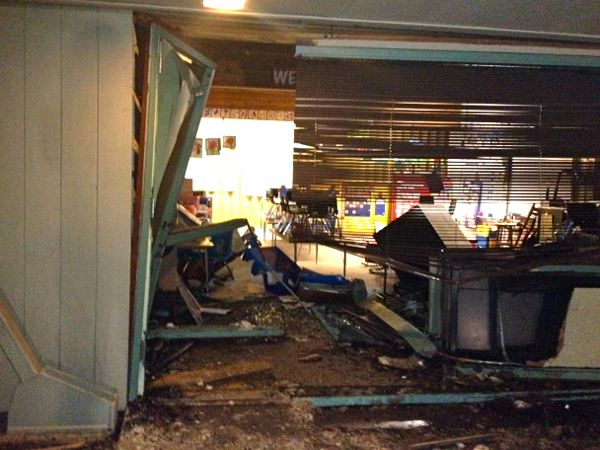
A vehicle doing doughnuts at the magnet school in Meyers on Friday night lost control and took out the entire front wall of a kindergarten classroom.

No one was injured in the 9:30pm Dec. 14 incident.

According to Lake Tahoe Unified School District officials, the person was in the parking lot and and back field. No one is in custody.

A vehicle on Dec. 14 slammed into a classroom in Meyers. Photo/Provided

On Saturday morning maintenance personnel were framing and constructing a new exterior wall.

The summer remodel plans include adding barriers in the front to prevent another such incident.

School officials believe it was a large white truck or SUV judging from the extent of the damage.

The California Highway Patrol is investigating. Anyone with information is asked to call (530) 577.1001.

 — Lake Tahoe News staff report


1 person dies in 2-car collision in S. Lake Tahoe

A South Lake Tahoe man was killed and two others injured in an early morning traffic collision.

A Honda Accord driven by Roberto Olazaba, 22, of South Lake Tahoe broadsided a GMC Yukon driven by Noe Corea, 26, of South Lake Tahoe, according to South Lake Tahoe police officers.

William Olazaba, 26, was a passenger in his brother’s Accord. He died at Barton Memorial Hospital.

An accident Dec. 15 killed a South Lake Tahoe man. This vehicle landing on the power box knocked out electricity on Ski Run Boulevard for five hours. Photo/Provided

Roberto Olazaba was at Barton under observation, according to officers. A passenger in Corea’s vehicle was treated and released from the hospital.

The accident occurred at 1:35am Dec. 15 at Pioneer Trail and Ski Run Boulevard.

Police believe alcohol was a factor.

This is the third fatal traffic accident in South Lake Tahoe in four months.

Anyone who may have witnessed this collision is requested to contact Officer John Speath at (530) 542.6100.

 — Lake Tahoe News staff report


Power restored to Ski Run area in South Tahoe

Many people along Ski Run Boulevard in South Lake Tahoe probably woke up to flashing clocks.

This is because a vehicle took out a Liberty Utilities switch on Pioneer Trail and Ski Run at about 2:30am Saturday.

Randy Kelly with the utility told Lake Tahoe News the vehicle was sitting on top of their equipment.

Power was out from Pioneer Trail down Ski Run, including Embassy Vacation Resort.

— Lake Tahoe News staff report


South Shore loop road down to 6 alternatives

By Kathryn Reed

STATELINE – While a decision has yet to be made as to whether a loop road beyond what exists today in the Stateline area should or will ever be built, the choices are being narrowed.

At a Dec. 13 meeting at Harveys there were six choices presented. This is down from the 16 that were talked about at the last two meetings. While people had the chance to write down their thoughts, no longer were they offered the chance to draw their own version.

Deanna Shoopman with Caltrans told Lake Tahoe News it is not unheard of in California to take a city street and make it a state highway and for the state highway to become a city street.

People study the various loop road alternatives on Dec. 13 at Harveys. Photo/LTN

That is essentially what proponents of the project want to do. While not everyone is convinced rerouting Highway 50 behind two or four of the casinos is necessary, the bigger arguments are about where the rerouting would start on the west side and whether it should be a half loop or full loop.

“Safety to the traveling public is our No. 1 priority,” Shoopman said.

For now, this is a Tahoe Transportation District project. Shoopman said her agency would formally weigh in on the project when the environmental documents come out.

Eric Guevin, fire marshal with Tahoe Douglas Fire Protection District, was perusing the maps Thursday afternoon, too. Traffic flow is what his department is concerned about.

“Intersections that are offset have more problems. There are visual barriers,” Guevin told Lake Tahoe News. “Squared intersections tend to be safer.”

Mike McKeen, who owns property in South Lake Tahoe that could be impacted depending on the route, believed the presentation was a charade, a propaganda campaign.

He took issue with the poster board that said 92 percent of the people favor moving forward, while 8 percent want the status quo.

Carl Hasty, TTD executive director, admitted those numbers were derived from the 118 people who attended the last two loop road meetings and that some of the same people attended both meetings and therefore were counted more than once.

What also isn’t in that number are the people who would vote to do nothing if their particular alternative is not selected.

Hasty said when his board next hears about the loop road, which could be March, that the history of the project will be told. This includes the various alternatives, not just what staff believes are the most popular.

It will be up to the TTD board to select which alternatives would be studied in the environmental analysis.

In the meantime, the economic analysis is ongoing. That, too, will be part of the environmental study.

TTD reps are also going business-to-business to talk to owners about their opinions.


U.S. traffic deaths at lowest point in 6 decades

By Ashley Halsey III, Washington Post

Deaths behind the wheel of an automobile fell last year to the lowest level since the Truman administration, but there was an increase in fatalities among bicyclists, pedestrians, motorcycle riders and big-rig truck drivers, according to federal figures released Monday.

Overall, highway deaths dropped to 32,367, almost two percent lower than they were in 2010, and a 26 percent decline since a peak in 2005. Maryland outpaced the nation with a 2.2 percent decrease, but deaths rose by 3.2 percent in Virginia and 13 percent in the District of Columbia.

The downward national trend began before the recession took some drivers off the roads, and it accelerated last year. It has been attributed to several factors, including increased use of air bags, seat belts and other vehicle safety features, improved roadway designs, and increasing awareness of the perils of driving drunk.

“In the past several decades, we’ve seen remarkable improvements in both the way motorists behave on our roadways and in the safety of the vehicles they drive,” said David L. Strickland, administrator of the National Highway Traffic Safety Administration.

He said police enforcement of seat belt and sobriety laws have played a key role.

But there already have been indications that the downward trend has ended. Preliminary data for this year indicated that fatalities increased 13.4 percent in the first three months of this year, and the total for April, May and June was 5.3 percent higher than in 2011.

“As we look to the future, it will be more important than ever to build on this progress by continuing to tackle head-on issues like seat belt use, drunk driving, and driver distraction,” said Transportation Secretary Ray LaHood, who has made distracted driving the cornerstone of his safety agenda.

The NHTSA data said the number of people killed in distraction-related accidents increased almost 2 percent, to 3,331, from 2010 to 2011. Federal and highway safety advocates said the increase may reflect better reporting of the distraction issue than an actual increase in fatalities.

The number of people injured in distraction-linked crashes declined by 7 percent, to 387,000 people in 2011, the federal agency said.

The evolution in travel patterns, relaxed safety standards and an improving economy were singled out for three of the areas in which fatalities bucked the downward trend.

The number of bicyclists killed increased by 8.7 percent and pedestrian deaths were up 3 percent.

“Our culture is beginning to move away from driving and toward healthier and greener modes of transportation,” said Jonathan Adkins, deputy executive director of the Governors Highway Safety Association. “We need to be able to accommodate all these forms of transportation safely.”

Adkins said a more-than-2-percent increase in motorcycle deaths was attributed to the fact that “state legislatures continue to listen to anti-helmet rider groups and ignore clear research supporting helmet use and laws.”

The largest increase was a 20 percent jump in the number of drivers and passengers of large trucks killed in accidents.

“There are more questions than answers about what is occurring here,” Adkins said, “but this could be in part to a strengthening economy.”

The data, collected under a federal system called the Fatality Analysis Reporting System (FARS), indicated that there were 1.1 deaths per 100 million vehicle miles traveled in 2011, down from 1.11 deaths per 100 million vehicle miles traveled in 2010.

The FARS statistics are based on numbers collected by each state, and Adkins cautioned that preliminary data indicates that the decline in highway deaths may end this year.

“Based on what we are hearing from states, we fully expect an increase in fatalities for 2012,” he said.

In 2011, 36 states had fewer traffic fatalities, led by Connecticut (100 fewer fatalities), North Carolina (93 fewer), Tennessee (86 fewer), Ohio (64 fewer) and Michigan (53 fewer). In Maryland, there were 11 fewer deaths than the 496 the previous year, while Virginia saw 24 more people die in 2011 than the 740 who died in 2010, and deaths in the District increased by three to 27.


Concessionaire sought for Spooner Lake

Nevada Division of State Parks is looking for someone or a business to provide concessionaire services at Spooner Lake.

Bike rental, bike shop operations, hiking supplies, cabin rentals, prepackaged food and drink sales, and shuttle services are what park officials want to provide. Winter operations would include snowshoes, cross country skis and other snow play items.

Max Jones for 27 years operated the concessionaire for the park at the junction of highways 28 and 50. This will the first winter without a formal cross country facility at the park.

The deadline to respond to the request for proposal is Feb. 15 at 2pm.

More info is online.

— Lake Tahoe News staff report