Buses free on popular South Lake Tahoe routes

By Kathryn Reed

Offer a free bus ride and people will jump on board.

That is what BlueGo officials discovered in September when two routes through South Lake Tahoe were free for five days. Ridership jumped 60 percent, according to Curtis Garner, who runs the transit system.

What isn’t known is if the riders were locals or out-of-towners.

BlueGo buses will be free on two routes Dec. 22-Jan.6 Photo/LTN file

“The long-term goal of the program is to get people to use public transportation a few times, discover how convenient it is, educate them about the benefits of public transit, whether it’s economic or environment, and increase ridership for the long run,” Garner told Lake Tahoe News.

Starting Saturday, routes 50 and 53 will be free. Part of the reason for picking the Dec. 22-Jan. 6 time period is because this is when a huge influx of vehicles will be in town for the holidays. The goal is to get visitors out of their cars and onto the bus.

These are essentially what metropolitan areas call spare the air days.

“We hope to have a decent impact on congestion this year,” Garner said.

Route 50 goes from the transit center at the Y to the transit center at Heavenly Village – all on Highway 50. Route 53 is from the Y, through Bijou, along Pioneer Trail and ends at the transit center on Kingsbury Grade.

Garner said those two routes transport approximately 70 percent of the riders who use the bus system.

Normally it costs $2 one-way on either of these routes.

BlueGo will be reimbursed through Congestion Mitigation and Air Quality funds. The Tahoe Transportation District, which oversees BlueGo, is eligible for the state funds because Lake Tahoe’s air is substandard.

“CARB, or the California Air Resource Board, determined many years ago that our carbon monoxide levels were too high. Steps have been taken to bring the area into compliance, but as of this time CARB has not changed our designation,” Garner explained.

Lake Tahoe is what’s a called a “non-containment area” because the air is “worse than national air quality ambient standards,” Garner went on to say.

Future of free buses

Mayor Tom Davis has long been vocal about wanting to develop a free bus service in town like other resort areas have. He is hoping the data collected from these free trial periods will help his cause.

The South Shore bus service has a budget of $4.5 million. Of that, $700,000 comes from the fare box.

Carl Hasty, executive director of Tahoe Transportation District, told the City Council this month, “In order to continue the service we have today and to make it free all the time it’s that $700,000 from the fare box (that needs to be funded). It would need to be more if you want to increase service.”

Councilwoman JoAnn Conner brought up the fact that there is no service to Meyers.

While ridership is increasing throughout the system, buses are not full. That is one reason the free rides can also be offered – there is room for people without adding buses.

In September, ridership increased by 8 percent compared to September 2011, and it was up 6.7 percent in October compared to October 2011.

——

Notes:

• Schedule and bus stop information is online, as well as at the transit centers and on buses.

• Free rides are Dec. 22-Jan. 6; only on routes 50 and 53 of BlueGo on the South Shore.



Unknown suspects making threats against schools

Schools across the country, including in Lake Tahoe, are on heightened alert as threats are being made that violence will erupt on Dec. 21. Some are saying this has to do with the Mayan calendar as well as potential copycats after last Friday’s shootings in Connecticut.

“Although there have been several rumors circulating throughout LTUSD (Thursday), we have not had any credible reports of incidents from the South Lake Tahoe or Douglas County (law enforcement), nor has any other school in El Dorado County according to the county superintendent’s office,” Angie Keil, spokeswoman for Lake Tahoe Unified School District, wrote in a mass email.

The district went so far as to leave telephone messages about 6pm Dec. 20 alerting people to the rumors and that the district is following up on every threat.

The FBI is also involved.

Washoe County sheriff’s deputies are also on heightened alert.

“Enhanced patrols in and around Washoe County schools will occur during the entire school day on Dec. 21. In addition, the Northern Nevada Counter Terrorism Center will be providing participating agencies with intelligence information, as it monitors conditions across the nation,” the department said in a press release. “While no credible threats have been received in Washoe County, area law enforcement is working together to ensure the safety and security of students and faculty.”

Extra security, including uniformed officers, is expected at LTUSD schools on Friday.

 — Lake Tahoe News staff report


E. Coli contaminates Agate Bay water

By KRNV-TV

According to a voice recording on the Agate Bay Water Company phone line, the water provided in Agate Bay (located between Kings Beach and Dollar Point on the North Shore) is contaminated with E. Coli.

All residents are under a boil water order.

E. Coli bacteria was found in a water sample collected on Dec. 13.

The boil water order will be in place until the California Department of Public Health determines that there’s no threat of contamination. They are hoping to lift the order by Saturday.


No arrests in magnet school vandalism

While Lake Tahoe Unified School District officials are sending out emails saying suspects have been located in the doughnut-spinning, wall demolition incident from last week, no one has been arrested.

A California Highway Patrol employee at the Meyers office tersely told Lake Tahoe News on Thursday night, “We are the investigating agency and no one is in custody.”

The wall of the kindergarten classroom was repaired last weekend after the Dec. 14 crash.

A change in policy is the staff parking lot gate is now locked at 4:30pm.

 — Lake Tahoe News staff report


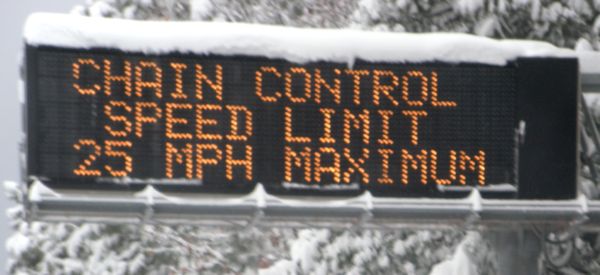
Snow totals to be measured in feet at Tahoe this weekend

A white Christmas it will be in Lake Tahoe. And a sunny one.

But before Tuesday arrives there is going to be a lot of shoveling and snow blowing in the basin.

A winter storm warning is in effect from Friday at 6am to Monday at 4am.

Expect to see this sign for the next few days in and around Lake Tahoe. Photo/LTN file

“There’s very high confidence of several feet of snow in the Sierra starting (Friday),” a National Weather Service spokeswoman in Reno told Lake Tahoe News.

The brunt of the storm is expected to arrive Saturday. That night into Sunday 1 to 2 feet of snow could fall at lake level, with 3 feet above 7,000 feet.

“The highest accumulations will occur along and west of Highway 89 where up to 5 feet is possible above 7,000 feet and up to 3 feet below 7,000 feet,” the Weather Service is predicting.

Wind is already gusting, and it will continue to do so. Ridgetops could see gusts of 100 mph. This will lead to whiteout conditions for motorists.

For road info, click on the state icons on the home page of Lake Tahoe News.

And the highs are not expected to reach the 40s.

If you need to know more, check out this video from the National Weather Service in Reno:

— Lake Tahoe News staff report


Judge hears arguments in Homewood development lawsuit

By Denny Walsh, Sacramento Bee

A Sacramento federal judge will decide soon whether public officials who green-lighted a major resort expansion in the Tahoe basin ignored the needs of the environment and the area’s residents.

U.S. District Judge William B. Shubb heard five hours of oral arguments Wednesday by attorneys for two groups challenging the development; the Tahoe Regional Planning Agency, which approved the proposed project; a comparatively small, existing ski resort that would be expanded; and a San Francisco-based developer.

The judge took the matter under submission and will issue a written order.

Placer County and its Board of Supervisors, which also approved the proposed project, are named as defendants in the lawsuit, but the county’s attorney did not argue.

The plaintiffs are the Sierra Club, a national conservation organization, and Friends of the West Shore, a community organization of more than 500 activists and residents on the West Shore of Lake Tahoe. They contend the supervisors and TRPA’s governing board steamrolled the project through the approval process with little or no concern for its effects on the quality of life in the area.

“The suggestion is ludicrous,” countered the defendants in court papers. “At every turn, the agencies solicited input. The developer met with the community – including members of both plaintiff organizations – hundreds of times. Formal opportunities for review and comment were generous and vastly exceeded what the law requires.”

The project would vastly expand the Homewood Mountain Resort, which has operated since 1962 as a wintertime recreation spot.

The community of Homewood, an upscale enclave of 906 residents on the lake’s West Shore, is six miles south of Tahoe City. The ski resort is next to and west of Highway 89, with residential neighborhoods to its north and south.

But the resort is failing, according to the defendants. It has gone in the hole $1 million in each of the last five years, Whitman Manley, a lawyer for the resort owner and the developer, told Shubb.

His clients, Manley said, are pinning their hopes on an expanded facility attracting midweek skiers for more than one day on the slopes. Manley said Homewood is a weekend “commuter” resort because there are no overnight accommodations, so it is unable to compete with other resorts in the lake region.

The plaintiffs, Manley and other defense lawyers argue, are a vocal minority and sore losers in the bruising arena of land use politics.

“Of particular note,” defense filings say, “year-round residents of Tahoe’s West Shore supported the project as the best prospect for revitalizing a community that is withering away and would be further devastated by the closure” of the ski facility.

The project would hike the resort’s size from approximately 25,000 square feet of the mountain to more than 1 million square feet. At its north base area, 14 new structures would go up and house 349 residential and tourist units, including hotel rooms, condominiums and townhouses. Also planned are a commercial area, a four-level parking garage, a ski lodge, an outdoor amphitheater, an ice skating rink, a swimming pool and a miniature golf course. A new day-use lodge would be built at the midmountain base area, along with a gondola terminal and a swimming pool.

The project “will significantly increase urbanization of the region and result in more automobile traffic, increased ozone levels, worse water quality and excessive community noise, but defendants have failed to adequately study and mitigate these impacts,” plaintiffs claim in court filings.

They accuse the defendants of failing to adhere to their environmental review obligations under the terms of the California Environmental Quality Act and the Nevada-California Compact that, along with its implementing regulations, governs the TRPA.

The region “is already violating air quality, water quality, and noise standards, with no workable strategy to correct course and achieve the standards,” the plaintiffs insist.

They do not oppose all development, but wanted the county and TRPA to shrink the project by about a third.

Defendants argue that would not alter environmental impacts “in any material fashion.” It would, however, “gut its economic viability.”

Plaintiffs’ attorney Wendy Park told Shubb on Wednesday that the county and TRPA broke their own procedural rules for processing development proposals in their haste to approve the project.

The developer is stingy with information and the proposal is vague, virtually bereft of details, which make it difficult to evaluate the arguments about how big the project must be and how it will improve the environment, she said.

“We make policy,” TRPA attorney Andrew Sabey told Shubb. “We are empowered to do it. We chose to support this project.”

“They lost this fight,” Sabey said of the plaintiffs. “That doesn’t translate to a viable lawsuit.”


Gray’s Crossing homesites in Truckee change hands

By Sanford Nax, Sacramento Business Journal

The same team that helped develop McClellan Business Park and owns the 4,000-acre Stanford Ranch in Rocklin has bought 81 finished homesites at Gray’s Crossing resort in Truckee.

LDK Capital LLC, is buying the remaining lots at Gray’s Crossing, a 750-acre community built around a championship golf course designed by Peter Jacobsen and Jim Hardy. A big marketing push is planned for 2013.

“We see substantial value in Gray’s Crossing, located in one of the most serene areas in north Lake Tahoe,” said Denton Kelly, a principal with his father, Larry Kelly, in LDK Capital. “The opportunity to own within a master-planned community where all of the infrastructure and amenities are complete provided a compelling investment.”

With the purchase, LDK is adding to its real estate investment portfolio in Northern California, which includes the conversion of the former McClellan Air Force Base into McClellan Business Park; a former H.J. Heinz Co. plant in Stockton that will be remade into a distribution and warehouse facility and Stanford Ranch.

Gray’s Community is on Interstate 80, a quarter mile east of downtown Truckee. It has six miles of public hiking and biking trails that connect to the commercial core. Tahoe Mountain Resorts Real Estate will continue to serve as the exclusive listing brokerage.


Ski resorts win water rights case against USFS

By Jason Blevins, Denver Post

A U.S. District judge on Wednesday overturned a controversial new water law requiring ski area permit holders on public land to turn over water rights to the Forest Service.

Judge William Martinez ruled that the Forest Service’s revision of 2011 and 2012 permit regulations governing water rights violated federal procedural rules, failed to evaluate economic impact and violated ski area rights.

Martinez sided with the National Ski Areas Association, which was suing the Forest Service over the new water rights permit rules, ordering the agency to not enforce the terms of the new rules. Martinez remanded the issue back to the Forest Service.

If the agency chooses to revive the issue, NSAA public policy director Geraldine Link said would “definitely be a more public process.”

“I think a lot of different entities will weigh in this time. This had much broader issues than just the ski industry. I don’t expect the Forest Service will issue the same clause next time around,” she said. “This really threatened the administration of state water law and I would be surprised if the state didn’t weigh in.”

The Forest Service argued that the new clause – which required ski area permit holders to transfer water rights secured by areas operating on public land to the federal government – kept the natural resource connected to the land. In mid-November oral arguments before Martinez, the Forest Service argued it merely returned permit water policy to long-held conditions imposed before a 2004 change in the rules.

Still, Martinez’s ruling noted that during the last three decades, the Forest Service “did not follow a uniform policy and did not require federal ownership of water rights in all ski area permits.”

The agency said it changed the permit requirements to assure that ski areas never sold water rights connected to federal land.

“It’s a monetary calculation,” Department of Justice attorney Clay Samford argued in the Nov. 15 hearing. “As the value of these rights increases, it may make economic sense for ski areas to sell some rights off.”

The NSAA argued that the agency violated the Federal Administrative Procedural Act by not soliciting public input on the new rule. The association’s January 2012 lawsuit also argued the new water regulations violated the National Forest Management Act and the Regulatory Flexibility Act. The NSAA said the agency water rules impacted 121 ski areas in 13 Western states.

The Forest Service admitted it did not follow the public review and comment guidelines of the Administrative Procedural Act because the new water rules were simply a regulatory tweak, not a consequential legislative rule change.

Martinez, who in October last year cited improper environmental review in ordering the U.S. Department of Energy to stop permitting uranium mining and milling at 31 leased sites in western Colorado, ruled the Forest Service violated all three regulatory acts when it issued the new water rule.

Martinez’s decision only addresses the Forest Service’s procedural deficiencies when it crafted the new water directives. He did not rule on the NSAA’s substantive claims, specifically that the agency should not condition ski permits on the transfer of water rights obtained through a state process.

The Forest Service midday Wednesday was checking on a response to Martinez’s ruling.

Colorado plays a large role in the water issue, said Melanie Mills, whose Colorado Ski Country trade group includes 21 of 25 of the state’s ski areas. She said ski areas were ready to work with the agency to forge water rights rules that did not impact water purchased off federal lands but used on federal lands.

“There is plenty of room for agreement. Plenty of common ground,” Mills said. “Our belief is that the focus should be on the water on the permit area itself. Talking about water that a permittee might divert from other areas off-permit or might purchase or lease through other arrangements, that gets into area that folks beyond ski areas will be worried about.”

Wednesday’s ruling is not that surprising. At the Nov. 15 hearing, Martinez grilled Forest Service attorneys on the idea that a ski area would sell essential water rights.

“Why would a ski area sell off water rights and leave itself with insufficient water to operate a ski area?” he said. “Then you are not a ski area anymore.”


Audit shows State Parks violated payroll rules

By Matt Weiser, Sacramento Bee

Dozens of employees at the state Department of Parks and Recreation were inappropriately paid for working outside their job classification, according to an audit by the State Controller’s Office released Tuesday.

These “out-of-class” work assignments may have cost taxpayers tens of thousands of dollars beyond the misuse of funds at the department that has been previously reported.

The audit was triggered by a Sacramento Bee investigation, published in July, that revealed a secret vacation buyout program offered to employees at parks headquarters in Sacramento. This program cost taxpayers more than $271,000, which would have been sufficient to save a half-dozen parks from closure as a result of state budget cuts.

The Controller’s Office opted not to probe the vacation buyout further, saying prior investigations by internal auditors and the Attorney General’s Office had been adequate. However, it did find that an additional three people received vacation buyout payments, for a total of 59. The amount of money paid to these additional three employees is not revealed.

The audit focuses primarily on other revelations involving parks employees allowed to work in positions above their usual pay grade, often done to temporarily fill a staff vacancy.

Auditors found 203 employees over a three-year period were assigned to these “out-of-class” assignments at state parks. It remains unclear whether all of these were improper, because the department did not follow required record-keeping procedures before approving the assignments.

In many cases, managers circumvented the usual process to approve out-of-class work assignments so that the employee could begin the assignment without the required paperwork.

The audit says this practice “presents a serious risk of abuse or fraud.”

“There’s a number of different rules that were violated here,” said Jacob Roper, a spokesman for the Controller’s Office.

Because of the inadequate documentation, the controller could not determine how much money was inappropriately paid to employees working above their pay grade. It directed the Parks Department to figure that out and seek reimbursement from the employees.

In one potential example, however, it found that 17 employees worked beyond the required 120-day limit in their out-of-class assignment. These cases, which clearly violate state rules, amounted to an expense of $38,900.

In a Nov. 30 written response to the audit, Aaron Robertson, chief deputy director at state parks, said all the affected employees were qualified to work in the out-of-class assignments. The primary issue was that required procedures were not followed.

The letter states the department will seek reimbursement from employees who inappropriately received out-of-class salary payments.

“In general,” Robertson wrote, “we acknowledge and it is widely known that some very unfortunate events occurred at the Department of Parks and Recreation.”


LTWC submits expansion plans to TRPA for wild animal rehabilitation facility in Meyers area

By Kathryn Reed

Before Lake Tahoe Wildlife Care backers begin an all-out fund-raising campaign to get the dollars together to buy a 16-acre parcel in Meyers and transform it into a state-of-the-art rehabilitation-education center, they want to make sure TRPA is OK with their plans.

This is why even though LTWC doesn’t own the property, plans were submitted last week and assigned to a planner on Monday who will review the documents.

The Tahoe Regional Planning Agency has 30 days from Dec. 10 – the date the plans were submitted – to determine if all the documents are in order. Then it could be 120 days before a decision is made.

LTWC is still in need of whole fish to keep feeding the raptors and bears it is caring for. Photo/Provided

However, Kristi Boosman, spokeswoman for the bi-state regulatory agency, said a hearing officer is expected to make a ruling in February. LTWC would need a special use permit for a public services facility. The use is allowed under either Regional Plan.

Boosman added that TRPA supports what LTWC wants to do.

“We are looking at a three-phase project. The first would be to move the rehab center from the current site to the new location,” Tom Millham told Lake Tahoe News.

Millham and his wife, Cheryl, have been running LTWC for more than 30 years. One of the main problems is they have been doing so in their back yard on three-quarters of an acre.

They are limited in the numbers of animals and types they can take in. LTWC has 10 bear cubs – the most in its history. Capacity meant the state Department of Fish & Game had to find another facility for two cubs that were injured and in need of help.

The three bear cages LTWC uses are all approved by the state.

In all, the center has nine cages. It’s anticipated that would increase to 14 at the new location. Plus, they would be larger.

The Millhams have devised a makeshift area for waterfowl. That’s something that would change at the larger location – having a dedicated site for those birds.

Plus, the plan is to have three areas for raptors. This would eliminate the need to seasonally take the netting up and down.

Right now LTWC volunteers are nursing a bald eagle and peregrine falcon. Both should be released back into the wild.

If TRPA approves the plans, then Lake Tahoe Wildlife Care supporters will begin in earnest raising the $10 million to $12 million that is needed to acquire the property and transform it into the animal rehab-education center.

What the education center – the second phase – would look like is also in the plans. The downstairs would be a teaching room, amphitheater, café and shop, while upstairs would be offices.

A large vacation rental is on the property now. The footprint would not change – just what the inside looks like and the use.

The property also has an active TRPA permit, so what LTWC is doing is amending it a bit.

“We submitted the plans with elevations, where cages would be placed on the property, all the water and electrical,” Millham said.

The third phase of the new facility would be to create a park for non-releasable animals. Only native animals to the Sierra would be housed there.