Personnel issues plague S. Tahoe’s juvenile hall

By Kathryn Reed

The $6.3 million Juvenile Treatment Center in South Lake Tahoe has been rife with problems since it opened in 2004.

Since September girls aren’t taken there. They must go to the facility in Placerville because there aren’t enough female employees to care for them. This isn’t the first time the girls have had to be transported to the West Slope.

And when they go, it means pulling a South Lake Tahoe police officer or El Dorado County sheriff’s deputy off the streets in the basin. That in turn means fewer cops on the street, and more expenses in terms of mileage and potential overtime.
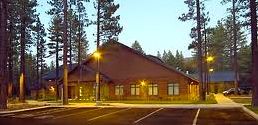
The Juvenile Treatment Center in South Lake Tahoe opened in 2004. Photo/LRS Architects

While the 26,500-square-foot facility has room to house 40 kids, it never has. Thirty-four is the most it has housed, according to Greg Sly, chief probation officer. (The El Dorado County Probation Department runs the JTC.)

According to Don Ashton, principal analyst with the Chief Administrative Office, this month the high mark was 17 juveniles, and 15 in both November and October.

Because the number of delinquents has never hit the maximum capacity, the probation department currently has a budget as though 30 would be the maximum number of kids housed at the center.

“A lot of times we’ve reduced the number to 20 beds and no one knows about it,” Sly said. “Occasionally it’s a problem for a parent of a minor if they’ve been moved to Placerville.”

The reduction in available beds has to do with staffing. With the 30-bed scenario, the Tahoe juvenile hall should have 20 line staff members, plus supervisors. Right now there are five vacancies at the line level – or 25 percent fewer workers than there should be.

Sly told Lake Tahoe News this is not a new problem, but one that has been going on since the center opened eight years ago. He attributes it to wages, people not wanting to live in the snow and/or not wanting to make the commute.

In a letter dated Sept. 27 Sly outlines his concerns to the Board of Supervisors in 36 pages. Much of what was included were historical issues with the facility, but he still presented a case for the need to hire more people to make the Tahoe JTC function at the level it was designed for.

That letter was part of the Oct. 16 Board of Supervisors packet. However, Sly was not able to present his findings and beliefs to the elected officials in person because one day after the letter was dated – Sept. 28 – he was placed on administrative leave.

El Dorado County Superior Court Judge Suzanne Kingsbury signed an order putting Sly on indefinite leave. That order was rescinded Dec. 12.

He was paid while he was on leave, but how much has not been released to Lake Tahoe News.

And why he is back on the job or was ever forced out on leave has not been made public. Kingsbury oversees the probation department. However, it is not possible to leave a message at the courthouse until Jan. 7 when employees return to work.

In September, Kingsbury deferred comment to Chief Administrative Officer Terri Daly. She is the top person in El Dorado County. Daly has yet to return any call or email of Lake Tahoe News’.

But Sly got what he wanted. Supervisors agreed to hire more personnel. It’s possible they could be hired by the end of January. Even so, they still must undergo several weeks of training.

Daly-Sly issues

Daly has been on the job since December 2010. She had worked as the county’s assistant chief administrative officer for five months before the promotion. She was the CAO in Amador County before working for El Dorado County.

Sly has been with the county since 1990, having been head of the department since July 2005. He was instrumental in getting the JTC funded and built.

Sly won’t talk to Lake Tahoe News about why he was put on leave or why he was allowed back. Nor would he say anything about the investigation that is going on regarding whether Daly acted in retaliation against him. He did say he has retained an attorney.

Bobbi Bennett, the county’s Human Resources manager, on Dec. 28 told Lake Tahoe News she would respond to a Public Records Request Act within the statutory 10 days.

Lake Tahoe News wants to know what the county paid Sly to not work for more 2½ months, why an outside law firm is handling the alleged retaliation investigation, and how much that firm has been paid. Answers to those questions are public information.

However, with the leave issue falling under “personnel”, it may never be known why the CAO asked the judge to remove Sly from his job in the form of an administrative leave.

Karl Knobelauch, the acting Human Resources director, is supervising the retaliation investigation. He did not respond to emails about the subject.

Knobelauch and Daly are friends and know each other from when they worked for Amador County. Knobelauch was the undersheriff until retiring in 2006.



Duffield buys second Incline lakefront estate

By Sarah Tilton, Wall Street Journal

Workday co-founder David Duffield has paid $25.5 million for the Osprey Estate in Incline Village, according to public records.

It is the largest sale at Lake Tahoe since 2008, according to listing agent Kerry Donovan of Chase International; the firm represented the buyer and the seller.

Duffield, also the co-founder of PeopleSoft, bought the 8-acre lakefront property through the Nevada Pacific Development Corporation, of which he is president. The property is the former home of inventor Jerome Lemelson and includes more than 670 feet of lake frontage, a private beach and a pier. There is also a contemporary-style 7,100-square foot main house, a guest house and a conference center. The late Lemelson and his wife, Dorothy, built the house in 1995. The Dorothy Lemelson Qualified Trust was the seller.

Duffield’s other properties in Incline Village include a separate 8-acre lakefront estate that he purchased for $27.6 million in 1999 through the same corporation.


Nevada group wants more money to aid problem gamblers

By Cy Ryan, Las Vegas Sun

CARSON CITY — A state advisory committee wants the governor to restore funding to help problem gamblers that was cut in half in 2011.

A letter sent to Gov. Brian Sandoval today by the Advisory Committee on Problem Gambling says it “strongly urges you to recommend restoring this funding to the level intended by the Legislature when the revolving fund was established in 2005.”

The program was originally financed from a quarterly $2-per-slot-machine tax but was lowered to $1 per machine during the budget crunch in 2011.

Carol O’Hare, chairwoman of the committee, said it is particularly important to increase funding to help Internet gamblers. Nevada is moving toward allowing intrastate online poker.

“If we are to play a leadership role in the Internet gambling era, as the state hopes, it is vital that we play a leadership role in every aspect,” the commission’s letter stated.

Restoring full funding “would not only allow expansion of treatment to cover internet clients, but also the restoration of prevention activities that would keep them from developing problems in the first place,” the committee’s letter to the governor said.

The committee estimates there are 68,000 Nevadans with pathological gambling problems.

Figures from the state Department of Health and Human Services shows $708,617 was spent in fiscal 2012 treating 455 problem gamblers, and there was no money for prevention programs.

The advisory committee said research by UNLV shows 92 percent of those treated show positive results. Fifty-two percent stopped gambling and 40 percent reduced their gambling.

More than 3,000 Nevadans have received state-funded treatment since 2006, according to a fact sheet from the advisory committee.

Sandoval has declined to reveal details of his proposed budget, which will be released Jan. 16 in his State of the State message to the Legislature.


Safeway prone to overcharging customers

By CBS-5

SAN FRANCISCO — When is the last time you checked your receipts? Getting overcharged at the register is more common that you might think.

In a follow up to an undercover investigation into overcharges at Safeway operated stores, ConsumerWatch found Safeway Inc. is even more likely to overcharge you than the average California retailer.

In November, ConsumerWatch reporter Julie Watts went undercover shopping at five Safeway stores in three counties. She was overcharged five times and it turns out that was just the beginning.

According to more than 1,800 scanner inspections at Safeway-operated stores in 31 California counties and 11 states, ConsumerWatch discovered that inspectors were overcharged on 1 out of every 50 items purchased over the past 5 years in California alone.

“It’s not shocking, complexity creates problems,” said the Federal Trade Commission’s David Newman. He points to Safeway’s complex combination of club prices, personalized deals, and short-run sales. With more price fluctuation, comes more opportunity for error and that can benefit the store’s bottom line, said Newman.

“Changing prices all the time generates a certain level Of confusion by consumers and that works to the stores advantage because they have the benefit of having drawn someone in with a sale price,” he said. But Newman pointed out the store is legally obligated to get that sale price right.

“None of this is top secret stuff, you know you don’t need to be NASA or the CIA to figure out how to get the prices right,” said Newman. If stores are not eager to do it on their own, then it’s up to enforcement agencies to incentivize them appropriately.”

That’s what the State of California has attempted to do with three separate lawsuits against Safeway and Vons since 2003. As a result of a 2008 lawsuit, Safeway must now give you an overcharged item for free or a $5 gift card (pending price). During its undercover investigation, ConsumerWatch found that Safeway was violating that portion of the judgment.

Following its detailed public records request from every county in California and every state with a Safeway operated store, ConsumerWatch has now discovered that state, and local officials are well aware of Safeway’s widespread overcharges.

Records show since the most recent lawsuit, the supermarket continued to fail state scanner inspections by overcharging in nearly three-quarters of the reporting counties. That doesn’t include another nine counties which denied access to the documents citing open investigations. The remaining counties have done no inspections or have no Safeway operated stores.

Nationwide, Safeway operates stores in 20 states under sevent different names including Vons, Pavilions, Carrs-Safeway, Dominick’s Finer Foods, Randall’s and Tom Thumb. The retailers have overcharged items in more than 30 percent of the inspections compiled coast to coast.

When asked if the Federal Trade Commission would consider federal action against Safeway considering that the California DA has sued several times to no avail, Newman responded, “You know I can’t comment on whether or not there is any current FTC action involving Safeway or any other company.”

The California Division of Measurement Standards also declined to comment on any ongoing investigations, but last year the agency performed a statewide price verification survey of various retailers.

It found that many stores make scanner errors and some are in your favor. However, the grocery stores inspected for the survey were nearly twice as likely to err in the stores’ favor and overcharge instead of undercharge. By comparison, Safeway stores were four times as likely to overcharge than undercharge according to the county inspections preformed during the same year.

The survey also found 28 percent of all of the grocery stores that were inspected failed scanner inspections with at least one overcharge. Safeway’s failure rate that year was 44 percent.

Safeway did not respond to those statistics, but it did comment on the findings that inspectors were overcharged on 1 out of 50 items over five years. Safeway claims this places the store “squarely within the industry norms”. However, if you compare its 2011 records to the data compiled in the 2011 state-wide survey, their overcharge rate is more than 12 percent higher than grocery stores inspected statewide.

Safeway scanner issues extend far beyond California. Inspections show even higher failure rates in at least three other states yet none has taken legal action. Many states with Safeway operated stores have done no inspections at all.

Safeway said it is committed to eliminating all pricing errors and never intends to overcharge customers. It does not think the inspections compiled for this report accurately reflect its actual performance.

The FTC won’t confirm or deny a federal investigation but said it’s up to consumers to check receipts and hold Safeway and other stores accountable for overcharges. Consumer in California should hold Safeway to the court-ordered policy and request overcharged items for free.

Safeway’s full response:

Dear Ms. Watts:

We have received your email of December 10 regarding your plan to run a follow-up to your recent scanner investigation story.

We are hampered in our ability to respond to your message because you have not given us access to your specific data. However, you say that you have reviewed records showing that “Safeway has overcharged about 1 out of every 50 items inspected over the past 5 years.” The California Department of Food & Agriculture’s 2011 Statewide Price Verification Survey reported a 1.97 percent overcharge rate out of thousands of purchases at many retail establishments across the State. So, if you do run a follow-up story, we trust you will explain to your viewers that your own research on this subject places Safeway squarely within industry norms. With that said, we would never be satisfied with just being average when it comes to pricing accuracy and, indeed, we are confident that our actual performance is even better than the 98 percent accuracy rate you attribute to Safeway.

It is worth noting there will always be some potential for an occasional discrepancy given the complexity and scale of the retail grocery business. A typical Safeway store carries more than 50,000 items that come in a broad range of sizes, flavors and varieties – not to mention the constant flow of newly introduced and discontinued items. We are frequently adjusting prices based on promotional activity and product cost and supply. Having said that, Safeway has a strict set of policies and systems in place to manage this activity and minimize errors. For example, we self-audit our stores and have our employees sign off to ensure all are following an established and rigorous set of programs and standards to ensure accuracy. We spend significant resources and time and attention to make sure our customers are accurately charged, and we strive to be even better than we are today. Our efforts in this regard are ongoing.

Regarding your question about retraining, we have taken steps to ensure our employees are aware of and understood our scan guarantee policy as it relates to all transactions, including our Just For U program.

As we have said before, Safeway has a well-earned reputation for responsive service, as well as a committed desire to achieve fairness in all of our business dealings. Price accuracy is no exception and we never intend to overcharge our customers under any circumstance. When these matters are brought to our attention, we will continue to respond quickly and correct the situation, refund any overpayments, and apply our price accuracy guarantee in a fair and reasonable manner.

Sincerely,

Keith Turner, director of Public Affairs


Pot grows wreaking havoc on California’s environment

By Joe Mozingo, Los Angeles Times

EUREKA — State scientists, grappling with an explosion of marijuana growing on the North Coast, recently studied aerial imagery of a small tributary of the Eel River, spawning grounds for endangered coho salmon and other threatened fish.

In the remote, 37-square-mile patch of forest, they counted 281 outdoor pot farms and 286 greenhouses, containing an estimated 20,000 plants — mostly fed by water diverted from creeks or a fork of the Eel. The scientists determined the farms were siphoning roughly 18 million gallons from the watershed every year, largely at the time when the salmon most need it.

“That is just one small watershed,” said Scott Bauer, the state scientist in charge of the coho recovery on the North Coast for the Department of Fish and Game. “You extrapolate that for all the other tributaries, just of the Eel, and you get a lot of marijuana sucking up a lot of water.… This threatens species we are spending millions of dollars to recover.”

The marijuana boom that came with the sudden rise of medical cannabis in California has wreaked havoc on the fragile habitats of the North Coast and other parts of California. With little or no oversight, farmers have illegally mowed down timber, graded mountaintops flat for sprawling greenhouses, dispersed poisons and pesticides, drained streams and polluted watersheds.

Because marijuana is unregulated in California and illegal under federal law, most growers still operate in the shadows, and scientists have little hard data on their collective effect. But they are getting ever more ugly snapshots.

A study led by researchers at UC Davis found that a rare forest carnivore called a fisher was being poisoned in Humboldt County and near Yosemite in the Sierra Nevada.

The team concluded in its July report that the weasel-like animals were probably eating rodenticides that marijuana growers employ to keep animals from gnawing on their plants, or they were preying on smaller rodents that had consumed the deadly bait. Forty-six of 58 fisher carcasses the team analyzed had rat poison in their systems.

Mark Higley, a wildlife biologist on the Hoopa Indian Reservation in eastern Humboldt who worked on the study, is incredulous over the poisons that growers are bringing in.

“Carbofuran,” he said. “It seems like they’re using that to kill bears and things like that that raid their camps. So they mix it up with tuna or sardine, and the bears eat that and die.”

The insecticide is lethal to humans in small doses, requires a special permit from the EPA and is banned in other countries. Authorities are now regularly finding it at large-scale operations in some of California’s most sensitive ecosystems.

It is just one in a litany of pollutants seeping into the watershed from pot farms: fertilizers, soil amendments, miticides, rodenticides, fungicides, plant hormones, diesel fuel, human waste.

Scientists suspect that nutrient runoff from excess potting soil and fertilizers, combined with lower-than-normal river flow due to diversions, has caused a rash of toxic blue-green algae blooms in the North Coast rivers over the last decade.

The cyanobacteria outbreaks threaten public health for swimmers and kill aquatic invertebrates that salmon and steelhead trout eat. Now, officials warn residents in late summer and fall to stay out of certain stretches of water and keep their dogs out. Eleven dogs have died from ingesting the floating algae since 2001.

The effects are disheartening to many locals because healthier salmon runs were signaling that the rivers were gradually improving from the damage caused by more than a century of logging.

“Now with these water diversions, we’re potentially slamming the door on salmon recovery,” said Scott Greacen, director of Friends of the Eel River.

In June, Bauer and other agency scientists accompanied game wardens as they executed six search warrants on growers illegally sucking water from tributaries of the Trinity River. At one, he came upon a group of 20-somethings with Michigan license plates on their vehicles, camping next to 400 plants. He followed an irrigation line up to a creek, where the growers had dug a pond and lined it with plastic.

“I started talking to this guy, and he says he used to be an Earth First! tree-sitter, saving the trees,” Bauer said. “I told him everything he was doing here negates everything he did as an environmentalist.”

The man was a small-timer in this new gold rush. As marijuana floods the market and prices drop, many farmers are cultivating ever bigger crops to make a profit. They now cut huge clearings for industrial-scale greenhouses. With no permits or provisions for runoff, the operations dump tons of silt into the streams during the rainy season.

Scanning Google Earth in his office recently, Bauer came upon a “mega grow” that did not exist the year before — a 4-acre bald spot in the forest with 42 greenhouses, each 100 feet long.

Figuring a single greenhouse that size would hold 80 plants, and each plant uses about 5 gallons of water a day, he estimated the operation would consume 2 million gallons of water in the dry season and unleash a torrent of sediment in the wet season.

“There has been an explosion of this in the last two years,” he said. “We can’t keep up with it.

Every grow has its own unique footprint. Some farmers on private land avoid pesticides and poisons, get their water legally, keep their crops small and try to minimize their runoff. Urban indoor growers might not pollute a river, but they guzzle energy. A study in the journal Energy Policy calculated that indoor marijuana cultivation could be responsible for 9% of California’s household electricity use. Other producers, like the Mexican drug trafficking groups who set up giant grows on public lands right next to mountain streams, spread toxins far and wide and steal enough water to run oscillating sprinkler systems.

But it’s not just the big criminal groups skirting the rules. Tony LaBanca, senior environmental scientist at Fish and Game in Eureka, said less than 1% of marijuana growers get the permits required to take water from a creek, and those who do usually do it after an enforcement action.

Responsible growers could easily get permits, with no questions asked about what type of plant they’re watering, LaBanca said. They just need to be set up to take their water in the wet season and store it in tanks and bladders.

Fish and Game wants to step up enforcement, but the staff is overwhelmed, he said. The agency has 12 scientists and 15 game wardens in the entire four counties on the North Coast, covering thousands of mountainous square miles.

Until the last few years, dealing with marijuana cultivation was usually a minor issue. Now, LaBanca said, it is “triage.”

On a recent day, Higley, the Hoopa wildlife biologist, took a reporter and photographer to some of the damage he finds in the most remote mountains, where bears, fishers, martens, rare salamanders and spotted owls live in cloud-mist forests. With his colleague Aaron Pole at the wheel, Higley headed north up the Bigfoot Highway and then up a dirt logging road 13 miles into the snow-peaked Trinities.

They were going to a grow that the sheriff had raided by helicopter in August. Deputies cut down 26,600 plants in eight interconnected clearings along Mill Creek, which flows into the Trinity River.

They parked the truck and started threading down precipitous slopes, through thick wet brush and forest. They stepped over bear scat, slippery roots and coastal giant salamanders.

Crossing a 2-foot-wide creek, they came across a black irrigation line. Vague footpaths emerged, empty Coors cans began glinting in the mud, more water pipes spidered out.

After another 40 minutes, they reached a clearing in the bottom of the canyon — a field of stumps, holes of dark potting soil and hacked-down stalks of marijuana. Dead gray brush and logs ringed the site. A few heavily pruned trees were left standing, to help mask the marijuana grove from the air.

Deputies had severed the irrigation lines during the August raid, but when Higley returned in September to study the environmental impact, some of the line had been reconnected to sprinklers and plants had re-sprouted. He saw a wet bar of soap on an upturned bucket and realized workers were hiding nearby.

On this return visit, the site was empty, and he started picking through the rubbish. “That’s d-CON rat poison right there, 16 trays.”

At a dump pile next to the creek, he found propane tanks, more rat poison, cans of El Pato tomato sauce, and empty bags of Grow More fertilizer, instant noodles and tortillas.

A lot of the trash had been removed during the sheriff’s eradication — dozens of empty bags accounting for 2,700 pounds of fertilizer and boxes for 10 pounds of d-CON (enough to kill 21 spotted owls and up to 28 fishers), as well as two poached deer carcasses and the remains of a state-protected ringtailed cat.

“It wouldn’t matter if they were growing tomatoes, corn and squash,” he said. “It’s trespassing, it’s illegal and it borders on terrorism to the environment.”


S. Tahoe’s persistence pays off with state

By Kathryn Reed

Hours of phone calls, countless emails and several meetings resulted in the state Department of Finance on Dec. 26 saying it only wants a check for $274,473 instead of $1,911,519.

South Lake Tahoe City Manager Nancy Kerry played hardball with the state agency when it came to what the successor agency to the city’s Redevelopment Agency would relinquish from its housing fund.

It’s a double-edged sword as to why the dollar amount dropped so significantly. Because the El Dorado County tax collector provided the state with the revised assessment figures on the “hole in the ground” near Stateline, the successor agency doesn’t have as much money as the state believes it is owed.

While this is good news for now, it means those 11 acres are not bringing in the projected revenue even as near-vacant land.

The successor agency will use what funds it has to make a modest dent in the $100 million debt it has for having borrowed so much money to get the Heavenly Village project built.

The dissolution of redevelopment agencies by the governor was all about getting more money into state coffers. It has backfired a bit because of all of the outstanding debt tied to various redevelopment agencies.

The local oversight board is scheduled to meet Jan. 4 to go over the next series of due diligence reports from the county auditor. The board will meet again Jan. 14. Both meetings are at 2pm at Lake Tahoe Airport.


South Lake Tahoe City Council to appoint fifth member; Lovell-Sass-Grego want the seat

By Kathryn Reed

Three people familiar to South Lake Tahoe voters have told Lake Tahoe News they want to be appointed to the City Council – Kathay Lovell, Austin Sass and Bruce Grego.

With Claire Fortier abandoning her seat midterm, it means the four remaining members were left with the decision to either appointment a replacement or call for an election. On Dec. 27, they unanimously agreed to have people apply, then go through a public interview process before the council picks the fifth member.

Any registered voter living in the city limits has until Jan. 25 to apply. Applications should be available next week through the city clerk’s office.

Interviews will be conducted Feb. 5 at the start of the regular council meeting. It’s then likely that person will be sworn in that day and expected to have read the agenda in order to be able to vote on items.

The term expires in December 2014.

Lovell was on the council for two terms before deciding not to run again in 2010.

“I feel like there is more to do and I want to be part of it,” Lovell told Lake Tahoe News.

Lovell said when Fortier first indicated months ago that she would not fulfill her commitment she began thinking about getting back on the council.

Sass, who came in third in the November council race, and Grego, who was fourth, were at Tuesday’s meeting listening to the council weigh the pros and cons about how to fill the vacancy.

The council had the option to pick someone who was on the November ballot. While the electeds did not go that route, nothing is preventing the men from filling out the paperwork for consideration.

Sass and Grego said after the meeting they each intend to file an application.

At the meeting John Cefalu, Kenny Curtzwiler and Mike McKeen spoke in favor of Grego being appointed.

Grego has the distinction of being one of less than a handful of people to ever have been appointed to the council. This happened after then Mayor Terry Trupp was arrested in June 1989 on a slew of federal drug charges stemming from Operation Deep Snow. He was not elected after the appointment expired. Grego was elected four years ago before being voted off seven weeks ago.

Four letters were read into the record – all in support of Sass being on the council. Those were from Harold Anino, Pat Pohl, Josh Benin and Toogee Sielsch. Sass has twice unsuccessfully run for the council.

The cost of an election – which could have been as much as $15,000 – was the overriding reason the council chose the appointment route. Second, was the desire to have a full council before the next possible election date. Had it been a mail-in election, May would have been the time frame; the soonest a traditional election could have been called was June.


Law enforcement ready to tackle Stateline New Year’s Eve problems

Douglas County sheriff’s deputies are preparing for upward of 60,000 celebrants to ring in the New Year in the Stateline casino core.

Highway 50 may be closed to vehicle traffic for public safety. If that should occur, vehicle traffic will be diverted around the Stateline casino core area using upper and lower Lake Parkway Drive – aka the Loop Road.

Drivers anticipating traveling through the Stateline casino core area on New Year’s Eve should expect it take 15 minutes longer than usual – and that’s not including weather being a factor.

In additions to DCSO present in the Stateline casino-core area throughout the evening, representatives from the Nevada Highway Patrol, South Lake Tahoe Police Department, El Dorado County Sheriff’s Office, California Highway Patrol, and the FBI will also be on the ground.

Douglas law enforcement warns that incidents that will most likely result in an arrest include acts that place celebrants or law enforcement officers in jeopardy; including acts of rowdy behavior, fighting, throwing projectiles, vandalism, theft, narcotic violations, severe public drunkenness, possession of or discharge of fireworks, minors consuming or possessing alcohol, or any other act that disrupts the goal of achieving a peaceful and safe environment for all in attendance.

Glass or metal containers, regardless of contents, are prohibited in the casino core area on New Year’s Eve. Alcohol or other liquids must be in a plastic or paper cup or other similar container.

The curfew in Douglas County is midnight for those younger than 18.


California fails to secure No Child Left Behind waiver

By Sharon Noguchi, San Jose Mercury News

Signaling that California again is marching to its own drum — perhaps trailing the parade — the federal government has denied the state’s request for a waiver from a key U.S. education law, thus assuring that schools will have to keep striving to meet what’s generally accepted as unachievable goals, then be punished for missing them.

Like other states, California had been hoping to win a reprieve from the restrictive provisions of the No Child Left Behind law. Among other terms, the law punishes schools and districts if not enough of their students reach proficiency in English and math.

With 33 states and the District of Columbia winning waivers from the law, and 10 more with waiver applications pending, that leaves California in the select company of states that must strive to meet escalating federal goals.

The sticking point for the Golden State was whether it was willing to evaluate teachers based in part on how well their students do on standardized tests.

California, pressed by politically strong teachers unions, has resisted.

“We felt our application was approvable,” said state Board of Education President Mike Kirst, professor emeritus of education at Stanford University.

He said he had anticipated the rejection, which came via telephone Friday. Instead, he blamed Congress for failing

to rewrite No Child Left Behind, a 10-year-old George W. Bush-era law known as the Elementary and Secondary Education Act, the primary federal legislation governing the education of poor children.

Efforts to revise the law have been mired in political bickering.

The law has required that a certain percentage of students test proficient in English and math. That percentage has increased annually; by 2014, every student — including the learning-disabled, poor and English learners — must reach proficiency.

If not, then schools must offer parents the option for their children to transfer to other schools within their district, and they also must set aside money for tutoring, transportation and teacher training.

Education officials don’t dispute the goals of educating all students, nor even some of the ways to do that. But they do object to the law’s punitive and prescriptive means, denoting schools known as “Program Improvement” and potentially mandating that a school’s entire leadership and staff be fired.

No Child Left Behind requires test scores that show yearly improvement. “When you have everybody not meeting annual progress, it gets to be ludicrous and it gets to have no impact,” Kirst said.

When asked whether the state should tie teacher evaluations to student test scores, he said, “I don’t have a personal position on this.”

On Friday, Kirst and state Superintendent of Public Instruction Tom Torlakson wrote a joint letter to county and district school superintendents and charter school administrators. The letter in part railed against the “unrealistic goals, labeling and programmatic burdens put on districts and schools” by the federal law, and it also said that California will continue using its own system to measure academic success.


Slick roads keep NHP troopers busy

Troopers from the Nevada Highway Patrol  investigated 92 motor vehicle crashes in Northern Nevada between 10am Wednesday an 6am Thursday.

Thirty-three crashes involved injuries, while the remaining 59 were property damage only.

Most of the activity was in the greater Reno-Sparks area. As for the injury crashes outside of the Reno-Sparks area, three were in the Carson City area, and one each in the Fernley and Fallon districts, while the property damage crashes yielded three in Fernley, one in Carson City and two near Lake Tahoe.

Another 54 calls for service were handled in that time frame. They included responding to vehicles that had spun out or slid off the roadway or whose driver’s needed assistance with some sort of vehicle mechanical failure.

NHP troopers urge motorists when driving conditions are challenging due to wet, icy, or snow covered roadways to increase distance from other vehicles, slow down, and allow more time to get to your destination.

— Lake Tahoe News staff report