Gun rights advocates gather in Carson City

By KTVN-TV

Thousands of people gathered in state capitals across the nation Saturday to rally against stricter gun control measures.

One of these “Guns Across America” rallies happened in Carson City.

Hundreds gathered outside the capitol and Legislature buildings in Carson City around noon Saturday. They waved signs about the second amendment as passing drivers honked in support.

Participants do not agree with the gun control proposals being discussed in Washington, D.C.

“We are not criminals,” said Corey Hornemann of Carson City. “These are the faces of actual, working, adult people that own weapons and we go out shooting and we have a good time. It’s a sporting event.”

A couple of days ago, President Obama unveiled a sweeping package of gun control proposals. Those proposals come after last month’s deadly school shooting in Newtown, Conn.

“Every time we have an incident like this in our country, all of the progressives, the liberals, the elites, they think they know better,” said Bill Miller of Carson City. “Well, you know what? We the people know better. Been that way for 300 years. Not going to change.”

The crowds also say Saturday’s rallies are about protecting the Second Amendment.

“This is not a partisan issue,” said P.J. DeGross, an organizer of the event. “This is not Republican. It’s not Democrat, black, white, old, young. This is about our Constitution, and this should be important to every American citizen to preserve our rights. We can’t afford to have legislation to take away our rights.”

DeGross says the second amendment also protects Americans in their right to protect themselves.


Early morning blaze destroys S. Lake Tahoe house

A house in the middle of South Lake Tahoe was completely destroyed early Sunday after flames swept through the dwelling.

No one was injured in the 12:30am Jan. 20 blaze, but the house is gone.

“Flames were raging and the house was completely engulfed,” Fire Chief Bruce Martin said in describing what firefighters found when they arrived at the structure on Carson Avenue between Knox and Armstrong avenues.

A small marijuana grow was discovered in the remnants.

“They are going to spend some time looking at that electrical to see if it may be the cause,” Martin told Lake Tahoe News. He said now it would be speculating to say the rewiring in the house was the cause of the fire. But based on the burn pattern it appears the fire started near the electrical junction box.

Initial reports were that someone was in the house, but firefighters did not find this to be true.

Martin did not know if people live at the residence full time or where they were during the fire.

Liberty Utilities workers cut power to the house. No neighboring houses caught on fire.

Firefighters did have to shovel snow from a hydrant to get to water, but Martin said that is not unusual.

The investigation is ongoing.

 — Lake Tahoe News staff report


Federal Rural Schools Act money allocated to 3 basin counties

Lake Tahoe Unified and Douglas County school districts will be receiving money through the Secure Rural Schools and Community Self-Determination Act.

The money is distributed to counties and then to school districts.

“These payments are part of the Department of Agriculture’s long-standing commitment to rural communities, schools and American youth,” Agriculture Secretary Tom Vilsack said in a press release. “Our century-long support of America’s public schools and roads is one of many ways in which the Forest Service, as a good neighbor and partner, contributes to rural communities becoming self-sustaining and prosperous.”

The federal government is giving more than $323 million to 41 states and Puerto Rico. El Dorado County is projected to get $2,269,335, Douglas County $30,130, and Placer County $924,886.

Lake Tahoe Basin Management Unit in the past has used some of these funds for Generation Green.

The money may be used for supporting public schools and public roads, for projects to help maintain and improve the health of forests, and for county projects including “Firewise Communities” programs, reimbursements for emergency services on national forests, and development of community wildfire protection plans.

Since 1908, the Forest Service has shared with states 25 percent of gross receipts from timber sales, grazing, minerals, recreation, and other land use fees on national forests to benefit public schools and public roads in the counties in which the forests are situated. With timber sales decreasing, schools suffered. That is how the act came about. It keeps being reauthorized, but in 2012 it was only re-authorized for this one distribution so future funding is not guaranteed.

— Lake Tahoe News staff report


Placer County supes move forward on Kings Beach project

The Placer County Board of Supervisors last week approved three items related to the Kings Beach Commercial Core Improvement Project.

There are 294 parcels within the proposed district’s boundaries, of which the county owns eight.

In its first action, the board authorized the county executive officer to vote “yes” on county-owned parcels to be assessed to pay for maintenance of the streetscape improvements.

The supervisors at their Jan. 22 meeting in Kings Beach will have a public hearing regarding the consideration of levying the assessments.

In the second action, the board approved an agreement between the North Lake Tahoe Public Utility District and the Placer County Department of Public Works to perform water and sewer line relocations within the Kings Beach Core Project.

The third action involved right-of-way property acquisitions as part of the project.

The $48 million project is designed to improve and revitalize a 1.1-mile stretch of Highway 28.

— Lake Tahoe News staff report


Gambling may be available on airlines

By Daisy Carrington, CNN

Two French aviation design studios are betting on gambling in the air.

Jean-Pierre Alfano of AirJet Designs and Frédérique Houssard, the founder of Designescence, have teamed up to create the Casino Jet Lounge, a luxe bar-cum-casino they hope will one day become standard on long-haul commercial flights. The Casino Jet Lounge features trendy seating, a drinks area and a blackjack table.

“We’re trying to bring back the glamor of the ’50s and ’60s a little bit; the kind you see in the James Bond movies,” says Houssard.

The concept is relatively new (launched last October), so as of now, Houssard and Alfano are still in talks with various airlines.

The idea of in-flight gambling may seem like a new one, principally because no airline is currently doing it. But in reality, the concept has been around for decades.

Singapore Airlines took gambling up in the air in 1981, when they installed lightweight slot machines in the aisles on a flight that operated between Singapore and San Francisco. It was an experiment that lasted a mere two months. The company admits the machines posed “an operational challenge”, and had them removed.

In the 1990s, Swissair installed gambling software that allowed passengers to bet up to $350 on a variety of casino classics, including poker, keno and blackjack. It seemed other carriers were going to follow suit, that is, until a Swissair plane crashed in 1998. Air crash investigators implicated a failure of the jet’s in-flight entertainment system as a reason for the disaster.

However, the idea of in-flight gambling re-emerged a few years ago. Virgin Atlantic Airways tycoon Richard Branson announced in 2005 that a handful of recently purchased A380 planes would include double beds and in-flight casinos.

“You’ll have two ways to get lucky on a Virgin flight,” he joked with The New York Times.

The company seems to have backtracked since then.

“Casinos were just an idea, along with many other ideas we talked about a few years ago,” a Virgin spokesman told CNN. “Truthfully, we did not really get any further with it.”

They declined to comment as to why they didn’t ultimately implement casinos on their A380s.

Ryanair announced in 2004 that it would introduce gambling through an in-flight entertainment system, though this too has yet to come to fruition. Ryanair’s head of communications, Stephen McNamara, said the company still hopes to do so in the future.

“We don’t have the technology in place at the moment, but hopefully we will in the next two or three years,” he says. “Really, the reason we don’t currently is based on the expense of the Wi-Fi technology that would be required for it. We’re waiting for the price to come down.”

Aside from the initial investment, there are several other barriers to introducing casinos on airplanes. For starters, as more carriers are unrolling Wi-Fi on their flights, passengers could feasibly just gamble online from their mobile devices. One wonders if this wouldn’t defeat the purpose of airlines investing in their own gaming systems.

McNamara says that Ryanair plans to combat the issue by ultimately offering “closed loop” Wi-Fi, so that passengers will have to go through the airline’s own system to gamble.

Houssard and Alfano also don’t see online gambling as competition to their own concept.

“When you’re gambling on your screen, or on your phone, you’re still cramped with other people. If you get out of your seat and enter another space with your friends and colleagues, it gives you a completely different experience,” notes Alfano.

“When you’re on a 14-hour flight, even when you’re in business class, all you can really do is eat, drink, watch movies and sleep. The Casino Jet Lounge isn’t just a bar or entertainment idea. We see it as a social space.”

It’s difficult to imagine that airlines would be willing to give over potential passenger space (and the fares that come with it) to a social arena, but Alfano says if designed properly, there shouldn’t be a conflict.

“Most big aircrafts have crew rest areas and lavatories in the cargo area down below. The space could be easily rearranged to include a social space, without representing a loss of revenue,” he says.

The biggest obstacle to in-flight gambling, however, is a legal one. Since 1994, gambling has been prohibited in U.S. airspace. Still, Houssard believes that this might change in the future.

“A few years ago, it was forbidden to play games for money on the internet. It was not open then, but now you can play online. A lot of things are changing.”


South Shore transit case goes to mediation

By Kathryn Reed

It took the judge in the MV Transportation-STATA court case the entire day to finally tell all the parties they are going to mediation.

U.S. Bankruptcy Court Judge Gregg Zive on Jan. 17 also ruled on a slew of motions. All parties have until Feb. 19 to let Zive know who the mediator will be and when the sessions will begin.

“I’m hopeful for mediation. I think there are paths forward through that process,” Scott Lichtig, Tahoe Regional Planning Agency attorney, told Lake Tahoe News. “I would like to see it wrapped up in months and not years.”

TRPA is also represented by outside counsel.

South Lake Tahoe City Attorney Patrick Enright would not comment at this point on whether he believes mediation is a feasible resolution for the city.

Jessica Woelfel, who is representing MV, declined to comment for this story.

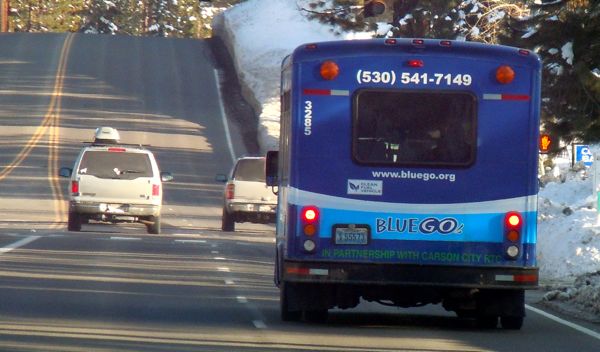
Fairfield-based MV Transportation used to run the South Shore bus system known as BlueGo. STATA – South Tahoe Area Transit Authority – was the overseer of the transit company. STATA was made up of public and private entities that had financially contributed to the bus system. STATA filed for bankruptcy; MV in 2010 filed a complaint to be paid.

El Dorado County is the only member of STATA to settle with MV.

One of the things that has protracted this case is each defendant has legal counsel, so there are multiple filings on the same motion.

Zive’s decision to send the case to mediation in part is because he recognizes the time and money that has been spent to date on the case.

However, if the parties cannot resolve their differences, litigation would be the next step.

In mediation it is likely the various parties will meet together and separately with MV and the mediator.

On Thursday the Reno judge denied:

• The motion by the private members of STATA (the casinos, Ridge Tahoe, Heavenly Mountain Resort) to dismiss the breach of contract/alter ego claim and the breach of the implied covenant of good faith and fair dealing claim.

• The motion to dismiss claim by all defendants regarding third party beneficiary, conspiracy and intentional interference with contractual relations.

• Tahoe Transportation District’s motion to dismiss the successor liability claim on the basis that MV’s allegation based on a fraud theory was plausible.

The only motion Zive dismissed was the negligent misrepresentation claim.

David Thompson, the federal bankruptcy trustee appointed by Zive, represents STATA – even though the agency doesn’t exist because the members dissolved it. But the question of STATA’s assets is pertinent to the case, which is why it is represented in the proceedings.

The defendants also submitted a series of motions to dismiss STATA’s cross claims. Zive denied all but the fraudulent transfer claims against the defendants except for TTD.


Dynamic pricing keeps consumers guessing

By Bill Saporito, Time

Maybe you didn’t notice it in the Christmas crush, but a huge shift took place this holiday shopping season: merchants changed the price of goods online more quickly than at any other time in retail history. How often? According to Eric Best, CEO of Mercent, a Seattle firm that creates and manages automated pricing programs, the most aggressive sellers were jiggling prices in 10-to-15-minute windows. That’s why they call it dynamic pricing.

You’re probably most familiar with dynamic pricing from buying airline tickets. The model, introduced by American Airlines in the ’80s, is designed to shift capacity risk (i.e., empty seats) from the airline to you in exchange for a discount on the full fare while giving the carrier a better shot at a profit. It works in that you can pretty much always find a seat, even if you end up paying twice the price of the passenger next to you. Win some, lose some.

More and more businesses are adopting this model. Sports teams like the St. Louis Cardinals once charged the same amount for the same seats at every game. But demand for a Saturday-night matchup with Philadelphia is greater than for a Thursday-afternoon contest with San Diego. So the Cards tease the price to attract the most customers, just like airlines, because if a seat goes empty, the revenue is lost forever. (In one sense, the Cards are replacing the scalpers’ market outside the stadium.) Theaters, golf courses and other businesses with time-perishable inventories are doing likewise.

Now the action is moving deeper in retailing, setting up a battle between consumers wielding shopbots like mySimon and algorithm-armed sellers and resellers. The retailers are trying to avoid losing value. Lego’s Epic Dragon Battle, for instance, has a manufacturer’s suggested retail price (MSRP) of $119. But the toy’s so hot, Amazon sellers are pricing it closer to $140, which means Lego is leaving money on the table. That’s why some merchants are abandoning MSRPs, instead setting a floor and letting dynamic-pricing programs take over. They monitor variables such as inventory levels, item velocity, competitors’ pricing and advertising. “The effort that the consumer had to go through in an eBay auction has been taken on by the retailer,” says Best, a former Amazon executive. “They are the ones that are determining perfect market value.” (Some sellers are also looking at behavioral variables by tracking your Web searches. That’s more controversial, but you can prevent them from doing it.)

The good thing for us is that pricing engines have to compete with one another and with our ability to gather information. And Amazon and Google want to kill each other, bringing pricing transparency to most products. That leaves sellers with the choice of being hyperefficient and duking it out on the price front, like Walmart and Amazon, or offering unique products and experiences, á la Apple and Disney. It’s a future in which many transactions–for milk, Uggs, baseball tickets–could follow the stock market’s bid/ask system. Think electronic price tags in brick-and-mortar stores that change as you approach, on the basis of your shopping history. Also gaining: consumer intermediaries like Decide.com that allow you to reverse-engineer the price engines. They predict the price of a camera, say, and recommend that you buy it at a certain amount; if you do and the price drops, they’ll pay you the difference. Some credit cards are offering price protection too. So is Target.

Pricing expert John Zhang of the Wharton School at the University of Pennsylvania says retailing is coming full circle. Before supermarkets, merchants–from Middle Eastern suqs to London shops–sized up their customers and priced goods accordingly. They cut personalized deals and made trade-offs. Today’s merchants simply use a different method. “Personal-identification storage technology has enabled the sellers to go back into the dynamic pricing they were doing for a century,” Zhang says. Expect it in the frozen-food aisle soon.


El Dorado County teen accused of murder

By Bill Lindelof, Sacramento Bee

An 18-year-old is in jail on suspicion of homicide after the stabbing death of another young man Wednesday night in El Dorado County.

El Dorado County sheriff’s deputies said they responded to the area of Brown’s Road and Cold Springs Road, just north of Placerville, about 4pm Wednesday where they were told a person had been stabbed.

They were also told that the person who stabbed 20-year-old Matthew Steele of Auburn had fled on foot. Paramedics arrived and transferred Steele to Marshall Hospital where he died about two hours later.

Deputies took Wesley Hampshire, 18, of Placerville into custody at his home on Brown’s Road. He was later booked into county jail on suspicion of homicide.

Details on what lead up to the stabbing were not available.


Asian immigrants outpacing Hispanics in California

By Stephen Magagnini and Phillip Reese, Sacramento Bee

The face of new Californians – once predominantly Latino – is increasingly Asian American, census data show.

A seismic shift in immigration has occurred in California over the last decade, with Asia replacing Latin America as the primary source of the state’s immigrants.

“This is a pretty astounding change over a short period of time,” said Hans Johnson, co-director of the Public Policy Institute of California, citing census data.

“For the first time in decades, the number of Asians coming to California exceeded the flow from Latin America, and it exceeds that flow by a lot – 2 1/2 times greater.”

To have Latino immigrants eclipsed by those from Asia over the past five to 10 years “could represent the end of an era,” Johnson said.

In 2001, 42 percent of immigrants coming to California were from Latin America, primarily Mexico, while 37 percent were from Asia. In 2011, 57 percent of new immigrants were from Asia, and just 22 percent were from Latin America, census data show.

California’s new faces were on display at a swearing-in ceremony at the Sacramento Convention Center on Wednesday. Of the 774 area residents who took the oath of citizenship, about 450 were born in Asia, compared with roughly 160 who were born in Latin America, according to the U.S. Citizenship and and Immigration Services.

They included 119 people from Mexico, 100 from India, 94 from the Philippines, 63 from Vietnam, 35 from Ukraine, 33 from the People’s Republic of China and 29 from Laos.

Among those celebrating their newly minted citizenship was Melody Malliet, who dressed in a crisp white suit to take the pledge of allegiance. She came here from the Philippines four years ago to marry an American citizen and is now a nursing assistant in Calaveras County. “It feels so good to be a U.S. citizen,” Malliet said with a huge smile. “I’m part of the greatest country in the world.”

Filipinos – the largest Asian ethnic group in Sacramento – often come here to fill jobs in health care.

The changing needs of California’s economy since the start of the recession explain much of the shift from Latin America to Asia. “Part of what we’re seeing is the changing face of California’s labor market, which has been increasingly demanding more highly educated workers,” Johnson said.

Unemployment has gone up at all levels, “but it’s gone up the most for people with high school degrees or less,” Johnson said. “Immigrants from Asia, particularly India, tend to be much more highly educated, much more likely to have earned a bachelor’s degree.”

While 74 percent of recent arrivals from India have at least bachelor’s degrees, 59 percent of Mexican immigrants have less than a high school degree, and there are now fewer jobs for less-educated immigrants, Johnson said.

The census doesn’t ask for a person’s immigration status, but the declining Latino numbers reflect a drop in undocumented immigrants, Johnson said. A substantial number of newcomers are sponsored by California businesses that help skilled immigrants obtain H-1B visas and other types of work authorization, he said.

“High-tech firms are arguing in Washington, D.C., that the number of work visas needs to be increased because they’re having a hard time finding people trained in computer sciences, and those jobs have often gone to Asian immigrants,” he said.

The number of foreign students coming to California also has risen. For example, there are now more than 1,500 students and scholars from China and Taiwan at UC Davis.

Asian Resources, which helps immigrants find jobs, has seen a large influx of immigrants from Mongolia, China, Laos and India, said executive director Stephanie Nguyen.

They include doctors, architects and professors seeking a better life, added placement counselor Sheng Lo. “Over the last three years, I’ve seen a lot of refugees from Iraq and Iran who came here as asylees or refugees seeking political or religious freedom,” Lo said. “And we had a couple from India – a teacher and pharmacist – who came looking for a better life for their kids. They learned they’d have to be retrained here.”

Overall, the U.S. Census Bureau estimates that the number of new immigrants coming to California went up slightly between 2010 and 2011, from 257,359 to 277,304. The Sacramento area also saw a slight boost in legal immigrants, from 8,047 to 9,469, federal immigration officials said.

But the number of new immigrants coming to California from Latin America annually has plummeted 65 percent since 2001, going from roughly 147,000 to 60,000 in 2011, Johnson said.

The drop began in earnest around 2007, when California’s economy began to falter ahead of the lengthy recession. Since 2006, the number of Latin American immigrants arriving each year in California has dropped by about 70,000.

Meanwhile, the number of Asian immigrants coming to California has grown, particularly from China and Taiwan. In 2001, about 129,000 immigrants came to California from Asia; by 2011, that number had risen to 160,000.

Immigrants coming each year from China and Taiwan grew 45 percent over the last decade, going from 25,000 to about 38,000. The biggest jump occurred from 2010 to 2011, when 10,000 more Chinese came to California than during the previous year.

The number of Koreans coming here each year has also grown sharply, going from about 13,000 in 2001 to 17,000 in 2011.

At Wednesday’s citizenship ceremony, hundreds of new immigrants waited in line for Social Security numbers.

Huy Tran, an 18-year-old senior at Florin High who arrived from Hue, Vietnam, in 2006, said he wants to help people with asthma, something he’s struggled with.

Ye Her, a Hmong refugee from Sacramento accompanied by her daughter May Saechao, 24, proudly displayed her citizenship certificate. “I’ve never felt this happy in my life before,” she said.


String of burglaries in Carson Valley may be related

Several burglaries occurred in the early morning hours of Jan. 15 in Douglas County, including at the Genoa Bar.

Burglars hit two unoccupied homes in Genoa, and several vehicles at two auto repair shops in Gardnerville.

Sheriff’s deputies said evidence recovered at the various scenes makes them believe the burglaries are related and were committed by at least two people.

Surveillance video at approximately 4:17am Tuesday shows a man walking around a security fence outside the location. He is in his 20s or 30s, between 5-foot-10 and 6-feet, with a large heavy-set build and brown short-cropped hair. He was wearing a dark colored jacket and lighter colored pants — possibly jeans.

Surveillance video from the Genoa Bar revealed that at approximately 5:08am on the same day two men forced entry into the building. They are seen rummaging around various locations within the building.

One man in the Genoa Bar burglary appears similar to the subject seen in the area of the vehicle burglaries committed in Gardnerville, officers said. The second person is described as a male, unknown age, 5-feet-8 to 5-feet-11, wearing a white hooded sweat shirt, dark colored baseball cap, and dark colored pants — possibly jeans.

Property stolen from the various incidents consists of a cash register drawer and portable electronic items.

A reward of up to $1,000 is available for information leading to the arrest and conviction of those responsible. Anyone with information should call (775) 782.9905 or Secret Witness at (775) 782.7463.

 — Lake Tahoe News staff report