Tahoe cop Poland behind bars on federal charges

By Kathryn Reed

South Lake Tahoe police Officer Johnny Poland is behind bars on five federal charges.

Poland, who has been in and out of trouble with the department, has been under investigation locally and by the FBI for more than a year. That investigation culminated Jan. 23 when he was arrested without incident outside the police department.

He faces five charges related to trying to get others to change their testimony and tampering with evidence. The violations allegedly started on June 29, 2011, and continued through Dec. 20, 2011.

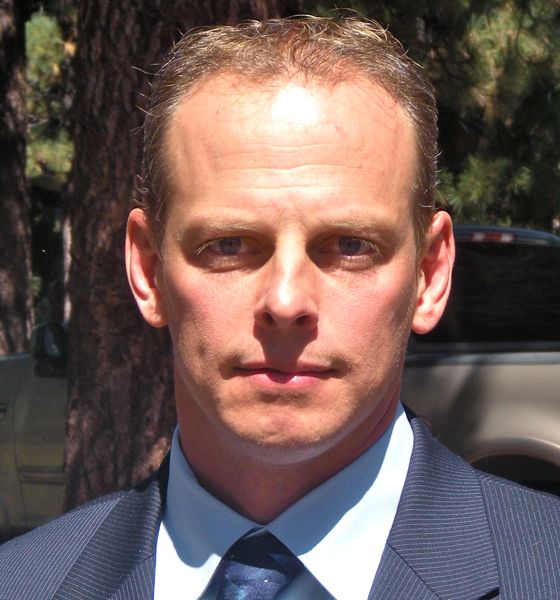
Johnny Poland

Police Chief Brian Uhler told Lake Tahoe News the charges have to do with charges Poland faces and not other cases.

Poland, 44, will be spending the night in Sacramento County Jail. He is scheduled to be in court Thursday morning.

Part of the federal complaint says, “In 2009, law enforcement had observed Poland, again off duty, in close association with gang members at a funeral.”

It goes on to say he was having a relationship with a gang member with whom he shared sensitive information.

The complaint says Poland in 2003 had sex with a 17-year-old South Tahoe High School student while he was the school resource officer. He was 35 at the time and married.

Poland has been on paid administrative leave since November 2011. That status will change to unpaid after the court hearing on Jan. 24, according to Uhler.

“We have a sense of conclusion or closure with the events that happened today. They were not unexpected,” Uhler told Lake Tahoe News.

Poland had been asked to come to the station Wednesday morning to fill out paperwork. He did. And then he was arrested in the parking lot.

Uhler said he met today with officials from El Dorado County District Attorney’s Office regarding state charges. A decision on whether more charges will be filed has yet to be determined.

Uhler is also working on what happens next in regards to Poland being an employee of South Lake Tahoe.

Poland complaint


S. Tahoe council refuses to ban plastic bags

By Kathryn Reed

South Lake Tahoe’s proposed plastic bag ban is in the garbage – for now.

The council on a 3-0 vote (Councilwoman Angela Swanson was absent) decided to not adopt an ordinance that would have banned plastic bags at stores throughout the city. They were not convinced of the environmental need in Tahoe or why they would want to legislate morality.

Plastic is allowed in South Lake Tahoe.

The city’s Sustainability Commission brought the idea forward after it had been discussed for more than three years. At the same Jan. 22 meeting, the council did away with the commission. That decision was initially proposed in the fall. Now the commission must decide if it wants to remain intact as a committee.

As for the plastic bags, it’s not that the council doesn’t want to help the environment, but the three had issues with various components of the proposal.

“I would like the stores to decide if they want to charge for paper,” Councilman Hal Cole said.

The proposal was to charge 10 cents per paper bag.

Kay Ogden, a member of the Sustainability Commission, said there are legal reasons for needing to have a fee associated with the paper if plastic were banned.

City Attorney Patrick Enright said changing the wording from “shall” to “may” for the paper fee would also trigger more CEQA analysis. As written, South Lake Tahoe’s proposal got by the California Environmental Quality Act with a categorical ban.

The bags used for produce and meat would have been exempt. And plastic of a certain thickness are considered reusable.

But Councilwoman JoAnn Conner says she and many of her friends reuse the plastic bags groceries come in.

The EPA says 5 percent of plastic bags are recycled. The Sustainability Commission says 8 million single use plastic bags are used in South Tahoe each year.

Ogden along with Juliana Prosperi said the plastic bag ban would help Tahoe businesses. Their presentation said it is estimated $200 a year in state and federal taxes are spent per person to clean up litter and waste associated with single use bags.

“In all of your documents you talk about cost savings, but I don’t see it,” Mayor Tom Davis said.

His biggest issue was with the potential bacteria growing in reusable canvas bags if people aren’t regularly washing them. He cited a study that says 97 percent of people don’t wash their bags.

Davis said he would prefer the plastic bag issue be resolved at the state level. In California, 60 cities and eight counties have adopted plastic bag bans, according to Ogden.

Everyone agreed educating the consumer about perceived and real harms of plastic bags needs to be done so more people would voluntarily use something other than a one-time plastic bag.


El Dorado County sheriff writes Biden about gun control

By Bill Lindelof, Sacramento Bee

The El Dorado County sheriff has fired off an anti-gun control letter to Vice President Joe Biden.

“It is well known and proven with facts, not emotional inference, that gun control of any kind, has no effect on the reduction of crime, anywhere,” wrote Sheriff John D’Agostini.

The letter, also sent out as a press release, was written to Biden Jan. 17.

Here is the El Dorado County sheriff’s letter to Biden.

The Obama administration is trying to get congressional support for a package of gun-control proposals, including an assault rifle ban. Biden helped formulate the proposals.

The gun control proposals come following the December shooting at a Newtown, Conn., elementary school that left 20 children and six staffers dead.


Push Fitness not changing hands

By Kathryn Reed

While one owner of Push Fitness is headed for federal prison, the other intends to operate the South Lake Tahoe gym.

“I’ll be running it,” Irene DiMatteo told Lake Tahoe News.

Her husband, Gino, has pleaded guilty to drug charges. The plea deal has him likely to receive a five-year-sentence on April 27.

The city issued a business license for the fitness center to Redemus COA 2 LLC, represented by Gino and Irene DiMatteo. Redemus COA 2 LLC is also registered with the state Secretary of State, which shows a valid business entity under the name Gennaro DiMatteo.

The DiMatteos bought the gym from Tim Christenson last year after City of Angels II, a medical marijuana dispensary they owned, closed.

The building and property where the gym are located are owned by someone else.

The feds have not seized the business or the DiMatteos’ South Tahoe residence. They have confiscated four bank accounts totaling about $40,000. Three of those accounts were in Gino DiMatteo’s name and one in City of Angels II.

“Right now the government has only filed against his bank accounts,” Lauren Horwood with the U.S. Attorney’s Office in Sacramento told Lake Tahoe News.


Will criminal charges be filed in State Parks scandal?

By Matt Weiser, Sacramento Bee

Six months after the public learned that California state parks officials had concealed $20 million even as they were crying poor and closing parks, one crucial issue remains foggy as ever: Were any crimes committed, and if so, will anyone be held to answer?

The state attorney general’s investigation into the secret funds, released Jan. 4, made it clear that $20.5 million was kept hidden in the State Parks and Recreation Fund (SPRF). The fund is the primary collection point for all visitor fees paid at the 278 parks in the California Department of Parks and Recreation system. Another $33 million, held in the Off Highway Vehicle Fund, was not intentionally hidden, according to the report, but was obscured nonetheless by complexities in managing that fund.

The investigation also revealed that, although the amount of the hidden funds varied over time and originally piled up because of budgeting errors, numerous high-ranking officials at parks headquarters in Sacramento made a decision to keep the money concealed from state finance officials for as long as 13 years.

“It is clear,” the investigation states, “that by no later than 2003, and perhaps as early as 1999, the failure to accurately report all SPRF monies … became conscious and deliberate.”

This finding raises the specter of criminal conduct, according to several legal experts interviewed by The Bee. And many state parks advocates – who opened their own wallets and volunteered time to keep parks open – are waiting for answers to this question.

“If there is evidence that crimes were committed, they should be prosecuted,” said Daniel Winkelman, a retired state parks ranger who lives in Folsom. “It’s as simple as that.”

The attorney general’s office did not review whether any crimes were committed. It conducted only an “administrative” investigation in response to a request from the Governor’s Office, said Richard Stapler, a spokesman for the Natural Resources Agency, which oversees state parks.

Officials at the Natural Resources Agency initially said they would review the attorney general’s investigation for signs of criminal conduct, then refer the investigation to the Sacramento County District Attorney’s Office, which would be responsible for bringing any criminal charges.

Now Stapler says the Natural Resources Agency will depend upon the attorney general to share its investigation with the district attorney.

“We do not have criminal attorneys working for us,” Stapler said. “We need to have it reviewed through that lens of someone who does criminal prosecution in order to make any type of public determination.”

Linda Gledhill, a spokeswoman for the attorney general, said her agency planned to formally share its investigation with the district attorney “in the next few days.”

Several former officials at state parks have admitted, in testimony released by the attorney general, that they chose to keep quiet about the surplus money over many years.

Some cited a concern that if they informed the Department of Finance about the money, the parks department’s general fund budget allocation would be reduced by an equal amount the next year, potentially harming park operations.

Others said they considered the surplus money a “rainy day fund.” They told investigators they hoped this money could be used to support parks, like a safety net, in the event a natural disaster slashed visitor revenues.

These choices violate numerous state administrative policies, as well as sections of the Government Code, which require employees to file accurate reports and to reconcile, or explain, inconsistences between accounts reported to the controller and the finance department.

Shaun Martin, a law professor at the University of San Diego, said a key criminal statute that may have been violated is Penal Code section 424.

This law makes it a felony if a public official “knowingly keeps any false account” or “fraudulently alters, falsifies, conceals, destroys or obliterates any account.” It ascribes mandatory prison terms of two to four years and bars the guilty party from ever holding public office again.

“I think the prosecution would have a decent shot at getting a conviction,” Martin told The Bee. “There are other statutes you could potentially charge them with, but this one, I think, would be the strongest.”

He said bringing charges under this law, however, will be complicated: Penal Code section 424, itself, is the subject of an evolving legal debate.

The debate stems from a case in Sutter County that is similar, in some ways, to the parks scandal.

The Sutter County auditor-controller was indicted by a grand jury in 2005 for allegedly misappropriating funds, and charged with violating Penal Code section 424. Just as in the state parks case, no money was embezzled or spent on anything improper. The auditor-controller simply allocated money in a way that conflicted with the wishes of the county administrator and the board of supervisors.

The case found its way to the California Supreme Court in a legal battle over the limits of section 424, an element of the state criminal code that dates to the 1880s.

The dispute the court considered was a longstanding tenet of law, which holds that ignorance of the law does not excuse criminal behavior. In other words, if you punch someone in the face, you can be convicted of assault even if you didn’t know that punching someone is a crime.

In its 2011 ruling in the Sutter County case, known as Stark v. Superior Court, the California Supreme Court turned this basic legal concept around. It concluded that where Penal Code section 424 is concerned, ignorance of the law may, in fact, be an acceptable defense. A government official who misappropriates money or refuses to transfer money as ordered may not be guilty of a crime if he acted in “good faith” and did not know the actions were unlawful.

“Public officials and others should not be criminally liable for a reasonable, good faith mistake regarding their legal responsibilities,” the court wrote in its unanimous opinion. “Nor is section 424 intended to criminalize ordinary negligence or good faith errors in judgment.”

The decision could make prosecuting state parks employees under this section of the Penal Code more difficult. A prosecutor may have to prove the employees knew the law – and knew they were breaking it.

“It’s an interesting area of law right now, because the Supreme Court has given us this hybrid intent kind of a crime that doesn’t exist anywhere else,” said Carl Adams, the Sutter County district attorney who is prosecuting the auditor-controller. The case is still pending before the local superior court. “Exactly how we define that difference – those cases will resolve over the next decade.”

His adversary, Sacramento attorney M. Bradley Wishek, represents Robert Stark, the Sutter County auditor-controller, who has been re-elected by voters twice since the 2005 indictment. Wishek asserts that Stark never did anything unlawful, and believes the Supreme Court ruling means it will not be possible for a jury to find Stark guilty.

“When the law is so complex that reasonable minds could differ, then we have to ask: If you guess wrong, does that mean you committed a felony?” Wishek said. “According to the Supreme Court, it doesn’t.”

Significantly, there is one clause in Penal Code section 424 where the Supreme Court did not make this conclusion. It is the clause that states a government employee who “knowingly keeps any false account” is guilty of a felony.

This may be the clearest parallel to what happened in the state parks scandal. Martin, the San Diego law professor, said the Supreme Court ruling left nothing to quibble over here.

“Under this clause, ignorance of the law is no excuse,” he said. “If you know that your account is false, you’re guilty – period.”

It then becomes a choice by the prosecutor whether the behavior is egregious enough to warrant criminal charges and possible prison time, Martin said. The Sacramento County district attorney will have to decide whether to make an example of the parks employees.

“I think it’s the right call to make things like this illegal,” Martin said. “But is it morally desirable to impose penalties on someone for making mistakes like this? It’s the prosecutor that has the hard choice to make in a case like that, not the jury.”


Poker tournament helps Caesars pick new hires

By Ron Sylvester, Las Vegas Sun

Most American companies screen and court MBA graduates the same way: They dispatch teams to elite business schools to schmooze and talk up their companies. They host mixers with free food and drinks. Members of the companies’ development departments screen students, often with problem-solving tests, then invite a chosen few to corporate headquarters for more interviews.

The best of the best land internships that could lead to full-time jobs and, possibly, corner offices.

Caesars Entertainment does it differently. It screens job candidates during a poker tournament.

Last weekend, as it has for the past eight years, Caesars hosted its MBA Poker Championships and Recruitment Weekend at Planet Hollywood. More than 500 people, most looking to join the company’s management corps, attended.

“The cool thing about this is you can be exposed to companies for a whole weekend, meet and talk with recruiters and executives, and play a little poker,” said Ashish Gupta, 29, a student at USC’s Marshall School of Business.

In Caesars’ experience, the MBAs who best understand poker are likely to be the same people best suited to run casinos and hotels.

“Look at the skills required of quality poker players,” said Paul King, corporate director of talent and recruiting for Caesars, which runs the World Series of Poker. “They are the same types of qualities we look for in candidates. They are analytical in nature, strategic in approach to the game and savvy in the way they play. What we’re looking for is a critical eye and analytical thinking skills.”

Of the hundreds who play in the three-day tournament, only a handful win positions with the company. Last year, 12 candidates from the poker weekend received invitations to work in Caesars’ President’s Associate Program.

The two-year apprenticeship offers associates a chance to interact with senior executives and participate in business decisions and analysis. It’s the first step toward being offered a permanent position managing table games, slot machines, hotels, restaurants, and marketing or finance departments. Four of the 12 president’s associates hired at last year’s MBA poker event were given full-time jobs.

The idea came out of a poker game among students at the University of Chicago’s business school. The friends began playing, then invited students from other business schools to play. King’s predecessor, Brad Warga, learned about the game and brought the concept to Caesars. He called it the MBA World Series of Poker.

“When it first started, it was much more a brand-building event, not as focused on recruiting,” King said. “In the last few years, we’ve changed that. We are interviewing people, and some are leaving with offers. We’re not a boring company, and what better way to expose people to the fun culture of our company and Las Vegas than a poker tournament?

“It’s now a pretty well-known event across the MBA universe. It has really become a huge part of our recruiting brand in this market.”

It also makes Caesars stand out from crowds of companies, including its competitors on the Strip. Caesars says it is the only casino company that markets itself this way.

“Every time I go out and talk about this, they say this is the most creative event they’ve seen,” King said.

The company imposes only one restriction: Poker players must be in the process of earning an MBA or have recently graduated to qualify for the tournament, which draws people looking to enter the workforce, as well as those who want to change careers.

“You’d be surprised how many people we get out of consulting companies like McKinsey or Bain,” King said.

The weekend also has spawned satellite tournaments. Students at the Carnegie Mellon Tepper School of Business, for instance, hold their own tournament, with the winner receiving a free trip to the Caesars recruitment weekend.

It isn’t all fun and games, though. Besides playing poker, candidates meet with Caesars executives, attend company presentations and participate in interviews.

On Sunday, invitations were handed out to those who met the company’s expectations.

“We get people who just want to come and play, hang out with their grad school buddies and enjoy Vegas,” King said. “But we also get a good majority who … are very actively looking for work.”

It’s easy to spot the job seekers, King said.

“The people who are just here for fun show up in shorts and flip-flops,” he said. “Those wanting jobs bring suits.”

Caesars doesn’t limit potential hires by school, but it does focus on a few key campuses. There’s Harvard, of course — the alma mater of Caesars chief Gary Loveman — as well as MIT, Duke, Vanderbilt, the University of Chicago, Northwestern, UCLA and USC.

John Payne, Caesars’ president of enterprise shared services, is the highest ranking executive to have come out of the program. Others alumni, according to their LinkedIn profiles, include Matthew Heiskel, assistant general manager of Bally’s, Atlantic City (2007); Jacqueline Beato, director of investor relations (2008); Neera Chanani, head of Caesars’ South Asia division (2010); and Chirag Tasker, regional vice president of marketing in Philadelphia (2010).

Caesars also opens the poker tournament to recruiters from other companies. On Saturday, the company hosted a Recruiters’ Lounge, where businesses that sponsor the tournament could meet candidates and collect resumes. This year, game manufacturer IGT signed on and sent executives to Planet Hollywood.

The weekend also raises money for charity. Players buy into the tournament for between $85 and $225. The top 10 players or so take home prize money from about 70 percent of the tournament fees. The rest is donated to Keep Memory Alive at the Lou Ruvo Center for Brain Health.

“We make it productive, and at the same time, it’s really, really fun,” King said. “It’s unique to Las Vegas and our company.”


Banks allowing small bills to be dispensed at ATMs

By Blake Ellis, CNN.Money

Hundreds of new ATMs capable of dispensing as little as $1 are popping up across the country.

Chase and PNC have been launching ATMs that churn out exact change to the dollar, allowing customers to withdraw denominations as low as $1 and $5.

Chase has rolled out between 350 and 400 such ATMs over the past 18 months, and the count is expected to double by the end of the year. Customers can type in the withdrawal amount, opt for “custom denominations” and select how many bills they want in denominations ranging from $1 to $100.

The new machines, located within branches or drive-throughs, even have the capability of dispensing coins, a service that will be piloted soon and eventually rolled out nationwide.

The move is part of Chase’s push to create what are essentially virtual tellers that don’t require additional staffing and increase efficiency for customers, said Bill Sheley, head of branch innovation. He calls the machines “next generation ATMs or new teller platforms.” Other services the ATMs provide include paying credit card bills and loading Chase prepaid cards with cash.

Meanwhile, PNC has upgraded more than half of its 7,200 ATMs to dispense $1 and $5 bills over the past year, and the rest are expected to be upgraded by the end of the summer. A PNC spokesman said the bank is adding this feature to make its ATMs more convenient for its customers.

The option to get exact change will be a plus for customers — including those with low account balances who want to take out less than $20 or who need $25 but don’t want to take out $40, for example, said Greg McBride, senior financial analyst at Bankrate.com.

“Particularly in difficult financial times when peoples’ account balances have been lower, not having to withdraw more money than you really need is helpful,” said McBride.

The new ATMs are free for customers. But the same $3 out-of-network fees apply to non-customers as they do for any of the banks’ ATMs. A customer’s own bank also typically charges a fee of about $1.60 when they use an out-of-network ATM.

In many cases, these out-of-network fees overshadow the convenience of getting exact change. But for some non-customers, it may be worth it, McBride said.

For someone who needs $45 but would overdraw their bank account if they took out $60, for example, it might make sense to pay a $4 fee to get the precise $45 from a PNC or Chase ATM.

Since it costs banks to add denominations to their ATMs, this new capability will need to prove worth it — either in fee revenue or customer retention — before other banks follow suit, said McBride.

Wells Fargo and Citi said they don’t have any ATMs that dispense $1 and $5 bills at this time. TD Bank has a small number of ATMs inside businesses that dispense $5 bills, but most of its machines dispense only $20 bills and it doesn’t have plans to introduce lower denominations. A Bank of America spokeswoman declined to comment on future plans but said its ATMs currently dispense $10 bills and that the bank “always looks at ways to make banking at our ATMs more convenient.”


Legislators receive gas money, but won’t say where they’ve been

By Torey Van Oot and Jim Sanders, Sacramento Bee

State legislators billed taxpayers more than $450,000 for on-the-job driving in the last legislative year, but officials won’t say where the lawmakers went.

The Senate and the Assembly this week denied records requests from the Bee to review mileage logbooks legislators submitted when seeking 53-cents-a-mile reimbursements for car travel related to their work.

Without the logbooks, it is impossible to track where lawmakers went on the public’s dime in the last legislative year, when they drove more than 849,000 miles on legislative business.

The decision, which comes little more than a year after the Bee and other newspapers successfully sued the Assembly for withholding office budgets under the Legislative Open Records Act, was met with criticism by advocates of greater transparency in government.

Phillip Ung, who works for California Common Cause, said legislative leaders continue to use the act in a way that makes it “the least transparency-promoting law in the state of California.”

“I think if legislators are going to be asking the public to reimburse them for their gas, the public has the right to know where these members are driving,” he said.

Officials in both houses said in written responses that they withheld the logbooks because the request “impacts upon concerns regarding privacy, security and legislative privilege,” pointing to a 1991 state Supreme Court ruling protecting certain information contained in a governor’s calendars from release.

Assembly Administrator Jon Waldie said the lower house is most concerned about safety of the members, since many list specific addresses in their logbooks. He compared the reasoning to both houses’ decisions to withhold legislators’ calendars from public disclosure in recent years.

“You’re going to get patterns, and then once you have the patterns you can easily discern where members are going to be and when they’re going to be there,” he said.

Secretary of the Senate Greg Schmidt echoed Waldie, saying he sees “legitimate security concerns” in releasing the documents.

“Logbooks indicate where people travel, and potentially provide information regarding recurrent travel patterns,” he wrote in an email.

Peter Scheer, executive director of the First Amendment Coalition, said legitimate security issues can exist in releasing records related to public officials’ transportation plans.

But disclosing information about “legislators who are not exactly household names and where they drive in a car is really not going to reveal anything of particularly sensitive nature.” He noted that some lawmakers have elected to use license plates that broadcast their status as a member of the Legislature.

“It reflects an exaggerated if not paranoid sense of their own vulnerability to say that all that information, that information if released could put them in some kind of physical jeopardy,” he said of the rationale.

Scheer also questioned how much travel records could reveal about the deliberative processes of the Legislature, another reason it cited for denying access to the records.

“Merely knowing where they drive within their district or outside of it and perhaps being able to infer from that one or two pieces of information about institutions they may be visiting or even people that they talk to, that does not even come close to breaching the deliberative process privilege,” he said. “That kind of information is … out there in public for anyone to see any time.”

As to what kind of activities on the road could fall under the privacy exemption, Scheer offered that the documents would have to reveal “an act of an X-rated nature in the vehicle which they were getting reimbursed for” to meet that standard.

Releasing the records, he said, could help the public judge “whether their legislators were submitting accurate and fair reimbursement requests or … instead abusing the reimbursement privilege to pass on to taxpayers what should be a personal expense.”

The Legislature began reimbursing members for work-related travel in their personal cars, including trips from their home to the Capitol, in December 2011, after a program providing state-leased cars to members was cut by the Citizens Compensation Commission. The change saved taxpayers nearly $240,000 in its first year, a Bee analysis of reimbursements issued between December 2011 and mid-December 2012 found.

While the change cut overall costs for the Legislature by about a third, individual mileage reimbursements varied significantly by member.

Some legislators declined to seek reimbursement, while others received large sums for driving thousands of miles on legislative business.

Some of the members logging the most miles represent vast, rural districts within driving distance of the Capitol, but others from geographically compact districts also racked up thousands of dollars in reimbursement costs. Sen. Rod Wright, D-Inglewood, for example, sought at least $4,700 in mileage reimbursements last year.

Wright, whose Los Angeles district covers about 108 square miles, has declined to say where he went.


Ohio town shows the divided country Obama will lead

By Eli Saslow, Washington Post

FREMONT, Ohio — On the same day, in the same county of northern Ohio, two new grandparents prepared to drive to the same factory for work. They had started their careers at Arm & Hammer the same year, and for more than two decades, they had stood together on a concrete floor and watched baking soda roll down an 80-foot production line. But, on this morning, what they saw looked nothing alike.

Bill Herr, 61, left a house that had declined in value by 20 percent, in a neighborhood blemished by foreclosures, in a town where he believed the economy for the middle class was “falling apart.” He said goodbye to a wife who was recovering from open-heart surgery, which she blamed in small part on the stress and disappointment of the presidential election. He grabbed a coat purchased for $6 at Goodwill and walked out a front door where he had recently hung a sign created by a local Christian motorcycle group: “AMERICA NEEDS GOD’S HELP! PRAYER OUR ONLY HOPE.”

Cathy Morris, 53, left a home she had bought with the help of a middle-class tax break and then drove by the mailbox where she sent regular $25 checks to President Obama. She passed through a town that she believed was “almost back” and pulled into an Arm & Hammer factory where orders had increased by 5 percent and management was once again hiring. “Obama,” she said. “Thank goodness.”

This is the America that Obama will govern in his second term: A place divided not only by ideology, race and class but also by the very perception of reality. Four years since Obama first took office, is the country better or worse off? Safer or more at risk? Principled or desperately lost?

Here in Fremont, as in much of America, it all depends on whom you ask. In this rural, Rust Belt county where Obama won exactly 50 percent of the vote, located in a state where he won 50 percent, residents expect Obama to either ruin the country or rescue it. The president who spoke ambitiously at his first inauguration about uniting America instead arrives at his second with the country further divided. Fourteen percent of Republicans think he’s doing a good job, compared with 88 percent of Democrats. The goal is no longer to effect sweeping conciliation so much as to find fractional compromise in a diminishing common ground.

Inside an Arm & Hammer factory that billows smoke across the farmlands of Ohio, 180 employees now self-segregate into what Morris calls “ideological islands.” Co-workers who were once moderate Democrats or Republicans shifted fully to their sides over the past four years, intensifying the disconnect.

There are free copies of a National Rifle Association monthly magazine in one break room and, as of late last year, a life-size cardboard cutout of Obama in the other. There are workers who share copies of Obama’s biography, “Dreams From My Father,” and others who distribute the movie-version parody, “Dreams From My Real Father: A Story of Reds and Deception.”

And then there are Morris and Herr, two longtime employees working side by side, each anticipating Obama’s second inauguration as a seminal moment.

For one, it is confirmation that life has gotten better.

For the other, it is proof that life has gotten worse.

‘Obama’s America’

Bill and Sally Herr built their farmhouse on the outskirts of Fremont in the months after Sept. 11, 2001, and they agreed to decorate it in homage to the country they served and loved. They placed two American flags on the lawn, five flag magnets on the fridge, a flag-themed coloring book in the grandkids’ room and a flag throw blanket on the living room couch. They framed another flag just inside the entryway, displaying it under three words that summarized their philosophy: “God Bless America.”

But lately, when they talked about the state of the country, the phrase Bill preferred was something different, something much less reassuring.

“Obama’s America,” he said.

Obama’s America: It was the wood pellets burning downstairs in their latest attempt to lower the energy bill; the constant threats of downsizing at the print shop where Sally has worked for 30 years; the 25 percent drop in tithing at their church; the date nights paid for with gift certificates to Arby’s or Casa Fiesta; the 37-year-old son with a doctorate who had been forced to move back in with them for six months after losing his job as a counselor in Toledo.

What bothered Bill most of all was the way he thought Obama had slighted the military, removing troops from combat zones too quickly and once disregarding Iraq as a “stupid war.” Stupid or not, Bill had been there to fight it when the Army sent orders to a 52-year-old whose military experience consisted mostly of humanitarian missions in South America with the Army Reserve. This time, the orders were to deploy on five days notice for a 12-month tour with a unit out of Chicago. So off he had gone into the desert with men less than half his age, once unloading 190 rounds in a single firefight, ducking behind a tank as his chin strap filled with sweat. “So that was stupid?” he wondered.

Bill and Sally were lifelong Republicans who had been wary of Obama from the start, but it was the frustrations of the past four years that had welcomed Fox News as a constant presence into their living room and tea party members to their annual backyard Fourth of July bash. They wanted friends with whom to share their frustrations. Now they forwarded along e-mails from those new friends suggesting murky details in Obama’s family history and traveled to Glenn Beck rallies across the state.

They had sought out a community of others who thought like them, and immersing in that community had changed what they thought.

“The first time he won, I really just considered him inexperienced and misguided,” Sally said. “This time, I think he is purposely taking us to a place we don’t recognize.”

Obama had said he wanted to raise the federal debt limit; Sally and Bill, meanwhile, were teaching Financial Peace University at their church, where they talked about borrowing $21,000 to buy their first house and then staying there 30 years until the mortgage was paid off.

“The most important lesson is you pay off what you owe before you borrow more,” Bill had told the congregants.

Obama wanted to cover rising costs for food stamps and unemployment insurance; Bill had found a factory job that paid $21 an hour and stuck with it through aching feet, back pain and boredom. He had selected a new Arm & Hammer trinket out of the company catalog to mark every five years of employment and displayed those gifts proudly around his house. He had continued to fill the vats of glue and load cartons of baking soda boxes onto the line, watching 270 of them get filled every minute, eight hours a day, for 23 years.

On the other side

Cathy Morris, an Arm & Hammer quality supervisor, had worked alongside Bill for every one of those years without ever speaking to him about politics. She had overheard enough of his conversations to know: “He’s way over on the other side,” she said — and she preferred to associate only with her own side whenever possible.

She picked out an elliptical machine at the gym farthest from the TVs, because they were always tuned to Fox News. She deleted conservative friends from her Facebook page. She went on Snopes.com to investigate rumors about Obama and then shared her findings mostly with other liberals — the mechanic at work whom she spotted at a rally for Vice President Biden, her union Democrat father or her two daughters who had graduated from liberal arts colleges. In what increasingly felt like a fight over basic American principles, she decided her role was to reinforce the stakes with liberals already on her side.

“Why waste my breath talking about the president to somebody who is always going to hate him?” Morris said. “If they can’t understand what he’s accomplished, it is already a lost cause.”

How, she wondered, could anyone not see the proof? The local unemployment rate had dropped from 13 percent to just more than 6 percent. The nearby National Machinery Plant, which had nearly closed its doors a few years earlier, now had trucks lining up at the loading docks like floats awaiting the start of a victory parade. The two colleges in town had become more diverse, and Arm & Hammer had begun offering benefits to same-sex domestic partners. Because of health-care reform, Morris’s youngest daughter, 22, has been able to stay on her mother’s health insurance plan. Morris decided to repay the president by doing something she had never done: making regular donations to Obama’s reelection campaign.

In this county of 50-50, she had decided there was no more room for ambivalence. “You are all in for him or against him, and you have to commit,” Morris said.

Local membership had risen for both the tea party and the Democratic Women’s Club, and one disagreement on election night had resulted in an assault charge. Even the area’s once-tranquil town hall meetings had devolved into a shouting match, with one woman suggesting that liberals in Washington should be “shot in the head,” prompting local Democrats to demand a police investigation. Ever since, local politics had all but come to a standstill.

But the line at Arm & Hammer had to keep moving, 270 cartons a minute, so employees had decided to guard the peace by talking sparingly about Obama or his second inauguration.

“I only confide in people who think like I think,” Herr said.

“Smile and stick to your side,” Morris said.

So they stood together in polite silence and watched baking soda roll down the manufacturing line and onto the trucks, where it would be delivered into an economy that was improving or combusting, in a country where life was getting better or worse.


Arkansas jury finds ex-Douglas County man guilty of murder

By AP

CONWAY, Ark. — A jury in Faulkner County has found a doctor guilty of killing two men at a Conway home in 2002.

The panel deliberated about an hour on Friday before convicting Richard Conte, 63, of two counts of capital murder. Conte was accused in the shooting deaths of 49-year-old Carter Elliott and 25-year-old Timothy Wayne Robertson.

Little Rock television station KTHV reports prosecutor Cody Hiland did not seek the death penalty. That leaves the only sentencing option of life in prison without parole.

Prosecutors charged Conte in 2011 as he was being released from prison in Nevada, where he was serving time for kidnapping his ex-wife, Lark Gathright-Elliott — who was once married to Carter Elliott.

Prosecutors used a fast food receipt to tie Conte to the scene.

Both Conte and Elliott had been married to Lark Gathright-Elliott. Conte’s marriage to her in 2001 lasted three months.

A month after the pair were slain in Arkansas, Conte kidnapped Gathright-Elliott from Utah and took her to his Clear Creek Canyon subdivision home in Douglas County. A contract physician with Carson-Tahoe Hospital, he drugged her. Sheriff’s deputies rescued her.