Laine wins appointment to S. Lake Tahoe council

By Kathryn Reed

After a 10-year hiatus from the South Lake Tahoe City Council, Brooke Laine will be sworn in Feb. 5. The ceremony will be at 8am so she can participate in that morning’s closed session prior to the open session starting an hour later.

On a 3-1 vote, with Councilman Hal Cole the dissenter, Laine was chosen Jan. 29 to fill the remainder of Claire Fortier’s term. At the meeting Laine told the council she intends to run for the seat when it expires in fall 2014.

Laine served on the council from 1998-2002. Cole and Mayor Tom Davis were on the council for part of her previous tenure.

“I served 10 years ago. I was 38. I have new ideas and experiences and I want to bring them forward,” Laine told Lake Tahoe News after the meeting. “I look forward to being a team player.”

While Laine was Cole’s second pick, he would have preferred Kathay Lovell return to the council.

Councilwomen Angela Swanson and JoAnn Conner had a problem with Lovell wanting the seat only for the 22-month term and not willing to seek re-election next year. Lovell served on the council from 2002-10.

Davis and Cole each picked Laine and Lovell as their top choices; Conner chose Laine and Scott Valentine; and Swanson picked Valentine and Kay Ogden.

The others who sought the seat were Austin Sass, Bruce Grego, Howard Bittner, Bill Crawford and Joan Walthall.

Each person had 10 minutes to make a case for him or herself. Walthall did not attend the meeting. Then the councilmembers asked various questions, with Davis participating via phone. And the public had a chance to comment about whom they preferred.

The council has been put in a similar situation in the past with needing to appoint a fifth person. However, it’s been a while. The last time was when Grego was appointed Aug. 1, 1989, to fill the seat vacated by Terry Trupp who in June of that year was arrested on a slew of drug charges.

On Dec. 15, 1970, William Ames resigned and Ken Smith was appointed Jan. 5, 1971, and on June 8, 1971, Donald Clarke resigned and Bill Moyer was appointed July 20, 1971. When Ken Smith resigned March 12, 1974, the council opted for a special election. That is when Robert Kaufman was elected on June 6, 1974.


Google wants to limit law enforcement’s access to customer info

By Reuters

WASHINGTON — Google will lobby Washington this year to make it harder for law enforcement authorities to gain access to emails and other digital messages.

In a blog post on Monday, linked to Data Privacy Day, Google’s chief legal officer, David Drummond, said the tech giant, in coalition with many other powerful tech companies, will try to convince Congress to update a 1986 privacy protection law.

He cited data showing that government requests for Mountain View-based Google’s user data increased more than 70 percent since 2009.

In 2012, Google said, it received 16,407 requests for user data affecting 31,072 users or accounts, more than half of them accompanied by a subpoena.

“We’re a law-abiding company, and we don’t want our services to be used in harmful ways. But it’s just as important that laws protect you against overly broad requests for your personal information,” Drummond said in the post.

The U.S. Electronic Communications Privacy Act, passed in the early days of the Internet, does not require government investigators to have a search warrant when requesting access to old emails and messages that are stored online, providing less protection for them than, say, letters stored in a desk drawer or even messages saved on a computer’s hard drive.

The current system also makes complex distinctions, many disputed in courts, between emails saved as drafts online, in transit, unopened or opened. Some of them are to be released with subpoenas, which have a lower threshold than search warrants as they often do not involve a judge.

A warrant is generally approved by a judge if investigators have “probable cause” to believe that their search is likely to turn up information related to a crime.

Google, Microsoft, Yahoo and popular social media site Twitter — among others — have resisted turning over customer data.

They have put in place policies, based on the constitutional protection from unreasonable searches, that require search warrants for access to content of private communications.

Privacy activists say the outdated law should be reformed to extend the constitutional right to privacy online, but legislation limiting government requests will not face an easy road.

Last year, Democratic Sen. Patrick Leahy, who chairs the Senate Judiciary Committee, introduced a bill that would have updated the current law.

It triggered a wave of concerns from the police and FBI that new restrictions would impede crime investigations and possibly endanger victims.

“After three decades, it is essential that Congress update ECPA to ensure that this critical law keeps pace with new technologies and the way Americans use and store email today,” Leahy said in a statement on Monday.

His privacy legislation died in Congress last year after his counterpart in the House of Representatives, House Judiciary Committee Chairman Bob Goodlatte, a Republican, drafted another version of that bill, which also tackled other issues but stripped out privacy reform language.

Last year, Goodlatte said he was willing to consider the privacy law reform, but that the timeline then was too short for a “thorough examination.”

Leahy has now included the change of privacy laws as one of his top priorities this year.


Residents protest South Lake Tahoe police

Corrupt law enforcement in South Lake Tahoe?

That’s what some people believe. And they took to the streets Monday to make their feelings known.

Ty Robben organized the Jan. 28 demonstration along Al Tahoe Boulevard. Robben’s issues started last fall when bounty hunters busted down his door. He’s been waiting for the South Lake Tahoe cops to finish the report. He even went to the City Council meeting last week to plead the electeds to intervene to speed up the process.

Within a week the report was done and passed on to the District Attorney’s Office.

But Robben said he is having a hard time getting a copy of the report.

One of the signs at the Jan. 28 protest in South Lake Tahoe. Photo/Provided

“I think this is the moment for Police Chief [Brian] Uhler to shine or sink. I think Chief Uhler seems like a nice fella based on my experience and I hope he’s legit. Perhaps some of the people below him are the problem,” Robben told Lake Tahoe News. “The PD does good things too and I would prefer to not be their critic or on their bad side.”

At the protest on Monday people were sharing stories of their run-ins with local law enforcement. Drivers honked their horns in support.

When an unmarked police vehicle went by and suddenly turned on its lights for no apparent reason one protester wondered out loud if that was to try to intimidate those who had gathered peacefully.

“I do think that the totality of my situation and others warrants some kind of future discussions. Most people are very, very intimidated to speak up or stand up for their rights because of retaliation by police, the DA or the courts. I have been retaliated against, but protesting is one thing I can do and I have certain control over that right. For some of us, that might be the only justice we ever get,” Robben said.

Robben hopes future protests are not necessary – but he said there would be more if he believes there is a need to raise awareness about what law enforcement is or is not doing.

The planning of the protest unintentionally coincided within less than a week of Officer Johnny Poland being arrested on five federal charges dealing with witness and evidence tampering. Robben was planning the protest before Poland’s arrest.

— Lake Tahoe News staff report


Lawmaker wants plastic bags banned throughout California

By Megan Hansen, Marin Independent Journal

Assemblyman Marc Levine, in his first piece of legislation, is calling for banning plastic grocery bags throughout California, starting in 2015.

Levine, D-San Rafael, introduced Assembly Bill 158 this month, reviving a similar bill that got stuck in a Senate committee last year after it faced criticism from plastic bag manufacturers and grocers.

“A similar bill was held up in the Senate, but that’s not a reason to advance good public policy,” Levine said. “This is about advancing good environmental policy and best business practices.”

Levine said plastic bags have a drastic impact on the environment, killing hundreds of thousands of marine fish and mammals each year. He said banning them could reduce beach debris by about 10 percent.

Under the bill, grocery stores with more than $2 million in annual sales or retailers with more than 10,000-square-feet of floor space would have to stop offering plastic bags.

These stores would be required to provide free recycled paper bags for their customers through July 30, 2016. After that, Levine said stores could charge a fee for recycled paper bags.

As part of the bill, stores would also be required to sell reusable grocery bags.

It’s no surprise Levine is advancing the legislation, coming from a county where a plastic bag ban has been in place in unincorporated areas since Jan. 1, 2012. Under Marin County’s ban, grocers can charge at least 5 cents for a recycled paper bag.

In addition, Fairfax has banned plastic bags since its residents in 2008 approved the idea with 79 percent majority vote.

Levine said he’s ready to take on critics and fight for the environment.

Levine said the plastic bag ban won’t apply to small bags in the produce area used for fruits and vegetables.

AB158 is being coauthored by Assemblyman Wesley Chesbro, D-Arcata, Tom Ammiano, D-San Francisco, and Bonnie Lowenthal, D-Long Beach. Levine said other legislators have also expressed interest in supporting the bill.

State legislation to ban plastic bags has been debated for several years. In 2010, a bill backed by both grocers and Gov. Arnold Schwarzenegger didn’t make it out of the state Legislature due to heavy opposition from the plastics industry.

Last May, Hawaii made headlines when it became the first state to ban plastic bags. San Francisco was the first city in the nation to ban them in 2007.

The last attempt to impose a statewide ban was put forth by termed-out Assemblywoman Julia Brownley, D-Santa Monica, in 2011. Her bill reached the Senate Appropriations Committee after a committee staff analysis indicated the ban would cost $200,000 to implement.

Levine said there are multiple cities and counties throughout the state enacting plastic bag bans, each with different rules and regulations. An uniformed state law would streamline plastic bag reduction efforts.

“We’re trying to make it easier for people, because those laws would apply the same way,” Levine said.

Levine said he’s ready to take on critics and fight for the environment.

“If oil and plastic companies want to put up a fight, we’re on the right side of the argument,” Levine said.


Poland out on bail; more charges possible

By Kathryn Reed

South Lake Tahoe police Officer Johnny Poland is out of jail on a $100,000 bond. He is scheduled to be in court on Feb. 14 to face five federal charges related to witness and evidence tampering.

Poland was arrested Jan. 23 and was released from the Sacramento County Jail the following day.

Johnny Poland

Although the complaint written by local FBI Agent Chris Campion details more than one incident of Poland having sex with minors, no statutory rape charges were filed against him.

When asked why there were no federal charges involving sex with students, FBI spokeswoman Gina Swankie told Lake Tahoe News, “The individuals in the complaint were not high school students during the time of the FBI investigation.”

Poland was the school resource officer at South Tahoe High School.

“Information in the complaint relates that the girls were victimized in 2003 and 2006 — while conducting an internal investigation, at the time, they denied sexual activities,” Police Chief Brian Uhler told Lake Tahoe News. “Later, during the joint FBI and SLTPD investigation – within the time restrictions of the appropriate statute of limitations – they disclosed the illegal conduct that could lead to the state charges. … the DA is considering these additional charges.”

The alleged crimes occurred when he was on and off duty.

Here is a copy of the Poland complaint.


El Dorado Savings Bank net income declines

By Mark Glover, Sacramento Bee

Low interest rates were blamed for a year-over-year decrease in net income at consistently profitable El Dorado Savings Bank.

The Placerville-based bank reported a profit of $9 million in 2012, down from $10.2 million in 2011.

Fourth-quarter net income was $2.8 million, compared with a profit of $3.3 million in the last quarter of 2011.

“We continued to experience strong growth in new accounts and deposits during 2012, but record-low interest rates have made it challenging to invest the funds profitably,” said Thomas Meuser, chairman and CEO. “We maintained our focus on originating good quality residential loans in our local communities, and the portfolio continues to perform well.”

The bank operates 32 branches in California and three in Nevada.


Tap on beer sales at S. Tahoe ice rink may be cut off

By Kathryn Reed

While beer is available at the South Lake Tahoe ice rink, those days may be numbered.

City resident Eric Thelin filed a petition with the Alcoholic Beverage Control to prevent the sale of alcohol at the city owned rink. While South Tahoe owns the facility, it is Tahoe Sports Entertainment that runs it and sought to sell beer.

Administrative Law Judge Nicholas R. Loehr sided with Thelin, though not necessarily for the reasons he was arguing.

Loehr’s decision is that for the city to be collecting a percentage of the gross sales from the ice rink operators that include alcohol sales it presents a conflict for the city in how ABC licenses are issued. Cities are not allowed to own a license.

City Manager Nancy Kerry said one alternative is to tweak the contract so gross sales do not include alcohol.

City Attorney Patrick Enright told Lake Tahoe News the judge’s ruling “seems like a broad interpretation” of how the city is supposed to deal with concessionaires selling alcohol.

If the ruling stands, the city would have to look at all of its concessionaire agreements – including the one with the restaurant at Lake Tahoe Airport, where a large percentage of its sales are alcohol.

Thelin’s issue is with the effects of alcohol on an ice rink. The skater said when he was in Santa Clarita the rink operators got a liquor license. He said the whole mood of the place changed, people were skating impaired and the attendance declined. This in turn, he said, led to prices going up for ice time.

The ABC is weighing if it wants to challenge the judge’s rule.

TSE owner Chris Cefalu did not return a phone call.

“I’m in limbo waiting for the next move,” Thelin said.

And Enright said he is investigating what other locales do in similar situations.


Federal money helps Placer County reduce energy consumption

Placer County is saving money and reducing energy use thanks to federal stimulus funds.

The county installed energy efficient lights at several county-owned buildings. More than 2,700 interior lighting fixtures were replaced with energy-saving fluorescent bulbs and ballasts. Lighting occupancy sensors were installed to turn off lights when offices are not in use.

In addition, more than 30 energy efficient building mechanical units were installed. These units included split and packaged heating, ventilation and air conditioning systems, boilers, and chillers.

The project completed last year with a $591,000 grant, is expected to save Placer County 686,761 kilowatt hours or nearly $100,000 in energy costs and reduce greenhouse gas emissions by 274 tons annually.

— Lake Tahoe News staff report


Funds from Measure R allocated for South Shore bicycle trail, ball field improvement

By Joann Eisenbrandt

The South Lake Tahoe Recreation Joint Powers Authority met Jan. 25 in the City Council chambers to decide how to allocate the estimated $450,000 in previously unspent Measure R money.

Shay Navarro, chairperson of the Bicycle Advisory Committee, presented her committee’s funding requests. That committee in conjunction with the city, California Tahoe Conservancy, El Dorado County and Lake Tahoe Bicycle Coalition identified trail building and maintenance needs within the JPA’s jurisdiction, to, as Navarro put it, “work alongside the city’s efforts to make this a world class, year-round bicycle destination.”

The committee requested the following allocations of Measure R funds:

• $100,000 to South Lake Tahoe to match the grant of $475,452 received from Caltrans through the Bicycle Transportation Authority, which is contingent upon the release of these JPA funds. Funds would be spent in the five bicycle trail rehabilitation zones as outlined in a detailed memo to the JPA from Jim Marino and John Upton.

• $88,000 for TREX (or similar) decking for the bicycle trail bridges over the Truckee River and Trout Creek. (In July, $30,000 was allocated for this, but the improvements were not made.) Additional research concluded that an additional $58,000 would be needed.

• Up to $45,000 for a bridge to raise the portion of trail behind McDonald’s that seasonally floods.

• An endorsement by the JPA of the Bicycle Advisory Committee letter to South Lake Tahoe and El Dorado County requesting creation of a collaborative agreement for a regularly-scheduled bicycle trail maintenance program (striping, sweeping and snow removal) among the city, El Dorado County, Caltrans and the Lake Tahoe Bicycle Coalition. This does not include any funding request.
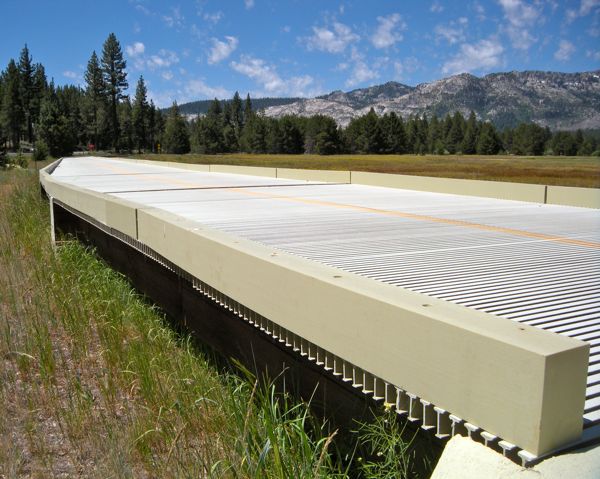
The South Shore can expect more bike trail improvements like this one at Sawmill and Highway 50. Photo/LTN file

Following Navarro’s presentation, bike committee member Chuck Nelson expressed concerns that the BAC’s recommendations on funding priorities as well as specifics on the creation of a collaborative bike trail maintenance program may not be carried out as envisioned.

“The Bicycle Advisory Committee has a very important role under Measure R in providing recommendations to the JPA,” he insisted. “We want to make sure it’s done right.”

He asked that the motion approving the allocation of the $100,000 to the city require acceptance of the BAC’s recommendations.

El Dorado County Supervisor Norma Santiago responded that she supported the allocation of the $100,000 but could not support imposing such requirements on a jurisdiction, adding that everything she’d heard from the BAC indicated there had been and would continue to be an openness on the city’s part and that if any recommendations needed changing, the BAC would be involved in that process.

City Councilwoman JoAnn Conner, the South Lake Tahoe’s JPA representative, told Nelson, “You sound accusatory. It’s unfair to categorize the city as uncooperative. There’s nobody on the City Council who doesn’t believe in this … I suggest you work from a position of trust with the city. We’re committed to getting this process done.”

After additional discussion, the JPA unanimously approved all four of the Bicycle Advisory Committee’s requests.

Fields Advisory Committee member Ken Riegel then presented a PowerPoint outlining his committee’s requests for Measure R funding. They were:

• $134,000 to the Lake Tahoe Unified School District to rehabilitate the field at Sierra House Elementary School, which he described as “a dangerous, uneven field.”

• $90,000 to LTUSD for varsity softball field No. 2 at South Tahoe High School. He noted the school district has already done substantial work there and these funds would be used to complete that work.

• $20,000 to LTUSD for planning only at this time for the construction of an added multi-used softball field at the Al Tahoe fields site. Additional funding for the projects themselves would come and be used in 2014 and 2015. These fields, he noted, are the most highly used with over 300,000 children using them annually for softball, baseball and soccer. Because so many families are involved, he indicated that, “many volunteers and professionals are also available to rally on completing these projects.”

• Designate future JPA funds in the following amounts for additional fields projects: $134,000 for constructing an added field at Al Tahoe; $29,150 for relocation of the T-Ball field at Al Tahoe; and $92,600 for upgrading the existing fields at Al Tahoe.


Riegel also listed additional “unfunded projects” identified by the FAC at the magnet school in Meyers, Tahoe Valley Elementary, Bijou Community School and South Tahoe Middle School. The magnet school was identified as their top priority.

FAC member Marilyn Breisacher spoke to the importance of the “gender-neutral” improvements that have been made to fields in the community, specifically referencing the amenities to the fields at South Tahoe High School for girls. Her daughter, she explained, had to play in the past on a field with “no restrooms, concession stand or adequate seating,” adding that the improvements won’t just help local players but will also help bring in more girls softball tournaments.

The JPA approved all four FAC requests as presented. The next Recreation JPA meeting will be in July. The Bicycle and Field Advisory Committees will be meeting later this quarter and will bring updates to the July JPA meeting.

The three-member JPA consists of Santiago, Conner, and Tahoe Paradise Park Improvement District Board Member Judy Clot. The latter two are new to the board, with Friday being each of their first meeting.

Measure R was passed in November 2011 with the intention of changing and expanding the locations and services that could be funded by the Community Facilities District originally established by Measure S when it passed in September 2000. Measure S provided for a $5.8 million bond to construct an ice rink, four ball fields adjacent to Lake Tahoe Community College, improving Tahoe Paradise Park and opening it to the public, and maintaining 25 miles of new bike trails. Measure S also provided for yearly maintenance funding for the new athletic fields by LTCC, Tahoe Paradise Park and the newly constructed bicycle trails. Under Measure S, each single-family home in the district is assessed $18/year. Measure S/R will sunset in 2030.

In reality, only about eight to 10 miles of bike trails were built. The unused remainder of the annual Measure S allocation of $125,000 continued accumulating, but was unspendable. Measure R unlocked those funds by adding to the authorized improvements and services funded by Measure S to include the renovation and maintenance of Class 1 bicycle trails existing prior to Sep. 19, 2000, and the renovation of youth ball fields within the Community Facilities District. It created a Bicycle Advisory Committee and a Fields Advisory Committee to make recommendations to the JPA as to costs and priorities of future improvements and maintenance for sports fields as well as bicycle paths in the district.


9 people want to fill 1 S. Tahoe council seat

Nine people have applied for the one South Lake Tahoe City Council seat.

The four council members will interview the candidates Tuesday starting at 9am.

City Clerk Suzie Alessi conducted a random drawing to determine the order of interviews. Applicants will be interviewed in the following order: Howard Bittner, Kathay Lovell, Joan Walthall, Brooke Laine, Bruce Grego, Austin Sass, Billy Crawford, Scott Valentine, and Kay Ogden.

At the start of the Jan. 29 9am meeting, the council will discuss the process in which interviews will be conducted. Interviewing could include a set of questions that all applicants will be asked; or the council may wish to hold more of a “free form” interview process; or any other type of process they agree on.

All applicants will be present in the council chambers, unless the council decides otherwise.

If the council cannot pick a fifth member to fill out the two-year term left on Claire Fortier’s term, the voters would decide June 4.