Poland pleads not guilty to federal charges

South Lake Tahoe police Officer Johnny Poland pleaded not guilty Thursday to four counts of witness and evidence tampering.

Johnny Poland

The 44-year-old was arraigned Feb. 14. He was arrested on the federal charges in January, with an indictment being handed down earlier this month.

At the hearing in Sacramento, Poland asked for a jury trial.

“The government asked for modifications to the terms of his release because there are several firearms unaccounted for and there are rumors that he has had contact with a witness,” Lauren Horwood with the Department of Justice told Lake Tahoe News. “The magistrate judge felt there was not enough evidence to modify conditions and admonished Poland to account for his guns.”

Poland’s next scheduled court date is at the end of March. For now he is out on bail. He is on unpaid leave from the police department.

 — Lake Tahoe News staff report


Experts: California housing market gaining momentum

By Alejandro Lazo, Los Angeles Times

New foreclosures in California fell sharply in January as state rules for banks took effect, signaling that repossessions may finally settle in at levels not seen since before the housing bust.

The resulting decline in bank-owned properties listed for sale on the market — as well as record numbers of investors prowling for bargains — should give the state’s housing recovery momentum this year, experts said.

In the Southland, the new year kicked off with a sharp annual gain in sales, the highest volume for a January in six years. The region’s median home price notched a sharp 23.5 percent gain over the same month last year. And new foreclosure actions plummeted statewide.

“The recovery is for real, that is what I think is happening,” said Esmael Adibi, director of Chapman University’s A. Gary Anderson Center for Economic Research. “It is being driven by real demand, and fundamentals are favorable.”

The price gains reflect a shift in the market away from foreclosures and toward regular sales, indicating a recovery on solid ground, said Christopher Thornberg, founding principal at Beacon Economics.

“The question is, is it the real deal?” Thornberg said. “Sure it is. It is driven of course by a very tight market … about as tight as it gets, and ultimately inventory drives prices.”

Although prices may be gaining, the healthiest contributors to housing strength — employment gains and consumer confidence — appear to be playing less of a factor than investor activity and low mortgage interest rates. That’s cause for some concern, but the housing market still has a long way to go to recover from its peak summer 2007 levels, DataQuick President John Walsh said.

“This fledgling housing recovery has momentum,” Walsh said in a statement. “Already, price hikes have caused some to question whether it’s sustainable, whether it’s a ‘bubble.’ Let’s not forget, though, that we’re still climbing out of a deep hole from the housing downturn.”

The home price and sales gains came as foreclosure starts in California took a massive tumble last month as new state laws aimed at prohibiting certain aggressive bank repossession practices went into effect. The real estate website ForeclosureRadar.com reported a 60.5 percent decline in California default notices in January from December.

The number of default notices — the first formal step in the state’s foreclosure process — fell 77.7 percent from January 2012. A total of 4,500 such filings were logged last month — the lowest number of default no-

tices since at least September 2006, when the website’s records begin.

The website noted that the foreclosure drop came in January, when a package of tough new laws protecting California homeowners went into effect. Most notably, the Homeowner Bill of Rights bans the practice of “dual tracking,” in which a lender seizes a home while the owner is negotiating to lower mortgage payments.

The laws also outlawed so-called robo-signing — the improper or faulty processing of foreclosure documents — and would allow state agencies and private citizens to sue financial institutions, under limited conditions, for economic compensation and for additional civil damages of up to $50,000. Passed last year, the legislative package was sponsored by California Atty. Gen. Kamala D. Harris and written by 10 Democratic lawmakers.

While dramatic, the drop is part of a general decline in foreclosure actions over the last year as banks look toward short sales and loan modifications as alternatives to seizing homes.

“You will see a continued decline in defaults from regulator activity, new laws and from the economy,” said Dustin Hobbs, a spokesman for the California Mortgage Bankers Assn. “As long as the economy, and especially the housing market, continues to slowly heal itself, you will see fewer and fewer defaults.”

Katherine Porter, a UC Irvine law professor who is monitoring the state’s accord with the nation’s five largest mortgage servicers over foreclosure abuses, said that it was not clear to her whether the dramatic drop in foreclosures resulted directly from new laws. The decrease could be temporary, she said, as mortgage servicers adjust their foreclosure processing systems.

Madeline Schnapp, director of economic research for ForeclosureRadar, believes the low levels of foreclosures will continue.

“The plethora of anti-foreclosure laws have been very effective in reducing foreclosure activity to what you are seeing today,” she said.

Foreclosed homes made up just 15 percent of the Southern California resale market last month, down dramatically from the worst of the crash, when they hit a high of 56.7 percent in February 2009, according to DataQuick. Short sales made up an estimated 25.9 percent of January’s resale market.

Fewer foreclosures will probably lead to more gains in home prices, because foreclosures have been the main supply of cheap housing. But rising prices also will lift more underwater homeowners out of a negative equity position, helping them sell their homes, which could also loosen up supply.

Buyers paid a median $321,000 last month in Southern California, a reflection of rising prices and a shift in the buying mix from lower-end starter homes to pricier digs.

Sales of homes in the region’s move-up market have continued to gain. Sales of homes priced from $300,000 to $800,000 soared 49.6% year-over-year in January, while sales of homes costing more than $500,000 jumped 74 percent from a year earlier.

Meanwhile, sales of homes costing less than $200,000 fell 23.5 percent from the previous January, an indication of tight inventory levels in those markets as investors look to snap up houses and rent them out.





Meyers concentrates on what residents want

By Kathryn Reed

MEYERS – Get rid of the bug station, put in a crosswalk on Highway 50 and have a welcome sign.

Those are just the basics that people in Meyers want.

But when it came to free form discussion Wednesday night of what else they want, the ideas ranged from the immediate – create an app that includes all things Meyers – to the more ambitious – build a direct link to the Pacific Crest Trail.

Adam Lewandowski with TRPA explains the area plan process Feb. 13 to Meyers residents and business owners. Photo/Kathryn Reed

Some of the other ideas include restoring the Meyers Creek which once ran through town, erect wayfinding signs, establish a recreation hub, build a sign that involves recreation like bouldering and/or a slide, have parking lots that connect to trails, make the Old Meyers Grade more welcoming, have Tahoe Paradise Park be more prominent, provide public transit that goes to Reno, put a bridge across the Upper Truckee River.

This South Shore enclave at the base of Echo Summit embarked on a path starting last April to capitalize on assets instead of reinventing itself. An advisory panel of seven (three representing recreation, two residents, two business people) has been meeting since August to fine-tune elements from community meetings.

Facilitator and Meyers resident Michael Ward said locals, not tourists have been the focus — which he said is the way planning should be done.

The priorities of this group were outlined Feb. 13:

• Maintain Meyers’ unique character – this in part means focusing on what locals want, not how to attract tourists; as well as embracing heritage.

• On the ground improvements – do things, don’t just talk.

• Simplify permitting – potentially streamlining how special events can take place.

• Recreation – connect trails, make Washoe Meadows State Park more integral.

• Bike-pedestrian friendly – have businesses along routes so people can easily stop.

• Clustered parking – so people don’t have to drive from one business to the next.

• Decrease Caltrans right of way – so the frontage paralleling Highway 50 is put to better use.

All of the information is being gathered to be put into an area plan that will eventually have to be approved by the El Dorado County Board of Supervisors and Tahoe Regional Planning Agency Governing Board. It then becomes the planning bible for Meyers. Area plans replaced community plans in the new Regional Plan. (Despite a lawsuit filed this week, the Regional Plan passed in December is the law of the land today.)

The draft area plan for Meyers will be developed between now and May. Another community meeting will be called in May to go over it. The final area plan should be done in June.


Former Raley’s executive pleads guilty to federal charges

By Cathy Locke, Sacramento Bee

A former advertising director for Raley’s has pleaded guilty to his role in a complex scheme to defraud the West Sacramento-based supermarket chain of more than $2.5 million.

David John Magana, 46, of Auburn pleaded guilty Tuesday in U.S. District Court in Sacramento to conspiracy to commit mail and wire fraud, and to a money-laundering conspiracy.

According to court documents, Magana conspired with others to defraud Raley’s through a scheme that involved kickbacks, selling Raley’s paper inventory to third parties at a discount and supplying paper to Raley’s at an inflated price.

Lauren Horwood, a spokeswoman for the federal Department of Justice in Sacramento, said Magana is the only person charged in the case, but the investigation is ongoing.

John Segale, a spokesman for Raley’s, said Magana’s employment with the company ended in September 2010.

“As far as we know, no current Raley’s employees are being investigated,” Segale said.

Raley’s issued a written statement saying, “We greatly appreciate the efforts of the FBI and the IRS in getting this guilty plea. While we may never know what motivated his decision to commit fraud, it is clear he will pay a very steep price for his actions.”

According to court documents, Magana demanded that a company that provided printing services to Raley’s, Vertis Inc., and a company that provided paper supplies, Graphic Communication Holding Inc., pay a co-conspirator unnecessary commissions if they wanted to keep doing business with Raley’s.

Given Magana’s position as director of advertising, both firms agreed to pay Magana’s co-conspirator as long as Magana made sure that Raley’s reimbursed them.

Magana reimbursed the companies for the unnecessary commissions by disguising them as additional charges within their regular invoices. Magana approved payment of all the inflated invoices from the firms, and his co-conspirator paid Magana a kickback after he received money from Vertis and Graphic Communication, according to a federal Department of Justice news release.

Magana and others also worked together to sell significant quantities of Raley’s paper inventory to third parties at a discounted rate, according to federal authorities. Much of that paper was stored in a warehouse managed by a logistics company, but as Raley’s advertising director, Magana had access to the paper in the warehouse.

Magana and his co-conspirators advertised the discounted paper by word of mouth and through the Internet, and kept most of the proceeds, authorities said. They falsely reported to Raley’s that the paper had been used in the normal course of business.

Magana and a co-conspirator used a company known as Seven Sisters Media Inc. as a shell corporation through which they laundered the proceeds, authorities said.

Magana and another co-conspirator used a company known as Advantage Paper Inc. to receive a portion of the proceeds from the fraud scheme and also used Advantage Paper to supply paper to Raley’s at an inflated price.

They met periodically to determine the amount Raley’s would pay for the paper. In each instance, authorities said, the inflated price included the money that Advantage Paper paid Magana as a kickback.

Magana is to be sentenced June 4 by U.S. District Judge John A. Mendez. He could face a maximum sentence of 20 years in prison on the mail fraud charge and a fine of $250,000 or more, according to the news release.

The maximum sentence for the money-laundering charge is 20 years in prison and a fine of $500,000, or twice the value of the laundered property, whichever is greater.


Credit card numbers, pins stolen at S. Tahoe gas station

Anyone who has used a credit or debit card at the Safeway gas station in South Lake Tahoe may be a victim of fraud.

South Lake Tahoe police officers found a skimming device Feb. 13 at the station on Highway 50. A tip to the El Dorado County District Attorney’s Office that was forwarded to the police led to the discovery.

A skimming device was found at the South Lake Tahoe Safeway gas station. Photo/LTN

“The victim’s credit card information was stolen using a skimmer. A skimmer is a device that it used to steal credit card information,” a press release from SLTPD says. “Skimming can occur when a third party card reading device is installed by an identity thief, either out¬side or inside a fuel dispenser or other card-swiping terminal. This device allows the thief to capture a customer’s credit and debit card information, including their PIN, with each card swipe.”

Officers suggest any who purchased fuel at the station this month to monitor their credit card statements. They said there is more than one victim.

If you have any information about the suspect or if have been a victim of this type of fraud, call (530) 542.6100 or Secret Witness at (530) 541.6800.

— Lake Tahoe News staff report


LTUSD, LTCC create district boundaries, change election dates

By Kathryn Reed

A specific individual will soon represent residents in the Lake Tahoe Unified and Lake Tahoe Community College districts.

While the respective five-member boards will still be accountable to the entire community, individually a minority of the greater area will elect them. Both entities will switch to district elections in 2014. And both will have the same boundaries.

The map to the left illustrates the districts. (The yellow looking area is two districts — yellow on the left, light green on the right. Double left click on the map for a larger view.)

All of this is to meet the 2002 California Voting Rights Act regulations. The purpose of the state mandate is to ensure all ethnicities are represented and that minority groups have a realistic opportunity to be elected. Both education institutions did an analysis that determined at-large elections could open them up to a lawsuit.

LTUSD board members voted Feb. 12 for the changes, while the college board did so in January.

Another change is elections for both will be in even number years. This means all the current board members will have a year added to their terms.

For LTUSD, Wendy David and Barbara Bannar were to have their terms expire later this year. Instead, they will retain their seats until fall 2014.

David told Lake Tahoe News she would not be seeking re-election.

For LTCC, it means Roberta Mason, Kerry David and Molly Blann have until 2014 before their terms end.

If no candidate comes forward for a particular district, the remaining board members can appointment a person.

Before all of this becomes official, the El Dorado County Board of Supervisors and the state must approve various aspects of the plan.

In other action at the Tuesday LTUSD meeting:

• The board agreed to pursue the possibility of Tahoe Valley Elementary School becoming a Performing Arts Magnet School. A new principal will need to be hired no matter the direction the district goes because Mark Romagnolo is retiring at the end of the school year.

• The board agreed to the proposals approved in January by the South Lake Tahoe Recreation Facilities Joint Powers Authority board for about $250,000 in field improvements. The three priorities are spending about $134,000 to upgrade the field at Sierra House Elementary, $90,000 for the softball field at South Tahoe High (though LTUSD still needs to kick in more than $40,000 for the bathrooms), and $20,000 for detailed planning to revamp the Al Tahoe fields. The money comes from voter approved Measure R.


Big 5 entertaining thoughts of opening in S. Tahoe

Big 5 Sporting Goods is eyeballing South Lake Tahoe as a possibility for a store location.

The Southern California-based sporting good retailer has long been rumored to want to operate on the South Shore. In the past, they had been linked to the resurrection of the old Millers Outpost. With T.J. Maxx opening there last fall, the athletic store chain has being looking elsewhere.

Now the spot of choice is at the Factory Stores at the Y in the old Adidas location. (They also looked at the old Sports Ltd. spot near Raley’s at the Y.)

An out of town sign maker contacted the city’s planning staff on Feb. 12.

“It is not an application for signage, which is the official document. It is a proposal to see if the signage would work,” associate planner Judy Finn told Lake Tahoe News. “Please be aware that we have had many inquiries similar to this for businesses that have not panned out.”

Officials from Big 5 did not return a call. It is not known what Big 5 officials know about the financial troubles the owners of the Y stores are having.

— Lake Tahoe News staff report


Plane bound for Tahoe crashes, 2 hurt

By Tri-County Newspapers

Two Ukiah men were injured when their plane crashed into the edge of an almond orchard near Williams on Tuesday.

The identities of the men were not immediately available, but Colusa County sheriff’s Sgt. Kevin Erdelt said that heavy smoke in the cockpit forced the two-seat Lancair 360 to the ground.

This is they type of plane involved in the emergency landing.

The two men were on their way from Ukiah to Lake Tahoe, Erdelt said.

“There was some light smoke in the cockpit so they started to descend,” Erdelt said. “Then the smoke got heavier and they ended up crashing.”

The craft, considered an experimental plane, hit some almond trees west of East Camp Road and about a mile south of Highway 20.

One man was airlifted to Enloe Medical Center in Chico with what was described as major injuries. The other man was taken by ambulance to Colusa Regional Medical Center, but also was expected to be airlifted to an area hospital, Erdelt said.

The accident, which happened about 11:30am Feb. 12., is under investigation by the Federal Aviation Administration and the National Transportation Safety Board.


Driver takes out wall of South Tahoe post office

By Kathryn Reed

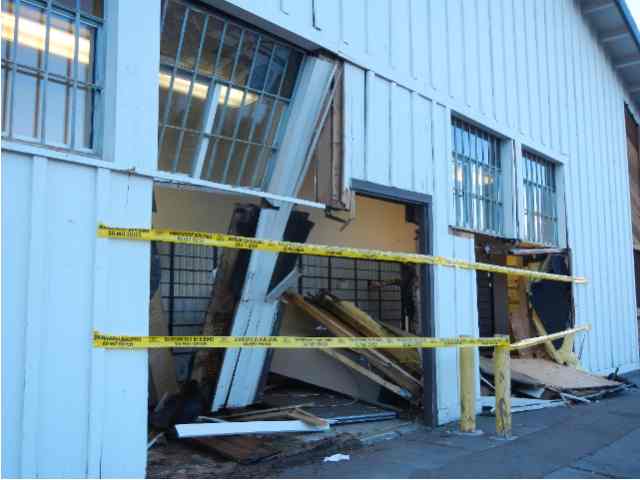
Almost an entire side of the post office at the Y in South Lake Tahoe is damaged.

A 61-year-old South Lake Tahoe woman twice drove through the wall on the left side of the building on Feb. 12.

When officers arrived the 2002 Ford Explorer was still in the building. The woman was given a field sobriety test, which was negative. She was not cited.

Two gaping holes were left from one vehicle Feb. 12 at the Tahoe Valley Post Office. Photo/Kathryn Reed

“She said the accelerator stuck, which caused her to go into building. She put it in reverse and as she was backing up she tried to put it in neutral, but she hit drive again and she went through post office again, at which time she shut the car off,” police Officer Donna Kingman told Lake Tahoe News.

The vehicle appeared to be totaled, with the windshield smashed and major damage sustained to the front end.

An ambulance was not called, but Kingman said the woman was spitting out glass.

While it caused quite a commotion Tuesday afternoon, it was business as usual inside the post office.

The building was to be secured, though just before 5pm the post office was wide open except for the yellow tape across the holes. People who have postal boxes in that area may obtain their mail from the front counter.

The local postmaster deferred comment to corporate PR. He was not available for comment.


Toxic emissions rise in California

By Edward Ortiz, Sacramento Bee

Toxic chemicals released into the environment by manufacturing plants and facilities in California rose in 2011 after steady annual declines since 2007, according to the U.S. Environmental Protection Agency’s yearly Toxic Release Inventory report.

The TRI report also found that releases decreased in Sacramento and Solano counties, but increased year over year in Placer and Yolo counties in 2011, the latest year for which the EPA has toxic release information.

Agency data show that the Valero Refining Co.’s petrochemical refinery in Benicia – in Solano County – was one of the state’s top 10 largest releasers of toxic chemicals in 2011, accounting for more than a half-million pounds of toxics released.

The largest emitter of toxics in Sacramento County was the Procter and Gamble plant on Fruitridge Road, which released more than 427,000 pounds of toxics, according to EPA data.

Nationwide, overall releases of toxic chemicals rose in 2011 for the second year in a row, the TRI report shows. Total toxics released increased by 8 percent from 2010.

In California overall, the EPA’s data found a 10 percent increase from 2010 in total pollution added to the environment.

In the state report, pollution released into the air statewide fell 13 percent in 2011, but releases to water and land increased by 10 percent and 9 percent, respectively.

The TRI yearly reports are used as indicators but do not establish what caused the numbers to change.

“There could be any number of different reasons for these numbers to go up or down,” said Lily Lee, toxics release inventory coordinator with the EPA.

Economics, however, may be a factor, she said.

“I have heard from individual facilities that have told me that economic activity may explain why release amounts have gone up in their facilities,” Lee said.

But Lee said the EPA analyzed a 10-year period of national TRI data in order to establish whether there is a link between economic indicators and increases or decreases in toxic releases. That analysis did not find a direct link between the two.

“The caveat is that the TRI report is a national grouping together of a lot of places and all kinds of industries,” Lee said.

Established by a 1986 law, the TRI report is one of the most comprehensive U.S. public pollutant databases. It offers a big-picture look at what is released into the environment in several industry sectors that include manufacturing, metal mining, electric utilities, commercial hazardous waste facilities and petrochemical facilities.

The public report – which encompasses 682 chemicals and categories of chemicals considered by the EPA to be harmful to the environment or human health – is used as an indicator of releases and not whether, or to what degree, the public is exposed to a certain chemical.

The broad strokes of the TRI report may be its biggest limitation, said Anthony Wexler, director of the Air Quality Research Center at the University of California, Davis.

“When you’re talking about any increases or decreases – that’s too crude a measure,” said Wexler. “Some toxic compounds may be emitted in large quantities but have very low toxicity, whereas other compounds may be emitted in small quantities but be very toxic. It’s the combination of these two factors that govern how ‘bad’ a release is.”

Some of the most problematic substances released are those that persist in the environment and in body tissue. In 2011 there was a 24 percent rise in such chemical releases in California.

One of those substances is lead, which saw a 3 percent increase in 2011, with about 4.9 million pounds added to the environment. Lead has been linked to nerve and brain damage – and other health problems – in children and adults.

For Wexler, of equal or greater concern may be what gets sent into the atmosphere under our noses daily – tailpipe emissions.

“Those kinds of releases are not like from an industry, where releases have to be reported,” Wexler said. “It’s you and me, as well as trucking and bus companies – these are also emitting these (carcinogens).”