Gaines, Bigelow bring no new taxes message to Tahoe

By Kathryn Reed

A unified anti-tax voice permeated the room as state Sen. Ted Gaines and Assemblyman Frank Bigelow spoke Friday to their constituents in South Lake Tahoe.

The two Republican legislators meandered through the crowd at Riva Grill before each addressed the assembled guests.

“We don’t need additional taxes, what we need is to streamline government,” Gaines said March 1 in response to a question by South Lake Tahoe City Councilwoman Angela Swanson.

State Sen. Ted Gaines and Assemblyman Frank Bigelow talk March 1 in South Lake Tahoe. Photo/Kathryn Reed

State Sen. Ted Gaines and Assemblyman Frank Bigelow talk March 1 in South Lake Tahoe. Photo/Kathryn Reed

She asked about whether the two men favored changing the current two-thirds requirement to raise taxes to be lowered to 55 percent.

“We have a problem in the system. There are a number of items that are bloated. We need to fix that before we ask anyone to step up and pay more,” Bigelow said.

Gaines touched on a few bills he is working on. From the get-go Gaines opposed the governor’s fire fee; instead calling it a tax. Senate Bill 17 would repeal the $150 fee CalFire levies on buildings in State Responsibility Areas (SRA). Senate Bill 125 exempts a property owner of a structure that is located both within an SRA and within the boundaries of a local fire protection district from paying the $150 tax. Senate Bill 147 exempts any property owner located within an SRA who has an income of less than 200 percent of the federal poverty level from paying the $150 fire tax.

He also talked about the state Board of Equalization on Feb. 28 voting to raise the excise tax on gasoline by 3.5 cents per gallon, which will be effective July 1.

Gaines also said he is working with Lake Tahoe Community College on a bill that would allow Nevada residents to attend the two-year institution at the rate Californians pay.

He tiptoed around the loop road controversy, saying it’s a “local decision.” While that is true, it is also a state issue because it involves a state highway.

This was Bigelow’s first public meeting on the South Shore since he was elected in November.

While the legislators said they are not anti-regulation, they agree it needs to be logical and reasonable. Considering the Lake Tahoe Basin is often touted as one of the most regulated regions in the country, the people listening are constantly facing layers of rules not often found elsewhere.

Both men represent a large swath of the state.

Gaines, who is from the Roseville area, is in a district that goes from Alpine County to the Oregon border. The 11 counties it encompasses is larger than 10 U.S. states. Bigelow’s Fifth District, which is newly realigned, takes in nine counties from El Dorado to Madera, where he is from.

Note:

Gaines is hosting a March 12 open house at his El Dorado Hills office that opened last month. It is from 6-8pm at 4359 Town Center Blvd., Ste. 112, El Dorado Hills.


Placer County changes sand mixture for snowy roads

By Barbara Barte Osborn, Sacramento Bee

Placer County supervisors approved a plan Tuesday that is expected to keep many thousands of pounds of fine sediment from entering Lake Tahoe.

The plan, to be submitted to the state Lahontan Regional Water Quality Control Board, includes the use of coarser sand on roads this winter to improve vehicle traction.

placer countyThe sand is expected to reduce the amount of fine sediment reaching the lake in snow and rain runoff by nearly 5,000 pounds annually, according to county officials. The county will also purchase a high-efficiency, vacuum-assisted sweeper.

“Our choice of sand material was based on a Caltrans study of different abrasives … comparing fine-sediment content and durability,” said Robert Costa, manager of the county’s Department of Public Works.

The county’s plan is required under a recently updated federal permit regulating storm runoff into the lake. Ongoing since 1992, it is renewed every five years, each time with new requirements, Costa said.

Six additional Placer sediment-reduction projects have begun. Projects in Kings Beach and Tahoe City are expected to prevent nearly 17,000 pounds of pollutants from entering the lake when completed, according to a county news release.


Concord’s Tahoe camp expected to be repaired before summer

By David DeBolt, Contra Costa Times

The Concord City Council voted unanimously Tuesday to support emergency repairs at Camp Concord, avoiding a possible delay in the opening of the city-operated camp.

The 5-0 vote declared an emergency at the Lake Tahoe facility and allowed interim City Manager Valerie Barone to execute a no-bid construction contract to speed up repairs.

The camp opens in May each year and runs until September, but copper thefts threatened to delay the opening.

During a security check Dec. 20, a camp seasonal employee found that all the copper pipe plumping had been removed from the family camp bathhouse, and that more copper was stolen from a maintenance shed, according to a city staff report.

A subsequent visit on Jan. 15 revealed that copper piping had been stripped from six additional buildings.

The camp is closed during the winter months, and is patrolled by security checks. The thefts are now under investigation by the El Dorado County Sheriff’s Department.

In a city report, interim City Engineer Jon Crawford said the usual bidding process, which can take up to three months, could mean a delay in opening the spring and summer programs at the camp. Any delay, he told the council Tuesday, could result in the loss of customers, and, in turn, revenue.

The city has already rented out the site to two groups in May, and some 60 families have registered to attend during the family camp season, according to the report.

City officials initially estimated the total damage at $70,000 to $80,000.

The city has leased the 29-acre site in the Lake Tahoe Basin from the federal government since 1967. Concord’s permit to run the camp expires in 2025.

The camp faced closure during the 2012 city budget talks, but was saved by overwhelming community support.

Earlier in Tuesday’s meeting, Public Works Director Justin Ezell said more than $1 million has been spent since 2007 to replace stolen copper wiring on city properties.


2 multimillion dollar lakefront houses sell at Lake Tahoe

By Sarah Tilton, Wall Street Journal

Venture capitalist Steven Stull and his wife, Claire, have paid $11.875 million for a waterfront home in Incline Village, according to public records.

The roughly 10,000-square-foot home sits on 0.82 acre with 100 feet of shoreline. The house has five bedrooms, five bathrooms, two half-bathrooms, an elevator, a wine cellar, four fireplaces and a laundry room with a pet shower.

The seller was Chuck Bluth, the former owner of the Cal Neva Resort, who built the home in 1997.

“It was a helluva buy,” says Bluth of the recent deal. Bluth has moved to a 20,000-square-foot home on 4 acres on the East Shore of Lake Tahoe. “I like land and I like my privacy,” says Bluth, a real-estate developer and entrepreneur.

Bluth had raised the asking price of the home to $15.5 million last month, up from a previous asking price of $13.998 million in September. It was first listed in 2007 for $15.998 million.

Lexi Cerretti of Sierra Sotheby’s International Realty represented the buyers. Jean Merkelbach of Sierra Sotheby’s International Realty represented the seller.

Also in Incline Village, rancher and real-estate developer Les Busick recently paid $10.5 million for a lakefront property that includes a 2,500-square-foot house, a white-sand beach, a pier and a boat house. The house had been listed for $13.9 million.

Tim Lampe of Lakeshore Realty represented the buyer and the seller. The seller was the Coleman Family Trust, according to public records.


Breast cancer among young women increasing

By Monte Morin, Los Angeles Times

Rebecca Johnson was 27 years old and had just graduated from medical school when she got the diagnosis: breast cancer. She thought she was a rare case, but then a few of her friends got it too. So did some friends of friends.

Was it all just a coincidence, or was breast cancer becoming more common in younger women?

think pink“I really wondered,” said Johnson, now 44 and the director of the Adolescent and Young Adult Oncology program at Seattle Children’s Hospital. So she examined decades’ worth of data from the National Cancer Institute and made a disturbing find: Cases of younger women with advanced breast cancer have increased about 2 percent each year since the mid-1970s and show no signs of abating.

The results, published in Wednesday’s edition of the Journal of the American Medical Assn., confirmed the suspicions of many oncologists who had noticed an uptick in patients younger than 40 with cancer that had spread to the bones, brain or lungs.

In 1976, 1.53 out of every 100,000 American women 25 to 39 years old was diagnosed with advanced breast cancer, the study found. By 2009, the rate had almost doubled to 2.9 per 100,000 women in that age group — a difference too large to be a chance result.

“Most studies have failed to show an absolute increase,” said Dr. Benjamin Paz, a City of Hope Cancer Center surgeon who was not involved in the study. “Now, looking at a longer period of time, this study shows there’s clearly been an increase. It’s the first to do so.”

The trend, which has yet to be explained, has raised real concerns about future efforts to treat the disease. Survival rates for young women with metastatic breast cancer are much lower than they are for older women, because the cancer tends to behave more aggressively in the young.

The data from the U.S. Surveillance, Epidemiology and End Results, or SEER, database detected a significant increase among black and white women in both urban and non-urban areas, suggesting that the root cause or causes were widespread.

“An increasing number of young women in the United States will present with metastatic breast cancer in an age group that already has the worst prognosis, no recommended routine screening practice, the least health insurance, and the most potential years of life,” Johnson and her coauthors wrote.

To be sure, it remains uncommon for a young woman to be diagnosed with breast cancer. About 7 percent of all breast cancers diagnosed in the United States involve women younger than 40, and on average, 1 in 173 women in this age group risks developing some type of breast cancer.

Johnson and her coauthors said they hoped that other Western nations would corroborate their findings using their own data. If a trend is established, research should investigate the reason for the increase, they added.

They hypothesized that the trend was due to a variety of lifestyle changes that have occurred during the study period. Diet, exercise, obesity, earlier onset of menstruation, use of birth control, delayed pregnancy and other factors all might play a role.

A few smaller studies have examined risk factors such as obesity, sedentary lifestyle and high caloric intake and concluded that when combined, they do predispose to young adult breast cancer.

However, it is still unknown exactly why cancers can behave so much more aggressively in younger patients, and why estrogen — or the blocking of it — has a very different effect on cancer cells in younger and older women.

“There’s something different about breast cancers in young adults than in older people,” Johnson said. “Researchers that are focusing on cancer in young adults are trying to tease out what those biological differences are.”

In the meantime, she said she hoped the study would alert young women to the risks of breast cancer.

“There’s no evidence that 29-year-olds should go out and get mammograms or anything like that,” Johnson said. “But if there’s a take-home message, I would say that it would be awareness of the fact that breast cancer can happen even in young women and that it’s important for both young women and their doctors to be aware of this.”


Students protest McClintock’s office

Student activists organized by California Fair Share gathered at Rep. Tom McClintock’s district office in Granite Bay on Feb. 28 to call on him to stop the sequester by closing corporate tax loopholes.

The students unfurled and gave the Republican congressman the 100-foot banner constructed from more than 600 petition signatures.

banner

Sierra College students protest Feb. 28 outside Rep. Tom McClintock’s office. Photo/Provided

“Hundreds of citizens and dozens of student leaders have come together in the past few weeks to make one thing clear: we should close corporate tax loopholes, not make cuts that will lay-off teachers, police and firefighters,” said Patrick Stelmach, an organizer with California Fair Share, said in a statement. “With California schools already overcrowded and underfunded, we cannot afford to slash education funding with reckless abandon. It is time to make corporations pay their fair share. Rep. McClintock should stand up for our kids’ future, not corporate profits.”

The group met with McClintock’s staff Thursday afternoon.

“McClintock wants the sequester cuts to go through. His position on corporate tax loopholes is he favors eliminating them but only if the overall rate was lowered. While we applaud his intention to close loopholes, we are opposed to the drastic budget cuts and giving corporations more tax breaks,” Stelmach said.


El Dorado County Grand Jury disbanded

By Kathryn Reed

El Dorado County no longer has a grand jury.

Steve Bailey, the Superior Court judge who oversees the volunteer board, signed a court order Feb. 22 dissolving this year’s jury. The document says the reason is because the grand jury numbers dropped below the minimum of 12 and “that due to the lateness of the year, alternate jurors cannot be sworn in and trained and thereafter conduct meaningful investigations before the statutory discharge of the jury in June 2013 ….”

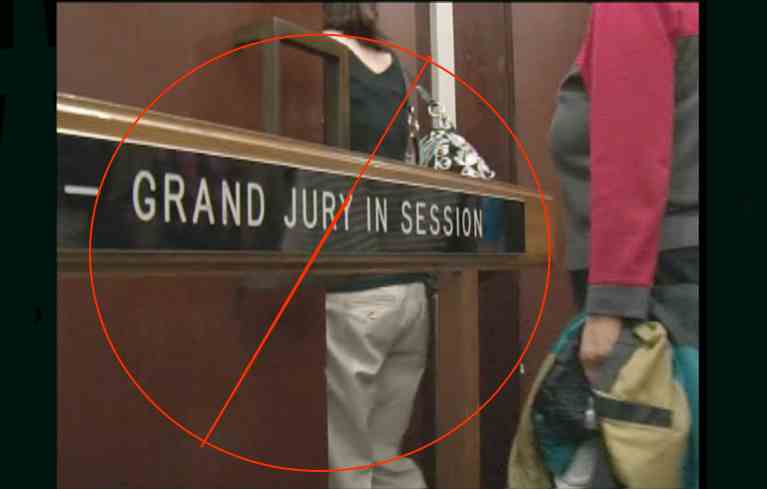
grand juryBailey is out of town this week at a conference and could not be reached.

He oversees the grand jury that looks into county matters, even though he is married into a politically charged family with deep roots on the West Slope.

There had been 19 active grand jury members, with 14 of them resigning this year.

Sources close to the situation told Lake Tahoe News one member of the grand jury was regularly meeting with former El Dorado County Supervisor Jack Sweeney to tell him what the grand jury was doing. This violates state Penal Code.

That individual essentially became a poison pill within the group, creating distrust and disharmony, and prevented others from doing the job they were tasked with.

Sweeney is good friends with Supervisor Ron Briggs. On Dec. 18, 2012, John Briggs, father of the supervisor, was before the Board of Supervisors representing the Briggs Family Trust. On a 4-0 vote, with Supervisor Briggs recusing himself, the others agreed to purchase 5.2 acres from the trust on which a future courthouse is likely to be built.

Judge Bailey is the brother-in-law of the supervisor and son-in-law to the elder Briggs. And it is Bailey who watches over the grand jury, which looks into county matters, of which his in-laws are intricately involved in.

Judges receive regular training on ethics and are charged with determining whether a matter they are assigned creates an impermissible conflict of interest per the Code of Civil Procedure.

Ray Van Asten, who was foreman of the 2012-13 grand jury, told Lake Tahoe News he is one of the jurors who quit. But he would neither say why, nor talk about what led to others quitting.

“We are unable to say what happens inside the jury room,” Van Asten said.

It is not known what the grand jury was investigating.

“What they are looking at or not is not something I could talk about if I knew,” Suzanne Kingsbury, presiding judge of the El Dorado County Superior Court, told Lake Tahoe News.

She said in the 28 years she has lived in the county (she has been on the bench 17 of those years) she does not know of a time when a grand jury was discharged midterm.

“The purpose of the civil grand jury is to act as a public watchdog and examine the operations of cities, counties and special districts. I think that the role of the grand jury in our state is a critical one,” Kingsbury said.

Even so, there will be no grand jury report in June. It is possible that whatever this term’s jury was investigating could be taken up by the next grand jury that is seated.


Online guns sales thriving

By Nick Leiber, Bloomberg Businessweek

In October, Google joined other big online marketplaces including eBay, Craigslist and Amazon.com in banning weapons listings on its revamped shopping site. The move, which the company said was in keeping with its advertising policy, predated the Newtown, Conn., school massacre by about two months. Yet there is no evidence that Google’s action has curbed online gun sales.

That’s because sellers, incensed by the prohibition on gun listings, are finding new outlets for their wares. Cory Brown, a sporting goods merchant who runs several e-commerce sites in Rockville, Md., estimates that Google once helped drive 80 percent of the roughly $5 million in annual sales of ammunition, shooting accessories and outdoor equipment at one of his online stores.

gunRather than just complain to the search giant, he started FreeGunShow.com in December, an online classified ad service for guns and other gear. “I was like, look, I’m tired of these companies, whatever (their) motivations, prohibiting the sale of things that are legal,” Brown said. “When Google pulled the plug on this kind of stuff, I knew something bad was happening.” Another firearms marketplace, GunCycle.com, based in Princeton, Kan., is scheduled to go online this week.

Internet auction sites

In 2000, when the U.S. Department of Justice last did an official tally, there were about 80 online firearms auction sites and approximately 4,000 other sites offering guns for sale in the country. Today, as the national gun control debate intensifies in the wake of the Newtown tragedy, it’s a safe bet that gun buyers have even more online options.

Bureau of Alcohol, Tobacco, Firearms and Explosives spokeswoman Ginger Colbrun says the federal agency is aware that there’s been a boom in gun buying sites. Federal gun safety proposals circulating in Washington that would tighten background checks might take a bite out of sales if passed by Congress. Yet none are intended to put these digital weapons bazaars out of business.

New sites like Brown’s and older ones such as GunBroker.com and Armslist function as marketplaces for buyers and sellers and make money through advertising or transaction charges. GunBroker.com, which bills itself as the world’s largest gun auction site, has brokered more than $2 billion in sales since its founding in 1999, according to the site.

Online sales anger gun control advocates because shoppers can use them to exploit a long-standing loophole in federal law that allows unlicensed private gun sellers to skip background checks on prospective buyers in their home state. Also, while it’s a felony to sell a firearm knowingly to an individual who would not pass a background check because of a criminal record or history of mental illness, many private sellers flout that rule.

Bob Ralph shuttered Express Police Supply, a brick-and-mortar store in Lenexa, Kan., that sold Smith & Wesson’s M&P 15 semiautomatic rifles and Glock’s 22 handguns, in 2011. Now he’s gearing up for GunCycle.com. Ralph acknowledges that a private collector who auctioned a gun through his site could meet the buyer in a parking lot and hand over the weapon without a background check. “There would be no way for me to stop that or preclude that,” he said. “And it would be legal for them to do it that way.”

An undercover investigation by New York City of private firearms sales online in 2011 showed 62 percent of sellers agreed to sell a firearm to investigators posing as buyers who indicated they probably couldn’t pass a background check.

“Buyers can buy and sellers can sell in almost complete anonymity. So if you’re looking to avoid being seen – a paper trail or legal scrutiny – you’re going to turn (to Internet sites) first,” said Mark Glaze, director of Mayors Against Illegal Guns. The group, which includes more than 850 U.S. mayors, was co-founded by New York City Mayor Michael Bloomberg.

Gun control advocates are trying to halt the proliferation of online marketplaces for firearms. Two days before the Dec. 14 Connecticut school shooting, Armslist was sued by relatives of a woman who was murdered in suburban Chicago in 2011 by a man who shot her with a weapon advertised on the site.

The wrongful-death lawsuit, the first against an online weapons seller, was launched by the Brady Center to Prevent Gun Violence on behalf of Jitka Vesel’s family. Armslist didn’t respond to requests for comment sent via its website; a telephone number wasn’t available.

Others in the same line of business have not been cowed. “This lawsuit will die. You cannot sue a third party in this case. Been proven over and over in case law,” Cory Brown wrote in an e-mail. He says his 2-month-old site has more than 1,000 registered users and would be doing even better if he had more merchandise. “A lot of our sellers own stores and inventory right now is real hard to get,” he wrote in another email. “Anytime we see an in-demand gun come up, it doesn’t last long.”


Resolution for some of Lane’s troubled South Shore land deals

By Kathryn Reed

Randy Lane, the developer of the would-be convention center in South Lake Tahoe that is a pile of rebar and concrete after his Lake Tahoe Development Company filed for bankruptcy on that project, is making news on both sides of the state line.

Regarding the property in South Tahoe, Owens Financial has filed a foreclosure notice on the remaining properties that were owned by Lane. If the trustee sale goes through on March 20, then Owens Financial will own those properties and Lane will not have any interest in the 11-acre site, South Lake Tahoe City Attorney Patrick Enright told Lake Tahoe News.

Lake Vista Apartments in Stateline.

Lake Vista Apartments in Stateline.

A portion of the project is going forward on land that Bill Owens already owns. His proposed retail development along six parcels that front Highway 50 is in the design review stage with the city. While he wants to start the project this building season, a performance bond and consolidation of the properties must be done first. He does not need a new building permit, just to tweak what was approved to allow for the project to go forward in stages. The proposal should be before the city Planning Commission in April or May.

In Douglas County, officials have worked out a settlement with the now-defunct Falcon Capital LCC that Lane once owned and ran.

The county filed a claim against Falcon Capital for breach of contract and misrepresentation. Falcon Capital was supposed to maintain the water quality improvements at Kahle Drive in Stateline after the county put them in. The construction of these improvements was a condition of approval imposed by the Tahoe Regional Planning Agency.

“When Falcon Capital did not perform its obligations under its contract with the county, the county filed suit and obtained a judgment against Falcon Capital on the breach of contract claim in the amount of $439,205.32,” County Manager Steve Mokrohisky told Lake Tahoe News. “Falcon Capital is now out-of-business and transferred its remaining assets, three parcels of undeveloped land located in Incline Village, to the county. The core claims against Meadow Brook Associates and Lake Vista Apartments are for unjust enrichment and equitable relief. Lake Vista is the managing partner for Meadow Brook Associates. These defendants were able to construct low-income housing on property formerly held by Falcon Capital.”

Douglas County commissioners at a meeting this month approved a 10-year settlement agreement that brings to a close the claims against Falcon Capital.

Mokrohisky said the only significant asset held by Meadow Brook and Lake Vista is the low-income housing project at 129 Market St. in Stateline. But, he added, it has been losing money for several years.

“The property is worth less than the amount due to the holder of the first deed of trust,” Mokrohisky said. “To settle the case, these defendants have agreed to perform maintenance for the county at a cost of $5,000 per year. Because the county wants to encourage affordable housing at Lake Tahoe, the county is willing to work to reach a settlement.”


Name released of South Lake Tahoe pedestrian who was killed

Updated Feb. 18 1:30pm:

The name of the man who was fatally struck by an alleged drunken driver Feb. 22 on Lake Tahoe Boulevard has been released.

John Carleton, 51, of South Lake Tahoe died at Barton Memorial Hospital.

The cause of the accident is still under investigation and autopsy results are pending.

—-

A South Lake Tahoe man died Friday night after being struck by a vehicle on Lake Tahoe Boulevard.

The vehicle involved in the fatal accident. Photo/Provided

The 51-year-old, whose name is not being released pending notification of next to kin, was near the Taco Bell when he was hit at 6:45pm Feb. 22.

Gregory Stearns, 49, of South Lake Tahoe was driving with a suspended driver’s license from a prior DUI conviction. He was arrested on charges of driving under the influence of alcohol and driving on a suspended license.

“The cause of the collision is still under investigation, initial indications are that the pedestrian was crossing Lake Tahoe Boulevard outside of a crosswalk, was wearing dark clothing in an unlit portion of the highway, and failed to yield to the oncoming traffic,” police Sgt. Shannon Laney said in a statement. “The pedestrian may also have been intoxicated and has a history with the South Lake Tahoe Police department for public intoxication.”

— Lake Tahoe News staff report