Roe v. Wade ruling casts shadow over gay marriage

By Adam Liptak, New York Times

WASHINGTON — When the Supreme Court hears a pair of cases on same-sex marriage on Tuesday and Wednesday, the justices will be working in the shadow of a 40-year-old decision on another subject entirely: Roe v. Wade, the 1973 ruling that established a constitutional right to abortion.

Judges, lawyers and scholars have drawn varying lessons from that decision, with some saying that it was needlessly rash and created a culture war.

Justice Ruth Bader Ginsburg, a liberal and a champion of women’s rights, has long harbored doubts about the ruling.

“It’s not that the judgment was wrong, but it moved too far, too fast,” she said last year at Columbia Law School.

Briefs from opponents of same-sex marriage, including one from 17 states, are studded with references to the aftermath of the abortion decision and to Justice Ginsburg’s critiques of it. They say the lesson from the Roe decision is that states should be allowed to work out delicate matters like abortion and same-sex marriage for themselves.

“They thought they were resolving a contentious issue by taking it out of the political process but ended up perpetuating it,” John C. Eastman, the chairman of the National Organization for Marriage and a law professor at Chapman University, said of the justices who decided the abortion case. “The lesson they should draw is that when you are moving beyond the clear command of the Constitution, you should be very hesitant about shutting down a political debate.”

Ginsburg has suggested that the Supreme Court in 1973 should have struck down only the restrictive Texas abortion law before it and left broader questions for another day. The analogous approach four decades later would be to strike down California’s ban on same-sex marriage but leave in place prohibitions in about 40 other states.

But Theodore J. Boutrous Jr., a lawyer for the two couples challenging California’s ban, said the Roe ruling was a different case on a different subject and arose in a different political and social context. The decision was “a bolt out of the blue,” he said, and it had not been “subject to exhaustive public discussion, debate and support, including by the president and other high-ranking government officials from both parties.”

“Roe was written in a way that allowed its critics to argue that the court was creating out of whole cloth a brand new constitutional right,” Boutrous said. “But recognition of the fundamental constitutional right to marry dates back over a century, and the Supreme Court has already paved the way for marriage equality by deciding two landmark decisions protecting gay citizens from discrimination.”

The author of the majority opinions in those two cases, Justice Anthony M. Kennedy, seemed to address the new ones in wary terms in remarks this month in Sacramento.

“A democracy should not be dependent for its major decisions on what nine unelected people from a narrow legal background have to say,” he said.

In Justice Ginsburg’s account, set out in public remarks and law review articles, the broad ruling in the abortion case froze activity in state legislatures, created venomous polarization and damaged the authority of the court.

“The legislatures all over the United States were moving on this question,” Ginsburg said at Princeton in 2008. “The law was in a state of flux.”

“The Supreme Court’s decision was a perfect rallying point for people who disagreed with the notion that it should be a woman’s choice,” she added. “They could, instead of fighting in the trenches legislature by legislature, go after this decision by unelected judges.”

That general view is widely accepted across the political spectrum, and it might counsel caution at a moment when same-sex marriage is allowed in nine states and the District of Columbia and seems likely, judging from polls, to make further gains around the nation.

“Intervening at this stage of a social reform movement would be somewhat analogous to Roe v. Wade, where the court essentially took the laws deregulating abortion in four states and turned them into a constitutional command for the other 46,” Michael J. Klarman, a law professor at Harvard, wrote in a recent book, “From the Closet to the Altar: Courts, Backlash and the Struggle for Same-Sex Marriage.” Klarman was a law clerk to Justice Ginsburg when she served on the federal appeals court in Washington.

But an article that will appear in Discourse, an online legal journal published by The UCLA Law Review, proposes a different account. “The Roe-centered backlash narrative, it seems, is the trump card in many discussions of the marriage cases,” wrote Linda Greenhouse, a former New York Times reporter who covered the court and now teaches at Yale Law School, and Reva B. Siegel, a law professor there.

“Before Roe,” they wrote, “despite broad popular support, liberalization of abortion law had all but come to a halt in the face of concerted opposition by a Catholic-led minority. It was, in other words, decidedly not the case that abortion reform was on an inevitable march forward if only the Supreme Court had stayed its hand.”

After the decision, they added, “political realignment better explains the timing and shape of political polarization around abortion than does a court-centered story of backlash.”

In an interview, Siegel said court decisions concerning same-sex marriage had played a valuable role.

“It is nearly two decades since courts in Hawaii, Massachusetts and other states began a national conversation about marriage,” she said. “There has been over the course of this long period a dramatic, revolutionary change in popular understanding of marriage equality. Courts can inspire resistance but also can teach.”

Klarman said it was not clear that a decision requiring same-sex marriage throughout the nation would give rise to the kind of sharp opposition that followed the abortion ruling.

“For abortion opponents, abortion is murder, which means the intensity of their commitment to resisting Roe was considerable,” he said in an interview. “For the gay marriage opponent in, say, Mississippi, how will their lives change if the openly gay couple living down the street can now obtain a marriage license?”

There is a range of possible outcomes in the case on California’s ban on same sex marriage, Hollingsworth v. Perry, No. 12-144. The court could uphold the ban; reject it on grounds that apply only to California or only to eight states; or establish a nationwide right to marriage equality. Or the court could say it is powerless to render a decision on the merits.

That last option would follow from the odd path the case took through the courts. After a trial judge struck down the California ban, from the voter initiative Proposition 8, and entered judgment against state officials, the officials declined to appeal. Supporters of Proposition 8 did appeal, but it is not clear that they have suffered an injury direct enough to give them standing to appeal.

The trial court’s judgment came in 2010 from Judge Vaughn R. Walker of the Federal District Court in San Francisco. During closing arguments in the case, Judge Walker made it clear that he, too, was working in the shadow of the abortion ruling. He said the Roe case “has plagued our politics for 30 years” because “the Supreme Court has ultimately constitutionalized something that touches upon highly sensitive social issues.”

“Isn’t the danger,” Walker asked Theodore B. Olson, a lawyer for the two couples challenging the ban, “not that you are going to lose this case, either here or at the court of appeals or at the Supreme Court, but that you might win it?”


Report: South Shore transit reliable, financially stable

By Kathryn Reed

STATELINE – Buses are in better shape, they run on time more often, the yard is cleaned up, and the whole system is operating in the black. Those are the changes to BlueGo since the Tahoe Transportation District took over in November 2010.

And today, not a dime of the budget is coming from the casinos.

Curtis Garner, who is charge of the transit system on the South Shore, updated the TTD board March 22 about what has happened in the two plus years since the change in operator.

“The baseline is improving. We project to have the highest level of ridership since the 2009-10 season,” Garner said. Projections are for the non-skier rides to top 500,000 this fiscal year.

This is what the fare cards will look like.

This is what the fare cards will look like.

Weather plays a large role in BlueGo’s numbers because many of those on board are headed to Heavenly Mountain Resort. The ridership was up significantly in 2010-11 on the ski shuttles because that was the winter that would never end.

When BlueGo offered free rides on its main Highway 50 route during the Christmas-New Year’s span the ridership spiked.

Angela Swanson, who is South Lake Tahoe’s rep to the TTD board, said she would like staff to show what it would take to offer free ridership year-round.

Because a free bus system isn’t likely to happen any time soon, BlueGo staff is going forward with creating six magnetic passes that will be used by riders in lieu of cash. As soon as the devices are installed on the entire fleet, the cards will be sold to riders.

Garner said the big thing Tahoe needs to do is create a regional transit system. He added, that until it does so, bringing in events like the X Games or the Olympics would not be possible.

TTD board chairman Steve Teshera said funding is the big stumbling block when it comes to that regionwide system.

The next goals, Garner said, are to conduct a travel impact study of people going from the Bay Area to the Lake Tahoe Basin, a regional facilities alternatives analysis and long-range transit plan, and define a preferred local alternative for a passenger ferry.


Mediator picked to resolve transportation lawsuit

Mark Shinderman with Milbank Tweed, Hadley & MCloy LLP in Los Angeles has been selected to be the mediator in the MV Transporation-STATA case.

In January, U.S. Bankruptcy Court Judge Gregg Zive sent the case to mediation.

Fairfield-based MV Transportation used to run the South Shore bus system known as BlueGo. STATA – South Tahoe Area Transit Authority – was the overseer of the transit company. STATA was made up of public and private entities that had financially contributed to the BlueGo bus system. STATA filed for bankruptcy; MV in 2010 filed a complaint to be paid.

The cost of the mediator is $25,000. Half of that will be paid by the defendants. It will come to about $1,000 per entity. The other half will be paid by the liquidating agent, also known as the trustee for STATA.

While the mediation dates have not been set, speculation is the parties will convene this summer.

— Lake Tahoe News staff report


Study: Californians don’t drive many miles

By Tony Bijzak, Sacramento Bee

Californians don’t drive much, a new report suggests.

What, that’s not what you’ve heard? You’ve heard California is a car-loving society where Joe Average spends more time behind the wheel each day – sipping coffee, talking on his cell, listening to CDs – than he does in his own family room at home?

Wrong, according to a national study released this week by the American Society of Civil Engineers.

The group assessed roads, bridges and levees nationally, and found America’s functional backbone quite weak. Like a ruler-snapping teacher, ASCE gave the country as a whole a D-minus grade and California a C grade. It called on government to invest far more money in roads and other infrastructure.

What we found most interesting in the report, though, was this tidbit: California ranks only 40th in average miles driven annually per person.

The typical Californian drove 8,647 miles last year. Wyoming residents did the most driving, 16,948 miles per driver. (Where were they all headed? We’ll never know.) Alaskans drove the least, 6,719 miles. (It’s hard to roam when it’s winter in Nome.)

So why do Californians drive less each year than residents of most states? Transportation planners have pointed out that most Californians live in dense, urban areas, where many jobs are close to homes and where a higher percentage of people find public transit useful, especially in the core Bay Area and in central Los Angeles.

Those who drive to work may spend more time in congestion but don’t travel as many miles as suburban or rural commuters.


Officials work to make travel in basin more functional

By Kathryn Reed

STATELINE – How to move people around the East and North shores in a more pleasant and manageable manner dominated Friday’s discussion of the Tahoe Transportation District board.

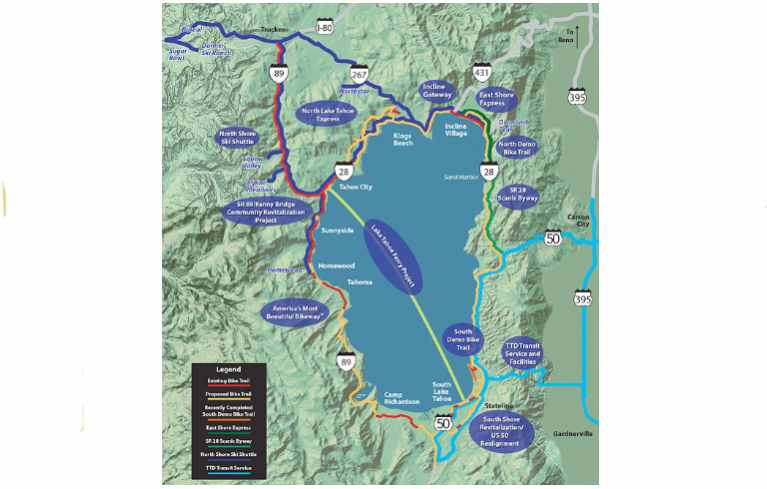
Stephanie Grigsby with Design Workshop presented a video of Highway 28 showing how it could be possible to make parking less treacherous while at the same time providing information for people who are new to the area.

Although this stretch of East Shore roadway from the junction of Highway 50 at Spooner Summit to Crystal Bay was designated a National Scenic Byway in 1996, improvements have been lacking. At that time it was called America’s Most Beautiful Drive. Efforts are under way to make the drive complement the natural beauty.

This shows Tahoe Transportation District projects throughout the basin.

This shows Tahoe Transportation District projects throughout the basin.

Access to the lake is also a big goal of the project. This should eliminate people needing or wanting to climb over guardrails and walking down steep embankments to reach Lake Tahoe.

Plans came about after the public gave input last fall. Safety, transportation, environment, recreation, scenic and economic needs are being woven into the plans.

The draft Highway 28 Corridor Management Plan is expected to be finished in the next two weeks. Three alternatives, plus a do nothing, are being created. In May, officials are expected to decide on the environmental review process.

This is a cooperative plan that has buy-in from the Nevada Department of Transportation, state parks, state lands, Nevada Highway Patrol, Incline Village General Improvement District (IVGID), Tahoe Regional Planning Agency, U.S. Forest Service, Federal Highways Administration, Washoe County, Carson City, Douglas County and Washoe Tribe.

“All of the scenarios include shared use paths, emergency pull-outs, vista points, and various levels of transit service providing connectivity between parking nodes and access to recreational areas,” the TTD staff report from March 22 says.

Tied into this is better public transit, which started last summer with the inaugural East Shore Express. More than 12,000 passenger trips between Incline Village and Sand Harbor were tallied. The goal was to eliminate walk-ins at the popular state park beach because of the dangers parked vehicles and pedestrians create in that area.

It is estimated that 2.6 million vehicles are on this highway every year.

While not part of the Corridor Management Plan, the Nevada Stateline to Stateline Bikeway was also on agenda. In some ways it is a companion piece to the greater transit discussion for the area.

TTD and IVGID are looking at whether six miles of the route can be placed on top of the sewer line; some of which is scheduled for replacement.

“If this works, we will be years ahead of where we would have been with the bike trail,” TTD Executive Director Carl Hasty said.

The bikeway when completed will go from Nevada’s two state lines in the Lake Tahoe Basin.

Board member Ron Treabess spoke about the changes that will take place this summer with the North Lake Tahoe Water Shuttle. It’s possible the Hyatt in Incline will be integral in future years as a marina stop; creating another tie-in to the bike route and scenic highway improvements.

This is the second of a three-year pilot program that transports locals and tourists to various marinas – Captain Jon’s Restaurant in Tahoe Vista, Gar Woods in Carnelian Bay, Tahoe City Marina and West Shore Café in Homewood. Captain Jon’s will be substituted for the North Tahoe Marina this summer because it is better protected.

Other changes include charging a flat $10 fee no matter the marina one departs at, allowing walk-on travelers and not just reservations, running from June 27-Sept. 22, and increasing hours to 10am-11:30pm.


States look for ways not to pay for ER visits

By Nancy Shute, NPR

Cash-strapped states are coming up with an appealingly simple fix for soaring Medicaid costs: Don’t pay for emergency room visits for people who aren’t sick enough to be there.

There’s a problem, though. It’s almost impossible to figure out who’s sick enough and who isn’t at the moment they walk in the door, researcher says.

“People don’t come to the ER with diagnoses, they come to the ER with symptoms,” says Maria Raven, an assistant professor of emergency medicine at UC San Francisco. She’s the lead author of the study published in the latest JAMA, the Journal of the American Medical Association.

Almost a dozen states have come up with plans to refuse to pay for ER visits or require copays from Medicaid patients if they have a health problem that could have been treated in a doctor’s office. They’re operating on the widely held premise that people without private health insurance use emergency rooms for minor complaints that would best be treated elsewhere.

To find out if that’s true, Raven and colleagues looked at the discharge records for almost 35,000 people who visited emergency rooms in 2009. They identified which people had problems that were “primary care treatable,” and then looked back to see what symptoms brought them to the ER.

Just 6 percent of the people had a problem that could have been treated in a doctor’s office. But it was impossible to identify them based on symptoms when they walked in the door, because they were the same as those for 89 percent of all emergency room visits. The hundreds of symptoms included toothache, skin rash, abdominal pain, earache, fever and chest pain.

Looking at the people with those symptoms, 11 percent were triaged as needing immediate care, and 12 percent were admitted to the hospital. The three most common diagnoses were abdominal pain, respiratory infection and chest pain.

“If you have a 65-year-old person who wakes up in the middle of the night with chest pain, the only logical thing for him to do it to go to the emergency room,” Raven says. “Then the doctor comes in and says, ‘Good news, you’re not having a heart attack. Maybe you have indigestion.’ We certainly don’t want people to be discouraged from getting primary care, especially because in many cases it could be a heart attack.”

The idea of identifying “primary-care treatable” cases was not to kick them out of the ER, but to make sure they got good primary care so they didn’t have to go to the ER, says Arthur Kellermann, an ER doctor and policy analyst for the Rand Corporation.

“If you’re going to apply this logic to reduce support to the emergency department, I suppose we should shut down fire departments because sometimes the public calls with a false alarm,” Kellermann told NPR.

“These visits are not happening because people are dumb or lazy or indifferent,” Kellermann says. “They’re symptoms that primary care is not adequate to meet the acute care needs of the population.”

The Affordable Care Act requires that Medicare and private insurers pay for emergency care that a “prudent layperson” would consider necessary. In other words, they can’t stick you with the bill if you go in with chest pain and it turns out to be heartburn. But Medicaid patients didn’t get the same protection.

In 2011, Washington state said it would stop paying for emergency department visits by Medicaid patients if they were “not necessary for that place of service,” but the plan was overturned by the governor.

If similar measures are enacted in other states, hospitals would end up paying the tab for emergency room patients the state refused to cover.


Arrest made in S. Tahoe bike shop theft

A 34-year-old South Lake Tahoe man is accused of breaking into South Shore Bikes and stealing one bike.

Officers found Lee Sparks at Barton Memorial Hospital about 1am March 18.

“He had several fresh cuts on his arms and when interviewed admitted to the burglary at South Shore Bikes,” South Lake Tahoe police Lt. David Stevenson said in a press release.

Sparks allegedly gained entry to the Emerald Bay Road store just after 9pm March 17 by forcing his way through a roof vent. He reportedly left through a window at the front of the business.

Officers said they found blood at the scene and other identifying evidence.

Sparks was arrested on charges of burglary and booked in the El Dorado County Jail.

— Lake Tahoe News staff report


S. Tahoe bank robbery suspect in custody

Paul Cortez

Paul Cortez

A South Lake Tahoe man has been arrested and charged in the March 27 robbery at El Dorado Savings Bank.

Police got wind that the suspect was in Reno. They met Paul Cortez, 29, there and subsequently obtained an arrest warrant.

Cortez was arrested by Reno officers on March 21 and is waiting to be transferred to South Lake Tahoe.

“Cortez confessed to the robbery including specific details of how the robbery occurred and how much money was taken,” South Lake Tahoe police Lt. David Stevenson said in a press release.

— Lake Tahoe News staff report


100 mph chase through S. Tahoe ends with arrest

Updated: March 22, 12:30pm

A car chase that hit speeds of 100 mph in South Lake Tahoe on Friday morning ended in the Carson Valley.

The California Highway Patrol at first chased a small black Chevy Malibu on Highway 50 starting in Meyers. The chase then went over Kingsbury Grade. There the driver sped through the town of Genoa.

The driver, Steven Linsey, 53, from San Francisco, was finally stopped at Jacks Valley Road and Trail Court.

According to Douglas County deputies, Linsey was arrested and transported to the Douglas County Jail and booked on charges of reckless driving, eluding a police officer, driving under the influence, possession of a controlled substance and possession of paraphernalia.

Additional charges are pending from California. The CHP is not returning calls.

— Lake Tahoe News staff report


California timber industry buzzing post-recession

By Shan Li, Los Angeles Times

Even before dawn breaks, workers at the lumberyard in Lynwood were bustling around, getting a move on the day. Men in yellow safety vests drove flatbed trucks stacked to the brim with planks of wood. Others were buzzing around in forklifts, ferrying more boards.

It’s a scene that had John Cencak smiling in satisfaction and relief. After years of anxiously waiting for the economy to rebound, the vice president of Jones Wholesale Lumber Cos. was seeing an upswing.

“You see this new truck?” Cencak said as he pointed to a glossy Freightliner truck, its white and green paint gleaming even in the dark. “We just bought three of them. That’s a half-million-dollar investment. It’s all part of the economic recovery.”

Timber from the South Shore Fuel Reduction Project may be more valuable this season. Photo/LTN file

Timber from the South Shore Fuel Reduction Project may be more valuable this season. Photo/LTN file

Thanks to a housing rebound in which new homes and apartments are being built, California’s timber industry is slowly on the mend after being devastated during the economic downturn.

Sawmills that cut timber into boards are reopening and hiring again. Truck companies that haul that wood out of state are revving up. Lumber prices have soared more than 40 percent over last year.

“The last few years have been a slow recovery from the recession for wood products,” said Phil Tedder, a forestry consultant at Resource Economics. “The main consumer was new housing, and that obviously wasn’t very good. But now things are picking up.”

Sierra Pacific Industries, one of the biggest timber companies in the country, has hired 140 lumberjacks, machinists and electricians for its reopened sawmill in Sonora after closing it in 2009 when the housing market crashed. An additional 26 jobs were added at a mill in Chinese Camp.

“It’s a combination of new housing and repairs and remodels,” said Mark Pawlicki, spokesman for the Anderson company, which operates 11 mills in the state. “The low interest rates for housing are helping. We are seeing an uptick in demand for windows, a lot of which go into remodels of homes.”

Jones Wholesale’s sales plummeted 50 percent in 2009 compared with three years earlier. It laid off nearly 20 workers — the first layoffs in its 89-year history. It also cut back on contractors that provided cleaning and security work.

“During the recession, we said we had to work twice as hard and make half as much,” Cencak said.

But things appeared to be turning around as the company’s 17-acre lot hummed with activity.

Workers hustled through the yard and swarmed around tall stacks of wood, which are unloaded, cut, stored and then reloaded onto trucks to be sent throughout the Southland and beyond California. The brightening outlook prompted the company to hire 10 workers last year. Now two or three times a week, trucks carry lumber all the way to Las Vegas, up from once a month in 2009. Workers have received promotions and long-overdue pay raises.

Cencak said sales in 2013 are projected to be 15 percent to 18 percent above last year’s, thanks in part to banks’ greater willingness to extend loans to businesses and home buyers.

“Everyone is gearing up,” he said. “The banks didn’t want to touch the industry for a while. Now they are picking up our calls.”

That’s welcome news for workers like Edgar Herrera, 33, who expects to be hired soon as an assistant dispatcher after working there four months through a temporary agency. After more than a year of unemployment during the recession, the Bellflower resident said he’s glad just to be getting a job, much more one that comes with health insurance.

“It’s really a big stress off your back to finally land something solid,” Herrera said. “After I had to extend unemployment the first time, I was really worried.”

But not everyone is betting on a cheery future.

Logging companies complain of environmental regulations that they say strangle the industry in California and contributed to a decades-long decline. Some gripe that new legislation signed into law by Gov. Jerry Brown last year — which was designed to protect the state’s timber companies by restricting legal damages for wildfires — won’t stop the slow decline of an old Golden State industry.

Over the last decade, Berry’s Sawmill and Lumberyard in Cazadero has laid off nearly 75 percent of its workforce, said general manager Bruce Berry. A recent uptick in sales has yet to prove sustainable.

“There is some positive stuff happening,” Berry said. “We’ll see if it continues.”

Experts say the recession has forced out weak players in California timber and encouraged surviving businesses to stay lean and increase efficiency, which will benefit them in the long run. Sierra Pacific, for example, has no plans to reopen two of the three mills it had closed. But it has worked on installing high-tech machinery that reduces waste.

Jones Wholesale also plans to make upgrades.

Cencak pointed to deep cracks in the floor near its sawmill. He said the company hasn’t repaved its yards since 2007, and that’s what concrete looks like after years of pounding by trucks, piles of lumber and heavy work boots every day. But now he is thinking about putting some money into smoothing over its potholes.

“Paving another 5 acres — that’s what a recovery looks like,” Cencak said.