Truck nearly crashes into liquor store

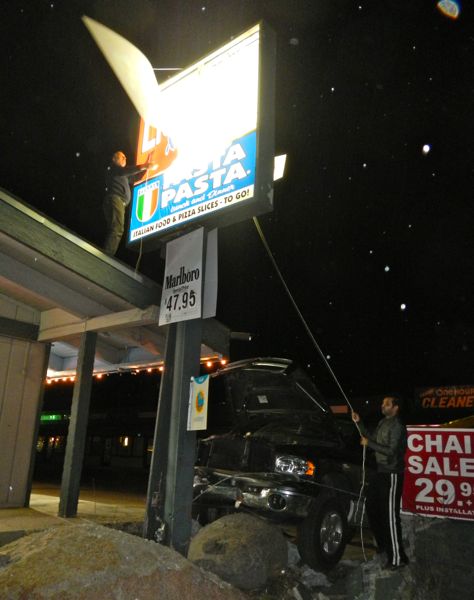
Keys Liquor workers on March 26 work to secure the sign. Photos/LTN

Keys Liquor workers on March 26 work to secure the sign. Photos/LTN

A rock stopped the truck from taking out the post.

A rock stopped the truck from taking out the post.

A Dodge Ram 1500 tried to do some urban four-wheeling, but instead ended up being towed Tuesday night.

South Lake Tahoe police Sgt. Jeff Regan said alcohol was not a factor in the 8:22pm March 26 accident. The driver and passenger refused medical treatment.

Regan told Lake Tahoe News the driver had been drifting on Highway 50 when the passenger woke up, grabbed the wheel and then caused the truck to veer into the front post of Keys Liquor.

Employees of the store that night were trying to secure the sign for the store and Fasta Pasta so it would not flap in the wind as rain started to sprinkle on them.

The truck, according to the tow truck driver, was likely totaled based on the damage to the undercarriage and both air bags having gone off. The truck was resting on a boulder that was in front of the post. Had it not been there, the post would have been taken out.

— Lake Tahoe News staff report


Businesses see dollar signs if Nevada reverses gay marriage ban

By Andrea Domanick, Las Vegas Sun

“Loosen his bow tie and snuggle up, you two,” says Las Vegas photographer Linda Quackenboss, directing a camera-shy couple sitting for portraits in her studio.

Reaching out, Phil Pineda does as he’s told and loosens Mel Cole’s bow tie. “There’s my GQ smile!” the 53-year-old tells the couple, who will be celebrating their fifth anniversary this fall. “Maybe I can shoot your wedding soon.”

For Quackenboss, who estimates that 30 percent of her clientele are members of the lesbian, gay, bisexual and transgender community, the suggestion is more than friendly conversation. It’s marketing.

Gay marriage is on the horizon in Nevada. A bill was introduced last week in the Nevada Senate that would begin to clear the way for legalizing gay marriage in Nevada. That news came just days before the U.S. Supreme Court is scheduled to hear oral arguments in a pair of cases challenging California’s ban on gay marriage and the federal Defense of Marriage Act. Polling suggests a majority of Nevadans support gay marriage.

That shift, in Nevada and nationwide, is being noticed by wedding industry professionals like Quackenboss, who is among local business owners positioning themselves for the opportunities that will come with legal gay marriage in the Wedding Capital of the World.

“With the economic climate the way it is, people are watching what’s happening around the country with a careful eye and will open up as soon as business demands it,” Quackenboss said.

According to economist M.V. Lee Badgett, research director of the Williams Institute for Sexual Orientation Law and Public Policy at UCLA, legalizing gay marriage would generate $23 million to $52 million in business revenue and $1.8 million to $4.2 million in tax revenue over the next three years in Nevada.

The brunt of the revenue impact from gay marriages, however, would come from out-of-state couples bringing their ceremonies and celebrations to Las Vegas: Eighty-five percent of the 86,203 marriage licenses issued in Clark County in 2012 were to couples from outside Southern Nevada.

“Vegas’ strengths lie in the fact that it is an event town,” said Kathryn Hamm, president of GayWeddings.com. “It has a vibrant collection of wedding chapels, it’s a destination location for many, can serve bachelor and bachelorette parties and honeymoons alike, and has featured on its stages every gay icon who has ever electrified and unified and entertained our community.”

The same-sex marriage industry in New York offers some inkling of what to expect in Las Vegas. In 2011, the first year gay couples could legally wed in New York state, marriage license fees, celebrations and wedding-related purchases helped shore up New York City’s economy by $259 million, according to the New York City Clerk’s Office and NYC & Company, the city’s tourism and marketing bureau.

Dianne Schiller, owner of Renta-Dress and Tux Shop in Las Vegas, said she can hardly wait. “It would definitely increase my business and add another dimension to it,” said Schiller, whose shop presented a fashion show at last month’s LGBT Wedding Expo at Circus Circus and has been marketing to gay couples for years. “If we really want to sell ourselves as the Wedding Capital of the World, we need to open the doors and embrace everyone.”

Same-sex marriage ceremonies would come at an otherwise dour time for the wedding business. Marriage licenses issued in Clark County are down 21 percent from 2007, and Schiller’s sales have dropped 20 percent this quarter.

“The last place people are spending their money now is on vacations and big weddings,” she said. “But generally speaking, gay couples do tend to have more disposable income and are higher up on the earning bracket. They have the dollars, and if they could spend it on weddings, I think they would love it.”

For Angie Kelly, owner of Peachy Keen Unions, a Las Vegas-based wedding officiant service that bills itself as a provider of “ceremonies for unique and eclectic couples,” the anticipated boost in revenue would be less important than the level playing field that would come with the legalization of gay marriage. She’s one of the few officiants in town who openly advertises as serving LGBT couples, and she acknowledged that she may be losing business by doing so.

“I think officiants have a tricky spot with same-sex marriages. If you advertise to same-sex marriages, there’s a chance you’re losing your highly religious couples, as well. It doesn’t matter to me, but it is a risk that I take,” she said of the 200 ceremonies she performs per year, a handful of which are for same-sex couples. She explained that while many other ministers and officiants won’t advertise to same-sex couples, they may still perform commitment ceremonies if asked. “I think there will be a big sense of relief that they can just breathe easy and serve this market. A lot of us are gunning for it be legalized.”

For other local businesses, welcoming gay marriage is a natural next step in their marketing efforts to the LGBT community. Caesars Entertainment is one of a number of resort companies already offering commitment ceremony packages at its properties, including planning services, floral design, photo shoots and commitment certificates. The company has helped attract such popular LGBT events as Dinah Vegas, or Girl Bar Dinah Shore Weekend, an offshoot of the long-running Dinah Shore Weekend in Palm Springs, and is among the businesses that signed an amicus brief on Feb. 27 urging the U.S. Supreme Court to strike down the Defense of Marriage Act and recognize gay marriages.

MGM Resorts International, which in 2004 became the first company in the gaming and hospitality industry to offer health benefits to gay employees’ partners, similarly anticipates gay marriage in Nevada with open arms.

“Legalization in Nevada would be a significant step forward in leveling the playing field, as we’d be in a better position to compete with destinations where same-sex marriage is legal,” said Alan Feldman, MGM Resorts senior vice president of public affairs.

The Las Vegas Convention and Visitors Authority, which launched its LGBT marketing campaign in the mid-2000s, declined to comment for this story.

Although many local businesses are primed to take advantage of the potential revenue boost, others, including Las Vegas’ numerous faith-based chapels, do not serve same-sex couples for religious reasons. They say that probably won’t change, even if the law does.

“I have gay people who work for me and I love them dearly and I have nothing against them. But we’re a Bible-based chapel, and we go according to the word of God and what he says in his word,” said Charolette Richards, the Christian owner of the Little White Wedding Chapel, which does not offer commitment ceremonies for gay couples. “If the law changed, I’m not saying that I would or that I wouldn’t either, but it’s against my religion. I’d have to pray hard to find what God would have me to do.”

Chapels that cater to same-sex couples say that just means more business for them — but that any economic gains are ancillary to the reason many of them began serving the LGBT community in the first place.

Just two doors up from the Little White Wedding Chapel is the Viva Las Vegas Wedding Chapel, which performs more than 5,000 weddings, vow renewals and commitment ceremonies each year, and is perhaps known best for its campy, Elvis-emblazoned neon sign beckoning visitors on the north end of the Strip. The chapel’s owners are gay, and they also operate under the name of Gay Chapel of Las Vegas. As one of the first wedding chapels in Las Vegas to cater to gay couples — it began performing commitment ceremonies more than 15 years ago — being able to perform legal marriages for the LGBT community is a long time coming.

“For us it’s a big deal. It would not only be a chance for us to provide more weddings and beautiful ceremonies, but also a chance for customers who are gay to have the same legal rights,” said Brian Mills, the chapel’s general manager and an Elvis wedding performer. “This being Vegas, all of us who work here are performers and have friends and people we know who would be affected by the social impact. And it’s about that more than anything.”



Report: California community college enrollment plunges

By Katy Murphy, San Jose Mercury News

California’s community colleges – the nation’s largest public higher education system – have lost so many teachers and classes that students are being driven away.

With the number of course sections down systemwide by as much as 20 percent since 2008, enrollment rates have hit their lowest point in two decades, concludes a Public Policy Institute of California report released Monday.

The community colleges’ ideal of open access for all, still dear to many Californians, barely resembles the reality on campuses today after years of budget cuts.

Students take a culinary class at Lake Tahoe Community College. Photo/LTN file

Students take a culinary class at Lake Tahoe Community College. Photo/LTN file

“I expected to get the classes I needed, but I was wrong,” said Rigo Navarro, a second semester student at Chabot College in Hayward. Navarro wants to major in criminal justice and engineering but said he has yet to find space in a math or a criminal justice class.

Alexandra Olivares, 18, had it even worse, at least at first. Every class she tried to take in the fall at Chabot was full. She cried as she joined wait lists, thinking she would have to delay her career and find a low-wage job. Eventually, she got in.

Such stories have become more of a rule than an exception. The community college chancellor’s office reports that a half-million students have been shut out of the system in recent years because they couldn’t get into classes. The system counted 2.4 million students in 2011-12, down from 2.9 million students in 2008-09, according to the report.

The problem can be especially acute for those beginning their college careers, such as Olivares and Navarro, as they often must wait to register until after returning students have a chance.

The number of young, first-time community college students in California fell even further behind the number of recent high school graduates between 2008 and 2011 – a trend that, combined with lower California State University and University of California enrollment, “does not bode well” for the state’s workforce, the report’s researchers concluded.

Even though voters last year approved a tax hike and the governor wants to infuse the schools with an additional $210 million, the report authors say that’s far from enough.

The state and the colleges must come up with a long-range plan to restore the system, whether through increased state revenue, local parcel taxes or student fees, the authors concluded. The report also listed online education and larger classes as possible ways to reach more students. A bill introduced this month by State Senate Pro Tem Darrell Steinberg, SB 520, would allow public college students shut out of classes to receive transfer credits for some online courses offered by the private sector.

“The saddest thing of all, for me, is that the one magnificent system that was open to all Californians has begun to ration what it can and cannot do,” said Rita Cepeda, chancellor of the San Jose-Evergreen Community College District.

Statewide, the number of for-credit classes fell by 14 percent between 2008 and 2011; the number of noncredit classes, such as English-as-a-second-language, dropped by more than one-third. The noncredit decline is noteworthy, as the governor wants to make the colleges responsible for teaching ESL and other adult education classes now offered by K-12 districts.

Since 2010-11, Chabot has closed about 12 percent of its classes, including some sections of the popular mass communications course.

Last semester, class instructor Chad Mark Glen tried to ease the damage, letting in every student who tried to register for his introduction course. The cap was 44 students, but he invited more than 90 into a little lecture hall – basically, packing two sections into one. Students sat on the floor and poured into the hallway.

Glen said the class was vibrant and fun to teach. It was also draining. This semester, he said, “I told my dean, ‘Put it back to 44.’ I just felt I couldn’t do it again.”


USFS firefighting budget cut despite dry terrain

By Chuck Raasch, USA Today

Dry conditions have persisted in many of the areas ravaged by fires last year and bark beetles have invaded millions of acres in western forests, creating a tinderbox of dead wood.

Persistent drought and an infestation of tree-killing insects have left broad swaths of the United States vulnerable to unusually fierce wildfires for the second straight year just as the U.S. Forest Service is dealing with cuts in its fire-fighting budget.

Areas most at risk include Southern California, Arizona, New Mexico, the eastern Rockies and Florida, according to the federal government’s most recent fire analysis.

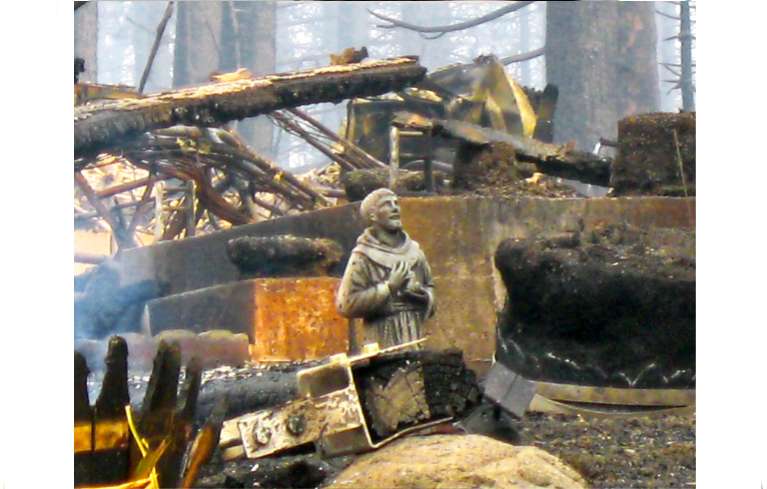
In 2007, 254 houses burned and bout 3,100 acres -- mostly USFS land -- on the South Shore of Lake Tahoe. Photo/Lake Valley Fire

In 2007, 254 houses burned and about 3,100 acres — mostly USFS land — on the South Shore. Photo/Lake Valley Fire

More than 9.3 million acres of public and private land — an area larger than Maryland — burned in 2012, the third most-active wildfire season since 1960, according to the Forest Service. The agency spent $1.4 billion fighting them.

Mega-fires from Oregon to New Mexico made headlines from Father’s Day to Halloween. Dry conditions have persisted in many of the fire-ravaged areas. Bark beetles also have invaded an estimated 46 million acres in western forests, creating an additional tinderbox of dead wood over an area bigger than Missouri.

“Our predictions for this incoming fire season are almost identical to where we were a year ago at this time,” said Tom Tidwell, the chief of the U.S. Forest Service, whose agency manages 193 million acres.

Tidwell said that spending cuts imposed by Congress and the White House will force his agency to hire about 500 fewer firefighters than the 10,000-10,500 it normally employs. He said the Forest Service will “mitigate the impact” by pre-positioning firefighters in vulnerable areas and moving them around more rapidly when outbreaks occur.

Fires are burning hotter and faster than a decade ago, a condition Tidwell attributes to warmer, drier weather. That creates drier vegetation and better fuel for fires.

Last year was the warmest on record for the continental United States, according to the National Oceanic and Atmospheric Administration.

“There is no question we are seeing these large fires become established more quickly, and at times they are almost explosive,” he said.

A fire near Los Alamos, N.M., two years ago burned 40,000 acres in its first 12 hours, Tidwell said. A decade earlier, a fire in virtually the same location took seven days to reach 40,000 acres.

He also said that over the past decade, warmer weather has extended wildfire seasons by 60-70 days a year.

The fire season normally begins this month in the East and progresses westward.

Areas of the Southeast, particularly Florida, are also coming off a drier than normal winter, raising concerns there, too. A fire in St. Lucie County over the weekend forced the evacuation of about 2,500 people, said James Karels, director of the Florida Forest Service.

Karels said he is worried about federal cuts on top of already stretched state firefighting budgets.

The feds “are partners in this kind of fire business, especially (in fighting) the big wildfires,” Karels said. “There isn’t anyone that can do it alone, and when we see further cuts in the federal end, that is a partner that is not going to be able to come to the table as strong as in the past. And that is a concern.”


Drug charges levied against 2 S. Tahoe residents

South Tahoe officers arrested a member of the Brotherhood motorcycle club on March 25 and confiscated weapons. Photo/Provided

South Tahoe officers arrested a member of the Brotherhood motorcycle club on March 25 and confiscated weapons. Photo/Provided

Two South Lake Tahoe residents were arrested Monday on drug charges.

Police Officer Travis Cabral allegedly saw Ryan Marino, 29, buy drugs in a parking lot at the Y on March 25. Marino, who is a member of the local Brotherhood Motorcycle Club and an ex-felon, was stopped by Cabral outside a residence in the 1800 block of 10th Street. (Marino was riding an unregistered motorcycle.)

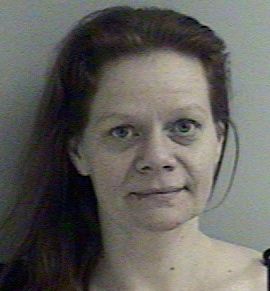
Shaleen Pierson

Shaleen Pierson

Cabral said he saw a fixed blade hunting type knife under Marino’s arm affixed to his vest, which led to Marino being frisked. During this search, Cabral said he found hypodermic syringes inside Marino’s vest and clear plastic packages

of what is suspected to be about a half ounce of methamphetamine in each baggie.

Ryan Marino

Ryan Marino

A warrant to search Marino’s residence was obtained.

Officers said in the room Marino shares with his 37-year-old girlfriend Shaleen Pierson they found a sawed-off shotgun, 12-gauge shotgun ammunition, a flare pistol and paraphernalia used to package illicit drugs for sale. Pierson was then arrested.

Both were charged with maintaining a residence to sell controlled substances, as well as a variety of drug and weapons offenses.

The investigation is continuing and additional arrests may be forthcoming. Officers intend to pursue with the District Attorney’s Office enhancement against Marino and Pierson for allegedly committing criminal offenses in the furtherance of a criminal street gang.

— Lake Tahoe News staff report


Study: Knowing a gay person impacts marriage beliefs

By Maura Dolan and Jessica Garrison, Los Angeles Times

SAN FRANCISCO — For Ohio Sen. Rob Portman, knowing that his son was gay helped change his mind.

For President Obama, talking with gay White House staffers and learning that his daughters’ friends had same-sex parents proved influential.

Today, Jean Podrasky, a 48-year-old accountant from San Francisco, will be sitting in a courtroom, where her first cousin — Chief Justice John G. Roberts Jr. — and the rest of the U.S. Supreme Court are hearing a challenge to California’s ban on gay marriage. It’s a ban that prevents her from marrying her partner of four years.

Podrasky said she does not pretend to know her cousin’s views on gay marriage. But her decision to publicly disclose her relationship with Roberts reflected a growing conviction in the gay rights movement that the way to win support for gay marriage is to put a personal face on the issue.

Attitudes on same-sex marriage have shifted rapidly, and polling data consistently shows that knowing a gay person is a strong factor.

A poll by the Pew Research Center for the People and the Press, released last week and conducted in mid-March, found that 14 percent of Americans say they have changed their minds about same-sex marriage. Roughly a third of them told pollsters it was because they know someone — a friend or family member or other acquaintance — who is gay.

The poll also found that more Americans now say they support gay marriage than oppose it. Roughly 49 percent of Americans now say they support gay marriage, with 44 percent opposed. By contrast, 10 years ago, 58 percent of Americans opposed gay marriage, and just 33% were in favor.

“It kind of puts a name to a face,” said Erik Schott, a USC clinical assistant professor of social work. “So it makes it a relatable issue.”

Though having gay friends and relatives may influence views, opponents of same-sex marriage balk at the notion that the issue boils down to whether you know someone who is gay.

Frank Schubert, who ran the campaign for Proposition 8 and whose sister is a lesbian, estimated that 75 percent of people in California have a member of the family or an acquaintance who is gay. Being in favor of barring same-sex couples from marrying does not indicate antipathy for gay relatives or other gays, he said.

“The premise is, if you oppose redefining marriage you must be anti-gay, and that premise is false,” said Schubert, who believes the high court will uphold Proposition 8.

Indeed, several prominent activists in favor of restricting gay rights have had gay relatives, including former state Sen. William J. “Pete” Knight and the conservative activist Phyllis Schlafly, both of whom had gay sons.

The late Justice Lewis F. Powell, while considering Bowers vs. Hardwick, a 5-4 decision in 1986 that upheld sodomy laws, told his then closeted clerk that he knew no one who was gay. The clerk later regretted that he had not revealed his sexual orientation during that conversation. “There is no doubt that knowing his clerk was gay could have shifted the balance,” said Kate Kendell, executive director of the National Center for Lesbian Rights.

Emma Tate, 67, the daughter of a Baptist minister, said her views on same-sex marriage changed after getting to know her friend’s lesbian daughter. The daughter told Tate that she wanted to marry because otherwise her benefits and pension might not be transferred to her partner if she died, said Tate, a resident of View Park, north of Inglewood.

“It made good sense to me,” Tate said. “If you’re there and you love them, and they’re supporting and taking care of you when you’re ill, they should be entitled to the benefits.”

Tate said she also was moved when she saw the care her friend’s daughter received from her partner when she became sick and bedridden. “I really saw their love, their connection. I just felt that it was beautiful to have someone love you that much,” Tate said.

Susan Russell, a pastor at All Saints Church in Pasadena, recalled that the late gay rights activist Harvey Milk urged gays to make their sexual orientation known to others to help defeat unflattering stereotypes. “And that was when it was not safe to be out,” she said.

Over the last few years, the gay rights movement has emphasized the importance of relationships in obtaining rights. Major public figures, including CNN’s Anderson Cooper, have publicly talked about their sexual orientation.

“People have not just stood in the street with signs or lit candles,” said Russell, a lesbian.

Scott Barclay, a senior scholar in public policy at the Williams Institute, a think tank at UCLA Law School that studies sexual orientation, said Americans’ views on same sex marriage have shifted “phenomenally” quickly.

“As far as we can tell, these seem to be the fastest shifts that have gone on for major social movements,” he said, citing public opinion polls showing that support for gay marriage is gaining 1.75 to 2 percentage points a year.

But being supportive of gay marriage rights does not always mean embracing the full gay-rights agenda. Portman, who was on Mitt Romney’s short list of potential running mates in 2012, told CNN that he favored letting states decide their marriage laws.

Still, no matter how the arguments go, Podrasky said she hopes to introduce her partner to her cousin the chief justice after the hearing.


Liberty Utilities’ N. Shore system inadequate

By Kathryn Reed

Liberty Utilities’ plans to upgrade the power supply to the North Shore are not moving forward as quickly as the company had hoped.

The U.S. Forest Service wants more detail than what the company had originally provided. Much of the land that would be affected belongs to the USFS.

Originally the power company thought it would be in the permitting phase by now, with construction starting this year. Now the company hopes all the paperwork will be in place by the end of the year.

“In general the two existing lines we are upgrading are following a similar path to what exists today, with minor variations,” Sam Rohn, the environmental, health, safety and security manager for Liberty in California, told Lake Tahoe News.

One issue the Forest Service wants more clarity on is how many trees the company plans to fell.

“Presently, the north Lake Tahoe transmission system does not have adequate single contingency reliability, meaning, if one of several critical lines is lost as a result of an intense storm event, fire, or downed trees, a severe and sustained power outage could occur in the system service area,” the scoping document says.

The project calls for lines going from the Kings Beach generation site to Tahoe City and one to Truckee. The plan is to upgrade the substations from 60 kilovolt (kV) to 120kV to allow the entire transmission loop to operate at 120 kV.

“We are strengthening the reliability on the North Shore. We will increase what the voltage lines are able to carry, handle additional load build-out at Martis Camp, Squaw Valley and Northstar, and other infrastructure that is going in on the North Shore,” Rohn said.

liberty map

Proposed route changes to Liberty Utilities’ North Shore lines.

All of the areas Rohn mentioned are either building now or have plans in the works. And they will all need more power in the future than they do today.

Plans call for replacing existing wood poles with steel, which are more reliable and apt to survive a wildfire.

Liberty on Jan. 1, 2011, took over NV Energy customers on the California side of the Lake Tahoe Basin, Truckee and Alpine County.

And while rate increase took effect Jan. 1, 2013, it wasn’t to pay for the North Shore project. Once that’s in the ground and online, Liberty can go back to the California Public Utility Commission and ask ratepayers to write bigger monthly checks.

Every three years public utility companies must file a rate increase or decrease with the CPUC.


Idea floated to ban fundraising while lawmakers work

By Torey Van Oot, Sacramento Bee

The concept of banning California lawmakers from fundraising while they’re at work has a new cheerleader: a former head of the state’s political watchdog agency.

Dan Schnur, a former Republican political consultant who served as chair of the California Fair Political Practices Commission, is launching a new effort to prohibit state legislators and statewide officers from raising cash when the Legislature is in session.

“Fundraising is a legitimate political activity. Legislating is a legitimate political activity. But you can’t do both of those things at the same time,” Schnur said in an interview last week.

It isn’t unusual for lawmakers to leave the Capitol at midday to raise money at a luncheon reception, or ask supporters for campaign cash at off-site fundraisers held before or after a day of votes. They’ve held 47 such events in Sacramento this month alone, according to notices posted in the Capitol Morning Report newsletter.

Changing that practice, Schnur said, will “weaken the link between political giving and government action.”

“Human nature being what it is, a large check written six months before a key vote is simply not going to have the same impact as that same check written 20 minutes before that same vote,” he said.

One plan Schnur is floating would mostly end incumbent fundraising between January and June, and then again in the month of August. The restriction would not apply to challengers.

Fifteen states currently ban campaign contributions while lawmakers are in session, though most meet far less frequently than California’s full-time Legislature, according to data collected by the National Conference of State Legislatures.

Schnur, who directs the Jesse M. Unruh Institute of Politics at USC, said he wants to start his effort by working with members of the Legislature and candidates for statewide office, but will consider backing an initiative on the topic if that doesn’t work out.

A former GOP strategist who counts Gov. Pete Wilson and presidential candidate John McCain among his past clients, Schnur said he reregistered as an independent after leaving the FPPC in hopes of approaching campaign finance reform “from a space outside of either of the two parties.”

Schnur’s plan will likely be a tough sell at the Capitol, where lawmakers have been reluctant to change the rules that govern how they run their campaigns. Similar proposals, including bans during the budget votes floated by former GOP Gov. Arnold Schwarzenegger, have failed to gain traction with California’s lawmakers. There are also varying views among advocates of reform.

Bob Stern, a campaign finance expert who has long called for added fundraising restrictions, said he thinks it makes more sense to ban taking contributions in odd-numbered years when no state elections take place. He agrees that limiting the calendar for fundraising could lessen the practice of special interests “giving for access reasons, to curry favor” while the legislators are at work.

“Ninety percent of the money comes from people who want something from the Legislature,” said Stern, the former president of the Center for Governmental Studies. “The more you restrict it in terms of tying it to the Legislature, the better it is and the better it looks in terms of when the money comes in.”

Polling suggests that changes to fundraising rules would be a hit with voters. Mark Baldassare, president of the Public Policy Institute of California, said such a proposal could tap into voters’ concerns with the role of money in politics.

“One of the things that creates a lack of trust in the state government and representative government in California is a belief that there are these few big interests looking out for themselves, have a lot of influence,” he said.

But some political operatives say fundraising bans won’t solve bigger issues surrounding the rising cost of campaigns and influence of wealthy interests.

Instead, they say, it will shift the timetable for collecting those contributions and possibly force more campaign money into independent expenditure committees that can raise and spend unlimited amounts.

“It’s sort of like sticking a finger in a dike,” said Steve Maviglio, a Democratic strategist who has worked inside and outside the Capitol. “The water is going to come out somewhere, and the money is going to get to legislators by the time they need it for their campaigns.”

Schnur argues that even if it didn’t slow the flow of money in state politics, a ban would ensure that legislators stay focused on governing responsibilities while in Sacramento.

“This would actually free up the legislators’ time to do the work that they were elected to do,” he said.


El Dorado County supervisor subject of DA probe

By Noel Stack, Village Life

El Dorado County Supervisor Ray Nutting is being investigated for how he used state grant money, according to, El Dorado County District Attorney Vern Pierson.

Through the years Nutting has received more than $74,000 in state Proposition 40 grants to complete fuel reduction projects on his Happy Valley property, according to grant documents. Invoices provided to the Sierra Coordinated Resource Management Council, CalFire’s partner agency that contracts with private landowners who complete fuel reductions projects within the parameters of Proposition 40, are being questioned.

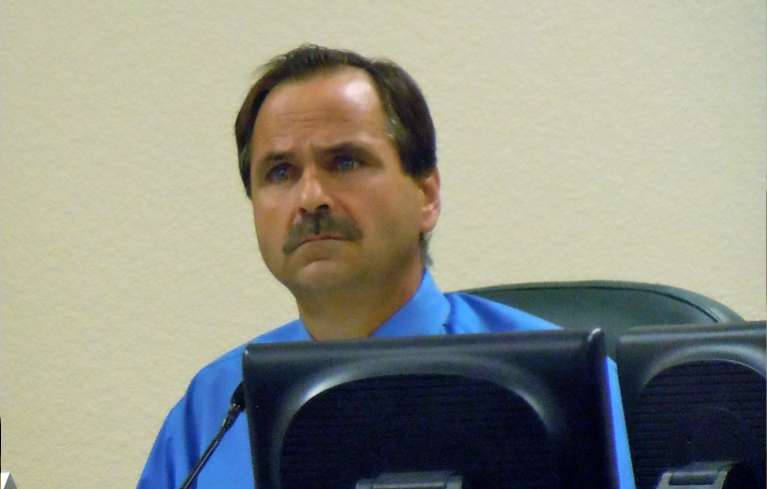
El Dorado County Supervisor Ray Nutting is under investigation. Photo/LTN file

El Dorado County Supervisor Ray Nutting is under investigation. Photo/LTN file

“We are aware of it and we are looking into it,” Pierson said in a telephone interview. “Beyond that, I can’t comment.”

Nutting, who contacted Village Life while working on another major Propositions 40 fuels reduction project on 37 of his 340 acres, said he’s aware of the investigation. The current project will result in a $49,348 grant.

“If I’d done something wrong, I’d know it,” Nutting said.

“I am highly scrutinized by registered forest professionals (hired to oversee the projects) and I’m highly scrutinized by CalFire,” the District 2 supervisor explained. “I have no latitude on Prop. 40. I have to do exactly what the grant documents say.”

CalFire offers grant opportunities to small forest landowners funded by Proposition 40, the California Clean Water, Clean Air, Safe Neighborhood Parks and Coastal Protection Act of 2002, according to the CalFire website.

“The goal of the Proposition 40 Fuels Management Program, or Prop. 40 program, is to contract with private landowners for mutually beneficial forest improvement and wildfire hazard reduction projects designed to reduce fuel loadings that pose a threat to watershed resources and water quality,” the website states.

Landowners in 15 Sierra Nevada counties — Butte, Plumas, Sierra, Yuba, Nevada, Placer, El Dorado, Amador, Alpine, Calaveras, Tuolumne, Madera, Mariposa, Fresno and Tulare — may participate. CalFire’s website explains, “The Prop 40 Program generally pays 75 percent of the costs and the landowners share is the remaining 25 percent. Landowner management plans, which are required for Prop. 40 program grants, will be paid 90 percent by Prop. 40 program and 10 percent by landowners.”

Since its inception, the Proposition 40 program has granted landowners more than $2.5 million.

In 2009 Nutting received $24,893 after three invoices were submitted — project management and addendum invoices in the amount of $3,137.50 on behalf of Stewart Forestry LLC and a $27,395 invoice on behalf of Nutting Brush Clearing, which shares Nutting’s home address in Somerset. A representative of the El Dorado County Treasurer-Tax Collector’s Office said they had no record of any business license under that name.

Nutting said interpreting Nutting Brush Clearing as a business is incorrect. The name on the top of the invoice, which was submitted by his registered professional forester, is the project name, not a business name.

“It’s a description of the job,” he explained. “My forester knows that, CalFire knows that … everybody knows that.”

The Nutting Brush Clearing invoice included a cost breakdown — $6,000 for 15 acres of thinning, $4,125 for 15 acres of pruning, $5,250 for 15 acres of slash disposal and $12,020 for 60.1 acres of herbicide treatment. No additional statements were submitted with the invoice but, Nutting said, the rates used to determine the totals for each portion of the job come from the state.

A Proposition 40 grant program audit released by the California Department of Finance’s Office of State Audits and Evaluations in 2009 questioned this lack of documentation.

“Without proof of actual costs by landowners (in the form of cancelled checks or information from bank statements), grant funds could be used for purposes not allowed by the program,” the audit noted.

Auditors recommended requiring proof of actual costs prior to authorizing payment.

Nutting said he agrees with the auditors findings and will provide additional documentation when submitting invoices related to his latest Prop. 40 grant project, which, he said, he’s been working on for more than a year.

“It’s back-breaking work,” Nutting said.

Nutting and his brother, Tom, each have 340 acres in southern El Dorado County. Nutting said the two have been trying to reduce fire fuels since inheriting the land after their parents died. Tom Nutting has also receive Proposition 40 grants. Ray Nutting noted that a few of his neighbors participate in federal fuel reduction programs.

Fire crews have twice come out to his property to douse flames, Nutting said.

“The easier thing to do would have been to do nothing and let it burn,” Nutting said. “I chose to work with the state and spend the years of my life doing these projects … making (the land) fire safe.”

The DA’s Office, which has requested documents and information from other public agencies, hopes to conclude its investigation within 30 to 60 days, Pierson said. If any wrongdoing is confirmed, Nutting could face charges related to presenting false claims and falsifying records submitted to state agencies, both felonies.


Reno-Tahoe airport security breach causes delays

By KTVN-TV

Officials with the Reno-Tahoe International Airport say things are getting back to normal Monday morning after a security breach caused the airport terminals to temporarily shut down.

Brian Kulpin says two people unintentionally went the wrong way through the security check-point causing officials to re-screen everyone who had already made it through security. This included those who had already boarded their flights.

Kulpin expects delays throughout the day and urges people to call their airlines and check the status of their flights.