3 Tahoe City businesses hit by burglars

By KTVN-TV

Placer County sheriff’s deputies are investigating three related business burglaries that took place late Thursday night or Friday morning.

Deputies say the burglars broke out windows to three businesses at the Cobblestone Mall, located at 495 North Lake Blvd. in Tahoe City.

Deputies say the burglars entered the Tahoe Rug Gallery and Kalifornia Jean Bar, while Blue Stone Jewelry showed signs of an attempted entry.

Some merchandise was taken.

Anyone with information related to this case should call (530) 581.6321 or Placer County Crime Stoppers at 800.581.6321. A $1,000 reward is being offered.


‘Monsanto Protection Act’ called outrageous, dangerous

By Michelle McGuinness, MSN News

A short-term spending bill has sparked intense debate about America’s food supply.

HR933 passed the Senate last week; President Obama signed it into law Tuesday. The bill helped the government avoid a March 27 shutdown. All of which sounds like standard procedure.

But activists are enraged over section 735 of the bill, the “Farmer Assurance Provision,” which they’re calling the “Monsanto Protection Act” and claiming could harm America’s food supply.

Monsanto is an agricultural biotechnology company that produces genetically engineered seeds. Opponents claim genetically modified organisms (GMOs) may be harmful to human health and environmental biodiversity.

“It’s outrageous,” said Dave Murphy, founder and executive director of Food Democracy Now.

“This is an ATM machine for Monsanto,” Murphy said. Monsanto “basically opened a new line of credit when they got this thing passed.”

Usually, any new GMO crops need to be approved by the U.S. Department of Agriculture and legal challenges can be filed to stop a seed from being planted until it undergoes a more vigorous review. But opponents of section 735, the “Monsanto Protection Act,” claim the bill eliminates regulatory checks and judicial review.

“It’s basically a corporate handout to Monsanto,” Murphy claimed. “It hurts every farmer. … Every consumer is at risk.”

In a statement to MSN News, a USDA spokesperson said, Secretary of Agriculture Tom Vilsack “has asked the Office of General Council to review this provision as it appears to preempt judicial review of a deregulatory action which may make the provision unenforceable.”

In an email to MSN, Kelly Clauss of Monsanto’s Public Affairs office said the Farmer Assurance Provision has enjoyed bipartisan support in Congress since June 2012.

“As we understand it, the point of the Farmer Assurance Provision is to strike a careful balance allowing farmers to continue to plant and cultivate their crops subject to appropriate environmental safeguards, while USDA conducts any necessary further environmental reviews,” Clauss wrote.

She said not only Monsanto, but other major grower groups like the American Farm Bureau Federation, the American Seed Trade Association, the American Soybean Association and the National Corn Growers Association supported the provision.

Clauss also provided a June 2012 letter to the House Committee on Appropriations signed by the groups cited as supporters.

“Opponents of agricultural biotechnology have repeatedly filed suits …. in order to disrupt the regulatory process and undermine the science-based regulation of such products,” the letter claims. It says the litigation has impeded the availability of new technology to growers and consumers.

The letter calls the provision a “positive step” that assures growers “the crops they plant could continue to be grown, subject to appropriate interim conditions, even after a judicial ruling against USDA.”

But that did not calm the worries of more than 250,000 people who signed a petition expressing their outrage at the passage of what they call the “Monsanto Protection Act.”

The petition alleges that the provision “forced USDA to immediately approve any permits for continued planting at the industry’s request, putting industry completely in charge by allowing for a ‘back door approval’ mechanism.”

Section 735 says the Secretary of Agriculture should “immediately grant temporary permit(s) or temporary deregulation” upon request from a farmer, grower, farm operator or producer.

Murphy said there was a protest at the White House March 27 that included a small group of local citizens.

“We gave Obama all the political cover he would need and he still caved,” he said.



Millions to be spent in South Lake Tahoe upgrading infrastructure

Publisher’s note: This is the first of a few stories about road construction planned for the Lake Tahoe Basin this summer.

By Kathryn Reed

Advice – set the alarm clock even earlier. That may be necessary to make it to your destination on time with the projected delays throughout the Lake Tahoe Basin from roadwork that is about to begin.

It’s not just the highways that will be torn up, but city and county streets, too. Some of this is because of repaving jobs, part has to do with sidewalks, scenic improvements are another factor. Utility crews are also upgrading their infrastructure – much of which is below ground and requires a jackhammer to get to.

“Everything we are doing this year will impact the public,” Jim Marino told Lake Tahoe News. Marino is South Lake Tahoe’s go-to guy when it comes to all things road related.

This are proposed projects for this construction season in South Lake Tahoe for all agencies. Map/South Lake Tahoe

These are proposed projects for this construction season in South Lake Tahoe for all agencies. Map/South Lake Tahoe

If all projects the city is involved with go forward this building season, it means about $17 million in improvements.

Sidewalks along Pioneer Trail between Highway 50 near Stateline and Larch Avenue will be put in starting mid-June. The $1.17 million contract is expected to be awarded at the April 16 City Council meeting.

South Tahoe Public Utility District must do some work in this area before the city begins its project.

The 5-foot wide sidewalks on both sides of the street will be traditional in design – nothing meandering or fancy.

“They will keep the baby carriages out of the roadway,” is how Marino described them.

This residential area has people walking and biking along the edge of the road at all times of day and night, as well as year-round. It can be difficult to see people because of how dark it is. And when the snow piles up, people are forced to walk in the road where drivers often whiz by at a high rate of speed.

Improvements will include lighting that is similar in design to what has been put in along Highway 50 where Caltrans made improvements for the last two years. All of these lights are expected to be operational by the end of the building season, Marino said.

Part of the bid process included having to specify traffic plans. The city will insist one lane of Pioneer Trail be open at all times.

Night work won’t be possible because of the proximity to residents.

This work is entirely funded by the feds through congestion mitigation air quality (CMAQ) funds.

Marino anticipates if the loop road ever gets built, it will take out some of the improvements being made this summer. But the rationale is do the work now and not wait for something that may never occur or could be a reality 10 years from now.

Plus, the city doesn’t have the luxury to let grant funds earn interest. Most are a “use it or lose it” scenario.


Feds trying to help wildlife adapt to climate change

By Neela Banerjee, Los Angeles Times

WASHINGTON — The Obama administration Tuesday announced a nationwide plan to help wildlife adapt to threats from climate change.

Developed along with state and tribal authorities, the strategy seeks to preserve species as global warming alters their historical habitats and, in many cases, forces them to migrate across state and tribal borders.

Over the next five years, the plan establishes priorities for what will probably be a decades-long effort. One key proposal is to create wildlife “corridors” that would let animals and plants move to new habitats. U.S. Fish and Wildlife Service Director Daniel M. Ashe said such routes could be made through easements and could total “much more than 1 million acres.” The plan does not provide an estimate of the cost.

A Tahoe coyote. Photo/LTN file

A Tahoe coyote. Photo/LTN file

The effects of climate change are already apparent, the plan notes. Oyster larvae are struggling off the Northwest coast. In the Atlantic, fish are migrating north and into deeper waters. Geese and ducks do not fly as far south. In the West, bark beetles destroy pines because winters are not cold enough to kill infestations.

The plan, called the National Fish, Wildlife and Plants Climate Adaptation Strategy, does not prioritize species to target, although “the polar bear is the poster child” of wildlife threatened by global warming, Ashe said.

But efforts have already begun to protect wildlife. The lesser prairie chicken in the Great Plains, for instance, also faces threats from mining, oil production, farming and ranching. Climate change models estimate that the chicken’s habitat could undergo a 5-degree Fahrenheit rise in temperature and a drop in precipitation by 2060.

The federal government already pays ranchers and farmers to remove land from production to create wildlife refuges. If native prairie were restored to 10 percent of that land, according to one analysis, that could offset the prairie chicken’s projected population decline.

Recently, some state-level efforts to adapt to global warming have been stymied by politicians who reject climate science. In North Carolina, for instance, planning to build infrastructure along the coast that could withstand storm surges worsened by sea-level rise has been delayed. State politicians dismissed scientific models that predicted the rise by the end of the century.

But efforts to help wildlife adapt have not provoked a backlash so far, state and administration officials said in a conference call.

“With coastal communities, there are challenges with coral populations, with changing dynamics in fish population,” said Eric Schwaab, assistant administrator for fisheries at the National Oceanic and Atmospheric Administration. “So people are less focused on why and more focused on what’s next.”


Heavenly fined for hazardous waste infraction

By Kathryn Reed

A 2010 state inspection of Heavenly Mountain Resort’s upper shop facilities determined the ski resort was not in compliance with hazardous waste regulations.

“There was no accident, spill or release that triggered this. It was about the containment facility not being up to code,” Russ Pecoraro, spokesman for Heavenly, told Lake Tahoe News.

Violations included:

• Lack of controls to prevent spillage and overflow of the used-oil tank.

• Failure to have a tank holding used oil assessed and inspected.

• Failure to provide refresher training to the emergency coordinator managing hazardous waste.

• Failure to maintain secondary containment for the used oil tank, and failure to provide secondary containment to pipes connected to the tank.

At no time was Lake Tahoe threatened or any other water source on the mountain, according to Pecoraro.

The infractions resulted in the resort paying the Department of Toxic Substance Control $94,000 in fines and $26,000 to reimburse the state for its costs.

Prior to the fall 2010 inspection Heavenly had not been advised that it needed to make changes to the waste oil containment section of the site. The other part of this site is a fuel station. But the two have different overseers from the state.

“We did not know we were out of compliance,” Pecoraro said.

When the facility was built in the early 1990s it met the regulations of the day set by El Dorado County, Lahontan Regional Water Quality Control Board and the U.S. Forest Service.

But rules change.

Besides now being in compliance, Heavenly says it has a better, open dialog with the state so something like this should not happen in the future.

—-

Here is a copy of the Heavenly settlement.


Barely any snow to measure in Sierra

By Kathryn Reed

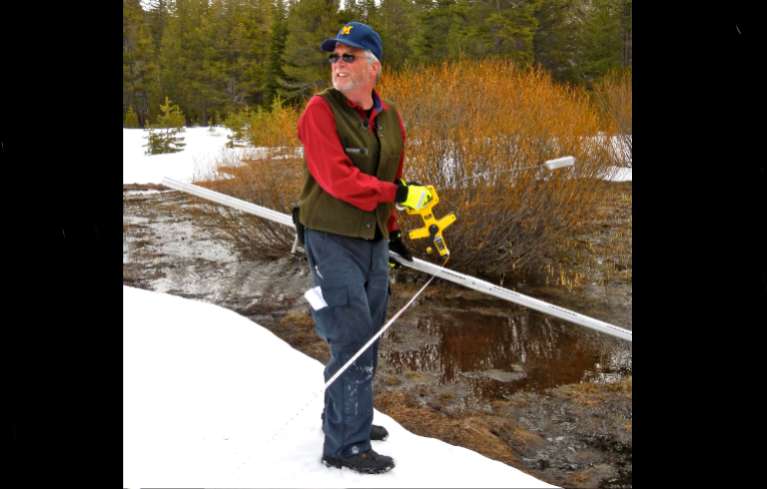
PHILLIPS STATION – No snowshoes or skis needed. Unable to make the final measurement because the snow stopped and the stream began. Dirt and grass.

The combination of the above conditions made the results of Thursday’s snow survey near Echo Summit anticlimactic. Frank Gehrke with the state Department of Water Resources walked through the snowfield that in places didn’t contain snow.

He came up with an average snow depth of 13 inches that accounted for 6.1 inches of water content. This makes it 32 percent of average for this time of year.

Frank Gehrke runs out of snow to measure on March 28 near the entrance of Sierra-at-Tahoe. Photo/Kathryn Reed

Frank Gehrke runs out of snow to measure on March 28 along Highway 50 just west of Echo Summit. Photo/Kathryn Reed

Statewide, the snowpack is 52 percent of normal.

Snowpack is supposed to be at its peak right now. Instead, it has been diminishing since the December storms.

Holes from last month’s survey of where the metal device is plunged into the snow were still evident.

With the lack of precipitation throughout the state, this makes for the driest first quarter on record. And while it’s not unusual to have one month that is dry, to have three consecutive months is what is alarming.

“We can’t rule out there will be a good April. But it would have to be a deluge,” Gehrke said.

And to get the numbers to historic averages, it would mean 22 inches of rain for April. This equates to about 220 inches of snow.

“You probably don’t want that to happen,” Gehrke said.

The dim bright spot in news coming out March 28 is that the reservoirs on average are 95 to 97 percent full.

Most water users – ag and domestic purveyors – look two years out when it comes to figuring out how to meet their needs. These users were notified last week that their deliveries would be cut.

The runoff from the Sierra snowpack is what fills the reservoirs around the state. That water is then sent downstream to be used as irrigation for crops and drinking water for others.

And reservoirs that aren’t full impact recreation as well as fisheries.


Upper Truckee Marsh comment deadline nears

The Upper Truckee River near Cove East is part of the California Tahoe Conservancy project. Public meeting: March 28, 6-8:30pm Lake Tahoe Community College, boardroom No presentation will be given, but questions will be answered. More info: Scott Carroll Scott.carroll@tahoe.ca.gov (530) 543.6062 Vitals: CEQA-TRPA comments due April 8 NEPA comments due April 26  Public meeting: March 28, 6-8:30pm Lake Tahoe Community College, boardroom No presentation will be given, but questions will be answered. More info: Scott Carroll Scott.carroll@tahoe.ca.gov (530) 543.6062 Vitals: CEQA-TRPA comments due April 8 NEPA comments due April 26Photo/LTN file

The Upper Truckee River near Cove East is part of the California Tahoe Conservancy project. Photo/LTN file

By Kathryn Reed

STATELINE — How the roughly 500 acres known as the Upper Truckee Marsh will be restored remains to be seen.

Once public input is completed next month, the California Tahoe Conservancy will begin the environmental analysis process. The final documents are expected to be out by the end of the year.

On Wednesday the Tahoe Regional Planning Agency Governing Board heard a presentation on the project. Ultimately that board will have to certify the environmental impact statement and then approve a project in order for permits to be issued.

While there is money in the bank to complete the planning phase, actual construction dollars are elusive. These days, though, dollars aren’t forthcoming until the CEQA (California environmental rules) and NEPA (federal regs) are all met.

Scott Carroll with the CTC told the TRPA board the soonest improvements would begin on this South Shore parcel would be 2015-16.

The state agency has yet to pick a preferred alternative. Of the five on the table, one is the customary no action. The others are 50-50 channel for the Upper Truckee River, No. 2 is to create almost an entirely new channel, No. 3 is a natural-distributary channel, and No. 4 is an inset floodplain.

This acreage is in the middle of South Lake Tahoe – with the Tahoe Keys and Cove East on one side and Al Tahoe and the former Barton Meadow on the other.

According to CTC, the benefits are:

• Restoration or enhancement of more than 500 acres of stream environmental zone

• Enhancing aquatic and terrestrial habitat

• Improving meadow and riparian vegetation

• Raising groundwater levels

• Reducing fine sediment reaching Lake Tahoe

• Enhancing sensitive species habitat

• Reducing impervious coverage in the stream zone

• Providing appropriate public access.

—-

Notes:

Public meeting: March 28, 6-8:30pm
Lake Tahoe Community College, boardroom
No presentation will be given, but questions will be answered.
More info:
Scott Carroll
Scott.carroll@tahoe.ca.gov
(530) 543.6062
Vitals:
CEQA-TRPA comments due April 8
NEPA comments due April 26.


Report: State should not operate every park

By Matt Weiser, Sacramento Bee

A study released Monday by the Little Hoover Commission recommends that California should consider divesting some of its state parks and permanently turning them over to local agencies.

The 120-page report is the result of a year-long investigation that began before financial scandals emerged in July 2012 at the California Department of Parks and Recreation. Among other things, department leaders were found to be hiding $22 million even as they moved to close 70 of the 278 state parks due to state budget cuts. Numerous other investigations have probed these events.

Vikingsholm at Lake Tahoe. Photo/LTN file

Vikingsholm at Lake Tahoe. Photo/LTN file

The 14-member Little Hoover Commission, appointed by the governor and Legislature, chose to focus on long-term survival of the state parks system, the largest in the nation.

“We felt it was more important to push harder on everything else that needs to be done,” said Stuart Drown, the commission’s executive director.

The commission found that the parks department is burdened by an obsolete management structure; it can’t raise enough money from visitor fees to replace cuts in funding from the state general fund; and land acquisition using voter-approved bonds has outpaced maintenance budgets.

“A great public institution is falling apart,” commissioner Virginia Ellis said in a statement.

The most controversial of six recommendations calls for appointing an advisory council to decide which parks have true “statewide significance” and which serve more regional or local needs. Those in the latter category should be transferred to local agencies.

The primary reason is that the department, heeding voters’ wishes, used bond funds to add 168,000 acres to the park system since the 1990s. But operational funding declined, partly because of general fund cuts by the governor and Legislature.

As a result, today there is a maintenance backlog in the system that exceeds $1 billion, and many of the state’s finest natural resources and historical treasures are in severe decay. Interpretive programs and park ranger staffing have also declined.

“The growth curve for the department is no longer in acreage, but in deferred maintenance,” the report states.

It commission recommends other reforms, including adding a new job classification of “park manager.” This would allow employees other than park rangers, who must have peace-officer training, to oversee a park.

It also urges the governor and Legislature to commit to a consistent level of general fund support for parks, and to allow parks to keep more of the money they generate locally. The department should also commission an independent study of crime trends in the parks and hire more park rangers accordingly.

Carolyn Schoff, president of the California League of Park Associations, was pleased by the study but said the idea of eliminating parks from the state system will be controversial.

“Certainly we want to keep our park system intact,” she said. “But if this is a recommendation that will keep the parks as open and available as they were intended to be, I think it’s a possibility.”


LTUSD has multiple principal openings

By Kathryn Reed

Lake Tahoe Unified School District on Monday will be posting jobs for three principals, a vice principal and instructor to oversee the Sports Medicine Academy at South Tahoe High School.

The school board created the vacancy at Bijou Community School Tuesday night when the five unanimously agreed to move Karen Tinlin to Mount Tallac High School as principal.

Karen Tinlin is moving from Bijou to Mount Tallac starting in the 2013-14 school year.

Karen Tinlin is moving from Bijou to Mount Tallac starting in the 2013-14 school year. Photo/LTN

The Tallac opening is because longtime Principal Susan Baker is retiring at the end of the school year. She is responsible for creating the Young Parents Program at the continuation school, which provides a nursery-day care for the children of students.

Other openings:

• Mark Romagnolo, principal at Tahoe Valley Elementary School, is retiring.

• Superintendent Jim Tarwater is giving up his principal duties at the environmental magnet school. He is also in charge of human resources for the district.

• Pat Hartnett is going from South Tahoe Middle School to South Tahoe High School as vice principal.

• The sports medicine job is new. The facility will open in August for the 2013-14 school year.

The district will be looking for someone who is bilingual to lead Bijou. The hope is this will make the 6-year-old Two-Way Immersion program even stronger.

While STHS chemistry teacher Joel Dameral has been an administrative intern at the Meyers elementary school, he must apply for that principalship like everyone else.

At Tahoe Valley, the candidate for the top job must have a performing arts background because in the 2014-15 school year it will have that as its focus.

Tinlin’s move to Tallac is not completely voluntary. Bijou per the federal No Child Left Behind Act became a program improvement school in 2004-05, having been put on notice two years prior.

While significant gains were made in test scores in 2010, they reversed course for the last two years. The rule makers say move the principal if things aren’t working.

Tarwater said he would not have made the change if not forced to by the state.

“The system and structure created this type of situation,” Tarwater told Lake Tahoe News after the March 26 school board meeting.

He has long been vocal in his dislike for the Academic Performance Index standardized test because it compares one grade level to another instead of calculating if a class is improving or not from year to year. Special ed and English learners are given the same test as everyone else and expected to know just as much.

With more than 60 percent of LTUSD’s students on free or reduced lunches, it proves people are struggling. And studies have shown students from poor families don’t have the academic success middle class families have.

Time will tell if moving the principal will change the test scores.

In the meantime, Tinlin told Lake Tahoe News she is excited about the challenges and changes coming her way. This will be her fourth school in the 37 years she’s been with LTUSD. She was also principal of what was Meyers Elementary School and the now closed Al Tahoe Elementary. She also taught at Meyers and Bijou. She has been principal at Bijou for the last eight years.

“I think it’s an advantage to have contacts and connections. It will help with the transition,” Tinlin responded when asked if she or someone new to the district might have an easier time taking over from Baker, who has been entrenched at the Gardner Mountain site for years.

She’s worked with many of the agencies that are involved with Tallac students. And Tinlin is bound to know some of the students, which she believes will help her. And while her career has not been with this age group, she has raised four children and many of their friends call her mom.

“I think change is good,” Tinlin said. She is looking forward to finishing her career – which will probably be after two more years – at Mount Tallac.


Growing dome at SHES on shaky ground

By Kathryn Reed

Advocates for a growing dome at Sierra House Elementary School have discovered they need to nurture their idea a bit more for it to sprout into a reality.

This means learning that permits are needed, a thing called coverage is an issue in the Lake Tahoe Basin, that the school board needs to OK something like this and the state gets a say, too. It also means finally admitting the Truckee dome that has been highly touted as a model is not on a school site – that it is actually on private property.

People have been working on this greenhouse of sorts for a year and just now came to the school board. But it was only on presentation Tuesday night and not something to vote on.

What the dome at Sierra House might look like.

What the dome at Sierra House might look like.

Soroptimist International South Lake Tahoe was under the impression the school had all the necessary permits and approvals in place to erect the dome on the South Shore campus. Wrong.

And because the Lake Tahoe Unified School District board has yet to approve the structure, let alone the Division of State Architect signing off on the project, the Soroptimist will not be handing over the $25,000 check at lunch today as was expected.

Based on SHES Principal Ryan Galles’ presentation to the school board on March 26, the dome advocates’ input and board member Sue Novasel’s comments, today’s action will come as a surprise. And Novasel is the incoming president of Soroptimist.

Soroptimist told Lake Tahoe News prior to the school board meeting that its board would discuss at its meeting next week how to proceed. It’s possible the money could be set aside for one fiscal year with the anticipation the dome people will get the necessary approvals. It’s also possible the Soroptimist board will distribute the money to another organization.

While the school board said it likes the concept of the greenhouse, the members all want more info before saying build it.

Galles told the board how the dome would have multiple educational purposes. For one, it would be a hands-on science lab where students would be growing vegetables year-round. It would complement the composting program that was started this year. It would show kids that food comes from someplace else before it reaches a grocery story. And it will give them something healthy to eat. The state has curriculum in its Garden in Every School program that could be used.

“It will build lifelong healthy habits, not just with kids, but with families,” Galles said.

About one-third of the full boardroom was comprised of people who were there solely to show their support for the dome.

School district officials said the Tahoe Regional Planning Agency supports the dome project.

TRPA told Lake Tahoe News planners have gone over drawings and specs with the dome people, and told them what to include with their application. But no application has been submitted.

A soil analysis needs to be done, still.

Steve Morales, LTUSD facilities director, said even though Sierra House is out of coverage, that issue can be resolved. But he said the board would need to consider what the future for the school is in terms of coverage for other structures.

He explained to the advocates how the state works. And with the millions of dollars LTUSD has put into facilities in the last few years Morales is intimately familiar with the process.

And while the advocates said they know politicians who are on their side, they seemed to forget they were addressing five elected officials. Morales and other staff pointed out the state Division of State Architect doesn’t bend to political pressure, but instead follows stringent guidelines.

Morales will be working with the advocates to get the state what it needs.

The dome group has revised its budget to be close to $100,000 for permitting and to meet the state’s needs. Of the $36,500 Galles told the board is in the bank, the reality is $25,000 of that is from the Soroptimist. And now that is on hold.

So, even if the district and state give a green thumbs up to the dome, the money to build it, operate it and maintain it still needs to be secured.