Reward offered in missing woman case

By Bill Lindelof, Sacramento Bee

The El Dorado County Sheriff’s Office said a $10,000 reward is being offered to find a woman who has not been heard from in more than a year.

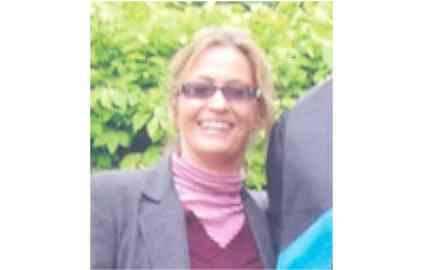
missing womanSara Fawcett, (pictured) a Placerville Wal-Mart employee, called in sick Sept. 22, 2011. She was last seen or heard from the next morning, according to a missing person’s bulletin.

The investigation into her disappearance continues. Her family is offering the reward.

Fawcett, 53, was reported missing by her father after she did not return home after several days.

Fawcett, who did not own a vehicle, usually borrowed her father’s car, but the vehicle was not taken by the woman. Her belongings were also not taken from her residence on the family’s Pollock Pines property.

At the time of her disappearance, the sheriff’s department said it is unlike Fawcett to leave her home without her purse and cell phone.

She is described as 5-feet, 1-inch tall, about 120 pounds, with brown hair and brown eyes. Anyone with information is asked to call Detective Paul Hadjes at (530) 642.4713.


Newspaper revenues — more bad news than good

By Dean Starkman, Columbia Journalism Review

The Newspaper Association of America takes some comfort, and with some reason, in the news that newspaper revenues declined only 2 percent in 2012, to $38.6 billion, from $39.5 billion the previous year.

That’s indeed something to cheer about when you consider that for the better part of a decade, industry revenues were plummeting from $57.4 billion in 2003, with some years showing declines near and above 20 percent.

Another bright spot is subscriptions. In its report, a detailed survey of 17 newspaper companies that combined make up 40 percent of the industry’s circulation, found that circulation rose — that’s right, rose — to about $10.5 billion from about $10 billion.

Any growth at all is big news, and half a billion dollars in new revenue is nothing to sneeze at.

It should be noted that all subscription growth is on the digital side — in a word, paywalls, which, as we’ve been saying, are a reasonable, ameliorative step that can slow (not stop) overall revenue declines and help to preserve newsroom assets while the shakeout continues. It’s digital subs that are saving the day.

That said …

The ad picture has nothing encouraging to offer. First, digital ads remain basically stuck in neutral, rising 4 percent over the previous year from a low base of $3.4 billion. Digital ads make up 11 percent of overall revenue on average (though the figure varies widely from paper to paper), and appear to be stuck at the level for the foreseeable future. This is particularly true given that digital ad rates generally themselves are falling materially.

And there is nothing good to be said about a 9 percent drop in print ad revenue, to $18.9 billion. Put it this way, for the $500 million the industry gained in subscription revenue last year, it lost more than three times that much in print ads. That’s the number to watch, and that’s the trend that doesn’t seem sustainable.

Further, it’s hard to know how far and fast digital subscription revenue can grow. The NAA numbers show robust growth in two kinds of digital subscriptions — a whopping 499 percent growth in subscriptions that combine digital and print editions, and 275 percent in digital-only subscriptions.

The first might be seen as more or less one-time pop as more and more newspapers adopt paywalls and begin levying new charges for the digital edition of their papers. This can be seen basically as a price increase, and there’s no telling how much more the market will bear. Partly as a result of bundling, print-only and newsstand revenues are way down — 14 percent.

The hope is in the digital-only subs. But while 275 percent growth is very nice, NAA doesn’t break out the raw numbers and it’s safe to assume that the growth, like digital ads, is also from a low base.

And this is where we say, “But the New York Times (!)…” And it’s true, the Times continues to astound not just with the success of its paywall, but that it continues to add new subscribers at a healthy clip of 50,000 or so a quarter, and at the year end stood at 640,000, far beyond most expectations.

Of course, the Times is sui generis in some ways, and other papers can’t expect that kind of growth. On the other hand, many predicted paywalls wouldn’t work at all, and they were wrong. So it’s not unreasonable to hope for some further growth in digital subscriptions to offset print ad declines. The question is how much and how fast.


5 loop road alternatives to be studied

By Kathryn Reed

STATELINE – With a near unanimous vote, the Tahoe Transportation District on Friday selected five loop road alternatives to study in the environmental documents. But what that assessment will look like is not expected to be released in draft form until January 2015.

Angela Swanson, South Lake Tahoe’s rep to the TTD board, voted the council’s preference April 12 when she was the lone dissenter. While she expressed the city’s desire for a loop road and to work with the partners to make it happen, she said because the majority of the council takes issue with one of the alternatives, she had to vote no.

Fellow TTD board member and Douglas County rep Nancy McDermid gave her a bit of schooling in policy and procedure; saying how it’s normal to not like all alternatives in any document, but that this is the democratic practice and it’s how prejudices get ironed out.

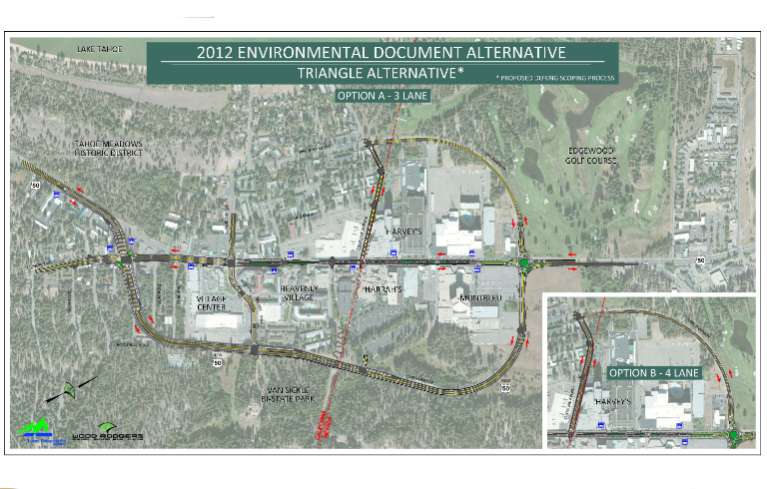
This triangle alternative is the preferred route for the loop road on the South Shore.

This triangle alternative is the preferred route for the loop road on the South Shore.

But McDermid doesn’t attend South Tahoe council meetings to know that this board wants to act united and not fractionalized. It also has no problems telling other entities how to do their job.

The Tahoe Transportation District – not the city, not Caltrans, not NDOT – drives the loop road.

This summer fieldwork will be done to help gather information that will be used for the environmental analysis. Then in 2014 the analysis will be done, with a draft coming out in early 2015.

The contentious alternative for the city is what is now called Alternative 2 with options. It would still take out the buildings to the west of the intersection of Highway 50 and Pioneer Trail near the state line.

The triangle alternative is deemed the preferred alternative. It would start about 500 feet west of that intersection at the two vacant lots on the highway that the city owns. Fewer businesses are likely to be demolished with this scenario.

Both of these alternatives require right-of-way acquisitions and displacement of businesses and residents.

The differences and impacts will be part of the environmental analysis, which looks at the environmental, social and economic effects of each alternative.

Both of these routes have Highway 50 going behind the Village Center, Harrah’s and MontBleu, with a two-lane roundabout at the intersection where it connects with present-day Highway 50 on the eastern side in Stateline.

In the analysis consultants will look at how narrow the current highway through the casino corridor could be, how wide sidewalks could be, and what median landscaping would work. That road would then be a city street – maintained by South Lake Tahoe and Douglas County where applicable.

The goal of the loop road is to create a complete street design to replace today’s highway, move the highway out of what proponents want to become a more pedestrian friendly area, create an area where events could be staged, and have an aesthetically pleasing area for locals and tourists.

McDermid said she would like planners to look at the possibility of separating cyclists from motorists as is done in many parts of the world, but is not common in the United States. This would mean a lane of car traffic, then a curb, then a bike lane, then another curb with sidewalk, and the businesses.

The other alternatives include a skyway that would be an elevated area near the casinos. This was included to show a route with less right-of-way needed to be secured.

McDermid asked about clearing snow and where the run-off would go. The concept was not taken seriously by the consultant or those in the room, as laughter accompanied any talk of this suggestion. Still, though, what the board voted on was that the alternatives were worth studying and represented diversity and input from the public via a series of meetings.

Another alternative is the one-way triangle that has traffic going in a circle, but creates more state highway coverage and does not create much of a streetscape.

As is customary, a do nothing alternative is included.

Having the loop road go on the lake side is not being considered, nor was it part of the economic analysis.

A business group was convened to study that economic report. It was originally tasked with providing peer review, but that did not happen. Instead, the outcome was the parroting of the project’s goals – create a more walkable, bikeable community, where people want to linger, spend money and events can be put on.

Going forward a citizens’ committee will be created with the preliminary desire to get input from people not just in the state line area. This is because whatever does or does not happen with the loop road will impact everyone who lives on the South Shore in terms of driving through the area, shopping, dining, increased-decreased tax dollars, construction delays, and the overall future of that section of the community.


Tool erases online data post-death

By Hayley Tsukayama, Washington Post

You may be a stickler for keeping control of all the data in your many online accounts, but what will happen to that data after you die?

It’s a question that Google’s addressing with the announcement of a new tool, the Inactive Account Manager, that gives Google users the option to have information from inactive accounts wiped from the system.

Those who use the Inactive Account Manager can choose to have their data deleted three, six, nine or 12 months after it becomes inactive. Users can also select “trusted contacts” to receive information from various Google services such as Blogger, Gmail, Picasa Web Albums, Google Voice and YouTube.

Accounts become inactive when users haven’t logged in for a certain amount of time, meaning that events other than death could trigger the notifications. According to Google, users can set their own “timeout” period, and then will receive a text message and email to a secondary account when the company deems the account is no longer active.

Users can find the tool on their account settings page, under the heading “Account Management.”

Finding a way to deal with social networking and other data has been a much-discussed topic as people put more of their data online.

Facebook, for example, allows users’ family members or friends to memorialize Facebook pages of those who’ve died. Once an account is memorialized, no one can log into it and the account will not accept new friend requests. Facebook also removes the profiles of deceased people from its suggested lists of “People You May Know.”

Content on the profiles of people who’ve died remain open using the privacy settings users set when they posted the information. To obtain other information from these accounts, Facebook requires a court order.

Family members, the company has said, can request for profiles to be removed.

As ABC News reported, some states have proposed legislation to deal with data after death. A New Hampshire state representative has introduced legislation specifically dealing with social networking data, while other states such as Rhode Island and Connecticut have legislation that deals with what should happen to users’ e-mail data after their death.


Nevada contemplating redefining marriage

By Cy Ryan, Las Vegas Sun

CARSON CITY — By a party-line vote, the Senate Committee on Legislative Operations and Elections has approved a proposed constitutional amendment to permit same-sex couples to marry.

The resolution passed April 11 would repeal the state’s ban on gay marriage and sets out that Nevada would recognize marriages, regardless of gender.

The resolution would have to be approved by this session of the Legislature and again in 2015 before the proposed change could placed on the 2016 election ballot for voters to decide. It now goes to the full Senate.

“All people in Nevada deserve the freedom to marry,” said Laura Martin with Progressive Leadership Alliance of Nevada.

The original proposal sought only to repeal language in the state constitution that defines marriage as between a man and a woman. But a late amendment adopted by the committee adds that the state “shall recognize marriages and issue marriage licenses, regardless of gender.”

“We felt it would be cleaner to both eliminate the current prohibition and make it clear Nevada does not discriminate in any way,” said state Sen. Tick Segerblom, D-Las Vegas, who introduced the bill.

The amendment drew opposition from Republican Sen. James Settelmeyer of Minden. Settelmeyer said he gave Segerblom his word that he would vote for the original bill, but withdrew his support because of the new wording.

“I don’t think the subject of marriage should be in the Constitution,” Settelmeyer said. “This is adding something else in, and I can’t support that.”

He was joined by state Sen. Barbara Cegavske, R-Las Vegas, in opposing the measure, SJR13.

In support were Las Vegas Democrats Patricia Spearman, the committee chairwoman, and Mark Manendo and North Las Vegas Democrat Kelvin Atkinson.

Voters in 2002 approved an amendment to the Constitution that “only a marriage between a male and female person shall be recognized and given effect in this state.” The vote was 337,197 to 164,573.

The Legislature later approved a law allowing same-sex couple to register as domestic partners with the Secretary of State’s Office but did not convey the full benefits of marriage.

As of April 1, there were 4,157 registered domestic partners in Nevada, but a spokeswoman for the office said some of them were male-female couples.

Janine Hansen, president of the conservative group Nevada Families for Freedom, called the committee’s vote a “kick in the teeth” of voters who approved the Protection of Marriage Act in 2000 and 2002, defining marriage as between a man and a woman.

“It makes same-sex marriage the standard in Nevada,” she said.

The Associated Press contributed to this report.


Fire damages historic Truckee building

By Barbara Barte Osborn, Sacramento Bee

One of Truckee’s most historic buildings, the C.B. White House, was damaged in a fire early Thursday.

Donner Pass Road between Spring Street and the downtown roundabout was closed from about 4-8am to accommodate firefighting equipment from local fire departments, said Paul Spencer, fire prevention officer for the Truckee Fire Protection District.

The fire, which was called in at 3:45am, started on an outside rear wall of the structure, Spencer said. No one was in the building at the time.

“The fire was fully contained, but it’s hard to say the extent of damage to such an old, historic building,” Spencer said. The fire is under investigation by Truckee fire and police officials.

The C.B. White House is a Queen Anne-Eastlake-style Victorian built in 1874 in downtown Truckee by a mill owner, W.H. Kruger, as his family residence.

In the late 1970s, Zena Krakowsky restored the mansion, earning it the area’s first listing on the National Register of Historic Places in 1982.

After another long period of sitting empty, the building had recently been purchased by new owners and reopened as a restaurant, Spencer said.


Swanson’s ethics still being questioned

By Kathryn Reed

Even with Gino DiMatteo being formally sentenced April 10 to five years in federal prison, the case is not completely closed.

Still blowing in the wind is Angela Swanson. The South Lake Tahoe City Councilwoman was caught up in the DiMatteo mess in August when she was questioned, had her house searched and electronic devices confiscated because at the time DiMatteo was suspected of bribing her.

The state bribery charge against the 43-year-old DiMatteo was dropped when the feds took over. The feds only leveled drug charges against the South Lake Tahoe resident. Earlier this year he pleaded guilty to all charges.

Angela Swanson -- Vern Pierson -- Gino Dimatteo

Angela Swanson — Vern Pierson — Gino DiMatteo

No charges have ever been brought against Swanson, but she is still under suspicion.

“We are not making any comments on the Angela Swanson matter at this time,” Nancy Anderson, secretary to El Dorado County District Attorney Vern Pierson, told Lake Tahoe News this week.

Swanson and DiMatteo knew each other because he at one time ran the City of Angels II medical marijuana dispensary in town and several times had business before the City Council.

Swanson along with Nancy Rollston, the head of the Lake Tahoe Educational Foundation, accepted more than $1,000 in cash for the foundation from DiMatteo that was delivered in an unmarked brown bag. (Despite its being drug money, the foundation has never returned it. Swanson is on the nonprofit’s board.)

Swanson told Lake Tahoe News she has had one phone conversation with the district attorney since August. That, she said, was not recent and it was to clarify paperwork.

“Nothing new is happening with me,” Swanson said on April 11. “I’m not accused of anything at this point.”

She is seeking from the Fair Political Practices Commission a written opinion exonerating her of any ethics violation. She said early on she received a verbal opinion saying she did nothing unethical.

Multiple phone calls to the FPPC were not returned.

Swanson said if ethics charges were filed against her by the district attorney, she would fight them.

People have told Lake Tahoe News that Swanson has a legal defense fund going to fight what they have been told will be an ethics case. As an elected official, Swanson must report all of those dollars and disclose donors’ names.


Burglars hit 2 S. Tahoe Y businesses

South Lake Tahoe police officers are looking for the people who burglarized two businesses at the Y this week.

Cash was taken from the register at Bert’s Café on Monday night. The next night two laptops were stolen from Barton University. While the businesses are across the street from each other on Emerald Bay Road, police Lt. Brian Williams told Lake Tahoe News, “We have no specific information which connects the two burglaries.”

Williams offered the following advice to help prevent a business from being the victim of theft:

• Lock your business doors and windows. This sounds obvious, but this is often overlooked.

• Burglars frequently commit their crimes close to their own residence … even if that may be a tent in a field. Business owners and employees should remain alert and observant to their surroundings; what is normal and what is not.

• Take note of suspicious persons or vehicles around the business, especially at opening and closing time.

• Take note of people wearing inappropriate clothing for the weather, such as heavy coats during warm weather.

• Be aware of people carrying duffel bags or similar items to collect and flee with stolen property.

• Be prepared to take brief mental descriptive notes about people and/or their vehicles.

• Equip your business with an alarm and video surveillance and periodically test this equipment to verify it is in proper working order.

• Ensure employees are trained in how to operate any surveillance recording gear in order to quickly provide officers with video recordings of the suspect.

• Establish good relationships with neighboring businesses to help watch out for one another.

• Try to keep the inside of your business well lighted, with unobstructed windows so that a clear view from the street or parking will assist police officers to see inside as they patrol the area.

• Use of lighting and video recording gear is particularly helpful at all entrances and exits to the business.

• Some businesses find it beneficial to leave the cash register drawer open and visible from windows to deter a burglar.

• Keep cash at a minimum, and post notices in the doorway of this fact.

• Keep the telephone number of the police department near the phone. (911 for an emergency, 530.542.6100 for nonemergency.)

• Develop and train employees in a plan of what to do in case a burglary is discovered. This should include — alert authorities quickly, do not search through the business before police arrive because the suspect may be hiding inside, protect the crime scene by not disturbing evidence, including unintentionally contaminating any remaining scent at the scene which may enable a police canine an opportunity to track a suspect’s path of escape, and position and identify yourself in such a way that responding officers will not mistake you for a possible suspect.

— Lake Tahoe News staff report


Nevada close to opening medicinal pot shops

By Cy Ryan, Las Vegas Sun

CARSON CITY — A Senate committee has cleared a bill to permit a network of medical marijuana dispensaries, but those who sell the drug will have to pay a $20,000 licensing fee.

In 2000, voters approved a constitutional amendment to allow possession of medical marijuana if prescribed by a physician. But the law did not permit for dispensaries to distribute it.

State Sen. Mark Hutchinson, R-Las Vegas, said the initial fee for licensing a clinic will be $20,000 with an annual renewal of $5,000. The fees would give the state Health Division money to regulate dispensaries, and any excess would go to aid to public schools, he said.

The Senate Judiciary Committee on April 11 endorsed the bill, which would permit 40 dispensaries in Clark County and fewer in other counties.

Under the bill a lottery will be set up if applications exceed the limit. Nevada companies would receive preference.

Hutchinson said Senate Bill 374 establishes a system of “tight controls” to track the marijuana from seed to sale.

State Sen. Greg Bower, R-Reno, said there was a “disconnect” between the federal law that prohibits the sale of marijuana and the proposed state law. But he called allowing dispensaries the “next logical step” in carrying out Nevada’s constitutional amendment to allow medical marijuana.

Committee Chairman state Sen. Tick Segerblom, sponsor of the bill, said he has seen press reports that the governor would be open to considering the measure, which now goes to the full Senate.

The bill originally suggested dispensaries be non-profit organizations, but that was changed to allow for-profit groups to run them. The initial bill also called for a $5,000 license fee, which was raised to $20,000 by an amendment adopted by the committee today.

Besides the authorized 40 clinics in Clark County, there would be a maximum of ten allowed in Washoe County, two in Carson City and one each in rural counties.


NV TRPA board member’s lobbying work questioned

By Anjeanette Damon, Las Vegas Sun

CARSON CITY — At a legislative hearing this month on a controversial bill that could determine the future of the bi-state agency tasked with protecting the Lake Tahoe environment, Tahoe Regional Planning Agency board member Steve Robinson urged the committee to preserve Nevada’s ability to abolish the agency altogether.

In his view as a board member, the threat that Nevada could pull out of the agency was the catalyst for recent progress toward fixing the dysfunctional agency in charge of overseeing development and environmental protection in the Lake Tahoe Basin.

Politics cast more clouds over Lake Tahoe than Mother Nature. Photo/LTN file

Politics cast more clouds over Lake Tahoe than Mother Nature. Photo/LTN file

But Robinson, who represents Nevada’s Conservation and Natural Resources Department on the TRPA board, never mentioned that he is also a contract lobbyist for a firm that pushed through the state law allowing Nevada to abandon its decades-old compact with California to protect Lake Tahoe in the first place.

Robinson was testifying on Senate Bill 229, a measure backed by environmentalists that would preserve the bi-state Compact by repealing the 2011 law allowing Nevada to withdraw from the TRPA if changes aren’t made to ease development around the lake.

The hearing highlighted Robinson’s dual role as both lobbyist and TRPA board member — a role that environmentalists say represents an inherent conflict of interest when it comes to protecting Lake Tahoe.

Robinson is the former government affairs director for R&R Partners, one of the largest lobbying firms in Nevada that was retained by Tahoe businesses to shepherd through the 2011 law, Senate Bill 271. Robinson is no longer an employee of R&R Partners, but is contracted with them to lobby for two mining companies.

Robinson, and the state official who gave him the job on the TRPA board, say he is able to keep the two roles separate. Robinson said he lobbies only on mining issues, not any Tahoe-related legislation.

“I was a bureaucrat for 30 years, both at the federal level and the state level,” Robinson said. “I think I know what conflicts are, and this ain’t one of them.”

But critics argue it’s impossible to dismiss R&R Partners’ role as chief cheerleader for SB271.

“Given the role R&R played in passing SB271, it certainly concerns me,” said Kyle Davis, political director for the Nevada Conservation League, of Robinson’s dual role. “He’s been very good at making it clear when he’s working on TRPA issues and when he’s working on R&R issues. But the TRPA issues are completely intertwined with what R&R does. I don’t know how you keep the two separate.”

Leo Drozdoff, director of the Nevada Department of Conservation and Natural Resources, appointed Robinson to the TRPA board in January 2011. Typically, Robinson’s seat on the board is held by the director of the department.

But Drozdoff said he wanted someone with more expertise on Tahoe issues, as well as the time to be a truly engaged board member. He selected Robinson, who has worked as a senior staff member for three Nevada governors and is the former deputy director of the U.S. Fish and Wildlife Department.

“We don’t see it as a conflict,” said Pete Ernaut, president of R&R Partners. “He asked if he could be on the board and given Steve’s background, this is an appointment that is well in keeping with his area of expertise.”

Drozdoff said he “made no bones about” the fact Robinson worked for R&R Partners, even including that fact in the press release announcing his appointment to the TRPA board.

But Robinson’s association with the lobbying firm didn’t become relevant until R&R Partners took the lead role in ushering SB271 through the Legislature in 2011.

“When all this stuff came about with 271, I talked to Steve at length about it,” Drozdoff said. “He said they have various firewalls in place and he’s not involved in any lobbying efforts.

“But I won’t disagree that it does create a bit of a conundrum.”

Robinson has been heavily involved in working on the measure now before the Legislature to repeal the 2011 law. He meets informally and formally with lobbyists on both sides of the issue.

But Drozdoff said he would expect nothing less from his appointee to the board, saying the DCNR wants to broker a compromise on the issue. And he has no concerns about Robinson’s private employment.

“Yes, I am confident that when he is taking a position at the Legislature, that position is consistent with mine,” Drozdoff said.

But environmental groups pushing to protect the compact aren’t so sure.

They point to Robinson’s testimony this month, when he took the microphone as a “neutral” witness on the bill to repeal the 2011 law but then advocated to preserve it.

“The specter of the possibility of Nevada’s withdrawal was absolutely essential to changing the hearts and the minds of those on both sides,” Robinson said of the recent collaborative effort from California and Nevada officials to fix inherent problems at the TRPA.

“While that legislation certainly has some faults, the option to withdraw should remain.”

Darcie Goodman Collins, executive director for the League to Save Lake Tahoe, said Robinson’s testimony as a TRPA board member was “inappropriate,” given his business interest with R&R.

“He works for R&R lobbying firm, which represents a lot of special interests,” Collins said. “In my opinion, he’s not adequately and honestly representing the (state) department.”

On the point of allowing Nevada to withdraw from the Compact, however, Drozdoff and Gov. Brian Sandoval tend to agree with R&R’s position.

Sandoval signed SB271 in 2011, and according to Robinson, does not support the law’s repeal this year. Nor does Drozdoff, who echoed R&R’s argument that more time is needed to change the direction of the TRPA.

Sandoval was non-committal when asked if he is concerned about Robinson’s dual role.

“I’ll have to think about that,” Sandoval said. “I’ll chat with Leo about that.”

Potential conflicts of interest abound at the Legislature, where lawmakers hold regular “day jobs” and meet only every other year. Some lawmakers work for lobbying firms, labor unions, or other companies that have business before the Legislature.

In that environment, some didn’t blink an eye at Robinson’s dual role.

“I hadn’t really thought about it and I wasn’t aware of it,” said Sen. Aaron Ford, D-Las Vegas, the chairman of the Senate Natural Resources Committee that heard the repeal measure. “It doesn’t sway me one way or the other, the fact he works for R&R and is also a board member. I am able to compartmentalize people’s roles in certain things, but also give credence to the position stated.”

But Robinson said he is confident the two roles don’t conflict, particularly since he is not retained by R&R to lobby Tahoe issues.

“I know what’s in my mind and my heart,” Robinson said. “There are a lot of people at the Legislature involved in a lot of things, including legislators. I just don’t see this as a conflict.”