Drug dealer with grows in El Dorado, Placer going to prison

A Fresno man who controlled marijuana grows in El Dorado and Placer counties was sentenced April 15 to 17 1/2 years in federal prison for drug crimes.

Uriel Ochoa-Espindola, 44, according to court documents, was the leader of a massive marijuana manufacturing operation and an interstate drug distribution ring. He and his partners grew tens-of-thousands of marijuana plants in three counties and shipped their product across the country with the aid of commercial truckers. Espindola’s operation was based near Delhi, but he controlled marijuana grows in El Dorado County, Tehama County, and Placer County.

According to court documents, investigators seized three handguns and nearly 11,000 marijuana plants at the El Dorado County grow site. They seized nearly 17,500 marijuana plants at a grow site in Placer County, and nearly 2,000 marijuana plants at the grow site in Tehama County.

According to court documents, Espindola was “one of the largest marijuana traffickers in Northern California.” He, his lieutenants, and his workers used firearms to further that operation. In addition to the weapons found in the El Dorado County grow site and a shotgun found at Espindola’s home, Ramirez-Cardinez, told one of the undercover officers that he brought a .22-caliber rifle to the Placer County grow site. Investigators ultimately found five other firearms at Ramirez-Cardinez’ house when he was arrested. Earlier, Ramirez-Cardinez gave one of the undercover officers an AK-47 rifle. The officer was supposed to pay for the weapon later.

— Lake Tahoe News staff report


Tahoe residents safe, Sparks couple hurt in Boston blasts

Smoke rises April 15 after bombs went off near the finish line of the Boston Marathon. Photos/Les Wright

Smoke rises April 15 after bombs went off near the finish line of the Boston Marathon. Photos/Les Wright

Four South Lake Tahoe residents who were in Boston for the country’s oldest marathon escaped the bombings unharmed.

Two bombs were heard going off near the finish line of the April 15 event just before noon Pacific time. Three people are confirmed dead and 144 injured.

“We were between both bombs which were 100 yards or less apart. We are back at our flat watching it on TV,” Les Wright of South Lake Tahoe said in an email to Lake Tahoe News. Wright puts on the Lake Tahoe Marathon and often travels to other races to promote his September event.

He is in Boston with his wife, Buffy, and their friend Kristin Blocher.

“We had just got through the massive crowd on the sidewalk where one of the bombs went off. I fear what the death toll will be. Earlier we were in the bleachers exactly across from the finish line first bomb in the bleachers. We had gone back to our apartment after the winners crossed and were just getting back to the finish line to see Kristin finish at around 4 hours. The bombs went off at 2:51 Boston time,” Wright said. “Kristin was running to the finish line between the two bombs. We are three very lucky people.”

Shandi Ashmore of South Lake Tahoe was also running the marathon. LTN has been notified that she was not harmed.

The race has 27,000 participants and can have nearly twice as many spectators.

The hotline for help locate friends and family is (617) 635.4500.

— Lake Tahoe News staff report

—-

The finish line before the chaos.

The finish line before the chaos.

The following is from the Reno Gazette-Journal:

After hearing two explosions, Frank Kight dove to the ground and mass chaos ensued.

“I heard that first explosion and my first thought was that maybe it was a festivity or cannon,” Kight, a retired Dilworth Middle School counselor from Sparks who was near the Boston Marathon finish line Monday when two explosions killed at least three and injured more than 100, said.

“When it went off I ducked and it was followed by another explosion — and at that point people were screaming. I dove to the ground and saw people screaming… It was mass chaos,” Kight said.

Shrapnel left a gash in Kight’s right calf and caught his pants on fire. His ex-wife was also taken to the hospital, where she remained after surgery to inspect a leg wound. They were in Boston to watch their daughter, Amy Blomquist, run the marathon. Blomquist was one of 33 Reno-Sparks-area runners in this year’s Boston Marathon.

There was no word on the motive or who may have carried out the attack, and police said they had no suspects in custody.

A senior U.S. intelligence official said two other bombs were found near the end of the 26.2-mile course.

The White House issued a statement Monday saying the government “will increase security around the United States as necessary,” and Reno-Tahoe International Airport spokesman Brian Kulpin said airport personnel were on a “heightened state of vigilance.”

People scramble for cover after two explosions go off at the Boston Marathon.

People scramble for cover after two explosions go off at the Boston Marathon.

The following is from the Boston Globe:

At a news conference Monday evening, Richard DesLauriers, head of the Boston office of the FBI, said the FBI was taking the lead in the probe of the blasts. “It is a criminal investigation that is a potential terrorist investigation,” he said.

Blood and broken glass covered sidewalks in the area after the blasts occurred at about 2:50pm.

“It was just immediately [evident] there were injuries, right in the middle of the spectator crowds,” said boston.com sports producer Steve Silva, who was on the scene to cover the race, normally a spectacle that is a magnet for elite athletes and determined runners from across the world.

“There was blood everywhere; there were victims being carried out on stretchers. I saw someone lose their leg. People are crying. People are confused,” Silva, who captured one of the explosions on video, said moments after the blasts.

Peter Fagenholz, a trauma surgeon, told reporters “several” people had to have limbs amputated. Doctors said those injured had metal debris embedded in their bodies, but they didn’t think that the metal was shrapnel that was built into the bombs.

“We will turn every rock over to find the people who were responsible for this,” Boston Police Commissioner Edward F. Davis said.

No suspects have been arrested, Davis said, though police were questioning many people.

Just before 8pm, a “person of interest” was being questioned at Brigham and Women’s in connection with the bombing, according to an official briefed on the investigation. The individual was hurt in the explosion, the official said. But Davis said at a mid-evening news conference attended by DesLauriers, Gov. Deval Patrick, and other officials, that “there is no suspect at Brigham and Women’s Hospital as has been widely reported.”

Neither Davis nor DesLauriers would discuss any specifics of the case.

Davis had initially said there had been a third explosion at the John F. Kennedy Library in Dorchester. But he downplayed those comments at an afternoon news conference, suggesting that the incident might not have been an explosion and might have been a fire.


Death of El Dorado County teen under investigation

By Cathy Locke, Sacramento Bee

The El Dorado County Sheriff’s Department is investigating the death of a teenager who was found critically injured in a roadway early Saturday morning.

Deputies responded about 4:19am to a report of a man lying on Sand Ridge Road in south Placerville. When they arrived, they found a 17-year-old boy lying in the roadway in critical condition, according to a sheriff’s department news release. Emergency medical personnel transported the youth to Marshall Hospital in Placerville where he died of his injuries.

Sheriff’s officials said the young man has been identified and his family has been notified of his death, but his name is being withheld pending further investigation.

They said the teenager reportedly left the area of Gopher Hole Road in Somerset on foot early Saturday morning. Detectives were told that he was walking toward a friend’s house on Sand Ridge Road before he was discovered in the roadway. Sheriff’s officials said his injuries were consistent with being struck by a vehicle, but the cause of death has not been determined.

Anyone with information pertaining to the case is asked to call Detective Jon Densmore at (530) 642.4718.


Legislature nixes lifetime unit limit at community colleges

By Melody Gutierrez, Sacramento Bee

Gov. Jerry Brown’s plan to make California’s community college system more efficient and increase access for students hit a road block last week as lawmakers rejected his proposal to set a lifetime limit on the number of units students can take at reduced in-state rates.

Budget panels in both houses of the Legislature rejected a provision in Brown’s budget proposal that would limit community college students to 90 units, or force them to pay more than four times the current $46-per-unit price.

The proposal was part of Brown’s spending plan for the state’s 112 community colleges, which included efforts to increase graduation and transfer rates by discouraging students from lingering or taking courses without an academic plan.

Reworking California’s public college system has been a priority for Brown, who has, among other things, proposed expanding access by increasing online course offerings.

Lawmakers said capping units is not the way to increase access or success. Assembly Budget Chair Bob Blumenfield, D-Woodland Hills, called the unit cap proposal inappropriate and off target.

“The administration proposals simply stick it to students who have already had to contend with fewer classes and massive fee increases,” Blumenfield said. “They respond to symptoms of a much bigger problem. Even if the administration could offer evidence showing a budget savings associated with these proposals, they are bad policy choices to make today.”

Critics expressed concerns that unit caps would hurt double majors or laid-off workers who have a degree but need to return to school for a new skill set.

Last month, the Senate’s education finance subcommittee voted against capping units for University of California or California State University systems. The Assembly Budget Subcommittee on Education Finance will weigh the proposal to cap units at UC and CSU on April 24.

Department of Finance spokesman H.D. Palmer said unit caps are a way to increase completion rates and create space for new students. Palmer said less than 30 percent of degree-seeking community college students transfer or earn a degree or certificate in six years. Sixteen percent of CSU students graduate in four years, while 60 percent of UC students complete their degree in that time, he said.

While the Legislature shot down unit caps, Palmer said it’s still early in the process.

“We have a ways to go,” Palmer said. “We intend to continue to have conversations with the Legislature.”

In separate votes on the community college issue last week, Assembly and Senate subcommittees rejected Brown’s plan along party lines, with Democrats opposed and Republicans supporting unit caps.

The Legislative Analyst’s Office has recommended adopting Brown’s unit-cap policy, saying it “creates positive incentives for students and motivates institutions to improve the efficiency of their academic programs.”

In the 2011-12 school year, there were nearly 95,000 students at community colleges who had earned 90 or more degree-applicable units, which is one academic year beyond what is needed to transfer or earn an associate degree, according to the LAO’s report.

Under the unit-cap proposal, many of those students would pay nonresident rates of $180 to $200 a unit, compared with in-state rates of $46 a unit.

The LAO said the unit-cap policy needed to be further developed so it included specifics such as which courses should be excluded and how to treat classes attempted but not completed. The current plan already excludes remedial courses, Advanced Placement or International Baccalaureate units earned in high school.

The LAO also recommended delaying the implementation for two years, instead of starting on July 1.

Opponents of the unit caps, including the community college system, said the proposal ignores a plan already in place to raise low completion rates.

That plan, which was required by lawmakers in 2010 and adopted by the college board of governors last year, will give priority enrollment to students who have developed an educational plan, taken a diagnostic assessment and have earned fewer than 100 units.

“That’s a much more nuanced way of addressing it than a straight 90 unit cap,” said Theresa Tena, vice president of Community College League of California.

Tena said the governor’s proposal is superseding efforts already underway by the community college system.

“We’d like to see the system effort implemented to see if that gets at the same thing the administration is trying to get at,” Tena said. “We think it will.”


Nevada excels at ‘patient dumping’

By Cynthia Hubert, Phillip Reese and Jim Sanders, Sacramento Bee

Over the past five years, Nevada’s primary state psychiatric hospital has put hundreds of mentally ill patients on Greyhound buses and sent them to cities and towns across America.

Since July 2008, Rawson-Neal Psychiatric Hospital in Las Vegas has transported more than 1,500 patients to other cities via Greyhound bus, sending at least one person to every state in the continental United States, according to a Bee review of bus receipts kept by Nevada’s mental health division.

About a third of those patients were dispatched to California, including more than 200 to Los Angeles County, about 70 to San Diego County and 19 to the city of Sacramento.

In recent years, as Nevada has slashed funding for mental health services, the number of mentally ill patients being bused out of Southern Nevada has steadily risen, growing 66 percent from 2009 to 2012. During that same period, the hospital has dispersed those patients to an ever-increasing number of states.

By last year, Rawson-Neal bused out patients at a pace of well over one per day, shipping nearly 400 patients to a total of 176 cities and 45 states across the nation.

Nevada’s approach to dispatching mentally ill patients has come under scrutiny since one of its clients turned up suicidal and confused at a Sacramento homeless services complex. James Flavy Coy Brown, who is 48 and suffers from a variety of mood disorders including schizophrenia, was discharged in February from Rawson-Neal to a Greyhound bus for Sacramento, a place he had never visited and where he knew no one.

The hospital sent him on the 15-hour bus ride without making arrangements for his treatment or housing in California; he arrived in Sacramento out of medication and without identification or access to his Social Security payments. He wound up in the UC Davis Medical Center’s emergency room, where he lingered for three days until social workers were able to find him temporary housing.

Nevada mental health officials have acknowledged making mistakes in Brown’s case, but have made no apologies for their policy of busing patients out of state. Las Vegas is an international destination and patients who become ill while in the city have a right to return home if they desire, the state’s health officer, Dr. Tracey Green, told Nevada lawmakers during a hearing last month.

She and others insist that the vast majority of patients they are discharging to the Main Street bus station are mentally stable and have family members, treatment programs or both waiting for them at the end of their rides.

That was not true in Brown’s case. His papers from Southern Nevada Adult Mental Health Services read: “Discharge to Greyhound bus station by taxi with 3 day supply of medication” and provided a vague suggestion for further treatment: “Follow up with medical doctor in California.” Brown said staff at Rawson-Neal advised him to call 911 when he arrived in Sacramento.

Nevada Health and Human Services Director Michael Willden told lawmakers last month that while health officials “blew it” in their handling of Brown, an internal investigation found no pattern of misconduct.

But an investigation by the Nevada State Health Division documented several other instances from a small sampling of cases in February in which the state hospital violated written rules for safely discharging mentally ill patients.

Other apparent violations surfaced during the Bee‘s investigation.

At least two patients from the Nevada system arrived in San Francisco during the past year “without a plan, without a relative,” said Jo Robinson, director of that city’s Behavioral Health Services department.

“We’re fine with taking people if they call and we make arrangements and make sure that everything is OK for the individual,” Robinson said. “But a bus ticket with no contact, no clinic receptor, anything, it’s really not appropriate.”

Robinson said she viewed the practice as “patient dumping,” and has reported it to federal authorities. “It’s offensive to me that they would show this lack of care for a client,” she said.

Practice called risky

Nevada mental health officials did not respond to repeated requests for phone interviews for this story, nor would they address a list of emailed questions about the origins of the busing policy and the safety protocols in place.

Southern Nevada Adult Mental Health Services, the agency that oversees Rawson-Neal, maintains detailed written policies for transporting patients “to their home communities,” with the stated goal of providing more appropriate care by the most economical means possible.

The policy includes a special section on “Travel Nourishment Protocol,” specifying the number of bottles of Ensure nutritional supplement the patient should receive for the bus trip – essentially six per day.

Staff members are supposed to fill out a “Client Transportation Request” form, which includes questions about whether the patient is willing to go, whether housing or shelter has been verified, and the cost of the trip.

The written policy calls for staff to confirm that a patient has housing or shelter available “and a support system to meet client at destination.” They are to provide information about “mental health services available in the home community.”

Interviews with health officials in California and numerous other states indicate Nevada’s practices are unusual. None of the 10 state mental health agencies contacted by the Bee said that placing a psychiatric patient on a bus without support would be permissible. And none recalled being contacted by Rawson-Neal to make arrangements for a patient coming from Nevada.

In California, where most public mental health treatment is overseen at the county level, agencies contacted by the Bee said they rarely bus patients and that Nevada’s practices seem out of step with the standard of care.

Several described the practice as risky, even if patients have someone waiting for them at the end of their journeys.

“Putting someone whose mental illness makes them unable to care for themselves alone on a bus for a long period of time could be absolutely disastrous,” said Dorian Kittrell, executive director of the Sacramento County Mental Health Treatment Center.

Patients could suffer relapses during their trips and potentially harm themselves or other people, said Kittrell and others. They could become lost to the streets or commit crimes that land them in jail.

“The risk is just too great,” said Dr. Marye Thomas, chief of behavioral health for Alameda County.

Southern Nevada Adult Mental Health Services has had an ongoing contract with Greyhound since July 2009, said bus company spokesman Timothy Stokes.

Stokes said he was unaware of any serious incidents involving mentally ill patients from Nevada. He said Greyhound has contracts with “a number” of hospitals around the country, but declined to identify them.

“We take it on good faith that the organization is going to make certain that patients are not a risk to themselves or others,” he said.

Still, officials in several of California’s largest counties said they rarely, if ever, bus patients out of state.

“We don’t do it, we never will do it, and we haven’t done it in recent memory, meaning at least 20 years,” said David Wert, public information officer for San Bernardino County. Rawson-Neal has bused more than 40 patients to that county since July 2008.

Los Angeles County officials said they have not bused a single patient out of state during the past year, and when they have done so in the past they have supplied chaperones. In the past five years, L.A. County has received 213 people from the Nevada hospital, according to the Bee‘s review, more than any place in the country.

Likewise, in Riverside County, sending patients out of state “happens very infrequently upon request of the family,” said Jerry Wengerd, head of the county’s Department of Mental Health. “A staff member accompanies the client and it is usually by air.” Nevada bused 20 patients to Riverside in the period reviewed.

Sacramento County bought bus tickets for five patients during the past year, Kittrell said. In all cases, he said, facility staff confirmed before patients departed that a family member or friend would meet them at their destinations, and provided referrals for treatment.

Organizations that advocate for mentally ill people said Nevada’s busing numbers seem unjustifiably high.

DJ Jaffe, executive director of Mental Illness Policy Org., a nonprofit think tank, said his group often hears anecdotally about patients being “dumped” from one county to another.

“Discharging severely mentally ill patients inappropriately is policy in this country,” Jaffe said. “But getting rid of them altogether by busing them out of state is, I think, rare. I am shocked by these figures. It seems to be almost routine in Nevada.”

After California, Arizona has received the most patients by bus from Nevada, at more than 100 over the five years.

But Cory Nelson, acting deputy director for the Arizona Department of Health, cautioned against drawing conclusions about Nevada’s practices based solely on number of bus tickets issued. In many cases, Nelson said, relatives could have agreed to house patients or made treatment arrangements before the clients left Las Vegas.

In rare cases, Nelson said, a hospital can find itself in a Catch-22 situation when a patient no longer needs to be in a hospital but refuses to cooperate with a discharge plan. “It kind of leaves a hospital in a tough situation,” he said.

Still, the sheer number of patients bused from the Nevada hospital “does seem pretty high,” he said.

‘A tsunami situation’

Several people interviewed said the numbers might be explained in part by the unusual nature of Las Vegas.

“As the whole country no doubt knows, Vegas is a pretty unique place,” said Dr. Lorin Scher, an emergency room psychiatrist with UC Davis Health System.

The city’s entertainment and casino culture draws people from all over the world, Scher noted, including the mentally ill.

“Many bipolar patients impulsively fly across the country to Vegas during their manic phases and go on gambling binges,” he said. “Vegas probably attracts more wandering schizophrenic people” who are attracted to the warm weather, lights and action, he added.

“I am by no means defending their practices,” he said. “It certainly gives cause for concern. But it’s one possible explanation.”

Stuart Ghertner, former director of Southern Nevada Adult Mental Health Services, cited other possible reasons.

He said Rawson-Neal has been under siege for years because of state budget cuts, a steady increase in poor people needing mental health services in the Las Vegas area and a revolving door of administrators.

He noted the city had a disproportionate number of people displaced by the housing and mortgage meltdown of a few years ago.

“The casino boom was over, people were losing their jobs and their homes. They were stressed and they wound up in a mental health crisis,” Ghertner said.

Between 2009 and 2012, Nevada slashed spending on mental health services by 28 percent to address budget deficits, according to data collected by the National Alliance on Mental Illness. Even before those cuts, Nevada fell well below the national average in spending on mental health services: In 2009, it spent $64 per capita on such services compared with a national average of about $123, according to the study.

“You’re looking at a tsunami situation,” said Ghertner, a psychologist who resigned last year after five years as agency director. “There is more pressure to turn patients over faster, and fewer programs (in which) to place them. Perhaps busing them became the easier solution.”

It also is cheaper, he noted. Southern Nevada Adult Mental Health Services spent a total of $205,000 putting patients on Greyhound buses during the past five years, according to the Bee analysis. The state hospital admits about 4,000 patients a year to its inpatient unit, and inpatient care runs around $500 per day per client, Ghertner said.

He said he was aware during his tenure that Rawson-Neal was busing patients out of state but that he thought the practice was rare.

At the time, “I had 800 employees and a $106 million budget,” he said. Ghertner regularly reviewed numbers pertaining to admissions, length of stay and other issues at the hospital, but patient busing was never on his radar, he said.

“I’m embarrassed to say that this practice was going on to this degree under my leadership,” he said. “I had no idea. It just never came up.”

Ghertner said the state mental hospital has been under stress since it opened in 2006, turning over five hospital directors since that time. That instability has taken a toll, he said.

“This busing issue is a symptom that reflects that the care there is not quality care,” he said. “Things clearly are being missed.”

Willden, Nevada’s Health and Human Services director, said during last month’s legislative hearing that policies have been tightened and disciplinary actions taken to ensure that patients are discharged only after the hospital confirms care and treatment at their planned destinations. The hospital administrator, Chelsea Szklany, now must approve all bus discharges ordered by medical staff, he said.

“Southern Nevada Adult Mental Health Services is committed to providing quality mental health services to its patients,” said spokeswoman Mary Woods in an emailed statement.

But investigations continue into the agency’s practices.

Rawson-Neal could lose vital federal funding pending an ongoing probe by the federal Center for Medicare and Medicaid Services. California state Senate President Pro Tem Darrell Steinberg has written a letter expressing outrage to U.S. Secretary of Health and Human Services Kathleen Sebelius.

The hospital’s discharge practices also have prompted a call for action by a member of the U.S. Commission on Civil Rights. Commissioner David Kladney called for a broad investigation by Nevada’s governor and Legislature.

“As a Nevadan, I am ashamed that my state is failing in its duty toward the neediest residents,” Kladney said. Nevada, he said, appears to be “simply hoping that other states will shoulder the responsibility.”




Nevada defends tourism slogan

By Richard N. Velotta

The director of the state Tourism Commission said that while many critics have pounced on Nevada’s new tagline, she’s confident the slogan will be embraced by residents and help attract tourists and businesses to the state.

Gov. Brian Sandoval unveiled “Nevada: A World Within. A State Apart” Tuesday.

“People are saying they like what the brand says about Nevada, and, for the most part, they’re saying, ‘Let’s give this the time it requires to really take a strong foothold and to grow,’” tourism executive Claudia Vecchio said.

Vecchio said she anticipated some criticism.

“There will always be detractors,” she said. “The moment you start a brand process, you know there are going to be people who don’t like it or for whatever reason think it’s not the right direction. We expect that. I hope we’ll be able to convince people through the way we execute it that it’s worth considering and it will become a brand that really does signify what Nevada is all about and drive business.”

Nevada is trying to embrace all segments of the Silver State. Photo/LTN file

Nevada is trying to embrace all segments of the Silver State. Photo/LTN file

In addition to the slogan, the state created a new tourism website and mobile application. Budget Travel praised the site last week.

“TravelNevada.com sets a new standard for state tourism sites and will certainly enjoy the sincerest form of flattery in the coming months and years as other states learn to package their travel and hospitality assets in beautiful and engaging new ways,” magazine editors wrote. “Visitors can assemble their own vacations, learn about destinations and share their findings via social media. The site also puts an emphasis on accessing partner sites for additional information, travel deals and even trip booking.”

Critics, however, ripped both the slogan and the cost of developing the brand and campaign.

The state paid $218,000 of a $250,000 two-year contract to Seattle-based GreenRubino, the first firm hired to research and develop a tag line for the state. That was in 2011.

The company failed to deliver a slogan the Tourism Commission liked.

Then New York-based Berson-Marsteller was hired to rebuild the state’s website, develop a mobile app and do public relations for the tourism campaign as part of a two-year, $3.2 million deal.

Berson-Marsteller decided to develop its own tag line, Vecchio said. The result was “A World Within. A State Apart.”

“Their contract was to do public relations, the website and new creative materials,” Vecchio said. “It was a fully integrated marketing program. And they said, ‘Because we’re committed to this state, we will do the branding also.’”

Television ads featuring the new tag line will begin airing Monday in Los Angeles, San Francisco and Phoenix. The ads include a soundtrack from Las Vegas rock band the Killers singing “Don’t Fence Me In” by Cole Porter.

The state budgeted $2.4 million for commercials during its summer campaign and $1.5 million for commercials during its winter campaign. The money comes from room tax paid by tourists.

Vecchio said she expects the marketing plan will have a high return on investment. State officials estimate Nevada generates at least $20 in tax revenue for every dollar it spends on marketing and advertising.

“Everything we do, we do to drive business, and we drive investment back into the state,” she said. “This brand is something that we believe is going to only help to increase that return on investment.”

Vecchio said she hopes to learn from the criticism but isn’t going to let it dampen her enthusiasm for the project.

“I think it’s such an opportunity to celebrate the potential,” she said. “Instead of attacking, we’ll look forward to something that has a possibility to take the state to new heights of success.”


More kids in court system with cops in schools

By Erik Eckholm, New York Times

HOUSTON — As school districts across the country consider placing more police officers in schools, youth advocates and judges are raising alarm about what they have seen in the schools where officers are already stationed: a surge in criminal charges against children for misbehavior that many believe is better handled in the principal’s office.

Since the early 1990s, thousands of districts, often with federal subsidies, have paid local police agencies to provide armed “school resource officers” for high schools, middle schools and sometimes even elementary schools. Hundreds of additional districts, including those in Houston, Los Angeles and Philadelphia, have created police forces of their own, employing thousands of sworn officers.

In the wake of the Newtown, Conn., shootings, a task force of the National Rifle Association recommended placing police officers or other armed guards in every school. The White House has proposed an increase in police officers based in schools.

The effectiveness of using police officers in schools to deter crime or the remote threat of armed intruders is unclear. The new N.R.A. report cites the example of a Mississippi assistant principal who in 1997 got a gun from his truck and disarmed a student who had killed two classmates, and another in California in which a school resource officer in 2001 wounded and arrested a student who had opened fire with a shotgun.

Yet the most striking impact of school police officers so far, critics say, has been a surge in arrests or misdemeanor charges for essentially nonviolent behavior — including scuffles, truancy and cursing at teachers — that sends children into the criminal courts.

“There is no evidence that placing officers in the schools improves safety,” said Denise C. Gottfredson, a criminologist at the University of Maryland who is an expert in school violence. “And it increases the number of minor behavior problems that are referred to the police, pushing kids into the criminal system.”

Nationwide, hundreds of thousands of students are arrested or given criminal citations at schools each year. A large share are sent to court for relatively minor offenses, with black and Hispanic students and those with disabilities disproportionately affected, according to recent reports from civil rights groups, including the Advancement Project, in Washington, and the NAACP Legal Defense and Educational Fund, in New York.

Such criminal charges may be most prevalent in Texas, where police officers based in schools write more than 100,000 misdemeanor tickets each year, said Deborah Fowler, the deputy director of Texas Appleseed, a legal advocacy center in Austin. The students seldom get legal aid, she noted, and they may face hundreds of dollars in fines, community service and, in some cases, a lasting record that could affect applications for jobs or the military.

In February, Texas Appleseed and the Brazos County chapter of the N.A.A.C.P. filed a complaint with the federal Education Department’s Office for Civil Rights. Black students in the school district in Bryan, they noted, receive criminal misdemeanor citations at four times the rate of white students.

Featured in the complaint is De’Angelo Rollins, who was 12 and had just started at a Bryan middle school in 2010 when he and another boy scuffled and were given citations. After repeated court appearances, De’Angelo pleaded no contest, paid a fine of $69 and was sentenced to 20 hours of community service and four months’ probation.

“They said this will stay on his record unless we go back when he is 17 and get it expunged,” said his mother, Marjorie Holmon.

Federal officials have not yet acted, but the district says it is revising guidelines for citations. “Allegations of inequitable treatment of students is something the district takes very seriously,” said Sandra Farris, a spokeswoman for the Bryan schools.

While schools may bring in police officers to provide security, the officers often end up handling discipline and handing out charges of disorderly conduct or assault, said Michael Nash, the presiding judge of juvenile court in Los Angeles and the president of the National Council of Juvenile and Family Court Judges.

“You have to differentiate the security issue and the discipline issue,” he said. “Once the kids get involved in the court system, it’s a slippery slope downhill.”

Mo Canady, the executive director of the National Association of School Resource Officers, defended placing police officers in schools, provided that they are properly trained. He said that the negative impacts had been exaggerated, and that when the right people were selected and schooled in adolescent psychology and mediation, both schools and communities benefited.

“The good officers recognize the difference between a scuffle and a true assault,” Canady said.

But the line is not always clear. In New York, a lawsuit against the Police Department’s School Safety Division describes several instances in which officers handcuffed and arrested children for noncriminal behavior.

Many districts are clamoring for police officers. “There’s definitely a massive trend toward increasing school resource officers, so much so that departments are having trouble buying guns and supplies,” said Michael Dorn, director of Safe Havens International, in Macon, Ga., a safety consultant to schools.

One district in Florida, Dorn said, is looking to add 130 officers, mainly to patrol its grade schools. McKinney, Texas, north of Dallas, recently placed officers in its five middle schools.

Many judges say school police officers are too quick to make arrests or write tickets.

“We are criminalizing our children for nonviolent offenses,” Wallace B. Jefferson, the chief justice of the Supreme Court of Texas, said in a speech to the Legislature in March.

School officers in Texas are authorized to issue Class C misdemeanor citations, which require students to appear before a justice of the peace or in municipal court, with public records.

The process can leave a bitter taste. Joshua, a ninth-grader who lives south of Houston, got into a brief fight on a school bus in November after another boy, a security video showed, hit him first. The principal called in the school’s resident sheriff, who wrote them both up for disorderly conduct.

“I thought it was stupid,” Joshua said of the ticket and his need to miss school for two court appearances. His guardian found a free lawyer from the Earl Carl Institute, a legal aid group at Texas Southern University, and the case was eventually dismissed.

Sarah R. Guidry, the executive director of the institute, said that when students appeared in court with a lawyer, charges for minor offenses were often dismissed. But she said the courts tended to be “plea mills,” with students pleading guilty in the hope that, once they paid a fine and spent hours cleaning parks, the charges would be expunged. If students fail to show up and cases are unresolved, they may be named in arrest warrants when they turn 17.

In parts of Texas, the outcry from legal advocates is starting to make a difference. Jimmy L. Dotson, the chief of Houston’s 186-member school district force, is one of several police leaders working to redefine the role of campus officers.

Perhaps the sharpest change has come to E.L. Furr High School, which serves mainly low-income Hispanic children on the city’s east side. Bertie Simmons, 79, came out of retirement 11 years ago to try to turn around a school so blighted by gang violence that it dared not hold assemblies.

“The kids hated the school police,” said Simmons, the principal. They arrested two or three students a day and issued tickets to many more.

Simmons searched for officers who would work with the students and build trust. She found them in Danny Avalos and Craig Davis, former municipal police officers who grew up in rough neighborhoods, and after years of effort, the campus is peaceful and arrests and tickets are rare. Discipline is usually enforced by a principal’s court with student juries, not summonses to the criminal courts.

“Writing tickets is easy,” Avalos said. “We do it the hard way, talking with the kids and coaching them.”

With new guidelines and training, ticketing within the Houston schools was reduced by 60 percent in one year. Citations for “disruption of classes,” for example, fell to 124 between September and February, from 927 in the same period last year.

“Our role is not to be disciplinarians,” Dotson said in an interview. “Our purpose is to push these kids into college, not into the criminal justice system.”


South Shore criminals keep cops busy

By Kathryn Reed

Gangs, drugs, the threat of violence at schools, parents who are not engaged, and a crime rate that is increasing.

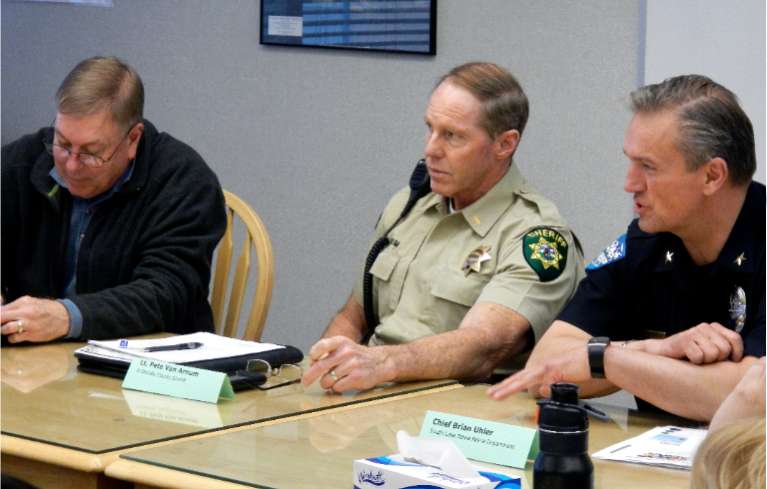
Those were some of the topics South Lake Tahoe Police Chief Brian Uhler, El Dorado County sheriff’s Lt. Pete Van Arnum, and Steve Heggen with county probation touched on during this month’s Lake Tahoe Collaborative meeting.

(Lake Tahoe Collaborative was founded in 1992. It is leaders of primarily social service agencies who meet monthly to discuss issues pertaining to the South Shore.)

Steve Heggen (probation), Pete Van Arnum (EDSO), and Brian Uhler (SLTPD) talk crime on the South Shore. Photo/Kathryn Reed

Steve Heggen (probation), Pete Van Arnum (EDSO), and Brian Uhler (SLTPD) talk crime on the South Shore. Photo/Kathryn Reed

On Friday, law enforcement used South Tahoe High School as a staging ground for a mock school takeover. This was done while students were on spring break so as not to disrupt classes, but some drama students got to participate.

“We are trying to change the mindset of school administration and teachers (to be more proactive),” Van Arnum said of the meetings he and others have been having with Lake Tahoe Unified School District personnel.  “You look at school shootings across the country and most of the kids talked to someone and they didn’t come forward. We need good relationships with students because they’ll give us information before it happens.”

SLTPD and probation have armed officers at South Tahoe High at various times. But law enforcement does not favor arming school staff. They relayed how as first responders they are going after the person on campus with a gun, and if a teacher or administrator is armed, that person may inadvertently become a victim of law enforcement.

Van Arnum said his experience is that the middle school is where the attention needs to be placed because that age group is most impressionable.

This is evident with the Norteno and Sureno gangs in town tapping into the younger age group.

“One of the more disturbing trends we are noting is those gang bangers are recruiting mentally challenged kids,” Uhler said.

Heggen said parents need to be watching and listening to their kids. He told a story of a mom he knows who didn’t allow her son to buy red shoes because of potential gang affiliation.

“What are we doing to model behavior we want them to model?” Heggen asked.

He sees kids who behave well in the Juvenile Treatment Center, but once released are back in the environment that contributed to their incarceration and the destructive behavior resumes.

Police K-9 units on occasion go to STHS. Uhler said while arrests have been made, this type of action is more preventative in nature. “Leave it alone or leave it at home,” Uhler said is the message officers try to convey.

Throughout the community marijuana and alcohol are the most abused drugs, with more locals being arrested than tourists. Uhler said 90 percent of the arrests his officers make are locals.

He will be making a presentation to the City Council this spring about crime stats from 2012.

“The total number of arrests is down, but we are seeing an increase in crime,” Uhler said. He said the bad guys are getting away with more because of staffing issues. “We are seeing alarming trends. Sexual assault numbers are up and aggravated assault.”


Placer County supes concentrate on fire issues

Fire safety was a predominant theme at this week’s Placer County Board of Supervisors meeting.

In the first action, supervisors approved the permanent expansion of the county’s hazardous vegetation abatement ordinance to all county unincorporated areas. In the second action, the board OK’d an update to the Community Wildfire Protection Plan. And the third action was approving an agreement with CalFire for fire protection and other emergency services.

The pilot vegetation management program started in 2007 in select areas in the Lake Tahoe Basin. It expanded to communities in unincorporated areas on the western side of the county.

With the ordinance now permanently in place, owners of unimproved parcels that have no structures can be required to remove untreated fire fuels that create a hazard to adjacent improved parcels.

The ordinance’s goals are to encourage property owners to meet state and county requirements through the use of inspections, public education and cooperation. Before compulsory abatement is ordered and billed to a property owner, the ordinance has a process involving inspections and cooperative efforts. The ordinance provides for a formal action to ensure removal of the fire hazard.

“The board’s action to approve the HVA ordinance countywide gives our unincorporated fire chiefs a tool to encourage the elimination of hazardous fuels from unimproved parcels when these fuels pose a significant risk to a neighbor’s home,” said Rui Cunha, Placer County Office of Emergency Services program manager, said in a press release.

The Community Wildfire Protection Plan is a collaborative effort between Placer County and federal, state and local partners in fire prevention and mitigation. The plan lists 46 defense zones or urban lot fuel reduction projects, community preparedness and education projects.

The plan defines specific fire hazards in designated areas, assesses the risk and identifies and prioritizes specific projects.

The CalFire contract covers approximately 475 square miles, or nearly one-third of unincorporated Placer County. The contract pays for the equivalent of 66 full-time firefighters operating from eight fire stations around the clock.

— Lake Tahoe News staff report


Clean tech means data-crunching alogorithms

By Bryan Walsh, Time

As environmental policy, improving energy efficiency isn’t just a no-brainer; it’s a no-loser. By limiting wasted energy, we reduce the number of power plants we need–along with their resulting pollution–and we save money.

Cutting energy waste is first and foremost a data challenge. You can’t cut waste until you know what you’re wasting, and most of us have only the slightest idea. Standard electricity meters take one reading for an entire month. Imagine trying to diet if all you knew was the total amount of food you ate every four weeks. Says Bennett Fisher, CEO of the building-efficiency start-up Retroficiency: “You need data to make energy saving work.”

We’ve got the data, thanks to the growth of smart, Internet-enabled sensors that can read and relay energy use almost in real time. A host of new big-data companies are figuring out how to crunch that information so energy users from huge factories to individual households can track and reduce waste. This combination of energy technology with the Internet–the industry calls it the Enernet–is the hottest sector in clean tech, in part because it relies on relatively cheap, easily scalable software rather than on the expensive factories needed for, say, making solar panels. “It’s much more capital-efficient,” says Roy Johnson, CEO of EcoFactor, an energy-management start-up.

And efficiency is what the Enernet is all about. Take Virginia-based Opower, one of the oldest and most successful Enernet companies. Opower began by offering homeowners the chance to compare their power use with their neighbors’. Just knowing whether they were energy hogs or energy saints–along with following Opower’s energy-efficiency tips–was enough to reduce waste among homeowners. But as smarter meters taking dozens of readings per day have begun to gather more-granular data, Opower has been able to offer much more. The company sorts through the data collected by smart meters to help customers identify exactly where the waste is occurring and how it can be reduced. “These are things we could never do without big-data analytics,” says Dan Yates, CEO of Opower.

For utilities, big data can be even more powerful and valuable for the bottom line. Smarter energy management can keep overloaded grids running and prevent the need for new, expensive plants. Energy use isn’t constant throughout the day or the year, but because utilities keep power running 24/7, they need to have spare capacity to accommodate spikes. Even if it isn’t needed all the time, that extra power has to be generated, usually by polluting and costly coal or gas plants. Companies like AutoGrid help utilities spread out the demand for energy, smoothing the spikes and reducing the need for unused excess power. AutoGrid’s algorithms sort through the petabytes of data from smart meters–adjusting for variables like weather–and spit out solutions that let utilities and their customers automatically shift nonessential electricity use to nonpeak times. The Enernet can also help utilities make better use of wind and solar power, compensating when the wind isn’t blowing or the sun isn’t shining. Amit Narayan, AutoGrid’s CEO, estimates that his company’s algorithms can help utilities get about 30% more power out of existing resources.

If we’re ever going to truly clean up our electrical grid, we’ll need to replace coal and natural gas with zero-carbon sources like solar or nuclear while improving efficiency. It won’t be easy or cheap. But a smarter, more efficient grid–enabled by the same intelligence that brought us the Internet–can help smooth that transition.