LTWC making progress to move, expand

Lake Tahoe Wildlife Care founders Tom and Cheryl Millham were honored at this week’s South Lake Tahoe City Council meeting for their 35 years of rehabbing wildlife.

Tom Millham spoke briefly with Lake Tahoe News after the recognition ceremony.

In the next two to three weeks the nonprofit will be looking for builders, surveyors, excavators and others who can help transform the 16-acre Echo Creek Ranch into a world-class wildlife care and education center.

The project is expected to go the Tahoe Regional Planning Agency Governing Board in June. A new special use permit from El Dorado County will also have to be obtained.

The wildlife center is currently operated on a half acre that is the Millhams’ back yard in what is now a residential area of the county.

“Once we get the approvals, then we will begin to negotiate to purchase the property,” Millham said.

It’s possible the underground infrastructure could be in place this fall.

A bridge will be built over Echo Creek so long-term cages can be put there for bears, bobcats, coyotes and other animals.

A building already on the property will become the education center.

Millham estimates it will cost $12 million to buy the land and make all the improvements. Most of the money still needs to be raised.

— Lake Tahoe News staff report


Caltrans signs remind motorists to move over

Caltrans workers and the California Highway Patrol were be out in force Tuesday on highways throughout the state, installing “Move Over” signs intended to help save lives and increase safety for motorists, highway workers, CHP officers, and other law enforcement.

“Every day, highway workers put their lives in danger just by going to work,” Caltrans Director Malcolm Dougherty said in a prepared statement. “We’re asking motorists to slow down, watch out for highway workers and CHP, and safely move over a lane when they see flashing amber lights on Caltrans or other emergency vehicles.”

The new signs will display the messages, “Move Over or Slow for Stopped Emergency and Maintenance Vehicles” and “Move Over or Slow When Amber Lights Flashing.” In addition, more than 700 existing electronic highway message signs statewide will display, “Move Over or Slow for Workers, It’s the Law.”

The Move Over law, which took effect in 2007, was amended in 2009 to add Caltrans vehicles displaying flashing amber warning lights to the list of vehicles for which motorists must move over if safe to do so, or slow down.

Highway construction and maintenance work is one of the most dangerous occupations in the United States. Since the 1920s, 178 Caltrans employees have died while on the job.


Boston locked down; 1 bombing suspect dead, brother on loose

By Annie Gowen, Clarence Williams and Debbi Wilgoren, Washington Post

WATERTOWN, Mass. — A massive manhunt was under way Friday morning in Boston and its suburbs, after one suspect in the Boston Marathon bombings died in a confrontation with police and the second was identified as a 19-year-old immigrant from Kyrgystan who, a classmate said, attended high school in Cambridge, Mass.

The two suspects are brothers, authorities said, and are believed to have lived in the United States with their family for several years. State Department officials said the family appears to have arrived in the country legally.

Boston, Watertown and several other suburbs were in an unprecedented state of lockdown on Friday, with mass transit canceled, schools and business closed and residents ordered to stay indoors.
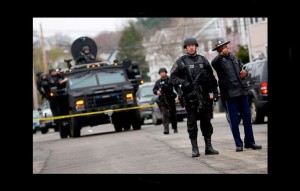
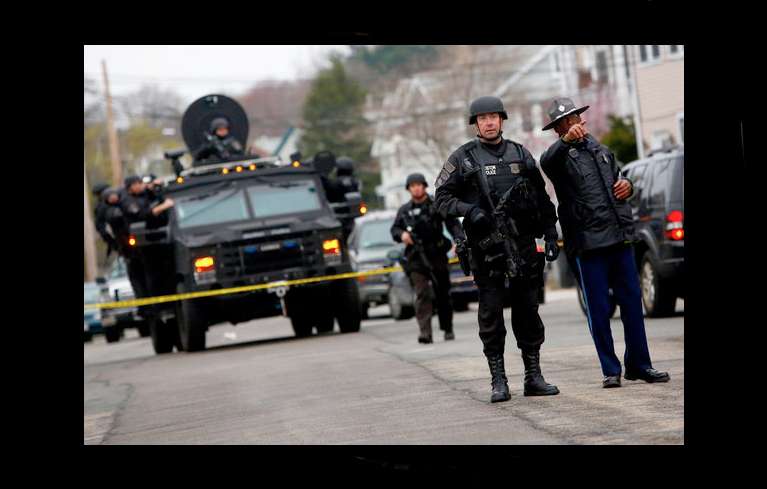
Boston is on lockdown as police look for the second marathon bombing suspect. Photo/Eric Thayer/New York Times

Boston is on lockdown as police look for the second marathon bombing suspect. Photo/Eric Thayer/New York Times

Law enforcement officials said they believed the at-large suspect, Dzhokhar Tsarnaev, may be strapped with explosives. They were taking extreme precautions in an effort to avoid further loss of life.

A campus security officer at the Massachusetts Institute of Technology was killed in a confrontation with the suspects Thursday night, and a transit officer was critically wounded.

“This situation is grave. We are here to protect public safety,” Police Commissioner Ed Davis said. “We believe this to be a terrorist. We believe this to be a man here to kill people.”

The suspects were introduced to the world via photos and video footage Thursday night. The one who was killed was identified as Tamerlan Tsarnaev, 26.

The brothers’ alleged motive in the bombings, which killed three people and injured more than 170, remains unknown, but their family appears to have immigrated from the Southern Russian republic of Chechnya, and two law enforcement officials said there is a “Chechen connection” to the bombings.

Dzhokhar Tsarnaev was born in Kyrgystan, law enforcement authorities said. He has a Massachusetts driver’s license. Tamerlan Tsarnaev was born in Russia and became a legal U.S. resident in 2007.

All public transportation was shut down in the greater Boston area Friday morning, officials said, and no vehicle traffic was permitted in or out of Watertown during the massive manhunt.

Residents of Boston, Watertown, Newton, Waltham and elsewhere were asked to stay inside, with their doors locked. Colleges and universities announced they would close for the day, and businesses were instructed not to open. Streets were ghostly quiet. Thousands of officers searched house-to-house, and some areas were evacuated.

A Massachusetts State Police spokesman says police closed down a stretch of Norfolk Street in Cambridge, where they think Dzhokhar Tsarnaev and his family lived. “We don’t know if he’s there. There is a possibility the suspect is there,” the spokesman, David Procopio, said.

Procopio said the manhunt was triggered after the brothers apparently robbed a 7-Eleven store on or near the MIT campus, about 10:20 Thursday night. They allegedly shot the MIT officer as he sat in his car.

A short time later, the brothers are believed to have carjacked a Mercedes SUV from Third Street in Cambridge. The driver of the car was forced to stay in the vehicle for about 30 minutes, police said, then released at a gas station on Memorial Drive. He was unharmed.

“The guy was very lucky that they let him go,” Procopio said.

Police were trying to activate the tracking device on the Mercedes when other patrol officers spotted the vehicle in Watertown and tried to do a traffic stop, Procopio said. The suspects fled, throwing what Procopio called “IEDs” at police. Shots were fired, and multiple explosive devices were thrown from the vehicle. Some exploded, which led to panic and concern in the town.

Richard J. Donohue, 33, a three-year veteran of the transit police force, was shot in the chase and is being treated at Mount Auburn Hospital, authorities said.

Tamerlan Tsarnaev — who was pictured in a black baseball cap in photos released Thursday evening— was fatally injured, law enforcement officials said.

He had been shot multiple times in the torso and also sustained injuries from some sort of explosives, said doctors at Beth Israel-Deaconess Medical Center, where he was taken. He was in cardiac arrest when he arrived at the hospital, and could not be revived.

Dzhokhar Tsarnaev — suspect No. 2, according to authorities — fled the vehicle on foot, which prompted the massive search.

“We have an active search going on by tactical teams. He’s considered armed and dangerous,” Col. Timothy P. Alven.

Procopio said that after the night of mayhem police have five active crime scenes around the Boston area. “We’ve got crime scenes we haven’t even been able to process yet,” he said.

A high school classmate of Dzhokhar Tsarnaev, Deana Beaulieu, described him as a quiet boy who had been on the wrestling team at Cambridge Rindge & Latin High School.

They attended school together since the 7th grade, first at Cambridge Community Charter School, then the high school, she said. He graduated in 2011.

Tsarnaev lived on Norfolk Street with his family, including an older brother and sister.

State Department officials said the Tsarnaev family appears to have arrived legally in the United States, though they did not specify when they arrived or the type of visas the family members had received.

Chechens have dispersed across the former Soviet republics and other countries in the region, but officials said there are not large numbers of them in the United States.

Chechnya has been racked by years of war between local separatists and Russian forces and extensive organized crime since the Soviet Union dissolved in 1991. The extent of the possible connection remained unclear.

Friday morning, the streets in and around Watertown were deserted, save for the enormous police presence. Outside the Arsenal Mall, hordes of reporters waited outside a staging area that was taking on the appearance of an armed camp, with State Police marching in formation, dozens of motorcycle police officers and the arrival of two large transit buses filled with police wearing neon safety vests. Agents with the Bureau of Alcohol, Tobacco and Firearms swept the area with a bomb-sniffing dog.

We’ve got every asset that we can possibly muster on the ground right now,” Gov. Deval L. Patrick said. “We are going to need the public to help us help them stay safe.”

Michael Demirdjian, 47, a postal worker from Watertown, said he was on his way back from Logan Airport early Friday when he suddenly found himself surrounded by police cars.

“It was amazing,” he said. “There were police cruisers all around. Thirty to 40 cruisers followed us to my house.”

He made it to his house, on Spruce Street, but “it was in the zone and they wouldn’t let us in.”

He said he saw police going from house to house with dogs, searching, the area blazing with flashing emergency lights. Heavily armed police told him he could not enter.

“They said ‘no way.’ I want to go home but it looks like it’s not going to happen,” said Demirdjian, who had been awake all night. “I’d like for them to get this thing under control as soon as possible.”

Lake Tahoe needs work to lure foreign travelers

By Kathryn Reed

STATELINE – Tahoe doesn’t have it. It could. But it’s going to take a concerted effort for that to happen.

That was the message delivered Thursday by two women who know tourism.

The it is what it takes to be on the list of places foreign visitors want to travel to.

Caroline Beteta, CEO of Visit California and chairwoman of Brand USA, along with Denise Pirrotti Hummell, CEO and founder of Universal Consensus, delivered their views about the future of tourism and what Lake Tahoe must do to capture a greater share of the market.

Lake Tahoe continues to struggle to be a destination that has it all. Photo/LTN file

Lake Tahoe continues to struggle to be a tourist destination that has it all. Photo/LTN file

In particular, the two spoke of the growing international market. Much of the focus was on China, where Beteta just returned. She was there with Gov. Jerry Brown on a mission to lure Chinese to the Golden State.

In 2012, Chinese travelers made more trips than people from any other country – 83 million. They spent $102 billion abroad last year.

Beteta said with the United States finally focusing on tourism, this should bode well for everyone. It used to take about 45 days for someone in China to secure a U.S. visa. Now it’s about five days.

But more needs to be done. Nikki Ekstein of Travel + Leisure magazine recently wrote, “According to a new survey conducted by the U.S. Travel Association, 43 percent of foreign travelers will tell their friends to avoid coming to the States. But it’s not cultural, culinary, or political differences that are turning off the international crowds—it’s our customs entry process, which 84 percent of visitors complain about and believe could be vastly improved. The survey polled 1,200 non-U.S. resident overseas travelers — of whom 1 in 7 missed a connection because of long customs lines.”

Even Beteta commented on how her travel plans were disrupted this week when American Airlines had to ground all of its planes because of a computer glitch.

For Tahoe, though, the advice is much simpler.

Hummell said how the sign Chocolate Nugget Factory would be confusing for the average international traveler. What’s a nugget? And how would they know shopping of some sort is available through those doors?

She showed pictures of the casino corridor and Park City.

“The center of town is not what I’m used to in mountain towns,” Hummell said of the South Shore.

The consultant suggested harmony with colors, installing quaint signs – even ones that are in English, Spanish and Mandarin, and putting in more lighting.

Guest relations need a drastic improvement, too, based on Hummell’s experience.

The speakers on April 18 also commented on how tourists want a locale where shopping is abundant – and that doesn’t mean multiple T-shirt shops. All one has to do is look at Las Vegas to see how shopping on The Strip is an activity unto itself.

The creation this summer of 20,000-square-feet of retail along Highway 50 as part of the stalled Chateau project is reportedly being marketed to businesses that would bring a different mix to the area compared to what exists today.

The state tourism agency is focusing on what it calls pillars. The five are: family fun, culinary, culture-entertainment, outdoor-adventure-recreation, and luxury-indulgence.

A series of commercials were shown, including the one filmed in 2011 featuring Olympians Julia Mancuso of Squaw Valley and Shannon Bahkre who grew up in Tahoe City.

“We should ride the coattails of outdoor adventure,” South Lake Tahoe City Manger Nancy Kerry told Lake Tahoe News after the forum. “When spending money on tourists you get a direct investment return.”

At the City Council’s first meeting in May the strategic plan will be discussed, which will include the topic of whether the city is doing its part to draw tourists to the area and working enough with the Lake Tahoe Visitors Authority.

“We know more tourists means more jobs,” Kerry said.

Hotel taxes in the city are up 26 percent from October through February compared to the previous year and sales tax for the last quarter of 2012 is up 13 percent from 2011.

The former number is definitely because of tourists, and the latter is partially tourists.

“Our job is to create a desire for the California experience,” Beteta told the group at Harveys.

After that, well, it’s up to the respective destinations to make it an experience people want to have again and one they want tell their friends about – in a good way. After all, word of mouth is still the best (or worst, depending on the message,) form of marketing.


Senators seek to allow electronics on planes

By Bart Jansen, USA Today

Several senators rekindled the debate Tuesday whether personal gadgets interfere with an airliner’s cockpit electronics and urged the head of the Federal Aviation Administration to allow more gadgets on planes.

Sen. Claire McCaskill, D-Mo. told FAA Administrator Michael Huerta there is no risk from personal electronics that are restricted near takeoff and landing on airliners because passengers use gadgets on general-aviation planes all the time.

McCaskill also rejected the idea that electronics were a distraction from safety lectures at the start of flights because flight attendants don’t insist that passengers put down their copies of “War and Peace.”

“I feel very strongly that this is an example of a rule that needs to go away,” McCaskill said of restrictions against personal electronics.

Sen. John Thune, R-S.D., said he would join her in changing the rules.

“It seems like these are rules for rules’ sake that sometimes go beyond what is even practical, let alone what is safe,” Thune said.

Personal electronics such as Kindles or iPads are prohibited from use when a plane is below 10,000 feet in the air. But the FAA has an advisory committee studying whether to allow electronics, which Huerta said “is of great personal interest to me.”

The study doesn’t cover cell phones because the Federal Communications Commission bans those phones on planes.

Huerta said plane manufacturers, flight crews and electronics makers are participating in the study, which is expected to make a recommendation in July. He said one complication is how could crew members could distinguish between restricted phones and other electronics while a plane is taking off or landing.

“The worst of all worlds for them would be if we made some determination that certain devices were OK while others are not because it becomes an extremely difficult thing for them to enforce,” Huerta said.

McCaskill said if the FAA doesn’t expand the use of electronics by the end of the year, she wants a written explanation for why not. And she asked Huerta to explain why personal electronics are allowed on Air Force One, but not airliners.

“If it’s safe enough for the president of the United States, it’s safe enough for the flying public,” McCaskill said.


Auditor: Specialty license plate money not collected, misspent

By Torey Van Oot, Sacramento Bee

California’s state auditor has found shortcomings in management and oversight of special license plate programs meant to provide funding for causes like Lake Tahoe, anti-terrorism efforts and state parks.

The report, released today, found that the state has failed to collect more than $22 million in revenue that should be generated by the special plate holders in the 2010-11 and 2011-12 fiscal years. In some cases, agencies appeared to spend the money they did receive on “unallowable or unsupported” expenditures.

California motorists can elect to order special plates benefiting one of 11 causes. Revenue from the sales are supposed to go to state-run accounts like the Yosemite Fund, the California Arts Council, and a fund intended to “fight threats of terrorism in the Golden State.”

But that hasn’t always happened. The audit found cases where money generated by the special plates was not used for the designated purposes.

Fixing the problems, the Department of Motor Vehicles responded, may require such a costly computer upgrade that the program may not be financially viable.

The Department of Agriculture, for example, spent nearly $900,000 generated by one plate fund for expenses like employee compensation and building leases that they could not justify. The California Emergency Management Agency was unable to show that employees paid from funds generated by a special plate were working on the intended goal of preventing terrorism. In other instances, agencies failed to submit required reports on the funds to state lawmakers.

In some cases, the money was never collected in the first place. The audit found that the Department of Motor Vehicles, which issues the plates, missed out on $12 million in renewal fees it should have collected in the 2010-11 and 2011-12 fiscal years. The motorists who did pay were undercharged by an estimated $10 million. The DMV also overcharged Environmental Plate Fund more than $2 million to cover administrative costs.

The California Tahoe Conservancy collects about $1.2 million a year from the specialty Lake Tahoe plate. That money is then used on trails and other projects in the basin.

The audit, available here, calls on DMV to do a better job collecting and administering the funds and recommends a series of steps to increase monitoring and documentation of the spending.

In its response to the audit, the DMV pledged to conduct a review of whether it is charging the correct amounts for the plates. But the agency said efforts to do a better job tracking and collecting renewal fees could require a costly upgrade to its database systems.

“The costs associated with such an effort could be substantial and likely would result in severely reducing any net proceeds to the special plate funds or even eliminating the programs’ viability altogether,” Chief Deputy Director Jean Shiomoto wrote in a letter. “As a result, further study is warranted to identify alternatives and determine the true cost to implement necessary changes before a final decision can be made as to what is the most appropriate course of action for the State, taxpayers and special fund stakeholders.”


Lesson from Placer fire — don’t play with incendiary devices

By Ed Fletcher, Sacramento Bee

In a scene that might have made Smokey Bear cringe, on a 100-degree day last July, a Sacramento man – in full view of his family and other witnesses – tossed a 2-inch diameter firework into a remote Placer County swimming hole.

An ember from the explosion shot 25 feet into the air, beyond a sheer rock face around the swimming hole on Shirttail Creek, and ignited the 2012 Robbers Fire, court documents show. The fire engulfed 2,630 acres, injured an inmate firefighter and destroyed four structures.

Bryon Craig Mason, 28, admitted to throwing the illegal firework, but his lawyer successfully argued during Mason’s preliminary hearing that Mason wasn’t guilty of arson because the fire wasn’t started willfully and maliciously.

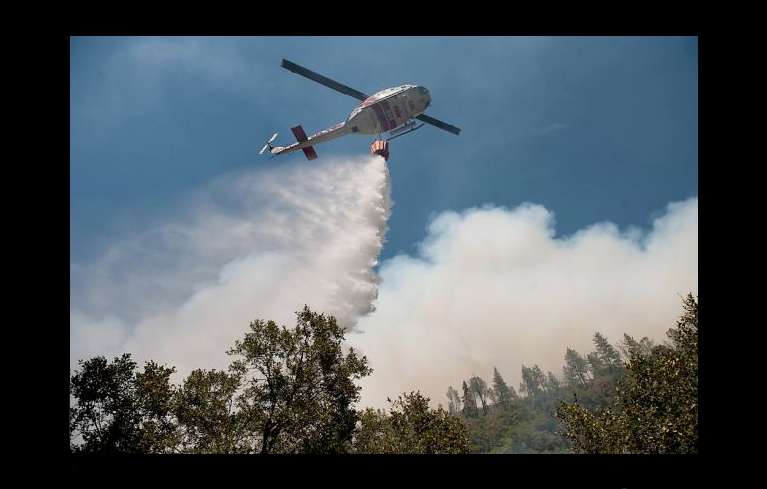
The 2012 Robbers Fire in Placer County is reminder of how dry conditions can rapidly ignite. Photo/Randy Pench/AP

The 2012 Robbers Fire in Placer County is a reminder how dry conditions can rapidly ignite. Photo/Randy Pench/AP

“There is no evidence to support the conclusion that a reasonable person would find it highly probable that the firework would explode in the water” clear a 25 feet high rock face and ignite a fire, said Placer Superior Court Judge Colleen Nichols in her ruling releasing Mason from custody earlier this month.

In her ruling, Nichols cited concerns about the credibility of the California Department of Forestry and Fire Prevention’s investigation of the fire.

The Placer County District Attorney’s Office has said it disagrees with the ruling but has not said whether it will make further efforts to prosecute the case. The District Attorney’s Office did not return calls for comment.

While prosecution of the incident may be in limbo, it does serve as a cautionary tale as fire season in Northern California approaches.

The region saw heavy precipitation early in the season but has been exceptionally dry since. Snowmelt is also ahead of schedule, pointing to an early start to fire season, said Tom Dang, a meteorologist with the National Weather Service.

“That basically prolongs the fire season for a month,” Dang said. “If we don’t see any precipitation between now and the end of the summer, fuels are going to be at exceptionally dry levels.”

He said the region may well see another storm before the end of May, but there are no significant storms on the immediate horizon.

Rui Cunha, assistant director of emergency services for Placer County, called for extra vigilance this summer.

“There is no question about it. The forest fuels are not getting the normal range of moisture. We are definitely going to feel the impact from that,” Cunha said. “It’s going to be even more important that we keep fire out of our forest land.”

Daniel Berlant, spokesman for CalFire, echoed the call for fire safety, saying: “We need to practice extra precaution.” He declined to talk about the case against Mason.

Placer County Supervisor Jim Holmes said the start of the Robbers Fire provides a fine example of why people shouldn’t play with matches. He said he could see how someone might think throwing fireworks into water was safe.

“I wouldn’t have done it, but I would have assumed it would be safe,” Holmes said. “It’s an unfortunate incident. I’m sure the gentleman had no malice. He wasn’t trying to set a fire. He was just trying to show off.”


Better to text than call during emergency

By Brad Stone, Bloomberg Businessweek

Toward the bottom of the list of disturbing aspects about Monday’s bombing at the Boston Marathon was this: Cellular networks in the area almost immediately slowed down and, for periods of time, appeared to stop working altogether. Runners and their loved ones could not connect, and victims had trouble communicating with emergency responders.

That frustrating scene has become familiar, evoking disasters from the Sept. 11 attacks in 2001 to Hurricane Sandy in 2012. We rely on cell phones to run our lives, but they tend to be useless – or at least far from useful – when we need them most.

Initial reports suggested that authorities deliberately shut down mobile networks in Boston to avoid the possibility that mobile devices could be used to trigger more bombs. The Associated Press reported this and then quickly reversed itself. The major wireless carriers denied it, saying that the networks were simply suffering from congestion: Too many people were trying to use their phones at the same time to get help or tell family and friends they were OK.

“Thinking of those at #BostonMarathon,” AT&T tweeted at around 5:30pm. “For those in the area, please use text & we ask that you keep non-emergency calls to a minimum.”

A Verizon Wireless representative also suggested that customers in the area use text messages or email to free up capacity for public safety officials.

The science behind these failures in wireless networks isn’t complicated. In every city, each mobile carrier operates hundreds or thousands of cell towers, which route calls and data to the carrier’s backbone network. Each tower is designed to accommodate a set number of calls per second, per a certain geographic area. In a crisis, when everyone naturally reaches for their phones, that limit is quickly surpassed and the radios on the tower get sluggish.

Mobile analyst Chetan Sharma, who estimates that a cell site can handle 150 to 200 calls per second per sector, said, “We’ve all had the experience of a fast-busy signal. That is the network telling you, ‘Sorry, but your cell is overloaded. There is no more space.'”

In these situations, sending texts or email is a better option because messages can be queued up and delivered as capacity becomes available. Twitter is especially efficient because information can be spread quickly and widely – one reason why the service has become increasingly important and reliable in a crisis. Google’s Person Finder, a central digital bulletin board for survivors and families of those in a crisis zone, has also proven invaluable.

Until it was debunked, the rumor that police deliberately shut down cell networks was an intriguing one. This is almost unheard of. When it has occurred, the practice has been controversial.

In August 2011, BART officials shut down underground phone service to prevent activists from coordinating their activities as they protested a shooting by BART police. The shutdown led to criticism that police were hindering the activists’ right to free speech, spurring a further round of protests. The police argued that they acted to protect the public.

Monday’s situation was different, of course. ABC News reported in a tweet that police were asking people on the scene not to use cell phones because they might set off other explosive devices. Still, it does not appear there was any widespread directive from law enforcement to shut down cell networks, and authorities appear to believe that cell phones do more to help than hurt in an emergency.

“The belief is that much more good comes from networks being available than the risk of them being utilized for bad intentions,” said Charles Golvin, an analyst at Forrester Research.

Can anything be done to improve network performance during tragedies such as Monday’s bombing? Probably not much. Carriers could engineer networks to handle these situations by adding radios and towers and amplifying connections from the towers to the network’s backbone. But a vast majority of that extra capacity would then be wasted.

“Over the years, a lot of research has gone into analyzing the trade-off between cost and capacity, and today’s networks are designed to provide enough capacity during the vast majority of ‘normal’ conditions,” Golvin said.

Just as landline networks were never meant to allow every person with a phone to place a call at the same time, wireless networks are designed to align resources with normal peak call volumes in the most efficient manner possible. As a result, hearing a loved one’s voice in the tense minutes after an emergency may always be difficult.


Some California employers welcome immigration reform

By Shan Li and Diana Marcum, Los Angeles Times

Central Valley farmers, Southern California bankers and Silicon Valley executives have all struggled to find workers — and they say an outdated immigration policy has been to blame.

They’re all hoping that a bipartisan group of U.S. senators will have the answer when it unveils its plan, as early as this week, to overhaul federal immigration laws.

Their stance: Reform couldn’t come quickly enough.

“What’s at stake is the future of our economy, whether we can remain the most entrepreneurial nation,” said Steve Case, co-founder of America Online and now chairman of investment firm Revolution. He called immigration a “key reason why America has been innovative and entrepreneurial and has had the leading economy in the world.”

The danger of not having a viable immigration plan is evident to Steve Spate. The Central Valley raisin grower whose farm is just west of Selma said he has struggled with a perennial labor shortage.

“When you’re standing on the edge of your fields in the morning and the rains are coming and not enough workers show up, when your livelihood and your ability to make payments on your house and your equipment are on the line, you’ll take anybody you can find,” he said.

Foreign workers affect nearly every aspect of the state’s economy.

Those highly educated work in Silicon Valley start-ups and tech giants such as Facebook and Google. Low-wage workers toil in farms, serve food in restaurants and work in hotels. The construction industry employs a number of immigrants to build homes.

The sweeping bill tries to fix huge problems plaguing the U.S. and its inflow of foreign workers.

Crafted by four Democratic and four Republican senators known as the Gang of Eight, the bill is aimed at creating an immigration system for the 21st century.

It offers, for instance, a 13-year pathway to citizenship for many of the 11 million immigrants already living here illegally. And it allocates billions of dollars — including $3 billion for increased surveillance — to tighten border security.

Under the bill, more foreigners with in-demand job skills will be able to get visas; currently those with family members already here are heavily favored.

Part of the bill would create new guest worker programs for farmhands and low-wage workers. Another section raises the cap on temporary high-skilled visas and creates a “start-up” visa for entrepreneurs who want to found companies in the U.S.

“It will be a tremendous boost to California’s economy,” said Sung Won Sohn, an economics professor at Cal State Channel Islands. “We will be able to get the right people from overseas and utilize them for the benefit of the economy.”

But the bill still faces many hurdles, even after months of negotiations among the eight senators. Opponents of any reform that offers a road to citizenship for undocumented workers in the U.S. can kill the bill. An immigration overhaul attempt under President George W. Bush in 2007, the last time a serious effort was made to retool the system, died on the Senate floor.

But this time around, public opinion may be on the bill’s side. Nearly two-thirds of Americans support giving undocumented workers a way to attain citizenship, according to a recent survey by the Brookings Institution and the Public Religion Research Institute. Sixty-eight percent polled say that a combination of enforcement and a path to citizenship was the best cure for the country’s illegal immigration problems.

Many California businesses welcomed the outline of the bill released Tuesday.

Farmers already struggling with a slowdown in workers from Mexico — brought on by a border crackdown, faltering economic recovery and drug violence — were hopeful the bill could widen the pool of laborers.

“The ones from Mexico are here to work,” said Ken Shinkawa, a raisin grower in Caruthers. “They don’t fool around. They just want to make their money and go home.”

In the past, Shinkawa said, he was forced to hire mostly undocumented workers. He has tried hiring U.S. employees, but that has never worked out. One year, he said, the Fresno residents he brought on couldn’t pick and stole his air conditioner.

And lately, he’s had trouble finding anyone to work his fields.

High-tech firms, which have lobbied hard for immigration reform, say the bill would bring much-needed highly skilled workers and entice international students who attend U.S. colleges to stay after graduation. Mark Zuckerberg, chief executive of Facebook Inc., even joined forces with executives from Google, Yahoo and other tech giants to form a new initiative called Fwd.us to push for reform.

“Immigration is innovation,” said Dean Garfield, chief executive of the Information Technology Industry Council, an advocacy group for tech firms. “Every day that goes by without immigration reform is another day when new jobs and new industries start in a foreign country.”

Already, about 35 percent to 40 percent of Silicon Valley’s workers are foreign, said Stephen Levy, director of the Center for Continuing Study of the California Economy. He said guest workers can help plug a gap in California as highly skilled baby boomers retire.

The finance and banking industry is also eager to hire workers such as mathematicians and computer experts to create programs to maximize trading and fight cyber attacks, said Scott Talbott, senior lobbyist for the Financial Services Roundtable, which represents banks, insurers and investment firms.

Los Angeles-based City National Bank already employs immigrants from Russia, Mexico, India and elsewhere, said Chief Executive Russell Goldsmith. He said one of the bank’s biggest strengths is being able to attract “some of the best and brightest individuals from all over the world.”

“We need and do hire people born elsewhere in information services and technology,” he said. “But you’ll find people born elsewhere throughout the bank.”


3 Mo’s Place bouncers accused of killing patron

Nearly one year after Derek “Zippy” Penaranda was beaten at Mo’s Place, three people have been accused of killing him.

Penaranda, who was from Ripon, was on the South Shore in May 2012 to celebrate his 30th birthday. He got in a fight at the South Lake Tahoe bar. He never recovered from the injuries he sustained. He died in October.

“Since the emergency room at Barton, I knew Zip wouldn’t be coming home,” Wayne Penaranda told Lake Tahoe News last fall.

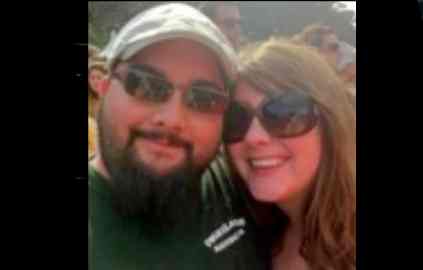
Derek "Zippy" Penaranda and Katie Musselwhite had hoped to one day marry. Photo/Provided

Derek “Zippy” Penaranda and Katie Musselwhite had hoped to one day marry. Photo/Provided

He was cautious at the time with what he wanted to release to the media regarding his son’s death and the criminal investigation. Since Day 1 he said he had been working with El Dorado County Deputy District Attorney Joe Alexander.

Penaranda was not available to speak of the proceedings that occurred this week.

The grand jury indictments leveled against the accused – Rodolfo Hernandez, 44, Sean Canilao, 48, and Ruben Lizzaragga (age unknown) – have been sealed by El Dorado County Superior Court Judge James Wagoner. These three worked as bouncers at the bar.

Hernandez was in custody on involuntary manslaughter charges with bail set at $50,000. However, there is an immigration hold on him. Arrest warrants are out for the other two.

For now the case is being heard in Placerville, though it could be moved to South Lake Tahoe. That may be decided on May 3.

— Lake Tahoe News staff report