USFS, states fighting over millions of dollars

By Richard Lardner, AP

WASHINGTON — The U.S. Forest Service is in the business of preventing fires, not starting them.

Yet the agency set off alarms in Congress and state capitols across the West by citing the automatic spending cuts as the basis for demanding that dozens of states return $17.9 million in federal subsidies. And it’s all come down to a bureaucratic squabble over whether the money is subject to so-called sequestration because of the year it was paid – 2013 – as the Obama administration contends, or exempt from the cuts because of the year it was generated – 2012 – as the states insist.

Right now, it’s a standoff heightened by history and hard fiscal realities. But with taxpayer cash scarce, both sides are digging in: The Forest Service has to slash 5 percent of its budget under sequestration. The states, meanwhile, have depended for decades on a share of revenue from timber cut on federal land. Perhaps least willing to compromise are members of Congress who are up for re-election next year and are loath to let go of money that benefits potential voters back home.

U.S. Forest Service Chief Tom Tidwell wants states to return federal subsidies.

U.S. Forest Service Chief Tom Tidwell wants states to return federal subsidies.

It’s not clear who gets to decide or whether the question ends up in court. But lines have been drawn.

“We regret having to take this action, but we have no alternative under sequestration,” Forest Service Chief Tom Tidwell wrote in March to governors in 41 states, explaining that since the payments were issued in the 2013 budget year, the money would be subject to sequestration.

Infuriated, Republicans and Democrats from Capitol Hill to the governor’s offices banded together to fight back, arguing the money was paid to the states well before the spending reductions went into effect. The governors of Alaska and Wyoming have flat out refused to send the money back.

“The frustration level is off the charts on this,” said Sen. Ron Wyden, D-Ore., whose timber-rich state is the top recipient of the Forest Service payments and stands to lose nearly $3.6 million.

Wyden, chairman of the Senate Energy and Natural Resources Committee, said he and Alaska Sen. Lisa Murkowski, the panel’s top Republican, are working together to “turn this around” so their states and others are not forced to return any money to the federal government.

“This is slap-your-forehead-in-disbelief kind of stuff,” Wyden said.

At issue are so-called county payments, a revenue sharing plan that’s existed since President Teddy Roosevelt created the national forests to protect timber reserves from the cut-and-run logging going on at the time. For nearly a century, hundreds of counties received a quarter of the revenue from the timber sold on federal land. The money is being used for roads, schools and emergency services and is a welcome addition to cash-strapped county coffers, especially in the Northwest. In recent years, the law has acted as a subsidy for states and counties hard hit by logging declines triggered by measures to protect threatened species.

Idaho’s Valley County, for example, would have to return more than $128,000 from its budget of $2.5 million for roads and schools. That leaves Gordon Cruickshank, chairman of the Valley County commission, in a no-win position. Should he forgo the repaving of even a single mile of the county’s 300 miles of paved roads, defer maintenance on a bridge or lay off two county employees?

“We are struggling really hard now to figure out what to do,” Cruickshank said. “It’s a tough pill to swallow that they sent these payments out just a few months before sequestration, and now they want them back.”

The Forest Service has paid billions of dollars to counties over the decades, but the receipts dwindled as logging on national forests dropped precipitously in the 1990s – first in the Northwest to protect the northern spotted owl and salmon, and then later across the country as concerns grew over the impact of clear-cut logging on wildlife and clean water.

In 2000, Wyden led the charge for a new law, called the Secure Rural Schools Act, a way for the government to pay counties that no longer could depend on revenue from logging in federal forests. But the law has expired, and the last payments went out in January. Wyden and other lawmakers are pushing to renew the subsidy.

The Forest Service issue provides one look at the real-world fallout of sequestration, which began March 1 after Congress and President Obama failed to agree on a deficit-cutting plan. Forced to find the required savings in the wobbly aftermath of recession, federal officials are getting creative – reducing hours at courthouses, furloughing employees and cutting back services. The full impact of sequestration remains unclear because most of the reductions have yet to take effect.

Ryan Yates of the National Association of Counties said state and local officials understand that sequestration is the law of the land and that future cuts to scores of federal programs are inevitable. But there is widespread concern that the Forest Service’s action means that the sequestration’s reach is far greater than they anticipated.

“This retroactive move by the administration to squeeze more money from rural forest communities is not only legally questionable, but insults the longstanding relationship between counties and the federal government,” Yates said.

Tidwell’s March letters to the governors incited lawmakers and state officials, who said the payments came from revenues generated in the 2012 budget year and were therefore not subject to sequestration.

The National Governors’ Association advised governors to consult closely with their legal staffs before making a decision.

“No one has ever heard of an agency demanding money back that they have already spent,” said NGA Deputy Director Barry Anderson.

In a letter sent to senior Obama administration officials in late March, four House Democrats joined 27 House Republicans in assailing the Forest Service’s demand, calling it an “obvious attempt by President Obama’s administration to make the sequester cuts as painful as possible.” The Forest Service was aware for months that sequestration was a possibility, they said. Yet even after it went into effect, the agency waited for several weeks before informing states that payments would have to be returned.

“We request that this action be halted,” the House members wrote.



U.N. seeks protection of journalists

By Australia Network News

On World Press Freedom Day, U.N. Secretary-General Ban Ki-moon says press freedom “does not happen automatically,” but requires the creation of a safe environment for dialogue, where journalists can do their jobs without fear of reprisal.

“Every day, freedom of expression faces new threats. Because they help ensure transparency and accountability in public affairs, journalists are frequent targets of violence,” Ban said in a joint statement with Irina Bokova, director-general of the U.N. Educational, Scientific and Cultural Organization (UNESCO).

The camera of an injured photographer is covered with blood in 2003. Photo/AFP/Getty Images

The camera of an injured photographer is covered with blood in 2003. Photo/AFP/Getty Images

They say action must encompass both traditional media as well as digital mediums.

“Bloggers, citizen reporters and social media producers, as well as their sources, face increasing threats to their safety,” they said.

According to UNESCO, more than 600 journalists have been killed in the past ten years, many while reporting in non-conflict situations.

Impunity is also widespread as nine out of 10 cases of killings of journalists go unpunished.

In addition to physical dangers, journalists are being targeted with psychological and emotional violence through cyber-attacks, data breaches, intimidation, undue surveillance and invasions of privacy.

World Press Freedom Day is observed each year on May 3.

Pacific media leaders have used World Press Freedom Day to call for greater media self-regulation in the region.

Solomon Islands has hosted an event to mark the day, attended by a core group of media managers from around the region who are working towards a standards process.

A key part of this concept is a regional Pacific media ombudsman, who would implement policies to make newsrooms more accountable and help media outlets handle complaints better.

Jason Brown, coordinator at the Pacific Freedom Forum, has been helping to draft the ombudsman plan.

He has told Radio Australia’s Pacific Beat that media organizations’ limited resources often mean there is no one to monitor regional media or oversee a complaints process.

“We’re meant to be the Fourth Estate, but our funding levels are more like the 40th Estate,” he said.

“So mistakes do happen, and the idea of the ombudsman is that if concerns can not be resolved locally – either through the media organization itself or any existing mechanisms in country.

“Then there’s a regional body that complainants, or indeed the media itself, can kick an issue upwards and get input from around the region and from the ombudsman’s office.”


Tax revenue creates surplus for California

By Chris Megerian, Los Angeles Times

SACRAMENTO — California has been flooded with revenue this tax season and is on track to finish the fiscal year with a surplus of billions of dollars, according to officials.

State coffers contain about $4.5 billion more than expected in personal income tax payments. Nearly $2.8 billion of it arrived April 17, the third-highest single-day collection in California history, according to government figures.

Business taxes have also rebounded and are likely to be $200 million ahead of projections.

Gov. Jerry Brown will reveal his latest spending plans this month. State law may require much of the surplus to go to schools and community colleges.

After years of budget cuts, and after voters approved Brown’s tax hike in November, the pressure on the governor will be intense from lawmakers and advocates eager to restore money to programs that were sliced to close deficits. But Brown has already cautioned that there may not be much cash to spread around after education funding requirements are met.

“Depending upon how the money flows, it may not be as available as many people are now thinking,” he said recently.

Brown, whose administration has projected that tax revenue will rise for the next four years, has also said he wants to use the opportunity to pay billions of dollars in debt. The tab for various borrowings during years of budget crisis is expected to be almost $28 billion by the end of June, according to state officials, and will take years to erase.

California relies heavily on income taxes to pay state bills. Last year, April taxes fell far short of expectations, widening the budget deficit. The new figures show a dramatic change in Sacramento’s fortunes.

Assembly Budget Chairman Bob Blumenfield, D-Woodland Hills, said he’s thrilled.

“We’re not framing the debate around what to cut,” he said. “We’re making choices about what kind of investments we want to make.”

The tax surplus is partly a sign that California’s economy is on the mend, with housing prices on the rise and unemployment dropping. The stock market has also been climbing, pumping more money into the state treasury.

“It’s almost certain that 2013 will be a very good year,” said Steve Levy, director of the Center for Continuing Study of the California Economy in Palo Alto.

Brown’s plan for raising taxes temporarily was intended as a “holding action” to keep state books balanced while the economy rebounds, Levy said. A strong recovery could help vindicate that approach. Brown’s measure added a quarter-cent to the state sales tax for four years and increased income taxes on high earners for seven.

Meanwhile, lawmakers, state officials and financial experts have cautioned that the spike in revenue may not hold.

It’s possible that Californians, fearing federal income tax hikes stemming from the budget standoff in Washington, cashed out investments late last year. Jerry Nickelsburg, senior economist at the UCLA Anderson School of Management, said federal statistics suggest many people did so.

“If you had a choice of taking income in January or December, and you will pay less taxes in December, why wouldn’t you do that?” he said.

That could account for some of the current surplus — and state income could fail to keep pace in the next fiscal year, which begins July 1.

Chris Thornberg, a founding partner at Beacon Economics in Los Angeles, said he is concerned that lawmakers will use the spike in revenue as an excuse to abandon efforts to rein in public-worker benefits or stabilize the state’s tax system. California’s reliance on income taxes makes its finances somewhat unpredictable and has led to cycles of boom-and-bust budgeting.

“Maybe they will shock me and do the right thing,” he said. “But I’m not holding my breath.”


Crop insurance becomes big subsidy for farmers

By Dan Charles, NPR

Say the words “crop insurance,” and most people start to yawn. For years, few non-farmers knew much about these government-subsidized insurance policies, and even fewer found any fault with them. After all, who could criticize a safety net for farmers that saves them from getting wiped out by floods or drought?

But consider this: According to a news analysis, crop insurance allowed corn and soybean farmers not only to survive last year’s epic drought, it allowed them to make bigger profits than they would have in a normal year. A big chunk of those profits were provided through taxpayer subsidies. In fact, crop insurance has grown into the largest subsidy that the government provides to America’s farmers.

Taxpayers foot bill of farm insurance. Photo/NPR

Taxpayers foot bill of farm insurance. Photo/NPR

Economist Bruce Babcock, from Iowa State University, carried out the new analysis. It was commissioned by the Environmental Working Group, a long-time critic of agricultural subsidies.

“We really saw, in 2012, how the crop insurance program performs,” says Babcock. “It kind of reveals itself.”

What’s revealed, first of all, is the fact that the vast majority of farmers are signing up for a version of insurance that Babcock calls the “Cadillac.” This kind of policy covers two different kinds of losses: Lower harvests, or lower prices.

Here’s why it’s Cadillac insurance, and why it ends up costing taxpayers billions of dollars. Last year, farmers got a poor harvest. At the same time, because corn and soybeans were in short supply, prices soared, which benefited farmers greatly. The insurance, however, paid farmers for the lost yield — but paid them at the higher, post-drought market price. Essentially, farmers reaped the drought’s benefits, yet were protected form its harm.

“Those farmers made more money than they anticipated making when they planted the crop. That’s clear,” says Babcock.

In all, payouts added up to $16 billion last year, a new record, most of which was paid by taxpayers. According to Babcock, if farmers had instead signed up for another kind of crop insurance, which simply pays a farmer for revenue that’s lost because of crop failure, payouts would have come to just $6 billion.

According to Babcock, the government should limit its subsidies to this simpler, “plain-Jane” insurance policy, which is a perfectly adequate safety net for farmers. Under the current system, he says, government subsidies make “Cadillac” insurance artificially cheap, dramatically driving up the cost of the program. (On average, the premiums that farmers pay cover only about 40 percent of the cost of crop insurance.) “It just seems to me that a lot of money could be saved,” he says.

Congress is once again starting work on a new version of the Farm Bill, which sets the rules for crop insurance. It tried to pass a new bill last year, but failed.


S. Tahoe residents discard 61 lbs. of drugs

Sixty-one pounds of prescription medication were turned in last weekend in South Lake Tahoe. This is the most collected in the since this program was started.

On April 27 the South Lake Tahoe Police Department and the Drug Enforcement Administration provided the public its sixth opportunity in three years to take back unwanted prescription drugs and collected

Northern California and Central Valley residents turned in 18 tons of unwanted and expired medications at 211 collection sites manned by 147 federal, state, and local law enforcement agencies that partnered with DEA on the event. Nearly 68 tons has been collected from the Central Valley and Northern California since September 2010.

According to the DEA, the National Prescription Drug Take-Back Day this past Saturday collected 50 percent more pills than the previous one, demonstrating the American public’s continued appreciation and need for the opportunity to discard unwanted, unused and expired prescription drugs from medicine cabinets, bedside tables, and kitchen drawers.

Nationally, 742,497 pounds of prescription medication were collected and destroyed.


Placerville man going to prison on pot conviction

Robert Edward Mulready of Placerville was sentenced May 3 to 42 months in prions after pleading guilty to a variety of drug charges.

Mulready admitted to conspiring to cultivate and distribute at least 100 marijuana plants.

Court documents alleged Mulready traveled to California for the purpose of growing marijuana and that he sold the marijuana to individuals out-of-state because it was more lucrative than selling to local dispensaries. Documents also allege that Mulready received two packages filled with cash from out-of-state individuals.

A search of Mulready’s house revealed several hundred marijuana plants, along with processed marijuana and packaging materials. Mulready also had more than $155,000 in cash at his house, including numerous bundles of cash hidden in his attic.

— Lake Tahoe News staff report


Boxer not in lockstep with environmentalists

By Richard Simon, Los Angeles Times

WASHINGTON — Barbara Boxer has long been one of the Senate’s environmental champions, racking up perfect scores for each of the last five years on the League of Conservation Voters’ report card on key votes.

But the Californian now finds herself on the opposite side of an issue from her usual environmental allies and some of her fellow Democrats. Environmentalists are upset because she is pushing legislation that would impose deadlines for environmental reviews of water projects, a move they see as “tilting the scales” toward rushed approvals.

“It’s difficult to have one of your stalwart environmental champions working to undermine one of the bedrock environmental laws,” said Friends of the Earth President Erich Pica, who, like other environmentalists, was conflicted about publicly taking on a powerful longtime ally.

Barbara Boxer's moves are not sitting well with environmentalists.

Barbara Boxer’s moves are not sitting well with environmentalists.

“I say to my friends in the environmental movement, we can’t agree 100 percent of the time,” Boxer said.

At issue is the $12-billion Water Resources Development Act. The measure, coming before the Senate this week, is a rarity on hyper-partisan Capitol Hill: It was passed unanimously out of the Boxer-chaired Environment and Public Works Committee.

Boxer disputed any effort to weaken environmental laws but acknowledged that she was seeking to end delays to crucial projects, such as those needed to protect communities from flooding.

“The environmentalists don’t like to have any deadlines set so that they can stall projects forever,” Boxer said. “I think it’s wrong, and I have many cases in California where absolutely necessary flood control projects have been held up for so long that people are suffering from the adverse impacts of flooding.”

Although she said she was open to listening to the environmentalists’ concerns, in this case, “I don’t think this is legitimate.”

Boxer’s support for the bill puts her in a tough spot, trying to balance her devotion to environmental groups with her desire to attract Republican votes for a bill she considers important to the economy and the environment.

The measure would authorize not only flood protection projects that have gained urgency after Superstorm Sandy, but also coastal restoration in the Florida Everglades and the Gulf Coast and projects aimed at promoting commerce on waterways. The bill is also expected to bring more money to Los Angeles and Long Beach for maintenance of their ports.

“It’s always hard for us to go after one of our champions, particularly someone like Sen. Boxer,” said Scott Slesinger, legislative director of the Natural Resources Defense Council. “We’re going to have to fight our normal allies if they’re going to be attacking what we think is one of the most important environmental statutes.” He referred to the National Environmental Policy Act, which requires extensive reviews of projects that could affect the environment.

Slesinger said Boxer’s legislation would establish deadlines for project reviews, leading to a “rush to judgment” on development that could cause significant environmental damage. Government agencies would face fines of up to $20,000 for failing to meet deadlines for project reviews, a requirement that he warned could lead to “slapdash” reviews.

“If the agencies are pressured into making decisions quickly, we will end up with projects that cause more harm than good,” said Melissa Samet, senior water resources counsel for the National Wildlife Federation.

Two of Boxer’s Democratic colleagues, Sens. John D. Rockfeller IV of West Virginia and Ron Wyden of Oregon, also have expressed concern about the “project acceleration” provisions.

But the senator says she is only seeking to end needless delays.

It’s not the first time Boxer has surprised her allies.

A few years ago, the stalwart liberal and frequent antagonist of big business sided with Republicans to champion a tax break for multinational corporations. She also defied the majority of her own party.

At the time, she was pushing a measure eagerly sought by California’s high-tech industry.


NV Energy profits rise

By Eli Segall, Las Vegas Sun

Despite a dip in revenue, NV Energy nearly doubled its first-quarter profit this year.

The Las Vegas-based power company said Friday it earned $21.5 million in net income, or 9 cents per share, for the three months ending March 31.

That compares to $12.2 million of profit, or 5 cents per share, during the same period last year.

The utility, which serves 90 percent of Nevada’s population, said it had $584.2 million of operating revenue last quarter, down from $611.4 million a year ago.

However, it slashed its energy efficiency program costs by $9.6 million and lowered its maintenance costs by $7.6 million. These and other factors helped boost its first-quarter profits.


McClintock shares his beliefs with the people

By Kathryn Reed

TRUCKEE – Federal spending, government regulations, banking, the economy, carbon emissions, immigration and the Auburn Dam dominated the discussion Thursday night between Rep. Tom McClintock and his constituents.

At times it was a bit argumentative between the congressman and those in attendance, as well as between attendees – but nothing like what is heard on talk radio.

McClintock, R-Granite Bay, was at the Truckee Tahoe Airport on May 2 for a town hall meeting. He represents Truckee and the California side of the Lake Tahoe Basin in Congress.

As chair of the House Water and Power Subcommittee, McClintock has some pull in getting the Auburn Dam project through; despite many thinking the issue was dead in the water. It’s a project that has been discussed since the late 1960s, was started, but has been on hold for decades because of seismic and political reasons.

Rep. Tom McClintock, R-Granite Bay, talks May 2 to constituents in Truckee. Photo/Kathryn Reed

Rep. Tom McClintock, R-Granite Bay, talks May 2 to constituents in Truckee. Photo/Kathryn Reed

One woman got in a bit of back-and-forth debate with the congressman about the benefits of the dam. She believes the value of today’s natural resources need to be weighed before a vast area is flooded to create what would be Lake Auburn.

McClintock believes the state needs another area to store water, that it would provide recreation and flood control.

The constituent said the money would be more wisely used to develop better irrigation for farmers who want to use Northern California’s water.

When it comes to the greater disconnect in Washington, McClintock said, “The government is divided because the people are divided.” He said the people need to resolve their differences and then lawmakers will follow their lead.

He is fine with sequestration, especially because it is getting people to the table to talk.

“At this moment in time it is the only tool we have to get the federal budget back to solvency,” McClintock told the nearly 50 people in the room.

But he is not usually for across the board cuts that are equal in nature.

“That’s the lazy man’s way to budget cutting,” he said. McClintock said that way of thinking doesn’t allow for thoughtful analysis of whether something should be funded more or less. He doesn’t want all things to be treated equally because their importance is not of equal value.

McClintock wants changes in Medicare and Social Security, saying the former will be bankrupt in nine years and the latter 10 years later.

One person responded, “I’m entitled to that. I paid into that.”

The congressman said with people living longer, people taking out more than they paid in and the ratio of those contributing compared to those withdrawing diminishing, the two funds are not going to have money for everyone who is paying in today.

When it comes to banks, McClintock believes people should know what their banks are doing – saying that if you have your eggs in one basket, you better keep an eye on that basket. The audience was a bit taken aback, wondering how they were supposed to know what big banks were doing with their money after it was deposited.

“I think the bailout was one of the worse, (most) corrupt mistakes ever made,” McClintock said.

But he is for personal accountability.

While he sympathizes with people who came to this country illegally as children, he doesn’t have an answer for what to do with them.

He believes in the path that exists to become a U.S. citizen, but does not want to allow those who are in the country illegally to have the right to become a citizen.

“If we are going to support illegal immigration, then there is no point to have legal immigration,” McClintock said.

He got in a bit of debate with a woman who said the system is not working for her. She has hired people from other countries with advanced degrees, but when their visa ran out the person had to leave. She believes the workforce is not educated enough to fill all the jobs on U.S. soil and that immigration laws need to change.

McClintock said if the recent gun control law that failed in the Senate had made it to the House, he would have voted against it.

“We are taking increasingly Draconian steps to disarm the law abiding population. That is not going to end well,” McClintock said.


Lack of moisture triggers early fire season

There was no snow to be found today during the final survey of the season near Echo Summit, which comes as no surprise considering temperatures in the Lake Tahoe area have been running above normal for most of this spring.

Statewide, the snowpack as of May 2 is 17 percent of normal for this date.

Electronic readings show water content in the northern mountains is 16 percent of normal for the date. Electronic readings for the central Sierra show 23 percent of normal water. The numbers for the southern Sierra are 9 percent of average.

While Lake Oroville in Butte County, the State Water Project’s principal storage reservoir, is at 103 percent of its average level for the date (86 percent of its 3.5 million acre-foot capacity) and Shasta Lake north of Redding, the federal Central Valley Project’s largest reservoir with a capacity of 4.5 million acre-feet, is at 95 percent of its normal storage level for the date (83 percent of capacity), it won’t take long for those numbers to change with water users downstream tapping into the supply and normal evaporation with summer’s high temps in these areas.

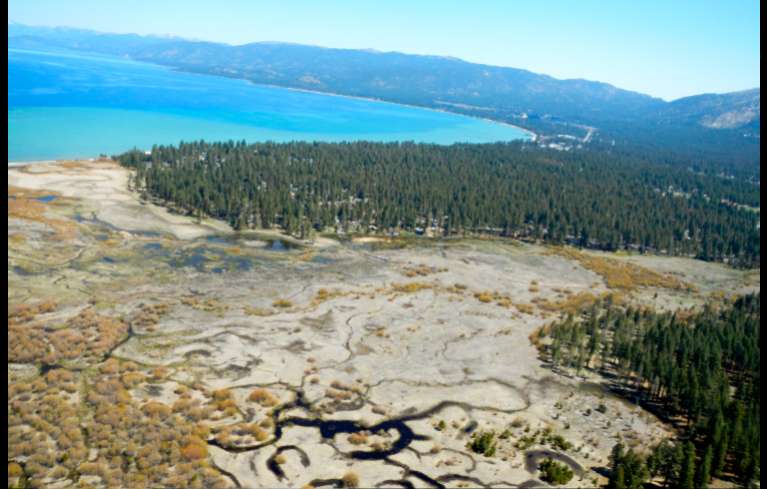
The Upper Truckee Marsh on April 22 is drier than normal. Photo/Kathryn reed

The Upper Truckee Marsh on April 22 is drier than normal. Photo/Kathryn Reed

Already the Department of Water Resources is projecting to deliver 35 percent of the requested amounts of water for SWP customers. Snow normally provides about one-third of the water for California’s homes and farms as it melts into streams, reservoirs and aquifers.

Sprinklers coming on in April was a sure sign the ground is abnormally dry in Tahoe.

The average temperature in the Lake Tahoe Basin has been running 10 to 15 degrees higher than normal for this time of year, which just helps to dry things out faster.

However, with the unsettled weather moving in, the mercury will be returning to normal – back to the low 60s.

Even though rain is in the forecast for the Lake Tahoe Basin starting on Saturday and continuing through Tuesday, the amount of wet stuff will not be enough to make up for the dismal snowpack.

The good news with thunderstorms in the forecast is there is still plenty of snow in the higher elevations. This means little chance of lightning starting a fire.

“Once this system moves out of the area, it will give a little reprieve before the start of fire season. But once it starts to heat up, fire season will be here earlier than typical,” Scott McGuire, meteorologist with the National Weather Service in Reno, told Lake Tahoe News.

For other areas of the state, fire season is in full force. The Santa Ana winds have whipped up multiple fires in Southern California that as of this afternoon were still out of control. Fire is also eating up grasslands in Sonoma and Napa counties. Fire season usually starts in June in California.

All indicators point to 2013 likely being a bad year for fire.

“Our firefighters have responded to an increased number of wildfires due to the very little rainfall we have received over the past few months,” CalFire director Ken Pimlott said in a statement. As of the end of April, CalFire had responded to more than 680 wildfires this calendar year. This is about 200 more than the average for this time of year.

— Lake Tahoe News staff report