Gaming industry across U.S. on growth spurt

By Ed Komenda, Las Vegas Sun

The U.S. casino industry captured $37.3 billion in gaming revenues in 2012, a 4.8 percent increase from 2011.

That growth rate is largest since the recession swept through the industry in 2008, according to an annual report released today by the American Gaming Association.

The AGA’s “State of the States” survey — a national snapshot of the casino industry based on economic data and public opinion — targets 22 states with commercial casinos and racetracks.

Frank J. Fahrenkopf, the AGA’s president and CEO, said this year’s data is a major bright spot in an industry marred by a recession that hemorrhaged workers and construction projects through the recession.

People continue to spend their money at casinos. Photo/LTN file

People continue to spend their money gambling at casinos. Photo/LTN file

“After three years of increasing growth and positive signs in all sectors of the industry, it’s clear we’ve weathered the recession,” Fahrenkopf said in a statement. “Whether we look at jobs, casino visitors served or tax revenues being provided, the bottom line is that there is much to be optimistic about in the commercial casino industry.”

In 2012, consumers spent $10.86 billion in Nevada casinos, 1.5 percent more than they did in 2011, when they spent $10.7 billion.

Of the 22 surveyed states with casinos or racetracks, 15 saw an uptick in consumer spending between 2011 and 2012.

Accelerated by the openings of casinos, spending in Kansas ballooned by 603 percent, growing from $48 million to $341 million in 12 months. The AGA attributes the growth to a full year of operations of the Kansas Star Casino in Mulvane and the opening of the Hollywood Casino at the Kansas Speedway.

Maryland saw another stellar increase in consumer spending, which increased by 142 percent, from $155 million to $377 million, rocketed by the opening of the Maryland Live! Casino.

Spending in New Jersey — home of the famed Atlantic City market — dropping from $3.32 billion to $3.05 billion. While the opening of Revel Atlantic City led to an uptick in jobs, the growth of regional competition and Hurricane Sandy led to the loss in revenue.

In 2012, Nevada had 170,000 commercial casino employees, a 2.4 percent drop from the previous year.

Employment grew by 5.8 percent in New Jersey, from 32,800 employees to 34,700.

The number of casino employees in New York grew by 9.2 percent, from 4,700 to 5,200. Many of those new employees went to work for Resorts World New York in Queens.

In all, the casino industry lost less than 1 percent of its employees, falling from 335,000 to 332,000.

The casino industry last year contributed $8.6 billion to the government in tax revenues, up 8.5 percent from 2011.

Gaming taxes in Nevada brought in $868 million, less than a percent more than the year before.

The AGA survey says 34 percent of Americans visited casinos last year.

Many of them did much more than gambling: more than 69 percent of casino visitors ate at a fine-dining restaurants, 55 percent saw a show or concert and nearly 45 percent visited a club. About 26 percent of those visitors said they never or rarely gamble when they visit casinos.

In the realm of public opinion, the survey says, the majority of Americans think casino gaming is acceptable for themselves or others.


Economic recovery missing from paychecks

By Paul Davidson and John Waggoner, USA Today

Stock markets and corporate profits are breaking records. The economy suddenly looks brighter after the government’s surprising report Friday that employers added 635,000 jobs the past three months.

But instead of celebrating, many working Americans are borrowing a line from the 1996 movie “Jerry Maguire” — “Show me the money.”

Hourly wages ticked up 4 cents in April to an average $23.87, rising at about the same 2 percent annual pace since the recovery began in mid-2009.

But taking inflation into account, they’re virtually flat. Workers who rely on paychecks for their income have been running in place, financially speaking. Adjusting for inflation, an average worker who was paid $49,650 at the end of 2009 is making about $545 less now — and that’s before taxes and deductions.

Stagnant wages aren’t only tough on workers — the American economy is paying a price, too. Living standards aren’t rising. Consumer spending, which is 70 percent of the economy, is more restrained. And the recovery advances at a slower pace.

“Ultimately, for the economy to thrive we need everyone participating,” said Mark Zandi, chief economist of Moody’s Analytics.

The profits of Standard & Poor’s 500 companies hit a record in the first quarter.

The roaring market is making the richest Americans richer and giving them more money to spend. But in 2010, only 31 percent of U.S. households had stock holdings of $10,000 or more, according to the Economic Policy Institute. During the first two years of the recovery, average net worth rose for the top 7 percent of households but fell for the other 93 percent, the Pew Research Center said.

“Don’t hold your breath” for employers to become more generous, said John Lonski, chief economist for Moody’s Investors Service. One reason, he said, is that revenue growth has been meager, up between 0.5 and 1 percent in the past year.


No more free beach parking in South Tahoe

By Kathryn Reed

While paid parking has been a reality in some areas of the South Shore for decades, it will be coming to new locations in mid-June.

It was a fairly hostile crowd that gathered Monday night at the South Lake Tahoe Senior Center to hear the city’s plans. The few who are fine with paid parking could barely be heard because others were disrespectful by talking over them.

The nearly 80 people in attendance were mostly well older than 50, completely resistant to change, and believe because the majority in the room were against paid parking that the other 20,000 people who live in South Lake Tahoe must be on their side and therefore the city should do as they say. Many believe the amount of revenue is not worth the angst.

South Lake Tahoe City Manager Nancy Kerry addresses a question from resident John Cefalu at the May 6 parking meeting at the senior center. Photo/Kathryn Reed

South Lake Tahoe City Manager Nancy Kerry addresses a question from resident John Cefalu at the May 6 parking meeting at the senior center. Photo/Kathryn Reed

City Manager Nancy Kerry made it clear no one is a cheerleader for paid parking, but the reality is this could be a revenue stream for the city. Projections are the sites where paid parking will go in will net $150,000 a year. This is from the fee and tickets given to those who don’t comply with the regulations.

Kiosks – which are how meters are now installed instead of a stand at each parking spot – are slated to go in on Venice Drive and near Lakeside Beach. Based on feedback from the May 6 meeting Kerry is going to propose to the City Council on May 21 that instead of meters at Regan Beach they go in at the Lakeview Commons area. Venice will be free in the winter.

While all the money had been designated to go in the general fund, meaning the cash could be spent on anything the city desires, that would not be true of money collected at Lakeview Commons. State Boating and Waterways mandates that parking money be reinvested in that area. That could mean improvements to the boat ramp, putting in a viable pier and other upgrades.

It will cost $2 an hour, with a maximum of $10 a day. The fee will be seven days a week from 8am to 10pm. It is possible holidays will be more expensive. Altering the rates or waiving the fee during special events like Live at Lakeview concerts on Thursdays is being talked about.

Some people think parking is a new topic around city hall. They are wrong. Parking has been on a City Council agenda four times since Nov. 20, 2012.

This is from an Oct. 22, 2010, Lake Tahoe News story:

“Metered street parking, parking garages, reconfiguring streets, changing public perception about paid parking, paying attention to public transit-walkers-cyclists, and approving future projects with adequate parking were all broached in the daytime meeting.

“Most in the audience agreed more parking and paid parking are likely to be more prevalent in South Tahoe in the near future. And they agreed it would be the locals, who are used to free parking, who will probably be the hardest to convince this is what’s needed.

“The consultants started work in July by speaking with nearly 300 people to gather their thoughts on parking in the city. They also have read the 10 or so parking studies the city has commissioned over the years.

“In the in-person survey, which mostly tourists answered, about 70 percent said they would be willing to pay for parking.”

This is from a March 2, 2011, Lake Tahoe News story:

“The other new source of revenue is via metered parking, especially near beaches. [City Attorney Tony] O’Rourke said most waterfront communities charge to park close to that body of water. The anticipation is this could bring in $450,000 a year.”

The projected revenue has been scaled back immensely because no longer is the city going to charge people for their permits – permanent ones or for guests. And the number of locations is not as great as once anticipated.

Residents on streets in about a two block area of where the kiosks will be located will be given free permits for their vehicles to let parking enforcement officers know they are allowed to park there.

Much of Monday’s meeting centered on people saying how they have all these friends who stop by, come to visit for days on end – and they need a place to park. Residents fear they won’t be able to get enough guest permits.

People believe the city will be limiting their guests’ activities. The city’s intent is to guarantee locals a place to park on their streets with the permits. If it were permit-only parking, then those who are looking to avoid using the kiosks would have to go several streets from the beaches to do so.

Other places that charge, usually on a seasonal basis, are the U.S. Forest Service beaches, California State Parks, Beacon Restaurant, Tahoe Keys Marina and Ski Run Marina.


NDOT raising traffic safety awareness

With a rise in Nevada traffic deaths in 2012, the Nevada Department of Transportation will post traffic fatality numbers on digital freeway boards to remind motorists to always drive safely.

Freeway digital message signs, or DMS, across the state will periodically display updated statewide traffic death numbers. The messages will be followed by safety messages reminding drivers to always buckle up, never drive impaired and other safety reminders.

Preliminary numbers show that 258 traffic fatalities occurred on Nevada roads in 2012, an increase of 12 deaths compared to the previous year. Despite recent upticks, Nevada traffic fatalities have generally trended down after reaching an all-time high of 432 in 2006.

Under the Nevada Strategic Highway Safety Plan, Nevada traffic and safety advocates implement enforcement, engineering, emergency medical and educational strategies to cut yearly traffic fatality averages in half by 2030, with the ultimate goal of zero fatalities on Nevada roads.


Problem gamblers increase with proliferation of casinos

By Stephen Singer, AP

HARTFORD, Conn. — Tom Leksan lost nearly everything when gambling became an addiction with easy access to casinos.

Once an Ohio lawyer, Leksan lost his job and marriage because of gambling, specifically blackjack. He had been gambling for years, he said, but did not become a problem gambler until he became hooked on riverboat casinos in nearby Indiana.

“I think the casinos thrive off the compulsive gambler,” said Leksan, now a car salesman in northern California. “They pay lip service to treating problem gambling, but that’s their bread and butter.”

The unrelenting spread of casino gambling across America is reaping billions of dollars for the industry and government coffers but is also creating more compulsive gamblers. Addiction experts say the sums spent by states for treatment and counseling are too little to keep pace.

Even after the worst recession in decades and during a weak economic recovery, developers are building new casinos and adjoining attractions with the blessings of cash-hungry states. Ohio opened its first casinos last year, casino developers are vying for permission to build three casinos in Massachusetts, and New York City’s new Resorts World Casino at the Aqueduct racetrack is also shaking up casino gambling in the Northeast.

Advocates for an expansion of treatment services point to enormous gaps between the money states are taking in and what they are spending on compulsive gambling. For example, casinos and card rooms in Pennsylvania generated about $2.3 billion in revenue in 2010 and the state transferred $17.5 million in casino revenue into its Problem Gambling Treatment Fund between 2007 and last year.

Connecticut’s casinos, off-track betting and the state lottery generated nearly $659 million in state revenue in 2012 while problem gambling services that include counseling, treatment and a toll-free phone number for gamblers received $1.9 million.

“Even as you see an expansion of gambling you’re not seeing a level playing field in treatment,” said Mark Vander Linden, president of the Association of Problem Gambling Service Administrators.

Linden’s organization, in a 2010 report, found that 37 states were providing public funding for gambling programs — at a combined total level of just over $58 million. Nevada alone reported casino and card room gambling revenue that year of $10.4 billion, according to Casino City’s North American Gaming Almanac.

About 2.6 million gamblers characterized as pathological, or unable to resist the impulse to gamble, are estimated to need treatment each year, the Association of Problem Gambling Service Administrators says.

Problem gambling is defined as behavior that causes physical, psychological, social or job disruptions. It is progressively addictive as gamblers become preoccupied with betting and require more frequent bets with more money. It can be as mild as spending too much at a slot machine, card table or convenience store selling lottery tickets or taken to the extreme, compulsive gambling results in overwhelming debt, divorce and sometimes crime such as embezzlement to raise money to pay off gambling debts.

Ray Pineault, executive vice president and chief operating officer at Mohegan Sun in Connecticut, said Mohegan Sun and neighboring Foxwoods Resort Casino contribute plenty — nearly $326 million last year as required by their agreement with the state — but the state spends too little to treat problem gambling.

“I don’t think the state does significant funding,” he said.

Rep. Stephen Dargan, the House chairman of the Connecticut legislature’s public safety committee, which oversees the two casinos, said finding money is always a struggle.

“There’s only so many dollars out there,” he said.

In addition, without an expansion in gambling in Connecticut and no Internet gambling, no one is clamoring for more funding. “Everything is pretty much status quo,” he said.

Donald Weinbaum, executive director of the Council on Compulsive Gambling of New Jersey, where gambling has been legal for decades, said the state’s Internet gambling law signed by Gov. Chris Christie in February will lead to a big boost in financing problem gambling programs. Each casino that wins state approval to operate Internet betting will be required to pay $250,000 a year.

It’s the first time casinos are being forced to pitch in to help finance such services, he said, and will boost current funding of $850,000 a year for treatment, prevention, education and other services that has held steady for about three years.

Massachusetts state Sen. Stanley Rosenberg, a principal architect of legislation in 2011 allowing up to three resort casinos and a slot machine parlor, said gamblers from his state are spending money in casinos in neighboring states, leaving Massachusetts to treat problems related to their gambling troubles.

“If they’re addicted, they leave their money and come home with their problems,” he said.

Massachusetts nearly doubled its annual problem gambling budget from $1 million, to $1.8 million — even before opening the doors to their first gambling hall — but Gov. Deval Patrick cut funding to about $1.3 million as part of spending reductions across state government.

Keith Whyte, executive director, of the National Council on Problem Gambling, said prevention and education programs have succeeded in reducing problem gambling and keeping the number fairly stable.

“With expansion, I’m not sure we’ll ever be able to knock it back down,” he said. “This is an addiction where state government is intimately involved and quite complicit,” Whyte said.

Part of the challenge in getting funding to treat gambling addiction is its invisibility, advocates say.

“It’s a very hidden disease,” said Arnie Wexler, a onetime gambling addict and former head of the New Jersey Council on Compulsive Gambling. “You can’t see it. You can’t smell it. There are no track marks, no dilated pupils.”

Treatment options in various states include phone or in-person counseling and public education in schools and churches.

In Connecticut, gamblers can find help at more than a dozen outpatient clinics and in one 20-bed facility where they can stay for up to two weeks for individual and group counseling.

“It’s a respite for someone who needs to get out of their environment for a period of time,” said Jim Crean, director of outreach and community relations at the Midwest Connecticut Council on Alcoholism.

Gamblers also may have their names included on lists to be kept from entering casinos. In Pennsylvania, 5,111 people have asked to be on the list over the past six years, said Doug Harbach, spokesman for the state Gaming Control Board. Gamblers who are listed and are caught gambling when they try to cash out their winnings are charged with summary trespass, Harbach said. About 875 violations have been issued.

Another concern is that a rising number of problem gamblers are young. Industry leaders, law enforcement and New Jersey officials gathered in Trenton recently to consider new preventive and treatment ideas to expand services to young at-risk problem gamblers. They emphasized the need to use social media promoting preventive measures at grade school and high school levels.

Gambling therapist Stephen Garbarini said he sees more young people requiring treatment and expects that trend to continue with online betting.

The expansion in gambling in Massachusetts will come with some innovative steps to deal with addiction. One requirement calls for intervention treatment centers at the casinos, a first in the nation, according to Marlene Warner, executive director of the Massachusetts Council on Compulsive Gambling. Gamblers will be able to stop in for advice or referrals.

Casinos also will be required to pay 5 percent of their proceeds from the state’s 25 percent tax on gross gaming revenue into a trust fund for programs to prevent and treat addiction and other gambling problems.

“We took advantage of the opportunity to address problem gambling while everybody was paying attention to gambling,” Warner said. “There’s a lot of prevention work to be done.”


Made in California may take on new meaning

By Marc Lifsher, Los Angeles Times

SACRAMENTO — A “Made in USA” label has long been seen as an advantage in marketing a product.

Now there are in-state manufacturers that want to see the adoption of an official label that declares Made in California.

State Sen. Ellen M. Corbett, D-San Leandro, has introduced legislation to require Go-Biz, the governor’s business development office, to come up with a plan — including the new label — to promote California-manufactured products. The bill, now before the Senate Appropriations Committee, would enhance California’s reputation for making environmentally safe and energy efficient products, Corbett said.

Backers of the legislation include high-end electric-car maker Tesla Motors Inc., a group of San Francisco Bay Area green-tech firms and small-business advocates. But some business leaders see problems ahead for the Made in California concept. Deciding whether something is made in California could be tough considering how complex manufacturing can be today, warned Jock O’Connell, a Sacramento-based international trade expert with Beacon Economics. Look, for instance, at international supply chains, especially for high-tech products such as aircraft that use parts made on multiple continents.

“I really see a good intention here,” O’Connell said, “but it’s a piece of legislation that in practice is nearly impossible to implement.”

California cities increasing are using tax money to woo companies or to keep them, but some lawmakers are urging caution.

Amazon got a share of new sales taxes receipts collected by the cities of Patterson and San Bernardino when the giant Internet retailer agreed to put its distribution centers and new jobs there. In addition, the Bay Area city of Martinez agreed to share tax money with an industrial firm that threatened to leave town.

Last year, state Sen. Mark DeSaulnier, D-Concord, said he was contacted by the city manager of Martinez, who was concerned about such tax giveaways. The lawmaker recalls the manager pleaded, “We need you to save us from ourselves.”

As a result, DeSaulnier — a former city councilman and county supervisor — has a bill requiring local governments to make an independent cost analysis before granting any tax subsidy of more than $1 million to a proposed developer. “In today’s global economy,” he said, “it is imperative that our cities have the best possible data as they negotiate with large corporations.”

The bill, SB673, won approval from the Senate Governance and Finance Committee last month. But it still faces formidable opposition from the League of California Cities, which blasted the bill for having “a clear anti-development bias.”


Court: Cities don’t have to allow pot shops

By Howard Mintz, San Jose Mercury News

SAN FRANCISCO — The California Supreme Court on Monday upheld the right of local governments to ban medical marijuana dispensaries, leaving intact a growing movement by political officials to outlaw the pot businesses despite a 1996 state law that permits the use of weed for medical purposes.

In a 7-0 decision, the state’s high court concluded that cities and counties have a right to restrict the dispensaries within their boundaries, rejecting the arguments of medical marijuana advocates who maintain local governments cannot bar activity that is legal in California. The ruling could now be used to further bolster local efforts to place stricter regulatory rules on medical pot dispensaries that are allowed to operate.

“Nothing in the (1996 law) expressly or impliedly limits the inherent authority of a local jurisdiction, by its own ordinances, to regulate the use of its land, including the authority to provide that facilities for the distribution of medical marijuana will not be permitted to operate within its borders,” Justice Marvin Baxter wrote for the court.

At least 180 cities across the state and Bay Area have enacted bans in recent years, from Hollister to Petaluma to Moraga. But the region’s largest cities, San Jose, San Francisco and Oakland, have permitted the dispensaries, taxing the revenues while communities in-between increasingly become dispensary-free zones.

South Lake Tahoe limits dispensaries to three at any one time, but any new ones beyond the one pot shop that exists must have City Council approval.

Many local governments have opted to ban the dispensaries

due to worries about problems surrounding them, such as lax control over the distribution of a drug that remains illegal under federal law. The Supreme Court case is the latest legal struggle over the issue, which has repeatedly tested the limits of the voter-approved law that allows the use of marijuana to treat illnesses such as cancer, glaucoma and AIDS.

The Supreme Court decision came in a challenge to Riverside’s dispensary ban. Riverside, backed by groups such as the League of California Cities, argued that local governments have strong rights to regulate land uses within their boundaries, particularly an unusual land use such as a medical pot dispensary.

Medical marijuana advocates, however, say the bans undermine the intent of the state law, which they argue was meant to provide uniform access to medical cannabis across the state for patients who need it most. With the bans in place, many patients are forced to drive long distances to obtain the drug — for example, Peninsula patients now for the most part must travel to either San Jose or San Francisco to get to a dispensary.

The Supreme Court’s decision was not unexpected. Legal experts have predicted the justices would be reluctant to strip cities of the right to enact the bans.


Busing psych patients bothered some Nev. workers

By Cynthia Hubert and Phillip Reese, Sacramento Bee

LAS VEGAS – In the darkness of early mornings during his graveyard shift at Nevada’s primary state psychiatric hospital, Gilbert Degala regularly walked patients outside and watched them climb into taxis bound for the Greyhound bus station on Main Street.

The scene made him uneasy.

Many of the patients, burdened with mental illnesses that caused them to become delusional, suicidal or violent, were being discharged from Rawson-Neal Psychiatric Hospital in Las Vegas to buses that would ferry them hundreds of miles away. They carried their discharge paperwork, enough medication to last them a few days, and up to a case of Ensure nutritional supplement for the journey.

Some of the men and women knew why they were traveling to places like Miami or Sacramento or Los Angeles, Degala said. They were returning to family or friends. But for a troubling number “there was no one to pick them up,” he said.

Some patients, he and other current and former workers told the Bee, appeared disoriented or unstable and not ready to leave the hospital.

“I felt bad for these patients,” said Degala, who as a mental health technician helped social workers and nurses manage clients. He wondered whether the men and women ever got on their assigned buses, he said, and what happened to them if they did.

He resigned last year along with many of his colleagues, he said, as working conditions became more stressful.

Patient care at Rawson-Neal – and its discharge practices specifically – have come under scrutiny in recent weeks amid revelations that the hospital has bused roughly 1,500 patients to states across the nation over the past five years, a third of them to California.

Since mid-2008, as the economy worsened and Nevada slashed mental health spending, the number of psychiatric patients getting one-way tickets out of Rawson-Neal steadily rose, according to a Bee review of Greyhound bus receipts purchased by the state agency that oversees the hospital. By last year, Rawson-Neal was busing patients out of Las Vegas at a pace of more than one per day, shipping nearly 400 patients to 176 cities in 45 states, according to the Bee‘s review.

The sheer scope of the busing program has raised questions in California and elsewhere about whether Nevada was systematically “dumping” indigent mentally ill patients across state lines, prompting criminal probes in Los Angeles and San Francisco, as well as federal regulatory investigations.

In the weeks since the Bee published its findings, Nevada health officials have revised and largely defended the unusual busing practice, saying Las Vegas is an international destination that attracts more than its share of visitors. They maintain the vast majority of the patients transported out of state were being sent back to their “home communities,” where they had support systems or family to meet them.

Nevada’s Health and Human Services chief has said that the increased pace of busing over the five-year period was not related to state funding cuts, and instead stemmed from a change in the hospital’s internal approval process that has since been remedied.

Several current and former Rawson-Neal staff members interviewed tell a different story.

Though the employees offered different perspectives on the wisdom of sending psychiatric patients alone on bus trips across state lines, most described increased pressure in recent years to move patients out. And budget cuts, they said, were a driving factor.

“There is so much pressure now to get people out as soon as possible,” said one longtime Rawson-Neal nurse, who requested anonymity for fear of losing her job.

“The administration has a meeting every week to talk about length of stay,” she said. “Doctors are told, ‘You need to get these patients out of the hospital.'”

According to the nurse, the pressure is most acute within the hospital’s psychiatric observation unit, where patients are assessed to determine whether they need to be admitted for inpatient care.

Nevada cut mental health spending 28 percent between 2009 and 2012, cuts that brought furlough days, staffing shortages and widespread reductions in outpatient services and housing for the mentally ill, according to employees and area social services workers.

“The problem is that we don’t have a place to send people,” said the nurse. Mentally ill patients are filling hospital emergency rooms all over town, she said, and the ERs are sending patients to Rawson-Neal.

Many of Rawson-Neal’s patients, she said, are chronically ill “frequent fliers” whose faces are familiar to staff members. Others are one-time visitors who had a mental break or abused drugs and “went off” while on their trip to Vegas.

At least once per shift, the nurse said, patients are so out of control that “we need to take them down” by force.

“Patients are being jammed down our throats,” she said. “Sometimes the psychiatric observation unit will take in 10 patients all at once. You’ll have ambulances backed up with patients. It’s extremely stressful.”

As pressures have mounted, busing patients from Rawson-Neal to locations out of state has become more common, workers said.

Toward the end of his tenure at Rawson-Neal, Degala said, “they were seeing too many patients coming in.”

“They could pay the Greyhound bus station, set up a treatment plan and ship,” he said. “It would be cheaper to give them a bus ticket than to keep them in the facility.”

Busing policy born

Rawson-Neal, a collection of squat brick and stucco buildings in an arid landscape a few miles from Las Vegas’ glittering Strip, opened in 2006 to great expectations for improving care for mentally ill people in Southern Nevada.

The hospital has four 40-bed inpatient units along with the 30-bed observation unit. The buildings surround a large, open courtyard with basketball hoops and patches of grass. Patients typically arrive via the ambulance bay at the side of the facility.

Interviews with state officials have left unclear exactly when the hospital put in place its patient busing policy. A long-standing written policy calls for transporting patients back to their “home community in order to provide more appropriate care and to remove the burden of treatment from the State of Nevada.”

The wording was revised in recent weeks, as concern over the busing practice spread, to remove the phrase “burden of treatment,” and the state announced late last month that patients no longer would be bused without chaperones.

Whatever the origins, Rawson-Neal clearly was issuing bus tickets to patients in earnest by 2008. Its umbrella agency, Southern Nevada Adult Mental Health Services, has had a standing contract with Greyhound since 2009, said a spokesman for the bus company. That year, the hospital bused 238 people. By 2012, the number had grown to 396.

By hospital policy, social workers and doctors are supposed to work together to come up with a plan for discharging patients, with a psychiatrist signing off on the discharge. But in recent years, as budget pressures increased, the process became more haphazard, according to some current and former employees, with staff members employing a loose definition of friends or family when deciding where to send patients.

Bryan Peralta worked as a mental health technician at Rawson-Neal for eight months, ending in November of last year. One of the reasons he left the hospital was its discharge of patients “who were not ready” to be released, he said.

Peralta recalled one young woman who was sent to the Greyhound station while “she was still foaming” at the mouth and talking to herself. She had a ticket to California, but was sent back to Rawson-Neal by a bus driver before she crossed the state border, he said.

Staffers typically made a cursory effort to connect patients with relatives or friends, Peralta said. But “half the time it’s not a mother or a sister, it’s a friend or a distant relative,” he said.

Krystal Chadwick is another former technician who left Rawson-Neal three years ago. Patients discharged to the bus station used to get fresh fruit, juice and other snacks to sustain them for the trip, she recalled. Now they receive bottles of Ensure.

“I didn’t want to give them Ensure,” she said. “They had a lot of travel ahead of them. Some person is going to Florida and all they have to eat is Ensure?”

Chadwick said she often worried that patients would relapse during their trips.

“These people are lost,” she said. “They can’t take care of themselves.”

In reporting this story, the Bee reached out to dozens of current employees to get their perspective on operations at Rawson-Neal. The vast majority did not respond or declined to comment. Those who did talk asked for anonymity for fear of being fired.

One current technician who spoke anonymously echoed Degala’s description of patients leaving without a treatment plan in place.

“Sometimes they say, ‘I’m just going,'” he said. “It’s wrong.”

Brian Little, who left the hospital in 2012 after eight months, had a different recollection. He said that in his “limited experience” patients “were not shipped off without a plan.”

The longtime nurse who requested anonymity said she also believed most patients bused out of state were stable enough to leave the hospital and had some kind of help waiting at their destination.

Her concern was what might happen along the way.

“A lot of them are not going to stay on the bus,” she said. “They’re going to get off and be on the streets, and maybe end up here again.”

Criminal probes launched

The spotlight turned on Rawson-Neal after one of its patients, James Flavy Coy Brown, showed up suicidal and confused at a Sacramento homeless services complex earlier this year. Brown, who is 48 and suffers from schizophrenia, had been living in Las Vegas shelters for years.

He ended up in Rawson-Neal’s psychiatric observation unit in February with symptoms of psychosis that suggested he was a danger to himself or others. After 72 hours, he was discharged to the Las Vegas Greyhound station with a one-way ticket to Sacramento, where he knew no one. He said Rawson-Neal doctors suggested he might like “sunny California” and told him to call 911 once he arrived.

He arrived in Sacramento out of medication and food. With the help of police and homeless services workers, he landed in the UC Davis Medical Center emergency room. He has since reunited with his daughter from North Carolina.

Nevada officials have acknowledged making mistakes in Brown’s case, saying the hospital “blew it” in busing him to Sacramento. But they insist his case was an exception and that the problems are not systemic.

“The most concerning thing to me is a narrative that we are dumping people,” said Dr. Tracey Green, Nevada’s state health officer. “We don’t dump people.”

Green defended the state of care at Rawson-Neal and said staffing ratios have remained consistent during her tenure. The hospital’s staffing levels are subject to independent and federal review, she said, and have not been found lacking.

“I believe we do excellent work here,” she said. “The bottom line is we will continue to do better.”

Since the April policy change requiring that all patients bused out of state now be accompanied by an escort, no patients have been bused from the hospital, Green said last week.

“We think the transportation policy is right where it needs to be,” she said.

As the furor over the busing policy has spread, Nevada state health officials conducted an internal investigation, which they say found 10 of 1,500 patients may have been placed on buses without support during the past five years. Two employees were fired following the investigation, and several others disciplined, said Mary Woods, spokeswoman for the Nevada Department of Health and Human Services.

The hospital’s discharge policies remain under scrutiny. City attorneys in Los Angeles and San Francisco have launched criminal probes to determine whether Nevada has been dumping its indigent psychiatric patients across state lines. They, along with Sacramento’s city attorney and county counsels from Alameda and Santa Clara, have demanded a meeting with Nevada’s attorney general to get more information on the patients bused to their jurisdictions in recent years.

In a letter to Attorney General Catherine Cortez Masto last week, the attorneys said their preliminary investigations have found that Brown’s case was not isolated.

The investigations “have confirmed that Nevada’s practice of transferring mentally ill patients to California without an escort and without prior arrangement for an institution or responsible person to receive the patient is more widespread,” the letter stated.

Late last week, an independent accreditation agency dispatched a team of investigators to Rawson-Neal in response to concerns about patient care. Its report will determine whether the state hospital can keep its federal funding and “gold star” accreditation status.

Patients through revolving door

Several former administrators and staffers blame the controversial busing practices on a lack of oversight, caused in part by instability at the top.

In its short lifetime, Rawson-Neal has had five administrators, one of whom lasted less than a week and another a few months. The turnover has created confusion about policies for admitting and discharging patients, current and former staffers said. The hospital’s current administrator, Chelsea Szklany, is an occupational therapist who has been on the job since January 2012.

Jonna Triggs, who served as director of Southern Nevada Mental Health Services between 2002 and 2006, said busing patients “was never a standard or routine” on her watch. “Certainly we did send some people back home, but not hundreds a year and not the way it’s being done now,” she said.

Others say Rawson-Neal’s problems reflect a broader fraying of the safety net for the mentally ill in southern Nevada.

Cuts to programs funded by the government have had a trickle-down effect on hospital emergency rooms and private agencies that run programs for needy people, observers said.

Last September, the Salvation Army in Las Vegas closed a 42-bed group home for chronically mentally ill people after grant funding was slashed, said spokeswoman Leslee Rogers.

A recent survey counted more than 14,000 homeless people living in Las Vegas, up from about 9,000 four years ago, she said. Many of the men and women living on the streets are mentally ill and end up in hospitals including Rawson-Neal, said Rogers.

“Yes, we get people all the time who have been dumped,” she said. Some arrive by taxi wearing hospital gowns and slippers.

Maj. Robert Lloyd, the Salvation Army’s Clark County coordinator, said the number of mentally ill people that the agency serves has risen dramatically during the past three or four years.

“We have folks show up from hospitals, completely unable to take care of their basic needs,” Lloyd said. “When we get someone who is self-mutilating, who is eating glass or pounding their head against the wall, we are in over our head. We’re not capable of dealing with it.”

Lloyd said he understands the plight of hospitals that are overextended.

“They can only hold someone for so long and then they’ve got to do something with them. But if they’re releasing them into a situation that’s not stable, it’s unacceptable.”

Lloyd said staffers have tried to get such patients readmitted to hospitals but usually are unsuccessful.

“So we call the police, and the next thing you know they’re out on the street again,” he said.

“It’s a revolving door.”



Bulletproof whiteboards and marketing school safety

By Liz Halloran, NPR

A recent news item out of Minnesota: “Bulletproof Whiteboards Unveiled at Rocori Schools.”

Bulletproof what? Where?

That would be whiteboards, at the small central Minnesota Rocori School District, which will spend upward of $25,000 for the protective devices produced by a company better known for its military armor products.

“The timing was right,” Rocori school board Chairwoman Nadine Schnettler tells us. “The company is making these in response to the Newtown shooting, and has been making similar products for our soldiers in Iraq and Afghanistan.”

The $300, 18-by-20-inch whiteboards, produced by Maryland-based Hardwire LLC, “will be an additional layer of protection” for students and teachers, she says.

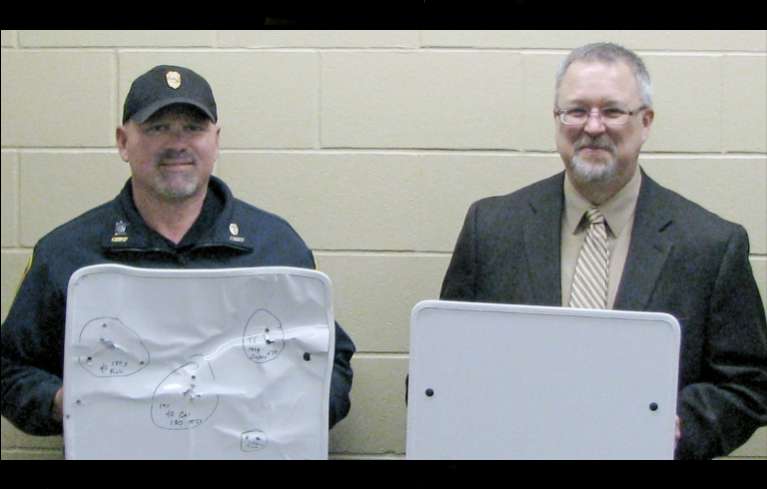
Cold Spring, Minn., Police Chief Phil Jones (left) and Rocori School District Superintendent Scott Staska hold bulletproof whiteboards in April while announcing the school system's $25,000 investment in the shields.

Cold Spring, Minn., Police Chief Phil Jones, left, and Rocori School District Superintendent Scott Staska hold bulletproof whiteboards. Photo/Hardwire

It’s not just the conversation about guns and school safety that’s changed since Adam Lanza gunned down 20 students and six adult staff members at Sandy Hook Elementary School in Newtown, Conn., in December. It’s also the plethora of products, including training programs that in some instances advocate fighting back, that are being marketed to school districts that are typically cash-strapped but desperate to prove they’re doing something to provide better security.

Bulletproof whiteboards and clipboards. Bulletproof wall panels. Bulletproof backpack inserts. Bullet “resistant” window film. Specialized locks. Training that turns the emergency lockdown, “shelter in place” response on its head.

While proponents of the school safety items and training say their products provide more than just a psychological fix, critics say they need a lot more persuading.

“After every high-profile school shooting, we have an explosion of gadgets, gurus and charlatans,” says Kenneth Trump, who is openly disdainful of the bulletproof items, but more so of training programs that advocate confrontation. “Corporations see dollar signs,” he says, “and believe that schools have huge budgets to buy new products and services.”

But school budgets are far tighter now than in recent memory, he says, with precious little to spend for whiteboards or training.

“Federal and state school safety grants have been hacked at, if not eliminated,” Trump says. “The pool of dollars that many vendors envision doesn’t really exist.”

His unvarnished take: “The vendors may be opportunistic, but the people on the purchasing end aren’t thinking it through, either.”

A post-Newtown measure that will be considered by the U.S. Senate would authorize $40 million in grants that must be matched by local school systems for improving security with measures including lights, locks and surveillance equipment, as well as for security training for teachers and administrators.

The U.S. Education Department is also developing an emergency guide for schools, and the Department of Homeland Security is writing a similar one on securing school buildings. The Education Department’s Readiness and Emergency Management for Schools has been a victim of budget cuts, unfunded since 2011.

When Hardwire LLC, traditionally a manufacturer of armor and shields for the military and law enforcement, wanted some attention for its new bulletproof school products, it’s not surprising it zeroed in on Rocori.

A decade ago at Rocori High School in Cold Spring, Minn., 15-year-old John Jason McLaughlin to kill two fellow students.

And Hardwire already had a working relationship with a local company, Cold Spring Granite, which provides material that the armor company uses in its products for bridge and building infrastructure protection.

The town’s police chief made the whiteboard pitch to the school board, says Schnettler. And members were pressed to act quickly, she says, to take advantage of a special offer: The granite company would donate 75 whiteboards to the district’s public and parochial schools if the board agreed to match the purchase.

“It wasn’t a unanimous vote,” Schnettler says, “primarily because Hardwire had a bit of a sense of urgency. They wanted Rocori to be the first district to have these, and if we didn’t take the offer, they were going to move on.”

Schnettler, who voted in favor of using $25,000 from a capital improvement fund to purchase the whiteboards, says that in hindsight she would still do the same.

“I don’t believe it’s a waste of money,” she says. “The chief showed us how to use it offensively — to block penetration of bullets through door windows, or to knock the gun out of the intruder’s hands.

“It buys time for your local law enforcement to get there,” she says.

Emily Heinauer, senior director of advanced programs for Hardwire, agrees that the whiteboards should be viewed as tools to buy time before help arrives.

“During the Virginia Tech shootings and at Sandy Hook, people were throwing themselves in front of their students to protect them,” she says. “The whiteboard is meant to be defensive,” used by teachers potentially in the line of fire.

Hardwire has created a nonprofit “adopt-a-school” organization through which tax-deductable donations may be made for the purchase of the bulletproof products. Heinauer says that the parents of the students killed at Rocori High School a decade ago also donated money to purchase additional whiteboards.

Schools Superintendent Scott Staska did not return calls for comment.

Cathy Paine speaks with authority about school security, and with good reason.

She was the school psychologist at Thurston High School in Springfield, Ore., when in 1998 student Kip Kinkel and wounded 25 others.

Paine, still a school psychologist in Springfield, is chairwoman of the National Association of School Psychologists’ emergency assistance team.

She says that though she understands the fear that is driving the school security market, she views bulletproof whiteboards and the like as “a knee-jerk reaction to a problem that doesn’t exist.”

“It’s such a rare event that an armed intruder will come in — there’s a 1 in 2.5 million chance it will happen,” she says. “We want to have comprehensive safety programs, we want to be prepared, but we should be looking at what are the likely crises.”

Her tack is to encourage school districts to balance the physical safety of their campuses with what she called the “psychological safety of the campus.” A bigger risk to safety in schools is kids being bullied and harassed, she says.

After the shooting at her school, there was a push by some for metal detectors, which the school ended up not installing. But the district did receive a federal grant through a program called the , which was used for crisis planning, looking at physical safety and the school environment.

The school system installed perimeter fencing, she says, redesigned some school entrances, and closed up others. The high school already had security cameras, which documented the shooter, gun hidden, as he approached the school.

That money, however, has dried up, Paine says, as has much of the other federal money once available for school safety measures, including school resource officers.

Paine and Trump, the school security expert, say they are particularly concerned with training programs that encourage, in certain circumstances, confronting armed intruders.

One of the programs receiving the most attention is known as, for Alert, Lockdown, Inform, Counter, Evacuate. It’s not a new concept, Trump says, and is similar to other training — except for elements that encourage students to “distract” and “confuse” an armed suspect by throwing things at him or her, and then potentially launching a physical attack.

“You put lipstick on a pig, but you still have a pig,” Trump says of the training, which he and some school experts argue has been discredited before in K-12 situations, and could place children in more danger both physically and psychologically.

Says Paine: “The main thing that’s disturbing about it is trying to have our children understand and execute this kind of a plan. I don’t think that’s a situation we want them in. … We’re better off teaching our kids to evacuate quickly and safely, or to shelter in place.”

ALiCE and programs like it have supporters — many of whom use the example of the passengers who fought back against hijackers on Sept. 11.

One of its advocates is Ridgemont, Ohio, schools Superintendent Emmy Davis, featured on the website of Response Options, which came up with the training program. She says it provides a “proactive approach, rather than hiding or waiting” when there’s a gunman in a school building.

Rob Slattery, a retired police officer who is director of operations at in Ohio, says the school protection products they make (including bulletproof whiteboards and backpack inserts) are just tools.

“I wish there wasn’t a need for this product,” he says. “And by no means are we saying this is a solution to the problem. This is an option. To have something between you and an assailant? Anything is a positive.”

He says he sees it as akin to the auto industry coming up with air bags.

His company has done a lot of business with lawyers, providing bulletproof clipboards and briefcases, but school products are now about 65 percent of its market.

Trump, who argues that the best practices in place at Sandy Hook got a lot of children out of the building safely, says he advises schools not to waste money on whiteboards or ALiCE, but rather to invest money on resource officers, counselors, radios and cameras.

“Focus on fundamentals and get back to the basics,” he says. “There is a security product for every possible need that your budget will buy. The question is, is that the best use of limited resources?”

But in Cold Spring, Minn., Schnettler, the school board president, says that the district was responding to parents who were concerned after Newtown.

“We installed a buzzer system and locks in the elementary schools that we didn’t have before,” she says. “And we looked at our other security measures and other things that had to be tightened up.”

And they purchased the whiteboards, which will be hung on the walls, the superintendent says, if or until they are needed.


Southwest Gas profits inch up

By Eli Segall, Las Vegas Sun

Southwest Gas Corp. narrowly raised its first-quarter profit after seeing a turnaround in its pipeline construction services unit.

The Las Vegas-based natural gas provider on Friday reported earning $80.8 million of net income, or $1.75 a share, for the three months ending March 31.

That compares to a profit of $78.9 million, or $1.71 per share, in the same period last year.

The company’s operating margin, or revenue minus the cost of selling gas, was $293 million last quarter, up from $288 million a year earlier. Also, its NPL Construction Co. unit accounted for almost $1.5 million of the company’s total profit. A year earlier, NPL lost the company $447,000.

Southwest Gas has almost 1.9 million customers in Arizona, Nevada and California.