College enrollment drops as people return to work

By Mary Beth Marklein, USA Today

College enrollments declined 2.3 percent this spring compared with a year earlier, a sign that more students are returning to the workforce as the economy recovers, a report out Thursday says.

The biggest drops occurred among adult learners attending for-profit colleges and public community colleges, which are most likely to enroll students in vocation-oriented classes tied to the local job market. Enrollments at those institutions fell 8.7 percent and 3.6 percent, respectively.

For colleges, which saw enrollments peak in 2011 during the recession, the declining numbers represent “a bit of a return to normal,”says Doug Shapiro, executive director of the non-profit National Student Clearinghouse Research Center, which released the report. “It’s reflective of good news for the economy and labor market.”

Numbers are based on data provided by about 95 percent of the nation’s colleges and universities to the National Student Clearinghouse, which offers verification and research services to participating colleges.

Enrollments this spring reached 19,105,651, down from 19,550,391 last spring. A similar decline has occurred during fall semesters, when enrollment figures have historically been higher. Enrollments last fall were down 1.8%, to 20,195,924, compared with a high of 20,556,272 in fall 2011.

Among details between this spring and last spring:

• Four-year public institutions saw a 1.1 percent drop in enrollments while four-year private colleges saw a slight increase.

• Across regions, the Midwest saw the greatest decrease in overall enrollment, 2.6 percent, while the Northeast saw the smallest decrease, less than 1 percent. The drops were 1.7 percent in the West and 2.2 percent in the South.

• The decrease was steeper for women than men (2.7 percent vs. 1.7 percent) but women still accounted for more than 57 percent of this spring’s enrollments.

• Enrollments among students over age 24 fell 3.6 percent, while rates for traditional-age students fell 1.4 percent.

Michael Reilly, executive director of the American Association of Collegiate Registrars and Admissions Officers, says the numbers are consistent with trends showing declines in the size of high school graduating classes and may reflect recent scrutiny on for-profit colleges. Last summer, Sen. Tom Harkin, D-Iowa, wrapped up a two-year investigation of the sector that found that students at for-profit colleges on average had lower graduation rates and higher average loan default rates than those enrolled in nonprofit institutions.

Steve Gunderson, CEO of the Association of Private Sector Colleges and Universities, which represents for-profit institutions, attributed some of the enrollment declines to what he called “right-sizing.” But he also said his schools also have grown more selective as federal and state policymakers focus on issues such as graduation rates.

“We as a sector used to practice what we would call open access (admissions). Everyone had a chance,” he says. Increasingly, he says, “enrollments are reflecting a better-prepared, less risky student body.”


Grass Valley man admits guilt in Incline deaths

A Grass Valley man last week pleaded guilty to charges stemming from a 2011 DUI case that ended with the deaths of an Incline Village couple.

Robert C. Mathis and Linda Mathis, both 46, died after being struck by a vehicle driven by Christopher Torii Smith, 26.

Christopher Torii Smith

Christopher Torii Smith

In pleading guilty to two felony counts of reckless driving causing death, Smith could be sentenced to six years in prison. The sentencing is scheduled for August in Reno.

Nevada Highway Patrol officers said on Dec. 30, 2011, the victims were crossing Highway 28 just south of Village Boulevard in Incline when they were struck by the pickup driven by Smith, who was headed south.

The following September, Smith was arrested for allegedly attacking another man in a bathroom at AT&T Park during a San Francisco Giants baseball game. No charges were ever filed in that incident.

— Lake Tahoe News staff report


Court backs paper’s right to publish juvenile’s name

By Denny Walsh, Sacramento Bee

California newspapers have a legal right to publish the names of children who are subjected to abuse if a name is newsworthy, a Sacramento appellate court ruled Friday.

Relying heavily on a 1998 California Supreme Court decision, a three-justice panel of the 3rd District Court of Appeal said that “publication of truthful, lawfully obtained material of legitimate public concern is constitutionally privileged and does not create liability” against the publisher.

Newsworthiness is not limited to news in the narrow sense of reports of current events, the panel said. It extends “to the use of names, likenesses or facts … when the public may reasonably be expected to have a legitimate interest in what is published.”

The 17-page, unpublished opinion was issued in the context of a child’s challenge to the publication of his name by the Record Searchlight as part of the Redding newspaper’s coverage of the violent abuse inflicted on the boy when he was 7 by his legal guardian.

Through a successor guardian, the boy sued the Record Searchlight; a sister newspaper, the Anderson Valley Post, which republished the six articles at issue; and the newspapers’ owner, E.W. Scripps Co.

He accused the defendants of invasion of privacy and gross negligence based on the use of his name and the fact he was in foster care. He asserted his name was confidential and privileged because he was a dependent minor.

Court documents filed by his attorney claim the boy’s emotional distress over the disclosure of his name was so intense that he needed therapy and he would surely later request to have his name changed.

The suit sought money to pay for his therapy, as well as punitive damages to “set an example and punish” the newspapers and stop reporters from violating the privacy rights of minors.

The appellate justices saw it differently and said in Friday’s opinion, “The minor’s lawsuit arose from acts by the media defendants in furtherance of the right of free speech in connection with a public issue, and the minor failed to prove a probability of prevailing on the merits.”

The opinion was authored by Associate Justice Louis Mauro, with the concurrences of Presiding Justice Vance W. Raye and Associate Justice George Nicholson.

In rejecting the boy’s appeal, the justices affirmed the ruling of Shasta Superior Court Judge Monica Marlow, who granted the defendants’ motion to strike down the boy’s complaint as one designed to choke off their constitutional rights to freely report on public affairs.

The boy’s attorney, Marc Barulich, argued in the trial court that, while the brutal abuse of his client in 2009 was newsworthy, the victim’s name was not.

“If that’s the case, why publish any name in the newspaper?” Marlow asked. “Are they just going to say ‘a person?’ You don’t think people would be curious who that person was?”

The appellate opinion quotes Silas Lyons, editor of the Record Searchlight, as explaining that the newspaper learned the boy’s name from a relative and published it because he was not a victim of a sexual crime, and because there was an outpouring of community good will toward the boy.


Democrats find more glory in Sac than D.C.

By Mark Z. Barabak and Richard Simon, Los Angeles Times

WASHINGTON — Early this year, Leticia Perez and her husband flew here for a whirlwind 48 hours. The couple dined at the Italian Embassy, visited the Lincoln Memorial and joined the crowd on the National Mall watching as President Obama was inaugurated for a second term.

Their host was the Democratic Congressional Campaign Committee, which hoped to persuade Perez, a Kern County supervisor, to run for a Central Valley congressional seat.

But a few weeks later, Perez ignored the entreaties from Washington when a spot in the state Senate unexpectedly opened up. The trip from the state capital to the Senate district, a 2 1/2-hour drive, was far more enticing than the cross-country flight between California and Capitol Hill, especially with a 2-year-old at home.

Perez was also convinced she could accomplish more in Sacramento — where Democrats hold the governorship and a two-thirds legislative majority — than in Washington, where she would be a member of the House minority. “I feel at this time and place, the state is where I can be most effective,” said Perez, one of five candidates in the May 21 special election.

After years of budget misery, public opprobrium and term-limit-induced turnover, Sacramento is starting to look a lot more attractive to Democratic lawmakers and candidates, who once might have viewed a seat in Congress as the higher, more desirable rung on the political ladder. (A voter-passed change in term limits, allowing legislators to serve 12 years in a single chamber, is another reason staying put has grown more appealing.)

“If you want to be on MSNBC … or quoted in Roll Call” — the Capitol Hill newspaper — then Congress is “a good place to be,” said state Sen. Kevin de Leon, a Democrat from Los Angeles who is favored to become the Senate’s next leader. The Legislature is far better, he said, “if you want to get real, tangible things done.”

He cites legislation creating the first state-run individual retirement program, which has brought De Leon national attention. Over the years, many other laws passed in Sacramento — on issues including family leave, clean air and consumer protection — have served as a model for Washington.

No congressional seat sits empty in California for want of interested candidates, Democrat or Republican. But with recruiting for the midterm elections underway and those races slowly taking shape, there has been no rush for the exits among Sacramento Democrats, even as more competitive primaries and a redrawing of political boundaries have loosened the hammerlock incumbents once held over their congressional seats.

“For all the criticism, much of it legitimate, over the last number of years when we were in the throes of the terrible deficit, look where we stand now,” said state Sen. President Darrell Steinberg, a Democrat from Sacramento who spoke with Perez as she weighed her choices. “We’re not perfect, but we’ve got a balanced budget, we’ve made deep cuts, we’ve passed a tax increase. We’re on the verge of turning it around, and so that’s a selling point.”

(For Republicans, the political dynamic is precisely the opposite. Democratic domination in Sacramento threatens to marginalize any Republican elected to the Senate or Assembly, while the GOP majority in the House of Representatives is an attraction. “You go to Congress and you’re part of a majority that’s likely to exist through the decade,” said Rob Stutzman, a veteran GOP strategist, who lamented the difficulty of attracting top-flight legislative candidates.)

Congress used to be the place where many of Sacramento’s most gifted and ambitious Democratic lawmakers — Philip Burton, Howard Berman and Henry Waxman among them — went to make their mark. The chance to serve in the congressional majority and build clout — the party controlled the House for 40 years, ending in 1995 — helped ease some of the hardship of living and working 3,000 miles from home.

Vic Fazio spent 20 years on Capitol Hill representing the Sacramento area after starting his political career in the California Assembly. The Democrat recalls without fondness the countless hours flying back and forth and having to choose on weekends between “going to your daughter’s soccer game or going off to the county fair, or whatever event your political life required.”

“It’s a very tiring kind of existence,” said Fazio, now a Washington lobbyist.

The sacrifice is far less attractive when the reward is serving in the minority, especially for lawmakers who, after about a year or so in Sacramento, have catapulted into leadership positions. California’s 38-member Democratic House delegation includes a former Assembly speaker, an ex-Senate majority leader and a number of former committee chiefs.

“That is a little bit of a culture shock,” said Democrat Julia Brownley of Oak Park, who spent six years in the Assembly and headed the Education Committee before winning a Ventura County congressional seat in November.

Rep. Jackie Speier, a Hillsborough Democrat who had hundreds of bills signed into law during 18 years in Sacramento — many by Republican governors — said pursuing policy goals in Congress “can be quite disheartening.”

“It doesn’t matter how talented you are,” she said. “It doesn’t matter if you have a good idea for a bill…. You can get, as I did the last session, 131 co-sponsors on a piece of legislation and I couldn’t get a hearing.”

Some have adapted better than others. “A lot of it is just finding the way to accomplish legislative ends and help your constituents in an environment where you’re not only in the minority, but it’s a very polarized, dysfunctional place,” said Rep. Adam B. Schiff, a seven-term Democrat from Burbank, who chaired the Senate Judiciary Committee during his years in Sacramento.

Liz Figueroa thinks she has a better idea.

The former Democratic state lawmaker from Fremont teaches part-time in the government program at UC Berkeley. When students and aspiring officeholders ask about a career in politics, she steers them away from Washington and toward Sacramento, where, she says, they can have a much greater impact.

“It’s the size of our state and the largeness of our economy that makes others pay attention,” she said via email. “Better to be the large fish in the small pond.”


NV leaders work hard to pass NV Energy bill

By Andrew Doughman, Las Vegas Sun

NV Energy’s plan to shut down coal plants in Nevada moved forward Friday with strong support from some of Nevada’s most influential politicians and business interests.

Republican Gov. Brian Sandoval, Democratic U.S. Senate Majority Leader Harry Reid, the casino and resort industry, labor unions and state legislators supported a third version of Senate Bill 123, which the utility calls “NVision.”

“The benefits of this for Nevadans are great,” said Sandoval and Reid in a joint statement.

Following a flurry of private negotiations, the state’s power brokers reached a deal earlier this week.

Gov. Brian Sandoval and Sen. Harry Reid are lobbying hard for the NV Energy bill. Photo/LTN file

Gov. Brian Sandoval and Sen. Harry Reid are lobbying hard for the NV Energy bill. Photo/LTN file

A legislative committee unanimously passed the negotiated version of the bill out of committee May 17, the first move toward making NVision the law.

Under the bill, the utility would divest from 800 megawatts of coal by 2019 with the controversial Reid Gardner coal plant in Clark County closing by 2017.

The utility’s latest iteration of its plan mandates an accelerated exit from the coal market in exchange for the utility reserving the right to own and operate 550 megawatts of new power generation, which would help the utility’s profit margins.

The Legislature would also mandate NV Energy to construct, acquire or contract for 350 megawatts of renewable energy, which would count toward the state’s Renewable Portfolio Standard, another legislative mandate requiring the state to derive 25 percent of its power from renewable sources by 2025.

For years, the environmental community, Reid’s office, and the nearby Moapa Band of Paiutes has hounded the utility to close the Reid Gardner coal plant. The Paiutes have brought a lawsuit alleging that pollution from the plant has harmed the health of the group.

“Retiring coal plants while developing new, renewable energy projects is right for Nevada,” Reid said in a statement.

Although three of the Reid Gardner units rarely operate, the bill would call for their official closure by the end of 2014. The larger and newer fourth unit would close by 2017 after the utility buys out a California stakeholder.

Sen. Kelvin Atkinson, D-North Las Vegas, said NV Energy, casino representatives, the governor’s office, Reid’s office, and labor unions worked for countless hours to craft this compromise.

“It was a lot of people that came together,” he said.

Legislators generally seemed pleased with the compromise in which the Public Utilities Commission would exercise more oversight over the utility than in previous versions of the bill.

The amendment also significantly decreases the amount of power generation the utility would construct, own or acquire in exchange for replacing coal. The first version of the bill had 2,600 megawatts of replacement capacity. The latest version has 900 megawatts.

This essentially means that the bill will result in a lower rate increase for consumers than originally forecast.

Although the committee did not take testimony during a rushed work session on the bill, Atkinson did invite the utility, supportive gaming representatives, and energy regulators to the testify on the bill.

The Public Utilities Commission, the body that regulates NV Energy, told legislators that one provision of the bill involving rate mitigation could actually let the company earn more by capping rate increases at 5 percent.

The utility would get to charge interest on the balance of a rate increase above 5 percent, meaning that the company could collect more over time from ratepayers than it would under a straight rate increase.

Otherwise, the commission would now have more authority to decide when the utility would build new power generation. It would also get to modify the utility’s plans to build new power generation.

The bill now heads for a vote on the Senate floor. It then faces another full hearing in the Assembly Commerce and Labor committee, where supporters and opposition will have another chance to spar.

But it may be difficult to defeat the bill with support from Reid, powerful utility and gaming lobbyists, and the unusually strong support from Sandoval.

While Sandoval normally does not comment on legislation because it could change before it reaches his desk, he earlier endorsed this proposal in its second iteration and has maintained support through significant changes in the third and current version.

“I look forward to working with the Legislature on this important public policy and urge the Legislature’s support so that I can sign it into law,” he said.

The Legislature has just over two weeks to pass the bill and get it to the governor within the 120-day legislative session, which ends June 3.


Red Hawk’s deal with state goes to Assembly

SACRAMENTO — The state Senate has approved a revised agreement with the Indian tribe that owns the struggling Red Hawk Casino.

Gov. Jerry Brown negotiated the new compact last fall with the Shingle Springs Band of Miwok Indians. The tribe owns the Red Hawk Casino, which officially opened in December 2008 just as the national recession began.

Sen. Ted Gaines, R-Rocklin, said his bill will let the tribe restructure and refinance its debt while retaining about 1,400 jobs in El Dorado County.

AB1267 would let the tribe reduce its payments for several years before requiring that it eventually pay the state 15 percent of the casino’s net winnings.

The bill passed unanimously and without debate Thursday, and now goes to the Assembly.

— AP


Douglas County’s Tahoe area plan nearly complete

By Kathryn Reed

STATELINE – While the South Shore Area Plan for Douglas County doesn’t come with a project per se; it is the map for which one could seek approval.

Area plans are the latest requirement by the Tahoe Regional Planning Agency per the updated Regional Plan. They will replace jurisdictions’ community plans.

The Douglas County Commission on May 16 heard a presentation from Brandy McMahon, the county’s senior planner, about the Tahoe plan. The county Planning Commission earlier this month approved the plan. The commissioners are expected to vote June 20. From there the TRPA Governing Board must adopt it.

Douglas County is close to finalizing the South Shore Area Plan. Photo/LTN file

Douglas County is close to finalizing the South Shore Area Plan. Photo/LTN file

Area plans are in theory supposed to give the five counties and one city in the Lake Tahoe Basin more control over development within their boundaries. Big projects – something like the Edgewood Lodge – would still require TRPA board approval.

Douglas County updated its master plan in 2011. Much of what is contained in the area plan is in the master plan. A big difference is that the land use element needs to be updated.

Much of the plan will address redevelopment because Douglas County – and the basin as a whole – is near build-out. The county has 102 vacant lots at the lake, with an expectation they could all be built on in 17 years.

Area plans, per TRPA, must take into consideration erosion control issues. These are part of the stormwater load reduction principles.

Douglas County has 18 percent of the basin’s shoreline and contributes 3 percent of the fine sediment that reaches the lake. It is that fine sediment that scientists say is degrading the clarity of Lake Tahoe.

McMahon said the goal is redevelopment projects will have a water quality component that will mean less sediment reaching the lake with the new building compared to what is on the land today.

Best management practices – or personal and commercial erosion control measures – is something a rep from the League to Save Lake Tahoe told the commissioners it is keeping a close watch on.

“One of the remaining issues is BMP enforcement and who will be taking that on,” Shannon Eckmeyer with the League said.

McMahon told the commissioners, “Douglas County has the highest BMP compliance rate in the Tahoe basin.”

Attorney Lew Feldman praised the plan.

Tom Hall, whose family has owned property on Kingsbury Grade for decades, also praised the plan even though his property straddles the two Tahoe plans – of which only one is being formulated. The county said down the road that issue would be addressed.

(Those were the only members of the public to speak Thursday.)

The South Shore Area Plan essentially mimics the area that was outlined in the South Shore Vision Plan. Richard Shaw, who works out of the Aspen office of Design Workshop and the key player of that plan, will be at the commission’s June meeting.

Something that was not considered in TRPA’s previous Regional Plan was economics and how land use decisions have a dollar value – even a negative value.

McMahon pointed out how in the Tahoe area of Douglas County gaming revenue decreased 38 percent from 2004 to 2011; employment at the casinos fell 52 percent from 2001 to 2011; the population dropped by 22 percent in the decade starting in 2000; school enrollment is down nearly 50 percent from 1990 to 2010; and half the homes are owned by out-of-towners.

“These are troubling trends we would like to reverse,” she said.

Planners – at TRPA and the county – as well as others believe area plans will be the tool for which redevelopment will go forward in the Lake Tahoe Basin, which in turn will be a financial stimulus with the construction, as well as sustained economic growth via providing a more attractive place to live and visit.


North Shore burglary suspects being sought

By Barbara Barte Osborn, Sacramento Bee

TRUCKEE — The Placer County Sheriff’s Office is seeking the public’s help in identifying three persons of interest in a series of auto burglaries.

The burglaries occurred April 20 along Highway 89 between Truckee and Tahoe City.

“The subjects are persons of interest and sheriff’s detectives would like to speak with them,” sheriff’s Detective John Riella said in a news release.

Anyone with information about the case is asked to contact Riella at (530) 581.6325 or jriella@placer.ca.gov.

Callers who wish to remain anonymous may call Placer County Crime Stoppers at 800.923.8191. Tips leading to the arrest of any suspects in this case may be eligible for a reward of up to $1,000.


LTCC solidifies administrative team

Interim has been lost from the title of two employees at Lake Tahoe Community College.

The board this week made Virginia Boyar permanent dean of Career and Technical Education and Kurt Green permanent dean of Instruction. Both had been in the respective jobs on a temporary basis.

Because there is no increase in the number of administrative positions the college did not have to advertise for the jobs.

On a 4-0 vote the board approved both. Molly Blann was absent May 14.

Boyar’s contract is through June 30, 2016, while Green’s is until June 30, 2014. He plans to retire at the end of the next school year.

At the May 28 board meeting one of the main topics will be the college’s facilities masters plan. In June the board will discuss whether an intercollegiate soccer program should created.

— Lake Tahoe News staff report


Chateau project’s water lines become an issue

By Kathryn Reed

Who owns the water lines at the Chateau site?

The answer is being debated. And until it’s resolved, the necessary contracts to go forward with covering some of the concrete and rebar at the far eastern edge of South Lake Tahoe can’t be signed.

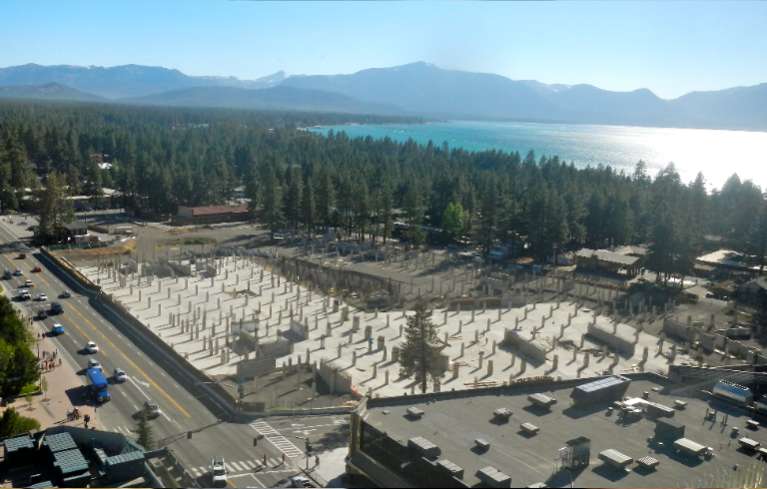
When Lake Tahoe Development Company was going to build the convention center, two hotels and retail, it meant some infrastructure needed to go in to service those facilities. Under what is the foundation for the parking garage are 604-lineal feet of 12-inch sewer main, 240-lineal feet of 8-inch sewer main, 50-lineal feet of 6-inch sewer main, eight manholes, 2,700-lineal feet of 14-inch water line and 90.5-lineal feet of 6-inch water line.

Tahoe Stateline Ventures, the company created by property owner Bill Owens, believes South Tahoe Public Utility District owns the water lines. The district isn’t so sure.

Water line ownership at Chateau site remains unresolved. Photo/LTN file

Water line ownership at the Chateau site remains unresolved. Photo/LTN file

“We didn’t construct the water lines and we don’t believe we own them,” attorney Kara Thiel of Feldman-McLaughlin-Thiel told STPUD’s board at the May 16 meeting. “Our contention is that TSV should not be burdened with ownership of the lines.”

Those lines when they were put in in 2007 were never dedicated to the district. That is why South Tahoe PUD doesn’t believe it owns the lines. However, the district has been using the lines.

While Thiel and Kevin Lane, consultant to the developer, were at Thursday’s meeting seeking a contract agreement, the board unanimously said not so fast. The board wants to see what staff and legal counsel work out with TSV before agreeing to anything.

“I think there is a fair list of things to be settled. I want to see a response to it,” board President Eric Schafer said.

He also said he remembers being “backed into a corner by the city” six years ago and expressed little desire to be bullied again.

Lane, who is the son of Randy Lane, one of the principals of the bankrupt Lake Tahoe Development Company that was to build what was to be a $410 million project, said it’s possible to get STPUD approval at the board’s June 6 meeting so city permits could be in hand by the end of June. Construction of the proposed 30,000-square-feet of retail along Highway 50 from Stateline Avenue to about McP’s Pub must start by July 15 or else the Tahoe Regional Planning Agency permits expire.

Another issue with the existing water lines is the party that has the drawings for where the lines are will not release them. This is because that firm was never paid by Lake Tahoe Development Company in the bankruptcy proceedings.

(STPUD had a third party inspect the water lines at the get-go, for which it has never been paid because of the bankruptcy.)

Where future lines will go is another issue that has not been finalized. Those drawings are supposed to be provided to STPUD by Monday. The next phase that could start this summer includes about 330-lineal feet of 14-inch water line.

A performance bond will be required by the district for the line.

The right-of-way is an issue for where the line will be placed. Still to be worked out is if the line is in the Caltrans right-of-way or if it would be put in under the yet-to-be-built sidewalk.

“I’m concerned about placing it under a sidewalk for future repairs,” South Tahoe PUD attorney Gary Kvistad said.

Kvistad brought up another unresolved issue – the agreement between STPUD and Lakeside Park Association. Lakeside provides much of the water for that area. But it never had the capacity for this project.

STPUD was to provide all the water for fire suppression and potable water for Phase A. Lakeside was to provide potable water for Phase B. With the project being more than those two phases, a new agreement needs to be drawn up.

Kvistad also said the district will make sure the six parcels that are slated to be built on this summer have one parcel map. The city allowed construction to start on the 11-plus acre site six years ago without consolidating the 29 parcels.