Study: Recreational pot not as safe as presumed

By Roxanne Khamsi, Scientific American

Marijuana is more popular and accessible in the U.S. than any other street drug. In national surveys, 48 percent of Americans say they have tried it, and 6.5 percent of high school seniors admit to daily use.

So it was not too surprising when two states, Washington and Colorado, became the first to legalize recreational marijuana in the November 2012 general election, albeit in limited quantity, for anyone over the age of 21.

Activists expect that similar measures will soon win approval in other parts of the country.

Some success with medical marijuana helped to pave the road to wider legalization of pot. Eighteen states and the District of Columbia permit possession and consumption of the drug for medical purposes.

Doctors in those jurisdictions may prescribe cannabis to treat or manage ailments ranging from glaucoma—an eye disease in which the optic nerve is damaged—to menstrual cramps. Cancer patients sometimes smoke pot to relieve the pain and nausea brought on by chemotherapy, and some people with the inflammatory disease multiple sclerosis rely on marijuana to ease muscle stiffness.

Although many physicians agree that marijuana is safe enough to temporarily alleviate the symptoms of certain medical conditions, the safety of recreational use is poorly understood. Researchers worry that short- and long-term use of the drug may harm the body and mind.

Marijuana’s continued popularity among teenagers raises particular concern because the drug might hinder the ongoing maturation of the adolescent brain.

Making matters worse, new growing techniques for the cannabis sativa plant — from which marijuana is prepared — have dramatically increased the drug’s potency. Some experts suggest that such high-octane weed is fueling a rise in cannabis addiction.

Finally, although investigators still debate how the legalization of recreational marijuana will change road safety overall, studies indicate that the drug slows reaction time and impairs distance perception behind the wheel. Despite such evidence, most new marijuana regulations, for medical or recreational use, fail to account for these potential risks.

Whether rolled into a joint or mixed into brownie batter, marijuana profoundly changes behavior and awareness. The primary psychoactive compound in marijuana, tetrahydrocannabinol (THC), mimics the structure of molecules called endocannabinoids that the human body produces naturally. Endocannabinoids act on a group of cell-surface molecules called cannabinoid receptors that help to regulate appetite, mood and memory. Because of its shape, THC fits into these receptors, too.

After all, jokes neuroscientist Giovanni Marsicano of the University of Bordeaux in France, “We don’t have a receptor in the body just to smoke marijuana.”

When THC strikes specific cannabinoid receptors, it triggers domino chains of interacting molecules in neurons that culminate in both unusually elevated and abnormally low levels of various neurotransmitters (the molecules that brain cells use to communicate with one another). The result is the well-known “high” of marijuana. Suddenly, the mundane seems hilarious, and ordinary foods taste delicious. People generally feel merry, relaxed and introspective, although undesirable effects—such as paranoia and irritability—are common as well.

Marijuana also temporarily impairs an array of mental abilities, especially memory and attention. Dozens of studies have shown, for example, that people under the influence of marijuana perform worse on tests of working memory, which is the ability to temporarily hold and manipulate information in one’s mind. Participants in these studies have greater difficulty remembering and reciting short lists of numerals and random words.

Research has further revealed that cannabis blunts concentration, weakens motor coordination and interferes with the ability to quickly scan one’s surroundings for obstacles.

Such mild cognitive deficits may not endanger anyone if a marijuana user lazes on the couch, but it is a different story when someone takes that high on the road. In driving-simulation and closed-course studies, people on marijuana are slower to hit the brakes and worse at safely changing lanes. Investigators still debate, however, at what point these impairments translate to more traffic accidents. A 2009 study found an increased risk of accidents for levels of THC higher than 5 nanograms per milliliter of blood, which some evidence inndicates is as impairing as a blood alcohol concentration around the legal limit of 0.08 percent. Typically one would have to take several puffs of a joint to reach such a concentration.

Consequently, voters in Washington State have adopted 5 ng/mL as the upper threshold for drivers.

Enforcing that limit presents a technical challenge, however. Unlike alcohol, marijuana cannot be detected with a relatively unobtrusive breathalyzer test. Police officers would have to look for it in blood—something that often requires a warrant.

“There is currently no practical method for law-enforcement officers at the scene to collect blood samples from suspected DUI cannabis drivers in a timely manner,” says Paul Armentano, deputy director of the Washington, D.C.–based National Organization for the Reform of Marijuana Laws, which advocates the legalization of marijuana.

Instead of using a blood test, Armentano says that police should look for poor maneuvering and the smell of pot wafting from the vehicle.

Although marijuana’s immediate effects are relatively easy to monitor in the lab, the drug’s long-term effects on body and mind are harder to determine. So far the results — which admittedly are subject to multiple interpretations — indicate the need for caution. In one recent study, clinical psychologist Madeline Meier of Duke University and her colleagues examined data from 1,037 New Zealanders. They found that people who began using pot earlier in life and used it most frequently over the years experienced an average decline of eight IQ points by the time they turned 38. By comparison, those who never smoked pot had an average increase of one IQ point by the same age.

A reanalysis of the New Zealand data by Ole Røgeberg of the Ragnar Frisch Center for Economic Research in Oslo, however, suggested that the IQ difference could be explained by socioeconomic factors. People who start smoking marijuana at an earlier age are often less intelligent to begin with. Even if this is true, Meier says, her study shows that the IQ drop is greatest for those who started smoking pot as teenagers rather than in adulthood, indicating a worrisome cumulative effect regardless of intelligence. This finding, she thinks, makes it all the more important to discourage the early use of marijuana among teens.

Increasingly potent marijuana of recent years may be driving a sharp rise in cannabis addiction among adolescents, according to a report released last year by the American Society of Addiction Medicine. Between 1993 and 2008, the average concentration of THC in confiscated marijuana jumped from 3.4 to 8.8 percent. Meanwhile hospital and rehabilitation center admission rates for minors abusing marijuana soared by 188 percent between 1992 and 2006. In contrast, admissions for alcohol abuse for the same group over the same period declined by 64 percent.

In addition to tracking levels of THC itself, some researchers have focused on the dangers of lingering contaminants in marijuana sold on the street. Dealers typically sell cannabis by weight, so some use sand or glass beads to make their products heavier. Breathing in these particles over the years may inflame and eventually scar the lungs.

An analysis published last year of data on more than 5,000 Americans did not find a decline in lung function among individuals who smoked joints two or three times a month over two decades. The authors emphasize, however, that they did not assess the effect of daily use on lung health.

“Somebody should do that study if marijuana is going to become legalized and prescribed” more widely, says Mark Pletcher, an epidemiologist at UC San Francisco, who co-wrote the paper.

Some opponents of legalization worry that lax regulation of medical marijuana foretells even looser laws concerning recreational marijuana. In states that have legalized medical pot, current laws do not guarantee the safety or quality of cannabis products or standardize levels of THC.

In Oakland, people can fill a marijuana prescription at Harborside Health Center, a massive dispensary with a strict quality-control system. Elsewhere in the state, however, people get their medical marijuana at mom-and-pop outfits or on the street.

The next big round of ballot initiatives to legalize cannabis in states other than Washington and Colorado could happen as soon as three years from now, in the 2016 presidential election. Until then, researchers have plenty of marijuana health risks to weed through.


Truckee man accused of stealing from family

A Truckee resident was arrested May 22 on multiple counts of check fraud, forgery, theft, burglary and financial related elder abuse.

Richard Copeland, 48, had allegedly been stealing money and other items from his family members for several months.

Once discovered by other family members, they reported their suspicions to law enforcement.

Copeland’s bail was set at $25,000.

 — Lake Tahoe News staff report


TRPA building allocation policy confounds board

By Kathryn Reed

INCLINE VILLAGE – It was obvious during a lengthy and at times heated discussion Wednesday that the Tahoe Regional Planning Agency Governing Board does not fully understand the building allocation policy. And they are the policymakers.

After last month’s meeting where staff enlightened the board about how 86 of a possible 130 allocations would be doled out, there was a bit of an outcry by local jurisdictions and contractors.

What was introduced at the May 22 meeting was a plan to distribute the remaining 44 allocations. Seventy-five percent will be given to South Lake Tahoe and the four counties at the lake (Douglas, Placer, Washoe and El Dorado) where building takes place. (Carson is also in the basin, but it’s all forest.) The remaining 25 percent, or 11 allocations, will be used for sensitive lot retirement and development right transfer programs that TRPA staff will be in charge of.

While this scenario was created in a month, associate planner Patrick Dobbs and other staff members told the board there isn’t enough time to alter plans for 2014 because there are more pressing matters to be dealt with. He didn’t say what those are.

At one point board member Steve Robinson said, “It’s complex. We are asking the public to jump through hoops when we don’t understand it. If we have to throw it out and start over, then do so.”

Member Nancy McDermid said, “This decreases the ability of local jurisdictions and their residents to have options.”

Elizabeth Carmel, who was at her first board meeting, thought the 25 percent figure could be increased because those allocations would better serve the environment.

The point of having allocations is to limit development in the basin. Before the updated Regional Plan was passed last year, 300 residences could be built each year. Executive Director Joanne Marchetta said it was in the 1980s that all 300 were last used.

In 1987, when the previous Regional Plan was adopted, 6,000 allocations were created for the more than 17,000 vacant parcels in the basin. The 2012 plan has 2,600 allocations available for about 4,700 vacant parcels. This comes to the 130 a year. (Government agencies own more parcels today than in 1987.)

Part of the allocation decision process is that jurisdictions get a set number based on a formula that deals with how well they met TRPA mandated environment improvement goals.

Board member Hal Cole has a huge issue with this criterion because he believes it punishes residents who want to build a house on land they own, but are not able to get an allocation based on things that are beyond their control. Instead of a city being punished for not meeting its environmental goals, individuals are hurt based on the jurisdiction not receiving its full allotment of allocations. Cole keeps saying this is unfair and wants staff to change it.

While economics are now supposed to be a factor in decision-making by the board, the lone contractor who spoke Wednesday believes the board is thwarting economic growth. John Adamski said his math shows the reduction of allocations from 300 to 130 year will impact the Lake Tahoe Basin by millions of dollars.

Jennifer Merchant with Placer County told the board that local jurisdictions have been talking since the April meeting, with the consensus being that all potential allocations should be distributed. She also enlightened the board that staff already takes 10 percent of the allotted allocations for the same pool where the newly created 25 percent of the leftovers will go for sensitive lot transfers. Staff never mentioned this in their spiel.

Merchant said a sensitive lot has not been retired in exchange for an allocation since 2005, so she questions the need to build up that supply.

McDermid said if the 11 allocations are not used this year, then a new system needs to be created.

By the end, the board said the way staff wants to give out the remaining 44 is fine. The Advisory Planning Commission will look at what is proposed and then the Governing Board will vote on it in June.

The board said flexibility needs to be incorporated into future policies

After the meeting, TRPA spokesman Jeff Cowen told Lake Tahoe News, “Too much development too fast slams the system and does not allow enough time for mitigation strategies like stormwater and transportation improvements to catch up and then keep up.”

But it was said by board members that development on vacant lots is good for the environment because it means people are putting in erosion control measures instead of allowing all of those dirt lots to send sediment into Lake Tahoe. It’s fine sediment that TRPA and others say is the biggest contributor to the decline of Lake Tahoe’s clarity.


Slight drop in travel expected over holiday weekend

AAA Travel projects 34.8 million Americans will journey 50 miles or more from home this Memorial Day weekend, a 0.9 percent decrease from the 35.1 million people who traveled last year.

The anticipated decline in holiday travel is predominately due to a decline in air travel of 8 percent, fee fatigue among travelers and a waffling economy.

Highlights from 2013 Memorial Day Travel Forecast include:

Eighty-nine percent of travelers (31.2 million) to travel by automobile, an increase from 31.1 million last year

Holiday air travel expected to decrease eight percent to 2.3 million from 2.5 million in 2012

Memorial Day holiday travel volume is expected to remain above the 12-year historical average of 34.7 million

Median spending is expected to decrease more than 6 percent to $659, compared to $702 in 2012 with transportation costs consuming about 28 cents of every travel dollar.

Travelers intend to journey an average of 690 miles which is higher than last year’s average of 642 miles.

A survey of intended travelers found that gasoline prices would have no impact on plans for 62 percent of travelers. Of the remaining 38 percent of travelers who said gas prices would impact their travel plans, 27 percent plan to economize in other areas. Eight percent are planning to take a shorter trip and 3 percent will travel by an alternate mode of transportation.


Poland admits guilt; could get 20 years

Johnny Poland will never be a police officer again after pleading guilty May 22 to a federal crime. Photo/LTN file

Johnny Poland will never be a police officer again after pleading guilty May 22 to a federal crime. Photo/LTN file

By Kathryn Reed

South Lake Tahoe police Officer Johnny Poland is going to prison.

Poland pleaded guilty today to obstruction of an official proceeding. This was one of four charges leveled against the 44-year-old earlier this year.

He will be sentenced Aug. 7.

He faces a maximum sentence of 20 years behind bars, a $250,000 fine and three years of supervised released.

According to court documents, on June 29, 2011, Poland interfered with the FBI’s investigation of a South Lake Tahoe gang member. He persuaded the gang member’s girlfriend to conceal and destroy evidence. In October and November of that year, Poland tampered with this witness in an investigation into his own conduct as well as the conduct of the gang member. Poland instructed another witness to conceal and destroy evidence rather than provide it to federal authorities. Poland admitted that he corruptly attempted to alter, destroy, mutilate, and conceal evidence material to an official proceeding.

Poland admitted guilt to all of this on May 22 in federal court in Sacramento.

The original federal complaint against Poland had details dating to 2003.

Poland, who was hired by the department in 1998, began having substantial public run-ins with his superiors beginning in November 2006. He was one of the officers called to South Tahoe High School regarding gang violence that led to the campus being on lockdown for several hours. The previous three years Poland had been the resource officer at the school.

He was fired in June 2007 after admitting to letting a student involved in the tussle to keep a BB gun in a vehicle despite a no weapons ban at the school.

He fought that termination and was reinstated in fall 2009.

In November 2011, when the federal investigation began, he was put on paid administrative leave.

Local FBI Agent Chris Campion, who was instrumental in the investigation, could not be reached for comment.

When the indictment came out earlier this year, the city was able to take him off the payroll. But even today, despite the guilty plea, the police department cannot automatically fire him.

“There is still a process that protects him under the Police Officer Bill of Rights,” Police Chief Brian Uhler told Lake Tahoe News. “We hope that he understands that resigning would free up a spot.”

Poland remains out on bail until sentencing. He was released after his arrest in January on $100,000 bond.


Paid beach parking in S. Tahoe is a done deal

By Kathryn Reed

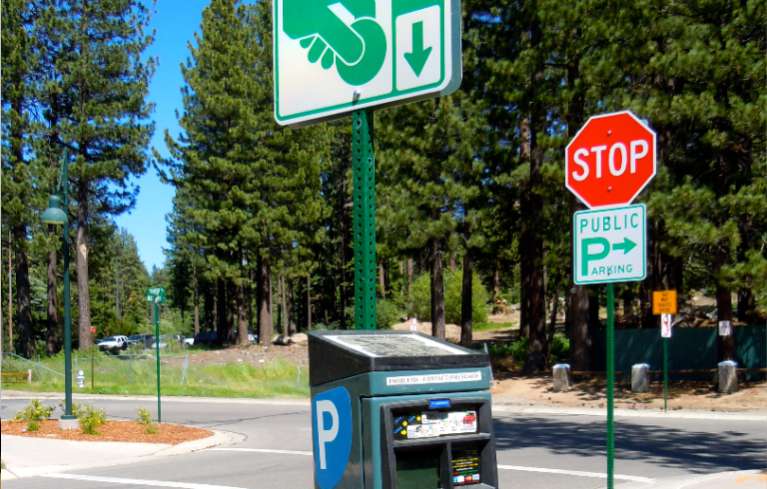
No longer can opponents to South Lake Tahoe’s expansion of metered parking point to Truckee as an example of a town that continuously loses money with paid parking.

Truckee is projected to net $140,000 this fiscal year that ends June 30. And the town council this month agreed – unanimously – to keep the program intact.

South Lake Tahoe on a 4-1 vote May 21, with Mayor Tom Davis dissenting, made what is expected to be the last tweak to its parking plan for this summer season.

The vote was to install the parking kiosks at the two lots serving Lakeview Commons and not put them in at Regan Beach.

A pilot parking meter program started in 2011 on Bellamy Court. Photo/LTN file

A pilot parking meter program started in 2011 on Bellamy Court in South Lake Tahoe. Photo/LTN file

At previous meetings it was agreed meters will go in at Venice Drive, with operation being seasonal during the warm months; and year-round near Lakeside Beach in the state line area.

“Everyone knows my position on paid parking. I hate it,” Davis said. He said in the fall he hopes it will have not been a success so he can be the first to make a motion to abandon the whole thing, and perhaps then the city can resell the used kiosks.

Councilmember Hal Cole said, “I’m a big believer in user fees. I think the people using it should fund it.”

Councilwoman Brooke Laine pointed out how the U.S. Forest Service charges at all of its beaches in the basin except for Kiva. She tied this to the city’s having paid parking at its beaches except Regan and Timber Cove.

State Parks is asking for $10 at the lot at Vikingsholm – and that could be for a 10-minute visit.

The city is going to charge $2 per hour, with a maximum of $10 per day.

Paid parking has been talked about for three years. In the past year, those against the concept have come out in large numbers to oppose the plan. However, at Tuesday’s City Council meeting, only four spoke — all against paid parking.

The council intends to assess in the fall how the program worked – or didn’t.

In other action:

• The council agreed to Tom Watson’s three-year contract. The city attorney starts July 8. He will make $154,000 per year, receive the same benefits as other city staff, and be given up to $7,500 in moving expenses. If the council wants to terminate him before the contract expires June 30, 2016, he will be paid six-months severance.

• Deputy City Attorney Nira Feeley will be the interim city attorney from June 1-July 7.

• Tom Greene with the Tahoe Prosperity Center updated the council on that group’s plan to bring broadband to the Lake Tahoe Basin.

• It was agreed in the near future the council would discuss the possibility of going to voters to seek a raise in the snow removal fee that currently stands at $20/year. That money is for equipment. Tying increases to the Consumer Price Index will also be broached.

• There will be a special council meeting May 30 at 4pm regarding the Bijou erosion project.

• Depending on the action taken Thursday by the Planning Commission, the Chateau project may be on the June 11 council agenda.

• A special council meeting may be needed in June regarding the area plan for the tourist core.


Phone glitch impacts potential murder trial jurors

Unable to call the courthouse, prospective jurors did their due diligence and showed up for potential jury duty on Tuesday.

What happened is hundreds of – with some estimates being close to 500 – people were outside the Johnson Boulevard facility in South Lake Tahoe. About 20 percent of those people were needed for questioning.

People were parked all over the place – at the cemetery, dog park and the north entrance of the complex at Marlette Circle.

Joseph Michael Nissensohn

Joseph Michael Nissensohn

The court didn’t know there was a problem May 21 until employees saw the line of people.

Jurors are needed for the Joseph Michael Nissensohn murder trial. He has been housed at the El Dorado County Jail in South Tahoe for several years.

He is accused of murdering Kathy Graves, 15. The remains of the South Lake Tahoe teen were found near the Mount Tallac trailhead in 1990, about one year after she was last seen alive. He was charged with that crime in January 2008.

Nissensohn, now 62, is also accused of killing Monterey County teenagers Tanya Jones and Tammy Lynn Jarschke in 1981. He was charged with those murders in fall 2008.

In 1990 he was convicted of second-degree murder in the 1989 stabbing death of a woman in Tillicum, Wash.

Jury selection is expected to take a bit. It started last week. The trial is likely to last until the fall.

If found guilty, Nissensohn faces the death penalty.

— Lake Tahoe News staff report


Tree vandals strike West Slope

By Cathy Locke, Sacramento Bee

El Dorado County residents and sheriff’s investigators are trying to track down vandals who have laid waste to thousands of dollars’ worth of trees on private property.

Detective John Robertson said he has five active cases, all involving cedars that have been felled in recent months.

Three of the incidents occurred on the same property along Lotus Road.

“We’re looking at it as vandalism,” Robertson said. “I’ve never seen anything like it.”

The incidents have occurred in the Lotus, Coloma and Shingle Springs areas, north and west of Placerville. Robertson estimated that the financial losses to property owners are in the thousands of dollars.

Wendy Deitz, whose property has been hit three times, said the first incident occurred just before Christmas. Her husband, Robert, had hung holiday lights on the cedars planted as a buffer between their house and Lotus Road.

In the early morning hours, someone removed the lights and chopped down 20 trees in varying sizes.

The Deitzes initially thought someone had cut them down and stolen them for Christmas trees, but then they discovered that the trees had been dumped in their pond.

They planted more cedars, including some donated by El Dorado Nursery, but someone came along and pulled them up, Wendy Deitz said. The couple replanted once again, and this time her husband installed game cameras.

When their trees were targeted a third time, the cameras captured the image of a man cutting a tree with a hand saw. Although he is seen from the back, “he is obviously left-handed,” Wendy Deitz said.

She and her husband also found a soda can that they turned over to the Sheriff’s Office for possible fingerprint or DNA analysis.

Wendy Deitz said they had heard from three other residents on Lotus Road that trees on their property had been cut down as well.

“I guess it’s just someone who doesn’t like cedars,” she said, adding that the trees are cut so low they won’t grow back.

Brendan Wilce, a nurseryman at El Dorado Nursery in Shingle Springs, said the trees targeted have been incense cedars, which are native to El Dorado County.

“They grow naturally in this area,” he said. “They’re the trees on the (Highway) 50 corridor that you see as you go up here.”

Wilce said he couldn’t think of any practical reason someone would want to destroy them.

“They’re not an invasive plant,” he said, “They’re a great local native tree.”

Although they produce pollen this time of year, he said, they tend to be less of a problem for allergy sufferers than oaks.

Wilce said it was difficult to estimate the value of the mature cedars that have been felled.

He said the replacement trees the nursery has supplied to some of the victimized property owners are 24-inch box trees, which retail for $250 each.

Detective Robertson said most of the targeted trees have been fairly close to roadways. He urged people who see any suspicious activity to call him at (530) 642.4722.


Fighting Chance helps keep kids safe

By Kathryn Reed

Krystal Steadman never learned the lessons taught in Fighting Chance. Her fourth-grade class at Meyers Elementary School was on the calendar that spring of 2000 a week after the 9-year-old was abducted.

It would be pure speculation that the then fourth-grader would be alive today had she been taught what to do if bad guys come after you.

Her capture occurred nine years after Jaycee Lee Dugard, then a fifth-grader at the same South Shore school, was abducted.

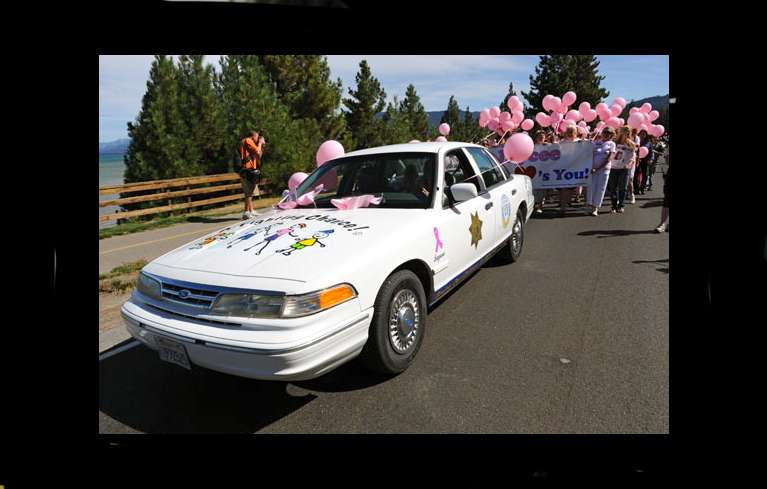
The Fighting Chance vehicle leads the 2009 parade celebrating Jaycee Lee Dugard's freedom. Photo/Lisa J. Tolda

The Fighting Chance vehicle leads the 2009 parade celebrating Jaycee Lee Dugard’s freedom. Photo/Lisa J. Tolda

Fighting Chance in large part came about as a reaction to Dugard’s abduction from a bus stop. Terry Probyn, Jaycee’s mom, is on the video that is used in the classrooms. This was taped on the 10-year anniversary of the abduction. (Jaycee was found alive in 2009.)

This week members of Soroptimist International South Lake Tahoe are in the classrooms throughout Lake Tahoe Unified teaching the Fighting Chance curriculum.

Brooke Laine, when she was president of the club, came up with the program in the mid-1990s. It has continued on every year since then. It started in the fifth grade, but now includes grade 3, 4 and 6, too. Laine said fifth grade was not chosen because that was Jaycee’s grade, but instead it had more to do with the age group molesters target.

“Pre-puberty, that is the age the child molesters want,” Laine told Lake Tahoe News. “They plan their attack. You have to be prepared to plan your escape. I don’t even want to tell them how many sexual predators are in town. I have a binder of them. I know where they live.”

Laine’s children were about 4 and 5 when the program started. She would read books about abductions, molestation – all to gain knowledge in her quest to put Fighting Chance together.

Laine said Probyn told her one of the biggest regrets she had was not teaching Jaycee what to do if someone grabbed her.

Soroptimist International Tahoe Sierra teaches the third-graders by using a board game that in large part looks like the South Shore. It’s about figuring out routes to get to home and school safely. Different “what if” scenarios are played out so kids will start thinking about what to do if some stranger approaches or grabs them.

Fourth-graders learn via the video. But the DVD is turned on and off, with discussion in between to engage them, let them ask questions and allow time for the material to sink in.

In fifth grade they are taught what to do. Laine said she is not aware in all these years of a single parent not turning in the permission slip. She said because the material can be “shocking”, parents must say it’s OK for their child to learn the message of Fighting Chance.

In sixth grade youths are taught that if the suspect gets out of the vehicle, but they’re locked in, to take a button off a shirt and put it in the ignition. Kick out a taillight if stuffed in the trunk. Cops in Tahoe know to pull over a vehicle with a busted out taillight just for the reason someone could be in there.

The El Dorado County Sheriff’s Office has twice donated an old vehicle for the purpose of teaching kids. And it has twice been used in a parade in Jaycee’s honor – first to remember her, and then to celebrate her release from captivity.


N. Nevada tourism guru focuses on gear heads

By Chris Ciarlo, KTVN-TV

As the economy continues to recover, every state is fighting for tourism dollars.

Here, at home, the Reno-Sparks Convention and Visitors Authority is launching a new campaign it hopes will bring in the next wave of tourists called Northern Nevada Motor Madness.

“When I arrived in Reno, I was really delighted to see all the cool, special events we had all summer long,” said Chris Baum, CEO of the RSCVA. “What I noticed was a lot of those are what I call piston powered; motorcycle, car, airplane, even Jet Skis. When you put it all together, we really have about a dozen world class activities that appeal to the gear head.”

The idea is if there’s an audience for Hot August Nights and there’s an audience for off-road racing out at Mustang, why not cross-promote?

Baum said cross-promotion gives every event exposure and a boost in attendance.

He also said this series is all about repackaging Nevada to the rest of the nation and no longer focusing on just gaming.

“We will always have gaming here, it just can’t be the lead offer anymore. We have to take something else and put it out front as what Reno-Sparks and North Lake Tahoe are today. Fortunately, we have a lot to go with because unlike a lot of other destinations that might be a one trick pony, we’ve got incredible, natural surroundings.”