California budget surplus not all good news

By Adam Nagourney, New York Times

LOS ANGELES — After years of grueling battles over state budget deficits and spending cuts, California has a new challenge on its hands: too much money. An unexpected surplus is fueling an argument over how the state should respond to its turn of good fortune.

The amount is a matter of debate, but by any measure significant: between $1.2 billion, projected by Gov. Jerry Brown, and $4.4 billion, the estimate of the Legislature’s independent financial analyst. The surplus comes barely three years after the state was facing a deficit of close to $60 billion.

At first glance, the situation should be welcome news in a state overwhelmingly controlled by Democrats, who have spent much of their time slashing programs they support. After last November’s elections, the party has two-thirds majorities in the Assembly and the Senate, relegating Republicans almost completely to the sidelines.

Instead, the surplus has set off a debate about the durability of new revenues, and whether the money should be used to reverse some of the spending cuts or set aside to guard against the inevitable next economic downturn.

At least seven other states — among them Connecticut, Utah and Wisconsin — have reported budget surpluses in recent weeks, setting the stage for legislative battles that, if not as wrenching as the ones over cuts, promise to be no less pitched. Lawmakers are debating whether the new money should be used to restore programs cut during the recession, finance tax cuts or put into a rainy-day fund for future needs.

The debate reflects uncertainty about whether the revenue is a one-time event, a result of state taxes on wealthy residents selling off investments at the end of last year to avoid increased costs as the Bush-era federal tax cuts expired. But it also illustrates philosophical differences about the role of government, about spending versus taxes and about the need, as Mr. Brown argued, to learn lessons from a decade in which many states saw the bottom fall out from their revenue collections.

“We’re seeing a change in conversation in state legislatures this year,” said Todd Haggerty, a policy analyst with the National Conference of State Legislatures. “They’re not talking about how to close a budget gap anymore, which is a welcome relief after years of that during and after the Great Recession. Rather, states are having conversations about how to allocate increased revenues.”

Nowhere does that battle promise to play out with more force and intricacy than in California, the state that underwent perhaps the most severe retrenchments in the country.

Brown, a Democrat who has always had a fiscally conservative streak, is leading the don’t-pop-any-Champagne-corks brigade, saying that he would oppose significant increases in new spending and that the money should go into a rainy-day fund. His administration put out the lower $1.2 billion estimate.

“A good deal of the surge of revenues that we have seen since the beginning of the year is the result of higher-income individuals being able to realize some of their gains at the end of 2012,” said H.D. Palmer, the director of external affairs for the California Department of Finance. “We don’t believe it is prudent to budget on the capital gains. It wasn’t that long ago when we had the same experience during the dot-com boom. We don’t want to see that movie again.”

In one particularly revealing moment, the office of the independent legislative analyst — which has a history of scolding governors for unrealistically optimistic budget projections — dismissed Brown’s figure as pessimistic, saying extra revenue was closer to $4.4 billion. The report undercut Brown just as he and lawmakers moved into the final stages of budget negotiations, and it empowered Democrats and social service advocates eager to reverse budget cuts.

“I support the governor’s call to pay down more debt aggressively, I support the notion of a rainy-day fund,” said Darrell Steinberg, the president pro tem of the Senate. “But I also believe that we have an obligation to make some limited but important investments in restoring some of what has been lost over the last four or five years.”

Vanessa Aramayo, the director of California Partnership, a group of organizations pushing for social service spending, said Mr. Brown was deliberately understating the state’s financial health.

“The governor is attempting to leave a legacy of solving our state budget crisis,” she said. “But he’s doing so on the backs of poor people in the state.”

Other Democrats said the Legislature should proceed with caution, given the history of financial gyrations in California and, no less important, concern that any perception that Democrats were on a spending spree could prove politically damaging to the party.

John A. Pérez, the speaker of the Assembly, said that he supported putting revenues into a contingency fund, but that some of the money should go to increase spending on programs like college scholarships for middle-class students.

“It is still uncertain how much of this is one-time money and how much is ongoing money,” he said. “Anything that is clearly one-time money we should treat as one-time money. What we’re mindful of is that historically in California, we have a greater degree of volatility than in other states.”

A capital-gains tax windfall from investors aside, the state has erased its deficit as a result of improving housing and stock markets, a temporary sales and income tax increase approved by California voters and the cuts in spending.

The debate over what to do next is not exclusive to California.

In Connecticut, local government officials want the Legislature to use $150 million in new revenue to reverse a $93 million cut in aid to local governments. It has not been an easy argument.

“We’re competing with hospitals and some social service programs for those surplus funds — along with the governor’s desire to put the money back into a rainy-day fund,” said James J. Finley Jr., the executive director of the Connecticut Conference of Municipalities.

In Indiana, Gov. Mike Pence called for using any surplus to finance a 10 percent cut in income taxes. But fellow Republicans who control the Legislature, after initially supporting that notion, reduced the tax cut by half, reserving the money for other programs.

“Coming off of a five-year recession, there were so many things that had been forgone during that period of time, like funding education and road infrastructure,” said State Senator Luke Kenley, the chairman of the Appropriations Committee. “The public and the leaders felt there were important things we needed to take care of first.”

And in Wisconsin, Democrats have pushed the Republican-led Legislature to use as much as $2.1 billion in new revenue to undo cuts.

“Last budget we had a deficit of $3.6 billion, and the talk was about shared sacrifice and targeting our public employees,” said State Senator Jennifer Shilling, a Democrat who is on the Budget Committee. “We need to invest any additional revenue back into our middle class.”

The disagreement in California is between members of the same party. Assemblyman Bob Blumenfield, the chairman of the Budget Committee, disputed Brown’s projection of the extra revenue.

“The only way the governor can possibly come up with his numbers is if you assume the worst on every single variable,” he said. “That’s just not going to happen.”

“We’ve made some brutal cuts,” Blumenfield said. “There’s a lot of pain that’s been spread across California, and we can’t ignore that. But we have to be smart. We have finally clawed our way to stability, and we’re not going to squander it.”


N. California quake shakes up seismic scientists

By Rosanna Xia, Los Angeles Times

A magnitude 5.7 temblor Thursday night was the largest earthquake to shake California since 2008 and has generated curiosity from seismologists.

The temblor occurred in a rugged section of Northern California that has not been studied as thoroughly as Southern California and the Bay Area and has less monitoring equipment. Experts said they were surprised the quake was felt over such a large area, and they plan to go to the region to investigate.

The magnitude 5.7 quake struck about 8:47pm, about 150 miles northeast of Sacramento; its epicenter was about 27 miles southwest of the town of Susanville.

The last quake of similar magnitude, recorded at 5.5, struck Chino Hills in San Bernardino County in July 2008, said David Schwartz, an earthquake geologist for the Northern California U.S. Geological Survey division in Menlo Park. It caused little damage, but it was the most sizable quake to hit a metropolitan part of California since the much larger and destructive 1994 Northridge quake.

Thursday’s quake did occur in a zone with known active faults, said David Schwartz, an earthquake geologist for the Northern California USGS division, including a series of faults that extend through the northern end of Lake Tahoe all the way to Oregon. But 5.7 is the strongest magnitude recorded in the area. This mountainous eastern Sierra Nevada region, known for its lakes, rivers and national forests, has had about seven magnitude 4 earthquakes since the 1930s, Schwartz said.

Scientists are still studying the intensity of Thursday’s shaking and have moved seismographs there from more populated areas to monitor aftershocks.

Within minutes of the first quake, more than 7,000 people reported feeling it, from across state borders into Oregon and Nevada and as far south as the San Francisco area, according to the USGS website. Officials in Susanville and Sacramento said the quake set off a number of home and car alarms and rattled windows. A Chico resident told The Times he felt a slow roll that lasted about 30 seconds.

The quake itself was not a huge surprise for Schwartz’s USGS division, but “what was interesting was it was felt along an unusual distance,” he said. “Earthquakes in different parts of the state are felt over different distances. We just haven’t had that many examples of earthquakes in this part of the state, really, for comparison.”

“There are more interesting questions now than we have answers for, at present,” he said.

More than four dozen aftershocks, ranging up to a magnitude 4.9 in an area of about 20 square miles, have been recorded since the first quake, according to the USGS.

Schwartz said these aftershocks look to be “fairly standard.” Within the next week, there is a 20 percent chance that an earthquake larger than magnitude 5 will strike the area and a 5 percent to 10 percent chance a quake of a magnitude greater than 5.7, according to a USGS probability report released Friday morning.

There have been no reports of injuries in the areas closest to the epicenter, Plumas County Sheriff’s officials said. About 600 residents lost power for a brief period, and a water tank was ruptured due to the earthquake, affecting up to 1,500 customers.

At least three homes in the area had moderate damage – collapsed chimneys and plaster cracking, authorities said. No structural damage has been reported.

“A 5.7 is still a moderate-size earthquake, and earthquakes of that magnitude can occur really anywhere throughout the state,” Schwartz said. “But it’s large enough to generate interest and provide us some real info on how things work. We plan to keep looking at the sequence.”


SnowGlobe’s return to S. Tahoe not definite

By Kathryn Reed

Between the producer of SnowGlobe wanting to be paid and the use of the field being a question mark, the New Year’s Eve music festival may not come back to South Lake Tahoe for a third year.

“The taxpayers voted to provide funds to construct a community play field and therefore the first concern is to ensure the taxpayers receive what they paid for. If the field can be protected in such a way as to ensure its playability and also be utilized for this and other events, that could be a win-win,” City Manger Nancy Kerry told Lake Tahoe News. “City staff has been exploring options to achieve both goals and believe the best solution would be to cover the field with rubber field mats, but the costs are significant.”

That is an expense the producer does not want to incur.

While the city could purchase the mats – they cost six figures, the installation and tear down would be passed on to whatever entities were to use them.

The music fest SnowGlobe starts its three-day run Dec. 29 in South Lake Tahoe. Photos/Kathryn Reed

SnowGlobe music fest may not threepeat in South Tahoe. Photo/LTN file

Chad Donnelly, producer of the three-day event, did not return phone calls.

Talks are still ongoing, but not as optimistically as they were earlier this year, sources have told Lake Tahoe News.

The event is said to be an economic boon for the region. It brings in people who would not otherwise have been in town and is an older crowd than those milling about Stateline on New Year’s Eve.

The city is also talking with Lake Tahoe Visitors Authority and the business community to see if they have the money Donnelly desires and if another location could be secured.

There was talk Donnelly was being wooed by North Shore entities. Andy Chapman with North Lake Tahoe Resort Association did not return a phone call.

As for LTVA, Executive Director Carol Chaplin said, “We’re not trying to keep it, we are trying to understand what the issues on all sides are, the challenges and the opportunities to make sure that if and when it happens, or not, that all of our constituents understand why and agree that it has been thoroughly vetted.”

LTCC’s board has already committed to being a partner with SnowGlobe if it were to return to the ball fields adjacent to the college.

“The college stands ready to support the local community. If SnowGlobe is an event our community finds as viable and a desired event, the college will be a partner in providing a safe and responsible event that benefits the businesses and community of South Tahoe,” LTCC President Kindred Murillo told Lake Tahoe News.


Tahoe bill passes Nevada Legislature

By Andrew Doughman and Conor Shine, Las Vegas Sun

Legislators slogged through dozens of bills Friday, turning the Senate and Assembly chambers into arenas for legislative triumph and death.

Following a lengthy day of voting, bills you might find good, bad or just plain weird are headed to Republican Gov. Brian Sandoval, meaning they now need nothing more than a signature from Sandoval to become law.

But just as many bills died because they didn’t pass by a legislative deadline that ended midnight Friday, perhaps none as spectacularly as a sex education bill from Assemblyman David Bobzien, D-Reno.

“You only have 120 days to do business with deadlines,” Bobzien said. “Bills die. That’s the way it is.”

Senate Democrats declined to consider the bill that Assembly Democrats had passed on a party-line vote, highlighting the inter-party fighting that can happen when senators need the Assembly to pass its bills and Assembly members need the Senate to pass its bills.

To achieve their goals, legislators swapped and traded in a this-for-that spate of paper-making frenzy resulting in dozens of last-minute amendments.

“We’ve done more alterations here than Joan Rivers’ plastic surgeon,” said Assemblyman William Horne, D-Las Vegas, in a tweet.

Legislators have for the past few months nurtured their bills through the legislative process, fending off opponents, compromising with interested parties, and gathering the legislative voting blocs necessary to pass their bills. In short, they get personally invested in the legislative process.

And while legislators can rise to the occasion to debate important state social and fiscal policy, they also can spend evenings in closed meetings debating the merits and demerits of a bill about raw milk.

“It’s surreal, but I think particularly for those of us who have been here a couple of sessions, you get used to it,” Bobzien said.

While past sessions’ deadline votes have run out the clock in lengthy and contentious arguments among legislators, the 2013 Legislature ended the day at 10pm with laughter in the Senate and congenial well wishes for a senator’s birthday.

Friday’s deadline is somewhat meaningless; big pieces of legislation including a major energy overhaul, a gun background check bill, a bill allowing for medical marijuana dispensaries, a gas tax, a Southern Nevada stadium study bill, and other bills are exempt from the deadline.

But that doesn’t mean major bills didn’t pass Friday either.

Here’s a look at some of the big bills the Legislature approved or killed Friday:

A bill to permit an increase in the sales tax to allow Las Vegas Metro Police to retain 300 officers has passed the Senate, 18-3. Assembly Bill 496 would increase the sales tax in Clark County by 0.15 percent if it is approved by a two-thirds vote of the Clark County Commission.

A controversial bill that would have updated and standardized sex education curriculum across the state won’t advance any further after it died in the Senate Friday.

Supporters framed the bill as a common sense update to the state’s sex education policy, but it became mired in heated rhetoric about what exactly would be changed.

Critics had earlier warned that the bill would serve to push the agenda of Planned Parenthood, especially in regards to abortion, and would disconnect sex education from morality and community concerns.

Legislators paved the way for a renewed agreement with California to protect the environment around Lake Tahoe.

Senate Bill 229 passed in the Assembly on a 40-1 vote and now heads to the governor’s desk.

Earlier this month, Sandoval and California Gov. Jerry Brown announced they’d reached a deal to keep the two states in a decades-old compact to protect the environment around Lake Tahoe, agreeing to ease some barriers for development and mollifying the concerns of some environmentalists.

The agreement comes two years after the Nevada Legislature passed a law requiring the Silver State to break the compact if substantial changes weren’t made by both the compact and the regional plan governing how the sensitive environment is developed. Environmentalists launched an effort this year to repeal the 2011 law, succeeding in convincing the Nevada Senate to pass Senate Bill 229 to keep Nevada in the compact.

Assemblyman Jason Frierson, D-Las Vegas, brokered a compromise to a major homeowners’ association bill that passed Friday out of the Assembly.

The omnibus HOA bill, Senate Bill 280, passed in a 35-6 vote.


Federal fine ends Ensign’s exit from politics

John Ensign, while a strong supporter of Lake Tahoe, left politics in disgrace. Photo/LTN file

John Ensign, while a strong supporter of Lake Tahoe, left politics in disgrace. Photo/LTN file

By Karoun Demirjian, Las Vegas Sun

Two years ago, the Federal Election Commission deciding to fine former Sen. John Ensign $32,000 for breaking campaign finance laws would have been big news.

But in a week filled with scandals, the first punishment levied on the erstwhile senator failed to stir anyone.

“It’s old news, and the political world has moved on,” said Eric Herzik, a political science professor at UNR. “It’s just a sad end to a sad story.”

The contorted tale of Ensign’s ethically shady steps to extricate himself from a long-term affair with his campaign treasurer — who also happened to be the wife of his chief of staff — gripped Nevada and the nation from when it was first made public, in June 2009, until well after Ensign stepped down in May 2011.

The Senate Ethics Committee excoriated him in a report detailing how Ensign had enlisted his staffers, family and even his Senate colleagues to help get Cynthia and Douglas Hampton to leave his employ quickly — and flagrantly ran afoul of campaign finance laws and congressional lobbying restrictions in the process.

In comparison to that 68-page tome, the FEC’s 10-page report offers few fresh details, save for a more exact itemization of Cynthia Hampton’s salary and health insurance cost, and the revelation that Ensign’s campaign and political action committee treasurer, Lisa Lisker (who replaced Hampton), was also complicit in failing to report the $96,000 Ensign’s parents gave to Hampton as off-the-books “severance.”

The FEC had dropped its case against Ensign in 2010, citing Ensign’s parents’ claim that they believed the $96,000 they gave the Hamptons was a “gift.”

Soon after, the Department of Justice dropped its investigation of Ensign.

The FEC only reopened its inquiry into the Ensign case after the Senate Ethics Committee released its report two years ago. The Justice Department, however, has not pursued charges against Ensign — and few think the FEC decision will change their minds.

“There’s nothing in there that DOJ didn’t already know,” said Melanie Sloan, executive director of watchdog group Citizens for Responsibility and Ethics in Washington, which has publicly criticized the Justice Department for failing to prosecute Ensign and filed a lawsuit seeking the Justice Department’s files on the case. “(The FEC decision) doesn’t even hold anybody culpable; nobody admits any wrongdoing. There’s not anything giving Justice grounds.”

The FEC rules by conciliation agreement — a handshake, effectively, between the FEC and the accused individuals — that the charges are fair and final. But there is a clause in the Ensigns’ agreement to ensure that the facts of the case, as laid out by the FEC, can’t be considered an admission of guilt.

Prior to the FEC’s fine, Douglas Hampton was the only person involved in the Ensign saga to have been sanctioned for his participation in illegal activity.

Hampton, who had been charged with seven felonies, was found guilty of breaking the law that requires former congressional staffers to wait at least one year before lobbying and was sentenced to a year’s probation.

Ensign, who was forced to abandon his political career, had otherwise gotten off scot-free.

Few in the political world think Ensign — who resumed his veterinary practice and has otherwise been keeping a low profile since he left Congress — will have to face a further reckoning.

“I would be amazed if there’s any more to this story. Ensign has moved on. The political world’s moved on. If anybody wants to go after John Ensign, I think it would be viewed as kind of piling on,” Herzik said. “You look back at it with a couple of years’ perspective, and there was no scandal here except the personal stupidity of John Ensign.”

“I think it’s just water under the bridge. If he were still in office, that’s a different ball game,” said David Damore, political science professor at UNLV. “But out of sight, out of mind. There’s been like 15 scandals since then.”


More than quarter of El Dorado, Placer homeowners under water

By Hudson Sangree, Sacramento Bee

The number of Sacramento-area homeowners who owe more than their homes are worth continued tumbling in the first three months of this year, real estate tracking firm Zillow reported this week.

In the first quarter of 2013, there were 140,857 homes in so-called negative equity in the Sacramento region, the Seattle-based firm reported. That was down from 156,840 homes in negative equity in the fourth quarter of 2012, it said.

Rising prices, caused by a limited supply of homes for sale and more homebuyers entering the market, are pushing thousands of area homeowners into positive equity.

Zillow’s negative equity forecast predicts the number of homeowners who are underwater on their mortgages will continue falling this year, freeing 40,000 more homeowners from negative equity by the first quarter of 2014.

In the four-county region, Sacramento County remained the most underwater. Nearly 42 percent of Sacramento homeowners with mortgages owed more than their homes were worth in the first quarter, Zillow said.

In Placer and El Dorado counties, about 29 percent of homeowners were underwater.

In Yolo County, 37 percent of homeowners remained in negative equity in the first three months of this year.

About 15 percent of homeowners in the region still owe at least double what their houses are worth, while about 34 percent are only slightly underwater, Zillow said.


Pilot survives crash near Martis Peak

A pilot suffered non life-threatening injuries after his plane crashed somewhere on Martis Peak near the Truckee Tahoe Airport on Thursday afternoon.

Crews say tough terrain at the crash site forced them to bring in helicopters to rescue the pilot.

The unidentified pilot was the only person aboard the plane when it went down about 3:30pm.

He was taken to Renown Medical Center in Reno.

 — KTVN-TV


Lake Almanor area quake rattles Tahoe, Truckee

By Rosanna Xia and Robert J. Lopez, Los Angeles Times

More than three dozen aftershocks, ranging up to a magnitude 4.9, have been registered following a 5.7 earthquake about 150 miles northeast of Sacramento, officials said.

The first quake struck at about 8:47pm Thursday; its epicenter was about 27 miles southwest of the town of Susanville and seven miles west northwest of Greenville near Lake Almanor, according to the U.S. Geological Survey.

People on Twitter told the Times they felt the quake in Sacramento and Lodi, as well as in Reno and on the northwest shore of Lake Tahoe.

Officials in Susanville and Sacramento said the quake set off a number of home and car alarms and rattled windows, but there were no immediate reports of damage.

Within minutes of the first quake, more than 7,000 people reported feeling it on the USGS website.

A Chico resident told the Times he felt a slow roll that lasted about 30 seconds.

Dozens of smaller earthquakes followed in the Greenville area, including a magnitude 3.5 temblor at 8:55pm, a magnitude 4.9 at 1:02am Friday, and a magnitude 2.5 at 5:36am, according to the USGS.

“House shook pretty hard,” one man near Truckee told the Times.


Future of Chateau up to S. Tahoe City Council

By Kathryn Reed

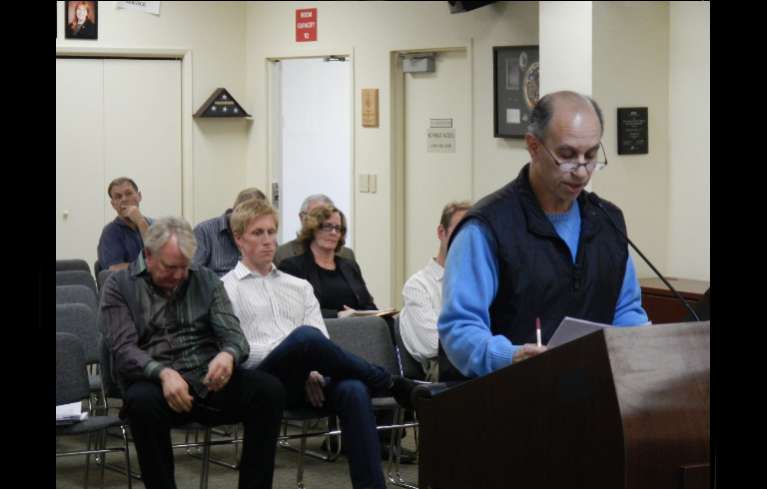
While the South Lake Tahoe Planning Commission on Thursday spent hours listening to testimony about the parceled down Chateau project, it will ultimately be up to the City Council on June 11 to decide what happens.

Much of the dialogue had nothing to do with what the commissioners were asked to take action on. History of what was to be a $410 million two hotel-convention center-retail project was hashed out, along with talk about how many locals have lost millions of dollars because of their misplaced trust in believing original developer Randy Lane would complete the project and not leverage their property.

City Manager Nancy Kerry, at the end of the meeting, said, “A lot of mistakes were made. A lot of people’s lives were harmed. We can’t undo the mistakes of the past. We agree it was a process problem.”

Harry Segal, an original property owner who is still in litigation, talks while current property Bill Owens (head down) listens. Photo/Kathryn Reed

Harry Segal, an original property owner who is still in litigation, talks while current property owner Bill Owens (head down) listens. Photo/Kathryn Reed

She said this time around staff is being more prudent and skeptical so those same mistakes are not repeated at the 11-plus acre site near Stateline.

This was evident when city engineer Sarah Hussong-Johnson and Deputy City Attorney Nira Feeley repeatedly said it is not up to the city to make a decision about the Caltrans right-of-way. An encroachment permit, per city regulations, is needed from Caltrans before the new building permit could be issued.

Lew Feldman, the attorney representing the developer, advocated the commission say that construction could begin without it. Staff said no way and that it is not up to the commission.

Kerry also said no authorization to go forward will be granted – assuming that is the course council takes – without proof the six parcels the applicant wants to build on this summer are consolidated into one map.

It was repeatedly brought up how the 29 parcels’ never becoming one led to many of the financial woes and problems that exist with property owners.

Rick Edwards, one of the original property owners, said, “Until we are made whole, this project should not go forward. I will do everything and anything to stop this project from going forward.”

He said a handful of locals are owed about $10 million.

Before the meeting he told Lake Tahoe News he felt bullied and threatened by Lane back when the developer was trying to shore up financing.

About 30 people attended the meeting, including all City Council members except JoAnn Connor. Seven people spoke, including a representative from City National Bank, which owns nine of the 29 parcels. The entrance off Cedar Avenue will affect a couple of those parcels. That person said so far they are not taking a position on the proposed project.

Three hours after all the talk the commission twice voted 3-1 to approve staff recommendations. Commissioner Tammy Wallace was the dissenter both times, but she didn’t explain her vote. Commissioner Jason Drew was absent.

The commissioners recommended to the council that:

• The original environmental documents be found valid;

• That 10,000 square feet of commercial floor area be designated to the project but that an additional 1,705 square feet of CFA that would come from a special projects pool be denied;

• The design review permit be granted;

• The special use permit for the increase in number of compact car parking spaces be granted.

The second vote involved abandonment of the right-of-way of a portion of Laurel Avenue and Poplar Street.

What is expected to be a two-year project is the building of retail along Highway 50 and a much larger McP’s restaurant at the corner of Stateline Avenue.


Study: Equity gaps widens in higher education

By Paul Fain, Inside Higher Education

Economic and racial stratification is increasing in American higher education, with growing concentrations of needy students at community colleges. Meanwhile, government funding skews toward universities with more advantaged students, due in part to research support and tax breaks.

Those are the findings of a new report from a panel convened by the Century Foundation. The paper, dubbed “Bridging the Higher Education Divide,” includes policy recommendations to address growing inequity in the academy.

“Two-year colleges are asked to educate those students with the greatest needs, using the least funds, and in increasingly separate and unequal institutions,” the report said. “Our higher education system, like the larger society, is growing more and more unequal.”

The report’s authors said community colleges’ relative lack of resources has contributed to the sector’s lackluster graduation rates.

Fewer than 12 percent of community college students earn a bachelor’s degree within six years of enrolling, the report said, while 81 percent of incoming students said they wanted to transfer and eventually earn at least a bachelor’s degree.

The federal government has long sought to level the economic playing field in K-12 schools, according to the report. That has not happened in higher education.

“We propose greater funding in higher education for institutions serving those students with the greatest needs, tied to accountability for outcomes,” wrote the panel, which was led by Anthony Marx, the former president of Amherst College and current president of the New York Public Library, and Eduardo Padrón, president of Miami Dade College.

Government support for colleges should incorporate the K-12 concept of “adequacy” funding, the report said, which require extra funding for schools with relatively large numbers of impoverished students.

The U.S. Department of Education should study the issue, according to the report. And state and federal lawmakers should develop funding formulas that take into account where disadvantaged students go to college.

If those strategies don’t work, the report points to the remaining branch of government – the courts – as an option.

“We encourage equity advocates to begin exploring the possibility of filing lawsuits in those states that have a constitutional guarantee that may extend to higher education,” said the report. “Litigation requiring adequate funding at the K–12 level has been successful in a number of states.”

Community colleges have far less money to spend on students than do four-year institutions, which have broader missions and access to more funding streams.

While four-year colleges have many costs — such as paying for faculty members to do research or running large residential facilities — that community colleges do not, they also spend more on student instruction. The two-year sector’s instruction costs were about $5,000 on per student in 2009, according to research cited in the report, compared with $10,000 at public research universities and $20,000 at private research universities.

Public funding contributes to this disparity, albeit somewhat indirectly. Community colleges received $8,594 per student in 2009 from federal, state and local government sources, the report said. Public research institutions received $16,966 while public master’s institutions got $8,384.

Private colleges also benefit from a range of tax breaks, said the report, including exemptions on private donations and endowment income.

The money gap is growing in higher education. In the decade before 2009, total operating expenditures at private research universities grew by an average of $14,000 per student while those of community colleges grew by only $1.

The policy paper is backed by three new studies. That research addresses the financing of community colleges, the racial and socioeconomic composition of students at two-year institutions, and the role of those factors in student success.

The growing divide in higher education has been driven in part by the increasing percentage of Americans who attend college – which has quadrupled since the 1950s. Inequality has gotten worse as more people go to college, the report notes.

At the most competitive colleges, wealthier students outnumbered those on the low end of the socioeconomic spectrum 14 to 1 in 2006. Yet the ratio of needy to wealthy students at community colleges was nearly 2 to 1. And that socioeconomic stratification has grown in recent decades.

Racial and ethnic divides are also increasing. White students’ share of overall community college enrollment dipped to 58 percent from 73 percent in the 12 years before 2006. That shift, which is due in part to the nation’s changing demographics, was only three percent at more selective four-year colleges.

The report proposes several fixes, aimed at both policy makers and colleges. They include:

  • Adopt state and federal adequacy-based funding akin to that used in K-12 education, combined with a consideration of outcomes.
  • Establish greater transparency regarding public financial subsidies to higher education.
  • Encourage the growth of redesigned institutions that improve the connection between community colleges and four-year institutions.
  • Take steps to help students transfer from community colleges to four-year institutions.
  • Encourage innovation in racially and economically inclusive community college honors programs.
  • Encourage innovation in early college programs that enhance community college diversity.
  • Prioritize funding of new programs for economically and racially isolated community colleges.
  • Provide incentives for four-year institutions to engage in affirmative action for low-income students of all races.