1 case of hepatitis A in El Dorado County from recalled berries

More people are coming down with hepatitis A after eating Townsend Farms Organic Antioxidant Blend frozen berries purchased from Costco.

El Dorado County health officials have identified one confirmed case associated with the hepatitis A outbreak. The individual, who lives on the West Slope, sought medical attention and is improving, according to county health officials.

The Centers for Disease Control and Prevention is reporting as of June 4 at least 49 people in seven states have gotten hepatitis A from eating the organic frozen berries. There have been no reported deaths.

The product has been recalled, and Costco has removed it from the shelves.

The California Department of Public Health is advising consumers not to eat the frozen berries and to throw away or return any unused product to Costco. People who have consumed the product within the last 14 days should consult with their health care provider to discuss possible hepatitis A prevention and treatment options.

Hepatitis A vaccine can prevent infection if given within 14 days of exposure.

— Lake Tahoe News staff report


Nutting silenced for bulk of supervisors’ meeting

By Peter Hecht, Sacramento Bee

It was an awkward public spectacle Tuesday for El Dorado County Supervisor Ray Nutting.

One week after the district attorney had him arrested on four felony charges of violating political disclosure and conflict of interest laws, the veteran supervisor publicly declared his innocence. Then he recused himself from participating in nearly every vote by the Board of Supervisors indefinitely.

Free on $55,000 bail in a criminal case stemming from his alleged concealment of state income for brush-clearing on his family ranch, Nutting took his seat Tuesday with his fellow supervisors as usual.

But then he agreed not to vote on anything involving the county budget, state and federal contracts – or even approving minutes of board proceedings.

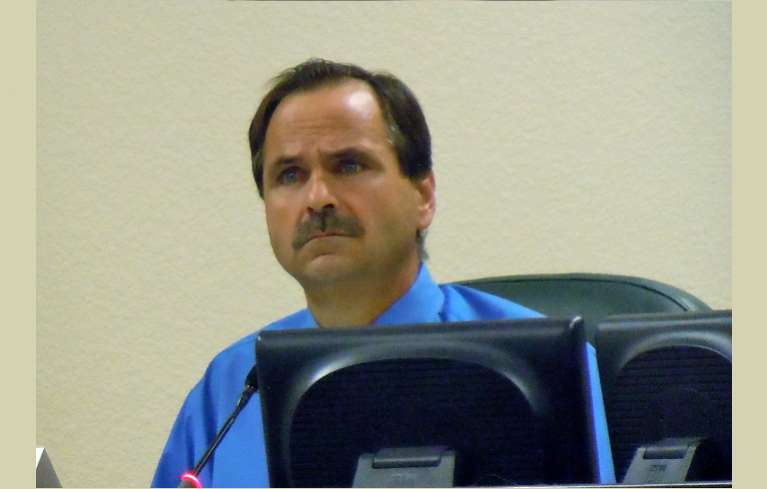
Ray Nutting

Ray Nutting

Wearing a gray suit, Nutting listened as County Counsel Ed Knapp delivered a lengthy address to the board asserting that it would be imprudent for Nutting to participate in any vote involving expenditure of taxpayer funds or any matter that could raise a specter of conflict of interest due to the supervisor’s criminal case.

“The county recognizes that all persons accused of a crime are presumed innocent until proven guilty in a court of law,” Knapp said at the opening of the board meeting. “However, the standards for the operation of the county’s business are different, and the county will take all necessary steps to ensure that the recent developments involving Supervisor Nutting do not interfere with the proper functioning of county government.”

A criminal complaint against Nutting, 53, charged that he broke the law by failing to list on statements of economic interest – required for public officials – that he received some $70,000 in income from the state in 2003 and 2009. He received the money from the California Forest Improvement Program for clearing brush at his 340-acre family ranch and is due to receive another $49,348 grant.

The supervisor also was charged with violating conflict of interest laws by failing to recuse himself from votes on county contracts with conservation districts that distribute the funds.

Nutting is due to be arraigned on the criminal charges next week. He said in an interview Tuesday, “I look forward to a speedy trial and being exonerated.”

At the board meeting, he promised to confine his votes to ministerial items – such as two declarations at Tuesday’s session in support of local Independence Day fireworks extravaganzas and a third item affirming an administrative list of surplus county property.

Nutting had pledged last week that he wouldn’t vote on any budget matters involving the District Attorney’s Office, which is prosecuting him. But Supervisor Ron Briggs, the board chairman, said supervisors were advised that no elected county officer facing indictments or complaints for political corruption could vote on county claims involving federal and state contracts.

In agreeing to recuse himself from most board votes, Nutting said Tuesday, “Although I am innocent, I believe my constituents want me to do what is in the best interest of the constituents – and protect those dollars.”

He added, “I do not believe there should be such a law that puts an innocent person in this situation.”

Amid sudden confusion over Nutting’s participation, the board on Monday had tabled a special hearing on the county budget. It also voted to hire the San Francisco law firm of Hanson Bridgett to advise the Board of Supervisors on how to handle the matter.

In his address to the board Tuesday, Knapp said that “due to the nature of the charges against Supervisor Nutting and various regulations involving use of state and federal funds, county counsel advises that Supervisor Nutting not participate in any board items that involve funding.”

Knapp also said Nutting should “recuse himself from any other items where his participation might give rise to an appearance of a conflict of interest.”

That infuriated one of Nutting’s constituents, Linda Columbo. A member of the Nashville-Sand Ridge Fire Safety Council in Nutting’s district, Columbo let the board have it for silencing his vote.

“I would like to see a little bit of fairness here, a little bit of compassion,” she told supervisors. “Stop the witch hunt. He (Nutting) represents my district and, for you to take away his right to represent me fairly, I can’t believe it.”

Nutting spent the day joining board members in passing noncontroversial items, honoring Boy Scouts and praising a presentation by a local skateboard park operator. But when most votes came up, he retreated to the audience or the hallway outside the supervisors chambers.

Nutting insisted Tuesday he will continue to work a full schedule. He outlined a public schedule including a community meeting tonight in Shingle Springs, where residents are protesting a proposed subdivision, and meetings with county school officials, the El Dorado County Chamber of Commerce and local fire districts. He also will listen to community groups focused on mining and the federal Endangered Species Act.

“I’m trying to be as good of a supervisor as I can,” he said.

Then he recused himself from an afternoon discussion on a board letter to the U.S. Fish and Wildlife Service over the proposed federal status of the Sierra Nevada yellow-legged frog and the Yosemite toad.

Nutting said it was suggested to him that he sit this one out, too.


Arrest made in death of Stateline man

By Phil Benson, KPHO-TV

An arrest has been made in the 2012 murder of Stateline’s Matthew McMaster.

Vrouyr Manoukian, 22, was taken into custody without incident and booked into jail May 31 on a charge of second-degree murder.

The burned body of the 24-year-old McMaster was found July 28, 2012, along a highway in Phoenix.

A witness saw a Jeep SUV pulling a small trailer behind it fleeing from the scene of the fire, police said.

Vroury Manoukian

Vroury Manoukian

The medical examiner’s autopsy determined McMasters died from blunt force trauma to the head. Police connected the body to a missing person’s report.

McMaster had been living with Manoukian and Randall Lee Young. Family members said the victim, Manoukian and Young had been in a fight. Manoukian allegedly broke it up by striking McMasters in the head, family members said.

Police arrived at the home and saw a Jeep SUV and trailer matching the description given by the witness. Manoukian and Young were taken into custody for questioning.

Officers said the men placed McMasters on a love seat on the patio in the fenced backyard. Young talked Manoukian out of calling an ambulance, investigators said.

Manoukian admitted that the furniture recovered from the fire scene in the desert belonged to him, police said.

A search warrant was obtained and served on the home. Blood stains were found in the back of the Jeep SUV registered to Manoukian. The blood was sent to the lab and was matched to the victim, police said.

A cigar found near the burned body was analyzed for DNA. The profiles were traced back to Manoukian and Young, investigators said.

Investigators said they were able to tie Manoukian’s vehicle to the crime scene. Blood and several gas cans were recovered at the home.

The investigation is ongoing.


Affordable housing complex may be S. Tahoe’s last

By Kathryn Reed

The nearly $9.5 million Aspens affordable housing project is likely to be the last such project to be built in South Lake Tahoe for decades.

This 48-unit development at the corner of Pioneer Trail and Ski Run Boulevard has been talked about for years. Then the state did away with redevelopment agencies. With that maneuver went $2.5 million the local redevelopment agency was going to put toward the project through the housing authority.

Then for a time it was thought the project would not get off the ground.

“The community should understand it has been a really long, arduous, expensive process,” Shellan Rodriguez, with Idaho-based Pacific Companies, told Lake Tahoe News. But in the same breath she praised the city and other agencies for staying at the table to make this a reality.

Work is under way on a 48-unit affordable housing complex in South Lake Tahoe. Photo/LTN

Work is under way on a 48-unit affordable housing complex in South Lake Tahoe. Photo/LTN

Ground was broken in May. It’s anticipated all the grading-type work will be done by the Oct. 15 deadline to stop moving dirt. During the winter the interiors will be completed, with the best-case scenario that leases could be signed in late spring 2014.

City Manager Nancy Kerry hopes this project will encourage others to step up their game to be more competitive. The neighboring Bart’s Tahoe complex has long been an eyesore and subject of fines, and was condemned at one time because several units were a health hazard.

Some of the more desirable affordable housing complexes in the city have waiting lists. Rodriquez anticipates that happening at Aspens, too.

This will bring the number of affordable housing units in the city to a little more than 300.

“We have more people who need that kind of low rent than we have supply,” Kerry told Lake Tahoe News. “I think people have varying perspectives for the need for controlled rent, which is what affordable housing is.”

There will be multiple buildings at the Aspens, with three-stories the tallest. The dormered roof is designed so it doesn’t appear that tall. They are energy efficient and being built to California’s Build it Green criteria.

“A community doesn’t want housing that looks low income and low income folks don’t want housing that looks low income,” Rodriquez said. This is a rendering of the Aspens project.

The company also has similar completed projects in Truckee, Mammoth and Carson City, as well as Jackson Hole, Wyo.

There is almost an equal number of one-, two- and three-bedroom units. Based on today’s formula, which is set by the state and federal governments, the apartments would rent from between $330 and $840 a month.

To qualify for one of the units, people will have to meet certain income requirements. Service industry workers are most likely the people who will qualify to live at the Aspens. But it’s also possible a single parent at an entry-level professional job could meet the requirements.

Half of the project site will not be developed; it will be open space.

Other amenities include bike storage and bike parking, play structures for little and bigger kids, a community building that will have laundry facilities and a common fitness area.

While high-end appliances and the like are not being installed, neither is the cheapest product. After all, Pacific Companies expects to own the complex for the next 55 years, so it wants things that will last a reasonable time. That is the time period in which these units are deed-restricted low income.

Because these types of projects are government subsidized and California eliminated its funding mechanism when it dissolved redevelopment agencies, the projection is these types of projects are a thing of the past.


High-end bike stolen from West Slope shop

This person is suspected of stealing a $7,000 bike.

This person is suspected of stealing a $7,000 bike.

Shop cameras caught suspect in the upper right corner.

Shop cameras caught the suspect in the upper right corner.

El Dorado County sheriff’s deputies are trying to track down the man who broke into a West Slope bike shop and stole equipment worth about $7,000.

The suspect on May 20 entered into Town Center Bike and Tri in El Dorado Hills early that morning. Deputies said he looked around the shop before taking off with a Trek, Speed Concept 7.5 bicycle (medium size, black with white accents), that had Zipp 808 black carbon fiber aftermarket wheels.

Anyone with information is asked to call (530) 621.7652.

— Lake Tahoe News staff report


Nev. Legislature kind to gaming industry

By Anjeanette Damon, Las Vegas Sun

CARSON CITY — A bill to legalize online poker after Congress failed to do it? Check.

A bill to protect big casino resorts from slot machine parlors and bars with sports betting kiosks? Check.

A $233 million lawsuit settlement that eliminates a disputed tax on comped meals? Check. (Well, almost check, the bill hasn’t yet been passed by the Senate but appears poised to do so.)

“So far, it’s been an OK session,” said Pete Ernaut, lobbyist for the Nevada Resort Association, who has been at the helm of many of the industry’s legislative initiatives this year.

These days, it’s good to be a gaming lobbyist.

The state’s most powerful industry is poised to come out of this legislative session the victor in a number of key battles that it asked lawmakers and Gov. Brian Sandoval to broker for them.

The industry racked up its first win early in the session, when the Senate and Assembly unanimously passed an online poker bill that was signed immediately by Gov. Brian Sandoval.

The entire process, from hearing to signature, took seven hours. Sandoval declared it a “historic day.”

Next up, a bill that would prohibit sports betting on kiosks, an emerging technology proliferating in Las Vegas bars and taverns that big resorts saw as a threat to their bottom line.

The measure, Senate Bill 416, also imposes new requirements on so-called slot parlors such as Dotty’s, which have been offering gambling without any other real business operation.

“The nonrestricted people, they came out like bandits,” said Sen. Tick Segerblom, D-Las Vegas. “The restricted guys, they are the big losers.”

Ernaut argued at the time that hotel resorts, which are required to make significant investments, including building 200 hotel rooms, in exchange for a nonrestricted gaming license, are in danger from smaller gaming operations who aren’t subject to as many requirements. Restricted gaming licenses are supposed to be reserved for a business that offers gambling that’s “incidental” to its primary activity.

“Protection of this industry: There can’t be a higher priority of this body than getting the No. 1 industry in this state right,” Ernaut said during one of the hearings.

That rankled some lawmakers, but the sentiment was generally shared under the oft-repeated premise that what’s good for the state’s biggest industry is good for the state.

“I think the Legislature has the primary duty to meet the needs of the citizens,” said Sen. Ben Kieckhefer, R-Reno. “But a thriving gaming industry is certainly a component of that.”

“I agree that we absolutely have to look out for the well-being and viability of the gaming industry,” said Sen. Greg Brower, R-Reno. “But not at any cost. We have to strike the right balance, and I think we’ve done that.”

Senate Bill 416 passed the Assembly unanimously and the Senate with only three opposed. It’s pending Sandoval’s review.

The industry’s last task: passage of a long-fought settlement of a $233 million court case on whether casinos should pay sales tax on the free meals they comp employees and patrons.

The battle, which dates to 2003, has been the subject of lawsuits, conflicting court opinions and intense behind-the-scenes settlement negotiations. The case is now before the Nevada Supreme Court.

The result: Casinos will stop pursing $233 million in refunds on taxes they’ve already paid in exchange for lawmakers passing a law that free meals for employees and customers are not subject to the sales tax.

In the last days of the session, lawmakers introduced just that bill, which passed the Assembly unanimously and appears poised to pass the Senate.

Sandoval, whose staff helped negotiate the settlement, backs the move as a way to protect the state from a massive liability that could blow a hole in the budget if the Supreme Court ruled against the state.

Not all lawmakers are happy about the settlement.

“It’s a settlement, so I’ll probably vote for it,” Segerblom said. “But it’s really disappointing they didn’t let the court decide. That’s a huge amount of money we’ve historically made the hotels pay. To let them off the hook is really a disservice, and we should revisit it.”

But if the Legislature revisits it before 2019, the state would be in breach of contract and would be forced to pay a pro-rated portion of the $233 million back to casinos, according to the settlement.

Many lawmakers, however, think the settlement is a good deal for the state, which will no longer be under the threat of the $233 million liability.

“I don’t have a problem deeming (the meals) untaxable,” Kieckhefer said.


Sierra bear poachers face felony charges

By AP

Two men arrested in possession of bear claws and gall bladders will be arraigned in El Dorado County Superior Court on felony charges.

Warden Mark Michilizzi said that Peter Vitali and Arthur Blake were arrested April 20 in the Eldorado National Forest.

The two possessed 20 large bear claws and three bear gall bladders.

The investigation suggested the men recently had killed a mother bear and two cubs. All had their livers and gall bladders removed.

At the time bear season was closed.

The bile inside gall bladders is believed by some to have medicinal properties and is sold on the black market.

Under state law it’s a felony to sell, purchase or possess for sale any part of a bear.

The pair will be arraigned June 4.


Abortion battles elsewhere may impact California

By Dan Morain, Sacramento Bee

In the past five years, 29 states have imposed new restrictions on abortions. California headed in the opposite direction.

Lest Californians think what happens beyond this state’s borders will always stay there, meet Kimberly Yee.

Well-schooled in the ways of politics, Yee worked for the Pete Wilson and Arnold Schwarzenegger administrations. Now back home in Arizona, she is a first-term state senator who is leading efforts to curb abortion, a winning issue for a politician on the rise in her Republican-controlled state.

Graphic/Paul Lachine/NewsArt

Graphic/Paul Lachine/NewsArt

“I’ve vowed to carry legislation for those who have no voice,” Yee said by phone. “The politics of abortion are very different here.”

With help from anti-abortion groups Center for Arizona Policy and Americans United for Life, Yee carried House Bill 2036, signed by Arizona Gov. Jan Brewer in 2012, to ban abortions past the 20th week of pregnancy.

Abortion rights advocates including the ACLU and Planned Parenthood sued to block the measure from taking effect. Reversing a federal judge in Phoenix who upheld the law, the San Francisco-based U.S. 9th Circuit Court of Appeals two weeks ago ruled that Yee’s measure violated Roe v. Wade, the 40-year-old Supreme Court decision that legalized abortions nationally.

Yee’s allies are certain to appeal. Although the U.S. Supreme Court takes up a fraction of the cases that are appealed to it, Arizona is at the head of the line of states that are mounting ever more aggressive challenges to Roe v. Wade.

California might seem worlds away from its next-door neighbor on the issue of abortion. In many ways, it is. This state’s supreme court legalized abortion in 1969, four years before Roe v. Wade. California protects the right of privacy for everyone, including women wrestling with the most personal of issues. That’s how it ought to be.

But even here, access to abortion remains an issue. In contrast to what is happening in most of the nation, however, legislators here are looking for ways to solve that issue, to their credit.

Five of the seven California counties with the highest rates of teenage births are in the southern end of the Central Valley. Tulare and Kern counties are first- and second-worst, followed by Kings, Madera and Fresno counties.

Not coincidentally, access to family planning and clinics that provide Medi-Cal abortions for low-income women is tight in those counties. There’s one provider in Kern County, none in Tulare and Kings counties, two in Fresno, and one in Madera County, according to Access Women’s Health Justice, which compiles such information.

Under current California law, only physicians are permitted to perform abortions. That limits access, given that doctors are scarce in much of the state.

At the behest of Planned Parenthood and its allies, and backed by many physicians, Assemblywoman Toni Atkins, D-San Diego, is carrying a bill to authorize nurse practitioners, certified nurse midwives and physicians’ assistants to be trained to perform first-trimester abortions.

Also at Planned Parenthood’s urging, Assemblyman Richard Pan, a Sacramento Democrat who is a doctor, is pushing AB 980 to ease outdated building standards that are unique to clinics where abortions are performed and can add 20 percent to construction costs.

The Assembly approved Atkins’ bill by a 48-22 vote and Pan’s bill by a 47-21 margin. The Senate likely will approve them both.

Just as Kimberly Yee’s bill never would pass in Sacramento, Atkins’ and Pan’s bills would not get out of committees in most other statehouses.

That’s especially true since 2007, when a divided U.S. Supreme Court limited Roe v. Wade by upholding the federal Partial-Birth Abortion Ban Act signed by then-President George W. Bush.

Since then, 29 states have tightened abortion access. At least 10 states, including Arizona, adopted laws requiring that physicians perform ultrasounds before aborting pregnancies, according to the Guttmacher Institute, which tracks such developments.

Several states impose waiting periods, including one where the wait is 72 hours. Several others require so-called counseling for women that is intended to dissuade women from making what already is a tough decision.

Arizona is one of 10 states that passed laws all but banning abortions after pregnancies reach 20 weeks. Arkansas passed a law to ban abortions past 12 weeks. North Dakota passed a law banning abortion after six weeks.

The Pew Forum on Religion and Public Life concluded in a primer on abortion law that the 2007 decision signaled that a majority on the court is willing to “rethink important premises in this legal debate, so it would not be surprising if the Supreme Court eventually were to take up the issues raised by this new restriction on the availability of abortions in the second trimester of pregnancy.” That’s where Arizona could come in.

The Supreme Court last week left in place an appellate court ruling that struck down an Indiana statute that defunded family planning clinics. But many more abortion challenges are en route, notably one involving Yee’s HB 2036.

Yee has ascended fast since returning to Phoenix in 2006, after spending two years as a deputy cabinet secretary to Schwarzenegger in Sacramento working on education issues. She spent time as a legislative aide in Arizona and as spokeswoman for Arizona’s state treasurer. Having ingratiated herself to conservatives, she was appointed to fill a vacant House seat in 2010 and won her Senate seat last year.

“Kimberly is a young, conservative, pro-life woman who is making waves on the national stage,” said Cathi Herrod, president of the Center for Arizona Policy, who helped Yee write HB 2036. Clearly pleased with the legislator, Herrod sees Yee as a future statewide candidate.

If the bill that Yee carried ever is implemented, physicians who perform abortions after 20 weeks could face six months in jail and $2,500 fines.

Maricopa District Attorney Bill Montgomery, who supports the measure and is joining the appeal to the U.S. Supreme Court, said the law is defensible because the safety of women is at greater risk when abortions are done after 20 weeks, and because fetuses feel pain at that point – claims disputed by the law’s opponents.

Michelle Steinberg, public policy director of Planned Parenthood of Arizona, noted that most abortions occur before the 20th week. Later abortions generally are done because fetuses have serious abnormalities. Hindering women from ending such pregnancies is especially pernicious.

“Who you elect influences how you get your health care,” said Kathy Kneer, president of Planned Parenthood Affiliates of California.

Women seeking help could come across the border, if they could afford the travel. Unlike most states, California’s constitution guarantees the right to privacy, though Arizona’s constitution has a privacy clause, too. California voters firmly support abortion rights. At some point, however, extreme steps taken outside California’s borders will have an impact here.




CalFire to bill Nutting for putting out fires

By Peter Hecht, Sacramento Bee

Ray Nutting, the embattled El Dorado County supervisor who collected state money to clear brush from his family ranch, is going to get a bill for causing a wildfire while performing the work.

Nutting, 53, faces four felony charges for failing to properly disclose about $70,000 in income received under two state contracts for clearing his own property for fire prevention. Through his attorney, he has denied any wrongdoing in the case announced Tuesday.

Now, CalFire says it is going to seek restitution from Nutting for unspecified costs of a Jan. 21 fire that erupted from an unattended burn pile on Nutting’s 340-acre timber ranch.

The fire burned 5 acres and required 65 firefighters and inmate crew members to put out. It occurred as Nutting was performing work on his ranch under a third state contract due to pay him another $49,348 once that job is done.

El Dorado County Supervisor Ray Nutting's problems are escalating. Photo/LTN file

El Dorado County Supervisor Ray Nutting’s problems are escalating. Photo/LTN file

State investigative reports and email correspondence, received by the Bee under a public records request, indicated the fire was the fourth that state crews had responded to on Nutting’s property on Happy Valley Road in Somerset since 2001.

At least three of the fires occurred while Nutting was performing work under California Forest Improvement Program grants given to private property owners to clear vegetation and other fire hazards. On three occasions, he was said to have been burning on “no burn” days set by local air quality officials.

Internal CalFire emails suggest a level of exasperation by agency officials over calls for assistance on Nutting’s property and dealings with the four-term supervisor.

“Yesterday, a fire occurred at the Nutting Ranch,” CalFire Battalion Chief Mark Brunton wrote his superior a day after the Jan. 21 blaze. He added: “Seems like an annual event and somehow I always end up there.”

A separate fire investigator’s report on the incident said Nutting had been burning brush on multiple days during a Jan. 15-22 burning ban set by the El Dorado Air Quality Management District.

The report from fire prevention Battalion Chief Christopher Anthony said hot embers from one of Nutting’s burn piles set off a blaze that jumped a road and burned up a mountainside. Anthony said Nutting told responders he walked off to have some lunch, then returned and “looked up and went, ‘Uh-oh.'”

No one was injured and no structures were damaged in the fire, which required 20 firefighters, 45 inmate hand crew members, five engines, two water tenders and two bulldozers to extinguish.

In his email, Brunton said he told Nutting that day that he would be held responsible. Brunton also wrote that, “During fire suppression activities, Ray Nutting was, to put it bluntly a pain in the rear” by barking orders to firefighters.

“I eventually got face to face with him and had a discussion on responsibilities of the landowner and the fire suppression personnel,” Brunton wrote CalFire’s El Dorado-Amador County unit chief, Mark Kaslin. “This was no different than past experiences with him.”

CalFire spokesman Daniel Berlant said last week the agency will file a claim against Nutting for the firefighting costs – still to be calculated.

“The decision has been made that we’re going to seek civil cost recovery for that fire,” said Berlant, who said investigators concluded that Nutting was negligent.

In emails to CalFire officials, Nutting expressed contrition after the incident – as well as concerns that he could be financially ruined if forced to pick up the firefighting costs.

“I have lost a lot of sleep over this fire that escaped on my ranch,” Nutting wrote in a Jan. 24 email. “As you know, I am being punished with the costs of putting out the fire.”

The supervisor, a longtime timber harvester, wrote that his property had become a “money pit” and he hadn’t sold any timber in 10 years. He said being held liable for the fire would “put my family’s financial stability at risk.”

According to records from the El Dorado County Air Quality Management District, Nutting was ordered to pay a $150 fine for burning on an unauthorized day. He was directed to complete an online safe-burning course.

Even if he ends up paying for the fire itself, Nutting is due for payment if he finishes work under a 2012 forest improvement grant. Under the contract, he is to receive the $49,348 for clearing brush, pruning and thinning out trees and removing flammable bark and wood debris on 277 acres of his ranch.

Nutting was paid $47,425 for brush-clearing and tree-planting work completed on his property in 2003 and $22,423 for work finished in 2009.

The state program is intended to reimburse private property owners to clear brush and remove hazards that can cause wildfires and damage watersheds.

While the grants are routinely awarded whether property owners hire contractors or do their work themselves, Nutting has come under political fire in El Dorado County in recent months for taking taxpayer funds for personal use.

On Tuesday, El Dorado County District Attorney Vern Piersen announced charges against Nutting alleging he broke the law by failing to disclose the state income on statements of economic interest required for public officials.

The charges also alleged that Nutting violated conflict-of-interest laws by failing to recuse himself on votes on county contracts with conservation districts that distribute funds for fire prevention.

Nutting attorney David Weiner called the charges “horse puckey.” He said the supervisor, whom he advised not to comment, made innocent paperwork errors but committed no crime.

Yet while taking state money for fire prevention, Nutting has drawn heat for causing fires.

In 2009, CalFire crews responded to his ranch to put out a 2-acre fire resulting from burning debris on a no-burn day. In 2002, crews extinguished a blaze that started during brush-clearing, a year after they put down a 2001 fire from an unattended burn pile on the Nutting property.

In a 2002 email to a CalFire superior, a state fire investigator noted that Nutting had a bulldozer and water tender on site but lacked sufficient water or easily reached fire hoses for safe on-site burning.

“This is a carbon copy of a problem we had with Ray last year at this time,” the investigator wrote. He said he told Nutting “that we could not continue to drive out there every time an old burn pile went active.”


S. Tahoe storm chaser dies in Oklahoma

By Kathryn Reed

Storm chaser Carl Young of South Lake Tahoe is one of several people who died Friday in an Oklahoma tornado. He was 45.

Young worked on Discovery Channel’s defunct “Storm Chasers” series.

“We are deeply saddened by the loss of Tim Samaras (55) his son Paul (24) and their colleague Carl Young,” Discovery Channel said in a statement. “Our thoughts and prayers go out to their families.”

The network is dedicating tonight’s documentary premiere of “Mile Wide Tornado: Oklahoma Disaster” to the three men.

Carl Young of South Lake Tahoe died May 31 chasing a tornado in Oklahoma.

Carl Young of South Lake Tahoe died May 31 chasing a tornado in Oklahoma.

The three died while tracking the EF3 tornado that ripped through El Reno, Okla., on May 31. Six other people died in that tornado, too.

This is Young’s bio on the Discovery Channel website: “Although Carl is a native Californian, he was called east in 2000 after a spell working on Hollywood film crews. He decided to take off on a two month storm chasing adventure in the Great Plains hoping to catch a glimpse of a few tornadoes but ending up with over a dozen twister encounters. Experiencing the raw force of nature in Nebraska was unlike any pyrotechnic display on a high-tech Hollywood set! This inspiration led Carl to the study of tornado dynamics and ultimately a master’s degree in atmospheric science from the University of Nevada, Reno. While attending a meteorological conference, Carl met Tim Samaras who encouraged him to collect meteorological data from inside tornadoes as the principal focus of his thesis research. Every spring since 2003, Carl has headed out with Tim, and together the team has tracked down over 125 tornadoes.

“Carl’s finest moment came on June 11, 2004, near Storm Lake, Iowa. Working with Tim, they defied the odds and deployed their probes right in the path of a tornado. The six-camera video probe captured amazing footage from multiple angles while the sensor probe recorded data that revealed just how fast wind speeds are close to the ground. Since then Carl remains eternally optimistic that they can repeat the same feat despite the huge challenges for successful deployments.”

Young taught geology on occasion at Lake Tahoe Community College. He was one of the school’s distinguished alumni. He earned a bachelor’s in economics at Cal and a master’s in atmospheric science at UNR.

He worked for a while at the League to Save Lake Tahoe on the program team.

“Carl was a very good analyst and passionate about Lake Tahoe and doing the right thing to protect the environment. He had lot of integrity and concerns for things being done the right way,” John Friedrich told Lake Tahoe News. Friedrich hired Young.

Young took over as program director at the League when Friedrich left.

“Carl did lot of good for Lake Tahoe and the world. He wanted to make the world a better place and gave a lot of himself to make things better,” Friedrich said.