Study: Hands-free doesn’t equate to risk-free

By Larry Copeland, USA Today

The increasingly popular voice-activated, in-car technologies that allow drivers to text, talk on the phone or even use Facebook while driving still allow for dangerous mental distraction, according to a study.

In the most comprehensive study of its kind to look at drivers’ mental distraction, the AAA Foundation for Traffic Safety found that as mental workload and distractions increase, reaction time slows, brain function is compromised, and drivers scan the road less and miss visual clues, researchers say. This could potentially result in drivers being unable to see items right in front of them, such as stop signs or pedestrians.

The study sought to measure the impact of cognitive or mental distraction on driving. The other two types of driver distraction, visual and manual, which involve the eyes and the hands doing something like looking at a cellphone while sending a text have been studied much more extensively.

“There’s a sort of arms race (among auto manufacturers) over what’s going into the car these days,” said David Strayer, a University of Utah cognitive distraction expert who co-authored the new report. “Any function that can be put in the car is being put in the car without a full examination of whether it should go in the car.”

The foundation’s research, which involved 150 drivers, follows a smaller study by the Texas Transportation Institute released in April, which found that texting while driving using a voice-to-text application was just as dangerous as texting manually.

Drivers in the AAA Foundation study were analyzed while engaging in eight different distracting activities as they “drove” on a sophisticated driving simulator and in an instrumented vehicle on residential streets in Salt Lake City.

Researchers measured brain waves, eye movement and other metrics to assess what happens as drivers listened to an audio book, talked on the phone or responded to voice-activated emails while driving. They found that, as drivers’ mental workload increased, their reaction time slowed, their field of vision narrowed and they missed visual cues.

“This is a reminder to the general public that distracted driving is real,” said Peter Kissinger, president and CEO of AAA Foundation for Traffic Safety. “Three out of four drivers believe that hands-free is better than handheld. But hands-free is not risk-free, and we now have new evidence that clearly demonstrates that.”

Kissinger said the foundation “is calling upon auto manufacturers and the electronics industry to work with us so we can learn as much as possible. Before any more wholesale installation of new technology, let’s step back and measure how the technology affects mental distraction.”

The group is also urging the National Highway Traffic Safety Administration to broaden its driver distraction guidelines to include the kind of mental distraction associated with voice-activated calling.

In March, ABI Research, a market intelligence company specializing in global technology markets, projected that infotainment systems in new vehicles would jump from 9 million in 2013 to 62 million in 2018.
California budget overhauls school funding

By Sharon Noguchi and Mike Rosenberg, San Jose Mercury News

Seven months after his tax initiative refueled funding for California’s beleaguered public schools, Gov. Jerry Brown has orchestrated what’s being billed as a major overhaul of how the state funds K-12 education.

The deal, scheduled for a vote Friday as part of the state’s 2013-14 budget plan, gives districts more control over their own spending and props up schools that teach the most disadvantaged kids.

The new formula will untangle four decades of growing mandates that created more than 60 pots of money for programs like school lunches and libraries. After years of state deficits focused the school funding debate on budget cuts, the proceeds from Brown’s Proposition 30 and rebounding economy positioned the state to change the conversation.

Starting this fall, most of California’s roughly 1,000 school districts will receive a larger base grant to spend as they see fit — supplemented by money for hard-to-educate students. Districts where more than 55 percent of students are poor, English learners or foster kids will receive even more money.

“It’s a huge change,” said David Plank, a Stanford education professor. “The system is clear, transparent and efficient in a way it has not been in the past.”

“I’m elated,” said Michael Kirst, president of the State Board of Education and a key Brown adviser who helped draft the blueprint for the governor’s Local Control Funding Formula.

However, critics say the change falls short.

With funding growing slowly, schools won’t be able to immediately restore the librarians, counselors, music and arts programs cut over the years. Even by 2020-21, the year the full funding formula kicks in, California will not be up to the national average in education funding.

Still, Brown has received much credit for engineering the change in school funding.

“A change in the formula that will strengthen local school districts, help poor kids and kids that have serious language barriers — this is a real step forward,” Brown said Tuesday at a news conference with legislative leaders at the state Capitol. He noted that, along with health care, one of his top two priorities during budget talks was “improving educational opportunity.”

Not only will Brown’s plan allow schools more latitude in how they use state money, it will hold them accountable for results.

How and what schools will have to prove — maybe minimum test scores, narrowing the achievement gap or reducing dropouts — will be set by the State Board of Education beginning next month.

“I think that’s going to be a very lively conversation over the next year,” said Plank, who directs the Policy Analysis for Education group.

How that plays out worries some. “We need to make sure that the accountability is clear and transparent,” said Patty Scripter of the California State PTA. The public, she said, should be able to keep track of how schools spend money and what they achieve.

The plan’s increases will be modest.

“It doesn’t resolve at all the grossly inadequate under-funding of our public schools,” said John Affeldt, lead attorney with Public Advocates, a party to one of two lawsuits filed against the state over the adequacy of education funding. That suit is in the state appellate court.

And other remnants of California’s old funding system won’t change. Most glaring is the dual level of funding: Tax-rich districts like Palo Alto, Mountain View-Los

Altos High, San Mateo Union High and others will retain the property taxes that help boost their schools funding beyond the level that the state would otherwise fund.

Under the new plan, revenue will grow more quickly in districts with high poverty levels, like Oakland Unified, West Contra Costa in Richmond and East Side Union High in San Jose, than in districts with fewer poor children and language learners.

But that is by design: Brown was insistent that schools get more resources to educate more challenging students.

The goal is to improve student performance. But some challenge the significance of the funding change.

Student achievement lags not because of the complicated funding formula but because of overall education spending, said Ron Bennett, executive director of School Services of California, which advises school districts.

“If we will remain last in the nation in per-student funding, it won’t matter that we have this new distribution mechanism,” he said.

Legislators had initially challenged Brown’s goal to give more funding to poor students. But they came around when Brown granted some legislators’ priorities. Assembly Speaker John Perez won phased-in university scholarships for middle-class students while Senate President Pro Tem Darrell Steinberg secured money for mental health programs and dental services for the poor.

“The governor has insisted on fiscal balance and a fundamental reform of how we finance public schools,” Steinberg said. “Those objectives are in this budget, and we’re very proud to join him.”

Sherry Bebitch Jeffe, senior fellow at the USC Price School of Public Policy, called it “refreshing, how (California leaders) actually sat down and came to some kind of compromise. But of course it’s easier now” with the surplus.

The Legislature created the old system in 1972, after the state Supreme Court in Serrano vs. Priest ruled school funding unconstitutional. So the state tried to equalize base funding — which in those days varied with each district’s property tax rate — and provide money for special needs.

“Over time, the old system became very unwieldy because of these 70-some categorical” programs, some of which came and went, Bennett said.

After Proposition 13 limited property tax increases, the state stepped in again to rescue school funding.

In that landmark change in school funding, the governor at the time was none other than Jerry Brown.


Full assault on wildland fire keeps it from reaching structures

By Susan Wood

STATELINE – Swirling winds gave firefighters chills Wednesday afternoon as they quickly battled a nearly 15-acre blaze on the top of Kingsbury Grade.

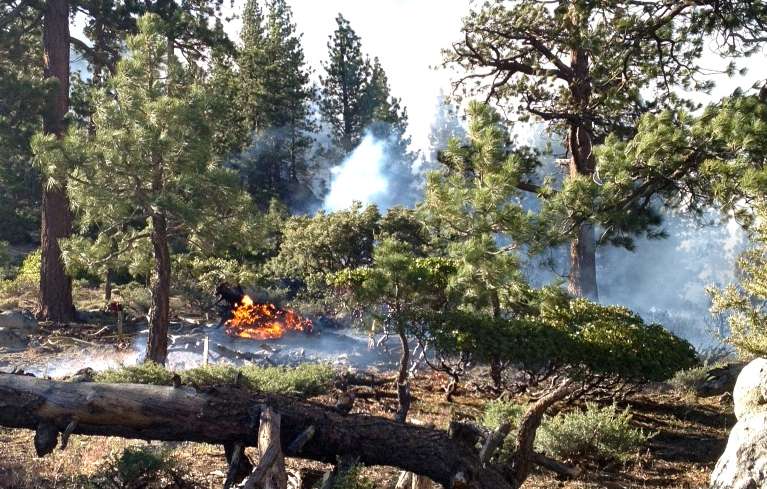
The June 12 blaze started at a spot where fire officials said a property owner is planning to build a home on a private road. A satellite dish erected on a pole and an iron bench mark the potential point of origin. Fire officials told Lake Tahoe News they believe the fire may be human caused. However, as reported earlier, it is possible a smoldering fire ignited from a lightning strike earlier this week could be the cause.

Tahoe Douglas Fire found out about the fire about 3pm when a motorist came into the station at the top of Kingsbury Grade saying smoke was visible while driving from the Carson Valley.

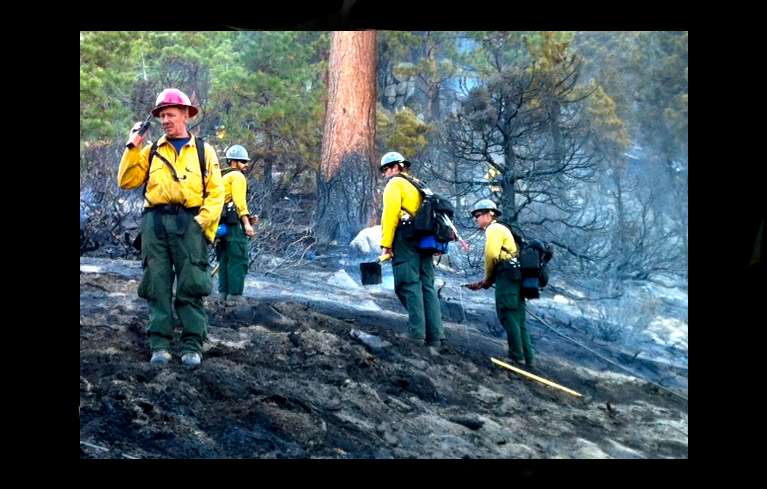
Firefighters on the evening of June 12 work the King Fire. Photos/Susan Wood

Firefighters on the evening of June 12 work the King Fire. Photos/Susan Wood

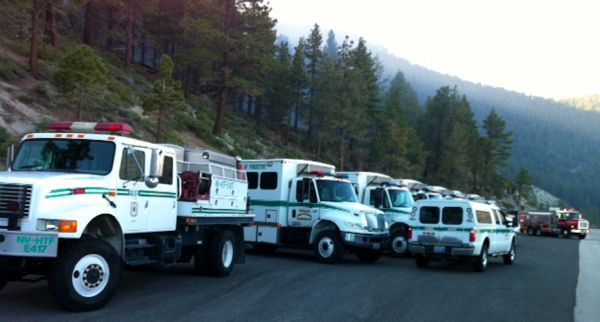
It took about 200 firefighters, 12 engines and two hand crews nearly five hours to contain the blaze. One firefighter suffered smoke inhalation. No air tankers could be used because of the high winds. A red flag warning is in effect until 11 tonight.

“It started here about 1 acre and moved pretty fast,” said Tahoe Douglas Capt. Bob Child as he showed Lake Tahoe News where the fire started.

Flames at times shot up 30 feet and high winds sparked spot fires farther down the slope toward the valley.

Child said, “If there was no wind, we would have eliminated this to 1 acre. But we got on this really fast.”

He told his crew this morning, “I hope we don’t have a fire today (because of the wind).”

Assisting Tahoe Douglas were the U.S. Forest Service, Genoa, East Fork, and Lake Valley firefighters.

Most of what burned was Forest Service land. Much of the flora was manzanita, which is highly combustible and burns extremely hot. The terrain is a mixture of brush, rocks and pine trees.

Had the fire gotten out of control, it could have reached the town of Genoa. Had the winds changed, Ridge Tahoe would have been in the path if the fire crossed Kingsbury Grade.

“If the wind changes, we have procedures to follow,” Sharon Graham with the resort told Lake Tahoe News. The management team met to make sure everyone was prepared.

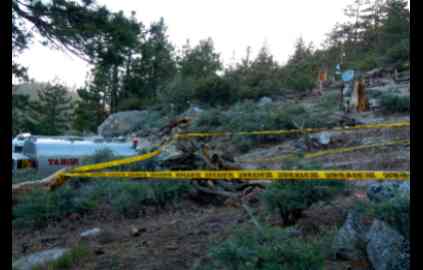
Tape outlines the potential point of origin of the 15-acre King Fire.

Tape outlines the potential point of origin of the 15-acre King Fire.

The fire was about three miles north of the ridgetop tourist area. The Ridge knows all about evacuating. Guests had to flee during the 2002 Gondola Fire. And the Ridge was home to firefighters fighting the blaze while it burned toward the resort that Fourth of July weekend.

No evacuation of tourists or residents was necessary with the King Fire.

“We were lucky the wind was headed in the direction it was, blowing northeast,” Child said.

Dave Pereira, assistant fire management officer with the Forest Service, agreed, and was impressed with the “great job the crews did.”

Pereira is concerned about the dry winter the Sierra and all of California and Nevada experienced because fire season has arrived earlier than normal.

No structure beyond the shed on the property where the fire may have started was ever threatened.

Kingsbury Grade was closed for several hours between Tramway on the Tahoe side and Foothill Road on the Carson Valley side.

Firefighters are expected to spend the night to fully extinguish the fire.

— Kathryn Reed contributed to this story.


Kingsbury Grade open; fire almost contained

Spot fires are flaring up outside the main King Fire. Photo/Tahoe Douglas Fire

Spot fires are flaring up outside the main King Fire. Photo/Tahoe Douglas Fire

Updated June 12 7:50pm:

Kingsbury Grade is open now that firefighters have a handle on the wildfire that erupted on the Carson Valley side of the Sierra highway.

Douglas County sheriff’s Sgt. Pat Brooks told Lake Tahoe News fire crews are expected to be working the fire throughout the night. However, containment of the approximately 5 acre blaze is expected soon.

Updated June 12 7:10pm:

One of the nearly 200 firefighters battling the King Fire is being treated for heat exhaustion.

The fire near the top of Kingsbury Grade continues to burn out of control, with spot fires erupting outside the main fire line.

An army of fire apparatuses are along Kingsbury Grade. Photo/Susan Wood

An army of fire apparatuses are along Kingsbury Grade. Photo/Susan Wood

The red flag wind advisory for the area is in effect through 11pm.

The fire is burning away from the Ridge Tahoe, though people in rooms looking out to the Carson Valley can see smoke.

“If the wind changes, we have procedures to follow,” Sharon Graham with the resort told Lake Tahoe News. The fire is about three miles north of the ridgetop tourist area.

The Ridge knows all about evacuating. Guests had to flee during the 2002 Gondola Fire.

As of now, no evacuations of tourists or the heavily populated residential area are in place with the King Fire, nor are any structures threatened.

—-

A wildfire on the Carson Valley side of Kingsbury Grade started just before 3 this afternoon.

Motorists must find another route between the valley and Lake Tahoe because Kinsbury Grade is closed from Tramway Drive to Foothill Road. It is being called the King Fire.

The fire started about one mile from the summit and as of 4:30pm was between 5 and 10 acres and growing.

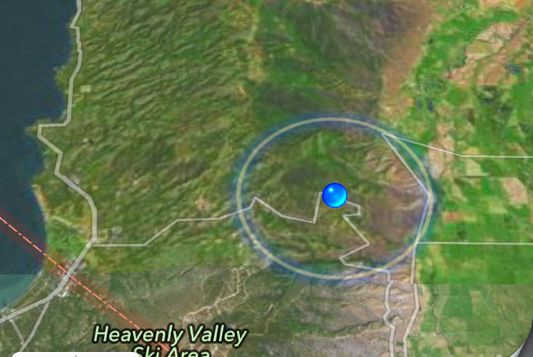
This shows the area of the fire.

This shows the area of the fire.

Eric Guevin with Tahoe Douglas Fire told Lake Tahoe News, “No structures are threatened at this time. Possible cause at this time is lightning.”

Winds have been heavy for much of Wednesday, which is causing the fire to spread in a northeast direction.

No air support has been called in because winds are 40 to 50 mph at the head of the fire, Guevin said.

Tahoe Douglas, East Fork and U.S. Forest Service firefighters are on scene.


— Lake Tahoe News staff report


Truckee High student dies in vehicle crash

By KRNV-TV

A Truckee High School student has died after a rollover crash Tuesday evening on Sierra County Road.

About 6:25pm, California Highway Patrol says, for reasons still under investigation, Corey Adam Neill, 18, drove his 1995 Chevrolet pickup at a speed that was unsafe for the condition of the dirt/gravel roadway. CHP says, due to Neill’s speed on the rough roadway, he lost control of his vehicle. The vehicle went into a ditch and then overturned.

As the vehicle overturned, passenger Andrew L. Metlenko was ejected from the vehicle and pronounced dead at the scene. Metlenko was not wearing a seat belt.

Alcohol was not a contributing factor.


Novasel wants to be El Dorado County supervisor

By Kathryn Reed

Sue Novasel made it official at Tuesday night’s school board meeting – she is running for El Dorado County supervisor in 2014.

“The biggest issue for people in Lake Tahoe is we need strong representation,” Novasel told Lake Tahoe News.

She said she is working on her platform.

The primary will be in June 2014, with the top two finishers squaring off in November. Official filing is not until February.

Sue Novasel is the first declared candidate for the 2014 El Dorado County Board of Supevisors. Photo/Provided

Sue Novasel is the first declared candidate for the 2014 El Dorado County Board of Supevrisors race. Photo/Provided

“I want to get the word out early because there is a lot to do,” Novasel said. She did not want to comment on the current turmoil on the board involving Supervisor Ray Nutting.

She said it’s important the next supervisor from Tahoe has a strong community background who understands the issues in the basin.

The 57-year-old is a longtime resident of Meyers and active member of the community.

She has been on the Lake Tahoe Unified School District board since 2003. Her term was supposed to end in 2015, but with the change in elections to even years, it goes to 2016. This means if elected to the full-time county seat, she would have to give up her LTUSD seat and that board would have to decide how to fill the vacancy.

Norma Santiago, who currently represents the county’s 5th District, is termed out.

What will be different in the next election is that District 5 will no longer be a Tahoe-only entity. Redistricting based on the 2010 Census has the district extending to Pollock Pines. This means it’s possible for someone outside of Tahoe to represent this area. There was a time when Tahoe had two reps in the halls of Placerville.

Novasel was instrumental with the first Meyers Community Plan, and has been part of the current one that is wending its way through the governmental process.

She is the incoming president of Soroptimist International South Lake Tahoe – with the induction being June 26.

Novasel is vice president of both the Lake Tahoe Wildlife Care board and South Lake Tahoe Wedding and Honeymoon Association. She owns Tahoe Dream Events, a wedding and event planning business.


Man found dead on S. Tahoe street

A 63-year-old South Lake Tahoe man was found late Tuesday night lying face down on the side of Lindberg Avenue near Lodi Avenue.

According to Police Chief Brian Uhler, the man had a history of heart disease and the cause of death appears to be natural.

The man’s belongings were on him and he had not been there long, Uhler said.

Police were called to the location just before midnight on June 11.

— Lake Tahoe News staff report


Hwy. 50 corridor housing boom about to begin

By Hudson Sangree, Sacramento Bee

Plans to build more than 10,000 homes across the dry, rolling foothills south of Highway 50 in Folsom are shifting into high gear in response to a housing market that has gone from “zero to 60” in a matter of months, housing experts said.

The 3,500-acre swath of cattle-grazing land that the city of Folsom annexed last year is one of the largest and most anticipated areas for residential construction in the Sacramento region. The market turnaround in the past year has renewed momentum for plans to build there.

“People were muddling through, and then we went from zero to 60, and everybody’s trying to do it at once,” said Greg Paquin, head of the Folsom-based Gregory Group, a home industry consultant.

Late last month, the New Home Co., based in Southern California, announced it had bought 431 acres of the former Russell Ranch from a partnership controlled by longtime developer Angelo K. Tsakopoulos. The price was not disclosed.

Lake Tahoe is a selling point to future home owners of what is now barren land. Photo/Paul Kitagaki Jr./Sacramento Bee

Lake Tahoe is a selling point to future home owners of what is now barren land. Photo/Paul Kitagaki Jr./Sacramento Bee

The company intends to build 900 homes on hillsides with sweeping views that extend to the Sacramento skyline, Folsom Lake and the Sierra. The goal is to start preparing the land next year and begin building by the end of 2015, said Kevin Carson, New Home’s Northern California president.

When the deal closed, Carson took the company’s two dozen employees up a gravel road to a windswept hilltop to celebrate.

“I told everyone that their children’s children’s children, when they drive to Lake Tahoe, are going to look at those hillsides,” Carson said. “It’s a very prominent location in the most desirable area in the region. From a home builder’s standpoint, it’s the absolute best location.”

The company’s plans call for homes to look west across the Central Valley to the Coast Ranges, with jogging and biking paths following natural swales and connecting to a 3-acre community and recreation center.

“We’ll be working with the topography instead of against it,” said Ashley Feeney, the company’s vice president for land and planning. On a tour of the site last week, he and Carson threaded their way among cow patties, keeping a lookout for rattlesnakes amid the rock outcroppings.

Part of the challenge of housing thousands of residents in the parched landscape has been securing a reliable water supply.

Tsakopoulos, who bought up thousands of acres of ranchland south of Highway 50 with an eye toward future development, once quipped that the area was so barren “jackrabbits carry their own lunch.”

Earlier plans called for water to be piped in from the Natomas Central Mutual Water Co., which serves farms miles away in northern Sacramento County and southern Sutter County. But the plan was expensive – buying the water and piping it to Folsom was expected to cost $250 million.

The city of Folsom has since approved a plan to provide the water from its own supply, said city spokeswoman Sue Ryan. Landowners have agreed to pay an estimated $52 million for facilities to treat and convey the water, she said.

The plan does not violate the terms of Measure W, which prohibited reducing the water available for current residents, said Folsom City Manager Evert Palmer. That’s because the city expects to cut water consumption by 20 percent in coming years under state conservation mandates. The excess supply would be diverted to the new south area, he said.

That water will help green the landscaping of more than 300 acres of parks and schools, 1,400 acres of residential development and 500 acres of commercial, industrial and office space, Ryan said. The project is expected to create 13,000 jobs.

Folsom’s growth south of Highway 50 has been considered inevitable since 2004, when residents approved Measure W, which imposed conditions on development but did not bar it from proceeding. One provision required that 30 percent of the land remain in open space.

At that time, Tsakopoulos and his investment partners controlled much of the land, but as development grew closer in recent months, buyers have snapped up major parcels.

Westland Capital Partners, based in neighboring El Dorado Hills, bought 960 acres of the former Mangini ranch from Tsakopoulos in October and closed on 760 acres of the former Carpenter Ranch from another seller in March, said Bill Bunce, the firm’s president.

Altogether, Westland could build more than 5,600 housing units on its properties along with commercial and light-industrial uses, he said.

Bunce declined to disclose the purchase prices, and the sales figures were not readily available last week from public records.

Land appraiser Dave Jarrette said he wasn’t involved in the deals, which often come with confidentiality clauses, but said he could offer an educated estimate at the selling prices. He said land in the annexation area sold for about $5,000 an acre decades ago but lately has been going for $25,000 to $50,000 an acre.

“The stuff south of 50 wasn’t selling for much 20 years ago,” Jarrette said. “Development was too far off.” Now, with site development only a year away, “it’s a near-term deal,” he said. “That’s why they paid the price.”

Paquin said Folsom, his hometown, and areas of Placer County in Roseville and Rocklin are considered prime building spots because of jobs, incomes and amenities. The houses that New Home Co. plans to build will be part of an area with good schools, family-oriented services, and miles of recreation trails, he said.

“I think south of 50 is a fantastic opportunity,” Paquin said. “It’s clearly a place where people want to live.”


South Lake Tahoe council unanimously approves next phase of multimillion dollar Chateau project

By Kathryn Reed

While the four votes by the South Lake Tahoe City council on Tuesday concerning the Chateau project were 5-0, they did not come easily or without some reservations.

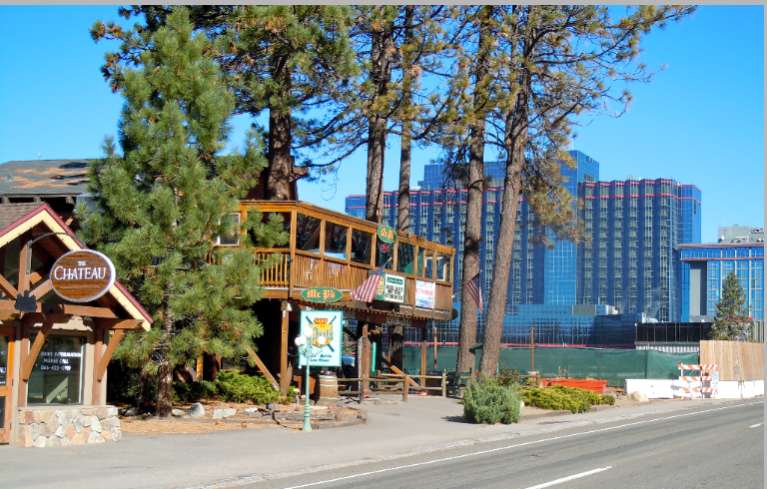
What it means is part of the concrete and rebar on the northwest corner of Highway 50 and Stateline Avenue will be covered starting next month, with completion of that phase expected next year.

SMC Contracting, which built what exists today, has been hired by the property owner to do the next phase.

“The design is based on continued vertical construction. Basically it’s a temporary roof that could be permanent,” SMC’s Joe Stewart told the council June 11.

The Chateau project is about to become a partial reality beyond rebar and concrete. Photo/LTN file

The Chateau project is about to become a partial reality beyond rebar and concrete. Photo/LTN file

The next phase is all retail along the highway from the state line to almost the existing McP’s Pub. McP’s will take over the corner location, as was originally planned.

This building was three-stories in its original concept. The top two floors were to be roughly 80 tourist accommodation units of some kind. They still will be, but in another phase of construction that today is called Phase 3.

“I think the whole building is what is best for the community,” Councilwoman Brooke Laine said.

But if that were to happen, the top two floors would be shells. Plus, it would add about another $8 million to construction costs.

The nearly $11 million project that is slated to break ground in July is called Phase 2. Phase 4 would be the convention center and high-end hotel. A stipulation is that before Phase 4 can begin, Phase 3 must be finished.

Owens Financial operating as Tahoe Stateline Ventures is developing the 27,868-square-feet of retail. No leases have yet to be signed, but discussions are under way. Owens Realty Mortgage is the sole investor of TSV, according to Lew Feldman, who represents the developer. Owens Realty Mortgage is a publicly traded REIT.

After 5½ hours of discussion June 11, the council agreed to modify the phases. This means one story instead of three will be built.

The developers had asked for 10,000 square feet of commercial floor area from the Stateline-Ski Run Community Plan to be transferred to the project. While this was always the plan, the amount was for the entire project and not just this segment. What will initially be built is about half of the total commercial floor area for the entire project.

Councilwomen Laine and JoAnn Conner initially proposed half of those 10,000 square feet be used in this phase and the remainder down the road.

Feldman said his client had no other source of CFA.

The Tahoe Regional Planning Agency has made CFAs a commodity with value instead of letting free market dictate how much can be built. The same goes with tourist accommodation units – or hotel rooms. That will likely to be an issue with future phases.

The council agreed to take CFA out of the environmental cache – which has not been tapped in the decade since the Safeway was built – along with half of the community plan CFAs. This leaves the developers needing to find 2,858-square-feet.

Owens Financial has some CFA on other parcels it owns in the project area, but had not wanted to use those for reasons that were not disclosed at Tuesday’s meeting.

Of the $11 million to construct the retail, about $2 million will be spent on stormwater (aka environmental improvements), landscaping, Highway 50 improvements and other upgrades.

Performance and construction bonds are required at a minimum of $10 million each. This means if the developer is unable to finish the project, the city would be able to trigger the bond to get the job done.

Such bonds were not required by the city before the now bankrupt Lake Tahoe Development Company (LTDC) broke ground in 2007.

Putting the developed parcels under one map was also never done. This in turn led to much of the problems that exist today – 29 parcels for one project. The six parcels that will be built on will have one map, all sides say, but the remaining parcels are owned by Owens and City National, with Randy Lane of LTDC in litigation with the McP’s parcel.

Randy Faccinto, attorney for City National, told the council his client is looking for a buyer of the property it owns and is not interested in becoming a developer.

Owens has spent about $30 million in loans on the original project, another $11 million to buy additional land and to pay back taxes.

Swanson said the project is estimated to bring in between $200,000 and $300,000 in sales and property taxes to the city each year.

On Tuesday, the council approved the design changes, commercial floor area allocations, abandonment of city owned roads that will be built on, and acceptance of the right-of-way from Caltrans.

—-

Here are renderings of the latest Chateau project.


Couple suspected of selling pot to students

William Anderson and  Makayla Hoehn

William Anderson and Makayla Hoehn

Two South Lake Tahoe residents were arrested Monday on charges related to providing marijuana to middle and high school students.

William Anderson, 30, and fiancée Makayla Hoehn, 25, are accused of furnishing marijuana to South Tahoe High School and South Tahoe Middle school students.

The school resource officer on June 10 received information that the two were selling marijuana to local schoolchildren. An investigation led to Anderson being a suspect.

Officers secured a search warrant at his Marjorie Street residence, where they said they found marijuana, methamphetamine and drug paraphernalia.

Police said Anderson admitted to selling marijuana to students and that Hoehn said she knew what was going on.

Their two small children are now in the custody of Child Protective Services.

Anderson was arrested on charges of selling marijuana to minors, possession of a controlled substance, possession of drug paraphernalia, maintaining a drug house and child endangerment. Hoehn was arrested on charges of maintaining a drug house and child endangerment.

— Lake Tahoe News staff report