Nev. lawmakers bet on tax breaks to generate revenue

By Andrew Doughman, Las Vegas Sun

Actor Nicolas Cage told legislators that investors and movie producers could flock to Nevada.

But he would only get to produce his “four scripts that could easily be shot in Nevada” if the Legislature passed a $20 million tax credit for the film industry, Cage told lawmakers several months ago. Legislators passed the bill, but only time will tell whether the $20 million tax discounts will ultimately bring more jobs and investment to the state.

The gamble for the state is this: Pay for schools, public safety, roads and other services now, or give some money away in hopes that the businesses receiving tax breaks will bring even more money to the state in future years.

Legislators made this bet again and again and again during the legislative session that ended this month in what’s become a give-’em-a-break ritual.

“We always have bills that deal with abatements,” said Carole Vilardo, director of the Nevada Taxpayers Association.

Legislators authorized hundreds of millions of dollars in potential tax breaks, most of which will benefit large businesses and organizations. (That’s in addition to hundreds of millions of dollars in breaks for things like energy-efficient buildings and renewable energy development.)

Whether it’s movie tax credits, insurance tax breaks for companies or investors, property tax exemptions or energy bill discounts, here’s a look at whom the Legislature helped this year.

With a banner cry of “help us help Nic Cage,” legislators passed the film tax credit bill, which the bill’s sponsor said will help attract all sorts of new business to Nevada.

Senate Bill 165 also had the enthusiastic support of Mayor Carolyn Goodman, who told a legislative committee that “my wholehearted support for his bill is beyond wholehearted.”

Basically, the bill says people filming movies, TV shows and other programs spending 60 percent of their production costs in Nevada can then claim tax credits for 15 percent of the expenses.

Sen. Aaron Ford, D-Las Vegas, said the bill will help stimulate a small but growing film industry in Nevada.

Critics of the bill attacked it from both the political right and left.

Former state Sen. Sheila Leslie, D-Reno, said on Twitter that she’d rather see the state spend money on health and education programs than give tax breaks to film companies.

Conservative critics said the government shouldn’t pick which industries deserve a tax break.

“That’s money that’s not available for a tax cut for everyone,” said Victor Joecks of the Nevada Policy Research Institute, a think tank critical of the film tax bill. “That’s money that’s not available for a government program.”

Will the tax credit bring in more money for government programs? Nevadans should know in five years, once the program expires and reports show how much went out and how much came back in.

Arguably the best deal for businesses is a tax credit that allows investors to get a tax break that eventually equals 58 percent of their investment.

In Senate Bill 357, the Legislature authorized up to $200 million in statewide “new market tax credits” that are generally awarded when investors put money into businesses in poor neighborhoods with high unemployment rates.

After an initial two years during which no exemption is awarded, investors can deduct from the state insurance premium tax 12 percent for the next three years and 11 percent for the next two years.

Unlike the film tax credits, nobody can trade or sell these on the open market.

Still, it’s not just the financial firms that get a tax break for insurance premium taxes. Under the law, investment firms like the ones that lobbied the Nevada Legislature will get to transfer the tax credits to their partners, members or shareholders in Nevada.

If those members are large insurance companies in Nevada, they could be able to claim a significant deduction on the state’s insurance premium tax.

The law, sponsored by Sen. Michael Roberson, R-Henderson, is modeled on a similar federal program designed to provide investors with an incentive to enter low-income markets and allow businesses in low-income communities to access private capital.

The current recipients of the federal tax credit in Nevada are banks and other investors.

It’s unclear which groups will participate in the state-level program.

Out-of-state manufacturing companies would benefit from another state-sponsored abatement.

The Nevada Manufacturers Association has long lamented that Nevada has some of the highest energy rates in the Western United States. So commercial and industrial businesses that might otherwise find Nevada’s low-tax environment attractive don’t come here partially because of high energy costs.

Assembly Speaker Marilyn Kirkpatrick, D-Las Vegas, sponsored Assembly Bill 239 in hopes of changing that.

New companies coming into Nevada can get up to a 30 percent discount on their energy rates during the first year they’re in the state, up to a 20 percent discount during the second and third years, and up to a 10 percent discount during the fourth year.

But the rate reduction is limited. These new companies could get a discount for up to 50 megawatts of energy use.

A report to the Legislature in 2015 should show how many companies participated in the program and how much of a discount they got.

Businesses that want to give more than $500,000 to Nevada’s universities and colleges can also get property tax breaks under certain conditions.

A new law created by Assembly Bill 138 allows businesses to invest in support of college certification, research or training in exchange for a property tax break up to 50 percent of the value of the investment for five years.

So, if the business meets all the requirements and invests $1 million, it could deduct $500,000 or 50 percent of its property tax bill, whichever is less.

It’s not just donations that qualify businesses for the tax break.

Businesses can give universities money, personal property or other assets to get the tax break, too.

In addition to the benefit to the universities, the businesses have to employ students as well.

Although legislators wrote in Assembly Bill 138 that tax exemptions “will achieve a bona fide social or economic purpose and that the benefits of the exemption are expected to exceed any adverse effect of the exemption,” nobody really knows what will happen.

Critics of these incentives and tax breaks say the money could go to health care or schools, both top priorities for Democrats at the Legislature this year. Critics on the right say that eliminating these specific incentives could allow the state government to lower tax rates for everybody.

Are the discounts worth it?

“You can make the argument that we’d collect more if you hadn’t given it,” said Steve Hill, the director of the Governor’s Office of Economic Development, which oversees many incentive and tax break programs. “Then you can make the argument that they wouldn’t have come without the abatement.”

This year, the Legislature also passed some bills to look at whether these tax breaks are actually working and whether they need a fix.

“This ought to be a virtuous circle where the Legislature sets policy, we implement that, we measure the results,” Hill said.

Because of those bills, Nevadans may know whether these gambits pay off. The governor signed into law Assembly bills 333 and 466, both of which will measure the costs and benefits of tax breaks, deductions, credits, abatements and so on.

“You’ll know if you’re building a farm or if you’re giving away a farm,” Vilardo said.



Nevada tries to make tourism website more engaging

By Richard N. Velotta, Las Vegas Sun

The Nevada Tourism Commission was feeling a little better about TravelNevada.com 2.0 after its brand consultant told members they’ll be tweaking the state’s tourism website after a lukewarm response to its mid-April debut.

Representatives of Burson-Marsteller, the New York-based consultant the state is paying $3.2 million over two years, told commissioners Wednesday they are working on fixes to the website that should be completed by the end of July.

“I must say it’s a dramatic improvement,” said Commissioner Christopher Baum, who heads the Reno-Sparks Convention and Visitors Authority, after getting a preview of the changes.

“It’s a dramatic improvement in terms of navigation, in terms of visuals, in terms of intuitive ability to find things that are of interest to travelers,” Baum said. “In a perfect world, it would have been the first version we launched, but I’m delighted that we’re getting to a version now that we can all be happy with. It’s dramatically better on virtually every level.”

Tourism leaders statewide complained that a portion of editorial content that had previously been accessible on the website was gone or difficult to find. Burston-Marsteller’s contracted website designer said one of the fixes planned is to restore some of the previously available content.

“We went too far in trip planning than rich narratives and other editorial content,” said Louis Hernandez in his presentation to the commission.

Some critics have complained that information about events was outdated and that the site’s functionality declined. Others were concerned about whether an out-of-state vendor was best qualified to develop the website. The website revisions also came at a time when the state unveiled its new brand, “A World Within. A State Apart,” which also was panned.

Tourism Commission Director Claudia Vecchio defended the brand, saying there would always be detractors and that it just needed more time for the public to appreciate it.

While commissioners were satisfied that improvements were under way, they were delighted by early reports of site metrics showing that visits to the page and increases in the number of requests for more information were on the rise, thanks primarily to the state’s strong social media presence.

Michelle Stevenson told the commission that Facebook posts about the state more than tripled in the last year and the dwell time on Nevada’s page was well above industry averages. The state agency focused on social media, spending minimally on more expensive television and traditional media advertisements.


Carson area experiencing swarm of temblors

The Nevada Seismological Laboratory has located 122 earthquakes in a continuing sequence of activity located on the southeastern edge of Carson City.

“It’s not unusual to see earthquake sequences similar to this in the Northern Nevada area,” Graham Kent, director of the Nevada Seismological Lab at the UNR, said in a statement. “Based on the historical record of earthquakes in the region, as earthquakes sequences progress, the probability of larger events that could be felt or that could potentially cause damaging ground shaking increases. We’re working with state emergency managers and are watching this closely so citizens can be informed and prepared.”

This most recent activity began on June 1 at 11:15pm. The largest events of the sequence have been one magnitude 2.9 and two magnitude 2.8 events. The most recent of these occurred at 8:06am June 20. Each of the larger events has been followed by numerous small earthquakes, some too small to be pinpointed, but nonetheless observed on the local seismic network.

“The activity is occurring about 5.5 miles below ground,” said Ken Smith, network administrator and associate director at the Nevada Seismological Lab. “This sequence of events is noteworthy and of concern in that it may be associated with the northern extent of the Genoa Fault Zone, a large range-bounding fault system capable of earthquakes of Magnitude 7 and larger. We cannot forecast or predict how this particular sequence of earthquakes will evolve, or if there will be larger events.”

Large damaging earthquakes are always possible anywhere in the Northern Nevada area.

Earthquake activity in the Carson City area will continue to be closely monitored and additional information will be issued as necessary to ensure public safety.


Man accused of growing pot on USFS property

A two-week investigation by El Dorado County sheriff’s deputies ended with the arrest of a 21-year-old Mexican national on drug charges.

On June 21, the West El Dorado Narcotics Enforcement Team along with the Mountain and Valley Marijuana Investigations Team entered a suspected marijuana grow operation on U.S. Forest Service land north of Stumpy Meadows Lake, east of Georgetown.

Omar Ruiz Talauera was booked into the county jail on charges of resisting an officer, cultivation of marijuana and possession for sale of marijuana.

Omar Ruiz Talauera

Omar Ruiz Talauera

Deputies said the suspect was dressed in camouflage and attempted to flee.

Deputies said the operation created extensive resource damage to the area. Thousands of square feet of timber had been clear cut to accommodate the illegal growing operation. The tops of the stumps that were left behind, were painted green in an apparent attempt to avoid detection by law enforcement aircraft. Several empty bags of fertilizer and trash were found in and about the garden area, which was directly above the Rubicon River, a tributary of the Middle Fork of the American River, eventually leading to the North Fork of the American River and into Folsom Lake.

— Lake Tahoe News staff report


AAA: Fewer July 4th travelers than a year ago

Not as many people in the U.S. are expected to travel during the upcoming Fourth of July holiday compared to 2012.

AAA is projecting 40.8 million Americans will venture at least 50 miles from home during the holiday, a 0.8 percent decrease from the 41.1 million people who traveled in 2012.

Much of this has to do when the Fourth falls — on a Thursday. When it was on a Wednesday last year, more people opted to take the whole week off.

Decade-high travel volume occurred in 2007 when 42.3 million Americans traveled and the holiday also fell on a Wednesday.

The Independence Day holiday travel period is defined as July 3-7.

Highlights from the 2013 AAA Independence Day travel forecast include:

  • Eighty-four percent of travelers (34.4 million) to travel by automobile, a decrease of 0.7 percent from 34.7 million last year
  • Holiday air travel expected to increase slightly to 3.07 million from 3.06 million in 2012
  • Independence Day holiday travel volume is expected to remain above the 13-year average of 38.9 million for this holiday
  • The largest share of travelers (32 percent) will depart July 3, with July 7 the most popular date of return
  • The average traveler is expected to travel a round-trip distance of 613 miles and spend $747

This year 46 percent of intending travelers plan to begin their trip prior to the start of the holiday travel period (July 3-7), compared to 65 percent last year. The largest share of travelers (32 percent) on a single day will depart on July 3 and the largest share will return on July 7 (38 percent).

Approximately 34.4 million people (84 percent) plan to drive to their destination, a decrease of 0.7 percent from the 34.7 million who drove last year.

 — Lake Tahoe News staff report


Hwy. 50 roadwork in S. Tahoe to increase

It will be even more difficult to drive along Highway 50 through South Lake Tahoe next week.

Caltrans will be alternating overnight lane closures because of grinding and paving work from 4pm to 2am Monday through Thursday from the Y to Trout Creek.

The repaving work is in addition to several Caltrans water-quality improvement projects in various stages of development along Highway 50 in South Lake Tahoe.

Eastbound and westbound motorists can expect alternating No. 2 lane and shoulder closures from Trout Creek to Ski Run Boulevard from 5am-8pm Monday through Thursday and from 5-11am on Friday for lane striping.

Eastbound and westbound motorists can expect alternating lane and shoulder closures from Fairway Avenue to Wildwood Avenue from 6am-4pm Monday through Thursday and from midnight to noon Friday for drainage work.

In addition, work is set to start on a $12.1 million project from the Y to the Lake Tahoe Airport next week.

Next week’s construction schedule on that project is midnight to 11am Tuesday through Thursday and midnight to 10am Friday.

There will be no weekend work on any of these projects and no work around the Fourth of July holiday.


Pot growers fouling up the environment

By Felicity Barringer, New York Times

ARCATA — It took the death of a small, rare member of the weasel family to focus the attention of Northern California’s marijuana growers on the impact that their huge and expanding activities were having on the environment.

The animal, a Pacific fisher, had been poisoned by an anticoagulant in rat poisons like d-Con. Since then, six other poisoned fishers have been found. Two endangered spotted owls tested positive. Mourad W. Gabriel, a scientist at UC Davis, concluded that the contamination began when marijuana growers in deep forests spread d-Con to protect their plants from wood rats.

That news has helped growers acknowledge, reluctantly, what their antagonists in law enforcement have long maintained: like industrial logging before it, the booming business of marijuana is a threat to forests whose looming dark redwoods preside over vibrant ecosystems.

Hilltops have been leveled to make room for the crop. Bulldozers start landslides on erosion-prone mountainsides. Road and dam construction clogs some streams with dislodged soil. Others are bled dry by diversions. Little water is left for salmon whose populations have been decimated by logging.

And local and state jurisdictions’ ability to deal with the problem has been hobbled by, among other things, the drug’s murky legal status. It is approved by the state for medical uses but still illegal under federal law, leading to a patchwork of growers. Some operate within state rules, while others operate totally outside the law.

The environmental damage may not be as extensive as that caused by the 19th-century diking of the Humboldt estuary here, or 20th-century clear-cut logging, but the romantic outlaw drug has become a destructive juggernaut, experts agree.

“In my career I’ve never seen anything like this,” said Stormer Feiler, a scientist with California’s North Coast Regional Water Quality Control Board. “Since 2007 the amount of unregulated activities has exploded.” He added, “They are grading the mountaintops now, so it affects the whole watershed below.”

Scott Bauer, of the state Department of Fish and Wildlife, said, “I went out on a site yesterday where there was an active water diversion providing water to 15 different groups of people or individuals,” many of them growers. “The stream is going to dry up this year.”

While it is hard to find data on such an industry, Anthony Silvaggio, a sociology lecturer at Humboldt State University, pointed to anecdotal evidence in a Google Earth virtual “flyover” he made of the industrial farm plots and the damage they cause. The video was later enhanced and distributed by Mother Jones magazine.

Brad Job’s territory as a federal Bureau of Land Management officer includes public lands favored, he said, by Mexican drug cartels whose environmental practices are the most destructive. “The watershed was already lying on the ground bleeding,” Job said. “The people who divert water in the summer are kicking it in the stomach.”

That water is crucial to restoring local runs of imperiled Coho salmon, Chinook salmon and steelhead, which swam up Eel River tributaries by the tens of thousands before the logging era. Scott Greacen, executive director of Friends of the Eel River, said, “It’s not weed that drove the Coho to the brink of extinction, but it may kick it over the edge.” By various estimates, each plant needs at least one gallon and as much as 6 gallons of water during a season.

The idea that the counterculture’s crop of choice is bad for the environment has gone down hard here. Marijuana is an economic staple, particularly in Humboldt County’s rural southern end, called SoHum. Jennifer Budwig, the vice president of a local bank, estimated last year that marijuana infused more than $415 million into the county’s annual economic activity, one-quarter of the total.

For the professed hippies who moved here decades ago, marijuana farming combines defiance of society’s strictures, shared communal values and a steady income. “Marijuana has had a framework that started in the 1930s with jazz musicians,” said Gregg Gold, a psychology professor at Humboldt State University. “It’s a cultural icon of resistance to authority.”

“In 2013,” he added, “you’re asking that we reframe it in people’s minds as just another agribusiness. That’s a huge shift.”

It is a thriving agribusiness. Derek Roy, a special agent enforcing endangered species protections for the National Marine Fisheries Service, said, “These grow sites continue to get larger and larger.” Things took off after 1996, when California decriminalized the use of medical marijuana, Roy said.

The older farmers say that as the fierce antidrug campaigns waned and the medical marijuana market developed, newcomers arrived eager to cash in, particularly in the past decade, according to two growers who spoke on the condition of anonymity.

“There is a gold rush,” Greacen said. “And it’s a race to the bottom in terms of environmental impacts.”

Now that Colorado and Washington voters have approved the recreational use of the drug, there is a widespread belief that the days of high prices for marijuana are nearly over.

As Mikal Jakubal, a resident of SoHum who is directing a documentary film about Humboldt County’s marijuana business, puts it, “Everyone thinks, ‘This might be the last good year.’” That helps fuel the willy-nilly expansion of cultivation, the tearing up of hillsides and the diversions that dry out creeks.

The worst damage is on public lands. There, extensive plantings are surrounded by d-Con-laced tuna and sardine cans placed around perimeters by the dozens, Gabriel said. Job of the land management bureau said these illegal operations have 70,000 to 100,000 plants; they are believed to be the work of Mexican drug cartels.

But small farmers have an impact, too. Bauer of the State Fish and Wildlife Department said that when he found the water diversion last week and asked those responsible about it, “these people we met with were pointing a finger all over the watershed, saying: ‘We’re not that big. There are bigger people out there.’”

Federal environmental agents, including Roy and Job, have brought two cases to the U.S. Attorney’s Office in San Francisco. The office declined to prosecute a case last year, they said. A new one is under review. But, they said, manpower for enforcement is limited.

Given federal prohibitions against profiting from marijuana, county officials have a limited toolbox. “We have land-use authority, that’s it,” said Mark Lovelace, a Humboldt County supervisor. He chafes at the county’s inability to establish a system of permits, for fear of running afoul of federal law. His board did just pass a resolution asking local businesses not to sell d-Con. (A representative of Reckitt Benckiser, which makes the poison, wrote a letter of protest.)

Lovelace and others contend that legalizing marijuana would open the door to regulation and put the brakes on environmental abuses.

In the meantime, the industry has begun to police itself. Some growers have benefited from a program run by a local nonprofit organization, Sanctuary Forest, that subsidizes the installation of tanks that can store water in the winter, when it is plentiful, for use in dry months.

“There may be people who grow pot in our group,” said Tasha McKee, executive director of Sanctuary Forest. “I’m sure there are. We don’t ask that question.”

A local group, the Emerald Growers Association, recently produced a handbook on sustainable practices.

“There is an identity crisis going on right now,” said Gary Graham Hughes, executive director of the Environmental Protection Information Center in Arcata. “The people who are really involved with this industry are trying to understand what their responsibilities are.”


Tahoe Douglas adds wildland engine to fleet

Tahoe Douglas added a wildland engine to its fleet. Photo/Provided

Tahoe Douglas is ready for the next wildland fire. Photo/Provided

A wildland fire in Tahoe – it’s not a matter of if, but when.

Tahoe Douglas Fire Protection District is even more prepared than before.

“This new engine provides our residents with two Type 3 Wildland engines for wild fires. Type 3 engines are a shorter wheelbase and typically four-wheel drive for operating off road in wildland fires,” Fire Chief Ben Sharit told Lake Tahoe News.

Tahoe Douglas firefighters are all too aware of how dry the terrain is after battling the King Fire last week on the Carson side of Kingsbury Grade. Now they have another machine to help them with the next fire.

“They can carry a crew of four or five firefighters and a lot of forestry tools, chain saws and hose packs. They can also cut fire lines around fires much like a hand crew does,” Sharit explained.

The 16-year-old engine this one is replacing will be put on reserve status for about five years.

According to Sharit, it’s best for an engine to see regular action for 15 years before moving to reserve status. Tahoe Douglas sells its 20-year-old engines or donates them to department that will use something that old. Lake Tahoe Community College Fire Academy is leasing one of the department’s reserve 1996 Seagrave Type 1 engines for $1 per year.

“This provides the college fire academy with an engine to train their recruits and assist TDFPD with storing the engine in case we need it back when our front line engines are assigned to large fires or are out of service for repairs,” Sharit said.

A Type 1 is also known as a structure engine. They are typically larger than a wildland engine and pump a lot more water. The Type 3 engines pump water at a higher pressure to deal with what is usually a longer hose in the wild compared to what is needed at a structure fire.

To pay for the equipment, Tahoe Douglas Fire Protection District has a strategic plan that includes a capital asset plan for replacing equipment in a 15- to 30-year span. This rig cost $280,000, which included all the equipment on like the hoses and saws.

— Lake Tahoe News staff report


Study: Americans working less, playing more

By Neil Shah, Wall Street Journal

With the economy struggling to find its footing, Americans spent less time at work last year and found more time for leisure activities such as watching television, a government survey finds.

The average American aged 15 or older spent three hours, 32 minutes a day doing work-related activities last year, according to the American Time Use Survey released by the Labor Department on Thursday. That is down from 2011, when time spent on work jumped from three hours and 30 minutes to three hours and 34 minutes. While such changes may not seem big, average yearly changes in time spent on different activities tend to be small, and even minor changes are significant.

The survey, which has been conducted annually since 2003 and includes employed and unemployed persons, suggests America’s sluggish recovery continues to hamper workers. While the U.S. unemployment rate fell last year from 8.3 percent to 7.8 percent — it is now at 7.6 percent — other trends are likely holding down average hours spent at work. The number of part-time workers was higher in 2012 than the year before, for example.

“The recovery has basically been a recovery for a tiny fraction of the population,” said Geoffrey Godbey, professor emeritus at Pennsylvania State University and co-author of “Time For Life: The Surprising Ways Americans Use Their Time.” “What you’re seeing is people who might want more work but aren’t getting it,” he said.

Meanwhile, the share of the population working or looking for a job dropped to 63.6 percent at the end of last year, compared with 64 percent in December 2011. That number, known as the labor force participation rate, has been falling as a result of a combination of discouraged workers dropping out of the workforce and baby boomers retiring.

The aging of America’s population means fewer people are working and more retirees are at home watching TV, Godbey said. At the same time, women have become a larger share of America’s labor force, but tend to work fewer hours than men do. And there’s a growing informal economy, he said, that might not be captured by government surveys.

With less time spent at work, Americans boosted the portion of their day going to leisure and sports activities: Time spent on leisure jumped about nine minutes to five hours and 22 minutes. Americans watched TV for two hours and 50 minutes a day, a second-straight increase from two hours and 44 minutes in 2010. Meanwhile, time spent sleeping edged up to eight hours and 44 minutes, from eight hours and 40 minutes in 2010. Time devoted to volunteering and cooking, meanwhile, fell.

Wendy Wang, a sociologist at the Pew Research Center, said the changing nature of fatherhood is also altering the way Americans use their time. In a March report based partly on the government’s survey, she found fathers were logging in fewer hours a week on job-related activities, roughly 37 hours on average in 2011, compared with 42 in 1965. Also, more American fathers are working part-time, and spending more time doing chores and with their kids. “Fathers think they need to go home earlier,” she said.

Indeed, the latest government survey shows men spent slightly more time doing housework than in 2011, while the reduction in time spent at work was more pronounced for men than women.


Douglas County approves South Shore Area Plan

By Kathryn Reed

STATELINE – The Tahoe Regional Planning Agency Governing Board next month will tackle the initial area plan under the 6-month-old Regional Plan.

In what some thought would be a big deal has been a rather easy process to date. On Thursday, the Douglas County commissioners approved all of the items associated with the South Shore Area Plan on 4-0 votes, with Lee Bonner absent.

While the League to Save Lake Tahoe submitted two letters and the Sierra Club one and reps from both groups spoke June 20, there was no other opposition.

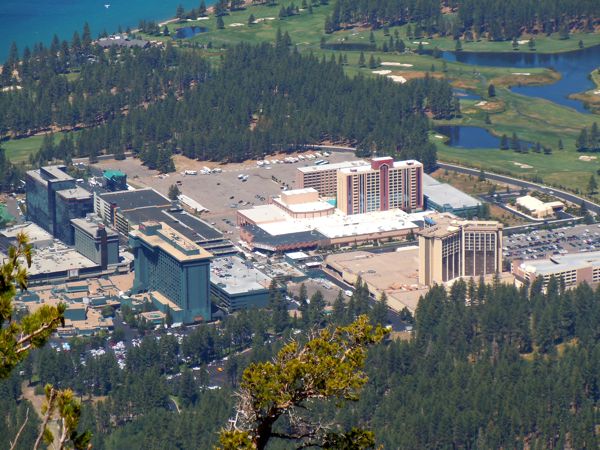
With Douglas County approving new design guidelines, it's possible the Stateline casino core could have more modern look one day. Photo/LTN file

With Douglas County approving new design guidelines, it’s possible the Stateline casino core could have a more modern, even alpine look one day. Photo/LTN file

They are likely to repeat what they said this week at the July 10 TRPA Advisory Planning Commission meeting and July 24 Governing Board meeting.

Douglas County opted to go with an environmental checklist for its review instead of a more stringent environmental process. Staff believes that by following what is in the Regional Plan, which had an environmental impact report and environmental impact statement, that duplicating those efforts was not needed.

Jennifer Quashnick with the Tahoe Area Sierra Club said there is a gap between the Regional Plan and checklist, adding that many of the changes have not been studied.

There is also a memorandum of understanding between the county and TRPA that the conservation groups have an issue with that is likely to be debated further at the TRPA level.

Richard Shaw, with Design Workshop in Aspen, developed the design standards and guidelines for the area plan. He is also the man behind the South Shore Vision Plan and Tahoe City’s Vision.

“It’s a visual guide that establishes the character for the area that is consistent with the mountain setting and environmental conditions,” Shaw said.

He told the commission he sees the document as a guide to what the area could become. He said with revitalization, the South Shore has the “capability to be a full resort community.”

This area plan affects the casino area of Stateline and Lower Kingsbury Grade.

This is a program document. Any projects must still be approved, and depending on what they are may require TRPA approval.

The county and South Lake Tahoe have been talking as each goes through the area plan process. The goal is that similar design guidelines will be adopted so it looks like one contiguous community.

This is more likely to happen if the casinos revamp their facades.

South Lake Tahoe’s plan on the other side of the state line will be the next one the TRPA will review. First, though, it has few local processes to go through. A special council meeting is set for July 2 at 9am at Lake Tahoe Airport, then the negative declaration will be released for a 30-day review. The Planning Commission will discuss the plan Aug. 8 and it will be on the council’s agenda Aug. 20. The APC and Governing Board will vote in September.

A difference with the city is that it must adhere to the California Environmental Quality Act, which can slow the process down.