USFS diverts money from fire prevention to suppression

By Jack Healy, New York Times

WOODLAND PARK, Colo. — A light breeze riffled the tops of ponderosa pines and old Douglas firs on the mountains above this tourist town. It was a serene summer day, but as Jonathan Bruno wandered through the trees, he wondered how long before it all went up in flames.

Jonathan Bruno, who works for a local environmental group, is worried about cuts to programs that help prevent fires.

“It’s just a matter of time,” said Bruno, who works on forest restoration projects for a local environmental group. “I’ve been losing sleep. There’s just not enough money.”
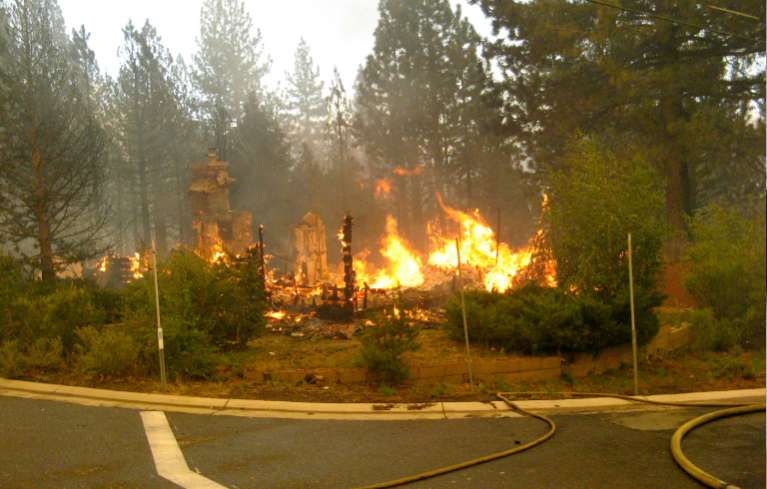
2007 was the worst fire season in the Lake Tahoe Basin when 254 houses on the South Shore were destroyed. Photo/Lake Valley Fire

2007 was the worst fire season in Lake Tahoe when 254  South Shore houses were destroyed. Photo/Lake Valley Fire

As another destructive wildfire season chars the West, the federal government is sharply reducing financing for programs aimed at preventing catastrophic fires. Federal money to thin out trees and clear away millions of acres of deadfall and brittle brush has dropped by more than 25 percent in the budgets for the past two years, a casualty of spending cuts and the rising cost of battling active wildfires.

The government has cut back on programs to reduce fire risks in areas where homes and the wilderness collide. The U.S. Forest Service treated 1.87 million acres of those lands in 2012, but expects to treat only 685,000 acres next year. Conservation advocates say that is likely to mean fewer people working to prevent runaway fires, fewer controlled burns and fewer trucks hauling away dry brush and tinder.

Trimming trees and clearing brush can make blazes less destructive, and the Forest Service said it had treated more than 26 million acres since 2000. But as the government spends an increasing amount to battle wildfires, critics say it makes little sense to cut back on prevention.

“There is a growing consensus in the West that dollar for dollar, these kinds of prevention efforts are paying off,” said Sen. Ron Wyden, Democrat of Oregon. “And when the big fires break out, the bureaucracy steals money from the prevention fund and the problem gets worse. The Forest Service has become the fire service.”

Twenty years ago, the Forest Service spent 13 percent of its budget on fighting fires. These days, 40 percent of its money goes to firefighting, and that is still not enough to cover the bills. Forest officials went $400 million over budget fighting last year’s fires, and they expect to run over again this year.

Automatic spending cuts approved by Congress have pinched in other places. This year, forest officials hired 10,000 seasonal firefighters — a decrease of 500 from a year ago — and say that despite updates to their aging fleet of air tankers, they are also fighting fires with fewer fire engines.

“Obviously, there isn’t enough to go around,” said Tom Harbour, the Forest Service’s director of fire and aviation management. “If you can get the forest in the right condition, we know that homes are going to be safer, forests are going to be safer. But we took a hit there.”

In 2012, the Forest Service and the Interior Department — which also manages huge swaths of public lands — spent about $500 million combined to clear out what they call “hazardous fuels” in fire-prone areas. In budgets for next year, the agencies are on track to receive less than $300 million, according to numbers compiled by Chris Topik, the director of Restoring America’s Forests, a Nature Conservancy program.

Harbour said forestry crews were focusing their prevention work on high-risk areas closest to homes, highways and businesses.

Conservationists and Western politicians say the cuts could not come at a worse moment.

Last year, more than nine million acres went up in flames during one of the worst fire seasons on record. Years of drought and beetle epidemics have turned entire mountainsides into matchboxes, and fire experts say rising temperatures and changing climates are making wildfires hotter, longer and more destructive.

“We’re heading in the wrong direction,” said Sen. Jon Tester, Democrat of Montana, where 150 homes burned in last year’s fires.

This month, Colorado’s most destructive wildfire erupted 25 miles from Woodland Park, in a pine-shaded suburb north of Colorado Springs. It killed two people and burned 511 homes. In southwestern Colorado, fire crews were still struggling on Thursday to contain a blaze that is burning through 83,000 acres, feeding on thousands of beetle-killed spruce trees in the San Juan National Forest.

A walk through the woods or a drive into the mountains shows how vulnerable parts of the West are to fire. Dry soil crunches and crumbles underfoot, and huge patches of dead evergreen trees dot the mountainsides. Across the country, officials say 65 million acres of national forest are at a high risk for fires — an area bigger than Oregon.

Towns like Woodland Park, population 7,200, are tucked into the mountains across the West, islands of development in an ocean of trees. Houses on roads like Forest Edge Road or Ponderosa Way brush up against national forest land, enjoying all the beauty and risk that comes with the location.

As operations director of the Coalition for the Upper South Platte, Bruno spends his days here convincing homeowners to trim low-hanging branches and identifying thick hillsides that could be the next to set off an inferno.

Studies have shown that thinning out forests — whether on one homeowner’s land, or a huge national landscape — can help keep fires in check, burning along the ground rather than racing from treetop to treetop. In the Southwest, treating land helped to control wildfires 87 percent of the time in 2011, and in 75 percent of cases last year, according to Forest Service data.

Some sections of Pike National Forest here have been thinned, spacing out the trees and removing low-hanging branches. But thousands more acres are dense tinderboxes, Bruno said.

“If the fire got in,” he said, “this town would not be here.”



2 arrested, 1 hospitalized in S. Tahoe fight

A house party Thursday night in South Tahoe ended with a fight a couple miles away that sent one person to the hospital and two people to jail.

Police were called to the house on Juniper Street before midnight June 27 because of loud music. On the second visit a citation was issued. (Police are still trying to identify the owner of the house.) The third visit was because of a report of a battery, which no one wanted charges filed on.

About 12:30am Friday police responded to a fight on James and 12th streets where a carload of men got out to beat up another group of men, according to police.

Lt. Brian Williams told Lake Tahoe News some of the participants of the fight were at the party. But what triggered the fight is still unknown.

Manny Ayala and Valente Uribe, both 18-year-olds from South Lake Tahoe, were arrested on three felonies – assault with a deadly weapon, battery with serious bodily injury and conspiracy to commit a crime.

Two people were injured, though neither of their names is being released. Both are adult males from South Lake Tahoe. One was knocked unconscious and taken by Calstar to Renown Medical Center in Reno. The other was the person who called the cops about the fight; he refused medical treatment.

Williams said so far there is no gang connection. The investigation is ongoing.

— Lake Tahoe News staff report


Plenty of variety in Tahoe luxury home market

By Kathryn Reed

For those with $42.995 million to spend it will get you a lakefront compound on five parcels with four houses. Those looking for some history might be interested in the former Howard Hughes estate that is selling for $19.5 million. Those with a more modest budget should check out the $2.495 million cabin that was built in 1926.

These were just three of the 23 houses available to tour on June 26 during the 17th annual Chase International Lake Tahoe Lakefront and Luxury Estates Tour.

Agent Sue Lowe, who organizes the event, was at a house on Skyland Boulevard that is going for $4.95 million. She explains Nevada property taxes to a potential buyer – how they aren’t configured anything like California’s, and how Douglas County where the house is located has much lower taxes than Washoe County.

The living area of this Fallen Leaf Lake house is inviting. Photos/Kathryn Reed

The living area of this Fallen Leaf Lake house is inviting. Photos/Kathryn Reed

Most of the houses on this tour are right on the water.

Lowe tells Lake Tahoe News these properties are still the most appreciated in the basin, with lake views second most popular.

It’s the rare property that has a pier, boathouse and sandy beach. Some don’t have any of those amenities. This house has the beach – which in itself is rare for this side of the lake, which is traditionally rockier.

The houses are all over the board in terms of what they look like from the outside, the character inside and the price range. The least expensive was $2.195 million in Meeks Bay. The most expensive was $42.995 million in Incline Village, which was recently reduced from $49.9 million.

The latter is known as Sierra Star. Tom Gonzales, founder of Commerce One, assembled the five parcels that have four houses. In what is called the Carriage House he used to have 100 motorcycles. There is 2,000-square-feet of garage space.

Below that is 10,000-square-feet – mostly concrete. A lift that can hold 250,000 pounds is off to the side.

The top floor is another 2,000-square-feet. It’s where the mechanics and others lived.

The main house is 10,000-square-feet. The other two structures – or guesthouses – are each 4,000-square-feet.

It’s possible to buy the whole 4.3-acre compound or pieces of it.

“The luxury market is heating up with increased activity around the lake,” Lowe says.

In the last eight months two houses on the lake each sold for more than $20 million. That hadn’t happened since 2008.

December 2012 was the hottest December that Lowe can remember. She attributes it to Californians being fearful about Proposition 30 and wanting out of the state, as well as the uncertainty of what the capital gains rate would be.

“In California, people realize we’ve hit bottom and if they want a slice of heaven, they need to do so now to get the best possible price,” Lowe said.

Another house that had lots of visitors on Wednesday was the property in Crystal Bay that was once owned by Howard Hughes. It’s known as Summertide.

The price tag is $19.5 million. The kitchen is small, but it’s been remodeled and feels very modern with the granite and high-end appliances.

The main area has a rustic, comfortable feel to it. The bottom floor has three rooms that seem more like hotel rooms with a shared balcony.

Someone on the tour said it’s about 200 steps down to the cottage that is closer to the water. Even from there it’s more steps to the alcove.

A cabin sandwiched between two larger homes is selling for $2.495 million. It was built in 1926 and feels like it hasn’t had any upgrades since the 1970s. There is no insulation, according the agent stationed at the property.

From the deck looking right is Zephyr Cove Resort – a quiet and raucous neighbor depending on the time of the year.

Another oldie is the $2.295 spread in Cascade Properties. It was built in 1961 and the original family is selling it. It’s been on the market two weeks. The driveway is harrowing and the inside stairs are probably not up to code. The setting is idyllic. The land is what this is about, not the house.

Out at Fallen Leaf Lake is a $4.495 million three-cabin spread. It also comes with three docks. The spaciousness of the main room in the largest of the three buildings would be ideal for entertaining, as would the kitchen.

The deck on one of the cabins is about as big as the interior.

According to Lowe, the market is improving in all price ranges — not just the seven-plus figure houses.

ngg_shortcode_0_placeholder (Click on photos to enlarge.)


Out of town cops raid empty Tahoe house

Citrus Heights cops raided an empty house on the South Shore earlier this month.

Western Highland Mortgage owns the house on Guadalupe Street. An employee with the company said the house is vacant and for sale, and that “it was obviously a mistake” by the cops. He didn’t want to comment further.

Jeff Catchings, with the South Lake El Dorado Narcotics Enforcement Team, said the Citrus Heights officers were following up on a case that involved a drug lab explosion. He told Lake Tahoe News one of the suspects in that case used to live in the El Dorado County house.

The lead detective from Citrus Heights Police Department was not available for comment.

El Dorado County sheriff’s deputies were on scene when this went down. Lt. Pete Van Arnum said it’s a courtesy among agencies to let another one know when a search warrant will be executed.

When a search warrant is executed officers surround the house to secure the perimeter, if no one answers, then forced entry is allowed – as was the case June 19 at the Guadalupe house.

— Lake Tahoe News staff report


Felon accused of possessing stolen gun

John Liska

John Liska

A convicted felon was found driving through South Lake Tahoe with a stolen gun in his vehicle.

John Liska, 34, of South Lake Tahoe was pulled over in a routine stop about 6pm June 26. South Tahoe officers said at first the suspect gave a false name.

Officer Chris Webber recognized Liska’s name as that of the suspect in an active criminal case he had investigated in May involving a local vehicle burglary. In that vehicle burglary, a check was stolen, forged and passed for cash at a South Lake Tahoe bank.

Liska is a convicted felon from Alaska.

Officers said when they searched Liska and his vehicle they found the stolen firearm, ammunition, metal knuckles, an illegal spring-loaded knife, a sap (a sap is weapon which is typically a flat-profiled, leather-covered lead rod, fitted with a spring handle, and is a felony to possess in California), marijuana and drug paraphernalia.

Weapons confiscated on June 26 in South Lake Tahoe. Photos/Provided

Weapons confiscated on June 26 in South Lake Tahoe. Photos/Provided

— Lake Tahoe News staff report


President releases sweeping global warming plan

By Paul Rogers, San Jose Mercury News

In the most sweeping action the federal government has taken to date to combat the warming of the planet, President Obama on Tuesday announced the nation’s first mandatory restrictions on greenhouse gas emissions from new and existing power plants.

The new rules, a centerpiece environmental initiative of Obama’s presidency, follow the lead that California set last year when it began to impose statewide greenhouse gas limits on power plants, factories and other industrial sources.

Speaking at Georgetown University, Obama took a swipe at climate deniers and described global warming as a major threat to the nation’s economy, farm production and its environment, noting that severe storms, droughts and forest

“We limit the amount of toxic chemicals like mercury and arsenic and sulfur in our air and water,” Obama said. “But power plants can still dump unlimited amounts of carbon pollution into our air for free. That’s not right. That’s not safe. And it needs to stop.”

The announcement sets up years of legal and political battles, with environmentalists and the administration on one side and the coal and utility industry, along with most Republicans in Congress, on the other. Opponents contend that the rules will cost too much and drag down the economy.

Experts said Tuesday that the president’s new climate strategy — which does not require approval from Congress — is expected to boost Silicon Valley companies involved in solar, wind, energy efficiency and other cleantech businesses, while also spurring more construction of large solar and wind projects in the Southern California desert.

“This is important for our environment and for the Silicon Valley companies that have made this the cleantech hub of the world,” said Carl Guardino, CEO of the Silicon Valley Leadership Group. “Companies like SunPower, SolarCity and Tesla Motors are leading the way in developing the innovative technologies and financing we need to meet the goals of deploying more renewable power, advancing energy efficiency and delivering on the promise of next-generation transportation.”

Obama’s new strategy on climate change also included broad new initiatives to increase renewable energy construction on federal land, tighten rules for appliance efficiency and begin planning for coastal cities and other areas to deal with the effects of the warming climate.

“This is exactly the way environmental policy moves forward in this country,” said Mary Nichols, who chairs the California Air Resources Board. “California starts out and takes a leadership post, then other states join in and the federal government comes in, and eventually we get a nationwide program. I think it’s great.”

Power plants — mostly from the burning of coal and natural gas to generate electricity — produce 33 percent of the nation’s greenhouse gases, the largest source. By comparison, all cars, trucks, planes, trains and boats account for 28 percent.

Obama is able to crack down on the dirtiest power plants through executive action.

In 2007, the U.S. Supreme Court ruled that the federal Environmental Protection Agency can regulate carbon dioxide, the primary gas that traps heat in Earth’s atmosphere, under the Clean Air Act — the same as it does with soot, lead and other types of air pollution.

“This is the change Americans have been waiting for on climate,” said Michael Brune, national executive director of the Sierra Club, based in San Francisco. “President Obama is finally putting action behind his words.”

Coal industry and utility groups are expected to try to block the rules through lawsuits. The new regulations, scheduled to be released next summer by the EPA, will make coal-fired power plants — which emit more greenhouse gases than other types of power plants — more expensive to build and operate.

“The last thing our economy needs right now is another layer of government red tape that will make it harder to grow businesses and hire more workers,” said House Speaker John Boehner, R-Ohio.

Obama’s new climate plan also directs the Interior Department to approve enough renewable energy projects, such as solar and wind, on public lands by 2020 to power 6 million homes. Millions of acres of California desert are federally owned by the Bureau of Land Management. In addition, it makes up to $8 billion in loan guarantees available for energy efficiency projects and advanced fossil fuel technology.

It also expands energy efficiency standards for federal buildings and home appliances, an area where California has led since the 1970s. And the plan commits to developing new gas-mileage standards for heavy-duty trucks on 2018 models and later.

Nichols said she doesn’t anticipate the new rules on power plants will upend California’s carbon-trading market or result in higher utility bills for California consumers. She noted the state already has a law requiring mandatory carbon limits from power plants and that California law requires that 33 percent of the state’s electricity come from renewable sources by 2020.

California uses very little coal-fired electricity because coal is not mined in the state and because power plants run on natural gas, which burns more cleanly, and have fit better with the state’s strict smog regulations. California’s electricity mostly comes from natural gas, hydroelectric power, nuclear energy and renewables.

Globally, the 10 hottest years on record have all occurred since 1998. Sea level rose 7 inches in the 20th century. Ice sheets in Greenland, Antarctica and the Arctic sea are all shrinking in size, as are most of the world’s glaciers.

“We don’t have time for a meeting of the Flat Earth Society,” Obama said. “Sticking your head in the sand might make you feel safer, but it is not going to protect you from the coming storm.”


Antibiotics in food chain affecting human health

By Monica Eng, Chicago Tribune

While Sam Spitz’s friends were loading up on pizza for lunch, the Whitney Young High School sophomore opted for a chicken Caesar salad.

Spitz was in training for a big sophomore baseball season — after having pitched on the school’s varsity team as a freshman — so, he says, he “wanted to make the healthy choice.”

But soon he was not so sure he’d chosen wisely. Severe gastric distress kept him in the bathroom for hours, and eventually he started losing blood.

After multiple trips to the emergency room, Spitz learned he’d been infected with an antibiotic-resistant strain of campylobacter, a pathogen most commonly linked to poultry. He blames the salad, as the chicken Caesar was his only source of poultry that week.

One month, 30 pounds and several failed antibiotics later, Spitz had lost his baseball season along with much of his confidence. He’d also lost a lot of faith in the “miracle drug” of the 20th century, antibiotics.

“I was 15 and I never pitched in high school again,” said Spitz, now 22. “I’d spent that entire offseason training, and I was stronger than I’d ever been. I thought I was invincible, but I watched myself and my baseball career wither away. … I thought antibiotics were supposed to work. But they didn’t and that was terrifying.”

Concern has been intensifying in recent years over the use of antibiotics in agriculture, which world health authorities agree contributes to the development of drug-resistant bacteria. These so-called superbugs infect hundreds of thousands and kill tens of thousands of Americans each year, according to the Centers for Disease Control and Prevention.

Legislation before Congress would rein in the use of medically important antibiotics on healthy livestock through mandatory restrictions as well as public disclosure of how antibiotics are used on animals and in what quantity.

But such efforts face resistance from the meat industry, and the U.S. Food and Drug Administration says the issue is better handled through voluntary guidelines it hopes to finalize this year, including more veterinary oversight.

Critics doubt that a voluntary approach would decrease use and say the current lack of transparency would prevent anyone from knowing whether it did — an issue also noted by the Government Accountability Office.

Health authorities say antibiotics should be used sparingly because any bacteria that can survive the drugs will multiply, increasing the strain’s overall resistance. Dr. Jean Patel, deputy director of the Office of Antimicrobial Resistance at the CDC, calls antibiotic resistance one of the nation’s most serious health threats.

“Resistance often emerges in the health care setting where antimicrobials are commonly used,” Patel said, “but these drugs are also used on the farm, and a number of foodborne pathogens, like salmonella, are becoming increasingly resistant to antimicrobials that are important for human health.”

The Environmental Working Group, a research and advocacy group, analyzed government data and reported last month that 69 percent of pork chops and 81 percent of ground turkey sampled in 2011 were contaminated with antibiotic-resistant bacteria. Turkey raised without antibiotics — including organic turkey — carries fewer such pathogens, according to recent research by Consumers Union, the advocacy arm of Consumer Reports.

About 80 percent of all antibiotics sold by weight in the U.S. in 2011 were used on livestock, according to FDA figures. That year, 7.3 million pounds of antibiotics were used to treat humans, compared with 29.9 million pounds sold for meat and poultry production.

All parties in the antibiotics debate agree that it makes sense to treat sick animals with appropriate antibiotics. And nearly all say that using antibiotics just to make animals grow faster — a practice long banned in the European Union — is, as the FDA puts it, “injudicious.”

If the FDA’s voluntary guidance is finalized this year, livestock producers will be asked to stop using antibiotics solely to fuel growth starting sometime in 2016. Antibiotics still could be given to animals to control and prevent disease, but licensed veterinarians would oversee the process.

Critics say the strategy is too weak. Noting that many antibiotics are marketed for growth promotion as well as disease prevention, environmental and consumer groups fear that animals will remain on a steady diet of antibiotics, if for different stated reasons.

“The first problem is that it is voluntary. As far as we are concerned the FDA has tried a voluntary approach on this for almost 40 years, and it hasn’t worked,” said Avinash Kar, an attorney who works on antibiotic issues for the Natural Resources Defense Council, an environmental advocacy group. “The second problem is that it leaves a giant loophole for so-called preventive uses.”

Dr. Bill Flynn of the FDA’s Center for Veterinary Medicine said the agency does not condone using preventive antibiotics for “just whatever disease might come along” in a herd of healthy animals. “Licensed veterinarians will need to play a key role in making sure these drugs are used appropriately,” Flynn said.

A bill from Democratic Rep. Louise Slaughter of New York, a microbiologist, would take a stricter approach, aiming to preserve the effectiveness of medically important drugs by limiting their use in animal agriculture. But that effort does not have the support of the FDA or the major players in the livestock and pharmaceutical industries.

“Antibiotic resistance is a very complex topic,” said Liz Wagstrom, the National Pork Producer Council’s chief veterinarian. “And so what might be appropriate for one bacteria in one type of animal might not be appropriate for another. So the idea of legislating this with a broad-based ban doesn’t seem appropriate.”

Speeding growth with antibiotics allows animals to eat less food over a lifetime, leaving “more corn available for the production of renewable fuels and less manure for the producer to manage,” according to the pork council. It also says its research has found a negligible direct risk to humans from antibiotic resistance linked to agricultural uses.

Two other bills in the House and Senate would require the FDA to make public the data it collects on how the drugs are marketed and used on animals, as well as require the agency to collect more information that could indicate, for example, whether drugs are being used to compensate for unhealthy living conditions.

Flynn said the agency is exploring its own “approaches for enhanced data collection” with a goal of having some baseline data before the voluntary guidance goes into effect.

In addition to legislation, some advocacy groups have launched legal challenges. The Natural Resources Defense Council successfully sued last year to compel the FDA to follow up on its own 1977 findings that nontherapeutic use of penicillins and some tetracylines was leading to antibiotic resistance and should be stopped. The FDA has appealed.

In April, month Spitz and his mother, Jennifer Amdur Spitz, traveled to Capitol Hill with other survivors, scientists, doctors and chefs to support legislative action in Congress.

Everly Macario, of Chicago, who has a doctorate in public health from Harvard University, told of losing her 18-month-old son, Simon, in 2004 to methicillin-resistant Staphylococcus aureus, or MRSA.

Macario says her previously healthy and hardy boy contracted the infection one night and was dead within 24 hours despite the use of a powerful broad-spectrum antibiotic. Even with her public health training, Macario said, she wasn’t aware how serious the issue of antibiotic resistance had become.

Even in “highly educated, high-income circles,” she said, “many still don’t know what MRSA is or they don’t understand how it is connected to antibiotics given to food animals.”

Like Macario, Spitz and his mother said they were grateful to have the opportunity to speak to lawmakers but found the experience dispiriting in the end.

“We came to Washington for only one day, and all we had to share were our stories,” he said. “But industry lobbyists are there every day, and they come bearing real gifts.”

As the legislative and legal battles drag on, some advocates say the fight also must be taken directly to the consumer.

Spitz’s father, Jeff, a documentarian, and his wife are making a film called “Food Patriots” that highlights food innovators around the nation and ways consumers can vote with their dollars for a safer and healthier food production system.

Amdur Spitz also started a petition in March on change.org urging the U.S. Department of Agriculture to ensure that at least some meat distributed to schools through its commodity program be raised without the use of antibiotics.

The Northbrook mom, a strategic communications consultant, notes that Chicago Public Schools already buys chicken raised without antibiotics for school meals once a month. A nationwide program, she said, would help preserve the effectiveness of antibiotics while offering safer meals and a lesson for students.

“The first thing is that you reduce the risk of superbugs in our children’s meal,” Amdur Spitz said. “And the second is that you create a dialogue at school and in the community about antibiotics in animal agriculture. … At the same time it pushes the marketplace toward producing more meat in ways that are healthier for the public.”

Some Chicago institutions, including O’Hare International Airport, Midway Airport, Shedd Aquarium and McCormick Place, recently announced or completed plans to source a portion of their meat from producers that don’t use antibiotics. The Chicago-area restaurants Sopraffina, Poag Mahone’s and Trattoria No. 10 say 100 percent of their meat is raised without antibiotics, amounting to about 400,000 pounds a year.

Consumer groups and other advocates say they will continue to apply pressure in Washington, though Macario said she is frustrated by the slow pace of legislative change.

“I just don’t get it,” she said. “I can’t understand why more people aren’t freaked out that we are on the precipice of a postantibiotic era.”


Lukins, STPUD reach deal on TJ Maxx building

By Kathryn Reed

A deal between two South Lake Tahoe water companies has been reached. All that is needed is approval by the state Public Utilities Commission. And that could come this week.

The CPUC must approve the expense of the connections that will provide fire suppression, if needed, to the building that houses TJ Maxx at the Y.

Lukins Brothers Water Company has agreed to buy a fire-only connection from South Tahoe Public Utility District for $147,566.52.

When TJ Maxx moved in last fall a temporary agreement was worked out between the water companies. The new agreement is the permanent solution.

The Garfinkles own the TJ Maxx building, which also includes an adjacent empty retail spot. They will be footing the bill.

“I don’t want to charge my customers something they are not benefiting from and the PUC won’t allow it,” Jennifer Lukins, operations manager for Lukins Brothers, told Lake Tahoe News. “The PUC looks at who is requesting service and who is it going to benefit. The Garfinkles are requesting service and the Garfinkles are getting the benefit.”

After the new 8-inch main is in place, the existing intertie between the two water systems at Eloise Avenue and Dunlap Street will be closed.

South Lake Tahoe Fire Department is also requiring a private fire hydrant be installed on site.

When TJ Maxx moved in they required that all utilities be separated from the adjoining building. However, the changes will benefit that side of the building as well. The Garfinkles are in negotiations with a potential tenant for that section, but nothing could move forward without the water situation being resolved.

Another factor in all of this is that the building next to the Garfinkles’, which is owned by someone else, could tap into the 8-inch line. If that were to occur, the two property owners would split the cost.

“Any sprinkler system required for a new building being discussed at the location of the old AAA building could also be connected to a short extension of the 8-inch main as well,” explained South Tahoe PUD General Manager Richard Solbrig.

There have been preliminary discussions of tearing down the existing building and replacing it with something else.


3 people hurt in 2-car accident

Three people were injured after two vehicles collided near Zephyr Cove early Wednesday morning.

Nevada Highway Patrol troopers are still investigating what led to the crash at 6:50am June 26 on Highway 50 just west of Zephyr Cover.

The driver of this vehicle was not hurt June 26. Photo/Provided

The driver of this vehicle was not hurt June 26. Photo/Provided

Names of the people involved in the accident have not been released.

Troopers say a green 1993 Cadillac four-door sedan was going east when the male adult driver crossed the double-yellow line. That vehicle struck the front portion of an approaching blue 2010 Subaru Forester that was driven by an adult female.

The male driver sustained serious injuries and was airlifted to Renown Medical Center in Reno by Care Flight. The two young children riding with him received minor injuries and were transported by ground ambulance to Barton Memorial Hospital in South Lake Tahoe. The female driver was not injured.

All lanes of the highway were closed for about 90 minutes.

— Lake Tahoe News staff report


Nutting faces 4 felonies; judge being sought to hear case

By Laura Cole, CBS-13

El Dorado County Supervisor Ray Nutting has been indicted by a grand jury on four felony counts, CBS13 has learned.

After more than a dozen witnesses’ testimony, jurors at a May closed-door hearing determined there was enough evidence to indict the El Dorado County supervisor.

Nutting’s family received or applied for $206,000 in taxpayer money for clearing brush and trimming trees on his own land.

Ray Nutting

Ray Nutting

In a March 27 interview with CBS13, Nutting said of the work, “Almost all of this is for my own labor.”

However, in a 2009 state invoice, Nutting said none of the money was for work that he performed himself.

Nutting eventually said it was a clerical error committed by Mark Stewart, an expert hired to oversee his project.

Under sworn testimony, Stewart admits it was his fault, saying “It should not have been a zero, and I think that was (sic) mistake where I had printed out.”

He goes on to say, “I didn’t catch that the zero was for my own labor on there.”

But Nutting still signed the invoice, and the grand jury found enough evidence to charge the supervisor with filing a false document.

Nutting’s also indicted for failing to report more than $120,000 on his state financial-disclosure forms, and voting to approve more than $600,000 in taxpayer money toward contracts to districts which had a role in awarding him state grants.

And under grand jury questioning, Nutting invoked his Fifth Amendment right and was excused.

But last week he issued a public statement saying, I fully intend to be acquitted in a court of law as quickly as possible, and then return to perform all the duties for which I was elected.”

Nutting still hasn’t been arraigned and doesn’t have a date for his arraignment, yet. This is because of the difficulty in finding a judge in the county who doesn’t have a potential conflict of interest with the supervisor. The trial will begin once the arraignment is complete.