Conservationists score with court’s biomass ruling

By Tennille Tracy, Wall Street Journal

WASHINGTON — A federal appeals court on Friday put pressure on the Environmental Protection Agency to move quickly on a rule that addresses carbon-dioxide emissions from power plants that burn timber and agricultural waste to generate electricity.

The U.S. Court of Appeals for the District of Columbia Circuit struck down an EPA rule postponing greenhouse-gas standards for new biomass power plants, but it didn’t specify a timetable for the agency to act. The court said the EPA had failed to justify its reasons for the delay.

The ruling comes just weeks after President Obama unveiled a broad new plan to address climate change, targeting mostly emissions from power plants that burn coal or natural gas.

Friday’s decision could also have a direct impact on a handful of new facilities that recently obtained permits or are in the process of getting them now.

“Our industry needs regulatory certainty so that biomass resources can be utilized to their fullest extent,” said Bob Cleaves, president of the Biomass Power Association.

EPA spokeswoman Enesta Jones said the agency “will review the decision to determine any next steps.”

At issue is the EPA’s 2011 decision to postpone a greenhouse gas rule for “biogenic” sources of carbon dioxide—that is, emissions that come from materials other than fossil fuels.

The EPA said at the time it needed three years to study these emissions because their net effect on the environment is difficult to calculate. Part of the equation, the agency says, is figuring out much carbon dioxide trees and other biological materials absorb from the atmosphere before being decomposed or burned, emitting carbon dioxide back into the atmosphere.

Biomass power plants are one large source of these emissions, but landfills, ethanol producers and other facilities also emit carbon dioxide.

The industry says biomass plants are far better for the environment than facilities that burn fossil fuels, but critics disagree.

Kevin Bundy, senior attorney with the Center for Biological Diversity, the group that sued the EPA, said the emissions still needed to be addressed. “There has been a huge push over the last few years to build these wood-fired power plants, under the theory that it’s clean power,” Bundy said. “Our real concern is that this rush to build these plants will actually make the climate problem worse.”


2 men accused of strong armed robbery being sought

South Lake Tahoe police are looking for these two men.

South Lake Tahoe police are looking for these two men.

Two suspects are being sought in the beating of a South Lake Tahoe man that occurred behind Whiskey Dick’s bar.

About 2am July 10 the 25-year-old said he was accosted by two men and then had his skateboard, which worth more than $200, stolen from him. The confrontation, according to officers, started in the bar. Then the victim left. But the suspects followed him and him allegedly beat him outside.

The victim, whose name has not been released, said he was punched more than 10 times.

He last saw the two men going east through the meadow toward William Avenue.

The first suspect is described as a Hispanic male, 5-foot-6 to 5-foot-8, age 30 to 35, heavy-set build, wearing backward black baseball cap. He is smoking a cigarette in the photo.

The other suspect is a white male, with scruffy beard, age 30-35, wearing gray hooded sweat shirt.

 — Lake Tahoe News staff report


Nutting not shying away from public

By Laura Cole, CBS-13

The El Dorado County supervisor who is facing criminal charges had his first town hall since his arrest on Wednesday.

While the topic of the night was land-use issues, Ray Nutting’s recent arrest and investigation into perjury and conflict of interest charges were also on the menu.

He walked away from CBS13’s camera, but eventually came back.

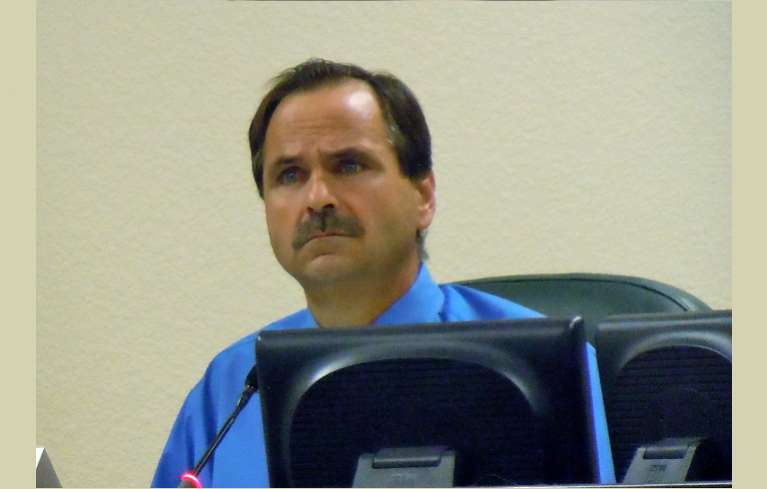
Ray Nutting

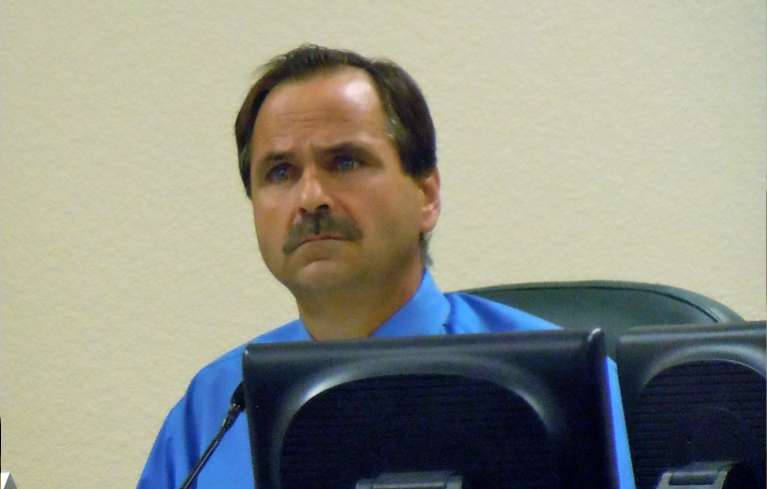
Ray Nutting

“I voted for the man,” said Janet Maynard. “I still think he should step down for the good of the community.”

He’s also facing charges of filing false documents, all of which stem from taxpayer dollars Nutting received for work he’s done clearing brush and trimming trees on his own land, as well as other income he didn’t report on state financial-disclosure forms.

But despite the charges, many at the meeting support Nutting.

“I think he’s innocent until proven guilty, and carry on like you’ve been doing until something else happens,” Skip Kelly said.

“Only an idiot would convict a person before trial,” said Richard Johnson.

But others worry about what his votes as a county supervisor could cost taxpayers.

“Every time he votes on something, if he doesn’t clear up his personal agenda with these legal issues, this is all going to come back to the county as cost,” said Sam Teresi.

Nutting’s response: “I plan on being exonerated by September and there will be no problems.”

At this point, he remains on the board, but recuses himself from voting on any financial matter on advice from county counsel.

His arraignment is scheduled for later this month.


Barton turns community clinic into health center

By Kathryn Reed

Walking in the front door it’s like entering brand new doctors’ offices. Gone is the cramped, dingy reception area. Beyond the waiting area are exam rooms that while sterile in a good way, are welcoming.

And gone is the name. Barton Community Clinic is now Barton Community Health Center.

“It’s a better fit for what we provide,” Barton spokeswoman Monica Sciuto said of the new name.

Barton Health Care Center

Barton Health Care Center on South Avenue in South Lake Tahoe near Barton Memorial Hospital. Photos/Kathryn Reed

It was in 1989 that doctors Paul Rork, Greg Bergner and Martin started the clinic. Barton took over in 1995. Martin is the only one still directly involved with the clinic.

For the past year the clinic-health center has been going through more than just a remodel. It is now a 7,379-square-foot facility. An additional 3,000-square-feet was added to the existing structure. It went from 11 exam rooms to 18, which includes two procedure rooms.

The front door is on the opposite side of the building. The old front door is now the employee entrance. And what was the waiting room is a doctor’s office.

The doors on the $1.4 million renovation were opened last month, with the official dedication planned for July 27.

Debbie McCarthy, outpatient clinical director, came on board three months ago to head the facility. She also runs Barton Family Medicine.

She didn’t get to see what the old facility looked like, but she has heard plenty of stories.

Three hallways divide the care areas. The ob-gyn area is set off in its own area, with an entrance next to the main one. This is so if someone from the general population has chicken pox or something else contagious, the expectant mother will not come in contact with that person.

The reception is more professional then the old clinic.

The reception is more professional then the old clinic.

The plan is to provide services from day one of pregnancy through post partum. Other services are being talked about – like nutrition, adding a social worker, teaching how to breast feed and how to use a car seat.

With the state projecting a 40 percent increase in Medi-Cal patients when the Health Care Reform Act takes effect Jan. 1, Barton Community Health Center knows its numbers will go up as well.

Barton is already doing outreach to let people know about the changes that are coming because of the federal medical reforms, but also plans to do more to reach the community that today is uninsured.

The facility primarily serves the uninsured on the South Shore, along with those on Medi-Cal, Medicare or who have limited insurance.

The center is averaging about 1,200 patients a month, with 1,113 coming in May, the last month numbers are available. Demand for services has been increasing since January 2009. The clinic has treated 1,600 patients in a month.

To help with demand the center is open on Saturdays. But for now, no staff has been added. There are five nurse practitioners, two physician assistants, four registered nurses, two medical assistants, four technician-receptionists, and six receptionists. That would change if the patient numbers spike 40 percent.

(Some jobs are being reclassified as the health center approach is implemented. More training is taking place as needed.)

Exam rooms are new or completely remodeled.

Exam rooms are new or completely remodeled.

General practitioners come in, as well as specialists, plus there is a growing telemedicine component.

Going from clinic to health center, it’s less about giving a patient a pill and sending them home and more about education, prevention and follow-up consultations to cut down on repeat visits.

“It’s wellness focused, not illness focused,” McCarthy said. “As we get more people who will quality for insurance, we hope they will seek health care and focus more on prevention and a better quality of life.”

The medical home model is being looked at. It’s about whole care coordination. It’s about educating people about their disease, following up with them via telephone, and having an RN on call 24 hours to answer questions.

“Especially with chronic diseases you want quality of life,” McCarthy said.

While the center is operating as usual, a few things are still being ironed out. And it is clear the decorating is one of the last items to be addressed.

—-

Notes:

• Open house on July 27 from 9-11:30am, 2201 South Ave., South Lake Tahoe. There will be tours and free health screenings.

• Funding: Barton Foundation $137,441; Barton Memorial Hospital Auxiliary more than $1 million.

• Barton Health has information online about the Health Care Reform Act. People will be able enroll in the health care exchanges in California and Nevada in October.


Air quality station at LTCC to aid students, TRPA

By Kathryn Reed

An air quality station that is going to be installed at Lake Tahoe Community College by the Tahoe Regional Planning Agency is also going to have an educational component to it.

The college board at its meeting last week heard a presentation by a member of the bi-state regulatory agency about the station that will monitor visibility, ozone and meteorological data. The board is expected to vote on the MOU at the Aug. 13 meeting.

The two entities are entering an agreement to place the device behind the physical education building near the South Tahoe Public Utility District pump house.

Hazy skies in Lake Tahoe on July 14 are from fires outside the basin. A station at LTCC will soon be able to monitor the air quality. Photo/LTN

Hazy skies like these on July 14 in Lake Tahoe might be something the station at LTCC would soon be able to monitor. Photo/LTN

“To provide mutual benefit with LTCC, we will provide the Science Department with a web–based display of the meteorological and particulate sampling from the equipment,” Jeff Cowen, TRPA spokesman, told Lake Tahoe News. “The primary intent of the LTCC monitoring station is to gauge how the basin is doing in terms of regional and sub-regional visibility, which is a measure of particulate matter in the air from wood smoke and suspended soil.”

According to the July 9 LTCC staff report, “Graphic display of the monitoring data will include hourly, daily and historical air quality trends on a 32-inch LCD screen.”

TRPA used to have a monitoring station near Timber Cove in South Lake Tahoe. The agency has had a station at D.L. Bliss State Park since 1991, and also has facilities in Kings Beach, Tahoe City, Incline Village, Echo Summit and at its Stateline office.

Air quality is one of the thresholds in TRPA’s Compact.

The Tahoe Basin Regional Air Quality Monitory Program is a jointly managed by TRPA, California Air Resources Board, UC Davis, Desert Research Institute and the Environmental Protection Agency.

TRPA is responsible for paying for the installation of the station at the college as well as all operational and maintenance expenses. This includes installing power, telephone service and fencing.


Agencies linked to Nutting want funds restored

By Peter Hecht, Sacramento Bee

In the 375-page El Dorado County grand jury transcript of The People v. Raymond James Nutting, a prosecutor took aim at two checks that an official from an obscure local resource district co-signed on behalf of another agency.

Deputy District Attorney James Clinchard asserted the state fire prevention grant checks paid to Nutting in 2009 were evidence the four-term county supervisor was guilty of a felony conflict of interest.

Ray Nutting

Ray Nutting

Yet now, following the release of the grand jury transcripts, two El Dorado County resource districts – and a former official who co-signed the checks to Nutting – wonder about the prosecution’s assertions.

They question authorities’ theory of political corruption that connects Nutting’s grant income to his votes to fund two other local districts that handle conservation projects.

They contend the local resource districts have been unfairly tainted by the Nutting controversy and – as a consequence – have temporarily lost their county funding until the matter is sorted out.

“I want to assure you there is no collusion going on and no special favors,” said Al Hubbard, who served until 2012 on the Georgetown Resource Conservation District, a local board that pays state and county money to contractors for fire safety, water and habitat projects. “I can promise you that.”

Read the whole story


Saturday voting may be possible for all Californians

By Annalise Mantz, Sacramento Bee

For California voters, finding time to cast ballots on a Tuesday could become a thing of the past.

A bill by state Sen. Leland Yee, D-San Francisco, would give them a chance to vote on a Saturday in the month before an election. Senate Bill 637 would require counties to have a polling place open for early voting for four hours on at least one Saturday in the 29 days before Election Day.

Twenty-five counties in California already allow voters to cast a ballot on a Saturday before Election Day, according to a survey conducted by the Los Angeles County registrar of voters in 2012. Nationwide, 32 states and the District of Columbia allow early voting in addition to mail voting.

Yee, who is running for secretary of state in 2014, said local elections with low turnout rates, such as the 23 percent of voters who cast ballots in June’s Los Angeles mayoral race, show voting needs to be more accessible. He blamed low participation rates on the stresses and time commitments of a hectic lifestyle.

Read the whole story


California milk war heating up

By Michael B. Marois, Bloomberg

Ray Souza’s voice cracks a bit when he says it, when he tells how his family’s Turlock dairy farm is struggling to pay the bills.

“We go from black to red month by month,” the 66-year-old said. “For us, it’s break even at best.”

Souza is like many other dairy farmers in the state who say the price they’re paid for milk from cheese producers isn’t enough to cover the soaring cost of feeding cows. Those economics have caused a fifth of California’s dairies to shutter since 2007, according to state agricultural figures.

California is the largest milk-producing state in the U.S., accounting for 20 percent of the national supply. Cheesemakers buy about 43 percent of all the milk produced in California at prices set under the state’s unique pricing system rather than by federal formulas.

The dairy industry has petitioned the state to raise the prices cheesemakers must pay to buy California milk and have sought legislation to change a pricing system that dates to the 1930s. The producers say raising prices will harm them, the very people the dairy farmers need to buy their milk.

“There needs to be a balance between producer prices and what the market can bear in terms of the product we manufacture and the market for those products,” said Rachel Kaldor, executive director of the Sacramento-based Dairy Institute of California, which represents processors. “In order for us to be able to stay in business, we need to be able to buy milk at a price that allows us to do that.”

Under California’s system, the state Food and Agriculture Department sets the minimum price for five classes of milk. The most expensive is fluid milk found at the dinner table. The cheapest is cheese. The system was set up in part to encourage more cheesemakers to open plants in California.

Farmers say the state system pays less than federal prices for milk used to make cheese and for whey, a dairy byproduct. California’s system worked for dairy farms a half-century ago, when 60 percent of milk sold was fluid. Now, almost 80 percent is sold for products such as butter, dry milk, powders and cheese, the least profitable of the classes.

The system has left cheesemakers paying less for milk they buy from California than elsewhere. California farmers in March were paid 19 cents per gallon less for milk sold to cheesemakers than those in Washington, Oregon, Wisconsin, Minnesota, New York, Pennsylvania, Vermont, Texas and Arizona, according to state and federal figures.

With the bulk of their product sold at the cheapest prices, hundreds of dairy farms were unable to stay in business as livestock feed costs rose. Corn prices, for example, reached a record $8.49 a bushel on Aug. 10 after last year’s drought, the worst since the 1930s, lowered U.S. output by 13 percent.

Frantic to boost income, farmers have been flooding the market with as much milk as they can, causing prices to decline even more.

“The last-man-standing syndrome comes into play,” said Sybrand Vander Dussen, president of the Ontario, California-based Milk Producers Council, which represents the state’s family-owned dairy farms. “You are trying to last longer than your neighbor.”

The farmers have been pressing California Food and Agriculture Secretary Karen Ross to add as much as a $1.20 subsidy per 100 pounds to the price of milk used for cheese. The price reached $15.91 in June.

Ross has said she doesn’t believe the problems facing the dairy industry in California can be fixed simply by increasing the minimum price. Last month, she again rejected their petition and opted to add a temporary surcharge of 12.5 cents per 100 pounds on average for all five classes for six months.

“California dairies and processors must operate within national and international markets that require the manufacture of milk products to be competitive with those produced elsewhere in terms of variety, price and quality,” Ross said in a letter announcing her decision June 21.

She also acknowledged that the program needs to change.

“Our system of regulated milk pricing is an antiquated one that impairs the ability of the dairy industry to rise to this challenge,” she said.

The dairy farmers pressed Assemblyman Richard Pan, a Democrat, to introduce a bill that would require the state’s milk-pricing system to more closely match how the federal program works. Pan’s bill was blocked by opposition from the cheese industry.

Nevertheless, Pan helped negotiate a short-term fix that has the cheese processors paying $110 million into a milk pool to be shared by dairy farmers while a task force devises a permanent fix.

“We needed to get immediate relief for California dairy farmers,” Pan said in an interview. “This is a good first step.”

Souza, the Central Valley farmer, said that in the last year he’s seen three of his neighboring farms go out of business. He watched one day as cattle trucks rumbled up to one of those farms and repossessed the owner’s Jersey cows.

“She was sitting off to the side and crying,” Souza said of the owner. “There is so much emotion right now in the industry. These are folks who have worked their entire life in dairy, sometimes multiple generations, and suddenly they don’t have a farm anymore.”


Cities, counties taking on lead paint industry

By Howard Mintz, San Jose Mercury News

From old cottages in Berkeley and Palo Alto to ranch-style homes in Silicon Valley, the remnants of a hazardous past can lurk in the walls — lead paint.

And now 10 California cities and counties and the state attorney general will finally get to try to make the powerful paint industry pay dearly to remove those poisonous ghosts from millions of homes around the state.

In a trial set to begin Monday in Santa Clara County Superior Court, a 13-year, billion-dollar legal battle will move forward over the paint industry’s role in spreading lead-based paint throughout California’s residential landscape.

And the industry will fight back hard, arguing that it never deliberately sold a hazardous product and that lead paint is no longer a significant public health threat in California.

But decades after the government banned lead paint because of its health threat to children, the substance remains in many homes built before 1978, particularly in older, low-income neighborhoods where families are considered less likely to be aware of the threat. Lead paint has been linked to a host of maladies in children, from learning disabilities and stunted growth to seizures and even death.

“Lead poisoning has been the longest-running epidemic in American pediatric history, and is a silent, ongoing tragedy,” David Rosner, a Columbia University professor who will be an expert witness for the governments, said in an email exchange.

Clara County, local governments sued the industry in 2000, alleging paint manufacturers knew of the dangers of lead paint as early as the late 1890s and yet peddled it to consumers without warning for decades. Alameda, Monterey, San Mateo and San Francisco counties are among the players in the case, as well as the cities of Oakland and San Diego and large counties such as Los Angeles.

Public officials will urge Superior Court Judge James Kleinberg, who is hearing the case without a jury, to find five paint manufacturers, including Atlantic Richfield, NL Industries and Sherwin-Williams, liable and order them to remove lead paint from an estimated 5 million homes in the 10 counties — at a cost of about $1 billion.

“It’s all about fixing the problem,” said Joseph Cotchett, a prominent Burlingame lawyer representing the counties.

Unlike cases involving individuals who sue over health hazards, which can be difficult to prove against an entire industry, California officials have alleged the paint makers violated the state’s public nuisance laws. Lead paint, they argue, has created “a substantial and unreasonable injury” to anyone exposed in an older home.

The case has dragged on for years, twice bouncing up through the appeals courts, which have allowed it go forward over the paint manufacturers’ objections.

“The other side has fought tooth and nail for 13 years to try to squash our case,” said Danny Chou, a deputy county counsel for Santa Clara County.

Lawyers for the industry say they’ve been unfairly targeted. In legal briefs, they argue that public health officials have successfully handled any hazards from lead paint, calling it a “public health success story.”

Among other arguments, they say recent studies found scant evidence of California children facing health problems from elevated lead levels in their blood, and, when lead is found, little proof it necessarily comes from lead paint. And they say a costly cleanup would do more harm than good, kicking up lead dust in homes where it would be better left alone.

“I find this litigation-by-hindsight puzzling,” said former Iowa Attorney General Bonnie Campbell, who is helping the industry’s defense. “The fact is, you have a very good, successful public health story, and there is no public nuisance.”

The industry has fared well in fending off similar lawsuits around the country, prevailing in legal battles in states such as Rhode Island, Ohio and Missouri.

But legal experts say the California case, with strong backing from a host of public officials, could be an effective use of public nuisance laws.

“There is a certain gravitas government sometimes brings to these cases,” said Richard Frank, head of the California Law and Policy Center at UC Davis.

Rebutting the industry’s claims, public officials say thousands of children in the 10 counties each year are found to have unsafe levels of lead in their blood. And they point to recent findings from the federal Centers for Disease Control that lead paint is the primary cause of elevated lead levels in children who live in older homes.

Under the judge’s pretrial rulings, government lawyers will not have to show that lead paint actually harmed any particular families. Instead, Kleinberg wrote, they must “provide a reasonable basis” that the industry “assisted in the creation of a public nuisance” through activity, such as promoting the product, that put lead paint in homes “affecting a considerable number of persons.”

Local public health officials in places such as Alameda County, which has a lead prevention program, say the problem persists and is far from cured.

“We’ve had a lot of success,” said Julie Twichell, an official with Alameda County’s lead poison prevention program. “But there is still a lot of work to do.”


More homes being built in fire-prone areas

By Felicity Barringer, New York Times

The death of 19 firefighters in Arizona recently highlights what has become a fact of life in the West: Every summer, smoke fills the big skies yet people continue to build in the places that burn most. More people live in these areas, and many balk at controls on how and where to build.

Just as many Easterners resist stepping back from their increasingly flooded coast, Westerners build where they want to build.

In a report last September, CoreLogic, a business analytics company, estimated that 740,000 homes in 13 Western states, with a total value of $136 billion, were at high or very high risk of burning up. Nationwide, Oregon and Wisconsin researchers found, 98.5 million people lived in 43.7 million homes in what is known as the wildland-urban interface or WUI (pronounced woo-ee) in 2010.

The sentiment that people should build where and how they choose is embedded in the Bitterroot Valley of western Montana, where a series of infamous 2000 blazes helped usher in the era of ever-more-dangerous Western wildfires.
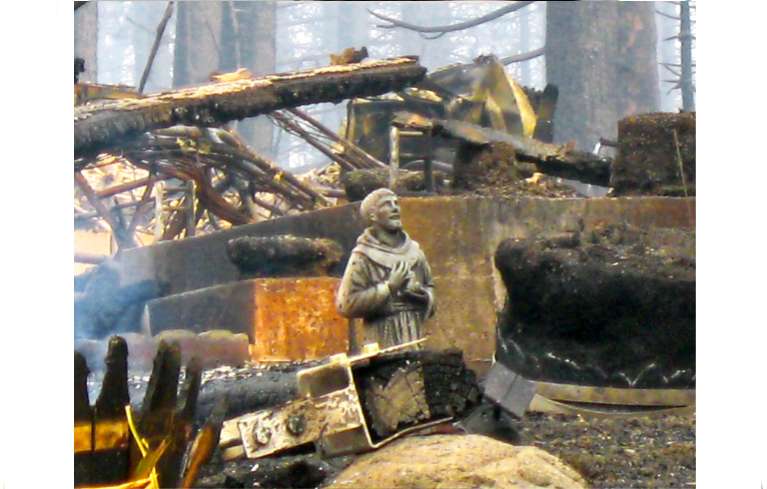
In 2007, 254 houses burned and bout 3,100 acres -- mostly USFS land -- on the South Shore of Lake Tahoe. Photo/Lake Valley Fire

In 2007, 254 houses burned and nearly 3,100 acres — mostly USFS land — near South Lake Tahoe. Photo/Lake Valley Fire

Seventy houses were destroyed, and one flare-up left Becky Koon, a landscape designer and local school volunteer, briefly frantic over the fate of her 13-year-old daughter, who, oblivious to the sudden danger, was sunbathing at a friend’s house. The girls were rescued, and Koon has since tried to help people there lower their risk by reaching out with information about brush- and tree-clearing and other ways to make their homes safer.

But she remains frustrated. “It’s a mixed bag,” was the best she could say of the reception her neighbors in Ravalli County, Mont., had given her efforts. This is a county whose voters decisively rejected a proposal to initiate local zoning and that prides itself on its log cabins and a belief that government should stay out of people’s lives.

Almost 15,700 of Ravalli County’s 19,000 homes are built where fires are likely, according to 2010 data compiled by researchers at the University of Wisconsin and Oregon State University. That is nearly double the 8,062 houses in the same area in 1990. Currently, more than 32,000 of the 40,212 people in the county live in the WUI.

But Ravalli county commissioners refused to adopt new maps of this interface, in the face of objections from homeowners and real estate agents that it would depress property values, increase insurance rates and lead to regulation.

As Greg Chilcott, a county commissioner, said: “Regulatory intrusion is a concern. We have somewhat adopted the philosophy, in my mind, that informing citizens of the risk of their choices as to where they build their homes is what our job is — rather than regulating them out of their homes or away from their lands.”

Ravalli County’s resistance to controls either by governments or insurers is hardly unique among the Western states. In fire-prone areas of California, Colorado, Texas, New Mexico and Arizona, the increase in wildfires has been exacerbated by droughts driven by climate change, and beetle infestations that turn evergreen forests into red tree graveyards. But construction has continued apace.

“Up until 2006 to 2008, the trend accelerated,” said Roger Hammer, a sociology professor at Oregon State University who has studied the issue for years. He called the recession “a speed bump” that “isn’t going to change the trend at all.”

But some of the more heavily inhabited places have started to change. The fierceness of recent fires in places like politically liberal Boulder, Colo., and politically conservative Colorado Springs changed minds. This year, Boulder required fire-resistant construction materials in such areas. Colorado Springs used WUI maps as the basis for new controls on hillside construction.

And Colorado’s governor, John Hickenlooper, this year appointed two public-private task forces to look at the issue of how to deal with fire risks.

“One of the things we’re looking at is, should there be fee assessments if you’re living in that area, to support wildfire-fighting efforts?” said Kelly Campbell, a member of one of the commissions and a vice president of the Property Casualty Insurers Association of America.

Another, she said, is “if we are providing insurance at a rate that is less than the risk, are we encouraging development in an area we might not want to?” But she indicated that until recently the question of wildfire risks was low on the insurance industry’s agenda because fire losses make up perhaps 2 percent of total losses, and wildfires even less.

Some communities, like Ruidoso, N.M., have aggressively used state and federal grant money to inform residents — many there only in summer — about mitigating fire risks. The village has stringent requirements for construction and management of trees and brush.

“Some local communities are getting the word,” said Stephen Pyne, a historian and expert on Western fires. “But we’ve got 30-plus years of backlog, of communities that need to be retrofitted, where we have to go back in and put in building codes and zoning and create a fire-resilient landscape. We are not going to banish fire.”

Even in the wake of a tragedy like the Yarnell Hill Fire in Arizona, northwest of Phoenix, lessons about lessening risk “are not being learned,” said Ray Rasker, executive director of Headwaters Economics, a research group in Bozeman, Mont.

About 16 percent of wildland-urban interface has been developed, he said. “But we’re not even having a national conversation about the other 84 percent.” He added that “the reason that local governments are not responding and not restricting development is that they don’t bear much of the cost” of fighting the fires and cleaning up afterward. “The bulk is borne by the federal taxpayer.”

Indeed, in Ravalli County, Koon pushed to have residents thin out combustible trees and brush on their property. “I was amazed at how many people believe it’s the government’s job to do this,” she said. “… For some of the landowners, it’s summer property. They don’t do anything.”