Thieves, vandals striking Liberty Utilities

Thieves and vandals have been targeting Liberty Utilities.

“We recently had a situation where the thief attempted to steal copper wiring and in the process, cut into some live lines,” Sam Rohn with Liberty Utilities said in a statement. “At the very least, the vandal received a significant electrical shock, but could have been hurt much worse.”

The crimes have have caused short-term power outages, add to operating expenses and can leave the criminal injured, utility officials say.

Anyone who sees suspicious activity or has information about vandalism, should call local law enforcement or Liberty Utilities at 800.782.2506.

Rohn noted that Liberty Utilities has increased security measures at undisclosed locations.


PUC: NV Energy should refund customers’ money

By Andrew Doughman, Las Vegas Sun

In an unprecedented move, two state agencies are arguing that NV Energy should refund its customers a total of about $14.6 million.

The state’s Bureau of Consumer Protection and staff at the Public Utilities Commission of Nevada say the utility basically earned too much money last year, so it should give some of it back to you, the ratepayer.

Both agencies filed testimony Wednesday arguing the company should refund the money.

The regulated monopoly has what’s called an authorized rate of return, but it’s possible it could earn a profit beyond what’s allowed by the PUC.

Last year, when the company reported $322 million in record profits, it also collected $14.6 million in energy efficiency charges.

Read the whole story


Tahoe bear cub surgery a success

Lake Tahoe Wildlife Care vet Kevin Willitts performed surgery on a bear cub Friday.

The 6-month-old cub was rescued by BEAR League volunteers, Truckee police and animal control officers near Truckee after it climbed a tree after having been hit by a car about a week earlier.

The cub had two broken legs. He is expected to fully recover at LTWC near South Lake Tahoe.

— Lake Tahoe News staff report


Lack of water threatens energy production

By Sandra Postel, National Geographic

When we flip on a light, we rarely think about water. But electricity generation is the biggest user of water in the United States.

Thermoelectric power plants alone use more than 200 billion gallons of water a day – about 49 percent of the nation’s total water withdrawals.

Large quantities of water are needed as well for the production, refining and transport of the fuels that light and heat our homes and buildings, and run our buses and cars. Every gallon of gasoline at the pump takes about 13 gallons of water to make.

And of course hydroelectric energy requires water to drive the turbines that generate the power. For every one-foot drop in the level of Lake Mead on the Colorado River, Hoover Dam loses 5 to 6 megawatts of generating capacity – enough to supply electricity to about 5,000 homes.

Shasta Dam allows for water storage via Shasta Lake. Photo/LTN

Shasta Dam allows for water storage via Shasta Lake. Photo/LTN

In short, energy production is deeply dependent on the availability of water. And, as a report released last week by the U.S. Department of Energy makes clear, as climate change brings hotter temperatures, more widespread and severe droughts, and lower river and lake levels, the nation’s energy supply is becoming more vulnerable.

Consider these examples from the DOE report:

In September 2010, Lake Mead dropped to levels not seen since the drought of 1956; as a result, the Bureau of Reclamation cut Hoover Dam’s generating capacity by 23 percent.

In 2009, NV Energy abandoned plans for a 1,500 megawatt coal-fired power plant that would have used more than 7.1 million gallons of water per hour.

Extreme drought in the fall of 2011 led the city of Grand Prairie, Texas, to ban the use of municipal water for hydraulic fracturing in order to save the city’s dwindling drinking water supply.

In 2007, 2010 and 2011, the Tennessee Valley Authority had to reduce power output from its Browns Ferry Nuclear Plant in Alabama because the temperature of the river into which the plant discharges was high enough to raise ecological risks.

In summer 2012, low snowpack in the Sierra Nevada curtailed California’s hydroelectric generating capacity by 8 percent.

At the Martin Lake Steam Electric Station in Texas, drought so reduced the level of its cooling pond that cooling water had to be piped in from another water source eight miles away.

One particularly interesting figure in the report compares the water requirements of seven different types of electric power facilities – nuclear, coal, biopower, natural gas combined-cycle, concentrated solar, photovoltaic solar and wind. The last two come out as by far the most water-conserving electricity sources. In contrast to the 20,000-60,000 gallons per megawatt-hour needed for nuclear and coal plants with “once-through” cooling systems, PV solar and wind require only negligible quantities.

Of the one hundred coal-fired power plants deemed to be most vulnerable to water shortages, most are located in the southeastern states of Alabama, Florida, Georgia, North Carolina and South Carolina. In these states, water for cooling may be constrained by low river flows, high water temperatures or both – forcing utilities to cut back on power generation.

On balance the study’s findings make a strong case for a more rapid shift to renewable energy sources to shore up the nation’s energy security in the face of climate change.

If there’s a call to action in the DOE assessment, it’s this: If, by 2050, the United States could get 80 percent of its electricity from renewable sources – with nearly half coming from water-thrifty wind and solar photovoltaic generation – then total water consumption in the U.S. power sector would decline by about half.

Given the projections for climate-related disruptions to the water cycle, there is little time to waste in making this transition.

Sandra Postel is director of the Global Water Policy Project, Freshwater Fellow of the National Geographic Society, and author of several books and numerous articles on global water issues.


Sting snares illegal contractors in South Tahoe

By KCRA-TV

A California state agency conducted a sting operation in Sacramento, South Lake Tahoe and in other parts of the state and arrested 79 people on suspicion of contracting home improvement projects without licenses or violating other standards.

In Sacramento, 11 people were arrested on suspicion that they were contracting without a license. Two of those arrested were taken to jail, one on illegal substance possession and another for drug paraphernalia and having an arrest warrant. In South Lake Tahoe, 12 were arrested.

The Department of Consumer Affairs’ Statewide Investigative Fraud Team conducted the stings on Wednesday and Thursday, posing as homeowners seeking bids for home improvement projects, including painting, landscaping, flooring and fencing.

The Contractors State License Board found many of the contractors through ads on Craigslist.org.

Mark Crosson, a homeowner in El Dorado Hills, knows the pitfalls that can come with hiring an unlicensed contractor.

Crosson told KCRA 3 Friday that he can no longer find his contractor, a man who failed to start a waterfall in Crosson’s backyard, even after he was already partially paid. It was too late by the time Crosson realized that the work the man did on a stone walkway was shoddy.

“Between what I contracted him for, I’m out $1,500, and it’s going to cost me at least another $2,500 to get all the work done correctly,” Crosson said. “I mean, you know, this is small-time stuff, but when it’s not done correctly, it’s going to cost you twice as much if you’re using an unlicensed contractor.”

When authorities with the CSLB contacted the contractors, some of them were found to be requesting excessive down payments or issuing stop orders without authorization in addition to offering services without a license, the department said.

In one instance, one worker drove away in his truck once authorities identified themselves. Another worker asked authorities to not give him a notice to appear because it would violate the terms of his parole.

One man failed to show for an appointment on day 1 of the sting because he was arrested the night before at a casino.

His wife called an investigator and rescheduled for the second day of the sting. Both showed up to give a bid, but while in the back yard, they left abruptly.

One suspect gave a bid of $3,300 for landscaping, including $500 for each sprinkler valve.

“Unlicensed, illegal activity that puts homeowners at risk and legitimate contractors at a competitive disadvantage will not be tolerated,” the department said in a news release.

Everyone arrested was given a notice to appear in court, and may face misdemeanor charges of contracting without a license. The penalty for a conviction is up to six months in jail and a fine of up to $5,000. The stings occurred in Sacramento, South Lake Tahoe, Artesia, Fresno, Long Beach, Oxnard and Redding.

KCRA’s Sharokina Shams contributed to this report.


Kings Beach trying to evolve and stay funky

By Kathryn Reed

KINGS BEACH – Lake Tahoe communities have the same vision – look pretty; be functional in terms of accessibility and the diversity of offerings; if there is a sense of community, don’t lose it and if there isn’t one, try to establish one; focus on recreation; have adequate tourist accommodations; and improvement the environment and economic vitality.

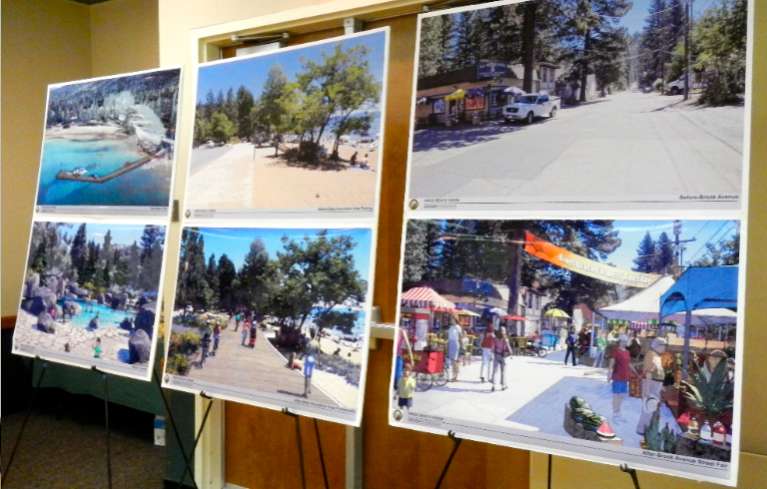
Kings Beach is the latest area to go through the visioning process. A three-day charette concluded Thursday with about 40 people perusing the various images created by Design Workshop.

While this area is already in the process of improving its streets, this larger vision encompasses the beach, the buildings, neighborhoods, transit, recreation and more. It will also be incorporated into Placer County’s Tahoe Basin Community Plan update.

Top photos reflect Kings Beach today and below are renderings by Design Workshop of what it could become. Photo/LTN

Top photos reflect Kings Beach today and below are renderings by Design Workshop of what it could become. Photo/LTN

Although work on the Kings Beach plan has been under way for a year, July 18 was the first time people’s visions were captured visually.

“The term funky was used quite a bit,” Stephanie Grigsby with Design Workshop said. And people want to keep that feel.

Her team’s goal was not to create a regulatory plan, but instead transform aspirational ideas into what could be Kings Beach’s future reality.

Making the beach into even more of a central location, with promenades and potential winter recreation amenities were ideas that came forward. Restoring the sand dunes that were leveled in the 1940s and addressing sand retention were brought up.

Extending the public pier to accommodate water transit was broached.

Height of buildings is a contentious issue. Proposed is to have lakeside buildings be no more than 36-feet tall and mountain side be a maximum of 48 feet.

Density is an issue that was not addressed in the charette process, but will be as the community plan goes forward.

An idea that has been talked about in some circles for more than a decade was brought to life on canvas – that is to close Brooks Street and create a series of uses for that area.

Kings Beach has a problem with sediment reaching Lake Tahoe. This is a large contributor to declining lake clarity. Redevelopment and roadwork could address some of those issues.

Through the charette much discussion was centered on what other uses the events center could have, but Design Workshop officials said the final outcome will be found in future meetings the community will need to lead.

Members of the community team that worked with the county and Design Workshop had mostly positive things to say about the process – saying they were listened to and didn’t feel like something was crammed down their throats.

—-

Notes:

• Placer County supervisors will be given an update on the plan July 23.

• Aug. 28 there is a workshop on the Tahoe City vision plan from 5-6:30pm at Granlibakken.

• Sept. 11 at 6pm is a town hall meeting on the Tahoe City and Kings Beach plans at the North Tahoe Event Center in Kings Beach

• In mid- to late September plans go to the county Planning Commission.

• More info will soon be on Placer County’s website.


S. Tahoe woman in Mono County jail on drug charges

By KRNV-TV

A traffic stop for an equipment failure ended with Amy Villastringham, 29, of South Lake Tahoe and Dustin White, 32, of Minden going to jail.

The two were stopped July 16 by deputies on northbound Highway 395 in Bridgeport. As the vehicle was run for current license and registration information, dispatch found Villastringham was driving on a suspended license. White returned with several possible felony warrants, one of which was for narcotics transportation. Villastringham and White were asked to exit the vehicle and asked if there was anything illegal in the vehicle. Villastringham said she had marijuana in the car, but that she had a medical marijuana card for it. White said he had several drugs in a black backpack in the car.

During a search of the vehicle the following narcotics were seized: 346 ecstasy pills; 8 grams of cocaine; 508 grams of marijuana; 221 grams of hash wax; and other narcotics paraphernalia.

Villastringham and White were arrested on charges of possession of narcotics and narcotics paraphernalia, transportation of narcotics, and possible narcotics for sale.

As a result of the traffic stop, a search warrant was issued in South Lake Tahoe on July 19.

Mono County deputies, with the assistance of South Lake Tahoe police officers, South Lake El Dorado Narcotics Enforcement Team, U.S. Immigration and Customs Enforcement, and the California Highway Patrol, served a search warrant at the residence of Villastringham at 1047 Williams St. Additional narcotics and narcotic paraphernalia were found in the residence. Further charges against Villastringham are pending with the El Dorado County District Attorney’s Office.


Missing S.C. teen returns to home state

Update July 19 7:55pm:

Police say the missing teen has returned to South Carolina even though they have not located her.

A missing South Carolina teenager may be in the South Lake Tahoe area.

Autumn Ellison, 16, has not been seen since July 7.

Autumn Ellison

Autumn Ellison

Mt. Pleasant, S.C., police believe Ellison does not want to be located and would likely provide a false name and/or ID to authorities. They also believe she may be at risk, but details related to what type of risk have not yet been specified to South Lake Tahoe police.

She is a white, 5-feet-1, 100 pounds, long brown hair and blue eyes.

She has friends in the Tahoe-Reno area.

There has been a social media page dedicated to communicating information regarding Ellison.

Anyone with information should contact the South Lake Tahoe Police Department or Detective Corp. Daniel Eckert of the Mt. Pleasant police at (843) 884.4176.

— Lake Tahoe News staff report


Calif. unemployment rate drops, but many jobs are part time

By Shan Li and Ricardo Lopez, Los Angeles Times

California continued its economic recovery in June as its unemployment rate slid to 8.5 percent, the lowest it has been in nearly five years.

Employers’ payrolls grew by 30,200 jobs, helping push down the jobless rate from 8.6 percent in May, according to data released Thursday by the state’s Employment Development Department.

The Golden State has outpaced the overall U.S. in job creation over much of the last year, and its turnaround has been swift. Since June 2012, the state’s nonfarm employment has grown 1.8 percent, adding nearly 254,000 jobs.

“The numbers are moving in the right direction,” said Esmael Adibi, director of Chapman University’s A. Gary Anderson Center for Economic Research. “It should get even better as we get through the year.”

Job gains were notched across six sectors. The trade, transportation and utilities sector led hiring last month, adding 13,200 jobs. That sector includes wholesale and retail trade, indicating that consumers have been driving the recent economic expansion.

That supports the recent consumer confidence report issued by the Conference Board. Consumer sentiment in June jumped to its highest level since January 2008. Shoppers have been splurging again as housing prices rise and the labor market improves, economists said.

But the recovery wasn’t across the board.

Five sectors shed jobs in June. Among them was the professional and business services sector, which lost 3,300 jobs. That industry includes high-paying occupations such as architects and lawyers. The construction and financial activities sector also showed small declines, losing 1,700 and 2,500 jobs respectively.

The California jobs report, though positive, showed that a large number of positions created in June were in low-paying industries, many of them part-time jobs. The leisure and hospitality industry, one of the fastest-growing segments of the economy, added 9,700 jobs last month.

Michael Bernick, former director of California’s Employment Development Department, said the sharp rise in part-time workers bodes poorly for the economy because of reduced spending power. Job seekers are facing a labor market where companies are reluctant to hire full-time employees.

“The intense competition out there for jobs hasn’t decreased at all, unless you are a highly skilled computer programmer,” Bernick said. “One explanation is a sharp national growth in part-time employment.”

Cary Campagna, 59, of Rancho Santa Margarita is among those struggling to find gainful employment.

He has been sending out resumes, responding to job ads on Craigslist and networking, with no luck so far. To make a little money, Campagna drives a limousine part-time. He earns about $50 driving clients to Los Angeles International Airport and $25 to Orange County’s John Wayne Airport.

“There’s a lot of jobs out there, but a lot of them pay in the $8- to $10-per-hour range,” he said. “Even if I worked 40 hours a week, I couldn’t live on that.”

The long-term unemployed, those who have been without work for 26 weeks or longer, also face another challenge. On Tuesday, California officials warned that the final tier of federal unemployment extension benefits would be cut if the state’s jobless rate falls below a three-month average of 9%.

The state said it expects to hear the final decision Friday from the U.S. Department of Labor. If that tier is eliminated, an estimated 100,000 Californians will lose up to 10 weeks of benefits.

An improving economy brings with it “more winners but also more losers,” said Sung Won Sohn, an economist at Cal State Channel Islands. Those who find jobs gain, he said, but the long-term unemployed may lose jobless benefits and be worse off.

Changes in unemployment rates were mixed across Southern California. Some counties saw their rates rise even as they added jobs.

Los Angeles County added 200 nonfarm jobs, and its unemployment rate edged up to 9.7 percent in June from 9.6 percent in May. The leisure and hospitality industry gained the most positions in the county, adding 7,000 jobs last month.

San Diego County added 7,500 positions but still saw its jobless rate tick up to 7.3 percent in June from 6.8 percent the month before. Orange County added 8,500 jobs, and its unemployment rate similarly jumped to 6.1 percent from 5.5 percent the month before.

The Inland Empire, which covers Riverside and San Bernardino counties, shed 6,700 jobs, and its unemployment rate jumped to 10.2 percent in June from 9.3 percent the month before. Losses were concentrated in the government sector, which shed 2,900 jobs.

In the Bay Area, San Francisco, San Mateo and Marin counties combined added 4,100 positions. Unemployment ticked up to 5.5 percent last month from a revised 5 percent in May.

The statewide and Los Angeles County unemployment rates are seasonally adjusted; the other counties’ are not.

The employment report normally is issued early Friday. However, the Bureau of Labor Statistics accidentally released the data prematurely on Thursday.


States slow to enforce laws they say are unconstitutional

By Juliet Eilperin, Washington Post

Once state legislation is passed, it’s usually up to the governor and attorney general to see that the law is implemented.

But in a number of high-profile cases around the country, top state officials are balking at defending laws on gay marriage, immigration and other socially divisive issues — saying the statutes are unconstitutional and should not be enforced.

In Pennsylvania, for example, Attorney General Kathleen Kane (D) says she won’t defend the state’s ban on same-sex marriage in federal court. In Hawaii, Gov. Neil Abercrombie (D) filed court papers calling that state’s gay marriage ban unconstitutional.

And in Indiana, Attorney General Greg Zoeller (R) has come under fire from conservatives for refusing to defend a portion of that state’s immigration law. He said a recent Supreme Court ruling on a similar Arizona provision means that Indiana’s law is unconstitutional.

The moves have put officials in both parties under attack from opponents, who accuse them of basing their decisions on political, rather than legal, motives. As a result, groups on both sides of the spectrum are laying plans to target the officials in upcoming elections.

“There’s no doubt that there’s more public pressure as we defend on issues of this social magnitude,” Zoeller said in an interview this week.

Attorneys general routinely have to decide whether laws facing legal challenges are constitutional. But in recent years, the high-profile nature of political battles over same-sex marriage and other social issues have put many of their decisions in the spotlight.

The phenomenon appears likely to spill over into the 2014 elections, with attorneys general in Colorado, Ohio, Michigan, Illinois, New Mexico and Nevada facing the possibility of being targeted by groups embroiled in the gay-marriage fight.

Gay activists are looking at putting money into a handful of such races next year, though they have not decided which ones they will target.

The issue garnered widespread attention in 2011, when U.S. Attorney General Eric H. Holder Jr. decided that the Justice Department would no longer defend the 1996 Defense of Marriage Act, which denied marriage-based federal benefits to same-sex couples. The Supreme Court struck down a key portion of the law last month.

Several academics, including former Maine attorney general James E. Tierney, said attorneys general are obligated to scrutinize laws that might be politically popular but legally flawed.

“The simple truth is that AG refusal to defend happens all the time,” Tierney, who directs the National State Attorneys General Program at Columbia Law School, wrote in an email. “Legislatures are comprised in most states by non-lawyers trying to do the right thing, but they do not understand the complexity of constitutional limits. They are advised, but often plunge ahead — both liberals and conservatives — and make constitutional mistakes. It then falls to the AG to clean this mess up.”

Rick Pildes, a constitutional law professor at New York University, said state officials should tread very carefully before deciding not to defend statutes.

“There’s always a very strong political temptation for elected officials — whether they’re attorneys general, governors or chief executives — not to defend laws they disagree with politically, or whose defense will alienate powerful political constituencies,” Pildes said.

In Pennsylvania, Kane said that last month’s Supreme Court rulings made her state’s same-sex marriage ban “wholly unconstitutional” and that it would be up to the Republican governor’s counsel to defend it.

Kane said in an interview last week that state law and regulations allow her to recuse herself if she believes she could not represent her client.

“If there is a law that I feel that does not conform with the Pennsylvania constitution and the U.S. Constitution, then I ethically cannot do that as a lawyer,” she said.

It is unclear whether there will be immediate political repercussions for Kane, who doesn’t face reelection until 2016. State Rep. Daryl Metcalfe (R), who opposes same-sex marriage, has raised the possibility of invoking impeachment proceedings against her because of the decision.

Kane had also raised the prospect of not defending the state’s controversial voter-identification law, but her office decided to defend the law at trial this week.

Democratic attorneys general say they are not pursuing a coordinated strategy on same-sex marriage. But gay rights lawyers have spent the past six years advising them on how they might handle these challenges once they reach their desk.

“There isn’t going to be one cookie-cutter approach to this,” said Ted Trimpa, a Denver-based lawyer who said shifts in public opinion can assist attorneys general in same-sex marriage cases if they want to “be bold.”

In Illinois, Democratic officials including state Attorney General Lisa Madigan have declined to oppose a lawsuit filed last year seeking same-sex licenses from the Cook County clerk. The Thomas More Society, a conservative law firm, has intervened on behalf of five clerks from other Illinois counties who are opposed to gay marriage.

“The people rely on the executive branch of doing its job of defending the laws, enforcing the laws,” said Peter Breen, the Thomas More Society’s vice president and senior counsel. “It strikes at the heart of our representative system of government.”

Evan Wolfson, president of the gay rights group Freedom to Marry, said the spate of decisions on same-sex marriage bans are an exception rather than the rule. “It’s almost a once-in-a-career moment for attorneys general who have sworn to uphold the Constitution and are being told to uphold these measures that are blatantly unconstitutional,” he said.

Zoeller, who has challenged aspects of the Affordable Care Act and defended Indiana’s right-to-work statutes, said groups frequently try to persuade him to walk away from certain cases.

“I tell them, if you object to a policy, you need to speak to the policymakers,” he said, adding that he is obligated to fight in court for any state law if “I have a good-faith basis to defend it.”

In Wisconsin, Gov. Scott Walker and Attorney General J.B. Van Hollen, both Republicans, refused to defend the state’s domestic partnership registry law when it came under attack from conservatives, prompting the gay rights group Fair Wisconsin to step in. A state appeals court upheld the law in December.

Stanford University Law School professor Michael McConnell, who directs the school’s Constitutional Law Center, said the only reason an attorney general should opt out of a case is if it conflicts with the executive branch’s authority or if there’s no reasonable argument that can be made for the law.

When McConnell served in the solicitor general’s office in the Reagan administration, he said, he defended a Labor Department minimum-wage rule he disagreed with personally in arguments before the Supreme Court. “I thought it was unconstitutional, but we prevailed nine to nothing,” he said.

Cardozo Law School professor Kate Shaw said that it was “appropriate” for attorneys general to decline to defend cases in some instances but that they should be transparent about their reasons and make sure another party is prepared to take up the case.

“If exercised too cavalierly, this power is somewhat troubling and could be dangerous,” she said.

Several experts warned that while Democrats seem more predisposed not to defend certain laws, Republicans could exercise the same option on issues including health care and hate crimes.

“You start down this path, and it simply breeds more partisan warfare, and it provides more precedents for doing it more,” said Norman J. Ornstein, a senior fellow at the American Enterprise Institute, a Washington-based conservative think tank.