Health care premiums may not be affordable

By Alex Wayne and Alex Nussbaum, Bloomberg

Health insurance under Obamacare will cost individuals at least $2,988 a year on average, a price that Republican opponents may target as out-of-reach for many Americans who don’t qualify for U.S. subsidies.

While the $249 monthly payment is intended to be discounted through tax credits, less than half of people now buying insurance on their own may get that help. The release of the data by the Obama administration comes just six days before the Affordable Care Act’s insurance exchanges open for enrollment, and a day after Ted Cruz, a Texas Republican, took the floor of the U.S. Senate to oppose the law.

The affordability of the overhaul has polarized debate since the act passed in 2010. While the law’s cheapest plans offer more care than minimal policies available today, including guaranteed coverage for people with pre-existing conditions, their cost may persist as an issue even though it affects only a relatively small percentage of people.

The law’s long-term success “will depend on the changes that are made over the next couple of years to address the affordability issue,” said Brian Wright, an insurance analyst at Monness Crespi Hardt & Co. in New York. “If you have modifications that can help address those issues, then it will ultimately be successful. If not, then it’s an open question.”

Read the whole story


Study: Calif. one of the best states for women

By UPI

WASHINGTON — Despite U.S. women’s advancements, substantial inequalities remain with men, but disparities for women also exist among states, a nonprofit group says.

A report by the Center for American Progress analyzed multiple factors — 36 factors overall — involving women.

For example, women in Vermont make on average close to 85 cents for every $1 a man makes, while women in Wyoming make only 64 cents $1 a man makes. Nationally, U.S. women are paid only 77 cents for every dollar a man makes. On average, African-American women make 64 cents for every dollar that white men make.

On leadership, 15 states have no female elected leaders in the House of Representatives or the Senate. Lastly, while less than 10 percent of women in Vermont, Wisconsin, Hawaii and Massachusetts are uninsured, nearly 25 percent of women in Texas do not have health insurance.

Read the whole story


Panel: It’s definite humans are changing climate

By Mark Memmott, NPR

Declaring that “human influence on the climate system is clear,” a U.N.-assembled panel of scientists reported Friday that “it is extremely likely that human influence has been the dominant cause of the observed warming since the mid-20th century.”

The Intergovernmental Panel on Climate Change, which brings together hundreds of researchers from around the world, adds that “warming in the climate system is unequivocal and since 1950 many changes have been observed throughout the climate system that are unprecedented over decades to millennia.”

Looking ahead, panel co-chair Thomas Stocker warns that “continued emissions of greenhouse gases will cause further warming and changes in all components of the climate system. … Heat waves are very likely to occur more frequently and last longer. As the Earth warms, we expect to see currently wet regions receiving more rainfall, and dry regions receiving less, although there will be exceptions.”

Read the whole story


El Dorado County attorney going to prison

And El Dorado Hills man is going to prison for committing 28-tax related felonies.

A federal jury on Sept. 26 found Donald M. Wanland Jr. guilty of attempting to evade personal income taxes from 200-03, failing to file tax returns for 2005-07, and multiple counts of removing, depositing, and concealing assets from the IRS in defiance of a levy.

Wanland, 53, was taken into custody following the verdict.

According to evidence, Wanland, a financially successful Sacramento-area attorney, evaded paying taxes for years. For tax years 2000 through 2003, he filed tax returns showing gross income of more than $1.5 million, for which he admitted owing taxes of $448,451. But he paid nothing.

When the IRS tried to collect, Wanland concealed the bank accounts that he used to receive and spend his income, and then filed no tax returns at all for years 2004 through 2007, according to authorities.

He continued working for his law firm and received more than $1 million during those years. When the IRS placed levies on his income in April 2005, Wanland repeatedly defied the levies by continuing to funnel his income to the concealed nominee accounts. He spent the money on various items including a $2,700 weekend at Squaw Valley, payments on a Mercedes Benz and a Cadillac Escalade, gambling in Las Vegas, vacations to Mexico and Hawaii, limousine services, and expenses for the pool at his home in El Dorado Hills. He also withdrew hundreds of thousands of dollars in cash and wrote hundreds of thousands of dollars in checks out of the concealed accounts.

Wanland faces a maximum statutory penalty for tax evasion of five years in prison, and a $250,000 fine. The maximum statutory penalty for removing, depositing, and concealing assets in defiance of an IRS levy is three years in prison and a $250,000 fine. The maximum statutory penalty for willful failure to file tax returns is one year in prison and a $25,000 fine.

— Lake Tahoe News staff report


Vail Resorts 4th quarter loss less than expected

By AP

BROOMFIELD, Colo. — Vail Resorts’ fiscal fourth-quarter loss widened as some expenses rose.

The loss was smaller than Wall Street expected but revenue missed expectations, and its shares slipped in premarket trading Friday.

The ski resort operator lost $59.9 million, or $1.67 per share, for the three months ended July 31. That compares with a loss of $53.8 million, or $1.50 per share, a year ago.

Analysts, on average, forecast a loss of $1.77 per share, according to a FactSet survey.

Total segment operating expense increased to $168.7 million from $161.8 million, while interest expense climbed to $13.7 million from $8.4 million.

Revenue dipped 1 percent to $112.3 million from $113.5 million as the Broomfield, Colo., company made less money from its real estate segment. Wall Street was looking for higher revenue of $120.1 million.

Shares of Vail Resorts Inc. slipped 23 cents to $68.75 in premarket trading 45 minutes ahead of the opening bell.

For the year, Vail Resorts earned $37.7 million, or $1.03 per share. In the previous year the company earned $16.5 million, or 45 cents per share. Annual revenue climbed 10 percent to $1.12 billion from $1.02 billion.

Total skier visits rose 14 percent to approximately 7 million, while ticket prices also improved.

CEO Rob Katz said in a statement on Friday that season pass sales for the upcoming ski season are showing strong growth, up approximately 23 percent in sales dollars as of Sept. 22.

For fiscal 2014, Vail Resorts expects net income in a range of $37 million to $55 million. Analysts predicted $40.2 million.


Congress may adjust online sales tax rules

By J.D. Harrison, Washington Post

Four months after the Senate approved a controversial bill requiring online merchants to start collecting sales tax, a pair of lawmakers have opened the debate in the House, but with one major change from the original legislation — no exemption for small businesses.

House Judiciary Committee Chairman Bob Goodlatte, R-Va., and Rep. Spencer Bachus, R-Ala., a subcommittee chairman, recently released an outline of principles for online sales tax legislation, citing input from taxpayers, trade groups and state and local governments. In it, they argue that lawmakers should take action to level the playing field for brick-and-mortar and Internet retailers.

“Americans across the country are affected by the issue of Internet sales tax whether they are consumers or business owners,” Goodlatte said in a statement, adding that the principles are meant to “provide a starting point for discussion in the House.”

Currently, states have the authority to collect online sales tax, but the onus is on the shoppers, not the sellers, to report what the transactions.

Read the whole story


Feds studying traffic and climate change

By Tony Bizjak, Sacramento Bee

UC Davis was chosen this week in a national competition to lead an $11 million federal study of how to reduce the impact America’s transportation system has on climate change – and to come up with ways to keep people moving when catastrophic climate events occur.

The U.S. Department of Transportation announced the Davis Institute for Transportation Studies will look into ways to reduce greenhouse gas emissions caused by the everyday movement of Americans to work, school and elsewhere.

Federal officials say the national transportation system, mainly solo drivers in cars, accounts for a quarter of greenhouse gas emissions, which have been said to influence climate change, including extreme weather events such as hurricanes. Davis researchers will head a team with several other universities on the two-year project.

Read the whole story


Water ruling may impact Calif. fire fee

By Tim Hearden, Capital Press

SACRAMENTO — A judge’s recent preliminary ruling that California water rights fees are invalid has piqued the interest of a group suing the state over fees charged to rural landowners for fire prevention.

Sacramento County Superior Court Judge Raymond Cadei agreed with petitioners that fees charged by the State Water Resources Control Board disproportionately burden rights holders with funding the agency’s Division of Water Rights.

“The deficiency rises out of the fact that no fees are assessed against the holders of approximately 38 percent of all water rights in California as expressed in acre-feet,” Cadei wrote in his ruling, issued Sept. 6. “This evidence is sufficient to establish that holders of water rights that are not charged fees nevertheless receive a benefit from the division’s regulatory activities …”

The proposed ruling, which could be finalized at an Oct. 30 hearing, comes as the Howard Jarvis Taxpayers Association is leading a legal challenge against $150-per-structure assessments imposed in rural areas as part of the 2011-12 budget package.

Read the whole story


Experimental forest holds keys to wildfires

By Tia Ghose, LiveScience

Experimental forests that have been groomed to slow wildfires could reduce the frequency of catastrophic fires in the future, researchers say.

The decade-long project to slow and contain forest fires could become a blueprint for fire management across California. The project, which was developed in an experimental forest at UC Berkeley’s Sagehen Creek Field Station in Truckee creates pockets of thinner trees in areas where the fire risk is high, while still leaving pockets of dense growth for wildlife habitat.

“The idea is that you coordinate treatments to change fire behavior across a landscape — a big landscape,” said John J. Battles, a Berkeley forest ecologist who helped develop the method.

The forest in the Sierra has evolved to thrive with frequent, small fires that consume saplings and brush on the forest floor. For instance, giant sequoia cones are sealed by a glue that only melts in fire, releasing their seeds.

But conflagrations like the recent Rim Fire — California’s fourth-largest wildfire in recorded history and the largest forest fire in the Sierra — happen, in part, because a century of fire suppression and replanting has left forests overgrown, with thick underbrush and cramped trees providing the perfect fuel for blazing hot fires. Hot fires scorch the earth, burning seeds in the ground and the carbon in the soil, and thus potentially changing the forest permanently.

The easiest way to contain or slow the spread of wildfire is to thin the forest. But old forests also provide habitat for iconic animals, such as the California spotted owl and the American marten. Many areas are too steep to reach with bulldozers to rip out trees, said Scott Conway, a vegetation management officer with the U.S. Forest Service in the Tahoe National Forest, who is also involved with the project.

Fire researchers are using models of the landscape and tree density, local weather patterns and historical fire data, combined with habitat information, to find the areas that are likeliest to burn catastrophically. The idea is that by treating only a portion of an area — typically about a third — fire managers can slow the spread of fire across the entire landscape, Battles said.

“By treating in certain spots, the fire never really gets rolling hot,” Battles told LiveScience.

For instance, northeast-facing slopes are likely to be cooler and wetter — and, therefore, less fire-prone — than southwest-facing slopes or ridgetops exposed to wind. Fire tends to race up steeper slopes more swiftly than flatter areas. Therefore, fire managers often treat southwest-facing slopes and the flatter areas around steeper slopes that can’t be reached by bulldozers.

“We would only strategically treat a portion of the landscape but in spots where we knew fire normally comes from,” Conway told LiveScience’s OurAmazingPlanet. “When fire hits one of these [treated areas], it’s forced to slow down and flank around these treatments.”

The strategy has been used in a few experimental forests: at the Sagehen Creek Field Station as well as the American River Ranger District of the Tahoe National Forest.

The method allows firefighters to actually protect critical areas, Conway said. (If the fire burns too hot, firefighters can do very little to contain it.)

The plan is to expand the method across the entire Sierra Nevada in order to reduce the frequency of catastrophic fires like the Rim Fire.

The researchers may already have a chance to see how their approach has worked: A fire is burning in the treated area of the American River Ranger District.

Once the fire dies out, the team will have a rare chance to see how the new technique worked in action, Conway said.
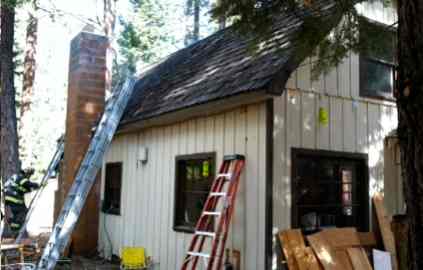


Chimney fire damages Tahoe Vista house

A fire in Tahoe Vista was damaged by fire Sept. 25. Photo/Provided

A fire in Tahoe Vista was damaged by fire Sept. 25. Photo/Provided

A chimney fire caused substantial damage to a house in Tahoe Vista on Wednesday morning.

The blaze on Winona Avenue moved into the attic. It took about 40 minutes for firefighters from multiple agencies to extinguish the blaze.

In the afternoon crews were overhauling the structure and salvaging contents.

North Tahoe Fire Prevention Bureau is conducting the investigation.

— Lake Tahoe News staff report