S. Tahoe hires veteran to lead fire department

By Kathryn Reed

A veteran firefighter is now at the helm of South Lake Tahoe Fire Department.

With his new employees sitting in front of him and his peers from other departments standing in the back of the room, Jeff Meston was given his badge from outgoing interim Fire Chief Bruce Martin.

Jeff Meston is South Lake Tahoe's fire chief. Photo/Kathryn Reed

Jeff Meston is South Tahoe’s fire chief. Photo/Kathryn Reed

Meston told Lake Tahoe News the chance to lead a department with so many young firefighters excited him enough to return to the profession. Plus, since retiring from the Novato department seven years ago he has been living in Incline Village doing consulting work. So, he is already a Tahoe guy. For now he plans to commute to South Tahoe.

South Lake Tahoe has been without a sole full-time fire chief since Lorenzo Gigliotti was asked to leave two years ago. For a while three battalion chiefs ran the department, then Police Chief Brian Uhler headed both departments and for the last nine months Bruce Martin had the job on a part-time basis.

Martin has bought a house in the area and will be a reserve deputy chief.

“I think he will take over where Chief Martin left off,” City Manager Nancy Kerry said of Meston. “He has had a very illustrious career.”

One of his board members from the Bay Area came to the badge ceremony, commenting on how to this day they still miss Meston.

While these types of ceremonies are common in the fire service, they have been lacking in South Tahoe. Some of that tradition is what Martin helped restore – along with leadership, training and morale.

Meston in his first gesture as fire chief continued that sense of tradition with a moment of silence for Mitch Underhill, a Lake Valley Fire Protection District firefighter who died Sept. 29 at age 34. All of the firefighters in attendance were wearing a black band across their badge to honor Underhill.

Meston has a master’s degree in public administration, is a chief fire officer designee with the International Association of Fire Chiefs, and a graduate of the Executive Fire Officers Program at the National Fire Academy.

He created a citizen disaster preparedness training program for business and homeowners groups that won an International Association of Fire Chiefs National Award, he has served on the state Training and Education Committee, and is a technical expert for the Fireman’s Fund Insurance Company’s Heritage Program.


USFS Fish Festival a victim of government shutdown; other Tahoe entities faring OK

By Kathryn Reed

Crime will still be fought on the South Shore, but this weekend’s Fall Fish Festival has been canceled because of the federal government shutdown that took effect today.

A big unknown is how the social service programs that so many in the area rely on will be affected by the government essentially turning off the financial spigot. While there is money in the pipeline, it won’t last forever. And there is no known date for when Congress might figure out how to resolve its differences.

govt shutdownGina Swankie with the Sacramento FBI office said the government shutdown is not affecting agents – including the ones stationed in South Lake Tahoe. However, the U.S. Attorneys Office is shuttered.

The U.S. Forest Service offices throughout the country are closed. Law enforcement and firefighters are still working.

For Lake Tahoe it means the Oct. 5-6 annual Fall Fish Festival, formerly known as the Kokanee Festival, has been canceled. Taylor Creek Visitors Center is closed, as well as Forest Service operated campgrounds.

However, campgrounds that are operated by a concessionaire and other concession-operated facilities are open as of now. The Forest Service is leaving gates and roads open, too.

The trail building day on Oct. 5 in the Angora burn area has been canceled because USFS personnel were going to oversee the work.

Tahoe National Forest offices, including the headquarters in Nevada City and ranger district offices in Camptonville, Foresthill, Sierraville, and Truckee are closed.

TNF is leaving its woodcutting hotlines open, and anyone with a fuel wood permit may continue to gather firewood as conditions allow.

The shutdown could delay the sale of any Forest Service cabins. Escrows will be unable to close unless the buyer has already interviewed with the Forest Service and documents were provided to title and escrow.

The other main federal agency in the basin – Tahoe Regional Planning Agency – is staying open.

“TRPA may not be impacted by a federal shutdown for some time. We are not directly funded by any federal agency, but partners with various agencies, such as the [U.S. Fish and Wildlife Service] through the Aquatic Invasive Species Program. We may not need to submit any invoices to the federal government for several months,” Jeff Cowen, with the Tahoe Regional Planning Agency, told Lake Tahoe News.

Barton Health officials do not anticipate any direct impact from this shutdown. Medicare reimbursements will still be forthcoming.

While the Centers for Disease Control and Prevention says the shutdown will affect its flu vaccination program as the country goes into flu season, Tahoe-ites should be OK.

“Barton has worked closely with El Dorado County Health and Human Services on the flu shot program for our community this year. El Dorado County will provide flu shots to community members at a low rate,” Monica Sciuto, Barton spokeswoman, told Lake Tahoe News. “Pharmacies in town are already offering flu shots as well. Barton will be providing flu shots through the physician offices and to patients at the hospital. Barton already has flu vaccines – we order a year in advance – and is ready to go with our flu program for this winter season.”

Educators believe they will weather a short shutdown just fine.

“The district has received this year’s federally funded program appropriations. However, payments may be delayed from the U.S. Department of Agriculture funded school lunch and breakfast programs. The district will continue to serve meals to all students until this possible federal shutdown is addressed,” Jim Tarwater, superintendent of Lake Tahoe Unified School District, told Lake Tahoe News.

Douglas County School District also receives funding for the free and reduced lunch program, as well as federal dollars for its three Title 1 schools.

Rich Alexander, assistant superintendent for DCSD, said the district is operating as normal and anticipates doing so for the foreseeable future while the feds work out the problem.

“If the shutdown does not last too long, we are not anticipating any issues. It is very hard to get a reading on the long-term impact, as there is a lot of speculation,” Lake Tahoe Community College President Kindred Murillo said.

Other government entities also are keeping an eye on Washington.

Steve Mokrohisky, Douglas County manager, told Lake Tahoe News, “While it appears that critical emergency support services may not be immediately affected, our continued efforts to resolve FEMA flood map issues, seek approval of our comprehensive lands bill, work with the Forest Service on improvements at Round Hill Pines, pursue federal funding for transportation and water quality improvements at Lake Tahoe, as well as several other areas will likely be delayed. New grant opportunities will also likely be on hold, which will impact our efforts to meet the infrastructure needs of local residents.”

South Lake Tahoe City Manager Nancy Kerry said there are no direct impacts right now, but that staff will be looking at how federally funded grant projects could be affected.


California driving up traffic fines

By Caroline Chen, Center for Investigative Reporting

Motorist Derick Neal doesn’t remember the April night when he rolled through a right turn at a red light in San Leandro.

The video from the red-light camera clearly shows the violation, he admits. Nevertheless, the 40-year-old software engineer is outraged about the price of the ticket: $490, plus an additional $59 for traffic school.

“It’s one thing if I was barreling through, but you can see my brake lights all the way through,” he said after viewing the video. “I expected it to be $100, $150 at most for the infraction.”

Like Neal, many of the more than 6 million California drivers who get tickets each year experience sticker shock. State records show that traffic citation fines have skyrocketed over the last decade, with some common infractions now costing close to $500.

Derick Neal’s ticket
Base fine
$100
State penalty assessment
$100
County penalty assessment
$70
DNA identification fund
$50
Court construction
$50
State surcharge
$20
Emergency medical services
$20
Emergency medical air transportation
$4
Court operations
$40
Conviction assessment
$35
Night court
$1
Total ticket
$490
Traffic school
$59
Total cost
$549

Running a red light, currently $490, cost $340 in 2003 and $103 in 1993, according to the Judicial Council of California, which sets the base fines for traffic offenses. A ticket for rolling through a stop sign costs $238; a decade ago, it was $130. Speeding up to 15 mph over the limit also comes with a $238 price tag ‒ more than eight times what it cost in 1993. And traffic school can add $60.

Oddly, the base fine for most violations has remained the same for the last 20 years. The growth in fines is due to add-ons known as penalty assessments, which are set by the Legislature. These fees are tacked on to citations, with the money earmarked for projects ranging from court construction to DNA research for solving crimes.

Viewed separately, each assessment might not seem particularly onerous, but the penalties add up. About a decade ago, there was one penalty assessment. Now, there are 10 – and total fines average four or five times the amount of the base fine.

The soaring fines don’t seem to have encouraged Californians to become better drivers. Each year, between 26 and 30 percent of drivers get a traffic citation, records show. But the high price of a ticket has led many traffic offenders to plead not guilty and contest their tickets in court, hoping to have them dismissed or reduced.

In 2003, about 196,000 traffic citations were disputed in California courts, according to Judicial Council statistics. That was 4.5 percent of the total issued. By 2011, that number had nearly doubled to 383,000, 7.1 percent of all the citations issued.

Advocates say the increased fines are especially hard on the working class.

“If you’re a single parent barely making it, one of those (red-light) tickets could really set you back,” said Shane Gusman, legislative representative for the California Teamsters union. “I think folks are doing the math and hoping that it will get dismissed if the officer doesn’t show up. I know our drivers are doing that calculation.”

Some traffic court judges offer community service, rather than fines, to those who plead guilty. Gusman says this isn’t much help for many people. At the community service rate of $10 an hour, it would take 49 hours to pay off a red-light violation ticket.

The courts don’t track whether they are losing revenue because more motorists are fighting their tickets. But some courts around the state are struggling to handle the influx of people contesting tickets.

Trial dates are backed up in San Diego County, where the number of motorists contesting tickets has doubled in a decade, said court spokeswoman Karen Dalton. The current wait is six months.

Those accused of traffic violations in Los Angeles County have been facing waits of nine months or more for a hearing, said court spokeswoman Mary Hearn. But it’s about to get worse. Recently, courts underwent their third round of layoffs in four years.

“With the changes our court was forced to make in the past few months, I expect those numbers will again increase dramatically,” Hearn said.

Derick Neal pleaded not guilty on his red-light violation and went to court in Oakland this month. He was found guilty and must pay the full fine.

Some courts offer discounts to motorists who plead guilty rather than fight their tickets. At the San Francisco Hall of Justice on a recent day, a court officer offered deals to about 80 people who had shown up to dispute their tickets. Motorists could pay $285 to settle any ticket of $400 or more, the officer said, and tickets of less than $400 could be settled for $178. If motorists went to trial and lost, they would pay the full fine, the officer warned.

But there was no such clemency across the bay in Oakland at the Wiley W. Manuel Courthouse, where Commissioner Taylor Culver reigns over his courtroom with sarcastic humor. During a red-light camera trial on a recent afternoon, when one defendant asked for a reduction in his fine, Culver boomed, “Nobody here is special or better than anybody. There’s nobody here special but me.”

In another case, Culver cut off a defendant’s comments by saying, “Just tell me about the money. How are you going to pay?”

Experts say there is little chance that the penalty assessments will stop increasing because it’s an attractive source of revenue for state and county governments. A 2006 report by the California Research Bureau, which studies issues for the governor and Legislature, estimated that traffic violations bring in more than $500 million per year.

“I don’t know we’ll ever have a rollback unless the state had enough money in the general fund,” said Gregory Pagan, chief counsel for the Assembly Public Safety Committee. “It’s an easy way to find a revenue stream to fund (a program). They’ll never stop.”

Former Block owner buys Michigan resort

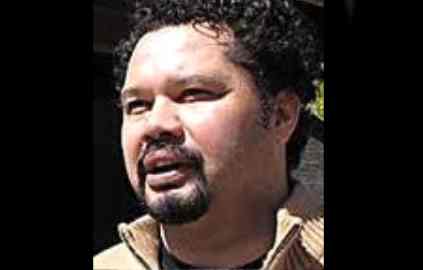
Eneliko “Sean” Smith, who ran The Block hotel in South Lake Tahoe into the ground and required the court to mandate he pay the city back taxes, is now the owner of Sugar Loaf Resort in Michigan.

Smith and his partners bought the 560 acres for an undisclosed sum. Their plans are to transform the resort into a  snowboarding Mecca titled The RoK at Sugar Loaf for the 2014-15 season.

Eneliko "Sean" Smith

Eneliko “Sean” Smith

The resort has been closed for the last 10 years.

According to a press release, unpaid tax issues like what happened in South Lake Tahoe will never be an issue again. “I suffered very deeply and I truly learned from that mistake,” Smith said in a statement.

Like in Tahoe where he helped create “The Block” reality show, he plans to do something similar in Michigan beginning with an employee boot camp reality show in July 2014.

— Lake Tahoe News staff report


U.S. government comes to a standstill

By Lori Montgomery and Paul Kane, Washington Post

The U.S. government began to shut down for the first time in 17 years early Tuesday, after a Congress bitterly divided over President Obama’s signature health-care initiative failed to reach agreement to fund federal agencies.

Hours before a midnight deadline, the Republican House passed its third proposal in two weeks to fund the government for a matter of weeks. Like the previous plans, the new one sought to undermine the Affordable Care Act, this time by delaying enforcement of the “individual mandate,” a cornerstone of the law that requires all Americans to obtain health insurance.

The new measure also sought to strip lawmakers and their aides of long-standing government health benefits.

The Democratic-led Senate quickly rejected that plan on a party-line vote. Senate Majority Leader Harry Reid, D-Nev., urged House Speaker John Boehner, R-Ohio, to abandon the assault on the health-care law and pass a simple bill to keep the government open. Otherwise, Reid warned, “the responsibility for this Republican government shutdown will rest squarely on his shoulders.”

Boehner refused to yield. He called instead for a special committee to meet in the coming days to resolve differences between the two parties, leaving in limbo the fate of millions of federal workers and the services they provide.

Shortly before midnight, the White House budget office issued a memo instructing agencies to “execute plans for an orderly shutdown due to the absence of appropriations.”

The impasse means 800,000 federal workers will be furloughed Tuesday. National parks, monuments and museums, as well as most federal offices, will close.

Read the whole story


Whittemore going to prison for 2 years

By Scott Sonner, AP

RENO — Ex-Nevada power broker Harvey Whittemore has been sentenced to two years in prison for funneling more than $130,000 in illegal campaign funds to Sen. Harry Reid’s re-election committee in 2007.

U.S. District Court Judge Larry Hicks also ordered Whittemore on Monday to pay $100,000 in fines for his three felony convictions.

Prosecutors said Whittemore gave money to family members and employees in 2007 to make contributions he had promised to Reid while concealing himself as the true source to skirt campaign finance laws.

Reid has not been accused of any wrongdoing. He has said he was unaware of any potential problems with the money he received.

Prosecutors wanted the judge to send Whittemore to prison for more than four years, while Whittemore’s lawyers argued he should be spared prison time based partly on his history of extraordinary charitable giving.

Whittemore took the stand on his own behalf for the first time for about a half hour Monday. Whittemore said he was appearing in utter shame, humiliation and disgrace to ask the judge to consider a lesser sentence.

Whittemore was convicted in May on three felony counts related to his use of conduit, or “straw” donors, to take money he gave them and in turn write checks totaling more than $133,000 to Reid’s 2007 re-election campaign. The jury deadlocked on a fourth charge of lying to the FBI.

Prosecutors described Whittemore as a greedy, power-hungry, unrepentant crook who deserves to go to prison. They said his “well-conceived and well-executed scheme” was intended to skirt federal election laws by hiding the true source of the money.

His “motivation to do so was not borne from political ideology, hero worship or naivete. Rather it was a knowing and cynical act, conceived in greed, arrogance and the lust for power,” Assistant U.S. Attorney Steven Myhre said in court briefs last week.

“He knew what he was doing was wrong but did it anyway,” he said.

Whittemore’s lawyers had argued Nevadans would be better served if the 61-year-old businessman was sentenced to probation and community service so he can make up for his mistakes by continuing his philanthropy.

“Confinement would only serve to strip him of that productivity and arguably divest northern Nevada of one of its most active community leaders,” defense lawyer Dominic Gentile wrote in his latest court filing on Friday.


Lake Valley firefighter dies unexpectedly

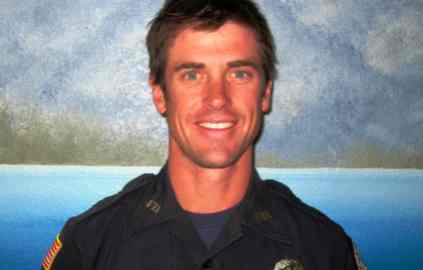
Mitch Underhill

Mitch Underhill

The Lake Valley Fire Protection District is deeply saddened to announce the unexpected death of 34-year-old firefighter paramedic Brandon “Mitch” Underhill on Sept. 29.

Mitch joined the fire district as a paid professional on Sept. 27, 2005, and served the community with dedication and devotion for just over eight years until his untimely death.

Mitch is survived by his wife and two young children, his parents, and a sister and brother.

Donations to help out the family in these toughest of times can be made at any El Dorado Savings bank branch under the name of the “Underhill Family Fund”. A website has been set up where people may post comments about Mitch.

— Lake Valley Fire Protection District


Landlords economically better off than savers

By Kathleen Madigan, Wall Street Journal

In this recovery, it’s better to be a landlord or investor than a saver.

That is the message from Friday’s report on personal income. Since the recession ended in the second quarter of 2009 to the average so far in the third quarter, the gains in income have been paced by rents collected by landlords and dividends paid to shareholders.

Since mid-2009, nominal personal income has increased 17%. Rental income has soared 85 percent, and dividends are up 44 percent. Retail income and dividends compromise less than 10 percent of all income, but have accounted for 25 percent of the increase in all earnings so far in the recovery. Following close behind is proprietors’ income, up about 42 percent.

Wages and salaries, about half of all household earnings, have grown about 14 percent, accounting for 40 percent of the entire income increase.

Some of the divergent growth rates reflect changes in the economy coming out of the Great Recession–trends that won’t last over time.

Read the whole story


SAT scores reveal students not ready for college

By Justin Doubleday, Chronicle of Higher Education

Less than half of the students who took the SAT in 2013 are ready to succeed in postsecondary education, according to a report released on Thursday by the College Board, which owns the SAT.

Only 43 percent of the test takers this year met or exceeded the benchmark score of 1,550 out of a possible 2,400, the same proportion as last year.

Those who reach that number, according to the College Board, have a greater chance of attaining a B-minus average or higher during their first year of college and persisting to graduation. The mean score for 2013 was 1,498.

In a conference call with reporters on Tuesday, College Board officials said the number of students reaching the benchmark score had remained virtually unchanged over the last five years. “We are just not moving the needle as aggressively as it needs to be moved,” said Cyndie Schmeiser, chief of assessments.

For more test takers to reach a score of 1,550, rigorous coursework will have to become more widely accessible, said David Coleman, president of the College Board.

Coleman plans to better align the SAT with the Common Core State Standards, which he helped write. They prescribe what students should learn, in English and mathematics, from kindergarten through high school. His proposal to make the essay portion of the SAT more analytical has been met by a mix of applause and apprehension.

The SAT results show that more must be done in elementary and secondary schools to prepare students for college and careers, Coleman said on Tuesday: “We at the College Board consider this a call for action.”

Read the whole story


Man killed in motorcycle accident identified

Updated: Sept. 30 8:45am

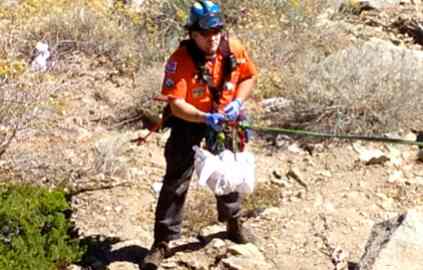
El Dorado County search and rescue helped with the accident, including getting evidence that was on the other side of the embankment. Photo/Provided

El Dorado County search and rescue helped with the accident, including getting debris that was on the other side of the embankment. Photo/Provided

A 61-year-old Rancho Cordova man died Friday morning when the motorcycle he was riding drove head-on into a Jeep Liberty.

According to the California Highway Patrol, David White was going east on Highway 50 near Echo Summit when he crossed the double yellow line and hit the Jeep being driven by Arthur Schallock.

Shallock, 89, and his wife, Dona, 86, sustained minor injuries. The Sonoma couple was transported to Barton Memorial Hospital.

The cause of the accident is under investigation. Alcohol does not appear to be a factor.

 — Lake Tahoe News staff report