Special interests to take their cause to voters in ’14

By Anthony York, Los Angeles Times

SACRAMENTO — While much of the country is gearing up for the holidays, political forces in Sacramento are girding for battle.

Already, special interests are lined up with plans that could shape next year’s general election ballot. They are considering propositions to increase medical malpractice awards, hike tobacco taxes and give local governments the right to scale back public employee pensions, among other ideas.

Each of the proposals could spawn campaigns costing tens of millions of dollars. Decisions about whether to proceed will be made in the next couple of weeks as de facto deadlines loom.

Some propositions have already qualified for the November ballot. One would allow the state insurance commissioner to veto proposed increases in healthcare premiums, as he now can with auto policies. Another is a referendum on a new Central Valley casino project approved by Gov. Jerry Brown this year.

Votes are also scheduled on a multibillion-dollar water bond and a limit on state spending. But those measures were placed on the ballot by the Legislature and could change, because lawmakers are not bound by the same rules or deadlines as initiative sponsors.

Read the whole story


Douglas County judge charged with manslaughter

By AP

MINDEN — A Nevada judge has been charged with misdemeanor vehicular manslaughter in the August death of a bicyclist.

A criminal complaint filed Friday says Douglas County District Judge Michael Gibbons failed to exercise due care when passing bicyclist Joseph Longo, 61, of Gardnerville.

Michael Gibbons

Michael Gibbons

Longo and Gibbons were westbound on Pinenut Road on Aug. 20, and Gibbons was making a right turn onto East Valley Road when the rear of his vehicle struck the bike, according to the Nevada Highway Patrol. Longo was not wearing a helmet.

The NHP’s investigation concluded the collision was a result of simple negligence, and there were no aggravating circumstances or egregious conduct involved.

Gibbons attorney David Houston issued a statement questioning District Attorney Mark Jackson’s handling of the case.

“We are surprised and disappointed that the local district attorney has decided to file charges,” Houston said in the statement. “We thought the case should be handled by a prosecutor from outside of Douglas County. We believe that this case is more properly resolved in a civil court because our accident reconstruction has shown that Judge Gibbons did not hit the bicyclist. This is a tragic incident for all.”

If convicted, Gibbons faces up to a $1,000 fine, a one-year suspension of his driver’s license and six months in jail.

Gibbons, a former chief deputy district attorney, was first elected to the bench in 1994 and re-elected in 1996, 2002 and 2008.

He’s scheduled to make an initial appearance in East Fork Township Justice Court on Jan. 13.


Online poker generating income for gaming firms

By Richard N. Velotta, Las Vegas Sun

Gaming companies blazing the trail for online poker are starting to generate revenue from their Internet investments.

It’s still too early to determine exactly how much they have made and how sustained the results will be, but frontrunners Caesars Entertainment and Station Casinos both have realized proceeds from online gaming.

Caesars, parent company of Harrah’s Lake Tahoe and Harveys, began generating online poker revenue during the third quarter of the year in Nevada and the fourth quarter in New Jersey. The company’s third-quarter earnings included only 11 days of online poker revenue. Caesars unveiled its World Series of Poker site Sept. 19. The company didn’t specify online poker revenue in its earnings report.

Station got an even earlier start, having already managed more than 1 million hands here, and is ready to roll out its product in New Jersey. Both companies take a percentage of gamblers’ money for every hand played.

Overall, Caesars reported revenue of $2 billion, down 0.7 percent from the third quarter last year. The company reported $112 million in casino revenue, a 7 percent decline offset by lower promotional expenses and increases in nongaming revenue.

Read the whole story


Teachers unions trying to retain clout

By Stephanie Simon, Politico

It’s designed to be an impressive show of force: Thousands of unionized teachers plan to rally today in cities from New York to San Francisco to “reclaim the promise of public education.”

Behind the scenes, however, teachers unions are facing tumultuous times. Long among the wealthiest and most powerful interest groups in American politics, the unions are grappling with financial, legal and public-relations challenges as they fight to retain their clout and build alliances with a public increasingly skeptical of big labor.

“I do think it’s a moment of truth,” said Lance Alldrin, a veteran high-school teacher in Corning who has split from his longtime union after serving for a decade as the local president.

The National Education Association has lost 230,000 members, or 7 percent, since 2009, and it’s projecting another decline this year, which will likely drop it below 3 million members. Among the culprits: teacher layoffs, the rise of non-unionized charter schools and new laws in states such as Wisconsin and Michigan freeing teachers to opt out of the union.

The American Federation of Teachers has been able to grow slightly and now represents 1.5 million workers — but because many new members are retirees or part-timers who pay lower dues, union revenue actually fell last year, by nearly $6 million, federal records show.

Read the whole story


STR branching out with what it recycles

By Kathryn Reed

No one is getting rich off recycling plastic. And come Jan. 1 with South Lake Tahoe banning grocery stores from handing out plastic bags, there is bound to be much less for South Tahoe Refuse to collect.

“Film plastic from grocery bags to trash bags for lawn maintenance to plastic film that goes around your bread is all recyclable. But it is very volatile. It is like the lowest grade of plastic besides Styrofoam,” explained John Marchini, owner of STR.

By volatile he means there isn’t much return for it per pound.

“Our brokers won’t accept it from us at times because there is no demand for it,” Marchini told Lake Tahoe News.

Even those blue bags are recyclable.
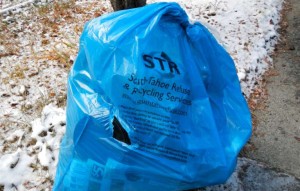
South Tahoe Refuse collects a substantial amount of its recyclables via blue bags. Photo/LTN

South Tahoe Refuse collects a substantial amount of its recyclables via blue bags. Photo/LTN

Still, STR, like all garbage companies in California, is required to meet certain recycling minimums. State rules are 50 percent of trash must be recycled. That percentage is slated to go to 75 percent in 2020. However, several years ago South Lake Tahoe said the rate must be 55 percent.

For the first nine months of 2013, STR is at a 63 percent compliance rate.

If people don’t put their recycling in blue bags, workers on the assembly line pick out the recyclables piece by piece. The problem is they can’t get everything. The blue bags come across the line separate from the garbage and are then sorted in appropriate recycling categories.

“Our employees target different material. Mixed paper is a stronger commodity and there is more of it than film plastic,” Jeanne Lear with STR explained. “There is a bigger bang for the buck if we pull off cereal boxes and mixed mail.”

Recycling goes well beyond what people on the South Shore put in their blue bags each week.

To get to 75 percent is going to require STR finding markets for nearly everything that comes through its doors. To increase the recycling by one percentage point it takes about 1,000 pounds of recycling.

“We are going to shoot for everything we can. Our focus over the last nine months to a year is really ramping up green, organic waste,” Lear said.

Contractors are given a drop box. Bigger projects separate the debris on site, while smaller operators bring in a mixed box. STR employees then sort through the bins, putting metal, wood, asphalt and concrete into separate piles.

“Construction has good weight and we have outlets for wood and metal. We will focus on that in the winter because there is not as much yard waste in winter,” Lear told LTN.

Insulation usually ends up at the landfill.

Drywall, though, is something the company recently started targeting. It’s a material that Full Circle Compost in Minden will take.

Wood often goes to Bentley Agrowdynamics in the Carson Valley.

Dirt is another commodity STR has started recycling.

Food waste also goes to Full Circle.

STR has been working with a handful of restaurants for several years to collect food waste. Last school year Sierra House Elementary came on board. After the first of the year Bijou Community School will be part of the program.

“We just need to make sure it is done well and that kids understand the whole process and we keep contamination levels down,” Lear said.

STR and Lake Tahoe Unified School District officials have talked about having a districtwide composting program. One holdback is the tipping fee at Full Circle. But if enough were recycled, then it would mean the district’s garbage fee would go down so it could pencil out.




McCall Realty sells to Sierra Sotheby’s

Thane McCall is again selling his business. This time to Sierra Sotheby’s International Realty.

Thane McCall

Thane McCall

McCall Realty started in 1981 as a solo office in Lake Tahoe. In the ensuing years it grew to about 100 agents at five outlets, serving people in Stateline, Carson City, Gardnerville, Incline Village and South Lake Tahoe. In the first quarter of 2005, Dickson Realty acquired McCall Realty.

In January 2010, McCall opened real estate offices in South Lake Tahoe and Round Hill using his name again.

At the time of the latest sale there were about 50 people working at McCall Realty.

“Joining forces with the industry’s leading real estate brand and organization will help us to provide an even higher level of service to our established clientele,” McCall said in a statement.

— Lake Tahoe News staff report


Study: Most U.S. workers unprepared for retirement

By Stuart Pfeifer, Los Angeles Times

More than half of U.S. workers aren’t saving enough money to be able to cover essential living expenses in retirement, according to a survey by Fidelity Investments.

The savings survey found that 55 percent of people will have trouble covering housing, healthcare and food expenses, Fidelity said.

The online survey of 2,200 households, performed from June through October, measured whether workers were on track to cover their estimated post-retirement expenses.

Read the whole story


3 bouncers at Mo’s Place may get plea deal in 2012 beating death of out-of-town patron

By Kathryn Reed

It is likely the three Mo’s Place bouncers will serve less than four years behind bars for their role in the death of Derek “Zippy” Penaranda.

Penaranda, who was from Ripon, was in South Lake Tahoe in May 2012 to celebrate his 30th birthday. He never recovered from the injuries he sustained from a fight at the Highway 50 bar. He died in October 2012.

Rodolfo Hernandez, 44, is charged with involuntary manslaughter. He has been in custody since he turned himself in after being indicted. He is on an immigration hold and could be deported if found guilty. If Hernandez is guilty, he faces a maximum of four years in county jail. (Because of changes in California prison rules a conviction of manslaughter is no longer a prison term.)

Derek "Zippy" Penaranda and Katie Musselwhite had hoped to one day marry. Photo/Provided

Derek “Zippy” Penaranda and Katie Musselwhite had hoped to marry  one day. Photo/Provided

Sean Canilao, 49, and Ruben Lizzaragga, 41, are charged with assault with force that is likely to cause great bodily injury. Both are out on their own recognizance. They face a maximum four-year prison sentence.

“One of the inconsistencies in the legislation is punishing of different types of crimes,” Joe Alexander, El Dorado County deputy district attorney, said of the new sentencing rules set by the Legislature.

Hernandez, Canilao and Lizzaragga are scheduled to be tried at the same time. The trial date is Feb. 11 in Placerville. However, a readiness and settlement conference is set for Jan. 3 before Judge Daniel Proud.

“I believe there is some likelihood of it settling on that date,” Alexander said in reference to next month’s hearing.

“There is evidence the crime was committed, but also other things occurred that to some extent mitigate the crime itself. Evidence that makes it more difficult than appears on the surface,” Alexander told Lake Tahoe News.

If a settlement were reached, that would mean the three men would be serving less than the four-year maximum for each of their crimes. Canilao and Lizzaragga until now had clean records, so they would benefit from good behavior allowances.

“Early on I told my family don’t be surprised if they only get probation. That is something the judge can initiate. We are in a wait-and-see mode,” Wayne Penaranda, the victim’s father, told Lake Tahoe News.

Penaranda has been at every court hearing. He is in regular contact with prosecutors. Now he wants it all to be over. His family wants closure.

“No amount of punishment will do anything or bring my boy back. It is kind of an academic situation. We are not real happy with it, but it’s the letter of the law,” Penaranda said. “All of the laws are built to protect the criminals’ rights.”


Calif. economy recovering at uneven pace

By Shan Li and Andrew Khouri, Los Angeles Times

California continues to be a story of two economies: coastal regions with healthy job growth and inland areas that are still struggling to recover, according to a UCLA report released Thursday.

UCLA economists said in their quarterly forecast that coastal counties stretching from Marin to San Diego have enjoyed employment gains that outpaced the U.S. In contrast, inland areas such as the San Joaquin Valley and the East Bay are showing little or even negative growth.

Years of economic turmoil have especially been hard on the Inland Empire, which includes Riverside and San Bernardino counties. The region’s October unemployment rate was 9.8 percent, down from 11.7 percent a year earlier. But its jobless levels were still well above the 7 percent in San Diego County and 5.8 percent in Orange County.

Read the whole story


Cost of cleaning Meyers Landfill not resolved

By Kathryn Reed

El Dorado County and U.S. Forest Service officials continue to bicker over the cost of remediation at the old Meyers Landfill.

The closed session item on the Board of Supervisors meeting this week was pulled as both sides continue mediation. It will be on a future agenda when something comes out of the mediation.

Earlier this year the Ninth Circuit Court of Appeals sided with El Dorado County in regards to whether it should pay for unexpected costs. The bill is about $13 million – twice what was expected. No matter who pays, it’s taxpayer money.

Meyers Landfill has been a contentious issue for decades. Photo/USFS

Meyers Landfill has been a contentious issue for decades. Photo/USFS

“Where a project owner like the USFS provides detailed design plans and specifications, the government, and not the contracting party (here the county) bears the risk if such plans and specifications are ultimately determined to be deficient,” the court wrote in its January decision.

That sent the case back to trial court, though the two are trying to resolve the dispute through mediation.

“There is still ongoing litigation over the costs of the closure of the site. The USFS hired a consultant to design the various items to be installed there in order to make sure there were no further problems (things like a ‘cap’ and drainage swales, etc.). The county followed those plans, however in doing so we discovered that the plans were woefully inadequate and failed to cover the entire site, so the county ended up expending a lot more money than originally anticipated,” Ed Knapp, county counsel, told Lake Tahoe News. “The county sued the USFS alleging that the USFS consultant’s plans were below reasonable standards, and that negligence cost the county several million dollars in extra closure costs. This dispute is still ongoing.”

Lisa Herron, spokeswoman with the Forest Service, had no comment because it is active litigation.

The Meyers Landfill off Pioneer Trail on the edge of South Lake Tahoe was used from 1947-71. Twenty years later the feds sued a slew of entities for cleanup costs. Vinyl chloride, a carcinogen produced when household waste breaks down, was the main contaminant under the sealed plot, although methane and other gases posed problems.