Truckee youth accused of stealing mail

By Barbara Barte Osborn, Sacramento Bee

TRUCKEE — A Truckee juvenile was arrested Wednesday after allegedly confessing to more than a dozen mail thefts and four burglaries the day before.

On Tuesday, the Truckee Police Department received more than a dozen reports in the Glenshire subdivision related to mail tampering. Additionally, two businesses and two residences were burglarized.

Read the whole story


Engineers: U.S. infrastructure close to failing

By Meagan Clark, International Business Times

U.S. infrastructure — roads, bridges, rail, drinking water, waste water, solid waste and more—is close to flunking according to a recent assessment from the American Society of Civil Engineers.

Once every four years, America’s civil engineers assess the nation’s infrastructure with an A to F report card. The engineers grade eight major categories: capacity, condition, funding, future need, operation, maintenance, public safety, resilience and innovation. This year’s grade average of all eight categories is a modest improvement, but hardly one to cheer about — it’s a D+ compared to a D in 2009. The nation’s infrastructure GPA has averaged in the D’s since 1998 for delayed maintenance and underinvestment across most categories.

“While the modest progress is encouraging, it is clear that we have a significant backlog of overdue maintenance across our infrastructure systems, a pressing need for modernization, and an immense opportunity to create reliable, long-term funding sources to avoid wiping out our recent gains,” the report states.

Solid waste earned the highest grade, a B-.

City and state efforts to repair and update some of the nation’s most vulnerable bridges improved the bridge category, and short-term federal funding improved several categories. However, improvements are not all due to government. Increased private investment for efficiency and connectivity helped rail’s grade improve.

Read the whole story


Incline couple reports death threats over bear issue

The bear-people issue in Incline Village has gotten so bad that a couple filed a report with Washoe County sheriff’s investigators saying they have received death threats because they reported a problem bear to state officials.

According to the Reno Gazette-Journal, Nevada Department of Wildlife trapped a 263-pound male black bear outside Richard and Adrienne Evans’ house on Dec. 13 and later euthanized it.

A trap was set because the bear had tried multiple times this month to get into one of the Evans’ vehicles and finally did so last week. The bear had been captured and released earlier this fall.

 — Lake Tahoe News staff report


STPUD makes case for rate increases

By Kathryn Reed

It’s possible South Tahoe Public Utility District customers could be paying $78.60 more a year for water and sewer service starting July 1.

This breaks down to another $4.40 per month for water over 10 years and $2.15 a month for sewer in the same time period. It’s called the “optimum” plan to accomplish the district’s goals. Other scenarios include increases just for meter installation or spreading all costs over 20 years. Board members could develop other alternatives.

More than a dozen people on Dec. 19 attended a workshop designed to touch on the reasons the South Shore entity needs more money. The five board members were hearing some of the numbers for the first time.
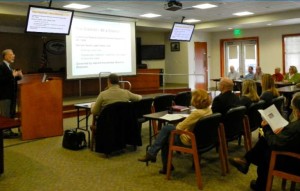
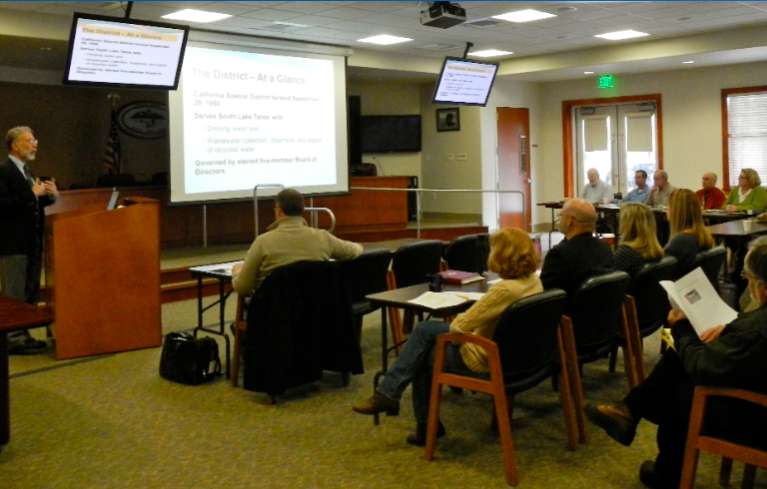
South Tahoe PUD General Manager Richard Solbrig, left, explains the district's capital improvement needs Dec. 19. Photo/Kathryn Reed

South Tahoe PUD General Manager Richard Solbrig, left, explains the district’s capital improvement needs Dec. 19. Photo/Kathryn Reed

In the coming months the electeds will be tasked with deciding if rate increases should be sought. A preferred plan is expected to be decided in March, with public hearings on a rate increase and the 2014-15 budget in May.

While one slide of the presentation said salaries and benefits have been cut by 3 percent, this is a bit misleading. What the district pays out is down by that amount over the last two years. There has been no cost of living increase, however some people have had salary increases to keep them on par with their peers in other districts. Three and half positions have not been filled. And the district saved money by switching from being self-insured for health care to going with a group of state water districts to lower the costs by about $900,000 per year.

Another cost-savings came from cutting the operations and maintenance budget by 20 percent.

Risk vs. affordability is how district staff is putting forth the discussion. Can the district keep going forward without having adequate fire protection? Where does the money come from to put the remaining 8,300 water meters that need to be installed by 2025 in the ground? Is Lake Tahoe threatened without upgrades to the sewer system?

The board was fairly silent until an audience member asked what they thought of the staff presentation.

President Eric Schafer said for the nearly 13 years he has been on the board he has advocated for small increases. (Later that afternoon at the regular meeting Schafer was appointed to be chair for another year and Randy Vogelgesang vice chair.)

“We want to give the public a system they don’t have to worry about. There is a price for that. It won’t get cheaper,” Schafer said. “I’m advocating doing as much as we reasonably can.”

Board member Jim Jones said 1 percent of the value of the $1.6 billion infrastructure that is in the ground should be spent each year to replace what is wearing out. That would be $16 million a year. He pointed out the district has been spending closer to $6 million a year for the last 10 years.

Some of the parts in the district are 50 years old – the life expectancy of much of the equipment.

“Lines wear out from age, not use,” General Manager Richard Solbrig said. “The water system is protecting your house whether you are there or not.”

But not every house has large enough water lines out front to fight a fire. The district says it will take $67 million over 10 years to upgrade the water system. The bulk of that money is so there are 8-inch water lines for adequate water suppression pressure.

The district has to have all customers on meters by 2025 per state law. A previous board decided the district would put in the meters instead of mandating individual property owners do it.

The California Department of Public Health is offering a 20-year zero percent loan. The application is due in June. The $21.5 million loan would equate to ratepayers paying an additional $1.10 per month. A 5 percent interest rate on a loan would come out to $1.75 a month for customers.

District customer Bob Olsen questions why he would have to pay to install other people’s meters when he paid for his own.

Solbrig said expenses have to be spread out and that it isn’t possible for each customer to be charged for the exact cost of delivering water or taking away sewage. He gave the example of how some houses on hills require more electricity to pump the water, but are charged the same as everyone else.

With 30 percent of the sewer budget spent on exporting the wastewater to Alpine County, one person asked why not lobby to get rid of the Porter-Cologne Water Quality Control Act.

“It’s probably regarded as the single most successful thing that has been done to protect Lake Tahoe,” Solbrig said of the federal mandate.

He doesn’t believe the district has any chance of winning that battle in Sacramento or Washington.

The Luther Pass pump station needs substantive upgrades, including increasing the voltage to get the wastewater up and over the mountain pass. Parts are so old that Liberty Utilities does not have back up parts.


Study: Law enforcement often doesn’t buckle up

By Jed Boal, Deseret News

SALT LAKE CITY — “Click It or Ticket.” That’s the highway patrol campaign in many states that urges everyone to wear their seat belts or face a fine.

But a study by California’s Commission on Peace Officer Standards and Training estimates that roughly half of law enforcement officers don’t wear seat belts, while 86 percent of the public now buckle up.

Scot Stephenson, Utah’s director of Peace Officer Standards and Training, was surprised to hear that. He said he believes 80 percent to 85 percent of law enforcement officers in Utah buckle up on the job because that’s the way they train.

Stephenson said he can’t be certain that’s the way the officers behave after they finish training, but he said seat belt training is a major component of what they learn. Stephenson also said there’s been a nationwide movement to cut down on the number of law enforcement fatalities.

Read the whole story


Measure would change criteria for teacher layoffs

By Laurel Rosenhall, Sacramento Bee

A ballot measure submitted by a political consultant for education advocate Michelle Rhee seeks to remove seniority as a factor when California school districts lay off teachers, requiring instead that decisions be based on performance and student test scores.

That approach has been at the core of Rhee’s advocacy efforts as head of StudentsFirst, a national group headquartered in Sacramento. Rhee, who is married to Sacramento Mayor Kevin Johnson, has said she established the group to try to counter the influence that teachers unions have in decisions about public education.

Unions generally reject the idea that teachers should be rated based on their students’ test scores, and prefer contracts that call for the most recently hired teachers to be the first let go during layoffs.

Read the whole story


Study: Pot use among high school students increasing

By Anahad O’Connor, New York Times

A federal report shows that the percentage of American high school students who smoke marijuana is slowly rising, while the use of alcohol and almost every other drug is falling.

The report raises concerns that the relaxation of restrictions on marijuana, which can now be sold legally in 20 states and the District of Columbia, has been influencing use of the drug among teenagers. Health officials are concerned by the steady increase and point to what they say is a growing body of evidence that adolescent brains, which are still developing, are susceptible to subtle changes caused by marijuana.

“The acceptance of medical marijuana in multiple states leads to the sense that if it’s used for medicinal purposes, then it can’t be harmful,” said Dr. Nora D. Volkow, director of the National Institute on Drug Abuse, which issued the report. “This survey has shown very consistently that the greater the number of kids that perceive marijuana as risky, the less that smoke it.”

Volkow said that one way marijuana might affect cognitive function in adolescents was by disrupting the normal development of white matter through which cells in the brain communicate.

Read the whole story


Sandoval wants Nev. mental health system studied

By Phillip Reese and Cynthia Hubert, Sacramento Bee

Gov. Brian Sandoval on Monday announced the creation of a special council to review Nevada’s embattled mental health care system and offer recommendations for improvements.

The announcement followed a Sacramento Bee investigative report published Sunday that found numerous patients discharged from Rawson-Neal Psychiatric Hospital in Las Vegas to Greyhound buses bound for other states were later arrested at the destination cities for crimes that included murder, assault, theft, vagrancy and sex offenses.

The new Behavioral Health and Wellness Council will be “comprised of members of the Legislature, law enforcement officials, national experts, and providers of behavioral health services in Nevada,” Sandoval said in a statement. It will “assist in closing gaps in services and offer policy recommendations to help improve the quality of life for those individuals living with behavioral health conditions.”

Read the whole story


9 Truckee youths accused of tagging

A six-week investigation into several graffiti cases throughout Truckee ended with the arrest of nine juveniles.

Most of the graffiti was considered to be tagging, with monikers related to the suspects, police said.

Additional suspects are being evaluated, according to Truckee police officers.

Police warn people that i t is a crime to supply a juvenile with spray paint, and it is a crime for a juvenile to possess spray paint.

“We take these cases very seriously and do not view them as petty crimes. Truckee is one of those communities where defacing property in any way will get our full attention,” police Capt. Rob Leftwich said in a press release.

Anyone with additional information should call (530) 550.2320.

— Lake Tahoe News staff report


Second AZ firefighters’ death probe more revealing

By Cally Carswell, High Country News

As we reported in October, the first investigation of Arizona’s Yarnell Hill Fire, in which 19 hotshots were killed this summer, drew extremely cautious conclusions. No “direct causes” of the accident were identified, no one was blamed.

Policies and protocols, the report said, were not violated. It was almost strangely timid, leaving some to wonder: How could 19 young men have lost their lives if so few mistakes were made?

That report was commissioned by the Arizona State Forestry Division, the agency that oversaw the firefighting effort on Yarnell Hill. Now, a separate investigation, this one from the Arizona Division of Occupational Health and Safety, has been completed — and it reached much more damning conclusions. The Associated Press calls it a “stinging rebuke” of the first investigation.

Worst of all, it bluntly concluded that protection of “non-defensible structures” — houses that didn’t have adequate clearings around them to allow firefighters to safely fight encroaching flames — was prioritized above firefighter safety.

Firefighters should have been told to stand down before the storm arrived that blew the fire up, lead investigator Marshall Krotenberg told the Arizona Industrial Commission, which administers and enforces worker safety laws.

Read the whole story