NV Energy rates going up Jan. 1

By Madison Corney, KRNV-TV

NV Energy residential customers will see an increase on their monthly gas and electric bills Jan. 1.

In June 2013, NV Energy submitted a legally required electric and gas general rate case to the Public Utilities Commission of Nevada. Last week the rate case was approved.

Starting on Jan. 1 a typical residential electric customer will see about a 3 percent increase on their monthly statement, which comes to about $2.84. A typical gas customer will see about a 5 percent increase which comes to about $2.43.

Read the whole story


Flu strain hits young people, healthy adults hardest

By Cynthia H. Craft, Sacramento Bee

Just days after a Christmas Eve federal health advisory, a top public health official warned Friday of a sudden increase in local influenza activity, possibly led by a strong resurgence of a version of the virus behind the 2009 worldwide flu pandemic.

Olivia Kasirye, the Sacramento County’s public health officer, said the viral strain known as influenza A pH1N1 is atypical because it tends to hit young people and healthy adults the hardest. In 2009, the H1N1 virus caused more illness in children and young adults, compared to older adults.

State and federal officials confirmed that the pH1N1 virus is the “predominant strain” circulating so far this season nationwide. Statewide, no influenza outbreaks have been reported to date and only local – as opposed to regional – cases have popped up, according to data collected by the state up to Dec. 14.

Read the whole story


Calif. undecided on legalizing recreational pot

By Peter Hecht, Sacramento Bee

On New Year’s Day in Colorado, state-licensed marijuana stores will begin selling pot purely for pleasurable consumption.

Colorado, already home to the nation’s most regulated medical marijuana industry, expects to open its first two dozen stores selling recreational cannabis users up to an ounce of pot each. Another 400 applications are pending for retail marijuana shops, commercial cultivators or pot product producers. In Washington, where voters also legalized recreational marijuana use in November 2012, the state is reviewing a flood of applications for 340 state licenses for marijuana stores expected to begin opening this spring.

Now in California, where a recent Field poll showed 55 percent voter support for marijuana legalization beyond medical use, four pot legalization ballot initiatives have emerged as contenders for the November ballot. Yet in the home of America’s largest marijuana economy, advocates remain hesitant about moving forward – and putting the necessary money on the line – to qualify a California pot legalization vote next year. They remain uncertain over the state’s political climate and are frustrated by failure of lawmakers to set rules governing California’s medical marijuana trade, once estimated at $1.5 billion, in the face of federal raids on cannabis businesses.

Read the whole story


No moisture in sight; drought-conditions grow

By Brian Lada, AccuWeather

With 2013 quickly coming to a close, it’s shaping up to be one of the driest calendar years on record for many places in California.

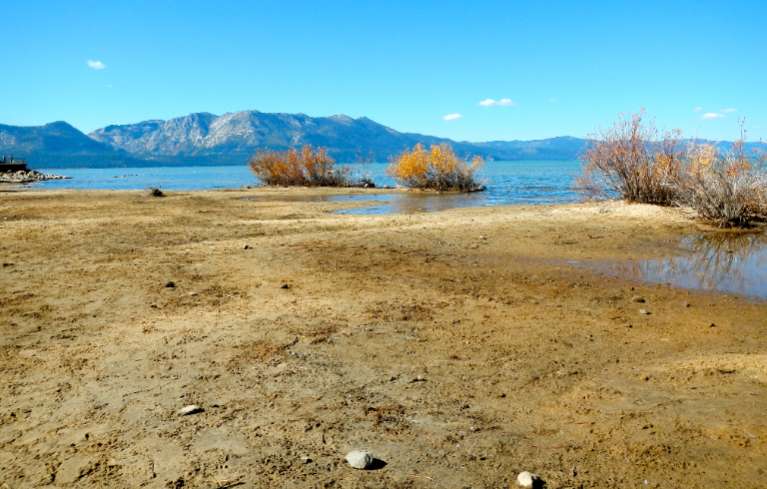
Regan Beach in South Lake Tahoe in October 2013. Photo/LTN

Regan Beach in South Lake Tahoe in October 2013. Photo/LTN

Almost all of the Golden State is under either a severe or extreme drought with no end in sight heading into 2014.

This prolonged drought has contributed to the heightened risk of wildfires over the past several months and is raising major concerns in the agriculture industry.

Looking at the forecast through the remainder of 2013 and into the beginning of 2014, it appears as though very little rain — if any at all — will fall across the state.

Read the whole story


Discounts make for profitable holiday season

By Siddharth Cavale, Reuters

Sales during the 2013 U.S. holiday season grew from a year earlier as deep discounting and increased promotions encouraged consumers to buy more.

Holiday sales between November 1 and December 24 rose 2.3 percent, compared with 0.7 percent a year earlier, according to data published in the MasterCard Advisors’ SpendingPulse report.

This sales growth was the highest in three years.

“It was actually a Merry Christmas for retailers,” Sarah Quinlan, senior vice president at MasterCard Advisors, told Reuters, adding that jewelry was the best-performing category.

Read the whole story


Sewage leak temporarily closes part of Squaw

The upper mountain at Squaw Valley reopened today after being closed because of a sewage leak.

Through the resort’s monitoring system employees realized something was wrong Dec. 26. The leak was found that afternoon, which led to the upper area being closed and the sewer system shut off.

“The site was excavated and the pipelines exposed between the afternoon of Dec. 26 and the early morning hours of Dec. 27. Squaw Valley determined that the leak had allowed earthen materials to enter the pipeline and to create a blockage,” resort spokeswoman Amelia Richmond told Lake Tahoe News.

Squaw Valley Public Service District employees were on site while resort staff and others cleaned out the blocked pipes.

Pipes were fixed by Friday afternoon and the tram began running again that evening.

“Placer County environmental health staff visited the site and observed that Squaw Valley had taken remedial measures, noting that the leak did not appear to have reached any water courses and that no sewage odor was present,” Richmond said.

— Lake Tahoe News staff report


El Dorado Savings making leadership changes

By Kathryn Reed

In this era of corporate banking and corruption, one bank has held true to its roots – El Dorado Savings Bank.

A lot has to do with the fact that members of the Cook family are still at the helm of the Placerville-based institution. It was George Cook Sr. and members of the Warren family who founded the bank in 1957. Cook still works in Placerville three days a week.

In the past 56 years the bank has grown to have 35 branches, including three in South Lake Tahoe, one in Tahoe City, one in Carson City, one in Gardnerville and one in Sparks.

El Dorado Savings has three branches in South Lake Tahoe. Photo/LTN

El Dorado Savings has three branches in South Lake Tahoe. Photo/LTN

The bank is a closely held company with about 180 stockholders.

On Jan. 1 a bit of musical chairs will take place in the front office for the first time in years. But those accessing the branches should not notice any changes.

George Cook Jr., who has been president of the bank for the last 23 years, will become CEO. Tom Meuser is stepping down as CEO, but will remain chairman of the board. Meuser is planning to work three days a week.

Cook has been with the bank for 40 years and Meuser 45 years, with the last 23 as CEO.

John Cook moves from senior vice president, chief appraiser, and facilities manager to president of the bank. He has been with the bank 34 years.

(John and George Cook are brothers.)

El Dorado Savings Bank has weathered the tumultuous financial times of the past few years. While it has had to deal with foreclosures, it is not in a precarious situation like other institutions.

“I’m pleased to report we currently do not have any real estate owned on our books and at the end of the year we will be without any on our books,” John Cook Jr. told Lake Tahoe News. “To be able to end the year without any foreclosures on the books is pretty darn good.”

In its last earnings report for the quarter ending Sept. 30, El Dorado Savings Bank earned $2.3 million. For the same quarter in 2012 the earnings were $1.9 million. El Dorado Savings Bank has approximately $1.9 billion in assets.

Cook said there have been plenty of positive signs in 2013 in terms of the real estate market improving and bank finances stabilizing.

In June, Bauer Financial Reports of Coral Gables, Fla., awarded El Dorado Savings Bank its highest five-star rating for being one of the safest banks in the U.S. for the 80th consecutive quarter dating to 1993.


Websites try to control nasty comments

By Barbara Ortutay, AP

NEW YORK — Mix blatant bigotry with poor spelling. Add a dash of ALL CAPS. Top it off with a violent threat. And there you have it: A recipe for the worst of online comments, scourge of the Internet.

Blame anonymity, blame politicians, blame human nature. But a growing number of websites are reining in the Wild West of online commentary. Companies including Google and the Huffington Post are trying everything from deploying moderators to forcing people to use their real names in order to restore civil discourse. Some sites, such as Popular Science, are banning comments altogether.

The efforts put sites in a delicate position. User comments add a lively, fresh feel to videos, stories and music. And, of course, the longer visitors stay to read the posts, and the more they come back, the more a site can charge for advertising.

What websites don’t want is the kind of off-putting nastiness that spewed forth under a recent CNN.com article about the Affordable Care Act.

“If it were up to me, you progressive libs destroying this country would be hanging from the gallows for treason. People are awakening though. If I were you, I’d be very afraid,” wrote someone using the name “JBlaze.”

YouTube, which is owned by Google, has long been home to some of the Internet’s most juvenile and grammatically incorrect comments. The site caused a stir last month when it began requiring people to log into Google Plus to write a comment. Besides herding users to Google’s unified network, the company says the move is designed to raise the level of discourse in the conversations that play out under YouTube videos.

One such video, a Cheerios commercial featuring an interracial family, met with such a barrage of racist responses on YouTube in May that General Mills shut down comments on it altogether.

“Starting this week, when you’re watching a video on YouTube, you’ll see comments sorted by people you care about first,” wrote YouTube product manager Nundu Janakiram and principal engineer Yonatan Zunger in a blog post announcing the changes. “If you post videos on your channel, you also have more tools to moderate welcome and unwelcome conversations. This way, YouTube comments will become conversations that matter to you.”

Anonymity has always been a major appeal of online life. Two decades ago, the New Yorker magazine ran a cartoon with a dog sitting in front of a computer, one paw on the keyboard. The caption read: “On the Internet, nobody knows you’re a dog.” At its best, anonymity allows people to speak freely without repercussions. It allows whistle blowers and protesters to espouse unpopular opinions. At its worst, it allows people to spout off without repercussions. It gives trolls and bullies license to pick arguments, threaten and abuse.

But anonymity has been eroding in recent years. On the Internet, many people may know not only your name, but also your latest musings, the songs you’ve listened to, your job history, who your friends are and even the brand of soap you prefer.

“It’s not so much that our offline lives are going online, it’s that our offline and online lives are more integrated,” says Mark Lashley, a professor of communications at La Salle University in Philadelphia. Facebook, which requires people to use their real names, played a big part in the seismic shift.

“The way the Web was developed, it was unique in that the avatar and the handle were always these things people used to go by. It did develop into a Wild West situation,” he says, adding that it’s no surprise that Google and other companies are going this route. “As more people go online and we put more of our lives online, we should be held accountable for things we say.”

Nearly three-quarters of teens and young adults think people are more likely to use discriminatory language online or in text messages than in face to face conversations, according to a recent poll from the Associated Press-NORC Center for Public Affairs Research and MTV. The poll didn’t distinguish between anonymous comments and those with real identities attached.

The Huffington Post is also clamping down on vicious comments. In addition to employing 40 human moderators who sift through readers’ posts for racism, homophobia, hate speech and the like, the AOL-owned news site is also chipping away at anonymous commenting. Previously, anyone could respond to an article posted on the site by creating an account, without tying it to an email address. This fall, HuffPo began requiring people to verify their identity by connecting their accounts to an email address.

“We are reaching a place where the Internet is growing up,” says Jimmy Soni, managing editor of HuffPo. “These changes represent a maturing (online) environment.”

This doesn’t mean that people have to use their names when commenting. But Soni says the changes have already made a difference in the quality of the comments. The lack of total anonymity, while not a failsafe method, offers people a “gut check moment,” he says. There have been “significantly fewer things that we would not be able to share with our mothers,” in the HuffPo comments section since the change, Soni says.

Newspapers are also turning toward regulated comments. Of the largest 137 U.S. newspapers — those with daily circulation above 50,000 — nearly 49 percent ban anonymous commenting, according to Arthur Santana, assistant communications professor at the University of Houston. Nearly 42 percent allow anonymity, while 9 percent do not have comments at all.

Curbing anonymity doesn’t always help. Plenty of people are fine attaching their names and Facebook profiles to poorly spelled outbursts that live on long after their fury has passed.

In some cases, sites have gone further. Popular Science, the 141-year-old science and technology magazine, stopped allowing comments of any kind on its news articles in September.

While highlighting responses to articles about climate change and abortion, Popular Science online editor Suzanne LaBarre announced the change and explained in a blog post that comments can be “bad for science.”

Because “comments sections tend to be a grotesque reflection of the media culture surrounding them, the cynical work of undermining bedrock scientific doctrine is now being done beneath our own stories,” wrote LaBarre.

We can’t wait to see the response to this story.


UC changing how it offers online classes

By Larry Gordon, Los Angeles Times

UC Riverside senior Matthew Emeterio was worried that he might be short of degree credits and have to delay graduation past next spring. But thanks to a soon-to-debut online program linking far-flung UC campuses, he expects to finish on time.

Starting next month, the political science major will be enrolled in a UC Davis course on climate change that he will be able to take via his computer mainly at night and on weekends, in addition to a full daytime load of traditional in-person courses at UC Riverside. He will be among the pioneers in an effort encouraging UC students to tap into faculty brainpower and curricula across the UC system while also exploring emerging online education.

The new “cross campus enrollment” is a change for a university system criticized for being too slow in adopting online courses and too Balkanized among its nine undergraduate campuses to significantly share teachers and classes.

Read the whole story


Detectives looking for men with ties to Incline death

Detectives with the Washoe County Sheriff’s Office want to talk to three men who may be able to provide information regarding the Dec. 22 death of Christopher Elliott.

Elliott, 46, was found dead on his front porch on Northwood Boulevard at 4am Dec. 22. The cause of death is pending an autopsy.

They are not suspects in this case, however they may be able to provide information useful to the investigation, deputies said.

They are described as three white males, were occupants of a dark-colored SUV that was parked in front of the 7-Eleven at Tahoe and Village boulevards shortly after 11pm Dec. 21. Detectives believe these individuals provided transportation for an additional person of interest in the investigation, described as a white male wearing a gray hoodie and shorts, from the 7-Eleven to a location on College Drive.

The individuals in question, or persons with information about the identification and location of these individuals, are asked to call (775) 328.3320.

— Lake Tahoe News staff report