Whooping cough cases surge in Placer County

By Cynthia H. Craft, Sacramento Bee

Once thought to be nearly eradicated, pertussis, the highly contagious respiratory disease also known as whooping cough, surged last year in many areas of California, with hundreds more cases reported in 2013 than in the previous year, state figures show.

In the greater Sacramento region, the largest bump in pertussis cases occurred in Placer County, which reported 79 cases in 2013, up from 11 cases in 2012. Sacramento County reported 65 cases, almost double the number in 2012. Yolo County was the only county in the region to see fewer pertussis cases in 2013: four, down from six the year before.

California health officials cite a variety of reasons for the uptick. A major contributor, according to the state, was declining immunity among children who had been vaccinated years earlier and had yet to get the booster shot recommended at ages 11 or 12.

Read the whole story


Wildland fire near Incline quickly snuffed

By AP

INCLINE VILLAGE — Firefighters hiked an hour through nearly a mile of thick brush early Friday to snuff out a small wildland blaze near Lake Tahoe, where authorities are bracing for an early start to a potentially dangerous fire season in the Sierra.

No structures were threatened by the fire that broke out at about 2:30am on a mountainside near Incline Village, North Lake Tahoe Fires Protection District spokeswoman Tia Rancort said.

Crews hiked through the heavy brush and downed timber before they reached the flames on U.S. Forest Service land at an elevation of about 7,800 feet.

The flames put up so much smoke at one point that officials issued an alert for smoke-sensitive populations, urging them to stay indoors and keep windows closed.

Rancort said there was no early indication of the cause of the fire, which remained under investigation. Fire district officials reminded residents that the entire area covering the north shore of Lake Tahoe remains under a “no public burning” order.

“Our fire conditions are still very dry,” Rancort said.

Northern Nevada is entering its third year of drought. Snowpack in the Lake Tahoe Basin closed out 2013 at about 33 percent of average, and the Truckee River Basin was at 23 percent.

North Lake Tahoe District Fire Chief Mike Brown said it’s as dry as he has seen it.

“Normally in the area where we have this fire we have 5 to 10 feet of snow,” he told KRNV-TV. “We have no snow in the area.”

Fire officials just over the mountain in Reno also worry about the potential for a challenging season like the one two winters ago, when a pair of fires burning with the intensity usually seen only in the heat of summer destroyed more than 50 homes.

Similar conditions this winter have fire crews on edge.

“We’re already going to go into summer with a fuel type that will be taxing us early on with our resources,” said David French, battalion chief for the Truckee Meadows Fire Protection District.

“As far as fire fuel, right now I’d say it’s about the way it is in June,” he told KTVN-TV. “I’d say we’re looking at very high to very extreme possibilities this summer.”


Honest day’s work amounts to poverty

By Lynn Stuart Parramore, AlterNet

Why should people in the richest country on Earth toil long hours for wages that would make Charles Dickens recoil in horror? A lot of Americans have been wondering the same thing.

The Bureau of Labor Statistics reports that in 2012, 1.57 million Americans earned the minimum wage of $7.25 an hour. Millions more were just above that figure, and plenty actually ended up below it. Over 60 percent of the minimum wage earners in 2012 were in retail, or in leisure and hospitality, which includes hotels and restaurants.

If we raise the minimum wage, an estimated 28 million will get a direct or indirect benefit, because when the wage goes up bosses often raise the wages of workers hovering right above the new minimum. So one in five American workers will take more money home. It’s not a silver bullet — employers will still try to avoid requirements by hiring contract workers and other tactics, and some workers will still end up exempt. But it’s a start.

Read the whole story


No snow: USFS sites busier than usual

Publisher’s note: This is one of a series of blurbs about how the lack of winter is impacting the Lake Tahoe Basin. If you have an idea, please email it to info@LakeTahoeNews.net.

U.S. Forest Service officials are noticing more people using their facilities in the Lake Tahoe Basin now compared to most winters. It all has to do with the lack of snow.

People have been asking Jean Norman at the front desk in South Lake Tahoe about hiking. That’s an unusual request for January. Most areas at lake level are clear, though icy spots exist because of the freezing temps overnight.

Bob Becker’s staff has been monitoring litter at popular areas like the Tallac Site and Taylor Creek Visitors Center.

“Once it’s closed and there are several feet of snow, they don’t go out there because the use is not that much,” Lisa Herron with the USFS told Lake Tahoe News. That’s in a normal year.

“People should get out and enjoy it while they can. For those who don’t ski or snowshoe it’s a good opportunity to do some hiking and not worry about a bunch of snow,” Herron said.

However, the other concern Forest Service officials have is for fire. Everything is dry. And while the agency doesn’t usually issue fire danger reports this time of year, it could if precipitation does not come. While other agencies have implemented winter fire restrictions, the Forest Service has yet to do so.

— Lake Tahoe News staff report


Calif. higher ed officials pledge to cooperate

By Larry Gordon, Los Angeles Times

SAN FRANCISCO — The leaders of California’s three public higher education systems Wednesday pledged more cooperation, particularly in transferring students, while Gov. Jerry Brown urged them to develop more innovative collaborations.

In a rare gathering, University of California President Janet Napolitano, California State University Chancellor Timothy P. White and California Community Colleges Chancellor Brice W. Harris said they want to break through some of the walls set up by the state’s 1960 Master Plan for Higher Education, which established different roles and student enrollment criteria for each sector. Yet they also said they want to maintain the plan’s basic tenets.

Napolitano said she hoped the systems would create a “student-centered” website that could track the academic progress of community college students and keep them on course to transfer to UC or Cal State.

Read the whole story


No snow: Time to water outside plants

Publisher’s note: This is one of a series of blurbs about how the lack of winter is impacting  the Lake Tahoe Basin. If you have an idea, please email it to info@LakeTahoeNews.net.

Water plants in January? Yes, says gardening expert Carolyn Meiers.

This is because they are used to getting moisture throughout the year. And because that is not naturally happening this winter, the plants need people to turn on the spigot to keep them alive.

Meiers recommends people in Lake Tahoe — and other places that aren’t getting moisture this winter — to water shrubs and trees that have deep roots.

“It doesn’t apply to anything with snow or ice because that is protecting the plant,” Meiers told Lake Tahoe News.

Watering in the afternoon when things have warmed is the best time. Water what you care about and possibly the items that are going to be expensive to replace.

— Lake Tahoe News staff report


Villalobos in poor health; trial delayed

By Dale Kasler, Sacramento Bee

Alfred Villalobos, a key figure in the CalPERS bribery scandal, has had his criminal trial postponed because of poor health.

The Lake Tahoe businessman and his co-defendant, former CalPERS Chief Executive Fred Buenrostro, will now go on trial April 28 in U.S. District Court in San Francisco, a judge ruled Wednesday. Trial was originally set for March 3.

Villalobos’ lawyer, Bruce Funk, said in a court filing this week that Villalobos was hospitalized much of last fall in the Reno area and spent some time in hospice care. “Apparently, Mr. Villalobos suffered from acute ammonia poisoning due to the various medications he was taking for his neurological illnesses,” Funk wrote in his court filing. “Around that time period in November, he was completely unresponsive in the hospital for days.”

Read the whole story


Calif. districts grapple with transgender law

By Alejandro Lazo, Wall Street Journal

SACRAMENTO — School districts in California are grappling with a newly enacted, first-of-its-kind law that spells out rights for those students who don’t identify as being the gender of their birth.

California law AB1266, the first such statewide legislation in the country, grants students who identify themselves as transgender the right to choose the sports teams and extracurricular activities—as well as the bathrooms and locker rooms—that correspond to their gender identities. Backers of the measure say transgender children have been subject to bullying in such settings and have thus taken to avoiding using the restroom or participating in athletics.

There are no firm estimates of how many such students might attend California schools, and no specific guidelines for determining if a youngster should be considered transgender.

Read the whole story


Drugs a leading cause of women’s incarceration

By Kathryn Reed

STATELINE – Drugs, alcohol and violence are the three primary reasons women end up in jail in El Dorado County. And meth is the drug of choice.

It takes a minimum of six years to kick the habit. And the deterioration of what one looks like is rapid and dramatic. But sometimes by the time they get out of jail they are returning to their original selves.

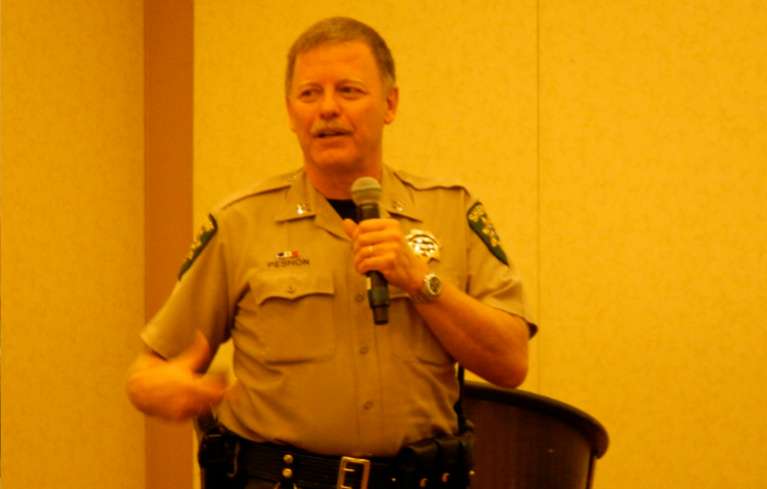
El Dorado County sheriff’s Capt. Randy Peshon spoke last week to Soroptimist International South Lake Tahoe about women behind bars and what is going on with the two county jails. The Placerville facility has 311 beds, while the one in South Lake Tahoe has 158. Both are co-ed, though seldom do the two populations mix.
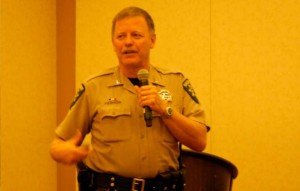
El Dorado County sheriff's Capt. Randy Peshon talks Jan. 22 about women in jail. Photo/LTN

El Dorado County sheriff’s Capt. Randy Peshon talks Jan. 22 about women in jail. Photo/LTN

There are between 60 and 75 women in the jails at any given time. Most are between the ages of 24 and 56.

“The No. 1 tool for managing a jail is the TV,” Peshon said. “If a fight breaks out, the TV is turned off.”

He said it’s a lot like raising children. Take away what they want and the behavior is likely to change.

“There’s not a lot of difference between the females and males in jail except for relationships,” Peshon said. “They care for each other unless you’ve committed a crime against a child. That’s where the men and women are the same.”

Riot gear is needed to deal with problems with the men. Sitting down and talking is how issues with the women are handled.

Women like the dormitory style housing because it is more sociable. The men don’t like this because it means living with other men.

Peshon has been in the jail division for decades. Before being promoted to captain a few years ago he ran the South Lake Tahoe facility. Now he is in charge of the entire jail system for the county.

He’s a big believer in programs for inmates instead of just having them sit around. The goal is to keep them productive. Peshon said about 80 percent of the people have problems that can be worked on, while there isn’t anything that can be done for the other 20 percent.

Mental health services are needed by 18 percent of the population. This is 4 percent higher than the national average.

“Jails have become the mental health providers of the county,” Peshon said.

It’s possible to obtain a full general educational development certificate, work skills, resume writing and other basic skills. Inmates may obtain a laundry manager certificate, which doesn’t cost the county a dime. This is the second year adult education classes have been offered.

One of the most successful programs started in 2007 is a partnership with Lake Tahoe Community College. The culinary arts program teaches them skills in the kitchen. They make meals for their peers and there is also a catering component.

Ninety percent of the inmates in the culinary program find a job – not necessarily in a restaurant – when they are released.

While most facilities would never put men and women together, Peshon likes to challenge the status quo. The culinary program and GED are co-ed. The thinking is that if one of the problems to begin with was the inability to get along with the opposite sex, isolation during incarceration is not going to help when they get out.

All the teaching also helps keep people from making a return stay at the jail. And it’s working. El Dorado County is renting out bed space to other counties.


No snow: Sierra-at-Tahoe reduces workers’ hours

Publisher’s note: This is one of a series of blurbs about how the lack of winter is impacting the Lake Tahoe Basin. If you have an idea, please email it to info@LakeTahoeNews.net.

Sierra-at-Tahoe ski school employees were sent an email Jan. 23 saying their hours would be cut as well as the hours the employee bus will be running.

“We are doing our best to manage labor and reacting to daily business volume. This also directly affects our bus routes. We will be running the red/blue bus route this upcoming weekend,” Steve Hemphill, spokesman for the South Shore resort, told Lake Tahoe News. “Everyone is doing their best to adapt to current conditions. We are not closing and do not plan to close. We will be staying open until mid-April.”

He would not say how many people are affected, when it takes effect, what the hours were and are now, or if others have had or will have hours cut.

 — Lake Tahoe News staff report