El Dorado, Placer income levels among best in state

By Claudia Buck, Sacramento Bee

When it comes to income, the Bay Area rocks. In the Central Valley and Inland Empire, not so much.

Overall, in another sign that California’s economy is shaking off the recession, state tax officials reported Tuesday that the statewide median income – for 2012 – was $70,938, up 4.1 percent over the previous year. That’s for those filing joint tax returns. For individual returns, the 2012 median income was $35,910, an increase of 3.5 percent, according to the state Franchise Tax Board.

Locally, Placer and El Dorado counties ranked in the top 10, at seventh and eighth, respectively.

Read the whole story


S. Tahoe man admits to bilking golf course investors

By AP

A South Lake Tahoe man accused of bilking 11 investors out of $3.6 million in a fraudulent scheme to buy a Douglas County golf course has pleaded guilty to 24 federal charges, including wire fraud and money laundering.

Scott Summerhays

Scott Summerhays

U.S. Attorney Dan Bogden says 55-year-old Scott Summerhays pleaded guilty Wednesday in federal court in Reno.

From 2008-10, prosecutors say Summerhays told potential investors he was purchasing Genoa Lakes Golf Club near Gardnerville for $17 million.

They say he faked documents suggesting he was a partner with Las Vegas Sands owner Sheldon Adelson and owned $30 million in stock in the Sands, MGM and Berkshire Hathaway. He faces up to 30 years in prison and $5.7 million in fines at his May 29 sentencing before Judge Larry Hicks.


Fire officials rethinking wildland urban interface protection

By Christie Turner, High Country News

Wildfire in the West is getting more severe all the time – burning longer, hotter and more frequently, destroying more homes, stretching federal funds to the limit, endangering more firefighters. Rising temperatures are driving the trend, and there’s no indication things will change course.

Faced with these dire circumstances, 20 of the West’s most influential wildfire experts gathered in Jackson Hole, Wyo., at a closed-door Wildfire Solutions Forum last month in an effort to generate radical ideas on how to lessen future fire danger in Western communities. The theme of the event centered on one question: How can we control the pace, scale and pattern of future development of the wildland urban interface, or WUI? Across the West, 84 percent of this interface – where federal public land abuts private land within a one-third-mile radius – remains undeveloped.

This “84 percent” was a rallying cry for the two-day forum, and symbolized a need to shift wildfire conversation away from the portion of WUI that is already developed. This is breakthrough thinking in the world of wildfire policy, where the priority has been to protect existing communities rather than venturing into the realm of future development.

Read the whole story


Transit agency may use taxis on S. Shore

By Kathryn Reed

It’s possible that by late spring a taxi could be picking people up instead of an on-demand BlueGo bus.

The Tahoe Transportation District board of directors will discuss altering the service at its Friday meeting.

“We are looking essentially at an additional provider for demand response services,” Curtis Garner, TTD transit manager, told Lake Tahoe News. “We would be looking for private taxi companies using their own vehicles.”

The on-demand drivers make about 1,200 trips a month. To use the service a rider must prequalify. Seniors and those with physical limitations are whom the service is designed for. People who would temporarily need a ride, for instance someone with a broken leg, may apply for service. Each ride costs $3.

While ridership is steady, there are stretches when need is limited. It is during these times that TTD is looking to use the taxi service.

The taxi service would likely cover the entire South Shore.

If the board approves the taxi idea, a request for proposal will likely be sent out Feb. 18 to attract bids. Garner said it is possible TTD could save $14,000 a year.

Notes:

• The TTD board meets Feb. 14 at 9:30 am at Sierra Nevada College, 291 Country Club Drive, Room 141, Incline Village.


LTCC, LTUSD paving smooth path for students

By Kathryn Reed

One day it may be possible for students at South Tahoe High School to graduate with a diploma and the first two years of Lake Tahoe Community College work completed.

Tom Greene, vice president of academic affairs and student services at LTCC, said there is a national movement to create such a curriculum. It’s for students who learn in nontraditional environments. It would also be a highly structured environment of integrated learning.

The two South Shore education systems are in the early stages of looking into this idea.

This is one example of how LTCC and LTUSD are collaborating. The two boards met together for the first time in more than a decade on Feb. 11. Together the boards, staff and administrators are creating what’s called Pathway-20, or P-20 for short. The goal is to create a seamless transition from K-12, through community college and to higher levels of collegiate study.

“We are probably at the first level. We are able to use facilities on both sides. It saves the taxpayers money,” LTUSD Superintendent Jim Tarwater said.
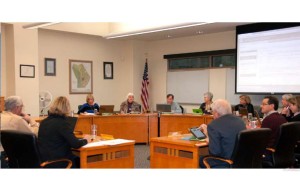
Lake Tahoe Community College and Lake Tahoe Unified School District boards of education meet Feb. 11. Photo/Pat Leonard-Heffner

Lake Tahoe Community College and Lake Tahoe Unified School District boards of education meet Feb. 11. Photo/Pat Leonard-Heffner

Instead of having duplicate infrastructure, the entities share resources. A good example is the state-of-the-art digital arts building at STHS that was put in as part of the $64.5 million facilities bond that was approved a few years ago. The college can use it for classes.

The three areas of study that are linked today are dental assisting, digital media arts-new media, and culinary arts.

Students are the overriding reason to do any of this, according to the educators. It will reduce redundancy in education plans, create a more efficient education system and provide them a road map for life as a student.

Taxpayers benefit by the consolidation of resources. This could also provide more opportunities for students.

With LTCC contemplating a general obligation bond for facilities, it is looking at the possibly of putting lights in at the South Tahoe Middle School field which would benefit LTCC as it grows its sports programs. It has the added benefit of helping LTUSD and the greater community.

The P-20 vision is, “A seamless, efficient educational system that leverages our education, business and community relationships to ensure all students, particularly those underserved historically, achieve their educational goals and enhance their social mobility.”

Already STMS and STHS share a path with digital media. Within LTUSD, the transition will be introduced between the elementary and middle school levels.

Together the education entities are going to apply for a career pathways grant that would provide seed money to help with planning P-20.

Already in hand is a $100,000 grant for the next three years for career technical education pathways that will be used on course articulation and faculty collaboration.

Another $165,000 grant is geared toward adult education. Adult ed fills the needs of those who may have left high school early and need to get their GED, or others who need some help to get into college. The money can be spent on streamlining and leveraging social services, GED-ACT-SAT and other testing services, improved citizenship, English skills, and the creation of short-term CTE training and apprenticeship programs. These are not courses taken for high school or college credit.

The next steps include a formal articulation of career technical education courses, gathering data on students, looking at the cost for high school students to attend LTCC, textbooks, and making the two systems be more aligned.

The expense of textbooks is one of the barriers to college. In college students pay for books, in K-12 they are provided.

In LTUSD almost every student has a netbook. LTCC is not as technologically robust as the K-12. That is a problem that is being addressed.

The idea of selling students the netbook upon graduation has been broached. The ideal scenario is netbooks would be a relevant device when going to LTCC instead of becoming a dust magnet.

Technology is another area where the two institutions have been working. Talks are under way to develop a regional data center that would host equipment for computer servers. Having staffs work together is already taking place.



Nevada ends fight to ban gay marriage

By Jonathan Kami, Reuters

Nevada dropped its defense of a state ban on gay marriage on Monday, saying the U.S. legal landscape had changed and its arguments in support of a voter-approved ban on same-sex nuptials were no longer sustainable.

The move, made by the state’s Democratic attorney general with the support of its Republican governor, does not legalize gay marriage in Nevada but removes the state as an opponent of those fighting to overturn the ban in federal court.

State Attorney General Catherine Cortez Masto said that after careful review, the state had filed a motion to withdraw a brief it filed last month in support of the ban in a case pending before the U.S. Court of Appeals for the 9th Circuit.

Read the whole story


Study: Nevada failing poor students

By Paul Takahashi, Las Vegas Sun

Nevada fails to provide adequate school funding to poor children, according to a national report.

Every two years, the Education Law Center publishes a report card that grades states on how fairly they distribute per-pupil funding to schools.

Education researchers at Rutgers University in New Jersey looked at several indicators to determine whether a state provides school funding fairly. These indicators ranged from how much state and local tax revenue is devoted to education to how much school funding goes to poor children.

Nevada received an overall grade of “F,” based on Rutgers researchers’ analysis.

Read the whole story


South Tahoe blackbirds die from strychnine

By Kathryn Reed

A flock of birds in South Lake Tahoe was thinned out after ingesting strychnine.

Stella McMillin, senior environmental scientist with the state Department of Fish and Wildlife Service, said it is not known if the poisoning was intentional.

El Dorado County Animal Services was called Jan. 28 regarding a large number of dead birds on the ground. Officers found 34 dead Brewer’s Blackbirds in the Tahoe Keys near the intersection of Lassen Drive and Tuolumne Drive.

Here is the picture of blackbirds taken by Bob Dietz (co-founder of LTWC) off of his back deck, overlooking Mt. Tallac.  In addition to blackbirds, you will also see Mourning Doves.

Blackbirds — and Mourning Doves — on the back deck of LTWC co-founder Bob Dietz. Photo/Bob Dietz

One bird was alive. Lake Tahoe Wildlife Care was able to rehab it, even though it was in convulsions when it was brought in. It was released Feb. 4.

A flock of more than 150 of these birds was seen in the area in late January. They were feeding in people’s yards.

“Why someone would cast it out in their yard and kill birds is beyond my comprehension,” Cheryl Millham, executive director of LTWC, told Lake Tahoe News. “Don’t let your dog lick anything off the ground. A cat, raccoon, coyote that would eat one of the birds that died of this would have secondary poisoning.”

McMillin said the only legal use for strychnine is to control pocket gophers by putting the poison under ground in their burrows.

“Either someone did an application incorrectly and put it above ground or they intentionally were poisoning blackbirds,” McMillin told Lake Tahoe News.

The state agriculture commissioner will conduct an investigation to try to determine who was responsible for the poisoning. At a minimum, McMillin said her department would come out with advice for people who live in the area about using chemicals that can end up targeting household pets and wildlife who were not the intended victims.

Poisoning animals is a crime.

“At this time, animal services does not know how the birds may have ingested the poison; they did not find any evidence of poisoning in the area where the birds were found,” according to Maggie Williams, spokeswoman for animal services.

Millham said if people have issues with gophers, she has a non-toxic solution she will share. For more info, call (530) 577.2273 or email tom@ltwc.org.


LTUSD employees granted series of raises

Employees of Lake Tahoe Unified School District will soon have a heftier paycheck.

The board of education on Feb. 11 approved 3 percent raises for certificated and classified workers that are retroactive to July 1. Another increase takes effect July 1, 2014. That comes in the form of a 6.5 percent raise. The contract, though, goes through June 30, 2016.

For certificated staff two staff development days will be eliminated in the 2014-15 school year. This means they will work 182 days, plus one professional development day.

Representatives from both unions shared their appreciation for the cooperative negotiating process. Board members in turn praised the quality of teaching and work of staff.

“Everyone agreed we are coming out of some dark times into some light,” board President Wendy David told Lake Tahoe News after the meeting.

— Lake Tahoe News staff report


Gun found in trash at South Tahoe Refuse

South Tahoe Refuse workers are used to sorting all sorts of things that come across the conveyor belt. On Monday it was a gun.

“The protocol is it gets turned into our manager immediately and then we call the police department and they come pick it up,” John Marchini, who owns STR, told Lake Tahoe News.

Marchini did not see this particular handgun on Feb. 11 so he does not know the caliber of it.

South Lake Tahoe police officers were not forthcoming with any information about the gun. This means it is not known if the gun was used in the commission of a crime, if it were stolen, why the owner dumped it or whom it is registered to.

Marchini said guns are not often found on the sorting line. Ammunition is more common.

When something comes along that workers think might have accidentally found its way in the trash – like car keys, jewelry and cell phones – they are put to the side so the person could come claim the item.

— Lake Tahoe News staff report