Photographers rally to protect work in ‘fair use’ cases

By Patricia Cohen, New York Times

To many photographers, a federal appeals court ruling last spring that permitted Richard Prince to use someone else’s photographs in his art was akin to slapping a “Steal This” label on their work.

The U.S. Court of Appeals for the Second Circuit reasoned that as long as Prince’s work transformed the images into original art, he was not violating anyone’s copyright.

But photographers are pushing back against that interpretation. Several membership and trade organizations have banded together recently to press their cause in Congress and the courts.

Read the whole story


Concern for driving high grows

By NPR

The Lodo Wellness Center in Denver has been selling medical marijuana for several years. But since Jan. 1, when marijuana in Colorado officially moved from underground to behind-the-counter, they’ve also been selling legal, recreational pot.

A majority of Americans now say they support full legalization, and the trend is spreading: Legal weed is coming soon to Washington state.

Meanwhile, the public health community is warning of a potential safety problem: more people driving while stoned. But health officials and law enforcement don’t yet have the data or tools to address the concern.

Read the whole story


Helicopter rescues hiker from Mt. Rose

A 27-year-old hiker on Mount Rose had to be rescued by helicopter on Sunday.

He was with a group that slept on the mountain the night before. Their plan was to go the summit Sunday morning.

Washoe County sheriff’s deputies, who have not released the man’s name, said he slid about 100 yards off the trail early Feb. 23. The department’s helicopter plucked him off the mountain about 9:45am and then he was taken by ambulance to Renown Medical Center in Reno. His condition is not known

— Lake Tahoe News staff report


West Tahoe fault overdue for major temblor

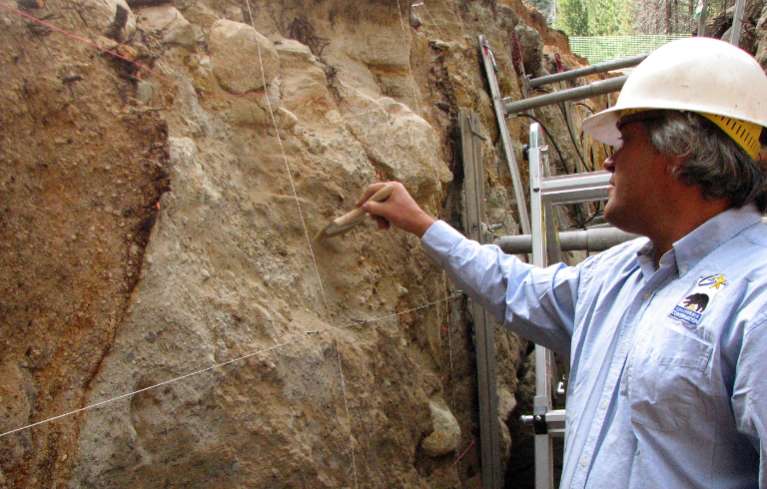
Gordon Seitz in the trench brushing dirt from the walls. The dark diagonal line or crack you see in the wall of the trench is the actual fault line. Photos/Provided

Gordon Seitz in the trench brushing dirt from the walls. The dark diagonal line or crack in the wall of the trench is the fault line. Photos/Provided

By Jessie Marchesseau

Anyone who has lived in Lake Tahoe for a while has heard stories of the impending tsunami if an earthquake occurs. In reality, those stories may not be too far off. And the earthquake may not be either.

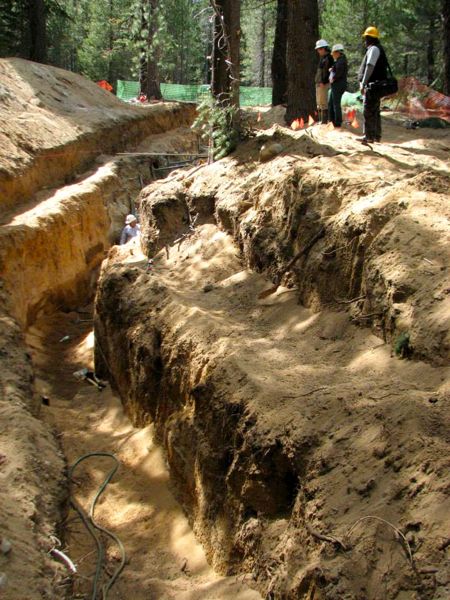
The California Geological Survey has been taking a closer look at the West Tahoe fault, the most active and most hazardous of the three faults in the Lake Tahoe Basin. Last October, the agency dug a trench approximately 15 feet deep and 15 feet wide across part of the fault near Meyers.

The project was years in the making, with the CGS working closely with the TRPA, USFS and Lahontan making sure the project was a low-impact as possible. The trench has already been filled in again and the land restored.

Gordon Seitz, engineering geologist with the CGS and lead on this project, said trenches are a relatively common way to study fault lines. By examining and sampling layers of sediment below the surface, geologists can determine frequency and magnitude of past earthquakes.

Seitz and his crew were able to learn quite a bit about what has happened at the fault since the last Ice Age (about 12,000 years ago). They found two earthquakes, each one shifting the earth on the west side of the fault higher than the east side resulting in a full 12-foot difference between the two sides.

“If we had an earthquake tomorrow, there would be a step, a vertical step on the fault,” Seitz told Lake Tahoe News. “It would be about 6-feet high.”

the trench itself before it was filled back in.

The trench before it was filled back in.

An earthquake tomorrow is not exactly out of the question, either. It will be a few more months before exact results are back from the lab, but so far it looks as if earthquakes happen on the West Tahoe fault about every 4,000 years. And how long has it been since the last one? About 4,000 years.

“If it happened tomorrow in Tahoe, I wouldn’t be surprised. But I’m not expecting it to either,” Seitz said.

The West Tahoe fault travels from just west of Meyers through Fallen Leaf Lake, down into the bottom of Lake Tahoe and back out again near Dollar Point. What Seitz said makes the Tahoe area so interesting is that in most places the biggest hazard during an earthquake is the shaking, but when the west side of the fault, 1,200 feet below the surface of Lake Tahoe, rises up 6, maybe even as much as 18-feet higher than the east side, a giant wave will ensue.

“If we have a shift like we see in the trench at the bottom of the lake, we will have a large wave, that’s a given,” Seitz said. “What we don’t know is how big the wave is or the impact.”

This is something else he is working on. Last July, Seitz was part of a team that took a remotely operated submarine-like vehicle 1,100 feet down into Lake Tahoe. What they saw was not a 12-foot step from the west to the east side of the fault like in Meyers, but a 36-foot step. This means there are either more earthquakes down there, or they are just bigger.

The team hopes to take the remote operated vehicle down again this summer for further investigation, and to hopefully determine which of those scenarios it really is.

Seitz expects to have solid data on the earthquakes of the West Tahoe fault within the next five years. However, he said the more difficult part of all of this is what to do with that data. The hope is to have reports, maps and computer models to explain where the fault is and how it and the waters of Lake Tahoe will behave in different scenarios. All this could be used for future planning in our communities, especially in the realm of emergency response plans.

“Overall, even though it sounds scary,” Seitz said, “it should make people feel better that we’re working on it.”


Obama proposes shift in wildfire funding

By Coral Davenport, New York Times

WASHINGTON — President Obama’s annual budget request to Congress will propose a significant change in how the government pays to fight wildfires, administration officials said, a move that they say reflects the ways in which climate change is increasing the risk for and cost of those fires.

The wildfire funding shift is one in a series of recent White House actions related to climate change as Obama tries to highlight the issue and build political support for his administration’s more muscular policies, like curbing carbon emissions from coal-fired power plants. On Monday, Mr. Obama plans to describe his proposal at a meeting in Washington with governors of Western states that have been ravaged recently by severe drought and wildfires.

The proposal will ask Congress to pay the costs of fighting extreme wildfires in the same way it finances the federal response to disasters like hurricanes and tornadoes, the officials said. When unpredictable events like Hurricane Sandy are destructive enough to be declared disasters by the president, the Federal Emergency Management Agency is authorized to exceed its annual budget and draw on a special disaster account. The account is adjusted each year to reflect the 10-year average cost of responding to such events.

Read the whole story


Yucca Mountain future being debated

By Conor Shine, Las Vegas Sun

Major progress is expected in the coming year toward resolving the outstanding questions and legal challenges surrounding Yucca Mountain’s potential as a repository for the country’s high-level nuclear waste, members of the state Legislature were told during an interim committee hearing Friday.

During a four-hour hearing, a range of experts and state officials laid out the road map for decisions in the upcoming year that will seriously affect Yucca Mountain’s future.

The hearing also laid bare the confusion and tension that still surround the project three decades and $15 billion after it was first considered, with a contingent of rural county officials and residents urging the state to reverse course and consider the potential economic impact the repository will have. Fully developing the Yucca Mountain site is projected to cost in excess of $100 billion.

Read the whole story


States outsourcing regulation of casinos to private firms

By Hannah Dreier, AP

When Springfield, Mass., needed to choose who would build its first casino, the city hired an outside adviser to help with the process.

The consulting firm Shefsky & Froelich recommended the deal go to MGM Resorts International. At the same time, the consulting firm also was working as a registered lobbyist in Illinois for MGM Resorts.

The arrangement highlights an often-overlooked trend as more cities and states embrace legalized gambling around the country: Private companies are being hired to write regulations and vet casinos, even as the same firms work the other side of the fence, helping casinos enter new markets and sometimes lobbying for their interests.

States hoping to make money quickly from legalizing gambling have few options as speedy as outside contractors, which allow them to get casinos up and running without having to hire and train a cadre of staff regulators.

But letting consulting companies with deep ties to the gambling industry decide how casinos are run — and who runs them — is a significant departure from how more established gambling states, including Nevada and New Jersey, go about their business.

Regulators in states that maintain control over their own rules say the move toward privatization is unnerving.

“How do you vet your consultants? If a lot of these consultants at one time or another have worked for the people that you’re in charge of regulating, at some point, you’re going to have issues with the purity of the investigation,” said Illinois Gaming Board spokesman Gene O’Shea.

At least 16 states now rely on private companies for major portions of casino oversight, according to interviews with regulators around the country.

The companies advise states about whether to legalize casino gambling, and then draft gambling rules, set up oversight commissions and institute regulations, deciding which casinos and executives are suitable for licensing. The companies sometimes hire lobbyists to get to know lawmakers before gambling is even legalized.

One of the largest of this new breed of consulting companies is Spectrum Gaming, which started in 1996 in a New Jersey basement and has twice been named among the fastest-growing private companies in the United States by Inc. magazine.

Spectrum got the call in summer 2007 when West Virginia was writing regulations for table games and in 2010 when the New Hampshire Legislature was considering legalizing gambling. It recently completed a study for Florida, which is considering expanding legalized gambling, and continues to vet casino workers for Ohio and Massachusetts.

At the same time, Spectrum has worked with casino companies including Caesars Entertainment, Las Vegas Sands, Wynn Resorts and Pinnacle Entertainment, and many Indian-run gambling operations.

Managing director Michael Pollock said his company would never work for competing interests simultaneously.

“You cannot be in this business if you’re willing to entertain conflicts of interest or even an appearance of a conflict,” he said.

State officials tend to rely on consultants to self-police, and ethics codes address only simultaneous conflicts. So while Massachusetts wouldn’t want Spectrum working for Wynn while also vetting the company for a license, the state doesn’t mind that Spectrum worked for Wynn in 2011.

This kind of coziness is common. For example, Ohio hired Spectrum and the consultant Moelis & Co. in 2009 to help establish gambling regulations and determine which casinos would be licensed. The companies turned in reports on the state’s two casino operators, Penn National and Rock Ohio Caesars, even though Spectrum has worked for Caesars in the past, and Moelis & Co. has worked for Penn National Gaming.

MGM CEO Jim Murren says these issues come down to the clubby nature of the mainstream gambling world.

“This is not a huge industry, and gaming law is highly specialized,” he said. “There are only maybe four or five firms that are experts in gaming law, and we know them all, and we’ve probably used them all.”

But MGM has also been on the other side of the issue.

The company complained when it emerged in 2008 that New Jersey regulators had been freelancing for Spectrum. MGM denounced the arrangement after New Jersey regulators issued a blistering report questioning the suitability of MGM’s new business partner in China.

Five years earlier, Spectrum had written a study raising questions about the partnership for MGM competitor Las Vegas Sands. The study was circulated anonymously, apparently to damage MGM.

Pollock says Spectrum would never take on a client who expected a predetermined result, whether it was Las Vegas Sands or a struggling state government.

“We make it clear from the outset that we are not necessarily going to tell you what you want to hear, we’re going to tell you what you need to know. And we will not entertain an engagement in which a client seeks a particular outcome,” he said.

Casino opponents are skeptical. John Sowinski, spokesman for the Florida nonprofit No Casinos, says that Spectrum often paints an overly rosy picture of the boon casinos might provide, overshooting tax revenue estimates in studies conducted for Ohio, and calling New Jersey’s Revel project “just the tonic that Atlantic City needs.” (The state-subsidized casino filed for bankruptcy 10 months after opening.)

Sowinski believes states in need of consultants should hire experts and firms with no connection to the casino industry

“The gambling industry is the one industry that seems to get away with this conflict of interest carte blanche,” he said.

Internal BLM memo shows mustang woes

By Scott Sonner, AP

RENO — The head of the government’s $70 million wild-horse management program warned last summer that it is headed for financial collapse unless “drastic changes” are made in the decades-old roundup policy she said could be setting U.S. rangeland-improvement goals back 20 years.

In a strongly worded internal memo to an assistant director of the U.S. Bureau of Land Management, Wild Horse and Burro Division Chief Joan Guilfoyle recommended suspending all roundups until thousands of mustangs currently in federal corrals are sold or adopted.

Scott Sonner, File/AP Photo FILE - In this June 5, 2013, file photo, horses stand behind a fence at the Bureau of Land Management's Palomino Valley holding facility in Palomino Valley, Nev. The head of the government's $70 million wild horse management program warned last summer it is headed for financial collapse unless ``drastic changes'' are made. Lingering drought, a record 49,000 mustangs in long- and short-term holding, and an on-range population that doubles every four years and is projected to exceed 60,000 in 2015, threaten the program's future. close window Read more here: http://www.sacbee.com/2014/02/22/6180608_a6180602/ap-newsbreak-internal-blm-memo.html#storylink=cpy

Horses stand behind a fence at the Bureau of Land Management’s Palomino Valley holding facility in Palomino Valley, Nev. Photo/Scott Sonner/AP file

Guilfoyle also said sterilization should be considered, and she recommended for the first time euthanizing wild horses on the range “as an act of mercy if animals decline to near-death condition as a result of declining water and forage resources.”

Those are among the few realistic alternatives given a crippling combination of congressional budget cuts, spiraling costs, lingering drought, a record 49,000 mustangs in long- and short-term holding, and an on-range population that doubles every four years and is expected to surpass 60,000 in 2015, Guilfoyle said.

It’s “nearing the point of financial insolvency due to undesirable trends in every aspect of the program,” she said in the August memo to Greg Shoop, assistant director for renewable resources and planning.

“Drastic changes in course are mandatory to remain financially solvent and reverse trends” undermining the Bureau of Land Management’s goals, she wrote. “Considering the circumstances, on-range management goals may not be achieved for another 20 years.”

Labeled “Internal Working Document,” the Texas-based Wild Horse Freedom Federation obtained the memo under the Freedom of Information Act and first posted it on its website Wednesday. The Associated Press also independently obtained a copy Wednesday but couldn’t confirm its authenticity until Friday.

Bureau of Land Management spokesman Tom Gorey said it was a “preliminary discussion document” produced in “recognition of the tight fiscal climate” and based on projections Congress would cut more from the agency’s budget than it ended up doing last fall.

“It explores a range of interim measures that could be implemented until more sustainable actions are available, such as the development of longer-acting, effective contraceptives and the reduction of holding costs,” Gorey said in an email to the AP.

The three-page memo offers a candid look at the political and public pressure fueling the controversy that has raged for decades but intensified since the number of animals in holding first exceeded those on the range two years ago. Last fiscal year, holding costs topped $46 million — 61 percent of the horse program’s overall budget.

Guilfoyle noted “heightened and increasing interest” in policy changes among conservationists, ranchers, horse activists and Congress. She said things “we can’t do” include “remove animals,” “new research” and “reduce or curb on-range population growth.”

“Funding and space prohibit the removal of any animals in the near future. Euthanasia of near-death animals is the only responsible alternative,” she said.

While Guilfoyle’s assessment was unusually frank, it echoes the General Accounting Office’s conclusion in a 2008 report to Congress that there was no end in sight to rising holding costs. A year later, then-Interior Secretary Ken Salazar warned “the current path of the wild horse and burro program is not sustainable.”

Last June, Arizona Rep. Raul Grijalva, the ranking Democrat on a public lands subcommittee, and 29 colleagues including Rep. Dina Titus, D-Nev., told Interior Secretary Sally Jewell the program’s soaring costs had created an “untenable situation” for both the mustangs and taxpayers.

The Bureau of Land Management suspended roundups shortly after Guilfoyle’s memo and has not formally scheduled any this year. But it awarded two helicopter contracts in January that could be used for gathers.

The Nevada Farm Bureau Federation and Nevada Association Counties argue roundups are necessary to cull overpopulated herds competing with livestock for forage. They filed a lawsuit in December trying to force the Bureau of Land Management to sell some older horses deemed unadoptable without the usual prohibition on resale for slaughter — an idea the agency has opposed.

Ginger Kathrens, executive director of the Colorado-based Cloud Foundation, said euthanizing or sterilizing mustangs would violate the 1971 Wild Free-Roaming Horses and Burros Act. The foundation is dedicated to the preservation of wild horses on public lands.

“It would be unconscionable to even consider use of these strategies,” she said.


El Dorado County’s former mental health chief dies

By Robert D. Dávila, Sacramento Bee

Tom Sullivan, a dedicated public servant who advocated for treatment services as mental health director for El Dorado and Sacramento counties, died Feb. 7 after a recent stroke, his family said. He was 71.

Mr. Sullivan was a widely recognized expert on mental health policy in California. He began his career at Napa State Hospital in the 1960s and worked with the Legislature on the landmark Lanterman-Petris-Short Act, which shifted responsibility for mental health care from state institutions to local agencies. He was a past president of the California Mental Health Directors Association.

He worked in Sacramento before moving to Placerville as El Dorado County mental health director from 1974 to 1979. A lifelong political activist, he was elected to the Placerville City Council in 1978 and served six years helping prepare the town for growth with a new downtown parking garage and other civic other projects.

Read the whole story


Calstar provides fast transport in an emergency

By Kathryn Reed

In many ways it’s an emergency room or intensive care unit that flies.

Calstar – or California Shock Trauma Air Rescue – has a base at Lake Tahoe Airport that makes runs down to Mammoth, far into Nevada, up to Quincy and over to Georgetown. But much of the work the pilots and flight nurses do starts on the South Shore.

The air ambulance often finds people who are lost in the wilderness, whisks them from the backcountry and delivers them to the appropriate hospital to get further treatment. Two critical care certified nurses are on each flight. Some of the care patients receive is equivalent to what a doctor would do in the ER.

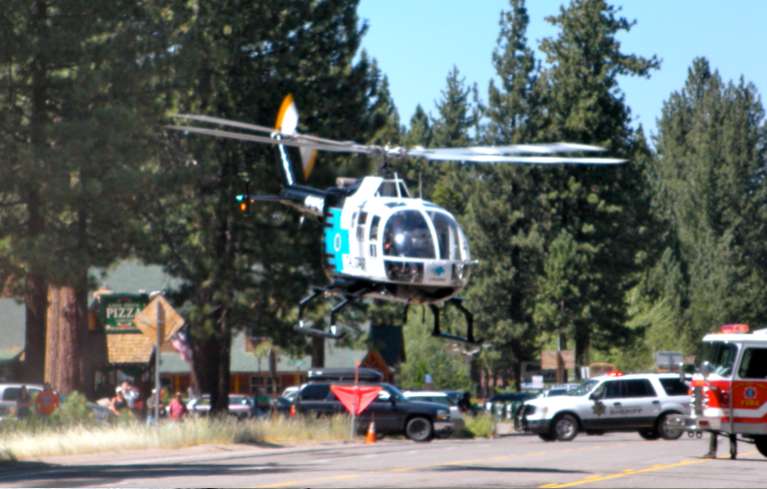
Calstar can land in many locations -- including the middle of Highway 50. Photo/LTN file

Calstar can land in many locations — including the middle of Highway 50. Photo/LTN file

Many trips are made between Barton Memorial Hospital and facilities that have specialties the South Shore care center doesn’t have.

This time of year the helicopter is busy with getting injured skiers from the slopes to the appropriate medical facility.

Night vision goggles, like what the military uses, help find people on the ground. With most everyone having a cell phone, the pilot will ask the lost person to turn their phone around and wave it. That is the easiest way for a pilot to see someone on the ground at night.

Bryan Pond, one of the two original members who opened the South Lake Tahoe operations in October 2001, spoke at the Soroptimist International Tahoe Sierra meeting last week about Calstar.

Last week was Critical Care Transport Nurses Day.

“On Feb. 18, 1943, the first class of flight nurses marched from the base chapel after graduating from their specialized course of medical training at Bowman Field in Louisville, Ky. On this day, the new field of transport nursing emerged as a specialty as both the Army and Navy instituted flight nurse programs,” Pond, who is a flight nurse, told Lake Tahoe News. “These nurses were trained to care for wounded soldiers during transport on converted cargo planes and on the field of battle. Since that time, nurses have expanded their role in this field to include the civilian sector, responding to care for patients in ambulances, helicopters and airplanes.”

Not all trips are of a life and death nature. Sometimes it’s a simple broken ankle. The problem could be the injured person is miles from his or her vehicle and can’t walk out or be carried out by friends. Calstar can get to most any location.

The California Highway Patrol helicopter crewmen work with Calstar on rescues at Lovers Leap because they can hoist people down. Then they bring the rock climber to Calstar, which is waiting in a meadow.

CareFlight is another partner agency. They have helicopters in Gardnerville, Reno and Auburn.

There are times when so much is going that multiple medical helicopters are circling about.

The Calstar helicopter can take two patients at once depending on their weight.

It’s run as a nonprofit that includes membership. Members may use the service for free after their insurance is billed. For more info, go online.