Couple’s gold-coin find called greatest in U.S. history

This image provided by the Saddle Ridge Hoard discoverers via Kagin's, Inc., shows one of the 1800s-era U.S. gold coins unearthed in California by two people who want to remain anonymous. The value of the "Saddle Ridge Hoard" treasure trove is estimated at $10 million or more. (AP Photo/Saddle Ridge Hoard discoverers via Kagin's, Inc.)

This image shows one of the 1800s-era U.S. gold coins unearthed in California. Photo/AP/Saddle Ridge Hoard discoverers via Kagin’s Inc.

By Ruben Vives, Los Angeles Times

A cache of 19th century gold coins uncovered by a California couple on their daily walk could end up selling for more than $10 million, making it the greatest buried treasure ever unearthed in the United States, experts said.

Donald Kagin, president of Kagin’s Inc., a numismatic firm that specializes in U.S. gold coins, announced the discovery Tuesday. The company is representing the couple, who wish to remain anonymous.

Identified by the firm only as “John and Mary”, the couple told Kagin they couldn’t believe they had made such a big discovery and were grateful for it. They unearthed the coins after noticing an old can sticking out of the dirt on a section of their property, the firm said.

Read the whole story


Technology may be the answer to gun control

By Michele Richinick, MSNBC

Smart guns similar to James Bond’s pistol are marching closer to reality as manufacturers expect to continue testing prototypes throughout 2014 and a few politicians push for new technology to make firearms safer.

Manufacturers design “smart” guns, also referred to as “personalized” or “owner-authorized” firearms, to prevent intentional and unintentional shootings by children and other unauthorized users. The idea of incorporating technology into guns took hold during the early 1990s when the National Institute of Justice commissioned a study to find a solution to prevent law enforcement officials from being killed by their own weapons, both in the home and by assailants, said Donald Sebastian, senior vice president for research and development at the New Jersey Institute of Technology. A report published in 1995 recommended radio-frequency identification as the viable approach for placing an electronic system into a firearm.

The U.S. government became attentive to the issue in the late 1990s by providing federal funding to accelerate the development of a safe and more secure personalized handgun, Sebastian said. Manufacturing companies worked with biometrics – using features of an individual to identify the user of a gun – in an attempt to implement firearms technology. But there wasn’t a commercial outcome.

Read the whole story


NASA to use space images to monitor drought

By Laila Kearney, Reuters

NASA scientists plan to use images shot from space and within the Earth’s atmosphere to help California monitor one of the worst droughts in its recorded history, officials said on Tuesday.

Scientists said they would deploy imaging tools to measure snowpack and groundwater levels and use a host of other technologies to help better map and assess the water resources in a state that produces half the nation’s fruits and vegetables.

The California Department of Water Resources has contracted with NASA to use data that will be collected next month with airplane mapping tools to measure water stored in the California snowpack, according to Jeanine Jones, the department’s interstate water resources manager.

Read the whole story


Minden airport installs fire retardant tank

Minden airport increases its firefighting capabilities. Photo/Provided

Minden airport increases its firefighting capabilities. Photo/Provided

The Bureau of Land Management bought a 10,000-gallon tank for fire retardant to be permanently installed at the Minden-Tahoe Airport.

This will allow the airport to respond to a fire more timely.

In the past a semi-tanker full of fire retardant would be brought the airport to fight a fire. This was deemed to be inefficient and expensive.

The tank will be installed in a permanent containment area near the Sierra Front Interagency Dispatch Center at the north end of the airport.


Community vision, determination brought college to South Lake Tahoe 40 years ago

By Kathryn Reed

No was not a word people who wanted a community college in South Lake Tahoe were willing to embrace. Their tenacity paid off and this year Lake Tahoe Community College District is celebrating its 40th year.

As Los Rios Community College District was forming in the 1950s there was a push to have all of El Dorado County be part of it. But Nels Nelson convinced the powers that be that it didn’t make sense for Tahoe to be included.

Besides the legacy of a hardware store in town that bears his name, Nelson has a bench in his honor near the college’s Demonstration Garden that was donated by his daughter Anne Johnson.

Had he not been so persuasive, South Lake Tahoe might be like Placerville, a city without a college and part of a district that doesn’t make sense.

It was in the 1960s that serious discussions began about having a community college in town. Ann and Bill Harriman had two children in high school and didn’t want to have to send them out of town. They approached Lake Tahoe Unified School District officials about starting a community college.

Superintendent Tony Magliari and Business Manager Bill Hauck were completely supportive of the idea. A committee was put together to figure out how to do this, what was needed and gather support of the community.

Magliari went before the state board of education on Dec. 15, 1967, with the proposal and was told “no”.

Not giving up

The idea cooled off for a bit until legislation was passed saying every area in the state must belong to a community college district. The state thought Tahoe, Alpine County and Mono County should be a district. Alpine County residents weren’t thrilled with this idea.

The El Dorado County Committee on School District Organization spent about three years studying what would be best for the area. Roberta Mason, LTCC board member, and Gene Bellisario were the Supervisor 5 committee members. Each of the five supervisorial districts had two members on the committee, plus there was one at-large member.
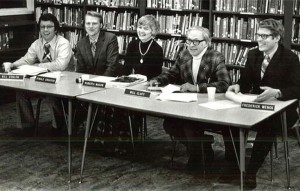
“First Board” is the very first Board of Trustees, voted in on March 5, 1974. Caption should read: from left to right, William Conlon, Rev. Donald Swanson, President Roberta Mason, Dr. Will Cluff, and Dr. Fritz Wenck. So Roberta was our very first Board president, and she was sworn in as Board president once again for this year. Photos/LTCC

LTCC’s first elected board: William Conlon, Donald Swanson, President Roberta Mason, Will Cluff and Fritz Wenck.Photos/LTCC

Mason said the reason the state wanted areas to be part of a district was to collect more taxes. Those outside a district paid 10 cents per $100,000 of assessed property per year, while in districts the tax could be 90 cents.

The state said “no” again to Tahoe when advocates lobbied for a solo district.

Then state Sen. Claire Berryhill arranged for a special election where Tahoe and Alpine County would vote on the district. But it was up to the Alpine County superintendent to call the election because the Legislature had said the county with the largest geographic area was in charge. Alpine stalled; ranchers didn’t want higher taxes.

Hazel Hoak, assistant superintendent of schools for El Dorado County, got involved.

“She and I went to court to force Alpine County to call an election,” Mason told Lake Tahoe News. It worked.

A radio campaign was launched to convince voters. Brooke Laine, who was 9, and David Foster’s kids did some of the spots, saying how they wanted to one day go to a local college. Dick Shehadi was the main outspoken opponent to the college district.

A college in South Lake Tahoe

On March 5, 1974, voters in the Tahoe area of El Dorado County and all of Alpine County were asked if Lake Tahoe Community College District should come to fruition. Tahoe said “yes” and Alpine “no”.
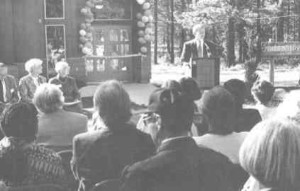
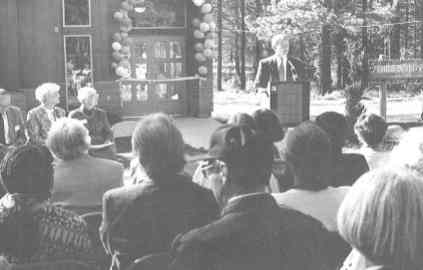
“CDC opens” is the Child Development Center’s grand opening, w/then-President Guy Lease doing the honors. September 1993

Then-President Guy Lease opens the Child Development Center in September 1993.

They also voted for the first board, with one seat for an Alpine County rep. Since that county said no to the district, the board started with four members. They were Mason, Donald Swanson, Will Cluff and Fritz Wenck. Wenck is also still on the board. In a special election for a fifth member, Bill Conlon was elected.

Mason was the first board president. She is also the current president. Her plan is to not run again when her term expires at the end of the year.

With the creation of the college district, it meant property owners would be paying 72 cents for every $100,000 of assessed value.

Hoak, who lives in Shingle Springs, filled in as interim college president until the board hired someone.

Mason said that was the board’s biggest decision – who to hire. A consultant was brought in to help find a president and figure out a salary.

“Jim Duke came to the top because he had quite a bit of experience with starting community colleges and four-year colleges,” Mason said. “Fritz and I were selected to make an offer to Jim.”

Duke’s response was that he was already making more than what was being offered. A second offer was made and Duke left Canada College in the Bay Area. He started with LTCC in September 1974. The county advanced the district the money to pay him and for some other start up costs.

“We had nothing but a post office box,” Mason said. “Jim said I’ll have a campus in eight years.” He missed the mark by a few years, but stayed long enough to be part of the permanent facility.
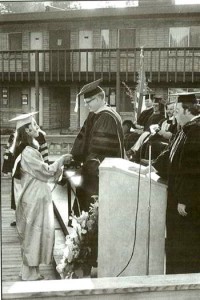
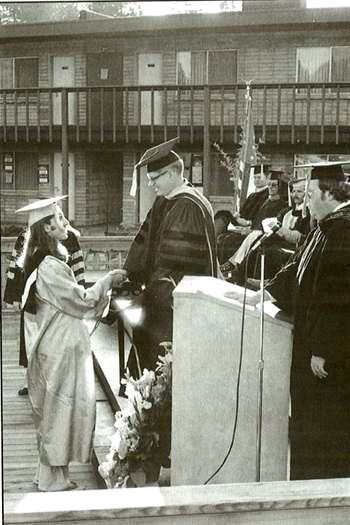
“First graduation” is from June 1976, with just 11 grads, back at the old motel. That’s Dr. Fritz Wenck handing out the diploma…still a Board member today.

Board member Fritz Wenck hands out diplomas at LTCC’s first graduation in June 1976.

Duke’s initial task was to hire a secretary. Angie Burns still lives in Tahoe. The two first worked out of a basement in a building on Ski Run Boulevard that is now owned by Wenck. Real estate agents came up with tons of ideas for where the first classes could be conducted.

Ultimately the board decided on the old Gerkin motel on Highway 50, which is now the Econo Lodge. The pool was covered and the ice rink turned into science labs. Walls were taken out of some rooms to make them bigger. Classes started in September 1975.

The first year the college opened there were 119 classes and 1,407 students. Eleven people graduated in 1976. Tuition was free at California community colleges at that time.

“The biggest argument was do we buy electric or manual typewriters,” Mason said. They went with IBM Selectrics.

To start with, a general education curriculum and business courses were offered. Through the years more programs have been added, some eliminated.

The building where the former mattress outlet was housed the first library. The building behind it had a computer lab.

At the same time Duke was busy looking for land to build what is today’s LTCC campus. The 164 acres were bought from Shell Oil Company for just less than $900,000. Money was being set aside every year to buy the land.

It was state money that built all the buildings that are on the campus today. The oldest building is the administration/commons area, and the newest is the library.

But the college is not done growing – in terms of curriculum or facilities. It has plans to be around for another 40 years.

—-

Significant dates:

• March 5, 1974, 66 percent of the voters say yes to the formation of Lake Tahoe Community College District. The initial board was elected.

• The board was sworn in on March 25, 1974.

• September 1974, the board hires Jim Duke as the first president.

• Sept. 18, 1975, classes begin in a converted motel on Highway 50.

• Dec. 27, 1979, the district buys 164 acres from Shell Oil Company.

• July 8, 1986, construction begins on the first phase of the permanent campus.

• October 1988, the college moves to its current location.

• June 30, 1990, Duke retires and Guy Lease takes over as president.

• September 1993, the Child Development Center opens.

• 1994, the college has men’s and women’s cross country teams.

• 1995, a women’s volleyball team is formed.

• 1996, the technology wing and theater open; portables are brought in for the garden classrooms.

• 1999, a Nordic ski team is formed.

• 2002, the physical education building opens.

• 2006, the library and Haldan Art Gallery open.

• June 2007, Lease retires.

• July 2008, Paul Killpatrick becomes president.

• July 2011, Kindred Murillo is hired as the fourth president.

• March 5, 2014, at 11am the college and public are returning to the old hotel, now the Econo Lodge on Highway 50, to celebrate the election 40 years ago.

• June 7, 2014, the college celebrates its 40th anniversary with a sit-down dinner from 6-8pm, plus the unveiling of the David Allan Barkley Memorial created by former Art Department Chair David Foster. For more info, email Julie Booth at Booth@ltcc.edu or call (530) 541.4660, ext. 245.

• Fall 2014, men’s and women’s intercollegiate soccer begins.


Nev., Del. sign online gaming agreement

By Steve Tetreault and Howard Stutz, Las Vegas Review Journal

WILMINGTON, Del. – The governors of Nevada and Delaware signed an agreement Tuesday morning that join their states in a partnership for online poker.

Documents signed by Gov. Brian Sandoval of Nevada and Gov. Jack Markell of Delaware established a legal framework for the first interstate Internet gambling relationship, officials said. The governors spent the weekend in Washington at a conference of the National Governors Association.

The deal aims to expand the marketplace for online poker in the small states that by themselves are not seen as having significant populations for Internet gambling to flourish. Nevada has legalized poker-only online for players logging on within the state, while Delaware has green-lit online slots, blackjack, roulette and poker.

Read the whole story


Drought’s impact on agriculture varies

By Alex Park and Julia Lurie, Mother Jones

California, supplier of nearly half of all U.S. fruits, veggies, and nuts, is on track to experience the driest year in the past half millennium.

Farms use about 80 percent of the state’s “developed water,” or water that’s moved from its natural source to other areas via pipes and aqueducts.

Much of California’s agriculture is concentrated in the parts of the state that the drought has hit the hardest. For example: Monterey County, which is currently enduring an “exceptional drought,” according to the U.S. Drought Monitor, grew nearly half of America’s lettuce and broccoli in 2012.

When it comes to water use, not all plants are created equal.

Read the whole story


Zephyr Cove woman accused of killing husband

A Zephyr Cove woman is behind bars for allegedly shooting her husband.

Tatiana Leibel

Tatiana Leibel

Harry Leibel, 64, died of a single gunshot wound.

Douglas County sheriff’s deputies said at first Tatiana Leibel, 50, told them her husband shot himself.

“During the subsequent investigation, information was developed to implicate Tatiana as a suspect,” deputies said in a press release.

The incident occurred at their Kent Way home. No one else was home at the time of the Feb. 23 shooting.

Leibel is being held without bail.

— Lake Tahoe News staff report


LTCC inching closer to putting bond on ballot

By Kathryn Reed

Lake Tahoe taxpayers have not directly paid for any of the buildings at Lake Tahoe Community College. But that could soon change.

The college is contemplating going to the voters in November with a general obligation bond between $35 million and $55 million. This would be spent on facilities.

The board this month agreed to hire Fairbank, Maslin, Maullin, Metz & Associates to conduct a survey of 400 registered voters in the district to gauge their opinion of the proposed bond. The research firm will be paid $19,500. The board had budgeted $20,000 for this expense.

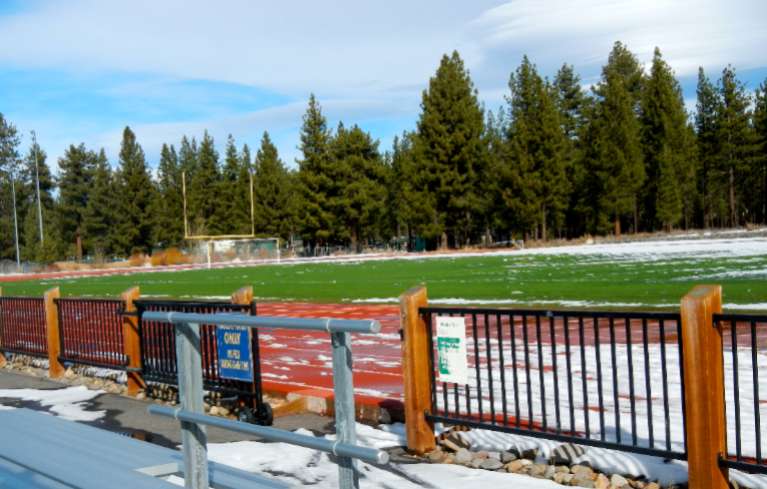
Lights at South Tahoe Middle School are a possibility. Photo/LTN

Lights at South Tahoe Middle School are a possibility. Photo/LTN

Different questions will be put to voters to find out what dollar amount, if any, they support. The survey will last about 19 minutes.

South Lake Tahoe will pay for a portion of the survey because it will have specific questions asked at the end. They will be multiple-choice questions, but the exact questions are not known.

Results of the survey will be presented to the board at the April 8 meeting.

The answers will help the board decide if it wants to go forward with the bond measure.

College President Kindred Murillo told Lake Tahoe News this would be the community’s opportunity to decide if it wants to help fund the college. The college would hope to leverage the taxpayer money like Lake Tahoe Unified School District did so there would be even more money available for improvements.

While the college has not definitively decided how it would spend the money, it has a list of ideas.

One idea is to put lights on the South Tahoe Middle School field so there are more opportunities to play football and soccer at night. With the college starting soccer programs in the fall, it will mean more demand for fields.

The college field is half on city property, half on college land. It is maintained by the city and governed by the recreation joint powers authority. The college, though, has priority over using it for classes and intercollegiate play.

Part of the bond money could go toward adding bleachers and dugouts at the college field.

“There’s a possibility of putting a bubble over it in the winter,” Murillo told Lake Tahoe News. “One major problem with artificial turf is snow.” She said snow is more damaging than something like a SnowGlobe music festival.

The expense of a bubble is being researched.

Three capital outlay projects have been submitted to the state. The first priority is a remodel for efficiency that would include an overhaul of the science labs, student services and technology. This will include a university center. This is needed as the college looks at offering four-year baccalaureate degrees.

The next project is for a regional public safety training facility. This could include having a city fire station on campus.

The third idea was for a sports medicine facility, but with South Tahoe High having just built one the college now sees this as being redundant. Instead, another project could be adaptive physical education or a sustainability center to go with environmental studies.

Safety improvements would be made throughout the campus, along with technology upgrades.

The college is also looking at improving the trails people use so they are clearly marked and in good condition.

Dorms are another project.

“They are essential to make a destination college real,” Murillo said.

Today students have to live at home or rent an apartment or house.

With improvements the city is making to Harrison Avenue and what the college could do in the future, Murillo foresees the area from Al Tahoe Boulevard to Lakeview Commons being a hub for college students.

Murillo also envisions creating an early childhood education center by taking the existing Child Development Center and perhaps moving the Tahoe Parents Nursery School to the campus.

Build-out of the projects is likely to take 10 years and the bond payments would last 20.

“We want to make the community feel like it’s theirs,” Murillo said of the college.


Multiple injuries in Kingsbury Grade collision

A two-car crash Feb. 23 snarled traffic on Kingsbury Grade. Photo/Provided

A two-car crash Feb. 23 snarled traffic on Kingsbury Grade. Photo/Provided

Kingsbury Grade was closed for several hours Sunday when two drivers from the Bay Area were in a collision.

Kevin C. Wilhite, 19, of Castro Valley was driving a black 2003 GMC Yukon east on the grade near Terrace View Drive when he crossed the double yellow line and struck the front of a Toyota Sienna minivan, according to officers.

Kavitha Mannava, 38, of Fremont was west on the highway with four passengers when her vehicle was struck.

Nevada Highway Patrol officers said Wilhite was speeding and struck the front end of the Toyota head-on. He sustained minor injuries and was treated at the scene, while his female passenger was taken to Renown Medical Center in Reno by ground ambulance for non-life-threatening injuries.

Mannava and one of her passengers sustained minor injuries and both were taken by ground ambulance to Barton Memorial Hospital in South Lake Tahoe.

Wilhite was cited for failing to drive on the correct side of the highway.

— Lake Tahoe News staff report