Caesars selling properties to restructure debt

By Howard Stutz, Las Vegas Review-Journal

Caesars Entertainment Corp. said Monday it’s selling four properties — three on the Strip and Harrah’s New Orleans — to its Caesars Growth Partners subsidiary for $2.2 billion.

The transaction, which the company said in a statement will result in cash proceeds of $1.8 billion, will allow Caesars Entertainment to reduce a portion of its gaming industry-high $23 billion of debt.

Caesars Entertainment will transfer ownership of Bally’s Las Vegas, The Quad and the under-construction The Cromwell, along with Harrah’s New Orleans, to Caesars Growth Partners for $2.2 billion.

Caesars Entertainment is the parent company of Harrah’s Lake Tahoe and Harveys.

Read the whole story


SnowGlobe promoter wants contract, more from city

By Kathryn Reed

SnowGlobe promoters want a multi-year contract and for the city to pony up more money.

The South Lake Tahoe City Council on March 4 will talk about whether the reported $6 million the three-day music festival brings into the region is worth the trade-offs.

2013 was the third year the event has been staged at the Lake Tahoe Community College ball fields on Dec. 29-31.

“Once the field is replaced, we don’t recommend coming back to that field,” City Manager Nancy Kerry told Lake Tahoe News.

The field is likely to be replaced in three years at a cost of about $500,000. The city has been setting aside money to replace it and has about 75 percent of what it needs in the bank. A large portion of the money comes from Measure S/R dollars, the recreation measure.

Snow actually causes more damage to the artificial turf field than an event like SnowGlobe. And last year was the first time the field was partially covered to prevent wear and tear.

Chad Donnelly, SnowGlobe promoter, wants the city to pay $25,000 in promotional expenses, pickup some transportation costs, and pay for garbage removal.

Donnelly did not return a phone call. It is not known how much he makes off the concert. The cheapest three-day tickets for 2013 were $149. It’s estimated 10,000 to 12,000 people attend the concert. Most do so all three days.

Donnelly has told the city 94 percent of the concertgoers are from outside the area. He bases this on ZIP codes from credit cards used to purchase tickets. From there he extrapolated that $2 million is being spent by attendees on lodging and $4 million on other things.

Kerry said she agrees with those figures.

“They definitely drive money into the local economy,” Kerry said.

But she added that the business community might want offer to help since they have benefited tremendously two of the three years because there was so little snow to draw people to town.

Lake Tahoe Community College will also have to weigh in on any contract because they own half the field. In addition, the physical education building is used, as is the parking lot.

Even if an agreement can be reached for this year and the next couple years, a long-term solution needs to be found if SnowGlobe is going to stay on the South Shore.

Lake Tahoe Airport is out of the question based on FAA regulations. Stateline casinos have said they need the parking that time of year so the answer is “no”. Heavenly is a definite “no”. The parking lot at any Lake Tahoe Unified School District property is a “no” because alcohol sales would not be allowed.

Camp Richardson and Bijou Community Park have not been ruled out.

The other alternative is after five or six years of Donnelly branding SnowGlobe enough people might attend no matter the date, meaning that another time of year could be found to bring the event to South Lake Tahoe.

Note: The South Lake Tahoe City Council meeting on March 4 starts at 9am at Lake Tahoe airport.


Calif. figuring out how to save money

By Niraj Chokshi, Washington Post

The recession was hard on California’s rainy-day fund.

By the end of the 2006 fiscal year, California’s reserves ranked 25th among states —- enough saved up to keep the state running for 43 days. Today, it’s ranked 48th, with enough to fund just over three days, according to the Pew Charitable Trusts.

But in November, voters will have the opportunity to upgrade the Golden State’s system for saving—a move that could light the path for other states looking to develop similar cushions.

Under the measure, any taxes collected above and beyond the 20-year trend would be funneled to the reserve fund. But, in January, Gov. Jerry Brown came up with an alternative plan, one which leaders of both state houses back. If two thirds of lawmakers go along, it would supplant the ballot measure.

Brown’s plan draws from the excess revenue collected from just one tax—the highly volatile capital gains tax—and that could also help reduce some of the perverse incentives in budgeting. Capital gains fluctuate a lot with the stock market and when that revenue spikes, it’s hard to tell whether it’s a lasting rise or just a blip. So sometimes budgeters see the bump and assume it’s there to stay, according to Pew.

Read the whole story


Drones doing business in the sky above you

By Tony Bizjak, Sacramento Bee

Drones, once known as weapons of war, are undergoing a dramatic makeover as a hot new business tool in the sky. But, as with unmanned military craft, domestic drones are prompting concerns over safety and privacy.

No agency tracks how many drones are now buzzing overhead. But it’s likely hundreds a day hit the skies nationally on commercial missions, equipped with video cameras and launched by entrepreneurs looking for faster, cheaper and easier ways to provide services. In Northern California, lightweight drones, some hardly bigger than a Frisbee, shoot dramatic bird’s-eye videos of ski races in Tahoe and outdoor weddings in the foothills. They provide aerial footage for car commercials in Roseville and real estate promotions in West Sacramento.

The new breed of small domestic drones – known more formally as “unmanned aviation systems” or “remotely piloted aircraft” – can sell for $1,000 to tens of thousands of dollars, depending on size and sophistication. Users say operating the remote-controlled, spider-like craft costs far less than hiring a helicopter or plane, and allows users to fly into tight spaces, including indoors.

Read the whole story


Republicans split on dividing California

By Molly K. Hooper and Jasmine Sachar, The Hill

Republican lawmakers in Congress are lukewarm on a conservative-backed proposal to split California into six states.

Republicans from the Golden State say they are watching conservative venture capitalist Tim Draper’s effort with “great interest.” But few are endorsing it.

In a recent survey of the California congressional delegation, The Hill found that Democrats oppose the proposition, while Republicans are generally divided. While California GOP lawmakers agree that the most populous state in the U.S. is “ungovernable” as is, they would prefer to consider a more conservative division of the state.

Read the whole story


2nd rabid skunk found in El Dorado County

A rabid skunk has been found in a residential and commercial area of Pollock Pines.

The skunk was found in the 2900 block of Fir Drive in Pollock Pines on Feb. 21. The skunk, which exhibited highly aggressive behavior, entered the yard of a resident and came into contact with three dogs. Animal services was called and retrieved the skunk.

Animal services is not aware of any human contact with the rabid skunk. The dogs that came into contact with the skunk are current on their vaccinations and are being quarantined to ensure their health is monitored.

This is the second rabid skunk identified in El Dorado County in 2014. Another rabid skunk was found on Jan. 28 on Autum Way in Shingle Springs.

The following precautions should be taken to prevent the spread of rabies:

  • Maintain current rabies vaccinations for pets
  • Keep property free of garbage, stored bird seed, and left over pet food to avoid attracting wild animals
  • Do not approach or handle any unfamiliar dogs, cats or wild animals
  • Report any exposure to bats; bats are one of the most frequent carriers of rabies in California
  • Call animal services if you see an animal that appears to be exhibiting signs of rabies
  • Notify animal services immediately of any person or animal bitten or potentially exposed to a rabid or suspected rabid animal.


Brown signs $687 mil. drought-relief bill

By Alex Dobuzinskis, Reuters

Gov. Jerry Brown on Saturday signed into law a $687 million drought-relief package to deal with a water shortage he has called the worst in the state’s modern history.

The legislation is intended to help residents, farmers and local communities, in part by tapping voter-approved bond money.

It includes measures to expand the recapture of storm runoff and the use and distribution of recycled water, as well as funding to secure emergency drinking water supplies for certain communities hard hit by the drought.

Read the whole story


2013 among the worst years for human rights

By Daniel Rothman, Los Angeles Times

WASHINGTON — With a Syrian chemical weapons attack that killed more than 1,000 civilians, violent crackdowns against protesters in Turkey and Ukraine and a string of anti-gay laws from Russia to Uganda, human rights abuses last year ranked among the worst in years, the State Department concluded Thursday in its annual review of more than 200 countries and territories.

“The year 2013 may well be known for some of the most egregious atrocities in recent memory,” Uzra Zeya, acting assistant secretary of State for democracy, human rights and labor, said during a briefing Thursday.

In addition to highlighting violence in Syria, Secretary of State John Kerry, who also attended the briefing, pointed to democratic back-sliding in several nations that threw off dictatorships during the “Arab Spring,” including Egypt.

Read the whole story


85 died 50 years ago in worst Tahoe plane crash

By Bill Kingman and Kathryn Reed

The worst plane crash in Lake Tahoe’s history was 50 years ago on March 1, 1964, when all 85 people on board the Paradise Airlines flight died.

They were coming from the Bay Area to Lake Tahoe Airport, then known as Tahoe Valley Airport,  in South Lake Tahoe when the plane struck Genoa Peak.

Weather at Tahoe was snow, alternating with clearing, then back to snow. It was heavy at times.

The captain had aborted his first landing approach due to near-zero visibility and then tried to loop around. But he failed to clear the trees atop Genoa Peak.

By early afternoon, it was apparent that the Paradise Airlines propeller-powered Lockheed Constellation in bound from San Jose to Tahoe was missing.

Search craft spotted the wreckage at the crest of Genoa Peak the next morning. Snow covered much of the debris.
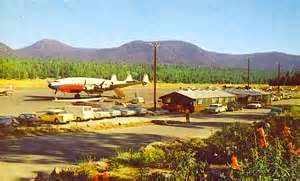
photo shows a Lockheed Constellation at TVL in 1963.

This is a Lockheed Constellation at Tahoe Valley Airport in 1963. Photo/Dave Borges

The peak has an elevation of 8,675 feet. Speculation is that had the plane been 300 feet higher it could have cleared the peak.

All 81 passengers and four crew members, including the airline’s chief pilot, died.

Another pilot warned the Paradise of icing at 12,000 feet, according to Aviation Safety Network.

The cause of the crash was ruled, “The pilot’s deviation from prescribed [visual flight rules] flight procedures in attempting a visual landing approach in adverse weather conditions. This resulted in an abandoned approach and geographical disorientation while flying below the minimum altitude prescribed for operations in mountainous areas.”

There was no tower at the airport then. One was built later, but today it is not operational.

The Civil Aeronautics Board grounded the airline.

Mike Ritter would ride motorcycles up the dirt roads north of Kingsbury Grade in the early 1970s. In 1973, he came across the crash site.
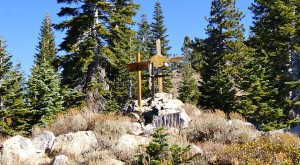
The crash site in October 2013. Photo/Provided

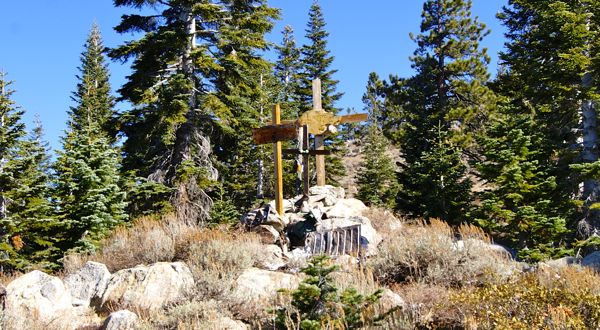
The crash site in October 2013. Photo/Chuck Westby

“The crash site was fascinating, particularly to a former Air Force radar controller who’d read his share of aircraft accident reports and even participated in a few,” Ritter told Lake Tahoe News. “The crash site was about 10 years old by that time, but we could stand on the ridge looking west and see the path of the aircraft as it crashed through the tree tops, cutting them off. It appeared, from that path of broken tree tops, that the aircraft hit about 30 feet below the ridge and spread a debris field over the top and down the east side of the mountain. With the exception of what looked to be a very large landing gear strut, most of identifiable pieces of the plane had been removed. But the bushes on the east slope were covered with small deteriorating scraps of blue and grey plastic material, very likely upholstery covers and/or cabin trim. At the peak of the ridge, centered on the impact site, visitors, probably over a period of time, had built a rock cairn, close to 6-feet tall and personal property that folks had found around the crash site – wallets, shoes, glasses etc. – had been placed on the rocks of the cairn. I was impressed with how respectfully the site seemed to have been treated.”

As a runner he revisited the site on occasion. Eventually the debris was removed or nature covered it.


SAT scores relevant to some employers

By Melissa Korn, Wall Street Journal

Stephen Robert Morse was a candidate for a communications job when the recruiter told him to be ready to discuss his SAT score in a coming interview.

Morse, 28, said he was “shocked” that a potential boss would be interested in the results of a test he took more than a decade earlier. He passed on the opportunity.

Proving the adage that all of life is like high school, plenty of employers still care about a job candidate’s SAT score. Consulting firms such as Bain & Co. and McKinsey & Co. and banks like Goldman Sachs Group Inc. ask new college recruits for their scores, while other companies request them even for senior sales and management hires, eliciting scores from job candidates in their 40s and 50s.

Read the whole story