CTC to raze, restore 3 SLT commercial parcels
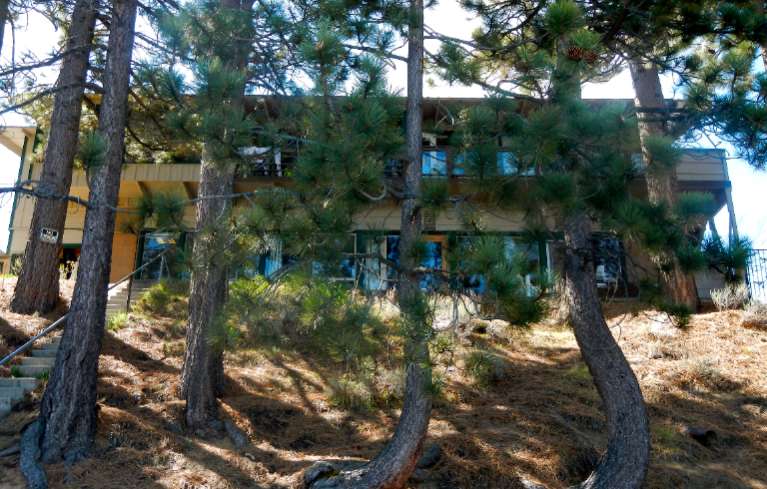
The CTC board on May 12 is expired to complete the approval process to buy the Alta Mira building in South Lake Tahoe. Photos/Kathryn Reed

The CTC board on May 12 is expected to complete the approval process to buy the Alta Mira building in South Lake.  Photos/Kathryn Reed

By Kathryn Reed

Three commercial properties in South Lake Tahoe are about to be owned by the state.

On May 9 the California Tahoe Conservancy board agreed to buy the South Y Lodge on Emerald Bay Road for $320,000 and the property on Highway 50 that houses the Smoke Shop and Tahoe Psychic for $325,000. On Monday there is a special board meeting to finalize the $2.5 million acquisition of the Alta Mira building.

The board started Friday’s meeting by touring the three locations.

CTC board members learn about the South Y Lodge property.

CTC board members learn about the South Y Lodge property.

The goal for all three is to tear down the existing structures and improve the land, while also giving the public access.

The first two properties share the same drainage, meaning the runoff ends up in the same filtration area before reaching Upper Truckee River. Water from the Emerald Bay property flows across the highway, then through a system going north on Highway 50.

The South Y Lodge rents rooms by the month; there are currently three tenants. Relocation for them will be part of the deal. The nine tourist accommodation units will be banked, as will the one residential unit and 14,400 square feet of hard coverage.

It’s possible the structure would come down in September.

Immediately to the north is another parcel the CTC owns. And next to it is the Barton Ranch, whose future remains unknown. Next to that is the Raley’s center at the Y.

On the current vacant CTC property is where the city has talked about creating a greenway and bike trails that would be part of the Tahoe Valley Area Plan. This area is also part of the city’s Tahoe Valley erosion control project.

These two structures sit in an stream zone.

These two structures sit in a stream zone.

This same trail system and greenway would cross the highway and tie in with the existing dilapidated trail network behind McDonald’s. Those all would ideally be upgraded, but is not part of the transactions that took place this week.

The two buildings on the less than one-half acre parcel fronting Highway 50 are in a stream zone. Puddles and mud from the previous night’s storm sat in the back area, proving drainage is inadequate.

The psychic owners must have been clairvoyant when they signed a three-year lease with the current owner the day before the Conservancy began negotiations. This means either the tenants will stay or the state buys out the lease. Those particulars still need to be worked out. As for the Smoke Shop, the owner is on a month-to-month lease.

Demolition at this site could be staggered, with the Smoke Shop likely not to be razed until next summer.

CTC will work with the city on water quality improvements in the area.

These two pieces of property have the same owner. Negotiations only started in the last few months and have progressed rapidly. This is in contrast to the Alta Mira building acquisition, which has been in the works for more than five years.

The Alta Mira site needs attention to be deemed safe for the public.

The Alta Mira site needs attention to be deemed safe for the public.

That purchase price is much higher because it is nearly 1 acre on the lake. It comes with 150 feet of Highway 50 frontage and 190 feet of beach.

“The purpose is primarily to enhance the public lake access,” Bruce Eisner with the CTC told the board. Visual and physical improvements are part of the plans.

To begin with, the physical upgrade will be to remove the building to open the view corridor to the lake. The six commercial and two residential tenants will be given money to relocate.

The Conservancy will need to improve fencing for safety reasons. The current stairs may not have met any sort of code when they were put in. The concrete slabs are narrow, steep and uneven.

From the beach looking up it is obvious slope stabilization is required as roots of several trees are exposed.

“We don’t know the future uses of the property other than lake access,” Eisner said.

This stretch will tie into the Lakeview Commons project to the south that the Conservancy funded at a cost of $65 million.

The city will play a role in what the future of this land mass looks like.


S. Tahoe man’s lawsuit against Facebook reinstated

By Bay City News

A federal appeals court ruled in San Francisco this week that Facebook users can go ahead with breach-of-contract and fraud claims against the online social network for allegedly allowing advertisers to obtain their personal information in 2010.

A three-judge panel of the 9th U.S. Circuit Court of Appeals reinstated those claims in a lawsuit filed against Menlo Park-based Facebook Inc. in federal court in San Jose in 2010. It overruled a decision in which now-retired U.S. District Judge James Ware dismissed those claims in 2011.

The lawsuit alleges that at least between February and May of 2010, Facebook violated its privacy promises by providing advertisers with headers revealing the user information of people who clicked on Facebook ads.

The lawsuit, originally filed by Facebook users Mike Robertson of Marin County and David Gould of South Lake Tahoe, seeks to be certified as a class action on behalf of an unspecified “millions” of users allegedly affected by the policy.

Read the whole story


S. Tahoe man arrested on pot charges in Ukiah

By Ukiah Daily Journal

A South Lake Tahoe man was arrested last week after an officer who pulled him over reportedly found concentrated cannabis in his car, the Ukiah Police Department reported.

According to the UPD, an officer stopped a vehicle in the 100 block of East Gobbi Street about 5pm May 1, and the driver was identified as Daniel A. Zook, 33, of South Lake Tahoe.

The officer reported that the vehicle smelled of marijuana, and Zook admitted to having the drug. He also reportedly displayed symptoms of having used it recently.

Read the whole story


U.S. students perform worse in higher grades

By Joy Resmovits, Huffington Post

High school test scores released by the federal government Wednesday provide fresh evidence of a troubling theme in American education: Students seem to perform worse on tests as they advance through the public school system to higher grades.

America’s high school seniors have mostly stagnated on the National Assessment of Education Progress in reading and math at least since 2005, when a comparable version of the math exam was first given, according to the report. In 2013, the latest NAEP math test, seniors scored an average of 153 out of 500 — three points higher than in 2005. In reading, students lost ground, dropping from 292 in 1992 to 288 in 2013. In both subjects, achievement gaps between ethnic groups didn’t diminish.

“Despite the highest high school graduation rate in our history, and despite growth in student achievement over time in elementary school and middle school, student achievement at the high school level has been flat in recent years,” said U.S. Secretary of Education Arne Duncan. “Just as troubling, achievement gaps among ethnic groups have not narrowed.”

Read the whole story


Whittell parents furious with class reductions

By Anne Knowles

GARDNERVILLE – Twenty-six parents, grandparents, students and teachers spoke out against the possible elimination of the music program at Whittell High School on May 9 during a special meeting of the Douglas County School District board.

Almost twice that many attendees filled the audience in the Carson Valley Middle School library where the seven-member board met Friday afternoon to discuss revisions to its strategic plan.

The possibility of curriculum cuts was not on the agenda, but some Zephyr Cove parents organized via email and Facebook to encourage people to attend the meeting and give a show of support to the music program during the period for public comment.

Whittell high parents crowd the May 9 board meeting. Photo/Anne Knowles

Whittell High parents crowd the May 9 board meeting. Photo/Anne Knowles

The speakers each talked about the importance of the music classes, choir and band to the students overall education and for college admissions, and many told personal stories of the value of the program.

“I’ve been in the music program since sixth grade,” said Gabe Rusk, a sophomore at Whittell who is a band member. “It’s something I need for my future. It’s probably the way I’m going to get into college.”

Elaine Welch talked about her two children, graduates of Whittell, who sang in the school’s Black and White Choir.

“They sang at the Sacramento Kings basketball game. They sang at the Reno Aces games,” said Welch. “It would be a shame if the choir program went away.”

Maxwell Glasson, a 2002 Whittell graduate, said his participation in the music program helped him get into college and, indirectly, into law school.

“I moved back to raise my family and to put my kids through school there,” said Glasson. “You’re putting these kids’ futures in jeopardy.”

Glasson and several other speakers struggled to speak after choking up with tears during their three-minute allotted time, and every speaker was met with a round of applause when they finished.

Many implored the board to form a committee of parents, educators and administrators to come up with ways to save the program.

“We’re asking to collaborate and for a seat at the table,” said parent Carol Chaplin. “We can think outside of the box together.”

Greg Felton, a parent of two children who graduated from Whittell and a third child attending it, suggested such a group could come up with a long-term plan.

“Put together a task force or committee with the people here and put in place a 10-year plan so this is not hitting us every year,” Felton said. “And in the meantime, freeze the cuts.”

Several parents said this is just the latest in a list of sacrifices the school has already made, especially after Kingsbury Middle School closed and its students were moved into Whittell, putting two schools into one building. It is now a 7-12 school.

“There were 92 periods offered when Whittell and Kingsbury merged,” said Kelly Krolicki, a parent, whose daughter Kate, a Whittell student, spoke after her. “Now there are 74 periods and we’re talking about cutting that to 72 periods. We’ve lost 20 periods in six years.”

Some parents talked about reductions in information technology classes and the unfulfilled promise to hire a vice principal for the school, but most were focused on the threat to the music program.

Nancy Gardner, a member of the DCSD board 40 years ago and a mother and grandmother to Whittell graduates, said she understood the fiscal constraints the current board was working under.

“I understand the issues. There are so many of the same issues we faced,” said Gardner. “One lesson we learned as a board was to carefully pick our fights. This is a battle you should not be fighting.”

Cindy Trigg, Lake Tahoe’s representative on the board also made public comment as a parent. She opened the meeting explaining that the board could not bring or comment on future agenda items during the meeting.

“We are not going to have a conversation back and forth,” she said.

Tom Moore, the board president, closed the public comment, thanking everyone for their respectful and thoughtful suggestions, and making a promise of sorts. The issue was not on an agenda item at the special board meeting. The meeting was called to tie up lose issues regarding the strategic plan.

“This is a conversation that is going to be taking place at the board level very soon,” Moore said.


Economists: College education pays for itself

Ben Leubsdorf, Wall Street Journal

Even with tuition bills on the rise, a four-year U.S. college education still pays for itself in the form of higher wages in the decades to come, according to a new research paper from the Federal Reserve Bank of San Francisco.

“Although there are stories of people who skipped college and achieved financial success, for most Americans the path to higher future earnings involves a four-year college degree. We show that the value of a college degree remains high, and the average college graduate can recover the costs of attending in less than 20 years,” wrote San Francisco Fed economists Mary C. Daly and Leila Bengali. “Once the investment is paid for, it continues to pay dividends through the rest of the worker’s life, leaving college graduates with substantially higher lifetime earnings than their peers with a high school degree.”

Daly and Bengali analyzed earnings data for U.S. workers. In 2011, college graduates made an average of roughly $20,050 more a year than high-school graduates. “The premium is much smaller, although not zero, for workers with some college but no four-year degree,” they wrote.

Read the whole story


Study: Health insurance saves lives

By Noam N. Levey, Los Angeles Times

Giving more people health insurance could save tens of thousands of lives nationwide, according to a new analysis of data from Massachusetts, whose reforms became the model for President Obama’s health law.

Throughout the national debate over the Affordable Care Act, critics have questioned whether expanding coverage results in better health. The new analysis adds to the growing evidence that it does.

Mortality rates in Massachusetts measurably improved compared with similar places around the country after the state began guaranteeing its residents health coverage in 2006, according to researchers at the Harvard School of Public Health, Brigham and Women’s Hospital and the Urban Institute.

The study, published Monday in the Annals of Internal Medicine, also implicitly warns that gaps among states in the health of their populations may widen in coming years. That divide will result from some states taking advantage of federal money to provide health coverage and others opting out of the system.

Read the whole story


Apple, Facebook, others defy authorities, notify users of secret data demands

By Craig Timberg, Washington Post

Major U.S. technology companies have largely ended the practice of quietly complying with investigators’ demands for e-mail records and other online data, saying that users have a right to know in advance when their information is targeted for government seizure.

This increasingly defiant industry stand is giving some of the tens of thousands of Americans whose Internet data gets swept into criminal investigations each year the opportunity to fight in court to prevent disclosures. Prosecutors, however, warn that tech companies may undermine cases by tipping off criminals, giving them time to destroy vital electronic evidence before it can be gathered.

Fueling the shift is the industry’s eagerness to distance itself from the government after last year’s disclosures about National Security Agency surveillance of online services. Apple, Microsoft, Facebook and Google all are updating their policies to expand routine notification of users about government data seizures, unless specifically gagged by a judge or other legal authority, officials at all four companies said. Yahoo announced similar changes in July.

Read the whole story


Barton Ranch decision delayed one month

Buildings on the old Barton Ranch in South Lake Tahoe will stay — at least for another month.

The South Lake Tahoe Planning Commission on May 8 agreed to staff’s recommendation to delay a vote on whether the buildings should be razed.

As Lake Tahoe News reported last month, the owners want to get rid of the structures, but don’t know what they want to do with the property.

Lake Tahoe Historical Society is reaching out to the Mosher family to see if there is a way to preserve this segment of South Shore history.

Money is the main stumbling block.

While the city first said a negative declaration for CEQA was protocol, in reality it is a mitigated declaration. A plaque acknowledging the history of the property and a report on its local significance are required.

The commission is expected to discuss the issue again at its June 12 meeting.

— Lake Tahoe News staff report


Diversity lacking among U.S. teachers

By Jesse J. Holland, AP

U.S. teachers are nowhere near as diverse as their students.

Almost half the students attending public schools are minorities, yet fewer than 1 in 5 of their teachers is nonwhite.

New studies from the Center for American Progress and the National Education Association are calling attention to this “diversity gap” at elementary and secondary schools in the United States. The groups want more to be done to help teachers more accurately mirror the students in their classrooms.

Teachers are always pushing their students to excel, said Kevin Gilbert, coordinator of teacher leadership and special projects for the Clinton Public School District in Clinton, Miss.

It becomes easier for students to believe “when they can look and see someone who looks just like them, that they can relate to,” said Gilbert, a member of the NEA’s executive committee. “Nothing can help motivate our students more than to see success standing right in front of them.”

More than minority students would benefit from a more diverse teacher corps, said Ulrich Boser, the author of the center’s report.

“Even in a place like North Dakota, where the students aren’t particularly diverse relative to the rest of the country, it’s important for our social fabric, for our sense as a nation, that students are engaging with people who think, talk and act differently than them but can also be just as effective at raising student achievement in the classroom,” he said.

There were about 3.3 million teachers in American public elementary and secondary schools in 2012, according to a study by the National Center for Education Statistics. It said 82 percent were white, 8 percent were Hispanic, 7 percent were black and about 2 percent were Asian.

Students are a different story. In 1993, minority students made up 31 percent of the public school population; it was 41 percent in 2003.

The Center for American Progress’ most recent statistics show 48 percent of the students in public schools are nonwhite — 23 percent Hispanic, 16 percent black and 5 percent Asian — and that percentage is expected to continue to increase.

“We project that this fall, for the first time in American history, the majority of public school students in America will be nonwhite,” Education Secretary Arne Duncan said last week.

Hispanics have passed blacks as the largest minority group of teachers, just as there are more Hispanic students than African-Americans in the public school system. This tracks with the increases in the number of Hispanics in the United States, with Latinos the largest minority group in the country and the fastest-growing.

Jan Alderson, a science teacher at Shawnee Mission South High School in Overland Park, Kansas, saw the changes at her school.

“We have very few teachers of minority background yet we’ve gone to about 40 percent minority population,” said Alderson, who was inducted into the National Teacher Hall of Fame this past week. “It’s a beautiful blending, it’s just teachers who don’t have that cultural background, I think just that there are more issues.”

Teaching used be one of the only professions African-American college graduates could aspire to and make decent money, said LaRuth Gray, scholar-in-residence at the Metropolitan Center for Research on Equity and the Transformation of Schools at New York University.

But as the county integrated and other professions opened their ranks, education lost its “cachet” and fewer African-American students thought about becoming teachers, she said.

“It’s not seen as the ideal careers to have, and so therefore our youngsters, our black children tend to move in other directions,” said Gray, who also serves as a government liaison for the National Alliance of Black School Educators.

It will take political will to change those numbers, advocates say. Most states already have programs and policies intended to increase the number of minority teachers, “but the yield of new teachers of color is disappointing,” the NEA report said.