Website provides detailed SLT budget data

By Kathryn Reed

Accountability and transparency are buzzwords in government circles.

South Lake Tahoe wants to take ownership of them by allowing the public to delve into the city’s multi-million dollar budget in ways it has never been able to until now.

In May the city unveiled its partnership with Open Gov, a firm that puts a government’s budget online in a way that allows users to drill down into expenses and revenues. Colorful charts pop up, with just the numbers below.

Data goes back to the 2008-09 budget year.
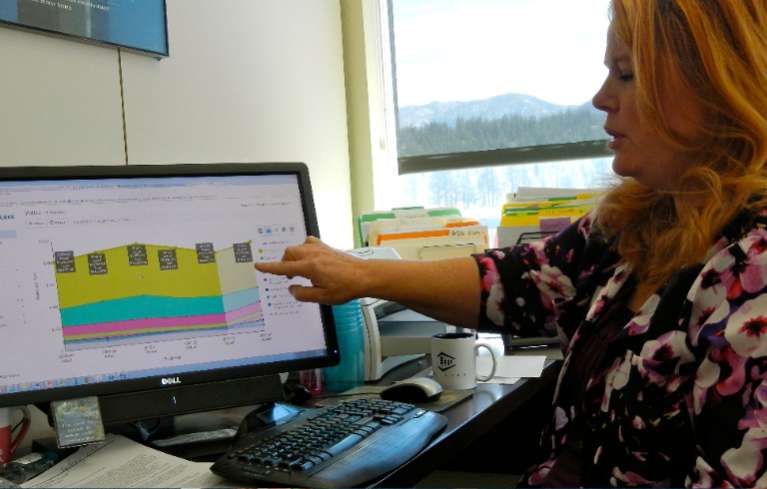
South Lake Tahoe City Manager Nancy Kerry demonstrates how Open Gov works. Photo/Kathryn Reed

South Lake Tahoe City Manager Nancy Kerry demonstrates how Open Gov works. Photo/Kathryn Reed

Budgets by nature are cumbersome. There are restricted and unrestricted funds. This simply means some dollars have strings attached, others don’t. Part has to do with where the money comes from, and part has to do with what it is being spent on.

Things people might not ordinarily think about can be found – like how much money has been spent to pay on-call employees to remove snow on city streets. In 2009-10, it was a whopping $76,633. It plunged to $16,199 in 2012-13. While $25,000 was budgeted this year, the final numbers aren’t in.

Accounts are updated quarterly. The finance staff sends them to Open Gov to upload. The city then does a check to make sure it was done correctly.

But like anything, the data is only as good as what is provided. And in an era of extreme public distrust of nearly all political entities, how is the public to know what is being presented is really the truth? Just look at the city of Bell or California State Parks – distrust still lingers.

“Bell had an auditing firm without access to the budget. Our auditor gets the budget,” South Lake Tahoe City Manager Nancy Kerry told Lake Tahoe News.

It’s an independent auditor who is reviewing the city’s budget. That is the public’s assurance that the numbers the city provides are factual – that there are no hidden accounts, that the income stated is true and what it’s spent on is factual.

What Open Gov does is allow people to more easily find the numbers. The actual budget document is so thick and convoluted that a few years ago Lake Tahoe News paid a financial expert to help sift through it in an attempt to bring understanding to it. Even then it was near impossible to grasp everything.

While Open Gov is a step in the right direction, it is still a bit clunky. So far there is no search button. The company is working on one, but has no time line for when it will be live.

Like most websites, there are multiple ways to get to what a person is looking for. The “reset” button at the top left is likely to be used a lot as people search for things.

In 2010, with the city changing how it categorized items, it makes the system seem a bit less fluid. After all, how many people know that in 2010-11 the vacation rental program enforcement became the job of the police department?

Open Gov cost the city $7,000 in start up expenses and will be a $4,000 line item each year for the company to upload and maintain the data.

This data, as well as the more than 40 other cities on Open Gov, is available to anyone. Kerry foresees this potentially being good for investors doing research on South Lake Tahoe to see how solvent the city is.

But her main goal with Open Gov is to get more engagement from locals in the budget process – for them to see where money is coming from and where it is going.

—-

Notes:

• Here is a link to South Lake Tahoe’s Open Gov site.

• For help with Open Gov, call Debbie or Olga in the finance department at 530.542.6000.



IRS bars employers from dumping workers into health exchanges

By Robert Pearmay, New York Times

WASHINGTON — Many employers had thought they could shift health costs to the government by sending their employees to a health insurance exchange with a tax-free contribution of cash to help pay premiums, but the Obama administration has squelched the idea in a new ruling. Such arrangements do not satisfy the health care law, the administration said, and employers may be subject to a tax penalty of $100 a day — or $36,500 a year — for each employee who goes into the individual marketplace.

The ruling this month, by the Internal Revenue Service, blocks any wholesale move by employers to dump employees into the exchanges.

Under a central provision of the health care law, larger employers are required to offer health coverage to full-time workers, or else the employers may be subject to penalties.

Many employers — some that now offer coverage and some that do not — had concluded that it would be cheaper to provide each employee with a lump sum of money to buy insurance on an exchange, instead of providing coverage directly.

Read the whole story


Truckee man among 6 presumed dead on Mt. Rainier

By KTVU-TV and AP

SEATTLE — A Truckee man who worked as a climbing guide for a Seattle company has been identified as one of the six people who likely fell thousands of feet to their deaths in a horrible alpine accident on Washington state’s iconic Mount Rainier.

Matt Hegeman

Matt Hegeman

Matt Hegeman of Truckee worked as a guide for Seattle’s Alpine Ascents International and had climbed Mount Rainier more than 50 times.

A helicopter crew on Saturday spotted camping and climbing gear in the avalanche-prone area. It is believed the group fell 3,300 feet from their last known whereabouts of 12,800 feet on Liberty Ridge, Mount Rainier National Park spokeswoman Patricia Wold said in a statement.

“There’s not a viable chance of survival,” park Ranger Fawn Bauer told the Associated Press.

Read the whole story


Calif. bill would let authorities temporarily remove guns

By Kimberly Kindy, Washington Post

On Wednesday, in response to the Isla Vista shootings, a bill was introduced in the California Legislature that would give families, neighbors, friends and law enforcement the ability to appeal to a judge to temporarily remove firearms while a court determines a person’s competency.

Assemblywoman Nancy Skinner, D-Berkeley, who introduced Assembly Bill 1014, said it would function like a temporary restraining order, providing people who were the subject of the court action with due process rights to make their case to keep their firearms. If they did not prevail, they could also appeal to the court to have them returned at a later date, after the court deems the person to no longer be a threat to themselves or to others.

The bill would not give the court or authorities the ability to remove other weapons, like knives, which were used by Rodger to kill his two roommates as well as a college friend who was visiting the two young men.

“This is a common sense tool that could be used by a family member, a roommate or a concerned friend who saw clear warning signals that a person was a clear threat of violence to themselves or others,” Skinner said in an interview.

The legal language for the bill was drafted immediately after the shooting at Sandy Hook Elementary School last year that left 20 children and six adult staff members dead. It was set aside, in favor of a package of other bills that seemed to have greater support at the time.

Read the whole story


Worst U.S. measles outbreak in 20 years

By Tony Pugh, McClatchy Washington Bureau

WASHINGTON — After declaring in 2000 that measles had been eliminated from the U.S. through a successful vaccination program, government officials now say the number of confirmed cases has reached a 20-year high as people who get the disease abroad bring it back to America.

Unvaccinated Americans and foreign visitors who traveled to the Philippines, Europe, Africa and Asia are the main culprits in a growing spike of U.S. measles cases that began several years ago and exploded this year.

As of last month, 288 cases have been reported in 18 states, the highest year-to-date total since 1994, when 963 cases were reported by year’s end. Ninety-seven percent – 280 – of the 2014 U.S. cases were imported from other countries.

A highly contagious viral respiratory disease that grows in cells at the back of the throat and lungs, measles is spread through the air by coughing, sneezing and even breathing. It can cause fever and coldlike symptoms, along with a stubborn rash.

Read the whole story


Divide exists over involuntary mental health treatment

By Kirk Siegler, NPR

The attacks near UC Santa Barbara are renewing focus on programs aimed at requiring treatment for people who are mentally ill as a way to prevent mass shootings and other violence.

In California, a 2002 law allows authorities to require outpatient mental health care for people who have been refusing it. Proponents argue that this kind of intervention could prevent violent acts.

But counties within the state have been slow to adopt the legislation and mental health professionals are divided over its effects.

The story behind Laura’s Law begins in 2001. In rural Nevada County 19-year-old Laura Wilcox was shot and killed by a 41-year-old man with a history of mental illness. He had walked into the county’s behavioral health center and opened fire.

Tom Anderson was the county’s chief public defender at the time and represented the gunman in court. He recalls that the man’s family had tried to alert mental health officials numerous times before the shooting.

“[Officials] were declaiming privacy issues and stuff and wouldn’t communicate with the family,” Anderson says. “He … started amassing guns and setting up booby traps around his house and he had this psychosis of he was going to be attacked any minute.”

Now Nevada County’s presiding judge, Anderson is also a vocal advocate for Laura’s Law, which was passed by the state legislature in 2002. The law allows counties to compel outpatient treatment for people whose family or friends are concerned about their mental state. It’s seen as an intermediate step before someone is forced into inpatient psychiatric care.

Read the whole story


Nev. says “no” to betting on presidential elections

By Sandra Chereb, AP

Proposals to allow betting on federal elections and monitoring taverns and slot parlors for compliance of “incidental” gambling activities failed to garner support of a legislative panel Tuesday.

Both measures were debated during the 2013 session and there was little to no appetite by members of the Committee to Conduct an Interim Study Concerning the Impact of Technology Upon Gaming to sponsor bills rehashing the issues when lawmakers meet again next year.

State Sen. Tick Segerblom, D-Las Vegas, had hoped to persuade the panel to request a bill draft for the 2015 session allowing Nevada sports books to take pari-mutuel wagers on elections for president, U.S. Senate and House of Representatives.

The Senate Judiciary Committee, chaired by Segerblom, introduced a similar bill that died in the 2013 session. Segerblom has said election betting could be a boon for state gambling revenues.

Interim committee members were not swayed Tuesday, and state Sen. Greg Brower, R-Reno, said betting on elections was inappropriate.

The effort for the committee’s backing fizzled when no one made a motion for a bill draft request, though the concept could still be resurrected in 2015.

Panel members also beat back urgings by Clark County Commission Chairman Steve Sisolak and Assemblyman William Horne, D-Las Vegas, to again wade into the ongoing dispute over slot machines in taverns and slot parlors.

Current regulations state restricted licenses for up to 15 slot machines may only be granted “if the operation of slot machines is incidental to the primary business.”

Sisolak said state law needs to more clearly define “incidental,” arguing that some taverns and slot parlors rake in a large percentage of their proceeds from gambling.

Horne, chairman of the interim panel, also urged committee intervention, if anything to define the different between traditional taverns and slot parlors, but a motion on his recommendation died when no one seconded it.

Peter Bernhard, chairman of the Nevada Gaming Commission, said the issue has been vetted several times over the past decade and suggested that local governments can set their own restrictions.

“Traditionally, local governments have determined where local taverns can be located,” he said. “The county commission and city councils should make those decisions.”

Bernhard also dismissed allegations that slot parlors have proliferated in recent years, saying they have emerged as an innovative business model to adapt to a changing market and economic conditions.

“Just because you happen to see them more than you’ve seen them before, it is because people with a competitive interest have brought them to our attention,” he said.

Bernhard suggested that a simpler way to resolve the issue was to delete the word “incidental” from the statute entirely.


LTCC putting finishing touches on Nov. bond

By Kathryn Reed

Everything is in place for Lake Tahoe Community College to proceed with a general obligation bond in November – except for the board voting to do so.

That is expected to take place at the June 10 board meeting. At the meeting this week the board approved an agreement with Keygent Advisors to provide bond financial advisory services, approved the contract with Orrick, Herrington and Sutcliffe LLP for bond counsel, and had the first reading of the list of projects the bond would cover.

The college, which will celebrate its 40th anniversary next month, is going to voters for the first time to ask for money that will only be spent on facilities. Some of it will be for upgrades, some for new things.

The exact amount has yet to be determined. In some ways it’s a guessing game based on what interest rates and assessed values will be. The college does not want people to pay more than $25 per $100,000 of assessed value on their property.

Joanna Bowes with Keygent went over different scenarios that would bring the college between $28.29 million and $53.729 million.

Her recommendation is to go out for a mix of current interest and capital appreciation bonds that would bring in $47.36 million at interest rates ranging from 1.5 percent to 3.5 percent, the former for this year and the later estimated for 2016-17. (Bonds are traditionally sold over the course of several years.) This scenario also calls for longer-term assessed value to increase 4.25 percent per year.

One issue staff and the board will have to deal with is the price tag for the project list is $55 million.

Jeff DeFranco, vice president of administrative services, told board members they will have to prioritize the projects. It’s also possible matching funds could come in higher or that the 3 percent inflation rate that is built into the numbers would not come to fruition.

While it was acknowledged the general consensus is the campus is fairly new, the truth is many of the buildings are aging as are the parts inside. The main building was built in 1988, Child Development Center 1993, four garden trailers 1996, two garden trailers 1999, student center/culinary and physical education 2002, and the library in 2005.

The campus includes 164 acres. The idea is to try to cluster buildings and avoid sprawl.

Per Tahoe Regional Planning Agency definitions, the college has 696,723 square feet of coverage. The proposed projects would bring that total to 485,864 square feet. The unallocated coverage would be 110,059 square feet.

Five projects the college hopes will receive state money to supplement the bond dollars include:

• Remodeling the science lab so it is efficient and has 21st century equipment;

• Building a public safety training center;

• Modernizing the main building, which includes enhancing the commons;

• Creating an environmental studies and sustainability center;

• Erecting a multipurpose building.

This last project was originally going to be an expansion of the phys ed facility, but has morphed into more than that. It would provide classrooms when the garden trailers are removed, storage and meeting space, and physical education rooms.

Money just from the bond would go to:

• Expanding the early learning center, which includes having room for Tahoe Parents Nursery School.

• Solar generating storage facility to house vehicles and equipment. It could be a demonstration site for sustainable studies related to solar generation.


STHS using questionable anti-drug program

Even though the California Department of Education in 2005 warned districts against using Narconon as a viable drug prevention curriculum, the group is still in schools – including South Tahoe High School.

“Yes, Narconon has sent a guest presenter to the Health Seminar class at STHS. They share curriculum with the students to have them avoid drug use and abuse,” STHS Principal Ivone Larson told Lake Tahoe News.

She said the curriculum includes:

• The difference between taking a drug for a necessary reason and taking a drug for a recreational reason.

• The dangers of drugs (overdose, addiction).

• Goal setting.

• The presenters’ “story” all have been past addicts who have recovered at the Narconon facilities.

• The process of addiction.

• The affects of drugs on the nervous system.

• The affects on driving.

The state’s issue with Narconon is that it was developed by the late L. Ron Hubbard, the founder of the Church of Scientology and Dianetics.

The state Department of Education has not changed its stance since first writing on Feb. 24, 2005, “Narconon’s drug prevention program does not reflect accurate, widely-accepted medical and scientific evidence.”

Larson said, “They are on the list of Health Seminar presenters because they share their story of drug abuse and how it has affected their lives. We continue to use a variety of resources to address current topics in the Health Seminar class that meet the needs of all our students.”

Narconon presenters at STHS are not allowed to not leave a phone number for students call, hand out any information, recruit, discuss their program’s steps or the philosophy behind it, Larson said.

Melody Easton, South Tahoe Drug Free Coalition coordinator, said, “I don’t know enough about this to comment.”

Narconon has an office in South Lake Tahoe, though it is not regularly staffed.

— Lake Tahoe News staff report


Laws to track Calif.’s biggest water users ignored

By Katharine Mieszkowski, Center for Investigative Journalism

The last time California endured a drought, legislators set their sights on the state’s heaviest water users: farmers.

The state designed laws to push agricultural water districts to closely track their water flow and make the largest districts charge farmers based on how much they use. The economic theory is simple: If you aren’t paying for how much water you actually use, you have little incentive to try to consume less.

But those rules are widely being ignored as they come into effect in the midst of one of the state’s most severe droughts on record.

All but the smallest agricultural water districts were required to track and report to the state how much water they deliver to customers as the result of a 2007 law. Only 20 percent – 48 of 242 districts – have filed those reports, according to California Department of Water Resources data. They were due 10 months ago.

Shasta Dam is an integral component of California's water system. Photo/LTN file

Shasta Dam is an integral component of California’s water system. Photo/LTN file

Under a 2009 law, the 55 largest agricultural water districts also are required to more precisely measure how much water each farmer is using. They’re then required to charge farmers – at least in part – on that basis.

The state doesn’t know how many suppliers are meeting this requirement or are even taking steps toward doing so, because almost half of them have failed to turn in the relevant reports, records show.

Charging for water based on use had been common in some agricultural areas where water is scarce, like the San Joaquin Valley. But now, it’s mandatory for large districts throughout California. These water management plans, which spell out how the districts will make the changes, were due at the end of 2012. Districts face few consequences for failing to comply.

By contrast, most residential water customers in California, whose use is metered, have long seen how much water they use reflected in the bills they receive.

“Throughout the state, people should be paying for water based on how much they use, and that will drive conservation,” said Peter Brostrom, program manager of water use efficiency for the Department of Water Resources.

Agriculture, which accounts for some 80 percent of the water that’s used in the state, has met the new rules with skepticism and indifference, as growers cope with the drought.

The Tulelake Irrigation District in Siskiyou and Modoc counties is not following the new rules. Earl Danosky, the district’s manager, said he has no plans to charge farmers for how much water they use individually. The district currently charges a flat per-acre fee once a year.

“I don’t believe it would save one drop of water,” Danosky said. He said he believes farmers there already are careful with the water they use out of necessity. “Too much water will damage the crop.”

Danosky said he didn’t realize he was supposed to be turning the reports in to the state. The district serves hundreds of family farms, which grow potatoes, onions, alfalfa and mint near the state’s northern border with Oregon.

Down in the Sacramento Valley, Reclamation District 108 is on track to meet the state’s new requirements. Still, farmers there doubt the changes will inspire much water conservation in their area.

“It’s a one size fits all for the state, and for us, it didn’t fit,” said Fritz Durst, the district’s board president, who grows rice, sunflowers, alfalfa and corn. “There’s probably areas where it would give people incentives to use less water, but with the way we manage our water here, there is no benefit.”

Water flows from the district’s system of canals through farm gates and into ditches next to the farmers’ fields, where it is used for irrigation. Rice especially relies on a lot of water. Growers flood the fields, allowing plants to sit in four inches of water. Water that drains off the fields is reused on other fields, accounting for about 40 percent of the total water the district delivers.

Local farmers voted to install a $2 million system to measure how much water comes out of these canals. Now, changing the district’s pricing to meet the regulations will require another vote. District officials hope to have the new pricing in place by the start of irrigation in spring 2016.

If Durst’s water bill goes way up, he said he likely won’t use less water. He said he’ll probably just grow a specialty rice that will fetch more on the market.

Districts’ failure to comply with the requirements troubles environmentalists who promote conservation as one tool for taking on the state’s water woes.

“Unless these districts start taking this seriously, it’s going to be their customers that suffer,” said Claire O’Connor, agricultural water policy analyst for the Natural Resources Defense Council.

The Department of Water Resources has had to rely on letters and workshops to try to cajole districts into complying. There’s no penalty for agricultural districts that don’t report how much water they’re delivering to farms.

Large districts that haven’t submitted their water management plans to the state have lost access to $472 million in state grants to encourage conservation and improve water management. But once they turn in their plans, they are eligible for funds again.

That money could be used to help farmers in their districts install more efficient irrigation systems, for instance.

A third party could sue districts for not fulfilling the requirements, but there’s little talk of this being in the works.

Farmers aren’t the only ones whose water use came under the legislative microscope during the last drought. The state is now trying to achieve a 20 percent reduction in urban per-capita water use by the end of 2020, based on the same law that targeted large agricultural districts.