Report: Climate change to cost U.S. billions

By Sharon Begley, Reuters

NEW YORK — Annual property losses from hurricanes and other coastal storms of $35 billion; a decline in crop yields of 14 percent, costing corn and wheat farmers tens of billions of dollars; heat wave-driven demand for electricity costing utility customers up to $12 billion per year.

These are among the economic costs that climate change is expected to exact in the United States over the next 25 years, according to a bipartisan report released on Tuesday. And that’s just for starters: The price tag could soar to hundreds of billions by 2100.

Commissioned by a group chaired by former New York City Mayor Michael Bloomberg, former Secretary of the Treasury and Goldman Sachs alum Henry Paulson, and environmentalist and financier Tom Steyer, the analysis “is the most detailed ever of the potential economic effects of climate change on the U.S.,” said climatologist Michael Oppenheimer of Princeton University.

The report lands three weeks after President Obama ordered U.S. regulators to take their strongest steps ever to reduce greenhouse gas emissions, including requiring power plants to cut carbon dioxide emissions to 30 percent below 2005 levels by 2030.

Read the whole story


People slipping through Nev.’s health exchange

By Kyle Roerink, Las Vegas Sun

Nevada’s Silver State Exchange was supposed to rescue people like Jill Parker.

Parker, a 35-year-old Las Vegas mother of three, needed health care. She was in constant pain, suffering from Graves’ and Hashimoto’s diseases and hypoglycemia.

She was relieved to see that Nevada planned to use the Affordable Care Act to help people such as her see doctors. In December, she signed onto the Nevada Health Link and paid $362 for an insurance premium.

The Silver State Exchange took Parker’s money. But for five months, despite phone calls and reassuring words from state officials, the exchange gave her nothing in return.

Read the whole story


Pain of California’s drought spreading

By Matt Weiser, Sacramento Bee

OUTINGDALE — In the small community of Outingdale in rugged El Dorado County, neighbors Mary Callahan and Steve White confess they used to leave the water running while brushing their teeth. No more.

Now, in addition to turning that tap off, they have stopped filling outdoor birdbaths and cut back on landscape watering. They bathe less and take “Navy showers” when they do, collecting the outflow in buckets and jugs as they wait for the water to heat up. They tell their visitors to live by these rules as well.

Outingdale is one of the first communities in Northern California to know what the worst drought since 1977 really feels like. Residents have been told by the El Dorado Irrigation District, their water provider, to consume no more than 68 gallons of water per person per day. That’s about one-third of the state average. Their use is being monitored by water meters at each home.

Millions more Californians could find themselves in a similar situation as the drought continues into the sweltering months of summer.

“It’s not a pleasant thing that’s going on here,” said Callahan, who retired to Outingdale with husband, Dennis, about 15 years ago. They recently asked their daughter and three young grandsons to cancel their annual summer visit because there isn’t enough water to go around. “It breaks my heart because I don’t get to see them very much.”

Outingdale, founded in the 1920s, consists of about 150 small homes on the flank of a forested canyon alongside the middle fork of the Cosumnes River. Residents enjoy more than a mile of riverfront access, including shaded beaches and deep, clear swimming holes that create a cool refuge amid the hot Sierra Nevada foothills.

That river is also their only source of tap water. Thanks to a state water right held by the El Dorado Irrigation District, the river is piped into two holding tanks, treated with chlorine, then delivered to homes and fire hydrants.

Read the whole story


Human remains found near Spooner Summit

Human remains were found in the Kings Canyon area east of Spooner Summit.

Washoe County will be conducting the autopsy to determine the cause of death and identify the deceased. Douglas County is leading the investigation.

The remains were located approximately 300 yards to the north of Highway 50 near the top of Spooner Summit, between the Tahoe Rim Trail and Kings Canyon Road, in a remote wooded area.

Inmate work crews clearing brush in the area located the remains and contacted law enforcement.

— Lake Tahoe News staff report


Calif. lawmakers, governor to get raise

By Jeremy B. White, Sacramento Bee

Gov. Jerry Brown, California lawmakers and other elected officials will be getting a 2 percent raise this year.

Pointing to California’s firmer fiscal footing, a panel that sets salaries for elected officials voted 4-1 Friday to enact a pay boost. Starting Dec. 1, the raise will add $1,906 to lawmakers’ annual $95,291 salary, giving them a yearly pay of $97,197. The raise for Brown will be $3,480, taking him to $177,467 a year.

Years of yawning budget deficits have given way to a surplus, allowing California to pass an on-time budget this year with minimal friction. Those sunnier circumstances framed the debate among members of the California Citizens Compensation Commission and guided Friday’s decision to hike pay for the second consecutive year.

“It would be hard to argue, I believe, that the state is not better off financially today than it was a few years ago,” said commissioner Scott Somers, a corporate executive and compensation expert. “If they get tarred when times are tough,” he added in reference to elected officials, “they ought to at least get some credit when things are improving.”

Read the whole story


Study: Gay marriage would bring cash to Nev.

By Wesley Juhl, Las Vegas Review-Journal

If Nevada were to legalize same-sex marriages, the state would see significant economic benefits, a report released last week found.

In the first three years that same-sex couples could marry, Nevada’s wedding and tourism industries could see spending rise between $23 million and $52 million, which would raise state and local tax revenues between $1.8 million and $4.2 million, according to the report by the Williams Institute on Sexual Orientation and Gender Identity Law and Public Policy, a think tank at the UCLA School of Law.

The institute tracked economic and census data from states that have legalized same-sex marriage and applied those trends to Nevada. If the Silver State follows suit, it could reap millions of dollars of taxable revenue, the report said.

Nevada has 7,140 same-sex couples living in the state, according to census data. If gay and lesbian couples married in Nevada at the same rate as those in Massachusetts a decade ago, half of Nevada’s LGBT couples would marry in the first three years, the report found.

Read the whole story


Future governance of Meyers up in the air

By Kathryn Reed

Who will be the voice for Meyers once the area plan process is through?

That answer remains to be seen.

At recent meetings regarding the Meyers Area Plan residents have said they want more say in what happens to their enclave that sits at the base of Echo Summit to the west of the city limits of South Lake Tahoe. Being in the unincorporated area of El Dorado County residents are governed by the Board of Supervisors who are based in Placerville, as well as the Tahoe Regional Planning Agency.

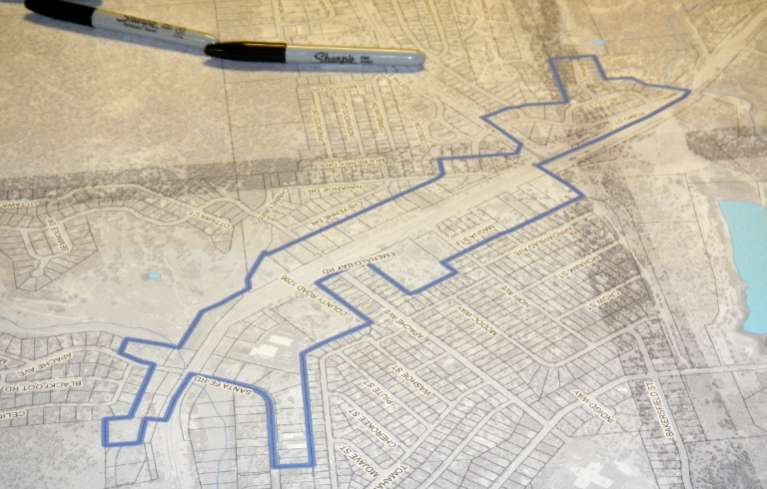
The Meyers Area Plan mostly deals with the highlighted area. Photo/LTN

The Meyers Area Plan mostly deals with the highlighted area. Photo/LTN

Forming a community services district has been talked about as a way to take what is the current Meyers Advisory Council and formalize it more. (The MAC evolved out of the Meyers Roundtable.)

Brendan Ferry, chief planner for El Dorado County, told Lake Tahoe News, “(The Meyers Area Plan) still formalizes the MAC as an official body of the county. It is just expanded to include the possibility of forming a CSD in the future. In that case the CSD board would essentially be the MAC.”

Here is the exact language in what is now the third draft of the Meyers Area Plan:

“Policy 1.2: El Dorado County shall establish and maintain a Meyers Advisory Council (MAC), with regularly scheduled and publically noticed meetings, to provide recommendations to the Planning Commission, County Board of Supervisors, and/or TRPA on the implementation of this Plan. The MAC shall include seven residents or property owners in the Lake Tahoe Region of unincorporated El Dorado County. The MAC shall include community members representing business, environmental, recreation, and other appropriate interests necessary to carry out the vision of the Meyers Area Plan. The MAC shall be comprised of elected board members of a Community Services District or other appropriate special district, or if no appropriate entity exists, the MAC members may be appointed by the El Dorado County Board of Supervisors.”

There is another meeting about the plan on June 26; at which time it’s possible the CSD will be discussed.

David Reichel, who is on the MAC, said at no time did that body make a formal recommendation to the community as a whole or to county staff about what it would like the MAC to be in the future.

“I’m aware people are looking at other options to make the body more formal,” Reichel told Lake Tahoe News.

A CSD is also a taxing entity and has elected board members. CSDs usually get a portion of property taxes or assess the area an additional tax that would be used just for that particular CSD’s business. But it can be an uphill battle to tap into the existing property tax allotment because it would mean some other entity would then be given less money.

LAFCo (Local Area Formation Commission) is the only governing body authorized to form districts. The three ways to get LAFCo’s attention is through voter petition, the landowner and petition by another agency.

The Legislature treats a CSD like it’s a junior city. But land use is not something a CSD has jurisdiction over. And land use is the overriding issue Meyers area residents want to control based on comments at public meetings for the past two years.

“If you want to have some kind of role in development issues, it would best to petition the Board of Supervisors to create some kind of advisory board that will give them input on what kind of development is going through,” Jose Enriquez, El Dorado County LAFCo executive director, told Lake Tahoe News.

He said Pollock Pines and other West Slope communities have these types of advisory boards. The Board of Supervisors appoints those members.

Enriquez said CSDs are usually formed for municipal services like fire, parks, and lighting-landscaping.

“If you want to be a land use regulating agency and not deal with the Board of Supervisors, then you form your own city,” Enriquez said. “That is a much larger discussion.”

Even though LAFCo doesn’t see a CSD being the correct route for Meyers, in the cover letter released earlier this month about the current draft Meyers Area Plan, it says, “Many community members have expressed a desire for a locally elected body to review project proposals in Meyers and to maintain and update the plan in the future. In response, the county is evaluating the establishment of a Community Services District, which would review proposed projects in Meyers, initiate future revisions to the plan, and direct some funding for local improvement projects. If established, this Community Services District would be comprised of a board directly elected by Meyers residents, and it would fulfill the role of the Meyers Advisory Council described in the plan.”

Neither El Doardo County Chief Administrator Terri Daly nor Supervisor Norma Santiago is responding to inquiries from Lake Tahoe News. The outside flack hired by Daly to deal with the media told LTN to attend this week’s meeting to have questions answered.

If Meyers went through with a CSD, it would also have to define what Meyers is in terms of geographic boundaries. Only property owners in that CSD would be taxed and have a say in who is on the CSD board.

Meyers could also form a business improvement district like the property owners along Ski Run Boulevard in South Lake Tahoe did. Or they could do like the South Lake Tahoe lodging establishments and form a tourism improvement district. These, though, are both taxing entities that would require those affected to vote on creating the districts and vote to tax themselves.

——

Notes:

• The next meeting is June 26, 6pm at the CCC building in Meyers.

• The draft plan is available online.

• Here are the proposed Meyers Area Plan revisions.

• Comments may be submitted to MeyersAreaPlan@edcgov.us.

• Future meetings: El Dorado County Planning Commission – Aug. 28, Placerville; El Dorado County Board of Supervisors – Sept. 9, Placerville; Tahoe Regional Planning Agency Advisory Planning Commission – Sept. 10, Stateline; Tahoe Regional Planning Agency Governing Board – Oct. 22, Stateline.


Project launched to keep sage grouse off threatened list

By Las Vegas Sun

The Obama administration is launching an effort to accelerate protection of sage grouse along the Nevada-California line with $31 million in spending commitments through 2024 to help ranchers and others improve grouse habitat.

A top official in the Agriculture Department told the Associated Press that Friday’s announcement may represent the best, last chance to keep the Nevada and California population of the bird off the list of threatened species.

Jason Weller, chief of the USDA’s Natural Resources Conservation Service, says that while the multiagency effort targets California and Nevada, it ultimately will benefit the overall habitat of the greater sage grouse in 11 western states.

Read the whole story


Chateau duplicating Heavenly Village retailers

While retail was supposed to open at the Chateau on July 1, that date has been pushed back to at least mid-July. Construction is still going on and all the storefronts have not been leased.

So far, the tenants are the same as what’s across the street at Heavenly Village. Powder House and Up Shirt Creek are each taking two units in the new center that fronts Highway 50 near the state line in South Lake Tahoe.

The round building will be the new McP's. Photo/LTN

The round building will be the new McP’s. Photo/LTN

Those are the only two companies to take out applications for interior tenant improvements with the city.

The other known occupant is McP’s, which was the plan for the last seven year. Only now the restaurant will be much bigger and is also slated to in part be a nightclub.

No company has taken out sign permits, according to city officials.

Lew Feldman, who represents the owners of the Chateau, did not return a phone call. So, the exact date when stores will open is not known, nor is it known what else will go in at the site.

— Lake Tahoe News staff report


Half of U.S. homes at risk from natural disaster

By Constantine von Hoffman, Money Watch

More than half of all U.S. homes are located in areas prone to tornadoes, earthquakes or hurricanes.

About 71 million housing units, or 55 percent of the nation’s total, fall into the high risk category, with 10.6 million of these, or 8 percent of the total, classified as very high risk, according to a report from RealtyTrac.

The report is based on historical and predictive data from the U.S. Geological Survey and the National Oceanic and Atmospheric Administration regarding the likelihood of a given county being hit by a 5.0 magnitude or greater earthquake over the next 50 years or highly destructive hurricanes and tornadoes.

“It’s fairly obvious from looking at the map that these high-risk areas tend to be places where a lot of people want to live, like along the coast,” said Daren Blomquist, vice president at RealtyTrac, which provides real estate data. “While we’re not expecting this to cause a mass exodus from those areas, at least when home buyers are looking at a house they should take it into consideration along with the other factors that can affect home value.”

Higher-risk areas around the country — such as San Diego and Riverside counties in Southern California, Manhattan and Brooklyn in New York, and the Boston metro area — generally have higher home prices than lower risk regions. Median home prices in the eight counties adjudged as being at low risk for natural disasters averaged $161,000 in April, while prices in the 12 high-risk counties averaged $377,483, according to RealtyTrac.

Read the whole story