Future of Meyers Area Plan in limbo

By Kathryn Reed

MEYERS – While El Dorado County doesn’t have plans for another Meyers Area Plan meeting before it goes before the Board of Supervisors, members of the Meyers Advisory Council are coordinating a get-together without agency involvement.

That was the outcome of a three-hour meeting June 26 at the California Conservation Corps center. MAC members told Lake Tahoe News they are shooting for late July to bring the community together to hash out issues that stand in people’s way from signing off on what officials have presented.

As for the county, it was the intention of officials the Thursday meeting would be the last before the environmental process begins. (It was reported that Supervisor Norma Santiago was ill and that is why she was not in attendance.)

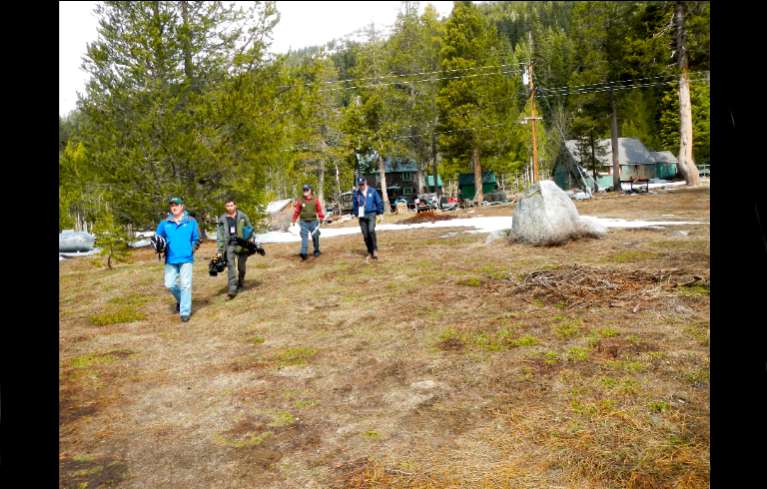
Meyers is struggling to figure out what it wants to look like in the future. Photo/LTN

Meyers is struggling to figure out what it wants to look like in the future. Photo/LTN

“We need to talk internally, with TRPA and Norma to see where we go,” Brendan Ferry, chief planner for El Dorado County, told Lake Tahoe News after the meeting.

Many of the nearly 50-person audience believed not enough outreach had occurred, that more community involvement is needed and the process needs to be slowed down – and perhaps delayed until after November when the area will be represented by a new supervisor.

If the process goes forward, there are at least five more public meeting where comments would be taken and changes could be made to the plan. Two are before the county and three involve TRPA.

While seven people acknowledged this was their first Meyers Area Plan meeting, the process has been going on for more than two years – with many public meetings. Postcards were mailed for the first time to residents announcing the meeting. However, they only went to people living or with businesses in the confines of the Tahoe Paradise Resort Improvement District, which is a fraction of the greater Meyers area.

Other than having a plan from 1993 on the books and needing to live with the rules within it, there is no legal reason the county or Tahoe Regional Planning Agency must move forward with the Meyers Area Plan. The TRPA’s Regional Plan allows these area plans; with an overriding goal to give local jurisdictions more say over planning.

Still, there is a template of sorts for these documents based on what is in the Regional Plan and laws regarding the reduction of green house gas emissions. It is not a document that is created from scratch.

The plan would be the planning blueprint for the Meyers area going forward for the next 20 years. However, it is recommended that whatever community group takes over for the Meyers Area Council reviews the plan every year.

Some of the main sticking points include determining how Meyers has a voice going forward.

County documents handed out at the meeting say, “The county is evaluating the establishment of a Community Services District, which would review proposed projects in Meyers, initiate future revisions to the plan, and direct some funding for local improvement projects.”

Stephanie McCorkle, the outside public relations person hired by the county, facilitated the meeting. She was also adamant that the county is not going to form a CSD; that it would be up to the residents of Meyers to do so if that’s what they want.

However, Ferry said, while it has not been fully flushed out, the idea of a municipal advisory council for Meyers has also been floated. He said members could be elected by the public or appointed by the Board of Supervisors.

Adam Lewandowsky with TRPA said, “The plan calls for a formal advisory council.”

With differing answers to the same question – Who is the voice for Meyers going forward? – this is an example of how distrust has become an issue when it comes to finding consensus about the plan.

Another concern is the density of multifamily homes has arbitrarily been bumped from 15 units to 20 units per acre. Some community members are not happy with that possibility.

Others want the California Tahoe Conservancy lots in Meyers to have more defined future uses. The state agency has agreed for the land use to be changed from residential/tourist to recreation. But recreation could still mean developable. That is what upsets some people.



‘Net neutrality’ a growing concern

By Edmund Lee, Bloomberg

The Internet is a set of pipes. It’s also a set of values. Whose? The people who consider it a great social equalizer, a playing field that has to be level? Or the ones who think of it as a marketplace subject to the laws of supply and demand?

It’s a philosophical contest that’s being fought under the banner of “net neutrality,” a slogan that inspires rhetorical devotion but eludes precise definition. Broadly, it means everything on the Internet should be equally accessible — that the Internet should be a place where great ideas compete on equal terms with big money. Even in the contentious arena of net neutrality, that’s a principle everybody claims to honor. Interpreting it is a different story.

With Internet use and related costs rising fast, the U.S. Federal Communications Commission proposed in May to let Internet providers like AT&T offer better technology at a premium price to content companies like Netflix, mainly for faster delivery of video. If approved, the new FCC rules would mean that for the first time some Internet content could get preferential treatment based on how much a publisher pays, instead of on whether it improves a network’s technical efficiency. Critics said that would give deep-pocketed companies an unfair advantage over upstarts, stifling the development of a new generation of Googles and Facebooks, costing customers more and opening the door to corporate censorship.

Supporters said it would simply create a “fast lane,” an improved alternate Internet where equals compete against equals.

Both sides invoked “net neutrality,” as do countries with widely varying definitions of the principle.

Read the whole story


Major ruling shields privacy of cell phones

By Adam Liptak, New York Times

WASHINGTON — In a sweeping victory for privacy rights in the digital age, the Supreme Court on Wednesday unanimously ruled that the police need warrants to search the cell phones of people they arrest.

While the decision will offer protection to the 12 million people arrested every year, many for minor crimes, its impact will most likely be much broader. The ruling almost certainly also applies to searches of tablet and laptop computers, and its reasoning may apply to searches of homes and businesses and of information held by third parties like phone companies.

“This is a bold opinion,” said Orin S. Kerr, a law professor at George Washington University. “It is the first computer-search case, and it says we are in a new digital age. You can’t apply the old rules anymore.”

Chief Justice John G. Roberts Jr., writing for the court, was keenly alert to the central role that cell phones play in contemporary life. They are, he said, “such a pervasive and insistent part of daily life that the proverbial visitor from Mars might conclude they were an important feature of human anatomy.”

Read the whole story


Report: 30% of Nev. kindergartners are obese

By Paul Takahashi, Las Vegas Sun

Nearly a third of Nevada children are considered obese by the time they enter kindergarten, according to a recent UNLV report.

Since 2008, the Nevada Institute for Children’s Research and Policy has issued an annual report listing demographic and health information for some of the state’s youngest residents: incoming kindergartners. This year, more than 7,300 surveys were collected from parents with the help of the Nevada Division of Public and Behavioral Health and the state’s 17 school districts. About 60 percent of survey respondents were from Clark County.

UNLV’s report found that 30 percent of Nevada’s 4- and 5-year-olds are overweight or obese, a 1.4 percent increase from last year. The Silver State’s share of overweight children has hovered around 30 percent since the survey was first administered five years ago.

Nationally, childhood obesity has more than doubled in young children over the past three decades, according to the Centers for Disease Control and Prevention. About a third of American children ages 6 to 11 are considered overweight or obese.

Read the whole story


Lawsuit leads to fireworks sponsorship change

By Kathryn Reed

The Tahoe Douglas Visitors Authority is now the lead agency behind the fireworks that are shot off twice a year on the South Shore.

For several years the pyrotechnic display has come under the Lake Tahoe Visitors Authority purview.

“The LTVA board received legal counsel advising that the best course of action would be to seek another sponsor, thus the TDVA. It makes sense, since the TDVA is a Nevada entity and the fireworks displays are being executed in Nevada and the oversight is being performed by a Nevada authority, the [Tahoe Douglas Fire Protection District],” Carol Chaplin, who is executive director of the LTVA and TDVA, told Lake Tahoe News.

The Nevada Legislature formed the TDVA in 1999. It is guaranteed funding through the transient occupancy tax collected by Douglas County. TDVA had been giving the LTVA money for the fireworks, so funding is not an issue.

A lawsuit filed last year by a Marla Bay couple cited the federal Clean Water Act. The suit was filed in Sacramento and settled this spring. The settlement calls for better cleanup of beaches, which is already taking place by volunteers. Changes are also being made to some of the shells and the immediate cleanup procedures.

“Yes, like any other organization, the TDVA could be sued,” Chaplin said.

What will change is that it will be harder for anyone to gain traction with a lawsuit in Nevada compared to California.

The Lahontan Regional Water Quality Control Board, a California agency, is tasked with regulating water issues in this area. But it has no power across the state line.

Nevada does not have a similar governing body. This means any future lawsuit regarding the South Shore fireworks would have to be filed in federal court in Reno, with the Environmental Protection Agency being the overseer.


Amador County Grand Jury attacks ex-CAO Daly

By Kathryn Reed

The just released Amador County Grand Jury report rips Terri Daly for her ineptness when it comes to finances.

Daly is the current chief administrative officer for El Dorado County. She was CAO of Amador County from March 2007-10. The incident in the report occurred during her tenure in Amador.

Terri Daly

Terri Daly

The report says, “Assuming $7.14 million in future indebtedness for $400,000 cash in hand is a very bad deal.”

The Amador report comes on the heels of the El Dorado County Grand Jury that called the county dysfunctional.

The Amador County issue involves the lease of the Health and Human Services buildings. There had been an agreement in place in 2006, but Daly renegotiated it in 2008.

“In the course of its investigation, the grand jury found flaws with literally every aspect of the lease negotiation process. The end result is a commitment to continue the current lease for five extra years at a cost of over $7 million, when a less expensive lease could have been obtained. Simple math would have identified the excessive costs associated with the lease,” the report says.

“The Amador Grand Jury Report is critical of the county’s handling of the Health and Human Services building lease for the entire project, not just during the time while I was CAO,” Daly told Lake Tahoe News. “As noted in the report, the project started in 2003, while I became CAO in March 2007. Neither the findings section nor the recommendations section cites the CAO specifically. The findings refer to systematic failures. While I was CAO, I worked to put in place practices and procedures, but clearly was unable to change the course of this project.

“I fully cooperated with the Amador Grand Jury in its investigation of this issue and agree with its findings.”

One of the findings by the grand jury is that “no county official, auditor, or controller has the official assignment to review fiscal commitments of the county prior to adoption and/or approval by the [Board of Supervisors].”

This is unlike El Dorado County where the elected auditor-controller does review financial documents and has a track record of not rubber-stamping what the CAO or supervisors want.


Snowmelt impacts communities from Sierra to Pacific

By Lisa Krieger, San Jose Mercury News

When a single snowflake falls peacefully atop a Sierra peak, it begins a turbulent journey to help quench the thirst of a drought-stricken state.

In most years, Sierra snow provides a third of California’s water supply. But it is by far the least reliable portion — and now, after three years of historically low snowfall, tensions are soaring over how we share the shrinking bounty of this great frozen reservoir.

Lake of snow in the Sierra this winter, as evidenced by the March snow survey, will impact hydro-electric power in California. Photo/LTN file

Lake of snow in the Sierra this winter, as evidenced by the March snow survey. Photo/LTN file

Today, on the cusp of a long, dry summer, we follow the melting snow — and meet its dependents — along one of its many routes from remote peaks to thriving communities around the Golden State.

As our snowmelt travels the 300-mile path from Yosemite’s Mount Dana to the sea, it meanders through the Tuolumne River watershed, past hydropower plants and nurseries, wildlife refuges and chemical plants, vineyards and the San Francisco Bay Area, where it provides water for millions of people.

Each of these water users, linked by a reliance on this fragile resource, has a legal right to some of the flow — and a growing need to insist on those claims.

The trouble is, in an average year, five times more water is committed than flows through all the state’s rivers and streams combined, according to new research by University of California scientists. The state’s population growth will further boost this demand. And climate change predictions suggest our water supply will only continue to diminish.

Read the whole story


Rainy day fund lacking for most in U.S.

By Aimee Picchi, MoneyWatch

An often-heard rule of thumb for financial health is to keep an emergency savings fund to cover unexpected events like a job loss. But if you’re like most Americans, you’ve fallen behind in tucking money away for that rainy day.

By some measures, the economy is showing improvement, with unemployment falling and the stock market hitting new highs this year. But a stubborn problem for Americans is stagnant wage growth, which makes it increasingly difficult to put away money, especially as prices for everything from food to clothing keeps climbing.

No wonder 26 percent of U.S. consumers lack any emergency savings, according to a new Bankrate survey. On top of that, two-thirds of Americans have saved less than the recommended six months’ worth of expenses, the survey found.

While the recession ended five years ago this month, many Americans are still living paycheck-to-paycheck, making it difficult to put money aside in an emergency savings fund. About 25 million middle-class Americans live “hand-to-mouth,” a recent study out of the Brookings Institution found.

Even the middle class is finding it difficult to put money away for an emergency, Bankrate found. For Americans with average household income of $75,000 or more, only 46 percent have a six-month savings cushion, the report notes.

Read the whole story


Squaw studies water; incorporation moves forward

With Squaw Valley wanting to dramatically expand its commercial and recreation offerings at the base area, the availability of water is a concern.

Last week the Squaw Valley Public Services District released the draft of the water supply assessment for the valley. The study is designed to look at how much water the project would use, what is available and how to meet future demand in dry and wet years.

“The total projected water demand represents a 43 percent increase over the average annual volume of 843 [acre-feet per year] currently used in the Olympic Valley, and a 47 percent increase over the current annual average groundwater,” the report states.

The Olympic Valley area uses groundwater. Today, SVPSD supplies 1,569 residential connections and 20 large commercial entities from four wells.

In coming up with data, the study looked at current use, and projected use for the project in addition to other proposed projects and needs for snowmaking. The findings are that four wells are needed for the Squaw expansion and two for other projects.

The state water code triggers this type of analysis based on the size of a project. On the 94 acres proposed for development, thousands of lodging units in the form of condos and hotels are likely, in addition to retail, a mountain adventure center and other components.

“We are pleased with and confident in the thoroughness of the PSD and their water resource experts’ analysis of the aquifer in the valley,” Andy Wirth, president and CEO of Squaw Valley Ski Holdings, said in a statement. “We look forward to the county issuing the EIR as part of the required CEQA process, giving everyone the ability to ask thoughtful questions and provide meaningful comments.”

Here is a copy of the 175-page document.

But all the proposed development is the overriding reason a group of Olympic Valley residents wants to incorporate. They want more of a say in what goes on instead of letting Placer County supervisors in Auburn dictate the rules.

They have gone to Placer County Local Agency Formation Commission seeking to be incorporated. LAFCo has selected Folsom-based Citygate Associates Inc. to perform the comprehensive fiscal analysis (CFA) for the town of Olympic Valley.

“We are excited to take the next step towards incorporation,” Fred Ilfeld, Incorporate Olympic Valley chairman, said in a statement. “We expect the CFA to show if whether or not the new town is financially viable. We are optimistic the analysis will prove positive for the prospect of incorporation.”

— Lake Tahoe News staff report


More options for buyers of high-end housing

By Hudson Sangree, Sacramento Bee

For home buyers in the region, it’s better at the top.

Anyone shopping for a home today under $500,000 is likely to find frustratingly few choices. Although inventory has doubled from historic lows last year, the region’s most popular price range – roughly $200,000 to $450,000 – remains a strong seller’s market with scant supply compared to demand.

Buyers who can afford a home priced at more than $500,000 are apt to encounter better selection, time to shop and room to negotiate. That’s because supply in the higher price ranges is much greater relative to the number of purchasers.

What’s different today is the extremely tight supply of homes at prices most people can afford.

In May, Sacramento, Placer, El Dorado and Yolo counties combined had only about 1.6 months’ worth of inventory in the $200,000 to $300,000 price range. By contrast, there were 3.8 months of inventory in the $500,000 to $750,000 category and a year’s worth in the $1 million-plus bracket.

The figures reflect the time it would take to sell all homes on the market in those price ranges. Anything less than three months of inventory is considered a seller’s market, while four to six months of inventory signals a more balanced and healthy market.

Read the whole story