EDSO deputy hurt in crash on West Slope

By KCRA-TV

An El Dorado County sheriff’s deputy was injured in a vehicle crash near Highway 50, a spokesman for the department said Saturday.

The deputy was hit at about 11:20pm Friday at the intersection of El Dorado Hills Boulevard and the eastbound Highway 50 onramp, investigators said.

Read the whole story


Nutting’s wife to run for his seat; appeal filed

By Peter Hecht, Sacramento Bee

The last time people witnessed the determination of Jennifer Nutting, she stood in the well of the El Dorado County Board of Supervisors chambers as her husband, embattled Supervisor Ray Nutting, wiped away tears.

The board voted to ask a judge whether Nutting must be kicked out of office for official misconduct as a result of misdemeanor convictions for improperly raising bail money from two county employees and a major contractor doing business with the county. In an emotionally charged speech, Jennifer Nutting hailed her “hero” and lit into those who “maliciously prosecuted my husband.”

Now Jennifer Nutting says she is running for her husband’s seat, which was declared vacant by Superior Court Judge Timothy S. Buckley at Nutting’s sentencing June 6. Six candidates have now opened campaign committees or officially announced that they will run in the Sept. 9 special election to replace him.

Nutting’s entry into the race to serve out the last 21/2 years of her husband’s term adds yet more flair to a long political and legal drama that has raged in El Dorado County. Nutting, who owns a Pollock Pines hair salon, registered a campaign committee Tuesday called “People for Clean Government, Jennifer Nutting for Supervisor.”

On Monday, Ray Nutting’s attorney David Weiner filed legal papers declaring Nutting’s intention to appeal his criminal conviction. Weiner said Nutting is seeking a new trial on the misdemeanor counts and will challenge the judge’s order forcing his removal from office.

Read the whole story


Logging companies must report water use

By Matt Weiser, Sacramento Bee

Logging companies in the Sierra Nevada and elsewhere in California will now be required to report how much water they extract from streams for dust control.

The California Board of Forestry adopted the emergency regulations in response to the drought. The action arose from concerns that very low water flows in many mountain streams could be further depleted by water extractions related to logging.

Logging companies commonly draw water from streams to fill tanker trucks, which then spray the water on dirt roads to control dust. Known as water drafting, the procedure is intended to protect animals, vegetation and people from the dust generated by heavy logging trucks.

Existing regulations require logging companies to report their water use only in streams where salmon or steelhead fish are present. They are also required to obtain stream alteration permits from the state Department of Fish and Wildlife. The new regulations, which became effective June 19, extend those requirements to all other streams in California.

Read the whole story


Experts: Government, corporations a threat to Internet

By Hayley Tsukayama, Washington Post

What are the biggest threats to the Internet in the next 20 years? According to experts canvassed by Pew, the biggest threats aren’t a rise in hacking attacks or new waves of Internet crime. They’re government and big online corporations.

Control and consolidation were the top threats for experts canvassed by Pew’s Internet and American Life Project in a study published Thursday. The think tank asked more than 1,400 experts — academics, theorists and those who work in the technology industry — to weigh in on what risks the Internet faces through 2025.

The majority pointed to government surveillance, restrictive regulation and corporate greed as the things most likely to kill the idea that the Web is a free-flowing network of information. Plenty expressed concern that the Internet will fracture due to government policies, such as those that limit access to the Web as some governments did during the Arab Spring, aggressive intellectual property laws or even well-meaning policies in Canada and Australia that aggressively filter all Internet traffic to combat child pornography. These efforts, experts said, cross the line — or at least flirt with it.

Read the whole story


Suspected DUI driver kills 2 on motorcycle

Two people on the same motorcycle were killed late July 4 on Highway 50.

The man and woman from Dixon, whose names are not being released pending notification of next of kin, were riding west on the highway near Twin Bridges when they were hit by a mini van.

California Highway Patrol Sgt. Chris Davis told Lake Tahoe News that Megan Olivia, 28, of Reno was headed east when she crossed the center line and struck the motorcycle. The riders were ejected from the bike and pronounced dead at the scene.

Olivia was arrested on charges of vehicular homicide and driving while under the influence. Bail was set at $135,000.

Davis said a motorist had called in just before the 11:44pm accident to report the Aerostar van driving at a high rate of speed. Officers were not able to stop it before the accident.

Davis said from Thursday at midnight to 6am Saturday officers have made seven arrests for driving under the influence.

There will be a DUI checkpoint tonight on the South Shore by CHP.

— Lake Tahoe News staff report


USFS using herbicides to kill invasive weeds

By Kathryn Reed

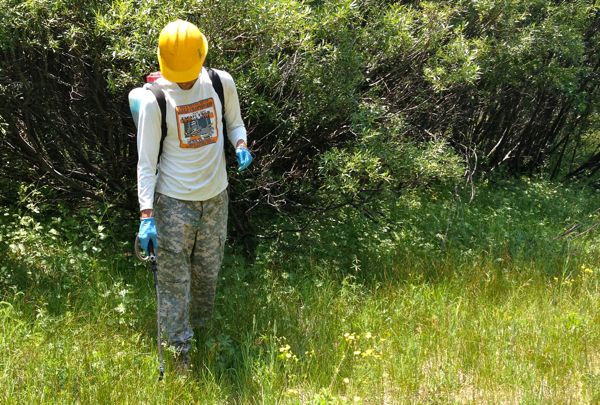
U.S. Forest Service employees are using three herbicides now through September to rid the Lake Tahoe Basin of invasive weeds.

The chemical treatment will cover about 12½ acres in nearly 70 locations.

“This is part of a continuing terrestrial invasive plant treatment project since 2011. Most infestations that have been chemically treated exhibited greatly reduced quantities of invasive plants in following years. Many now have no plants at all,” Courtney Rowe, forest botanist, told Lake Tahoe News. “This is part of a larger ‘early detection, rapid response’ invasive plant management strategy, in which the LTBMU tries to eradicate or control certain priority invasive species that have high ecological impacts but currently exist at a low number of infestations before these species spread to a point that their eradication/control is unfeasible.”

The USFS is trying to eliminate invasive weeds from the Lake Tahoe Basin. Photo/Courtney Rowe

The USFS is trying to eliminate invasive weeds from the Lake Tahoe Basin. Photo/Courtney Rowe

The plants the Forest Service is trying to eradicate are whitetop, Dalmatian toadflax, yellow toadflax, hoary cress and Canada thistle.

Rodeo, Milestone, and Telar are the products that will be applied via backpack sprayers and other handheld tools.

The agency conducted an environmental analysis in 2010 that addressed safety concerns.

“That analysis states that the project’s control methods would pose little safety risk to workers or the public as long as safety practices and resource protection measures are enforced,” Rowe said.

Rowe said the drought tends to make plants flower sooner, but there is no evidence there are more of them.

The problem with the invasive non-natives is that they can overrun native species, which leads to their disappearance. This can then impact wildlife, cause erosion problems, which then impairs waterways.

The project areas include: the 64 Acres parking lot, Angora Fire area, Baldwin Beach meadow, Burke Creek trail, Luther Pass campground, Heavenly Creek Meadow, Heavenly Mountain Resort, Rabe Meadow, Lower Truckee River below Tahoe City, and Spooner Summit fire station.

Weed infestations on Forest Service urban lots will be treated near: Ralph Drive, Terry Lane, Ski Run Boulevard, and Mt. Rainier Drive in South Lake Tahoe, Sugar Pine Drive in Incline Village, Marge Court in Zephyr Cove, and Pine Street on Kingsbury Grade.

During spraying, caution signs will be posted for at least 48 hours after treatment. Orange and black caution tape will mark the boundary around each treatment area. Rowe said most of the areas are small, and some include targeting less than a handful of plants.


Nevada gets 1-year reprieve on NCLB

By Sean Whaley, Las Vegas Review-Journal

CARSON CITY — Nevada has received a one-year extension from the U.S. Department of Education for flexibility from some provisions of the No Child Left Behind Act, a state education official said Thursday.

Superintendent of Public Instruction Dale Erquiaga said the extension of its flexibility waiver will run through the 2014-15 school year.

Nevada’s waiver has been effective in providing support for the critical elements of reform in the state’s annual plan to improve student achievement, he said.

Nevada, along with 41 other states and the District of Columbia, are currently operating under requests for flexibility from certain provisions of what the state Education Department called the “outmoded” No Child Left Behind Act.

Without the extension, Nevada would be required under federal law to meet the requirements of the act and “adequate yearly progress” would again be the measure of school performance.

Read the whole story


Drugs, alcohol issues on beaches; TK launch closing early July 4

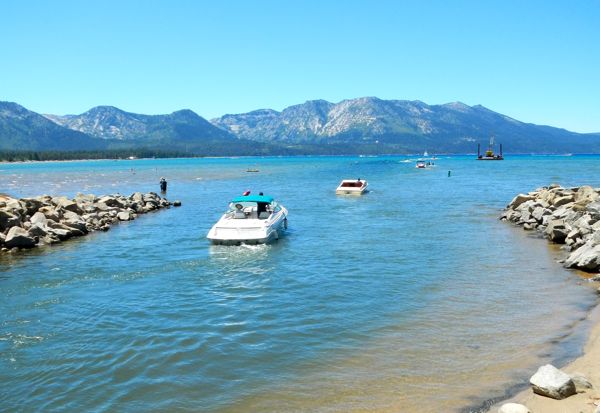
Boaters leaving the Tahoe Keys Marina on July 4 have until 9 to get back if they are trailering their boat tonight. Photo/Kathryn Reed

Boaters leaving the Tahoe Keys Marina on July 4 have until 9 to get back if they are trailering their boat tonight. Photo/Kathryn Reed

By Kathryn Reed

Beaches in the Lake Tahoe Basin have been busy all day with people having fun and misbehaving.

Nevada Beach’s prime fireworks viewing spots were full by 11:45 this morning, with Douglas County sheriff’s deputies not allowing people in because the lot was full.

Venice Drive in South Lake Tahoe was full of vehicles. The beach was not crowded at Cove East, but the boat traffic was constant in and out of the Tahoe Keys Marina.

New this year is the marina is closing the launch at 9pm July 4 instead of extending it to midnight like years past. An employee said he was not given a reason for the change.

This could mean some fireworks revelers will be spending the night on their boat unexpectedly. The launch opens at 8am Saturday.

The ever-increasing sandbar by Cove East could present a problem for boaters because it is not marked. Another potential obstacle is the barge that is anchored near the channel not far from shore.

U.S. Forest Service and El Dorado County sheriff’s officers broke up three large parties on Ski Beach. There have been arrests for probation violation, possession of cocaine, and outstanding warrants. Several citations have been handed out for underage drinking and marijuana possession.

Cheva Heck, spokeswoman for the USFS, told Lake Tahoe News the best news is there have been no illegal fires.

At USFS beaches on the East Shore, as of 5pm Friday there had been 30 citations, 50 warnings for alcohol possession where it is banned, and 15 citations for minors in possession of alcohol.

Douglas County sheriff’s deputies arrested two people on charges of drug possession.

The fireworks on the South Shore that are set off near Edgewood Tahoe are set to start at 9:45pm. The wind, so far, is not a factor.


Water fetching record prices in California

By Garance Burke, AP

SAN FRANCISCO — Throughout California’s desperately dry Central Valley, those with water to spare are cashing in.

As a third parched summer forces farmers to fallow fields and lay off workers, two water districts and a pair of landowners in the heart of the state’s farmland are making millions of dollars by auctioning off their private caches.

Nearly 40 others also are seeking to sell their surplus water this year, according to state and federal records.

Economists say it’s been decades since the water market has been this hot. In the last five years alone, the price has grown tenfold to as much as $2,200 an acre-foot — enough to cover a football field with a foot of water.

Unlike the previous drought in 2009, the state has been hands-off, letting the market set the price even though severe shortages prompted a statewide drought emergency declaration this year.

The price spike comes after repeated calls from scientists that global warming will worsen droughts and increase the cost of maintaining California’s strained water supply systems.

Some water economists have called for more regulations to keep aquifers from being depleted and ensure the market is not subject to manipulation such as that seen in the energy crisis of summer 2001, when the state was besieged by rolling blackouts.

“If you have a really scarce natural resource that the state’s economy depends on, it would be nice to have it run efficiently and transparently,” said Richard Howitt, professor emeritus at UC Davis.

Private water sales are becoming more common in states that have been hit by drought, including Texas and Colorado.

In California, the sellers include those who hold claims on water that date back a century, private firms who are extracting groundwater and landowners who stored water when it was plentiful in underground caverns known as water banks.

“This year the market is unbelievable,” said Thomas Greci, the general manager of the Madera Irrigation District, which recently made nearly $7 million from selling about 3,200 acre-feet. “And this is a way to pay our bills.”

All of the district’s water went to farms; the city of Santa Barbara, which has its own water shortages, was outbid.

The prices are so high in some rural pockets that water auctions have become a spectacle.

One agricultural water district amid the almond orchards and derrick fields northwest of Bakersfield recently announced it would sell off extra water it acquired through a more than century-old right to use flows from the Kern River.

Local TV crews and journalists flocked to the district’s office in February to watch as manager Maurice Etchechury unveiled bids enclosed in about 50 sealed envelopes before the cameras.

“Now everyone’s mad at me saying I increased the price of water. I didn’t do it, the weather did it,” said Etchechury, who manages the Buena Vista Water Storage District, which netted about $13.5 million from the auction of 12,000 acre-feet of water.

Competition for water in California is heightened by the state’s geography: The north has the water resources but the biggest water consumers are to the south, including most of the country’s produce crops.

The amount shipped south through a network of pumps, pipes and aqueducts is limited by the drought and legal restrictions on pumping to save a threatened fish.

During the last drought, the state Department of Water Resources ran a drought water bank, which helped broker deals between those who were short of water and those who had plenty. But several environmental groups sued, alleging the state failed to comply with the California Environmental Quality Act in approving the sales, and won.

This year, the state is standing aside, saying buyers and sellers have not asked for the state’s help. “We think that buyers and sellers can negotiate their own deals better than the state,” said Nancy Quan, a supervising engineer with the department.

Quan’s department, the U.S. Bureau of Reclamation and the State Water Resources Control Board have tracked at least 38 separate sales this year, but the agencies are not aware of all sales, nor do they keep track of the price of water sold, officials said.

The maximum volume that could change hands through the 38 transactions is 730,323 acre-feet, which is about 25 percent of what the State Water Project has delivered to farms and cities in an average year in the last decade.

That figure still doesn’t include the many private water sales that do not require any use of government-run pipes or canals, including the three chronicled by the AP. It’s not clear however how much of this water will be sold via auctions.

Some of those in the best position to sell water this year have been able to store their excess supplies in underground banks, a tool widely embraced in the West for making water supplies reliable and marketable. The area surrounding Bakersfield is home to some of the country’s largest water banks.

The drought is so severe that aggressive pumping of the banked supplies may cause some wells to run dry by year’s end, said Eric Averett, general manager the Rosedale Rio Bravo District, located next to several of the state’s largest underground caches.

Farther north in the long, flat Central Valley, others are drilling new wells to sell off groundwater.

A water district board in Stanislaus County approved a pilot project this month to buy up to 26,000 acre-feet of groundwater pumped over two years from 14 wells on two landowners’ parcels in neighboring Merced County.

Since the district is getting no water from the federal government this year, the extra water will let farmers keep their trees alive, said Anthea Hansen, general manager of the arid Del Puerto Water District.

Hansen estimated growers would ultimately pay $775 to $980 an acre-foot — a total of roughly $20 million to $25.5 million.

“We have to try to keep them alive,” Hansen said. “It’s too much loss in the investment and the local economy to not try.”


GOP: EPA rule could ruin Fourth of July

By Michael Bastasch, Daily Caller

While Americans get ready for the thousands of fireworks shows that will be occurring across the country this weekend, Republicans are warning that pending federal water regulations could ruin fireworks displays next year.

The Environmental Protection Agency is trying to expand its authority under the Clean Water Act. Republicans warn that the agency’s proposal to expand the definition of “waters of the United States” could allow the EPA to regulate bodies of water on private property.

Republicans are now warning that EPA water rules could threaten fireworks by allowing environmental activists to sue and shut down shows across the country.

“If the proposed ‘waters of the United States’ rule becomes final and serves as the eventual basis for future citizen suits against those who organize fireworks shows, we fear fewer homeowners, communities, or local organizations will be able to conduct fireworks displays as they have for decades or longer,” wrote Republican Senators, including David Vitter of Louisiana and John Barrasso of Wyoming, in a letter to the EPA.

Environmentalists have already been using litigation to stop fireworks shows from happening near or over federally protected waters. Environmentalists sued the Lake Tahoe Visitors Authority alleging their fireworks show violated the Clean Water Act.

Environmentalists said the fireworks show would result in the unpermitted discharge of pollutants into the lake. The lawsuit demanded that Lake Tahoe pay $37,500 per day in penalties for each violation of the Clean Water Act. Lake Tahoe officials nearly canceled the show. The lawsuit was settled in April.

“By expanding federal Clean Water Act jurisdiction to include ditches, small streams, ponds, and other purely local waterbodies, EPA and the [Army Corps of Engineers] may be exposing landowners and municipalities across the country to costly citizen suit litigation if they should attempt to conduct a neighborhood fireworks show,” Republicans wrote.

“Commemorative fireworks displays have been a part of our nation’s history since its founding. However, there are individuals and groups who would like to significantly limit this tradition through heavy-handed citizen suit litigation under the Clean Water Act and other laws,” Republicans added.

In March, the EPA published its proposed “waters of the United States” rule. The agency said the rule was meant to clear up confusion surrounding two federal court decisions on the agency’s Clean Water Act authority.

But Republicans have said it’s no more than a power grab by the Obama administration. The rule could allow federal agents to regulate water on private property, they warned.

“As expected, the EPA’s proposed water rule expands the agency’s control over natural and man-made streams, lakes, ponds and wetlands,” said Rep. Lamar Smith, R-Texas. “If approved, this rule could allow the EPA to regulate virtually every body of water in the United States.”

The EPA’s draft rule defines “waters of the United States” as “traditional navigable waters; interstate waters, including interstate wetlands; the territorial seas; impoundments of traditional navigable waters, interstate waters, including interstate wetlands, the territorial seas, and tributaries, as defined, of such waters; tributaries, as defined, of traditional navigable waters, interstate waters, or the territorial seas; and adjacent waters, including adjacent wetlands.”

But the agency says additional bodies of water could be regulated if they have a “significant nexus” to a “traditional navigable water, interstate water, or the territorial seas.” The EPA says it will provide a definition of “significant nexus” when the rule is published.

These waters need not even be navigable — the type of water body the federal government has traditionally regulated. Republicans have questioned how the EPA could justify regulating water bodies that are no longer connected to navigable waterways or other traditionally regulated bodies of water.

“In preparing this proposal, the EPA failed to incorporate adequate peer-reviewed science in accordance with the agency’s own statutory obligations,” Smith said. “It’s troubling that the administration proposed this expansion before its independent science advisers have had the chance to complete its review of the underlying science. The Obama administration continues to sidestep scientific integrity in order to fast track an abusive regulatory agenda.”