Placerville man admits cheating on tax returns

Thomas W. Stringfellow, 55, of Placerville pleaded guilty July 31 to two counts of willfully making false tax returns.

According to court documents, from 2006-10 Stringfellow underreported his business income on tax returns by more than $1.1 million, and underreported his personal income on tax returns by more than $1 million. Stringfellow owned New Horizon Painting. Rather than depositing all of the business checks into the appropriate accounts, he cashed some of the checks and did not report them income, according to U.S. Attorney Benjamin Wagner.

The underreporting led to a tax loss of more than $687,000, according to officials.

Stringfellow is scheduled to be sentenced Dec. 18. He faces a maximum of three years in prison and a $250,000 fine on each count.

— Lake Tahoe News staff report


1 person seriously hurt at Angora Lakes

A person jumping off the rocks at Angora Lakes was seriously injured Thursday.

The severity of the injuries required the person be airlifted to Baron Memorial Hospital.
Lake Valley Fire Department, the lead agency on the July 31 rescue, did not know the gender, hometown or age of the victim.

— Lake Tahoe News staff report


Study: Parents in denial about kids’ obesity

By Cari Romm, Atlantic

There’s a certain type of parental pride that grows from just the right combination of willful ignorance, unflagging optimism, and impressive mental gymnastics. Junior’s latest report card was less than stellar? Well, yes—he’s so smart that school just bores him. Little League game spent on the bench? The coach probably doesn’t realize the talent he has on his hands.

But that usually harmless denial can also manifest itself in a more significant—and more damaging—way, according to a new study in the Journal of the American Academy of Nutrition and Dietetics. Specifically, the study lent more support to the notion that parents of obese children often fail to see their kids’ weight as unhealthy, even after a doctor’s diagnosis.

Researchers from the University of California San Diego and Brown University surveyed parents of first-time patients at a pediatric obesity clinic, assessing the families’ willingness to help their children lose weight. The patients, who ranged in age from 5 to 20, had all been classified as overweight or clinically obese, and most had been referred to the clinic for treatment by their regular pediatricians.

The majority of parents, 93.5 percent, correctly recognized that their children were, in fact, overweight or obese—but nearly 30 percent said they didn’t see their children’s weight as a problem, and roughly the same number rated their children’s health as “very good” or “excellent.”

Read the whole story


Nutting loses appeal to retain supervisor seat

Former El Dorado County Supervisor Ray Nutting lost his appeal July 31 to retain his seat.

He wanted the Third District Court of Appeal to vacate the June 6 decision of Superior Court Judge Timothy Buckley which said Nutting should be removed from office.

Nutting was convicted of six counts involving obtaining illegal loans from county employees and a county contractor.

A special election is set for September to fill Nutting’s District 2 seat. His wife, Jennifer, is one of the candidates.

— Lake Tahoe News staff report


1 in custody, 2 at-large in Tahoe City burglary

By Kathryn Reed

A quick thinking Placer County sheriff’s deputy was able to recover jewelry stolen in a heist this morning in Tahoe City.

The deputy was driving when he heard a window smash about 6am July 31. He saw a truck in an alley with three men looking at him. Two people fled on foot and the driver sped off.

The officer was able to pull the driver over near the River Ranch on Highway 89.

Michael Potter, 20, of Sacramento was arrested on charges of commercial burglary, possession of stolen property, conspiracy to commit a felony and possession of a stolen vehicle.

Detective Sgt. Dave Hunt said all of the jewelry taken from Bluestone Jewelry was recovered from the vehicle.

“They were in the store less than a minute,” Hunt told Lake Tahoe News. And in that time they were able to grab “a large amount” of jewelry, he added. He said they smashed a window to gain access.

A helicopter and large law enforcement presence have been scouring the area looking for the two male subjects who got away. They were wearing all black.

The vehicle used in the heist had recently been stolen in Tahoe City.

Different suspects who were eventually caught had burglarized Bluestone in the last year.

A similar caper happened in South Lake Tahoe in April, where a stolen vehicle was used in a jewelry store heist. No one has ever been arrested in the Simpson’s Jewelry smash and grab.


Placer County supes want voters to approve raise

By Richard Chang, Sacramento Bee

Supervisors in fiscally conservative Placer County took the unusual step last week of asking voters to more than double their salaries and provide access to county health and retirement benefits.

The five-member Board of Supervisors voted unanimously for the November ballot proposal, pointing to data showing that their compensation falls well below their regional peers after a 1992 voter initiative capped their compensation.

Currently, supervisors receive $30,000 annually and no benefits. If voters pass the proposed county charter amendment, salaries would rise to an estimated $71,755 in January 2015, based on the average supervisor wages in neighboring counties.

The latest push to raise supervisor salaries comes after the county Charter review committee recommended in January that supervisors receive a pay hike. Two previous bids failed, first in 1998 to pay $35,000 annually and again in 2008 to pay $48,000. Nearly 75 percent of voters rejected the latter proposal, according to the Placer County Elections Office.

Read the whole story


Weather kills 2,000 a year; cold No. 1 reason

By Mike Stobbe, AP

NEW YORK — The weather kills at least 2,000 Americans each year and nearly two-thirds of the deaths are from the cold, according to a government report.

That may surprise some people, the researchers acknowledged. Hurricanes, tornadoes and heat waves “get more publicity, for some reason, than cold-related deaths,” said Deborah Ingram, one of the report’s authors.

The report released Wednesday by the Centers for Disease Control and Prevention analyzed U.S. deaths attributed to the cold, the heat, storms, floods and lightning. It used national death certificate information for five years.

The report found:

  • Of the 10,649 deaths attributed to the weather, about 63 percent were tied to exposure to the cold or hypothermia. Those who more often fall victim to the cold include the homeless, alcoholics, those who take part in wilderness activities and winter sports, and fragile people already fighting illnesses who live in under-heated homes.
  • About 31 percent of the deaths were caused by heat, heat stroke or sun stroke. The remaining 6 percent were blamed on storms, floods or lightning.
  • More than two-thirds of weather-related deaths were men and boys, and men were twice as likely as women to die from storms, floods or lightning strikes. And people 65 and older had much higher death rates than younger people, perhaps because it’s harder for them to endure temperature extremes, the researchers said.
  • The highest heat-related death rates were in cities and very rural areas; the most isolated areas also had the highest rates related to the cold and to storms, floods and lightning. Low-income counties had higher weather-related death rates than high-income counties. That could be due to people in poor rural or urban places lacking heating, air conditioning or help during blizzards or heat waves, the researchers said.
  • For blacks, the heat-related death rate was about 2.5 times higher than the rate for whites, and about twice as high as the Hispanic rate. Blacks also died at a higher rate from the cold. That finding may be tied to higher concentrations of low-income blacks in large cities or very rural areas. Also, blacks might be more vulnerable to weather extremes because they have more heart disease and other chronic health problems. Whites, however, died at twice the rate of blacks from floods, storms and lightning strikes.


EDC supervisor candidates try to woo voters

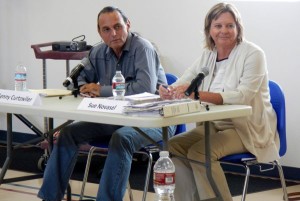
Kenny Curtzwiler and Sue Novasel are running for El Dorado County supervisor, district 5. Photo/LTN

Kenny Curtzwiler and Sue Novasel are running for El Dorado County supervisor, District 5. Photo/LTN

By Kathryn Reed

MEYERS – A contrast in styles is the overwhelming difference between the two El Dorado County District 5 supervisor candidates.

Kenny Curtzwiler is animated and passionate. He talks about how he goes to all the events in town, how people come to him with their problems and how he will get things done.

Sue Novasel is more reserved and thoughtful in her approach. She talks about building consensus, needing to count to three and being a team player.

On July 29 they spoke to an audience of about 50 people at the California Conservation Corps offices about county issues and why they should be the next supervisor to represent Tahoe in Placerville.

Members of Tahoe Regional Young Professionals started the questioning before the public questions were asked. The first was: What would your top three priorities be as supervisor?

“The top three are basically the same for me. It’s community involvement,” Curtzwiler said. “The community is what makes it a community.”

Novasel said her priorities are economic vitality, fire safety and public safety, which include mental health.

When it comes to the Meyers Area Plan, Novasel said, “It still needs some tweaking.” But she did not elaborate. The questioning panel did not ask a follow up question.

Curtzwiler said he likes the Meyers plan.

“I read the entire Catalyst project. It’s good, but it’s too big for the community,” Curtzwiler said. “There is another project out there if the community knew about it, they would like it.”

He didn’t elaborate and the questioning panel didn’t press him further.

They were asked how they are involved in the community.

“I attend almost every single community event,” Curtzwiler said. He said through his business he donates time and resources to various causes.

Curtzwiler also said he is involved with Christmas Cheer.

Novasel was more specific with her involvement – Lake Tahoe Wildlife Care, 12 years on the Lake Tahoe Unified School District board, Lake Tahoe Community College Foundation, Soroptimist International South Lake Tahoe and Lake Tahoe South Shore Chamber of Commerce board (one of the event sponsors).

Curtzwiler was asked to clarify something he had written about the morality of breaking a contract. He said it was about Heavenly Mountain Resort not paying its fair share of taxes to South Lake Tahoe; that he believes the contract should be broken by the city.

Novasel countered, saying, “You have a moral obligation when you have a contract. If something needs to be changed, you do so through legal channels. You work with your board.”

When a member of the public asked about county’s Charter review committee, neither candidate had a firm grasp of what it is or why they should care about it.

When it comes to infrastructure, Novasel wants to see roads and broadband. She believes recreation is the “lifeblood” of the area.

Curtzwiler doesn’t believe it’s the county’s job to provide Internet. He also believes recreation should be No. 1.

Curtzwiler said he is not asking for people’s vote, but instead for their vote of confidence and accountability. He wants to be the first person people call when they need something.

Novasel said she is asking for people’s vote. She plans to listen more than talk, and she said she will build consensus.

The election is Nov. 4.


Man nearly drowns at Incline

Updated July 30 8:40pm

A 19-year-old visiting Lake Tahoe nearly drowned July 30 at Sand Harbor.

He was swimming on the south side of the boat ramp  with a friend for about 10 minutes when he started having problems. A friend yelled for help. People pulled the victim off the floor of the lake and brought him to shore on a flotation device.

North Lake Tahoe Fire Protection personnel began reviving him. CareFlight flew him to Renown Medical Center in Reno where he was listed in critical condition.

The name of the man has not been released. Authorities are only saying he did not reside in Nevada.

“People underestimate Lake Tahoe can be very dangerous,” Washoe County sheriff’s Lt. Jeff Clark told Lake Tahoe News. “Lake Tahoe is really cold. I think often times people get in and underestimate the temperature of the water. Their body temperature drops and they can cramp.”

On Monday a 42-year-old Southern California man swimming at Diver’s Cove at Sand Harbor drowned.

— Lake Tahoe News staff report


Middle class 20% poorer than in 1984

By Matt O’Brien, Washington Post

Nostalgia is just about the only thing the middle class can still afford. That’s because median wealth is about 20 percent lower today, in inflation-adjusted dollars, than it was in 1984.

Yes, that’s three lost decades.

Now, as you might expect, the middle class has been hit particularly hard by the Great Recession and the not-so-great recovery. It’s all about stocks and houses. The middle class doesn’t have much of the former, but it does have a lot of the latter. And that’s bad news, because, even though the crash decimated both, real estate hasn’t come back nearly as much as equities have. So the top 1 percent, who hold more of their wealth in stocks, have made up more of the ground they lost. But, as the Russell Sage Foundation points out, the slow housing recovery means that, in 2013, median households were still 36 percent poorer than they were a decade earlier.

In fact, the housing bust was big enough to erase all the gains the middle class had made the past 30 years—and then some. As you can see below, median households didn’t add much wealth between 1984 and 2007. That’s what happens when real wages don’t increase, and the cost of a middle class lifestyle—housing, healthcare, and higher education—does. So, as Dean Baker points out, when the crisis did come, it devoured these meager gains and left the middle class with 20 percent less wealth than they had when it was “Morning in America.”

Read the whole story